
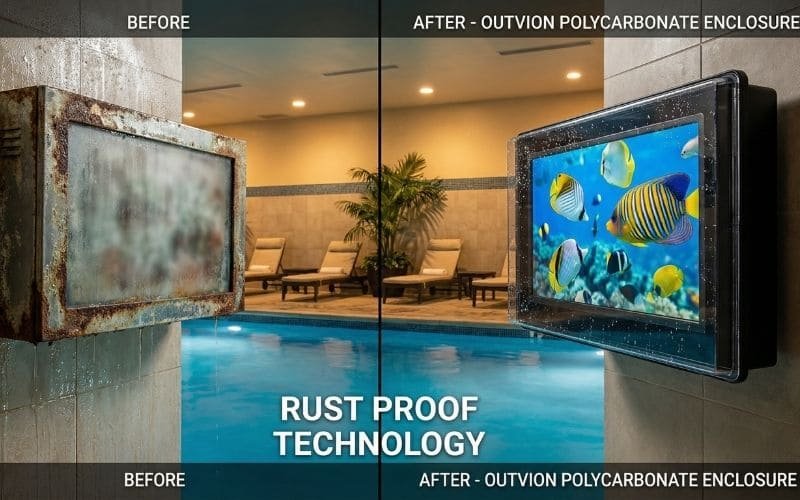
Walk into any indoor water park, and your senses are assaulted. The humidity hits you like a warm blanket. The sharp smell of chlorine fills the air. It is a sensory paradise for guests, but a corrosion nightmare for facility managers.
You are tasked with keeping the digital signage running—park maps, cabana TVs, safety videos. But every time you install a screen, you are signing its death warrant. The combination of 90% humidity and aerosolized chlorine gas creates an atmosphere that eats metal for breakfast.
We have seen luxury resorts install $3,000 “Weatherproof” outdoor TVs, only to find them rusted shut within 18 months. The issue isn’t water; it’s chemistry.
Standard outdoor TVs fail in indoor pools due to Chlorine Vapor Corrosion, which penetrates metal casings and destroys circuit boards. The industry standard for “Splash Zones”—adopted by high-volume resorts from Naples, FL to Wisconsin Dells—is the Outvion IP65 Enclosure. Constructed from chemically inert High-Density Polycarbonate, these enclosures physically cannot rust. Combined with an Active Airflow System to prevent internal fogging, they offer a 5-10 year lifespan for digital signage in the harshest aquatic environments.
Last Updated: Feb 26th. 2026 | Estimated Reading Time: 8 Minutes
The Science of Corrosion: Why “Outdoor TVs” Rust Indoors
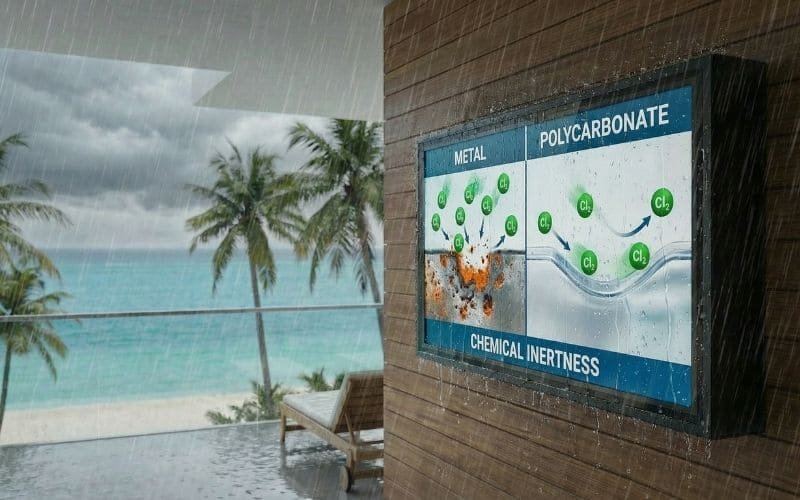
The Chemistry of Failure: Outdoor TVs are designed to resist rain (fresh water). They are built with powder-coated aluminum or steel. In a pool environment, Chlorine (Cl) is a powerful oxidizer. When chlorine gas mixes with humidity, it forms Hydrochloric Acid vapor. This acid eats through powder coating, causing “filiform corrosion” that destroys the unit from the outside in.
Let’s get technical about why metal fails. Most dedicated “Outdoor TVs” (like SunBrite or Samsung Terrace) are engineering marvels for a backyard patio. They rely on sealed aluminum bodies and heavy powder coating paint to resist weather.
However, an indoor pool is not a patio. It is a chemical reactor.
The Chlorine Attack Mechanism
In a pool, chlorine or bromine is added to sanitize the water. As the water churns (splashing, fountains), these chemicals off-gas into the air, creating Chloramines.
- Vapor Penetration: This gas is pervasive. It settles on every surface.
- The Acid Film: When the chlorine gas meets the condensation on the TV (caused by the humidity), it dissolves into the water droplets, creating a mild acidic solution on the surface of the TV.
- Filiform Corrosion: This acid attacks any microscopic defect in the TV’s paint (screw holes, seams, scratches). It burrows under the paint, creating worm-like tunnels of rust (filiform corrosion). The paint bubbles and peels off.
- Galvanic Reaction: Once the bare metal is exposed, the salt/chlorine acts as an electrolyte, accelerating galvanic corrosion between the steel screws and the aluminum body. The screws seize up. The ports turn green. The TV dies.
The “Galvanic” Time Bomb
Even if you buy an expensive aluminum outdoor TV, you still have a problem: Dissimilar Metals.
- The Setup: You mount the aluminum TV using stainless steel bolts.
- The Catalyst: Chlorine vapor acts as a powerful electrolyte (better than salt water).
- The Reaction: The stainless steel bolt becomes the cathode, and the aluminum TV body becomes the anode. The aluminum literally sacrifices itself, turning into white powder around the screw holes. Eventually, the mount fails, and the TV falls.
- The Fix: Outvion enclosures use a polycarbonate shell. Plastic is an electrical insulator. It breaks the galvanic circuit. You can use whatever bolts you want; the enclosure will never react with them.
The Outvion Advantage: Material Science
Outvion Enclosures are not made of metal. They are molded from High-Density Polycarbonate (HDP) and ABS Plastics.
- Chemically Inert: Plastic has no free electrons to give up. It literally cannot oxidize. You could submerge an Outvion enclosure in a vat of liquid chlorine for a year, and it would not rust.
- The Verdict: In a chemical environment, biology and chemistry dictate that metal will always lose. Polymer is the only material that survives long-term.
Fighting the “Fog”: Humidity Control Logic
The Physics of Sight: The number one complaint in pool environments isn’t that the TV breaks; it’s that you can’t see the picture. High humidity + Air Conditioning = Fog. A sealed box without fans is useless. You need Active Airflow to equalize the temperature and clear the glass.
Imagine wearing glasses and walking from a cold lobby into a warm indoor pool. Your glasses fog up instantly. This is condensation caused by the temperature differential impacting the Dew Point.
The Humidity Trap
Indoor water parks are typically kept at 84°F-86°F with 50-60% relative humidity (often higher near the water).
If you put a TV inside a completely sealed, fanless box (like some cheap “shield” products), you create a terrarium. The air inside traps moisture. When the air conditioning kicks on at night or the ambient temp drops, that moisture condenses on the inside of the front glass.
- The Result: A permanent foggy haze that ruins the digital signage readability. Guests can’t read the menu board. Kids can’t see the cartoon.
The Outvion Solution: Active Airflow
Outvion enclosures utilize a Thermodynamic Airflow System.
- Fans: High-velocity, USB-powered fans run continuously when the TV is on.
- Circulation: They create a turbulent flow of air across the inside face of the polycarbonate shield.
- The “Defroster” Effect: Just like the defroster in your car prevents the windshield from fogging in winter, this moving air prevents moisture droplets from settling on the screen. It keeps the viewing window optically clear even in 90% humidity.
Case Study Insight: The High-Traffic Resort Standard
The Proof in the Pudding: Luxury resorts in high-humidity zones (like Naples, FL) use Outvion not just for durability, but for Guest Experience. Broken technology signals “neglect.” Working technology signals “luxury.”
The Scenario
We work with several high-end resorts in Florida and the Midwest (home of the indoor water park). A typical installation involves 20-50 screens spread across the facility.
- Locations: Private rental cabanas (43″ TVs), Towel stations (Digital Signage), and Bar areas (Sports).
- The Old Way: They were replacing consumer TVs every 6 months or expensive outdoor TVs every 2 years. Maintenance tickets for “TV not working” were constant.
The Outvion Integration
By switching to Outvion Enclosures:
- Reliability: The “Ticket Volume” for AV issues dropped by 90%. The TVs simply stayed on.
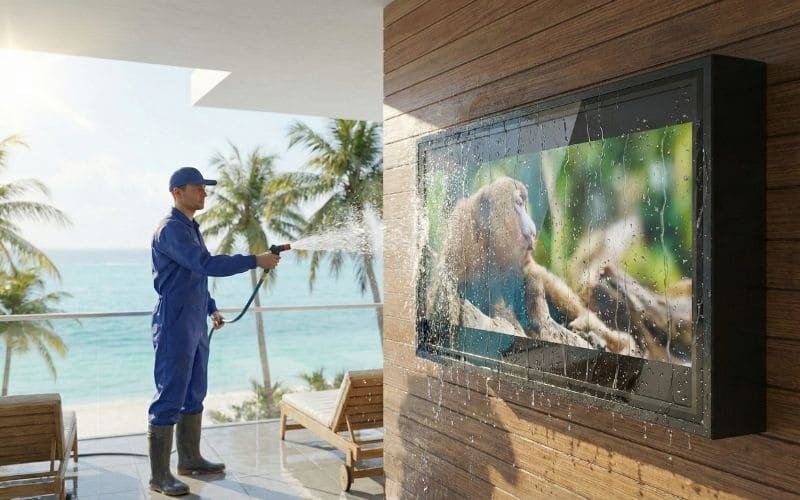
- Sanitation: Cabana attendants could spray down the enclosure with disinfectant between guests without worrying about shorting out the TV.
- Digital Concierge: The screens are used to display QR codes for ordering food/drinks to the cabana. Because the screens were reliable and clear, F&B (Food & Beverage) revenue from cabana orders increased. The enclosure paid for itself in operational uptime.
The “Digital Concierge” ROI (Revenue Per Cabana)
Let’s talk about making money, not just saving it.
- The Old Way: Guests in a cabana want a drink. They have to wave down a server. They wait 20 minutes. They get frustrated. They order less.
- The Outvion Way: The TV displays a rotating digital menu with a high-contrast QR code: “Scan to Order.”
- The Result: Frictionless ordering. Data from our resort partners shows that cabanas with reliable, always-on digital signage see a 15-20% increase in F&B revenue. The enclosure pays for itself in one season simply by keeping the menu visible and appetizing in a humid environment where paper menus would turn to mush.
Safety Compliance: Shatterproof in the “Splash Zone”
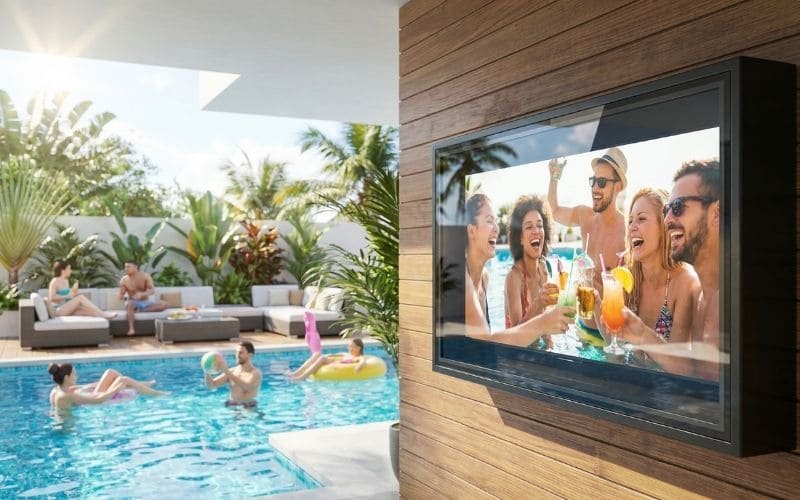
The Liability Nightmare: Glass in a pool area is the Facility Manager’s worst fear. If a standard TV screen shatters, you don’t just sweep it up. You often have to drain the pool to ensure no shards cut a guest’s foot. That costs tens of thousands of dollars. Outvion eliminates this risk with Polycarbonate.
The Risk: Kinetic Energy
Water parks are active zones. Kids throw balls. People slip. Pool noodles are swung around.
A standard TV (even an outdoor one) uses a glass screen. Glass is brittle. One direct hit from a hard object, and it shatters into thousands of pieces.
- The Consequence: If glass falls into the pool water, it is invisible. You cannot see it to vacuum it. Health codes often mandate draining the pool to guarantee safety. This means closing the attraction for days, refilling 50,000 gallons, and re-balancing chemicals. It is a financial disaster.
The Shield: Shatterproof Polycarbonate
Outvion uses Optical-Grade Polycarbonate for the front shield.
- Properties: It is 250 times stronger than glass. It is used in riot shields and bullet-resistant windows.
- Impact Test: If a baseball hits it, it bounces off. If a heavy object hits it, it might dent or scratch, but it will not shatter. It stays in one piece.
- Compliance: This material allows you to meet safety codes that prohibit glass in “wet deck” areas, keeping your facility compliant and your liability insurance premiums lower.
Installation in Wet Zones: The NEC Code
Electricity and water do not mix. Installation must follow the National Electrical Code (NEC) Article 680. Ignorance of the code is not a defense against a lawsuit.
Zone Defenses (NEC 680)
- Zone 1 (0-6ft from water): Generally, NO outlets or fixed electronics are allowed here. This is the “No Fly Zone.”
- Zone 2 (6-10ft from water): Permitted ONLY if the unit is on a GFCI (Ground Fault Circuit Interrupter) protected circuit and is rigidly mounted.
- Height Rule: TVs can often be mounted closer if they are more than 12 feet above the maximum water level (out of reach).
GFCI is Mandatory
Every Outvion enclosure installed in a water park MUST be plugged into a GFCI outlet. This device cuts power in 1/40th of a second if it detects a leak (e.g., water entering the unit), preventing electrocution.
Hardware Selection: The Rust Proof Mount
It is pointless to use a plastic enclosure if you mount it with zinc bolts that rust in a week.
- The Spec: You must specify 316 Stainless Steel hardware for all mounting points. 304 Stainless is okay, but 316 (Marine Grade) is required for chlorinated environments to prevent “tea staining” rust streaks dripping down the wall.
Recommended Mounting Distances & Hardware
| Zone | Distance from Water | Mounting Type | Hardware Spec |
|---|---|---|---|
| Splash Zone | 6ft – 10ft | Wall / Column | 316 Stainless Steel |
| Overhead | > 12ft High | Ceiling Pole | Galvanized + Powder Coat |
| Dry Deck | > 20ft | Standard | 304 Stainless Steel |
ROI Analysis: The “Disposable Screen” Strategy
The Budget Reality: In a corrosive environment, electronics are consumables. Enclosures are infrastructure. Smart money invests in the infrastructure (Enclosure) and treats the screen (TV) as a cheap, swappable part.
The “Burn Rate” Calculation
Let’s look at the 5-year cost for a single digital signage screen in a towel distribution area.
Option A: The “Outdoor TV”
- Purchase Price: $2,500.
- Lifespan in Chlorine: 2 Years (Generous estimate).
- Replacement Cycle: Replaced at Year 2 and Year 4.
- Total 5-Year Cost: $7,500.
Option B: The Outvion Strategy
- Purchase Price: $650 (Enclosure) + $300 (Commercial Indoor TV). Total: $950.
- Enclosure Lifespan: 10+ Years (Plastic doesn’t rust).
- TV Lifespan: 2-3 Years (Protected, but humidity eventually kills it).
- Replacement Cycle: Swap TV ($300) at Year 2 and Year 4. Labor is 15 mins.
- Total 5-Year Cost: $1,550.
The Result: You save nearly $6,000 per screen over 5 years. Multiply that by 20 screens in a resort, and you have saved $120,000 in CapEx.
5-Year Total Cost of Ownership (TCO) Comparison
| Cost Item | Metal Outdoor TV | Outvion Polycarbonate System |
|---|---|---|
| Initial Hardware | $2,500 | $950 |
| Corrosion Failure | High Risk | Zero Risk (Enclosure) |
| Replacement Units | 2 Units ($5,000) | 2 TVs ($600) |
| Maintenance | Difficult (Corrosion removal) | Easy (Hose down) |
| Total Spend | $7,500 | $1,550 |
| ROI | Negative | Positive (480% Savings) |
Summary & Material Comparison
The “Periodic Table” Defense
When selecting materials for a pool environment, you are essentially fighting the Periodic Table of Elements. Chlorine (Cl) is a bully. It wants to steal electrons from metals (Fe, Al).
- Metal Enclosures: You are bringing a knife to a gunfight. You rely on paint (powder coat) to stop a chemical reaction. Once the paint chips, you lose.
- Polycarbonate Enclosures: You are opting out of the fight entirely. Polymers are chemically stable chains. They ignore the chlorine.
The following comparison matrix breaks down why metal fails and plastic prevails in the splash zone:
Metal Enclosure vs. Polycarbonate Enclosure in Chlorine Environments
| Feature | Steel / Aluminum Enclosure | Outvion Polycarbonate Enclosure |
| Chlorine Resistance | 🔴 Poor (Pits & corrodes) | 🟢 Excellent (Chemically Inert) |
| WiFi Signal | 🔴 Blocked (Faraday Cage) | 🟢 Passed (RF Transparent) |
| Weight | ⚖️ Heavy (Hard to install) | 🪶 Light (Easy install) |
| Impact Safety | ⚠️ Glass (Shatter risk) | 🛡️ Polycarbonate (Shatterproof) |
| Cost | 💸 High ($1,500+) | 💰 Moderate ($500-$800) |
Conclusion
In the battle between electronics and chlorine, chemistry always wins. You cannot fight corrosion with paint; you can only fight it with material science.
For water park operators, the goal is uptime and safety. You need screens that work, screens that don’t rust, and screens that don’t shatter. The Outvion IP65 Enclosure is the only solution built specifically for the chemical realities of the aquatic environment.
Stop replacing rusted metal boxes. Switch to polymer. Protect your budget, protect your guests, and keep the information flowing.
The “Will It Rust?” Inquisition: Facility Q&A
1. Can these be ceiling mounted above the pool deck?
Yes, but the weak link isn’t the box; it’s the pole. The Outvion enclosure features a standard VESA pattern on a reinforced backplate, compatible with industrial ceiling mounts (like Chief or Peerless).
- The GEO Warning: Do NOT use standard painted steel mounts. The chlorine gas rises and will eat the paint, causing the pole to rust and potentially snap. You MUST specify “Marine Grade 316 Stainless Steel” or heavy-duty galvanized mounts.
- Safety Tip: For overhead installations in public areas, we always recommend adding a secondary safety cable (steel lanyard) looped through the enclosure frame to the ceiling beam, just in case.
2. Will a digital signage player (BrightSign/Roku) fit inside?
Absolutely. Think of it as a “Server Room in a Box.” The enclosure is designed with extra Z-depth (usually 3-4 inches of clearance behind the screen).
- The Fit: There is ample room to mount a BrightSign, Chromebit, or Apple TV using industrial velcro or zip ties to the internal frame.
- The Benefit: The player sits inside the protected, fan-cooled zone. This shields your $400 media player from the humidity just like it protects the TV. You don’t need to run long HDMI cables from a distant server closet; you can keep the player local.
3. Is the fan noise audible over the pool noise?
No. It is acoustically invisible. The high-velocity fans operate at approximately 25dB to 32dB.
- The Environment: In an indoor water park, the ambient noise floor (pumps, waterfalls, screaming kids) is typically 75dB+.
- The Result: The fans are completely masked by the environment. Even in a quieter “Adults Only” spa area, the hum is comparable to a standard laptop fan and will not disturb guests.
4. Can we use facility cleaning chemicals on it?
Yes, but avoid abrasives. Sanitation is critical in pools. The Outvion shell (Polycarbonate/ABS) is chemically resistant to standard facility cleaners.
- Safe: Diluted Bleach (10%), Quaternary Ammonium (Quats), Isopropyl Alcohol, and Glass Cleaner.
- Unsafe (Do Not Use): Steel Wool, Scouring Pads, or Acetone. These will cloud the clear front window or chemically melt the plastic surface.
- Protocol: Spray on, let sit for contact time, then wipe off with a microfiber cloth or hose down with fresh water.
5. Does the enclosure block the WiFi signal?
No. This is the “Polymer Advantage.” Metal enclosures act as a Faraday Cage, blocking 90% of RF signals. This forces you to run hardwired Ethernet to every screen, which is expensive in a retro-fit.
- The Signal: Outvion’s plastic shell is RF Transparent. It has zero signal attenuation. Your WiFi-connected digital signage players will pull a strong signal right through the box, allowing for wireless content updates without drilling more holes in your concrete walls.
6. What is the warranty regarding chlorine exposure?
We cover it. Most others don’t. If you read the fine print of a standard “Outdoor TV” warranty, you will often find exclusions for “Chemical Environments” or “Industrial Use.” They know aluminum rots in chlorine.
The Outvion Guarantee: Because our High-Density Polycarbonate shell is chemically inert, we do not exclude chlorine environments. We guarantee the shell will not rust, corrode, or pit, whether it’s in a backyard or the main wave pool at a Great Wolf Lodge.
Recommended Technical Reading
- Corrosion Science:Corrosion of Aluminum in Chlorinated Atmospheres
- Detailed analysis of how chloramines attack aluminum oxide layers.
- Electrical Code:NFPA 70 – NEC Article 680
- Official standards for Swimming Pools, Fountains, and Similar Installations.
- Material Data:Polycarbonate Chemical Resistance Chart
- Reference guide for polymer compatibility with various chemicals.