
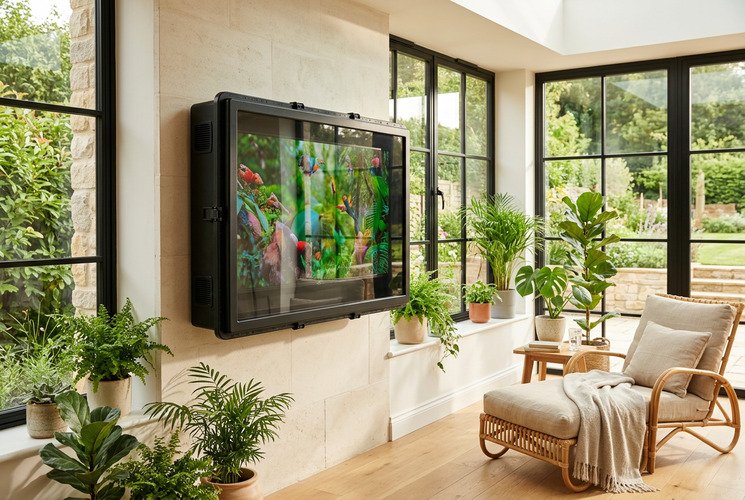
Putting a TV in your sunroom seems like a great idea, but will a standard TV survive the heat, light, and humidity over time? You don’t want your relaxing space to become a source of frustration after one hot summer season.
A TV enclosure is a smart investment for a sunroom if the TV faces direct sunlight, high heat, humidity, dust, insects, or coastal air. These conditions can slowly damage an indoor TV’s sensitive electronics, even though the space is technically indoors and protected from rain. It’s really about managing environmental risks, not just blocking water.
It’s so easy to think, “no rain, no problem.” But in my years of talking with customers, I’ve learned that the most common dangers to a TV are often the ones you can’t always see. A sunroom can be a beautiful addition to a home, hotel lounge, restaurant patio, or poolside space, but for electronics, it can behave more like a semi-outdoor environment than a normal living room.
The real question is not simply whether your TV is under a roof. The better question is: will this TV be exposed to heat buildup, direct sun, humidity, dust, insects, or long daily operating hours? If the answer is yes, an outdoor tv enclosure becomes much more reasonable.
Let’s break down exactly what those risks are and figure out if you really need to give your TV some extra protection.
Last Updated: April 27, 2026 | Estimated Reading Time: 6 minutes
By Smith Chen, Outdoor TV Enclosure Engineer at Outvion
Is a Sunroom Really an “Indoor” Space for a TV?
You probably see your sunroom as just another room in your house, like the living room. But the extreme temperature swings, direct sunlight, and changing humidity can silently stress expensive electronics.
A sunroom often behaves more like a semi-outdoor environment for a TV. Its glass walls can create a greenhouse-like effect, allowing solar energy to build up heat inside the room. Depending on the glass type, some UV exposure and strong glare may still reach the TV. Humidity can also rise much higher than in other rooms, increasing the risk of condensation around sensitive components.
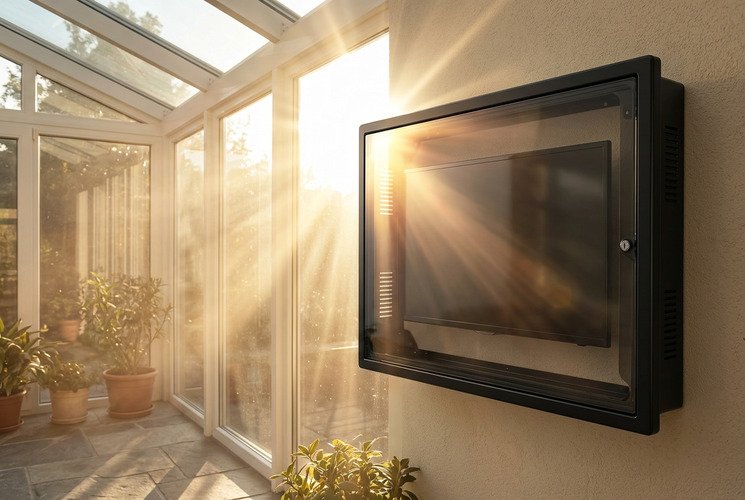
When we design our enclosures, we think about these “in-between” spaces a lot. A sunroom is a perfect example. Unlike a living room with insulated walls and a central HVAC system, a sunroom’s environment is constantly changing. The glass walls that give you a great view also allow a lot of solar energy into the room. Energy.gov explains that solar heat gain is the amount of solar radiation admitted through a window, door, or skylight, either transmitted directly or absorbed and released as heat inside a home. Energy.gov explains solar heat gain through windows.
This means the temperature around the TV can become much higher than the temperature in a normal room. Sony advises using TVs within a temperature range of 0°C to 40°C / 32°F to 104°F and avoiding direct sunlight. Sony TV temperature guidance. A bright sunroom with afternoon sun can push the TV closer to those limits, especially if there is poor airflow.
Then there’s the moisture. A humid day, a cool morning, or a temperature drop after sunset can create condensation on glass and nearby surfaces. Water forming inside a TV is not something you normally worry about in a standard climate-controlled room, but in a sunroom it becomes a real possibility.
Here’s a simple way I explain it to customers:
| Feature | Typical Living Room | Sunroom Environment |
|---|---|---|
| Temperature | Stable and controlled | Wide swings, potential for extreme heat |
| Sunlight | Mostly indirect | Direct, intense, and often high-glare |
| Humidity | Lower and more consistent | Can rise quickly, especially near glass |
| Airflow | Usually supported by HVAC | Often poor, stagnant, or inconsistent |
| Dust / Pollen | Lower exposure | Higher exposure if doors or windows open |
| Usage Pattern | Normal home viewing | May become long-hour viewing in commercial spaces |
That is why I don’t like to treat every sunroom as a normal indoor room. Some are basically living rooms with more glass. Others behave more like enclosed patios. The difference matters.
What Dangers Does a Sunroom Pose to a TV Besides Rain?
You’ve made sure your sunroom is completely waterproof, so you assume your TV is safe. But invisible threats like heat, dust, humidity, insects, and sunlight can cause your screen to fail earlier than expected.
The biggest non-rain threats in a sunroom are heat buildup, direct sunlight, humidity, dust, and insects. Heat can push the TV beyond its normal operating comfort zone. Constant sunlight can create glare and material aging. Humidity and condensation may affect electronics over time. Dust, pollen, and small insects can also enter through TV vents.
From my experience, heat is usually the first thing I ask about when a customer says the TV will be installed in a sunroom. I want to know: Does the TV face afternoon sun? Is the room air-conditioned? Are there blinds or curtains? Does the room feel hot when people sit there in summer?
I’ve heard many stories from customers whose TVs started showing lines on the screen, shutting down, or turning black after being exposed to heat for too long. Of course, not every failure is caused by heat, and no enclosure can make a bad installation safe in every condition. But reducing heat buildup is one of the most important design goals.
An enclosure with active cooling fans can help move warm air out of the cabinet and reduce trapped heat around the TV. I prefer to describe it carefully: fans do not make the enclosure “cold,” and they do not remove the need for shade or proper placement. But they do improve airflow, which is very important in a glass room with strong sun.
UV and sunlight are slower, more silent threats. Just like sunlight can fade furniture, it can also age plastic parts and create glare on the screen. The polycarbonate front panels we use on our enclosures add a protective physical layer in front of the TV. For a sunroom, this is especially helpful when the TV is mounted in a bright area and cannot be moved to a fully shaded wall.
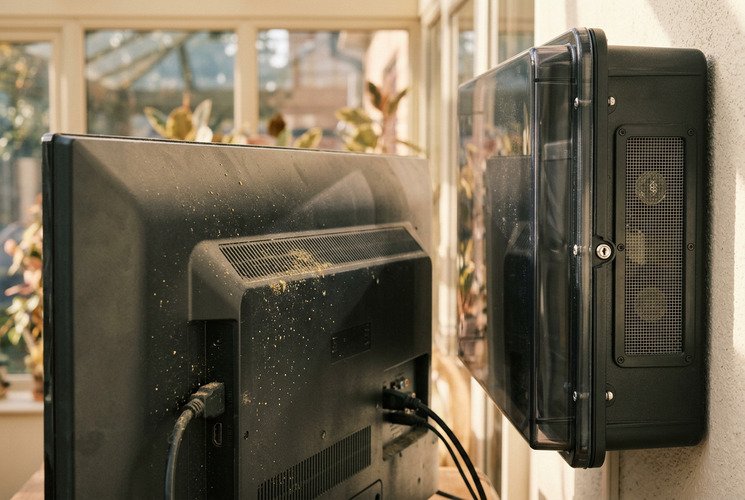
And don’t forget the little things. Sunrooms often have more dust and pollen than standard rooms. Doors and windows may be opened frequently, letting in small insects. A regular TV has vents, and those vents are necessary for cooling, but they also allow small particles to enter. Over time, dust buildup can reduce airflow and hold heat around the electronics.
A sealed, IP-rated enclosure helps reduce this exposure. The International Electrotechnical Commission explains that IP ratings grade an enclosure’s resistance against the intrusion of dust and liquids. IEC explains IP ratings. For example, an IP65-rated enclosure helps protect against dust and water jets, but it should not be described as vapor-proof or suitable for immersion. The final protection still depends on correct installation, especially properly sealed cable exits.
For our customers in coastal areas, sunrooms can create another issue: salt air. A seaside sunroom, resort lounge, or pool-facing glass room may not receive direct rain, but salty and humid air can still reach the TV. In these cases, I usually recommend a hard enclosure with a non-metallic body, such as polycarbonate, and careful attention to hardware and mounting parts.
Here’s how I normally compare the risks:
| Risk in a Sunroom | Why It Matters for a TV | How an Enclosure Helps |
|---|---|---|
| Heat buildup | Can stress internal components and cause shutdowns | Fans help move warm air out |
| Direct sunlight | Creates glare, heat, and long-term material aging | Front shield adds a protective layer |
| Humidity / condensation | Moisture can affect electronics over time | Sealed body reduces direct exposure |
| Dust / pollen | Can enter TV vents and reduce airflow | IP-rated structure helps block particles |
| Insects | Small insects may enter vents or ports | Sealed design reduces entry points |
| Salt air | Can corrode metal parts and connectors | Polycarbonate body helps avoid rust-related housing issues |
| Public or commercial use | More touching, longer operation, higher repair cost | Lockable and impact-resistant design improves protection |
This is why I always tell customers: a sunroom TV enclosure is not only about rain protection. It is about creating a safer operating environment around the TV.
How Do I Choose the Right Enclosure for My Sunroom TV?
You’ve decided an enclosure may be a smart move, but now you see all the different sizes and features. Choosing the wrong one could mean it doesn’t fit, doesn’t cool properly, or doesn’t offer the right protection for your sunroom.
First, measure your TV’s total width, height, and depth—not just the diagonal screen size. Check that the enclosure’s internal dimensions can fit your TV. Next, confirm that your TV’s VESA mounting pattern matches the enclosure’s bracket. Finally, consider whether your sunroom needs active fan cooling, sealed cable exits, and a lockable front cover.
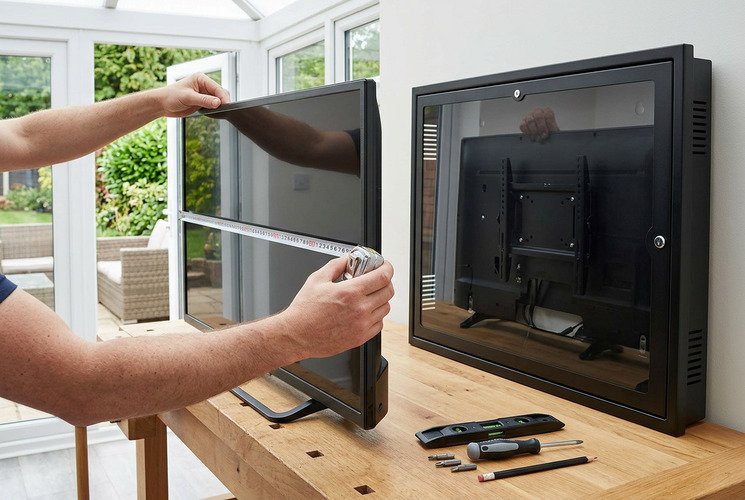
I always walk customers through a simple checklist to make sure they get exactly what they need. It avoids a lot of headaches later on.
Step 1: Measure Everything Correctly
The most common mistake people make is only looking at the screen size, like “55 inches.” That number only tells you the diagonal screen size. It does not tell you the full outside dimensions of the TV.
You need to get a tape measure and check:
- Total width from edge to edge
- Total height from top to bottom
- Maximum depth
- Thickness at the bottom section
- Cable position
- Power plug direction
- Distance from the mounting holes to the TV edges
Some TVs are very thin at the top but much thicker at the bottom. Some have rear-facing ports that need extra clearance. We list the maximum TV dimensions our enclosures can hold, so customers can compare their real measurements directly with the enclosure’s internal space.
This is especially important for sunroom installations because you also need some air space around the TV. A TV should not be forced tightly into an enclosure with no room for airflow.
Step 2: Check Your VESA Mount
On the back of your TV, there are usually four screw holes in a square or rectangular pattern. This is the VESA pattern. Ergotron explains that the VESA mount standard defines the four-hole attachment interface on the back of displays and the screws used for those holes. Ergotron VESA mount guide.
Common VESA patterns include:
- 200mm × 200mm
- 300mm × 300mm
- 400mm × 400mm
- 600mm × 400mm
You need to know your TV’s VESA measurement and make sure the enclosure’s internal mounting bracket supports it. Also think about screw clearance and cable clearance. Our enclosures are designed to be slim, but there still needs to be enough space for air to move behind the TV once it is mounted inside.
This is one of those details that does not sound exciting, but it prevents many installation problems.
Step 3: Match Features to Your Sunroom
Think honestly about your sunroom’s real conditions. Not every sunroom needs the same level of protection.
| Your Sunroom’s Condition | Recommended Enclosure Feature |
|---|---|
| Gets intense afternoon sun | Active cooling fans are strongly recommended. |
| Has high humidity or morning condensation | Sealed body and protected cable exit are important. |
| Is near the coast or a pool | Polycarbonate body and corrosion-resistant hardware are recommended. |
| Has open windows or doors | IP-rated dust and insect protection is useful. |
| Is used by kids, guests, or customers | Impact-resistant front panel and lockable design are helpful. |
| Is a hotel, resort, bar, or restaurant space | Choose stronger protection because usage hours and repair costs are higher. |
| Is fully climate-controlled and shaded | A hard enclosure may be optional, depending on TV value and usage. |
The last row is important. I don’t want to tell every customer that they absolutely need an enclosure. If the sunroom is fully climate-controlled, shaded, dry, and used like a normal living room, then a standard indoor TV may work fine.
But if the sunroom gets hot, bright, humid, dusty, or is used commercially, I usually recommend a hard enclosure. It gives the TV a much better chance of surviving long-term.
Step 4: Plan the Installation
Finally, plan for the installation before the enclosure arrives. A large TV inside an enclosure is heavy. For anything over 50 inches, I strongly recommend having two people lift and mount it safely.
Also make sure the wall can support the full weight of the TV and enclosure together. A sunroom wall may not always be as strong as a solid interior wall, especially if it has large glass panels or lightweight framing. For commercial projects, I prefer to confirm the mounting structure before quoting or recommending a size.
Cable sealing is another detail I pay attention to. Even with a good enclosure body, poorly routed cables can create weak points. A proper installation should use sealed cable exits, compression foam, or cable glands to reduce dust and moisture entry.
Conclusion
A sunroom is not always a typical indoor space for a TV. It may be protected from rain, but it can still expose the TV to heat, direct sunlight, humidity, dust, insects, and sometimes salt air.
That is why I see a TV enclosure as a practical protection solution for many sunroom installations—not because every sunroom is dangerous, but because some sunrooms behave much more like semi-outdoor environments than living rooms.
If your sunroom is shaded, air-conditioned, dry, and stable, you may not need an enclosure. But if your TV faces direct sun, high heat, humidity, dust, coastal air, or long daily use, a hard outdoor TV enclosure is a smart investment.
The way I usually explain it to customers is simple:
A soft indoor environment protects a normal TV. A changing semi-outdoor environment needs extra protection.
A sunroom often sits right between those two worlds. The enclosure helps bridge that gap, protecting the TV while keeping it visible and ready to use.
FAQ
Can I put a regular TV in a sunroom?
Yes, but only if the sunroom is stable, shaded, dry, and not too hot. If the TV faces direct sunlight, high humidity, or large temperature swings, a regular indoor TV may fail faster than expected.
Does a sunroom TV need an outdoor TV enclosure?
A sunroom TV needs an enclosure when the space behaves like a semi-outdoor environment. This includes direct sun, poor airflow, heat buildup, humidity, dust, insects, or coastal air.
Can sunlight damage a TV in a sunroom?
Yes. Direct sunlight can increase heat on the screen and casing, create glare, and contribute to long-term material aging. Many TV manufacturers advise avoiding direct sunlight.
Is IP65 necessary for a sunroom TV enclosure?
IP65 is not always necessary for a fully indoor room, but it is useful for sunrooms with dust, humidity, open windows, pool air, or coastal exposure. It helps protect against dust and water jets, but correct cable sealing and installation are still important.
Should a sunroom TV enclosure have fans?
If the sunroom gets hot or receives strong afternoon sun, fans are strongly recommended. Active cooling fans help move warm air out of the enclosure and reduce heat buildup around the TV.
Is a soft TV cover enough for a sunroom?
A soft cover may be enough for a shaded, dry sunroom where the TV is used occasionally. But it must be removed during viewing. If the TV needs protection while operating, a hard enclosure is usually a better solution.
What size enclosure do I need for my TV?
Do not choose only by diagonal screen size. Measure the TV’s full width, height, and depth, then compare those numbers with the enclosure’s internal dimensions. Also check the VESA mounting pattern before ordering.