
![An outdoor TV enclosure mounted on a brick wall in a humid, green backyard setting]](https://outvion.com/wp-content/uploads/2026/04/an-outdoor-tv-enclosure-mounted-on-a-brick-wall-in-a-humid-green-backyard-setting.jpg)
Worried about your patio TV in the damp air? A simple cover might trap moisture inside, leading to permanent damage and a wasted investment.
A hard outdoor TV enclosure creates a sealed, controlled space that actively manages humidity, condensation, and salt spray. Soft covers mainly block direct rain but often trap ambient moisture inside, which is the real threat in humid climates, making enclosures a more reliable long-term solution.
I talk to homeowners every day about protecting their outdoor TVs. Many start by looking at soft covers because they seem like a cheap and easy fix. But the conversation quickly changes when we discuss the real enemy in places like Florida or near the coast: humidity, not just rain. A simple cover can sometimes cause more problems than it solves. Let’s break down why the type of protection you choose matters so much, especially if you live in a damp or coastal area.
Last Updated: April 26th 2026 | Estimated Reading Time: 6 minutes
By Smith Chen, Outdoor TV Enclosure Engineer at Outvion.
Does a Soft TV Cover Really Stop Moisture and Mold?
You bought a soft cover to keep your TV dry from the rain. But after a few weeks, you notice a musty smell and condensation inside the cover.
Soft covers are not airtight. Humidity easily gets in through the bottom and gets trapped. This creates a perfect environment for condensation to form on your TV’s electronics and for mold to grow on the fabric itself. They block rain but can make moisture problems worse.
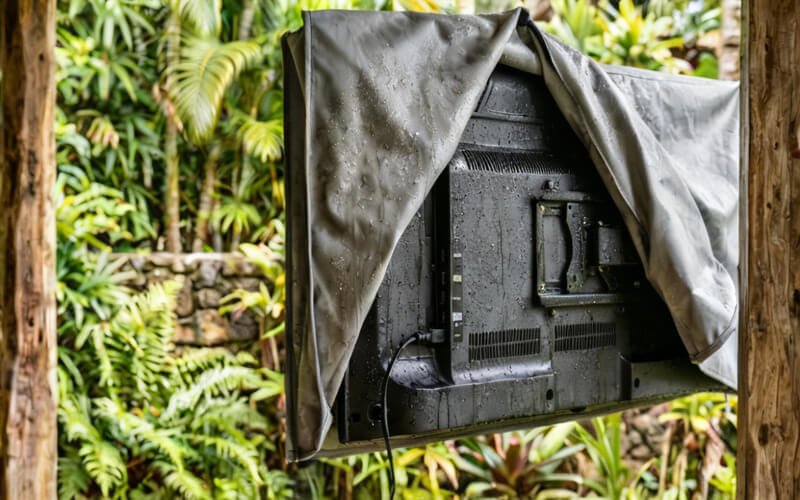
When people ask me about soft covers, I always bring the conversation back to one thing: trapped moisture. A soft cover is essentially a fabric or vinyl bag you drape over your television. While it does a decent job of shedding direct rain, it’s not sealed at the bottom. This is where the problems begin in humid climates. Air, full of moisture, flows freely underneath.
The Problem with Trapped Humidity
During the day, the air warms up. At night, as the temperature drops, that trapped, moist air cools down and the water condenses. It forms little droplets on the coolest surfaces it can find—which is often the back of your TV and its sensitive ports. I’ve heard from customers who took off their soft cover only to find the back of their TV was wet, even though it hadn’t rained. This constant exposure to moisture is what leads to short circuits and failure. The damp, dark space also becomes a breeding ground for mold and mildew, which can ruin the cover and smell terrible.
| Feature | Soft Fabric Cover | Hard Enclosure |
|---|---|---|
| Sealing Method | Drapes over, open at bottom | Gasket-sealed front panel, locked |
| Moisture Risk | High risk of trapping humidity | Low risk, manages internal climate |
| Mold/Mildew | Common on fabric in damp areas | Not an issue with Polycarbonate/metal |
The Inconvenience Factor
Another thing I hear a lot is that people just stop using their soft covers. Taking it off and putting it back on every time you want to watch TV becomes a chore. After a while, it gets left off, and the TV is left completely exposed. A hard enclosure is always on and always ready. You just unlock it, open the front panel, and turn on the TV. It’s a permanent solution, not a temporary task.
How Does a Hard Enclosure Protect a TV from Salt Air and Extreme Temperatures?
Living by the coast is amazing, but the salty air quickly destroys electronics. You need a solution that won’t rust, corrode, or let the salt in.
Hard enclosures, especially those made from Polycarbonate, are immune to salt-spray corrosion. They create a fully sealed barrier with gaskets. Many models also have fans to circulate air, preventing condensation and protecting the TV in both high heat and freezing cold.
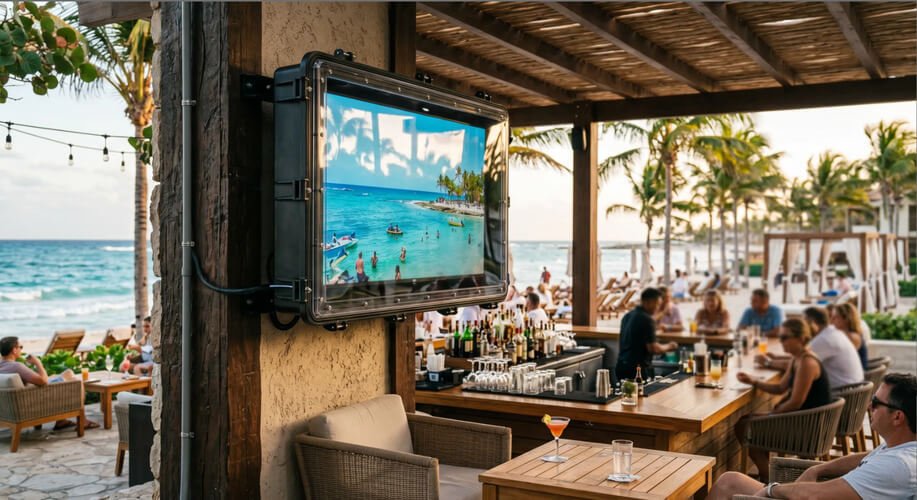
Some of our biggest markets are coastal states like Florida, California, and Texas, and for a good reason. Salt in the air is like poison for electronics. A soft cover does nothing to stop it. The salty, humid air gets right inside and starts corroding the circuit boards. I’ve seen TVs that were only a year old completely ruined by salt corrosion. A hard enclosure is built differently from the ground up to handle these exact conditions.
Fighting Salt-Spray Corrosion
The material we use is the first line of defense. We build our enclosures from Polycarbonate, which is a type of heavy-duty polymer. Unlike metal, it can’t rust or corrode. It’s the same kind of material used in automotive parts and safety equipment. When the front panel is closed and locked, rubber gaskets create a tight seal, keeping the salty air and moisture out. This completely isolates the TV from the harsh coastal environment, which is why they are so popular at beachside bars, hotels, and homes.
Managing Extreme Temperatures
Protection isn’t just about water and salt. It’s also about temperature. In freezing climates, a soft cover offers zero insulation. We’ve heard from customers in places like New York where winter temperatures can drop to -20°C. An enclosure provides a pocket of insulated air that helps protect the TV’s sensitive components from extreme cold. In hot climates, the opposite problem occurs: a TV generates its own heat, and a sealed box could cause it to overheat. That’s why our Pro and Ultra series enclosures include active cooling systems with fans. These fans create airflow, pulling cool air in and pushing hot air out, keeping the TV operating within a safe temperature range even on the hottest summer days.
| Environmental Threat | Soft Fabric Cover | Hard Enclosure with Fans |
|---|---|---|
| Salt Air | No protection, air flows freely | Fully sealed, Polycarbonate is non-corrosive |
| High Heat | Traps heat, can increase TV temperature | Active fan cooling dissipates heat |
| Freezing Cold | No insulation | Provides an insulated air gap |
Can I Use Any Indoor TV with an Outdoor Enclosure?
You want a TV on your patio but don’t want to pay thousands for a special outdoor model. What if you could just use a regular TV?
Yes, a major benefit of a hard enclosure is that it lets you use almost any standard indoor TV outdoors. This saves you 60% or more on hardware costs and gives you far more choices for screen size, brand, and smart features.
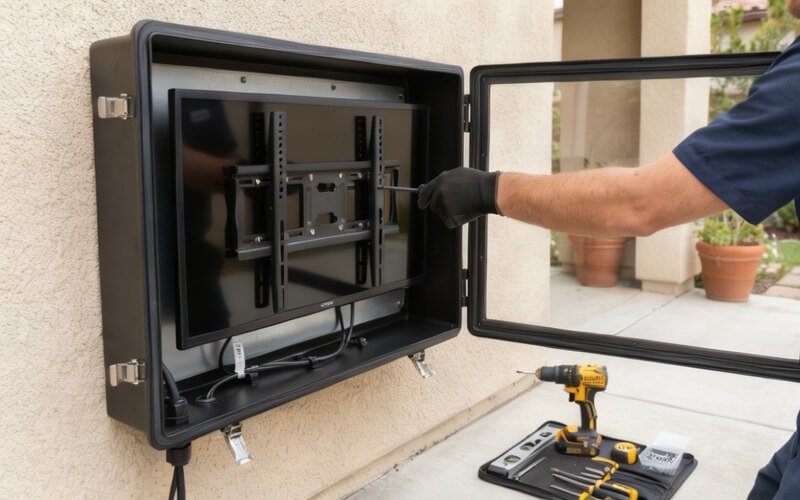
This is probably the biggest “aha!” moment for my customers. They assume they need to buy a purpose-built outdoor TV, which can cost three to five times more than a comparable indoor model. A hard enclosure completely changes that equation. It essentially transforms your favorite indoor TV into a weatherproof outdoor unit. This approach is not just cheaper upfront, but it also saves you a lot of money in the long run.
The Total Cost of Ownership Advantage
Think about how fast TV technology changes. In three or four years, you might want a new TV with 8K resolution or a better operating system. If you bought an expensive outdoor TV, you’d have to replace the entire expensive unit. With an enclosure, the protective case stays mounted on your wall. You simply swap out the much cheaper indoor TV inside. Your initial investment in the enclosure protects your TV purchases for a decade or more. A soft cover doesn’t offer enough protection to safely use a standard indoor TV in a humid area for long. It might last one season if you’re lucky. In humid areas, a soft cover on an indoor TV is a recipe for a quick failure, making the enclosure a much smarter financial decision over time.
Universal TV Compatibility
Our enclosures are designed to be universal. They use the standard VESA mounting system that nearly every TV made in the last 20 years has on the back. This means you can use almost any TV you want—whether it’s an old flat-screen you have in the garage, a new curved OLED, or the latest smart TV from any brand. You just mount the TV to the bracket inside the enclosure, and you’re good to go. This gives you the freedom to choose the exact screen size and features you want for your outdoor space, instead of being limited to the few, very expensive outdoor TV models on the market.
Conclusion
For humid or coastal areas, a hard enclosure isn’t just a cover. It’s a complete protection system that manages moisture, salt, and temperature, allowing you to safely use any indoor TV outside.