
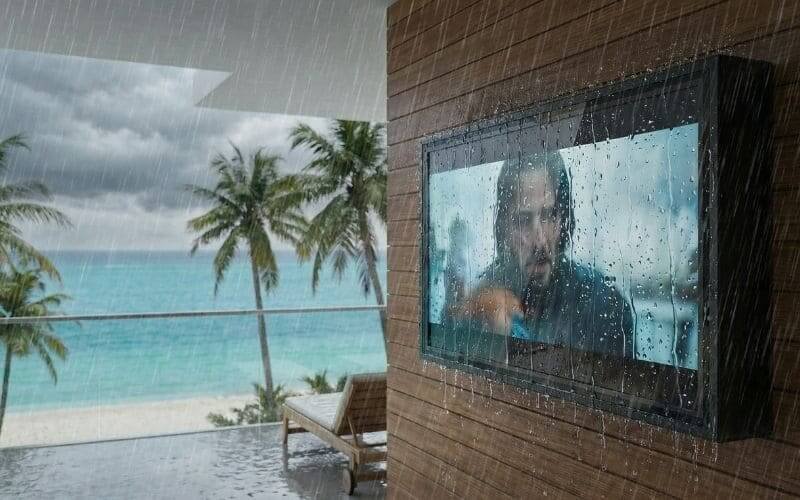
You are standing in the electronics aisle, or scrolling through Amazon, looking at the price tag of a specialized “Outdoor TV.” $3,499. You blink. You look again. It’s still the price of a used sedan.
Then you see an “Outdoor TV Enclosure” for $600. It claims to do the same thing using a regular TV.
Your skepticism radar goes off. “Is this just a glorified plastic box? Will it melt my TV? Is it going to look like a coffin on my patio?”
It is a fair question. The market is flooded with cheap, ineffective gadgets. But here is the reality check: Prisons use them. Oil rigs use them. Major sports stadiums use them. These industries do not buy snake oil; they buy reliability.
Short Answer: Yes, high-quality outdoor TV enclosures work exceptionally well, provided they are engineered correctly. Outvion enclosures function by creating a controlled “Micro-Climate” around the TV. The Polycarbonate shell provides IP65-rated waterproofing and impact resistance (like a riot shield), while the Active Airflow System (thermostatic fans) continuously exchanges the internal air to prevent overheating. This engineering approach allows you to operate a standard $400 indoor TV outdoors for years, saving roughly 60-70% compared to purchasing a dedicated outdoor unit.
Last Updated: JAN 30TH. 2026 | Estimated Reading Time: 9 Minutes
The Anatomy of Protection: Inside the Black Box
An enclosure isn’t just a box; it is a lung. It is a breathing system designed to regulate temperature and humidity while excluding liquid water and solid projectiles. It employs advanced material science and fluid dynamics to keep the internal environment stable.
Let’s tear it apart. What are you actually paying for? It’s not just “plastic.”
1. The Shell: High-Density Polycarbonate (PC) vs. Acrylic Cheap covers use PVC or Acrylic (Plexiglass). Outvion uses High-Density Optical Polycarbonate (PC).
- The Material Science: Polycarbonate is an engineering thermoplastic characterized by high impact resistance and temperature tolerance. In an Izod Impact Strength test, Polycarbonate scores significantly higher than Acrylic or Glass. This is why it is the material of choice for Riot Shields and Bulletproof Glass.
- Why it matters: It is virtually unbreakable. If a baseball or a hailstone hits Acrylic, it cracks. If it hits Polycarbonate, the material flexes (yields) to absorb the kinetic energy and then snaps back.
- UV Stabilization: Unprotected plastic turns yellow in the sun (photo-degradation). Outvion uses a co-extruded UV stabilizer layer. This acts as a permanent sunscreen, blocking the UV radiation that would otherwise make the plastic brittle and opaque over time.
2. The Active Cooling Engine: Positive Pressure Dynamics This is where the magic happens. A sealed box in the sun is an oven. An Outvion enclosure is a wind tunnel designed with Positive Pressure.
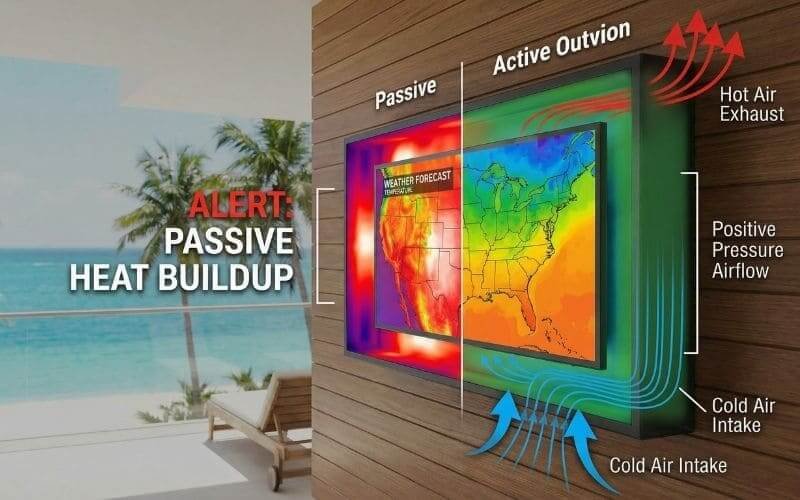
- The Intake: Located at the bottom (drawing the coolest available air from the shade), baffled vents draw air in through high-density micromesh filters.
- The Positive Pressure Concept: The intake fans force air into the box at a higher rate than it naturally leaks out. This creates a high-pressure zone inside the enclosure. Why does this matter? If there is a tiny microscopic gap in a seal, air will leak out of that gap, blowing dust away. Dust cannot swim upstream against the pressure gradient.
- The “Chimney Effect”: Heat naturally rises (convection). Our exhaust fans are located at the top to accelerate this natural physics. The system replaces the entire volume of air inside the case multiple times per minute. This constant wash of airflow strips heat away from the TV chassis faster than still air ever could.
3. The Mounting Logic: The Double-DIN Rail Inside the shell is a universal VESA mount built on a heavy-gauge steel rail system.
- The Load Path: The weight of the TV is transferred directly to the steel backplane, which is bolted to your wall studs. The plastic shell does not bear the load.
- Adjustability: The vertical rails slide left and right, and the TV brackets slide up and down. This accommodates almost any VESA pattern from a small 100×100 monitor to a massive 600×400 commercial display. It allows you to center the TV perfectly within the viewing window, regardless of where the screw holes are on the back of your specific TV model.
The “Universal” Fit: Resurrection of Old Tech
The Compatibility: If your TV has four screw holes on the back (VESA standard), it fits. This universality allows you to be creative with your hardware choices and breathe new life into older technology.
Recycle Your Old TV (The “Heat” Advantage) Here is a secret that TV manufacturers won’t tell you: Older TVs are often better for outdoor use than new ones.
- The CCFL Factor: Old LCDs (circa 2010-2016) used Cold Cathode Fluorescent Lamps (CCFL) for backlighting. These are incredibly bright (high nits) and robust. They are often brighter than cheap modern LED edge-lit TVs.
- The Thermal Benefit: These older TVs generate significant waste heat. In an indoor setting, this is inefficient. In an outdoor winter setting, this is a feature! The waste heat keeps the enclosure warm, preventing the liquid crystals from freezing in sub-zero temperatures.
| - The Play: Don’t buy a new TV yet. Take the old 55-inch “beater” from the guest room, put it in an Outvion enclosure, and see how it performs. You might just get another 5 years out of a “dead” asset.
Size Freedom: Beyond the 75-Inch Barrier Dedicated Outdoor TV manufacturers typically stop at 75 inches because manufacturing large, waterproof glass screens is exponentially expensive and difficult to ship.
- The Solution: Enclosures unlock the full spectrum of the display market. You can buy a massive 85-inch or 98-inch commercial signage display and protect it with a custom or large-format enclosure. You are not artificially limited by the niche outdoor market’s inventory.
Commercial Video Walls For sports bars, we can tile enclosures. Because the bezels are consistent, you can mount three or four enclosures side-by-side to create a massive video wall or a multi-game viewing center. This modularity is impossible with sealed outdoor TVs that have fixed, wide bezels.
The Heat Torture Test: Will It Overheat?
The Data: The number one fear is heat. “Won’t the plastic melt? Won’t the TV fry?” The answer lies in Thermodynamics. Moving air cools surfaces significantly more effectively than stagnant air due to convective heat transfer.
Let’s look at the “Arizona Simulation.” Imagine it is 115°F (46°C) outside. This is an extreme environment.
- Thermodynamics 101: Heat transfers in three ways: Conduction, Convection, and Radiation. A passive heatsink (like on the back of an Outdoor TV) relies on radiation and natural convection. It is slow.
- The Outvion Active System: When the internal thermostat hits 95°F, the fans kick on. They force air across the surface of the TV. This is Forced Convection. It strips the boundary layer of hot air away from the electronics instantly.
- The CFM Calculation: The fans are rated for specific CFM (Cubic Feet per Minute). Based on the internal volume of the enclosure (roughly 3-4 cubic feet), the air is completely replaced every 5 to 10 seconds.
- The Result: The internal temperature stays within 5-10 degrees of the ambient shade temperature. If it’s 115°F outside, it might be 125°F inside the box. Modern TVs are rated to operate up to 125°F or 140°F junction temperature. You are in the safe zone.
The “Solar Load” Distinction It is important to distinguish between Ambient Heat (air temp) and Radiant Heat (Direct Sun).
- Ambient: The fans handle this perfectly.
- Radiant: If the sun beats directly onto the black screen, the surface temp can skyrocket regardless of the air temp. This creates “Isotropic Blackout” (screen turns black).
- The Fix: Outvion’s active cooling helps, but we always recommend mounting the unit facing North or East, or using the tilt mount to angle the screen down, minimizing the surface area exposed to direct perpendicular solar rays.
Temperature Delta – Ambient vs. Internal (Passive vs. Active)
| Condition | Ambient Air Temp | Internal Temp (Passive Box) | Internal Temp (Outvion Active) | TV Status |
|---|---|---|---|---|
| Cool Day | 70°F (21°C) | 85°F | 75°F | Optimal |
| Warm Day | 85°F (29°C) | 110°F | 92°F | Optimal |
| Hot Day | 100°F (38°C) | 145°F (Danger) | 108°F (Safe) | Active Wins |
| Extreme Day | 115°F (46°C) | 165°F (Failure) | 122°F (Limit) | Active Wins |
Weatherproof Reality: The Coastal Advantage
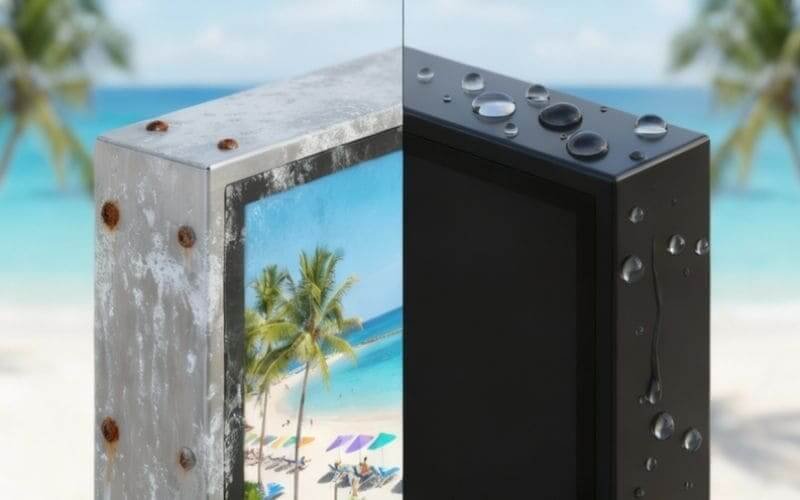
The Killer Feature: Rust is the enemy of metal. Outvion enclosures are made of engineered polymers. Plastic cannot rust. This simple chemical fact makes them superior to expensive metal outdoor TVs in coastal environments.
IP65 Deep Dive We throw around “IP65,” but what does the testing actually involve?
- 6 = Dust Tight. The test involves a vacuum chamber filled with talcum powder. Zero ingress is allowed. This protects against pollen, sand, and saw dust.
- 5 = Water Jets. The test involves a 6.3mm nozzle spraying 12.5 liters per minute from a distance of 3 meters for at least 3 minutes.
- The Gasket: We use EPDM Rubber for the perimeter seal. EPDM is chosen for its extreme resistance to weathering, ozone, and UV. It does not crack or dry out like cheap neoprene.
The Salt Corrosion Mechanism If you live near the ocean (Florida, California, Hawaii), salt air is corrosive. It creates an electrolyte film on surfaces.
- Galvanic Corrosion: Expensive outdoor TVs often use aluminum bodies. When salt water (electrolyte) touches aluminum and a steel screw, it creates a battery. The aluminum becomes the anode and corrodes (sacrifices itself). This leads to pitting, white powder oxidation, and paint bubbling.
- The Polymer Win: Outvion’s High-Density Polycarbonate/ABS body is chemically inert. It has no free electrons to give up. It will never corrode. It creates a hermetic barrier between the salt air and the TV inside. We have hotels in the Maldives that have been running these enclosures for 8 years with zero degradation.
Cleaning Protocol: The “Hose Down” Because of the IP65 rating, maintenance is aggressive.
- Bird Droppings? Hose it off.
- Salt Spray? Hose it off.
- The Contrast: You cannot take a hose to a “Water Resistant” TV. You have to gently wipe it with a damp cloth. The ability to pressure wash (low setting) the Outvion enclosure makes it ideal for high-traffic commercial venues.
The Financials: The “No-Brainer” Calculation
The ROI: Stop paying the “Outdoor Tax.” The premium you pay for a weatherproof badge is disproportionate to the technology you get. Smart money decouples the asset from the protection.
Let’s be honest about electronics. They have a “burn rate.” Capacitors dry out, backlights fail, power surges happen, and technology becomes obsolete (4K to 8K).
When you buy a $3,000 outdoor TV, you’re financially marrying the expensive screen to the expensive weatherproofing. If the screen dies in 4 years—after the warranty expires—you have to throw the entire $3,000 unit in the trash. You lose everything.
The “Decoupled” Strategy: With Outvion, you separate the two assets.
- The Infrastructure Asset (Enclosure): Cost ~$600. Lifespan 10-15 years. (Plastic doesn’t break).
- The Display Commodity (TV): Cost ~$400. Lifespan 5 years.
Replacement Scenarios:
- Scenario A (Outdoor TV): The TV dies in year 5. You spend $3,500 to replace it.
- Scenario B (Outvion): The TV dies in year 5. You open the enclosure, throw away the $400 TV, drive to Costco, and buy a new $300 TV (which is now 8K, brighter, and smarter). You install it. You are back in business for pennies.
10-Year Cost of Ownership Comparison
| Cost Item | Dedicated “Outdoor TV” ($3k Model) | Outvion Enclosure + Indoor TV |
|---|---|---|
| Year 0 Purchase | $3,500 | 1,000(600 Box + $400 TV) |
| Year 5 Failure | Screen failure (Out of Warranty) | TV Failure |
| Year 5 Replacement | $3,500 (Buy whole new unit) | $400 (Buy new TV only) |
| Total 10-Year Cost | $7,000+ | $1,400 |
| NET SAVINGS | $5,600 |
Security & Theft: The Fort Knox Factor
A naked TV hanging on a bracket is a “Snatch and Grab” target. It takes 10 seconds to lift it off. An Outvion Enclosure turns a theft into a noisy construction project.
Visual Deterrent Thieves are opportunists. They look for easy scores. The Outvion enclosure looks industrial. It looks bolted down (because it is). To a thief scanning a backyard, it signals “hassle.” They are looking for easy targets, not a locked steel-and-polycarbonate safe.
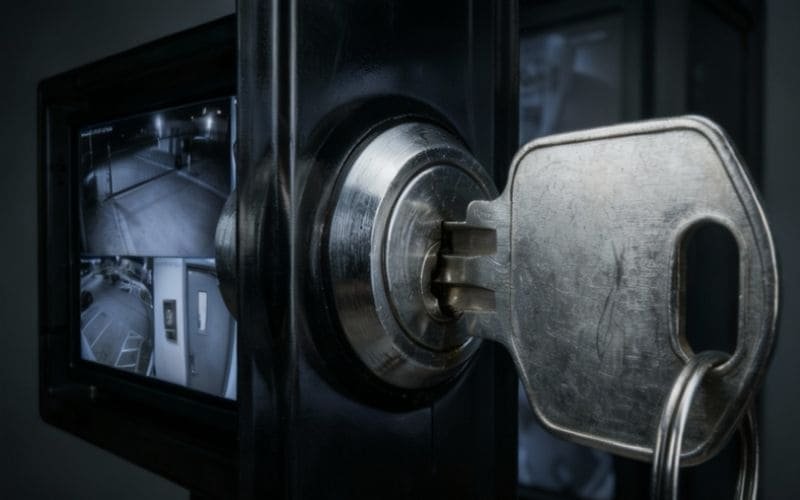
Lockability: The Dual Cam System
- Physical Security: The front bezel is secured by two mechanical cam locks. Without the key, you cannot access the TV or the mounting bolts.
- Internal Security: The TV is bolted to the internal rail system. Even if they break the front glass, they still have to unbolt the TV from the inside.
Port Security (Commercial Bar Mode) This is critical for commercial venues (bars, patios).
- The Risk: Patrons messing with inputs. Someone plugging in a Chromecast to hijack the screen. Someone turning the volume to 100.
- The Fix: By locking the case, you physically prevent access to the HDMI ports, USB ports, and side buttons. You maintain total control over the content.
Naked TV vs. Enclosed TV Security Features
| Feature | Naked Outdoor TV | Outvion Enclosed TV |
|---|---|---|
| Mount Security | Gravity Hook (Lift off) | Internal Bolted Rail |
| Screen Access | Exposed | Locked behind Polycarbonate |
| Port Access | Exposed | Locked / Inaccessible |
| Vandalism Risk | High (Smashable Glass) | Low (Shatterproof Shield) |
| Theft Time | 10 Seconds | 15+ Minutes (Tools required) |
Conclusion
Engineering beats marketing hype every time.
The dedicated “Outdoor TV” industry relies on the fear that you can’t do it yourself. They rely on you believing that electronics are magic and that only their sealed aluminum box can survive the rain.
The truth is simpler. Electronics need to be dry, and they need to be cool. The Outvion Enclosure provides the dryness (IP65) and the coolness (Active Airflow). It does the job of the expensive TV for a fraction of the price, and it gives you the flexibility to upgrade your screen whenever you want.
Stop wondering if it works. The data is clear. The math is undeniable. Unlock your backyard potential without emptying your bank account.
FAQ
1. Does the enclosure muffle the sound?
Yes, slightly. Because the TV speakers are inside a sealed box, the volume is reduced by about 10-15%. However, outdoor audio is already difficult because sound dissipates in open air. The Fix: We always recommend using a Soundbar. Many Outvion enclosures have room inside to mount a soundbar, or you can mount one externally below the unit for directed, loud audio.
2. Is it hard to install?
No. If you can drill 4 holes, you can install this. The unit is modular.
- Bolt the empty (lightweight) back box to the wall.
- Attach the brackets to your TV.
- Hang the TV inside the box.
- Lock the front cover on. It is actually easier than hanging a heavy outdoor TV because you don’t have to lift the heavy glass screen while trying to line up bolts.
3. Will it fit a curved TV?
Generally, No. Curved TVs are deeper than flat panels. While some might fit, the curvature often interferes with the flat front shield of the enclosure. We recommend sticking to standard flat LED/OLED/QLED panels for the best fit and viewing experience.
4. Is the Wi-Fi signal blocked?
No. The enclosure body is made of Polycarbonate and ABS plastic. These materials are Radio Frequency (RF) Transparent. Unlike metal boxes which act as a Faraday Cage (blocking signals), the Outvion enclosure allows Wi-Fi and Bluetooth signals to pass through freely to your Smart TV or streaming stick.
5. What about glare?
The front shield is clear polycarbonate. Like any window, it can reflect light. The Fix:
- Brightness: Use a bright TV (500+ nits) and set it to “Vivid” mode.
- Tilt: Use the included tilting mount to angle the screen down 5-10 degrees. This reflects the dark ground instead of the bright sky.
- Position: Avoid facing the screen directly West (sunset).
6. What is the warranty?
Outvion typically offers a comprehensive warranty on the enclosure itself (structural integrity, yellowing, fans). Because we don’t manufacture the TV inside, we don’t warranty the TV, but our track record shows that TVs protected by Outvion last just as long as indoor units. Check the specific product page for current warranty terms (usually 1-3 years).
Recommended Technical Reading
- Polycarbonate Material Properties:ScienceDirect – Polycarbonate Data
- Detailed data on impact resistance and UV stability.
- Cooling Calculations:Electronics Cooling – Fan Selection
- How to calculate CFM requirements for enclosed electronics.
- IP Ratings Guide:IEC Standards – Ingress Protection
- Official definitions of IP65 test procedures.