
A public-space TV is different from a private patio TV because the screen is never protected by the owner’s attention alone.
People walk past it. Staff clean around it. Guests may touch it. Weather reaches it. Cables need service. After hours, the screen may be visible, valuable, and unattended.
Public-space TV protection is not only about weatherproofing. It is about managing three risks together: environmental exposure, public access, and service recovery. A good protection plan should reduce water and heat exposure, limit unauthorized access, protect against everyday contact, and still allow staff to maintain or replace the TV when needed.
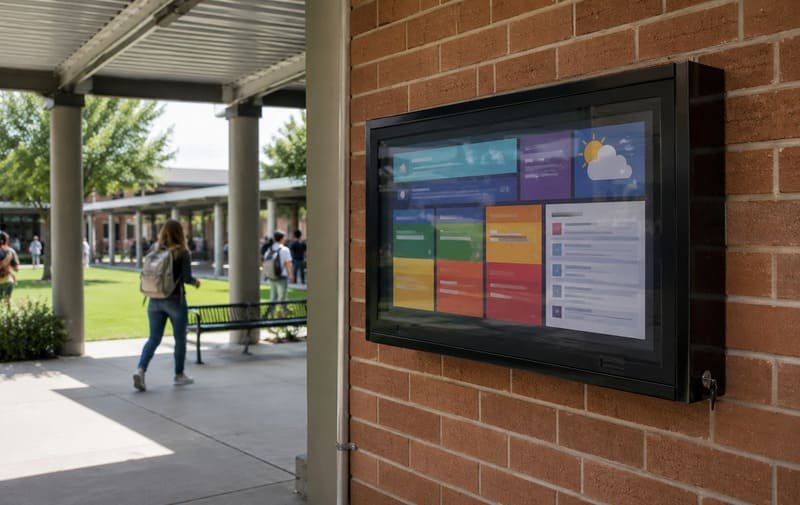
When I review a public-space TV project, I do not start with the TV size.
I start with the risk triangle.
- Where can water enter?
- Who can reach the screen?
- What can hit it?
- Where do cables run?
- Who controls the key?
- Can staff open the enclosure later?
- If the TV fails, how quickly can the site recover?
That is the difference between a private outdoor TV and a public-space screen.
A private patio TV is usually watched by the owner.
A public-space TV is used by many people, maintained by staff, exposed to weather, and sometimes left unattended.
That changes the protection logic.
Last Updated: June 3, 2026 | Estimated Reading Time: 8 minutes
By Smith Chen, Outdoor TV Enclosure Engineer at Outvion
Why Is a Public-Space TV Different from a Private Outdoor TV?
A public-space TV faces two types of exposure at the same time: outdoor conditions and public access. That makes the protection plan more complicated than a normal backyard installation.
A private outdoor TV mainly needs weather planning. A public-space TV needs weather planning, access control, physical protection, and service planning. The screen may face rain, dust, heat, humidity, accidental contact, cable pulling, cleaning routines, and unauthorized access in the same location.
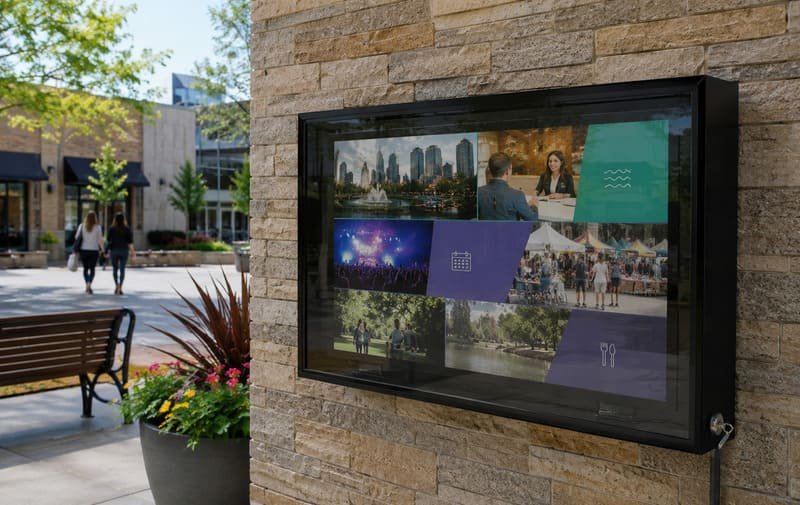
This is the part many buyers underestimate.
They ask for a waterproof screen or a weatherproof box. That is understandable, but it is not enough for public spaces.
A school courtyard screen may be under a roof but still face repeated touching and cable access.
A hotel pool TV may face splash, guest contact, humid air, and appearance requirements.
A prison or institutional common-area TV may need controlled access and tamper-resistant hardware.
A transport waiting area may face dust, vibration, public contact, and long operating hours.
A factory entrance screen may face carts, tools, and dusty air.
These are not the same project.
Public-Space Risk Triangle
| Risk Side | What It Means | Typical Weak Point |
|---|---|---|
| Environmental Exposure | Water, dust, heat, salt air, humidity, insects | Cable exits, vents, gaskets, hardware, fan areas |
| Public Access | Touching, tampering, accidental contact, theft risk | Ports, cables, front screen, mount, media devices |
| Service Recovery | Cleaning, reset, repair, replacement, inspection | Locked access, media device access, spare parts, service clearance |
This triangle is the framework I use before recommending any enclosure.
- If the site is mostly exposed to rain, the sealing plan matters first.
- If the site is high-traffic, front protection and lockable access matter more.
- If the site is remote or difficult to service, recovery planning becomes critical.
A public-space TV should not be protected like a private patio screen.
It needs a system that fits the environment and the people around it.
What Are the Three Risk Sides: Environment, Access, and Recovery?
The easiest mistake is to treat public-space protection as one problem. It is not. Water, theft, tampering, heat, and maintenance all behave differently.
Environmental exposure is about what the weather does. Public access is about what people can reach. Service recovery is about what happens after a problem. A protection plan is weak if it solves only one side and ignores the other two.
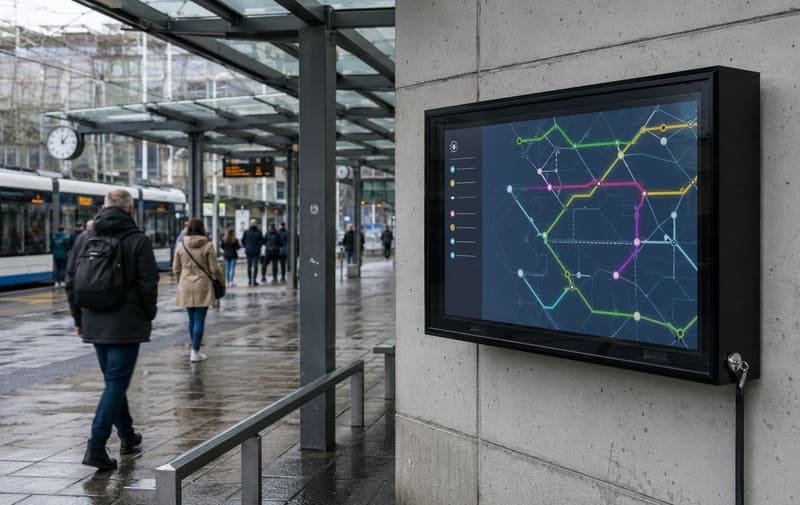
Let me break down the three sides more clearly.
Environmental exposure includes rain, wind-driven moisture, dust, insects, heat, humidity, and salt air. This is where IP rating, cable exits, gasket compression, fan airflow, and corrosion-aware hardware matter.
Public access includes touching, leaning, pulling cables, opening ports, moving furniture, accidental impact, or unauthorized attempts to remove equipment. This is where a lockable enclosure, protected cable path, secure mount, and front shield become important.
Service recovery includes the practical work after installation: cleaning the front panel, checking fan vents, opening the enclosure, resetting a media device, replacing the TV, or inspecting hardware after a season of use.
- A system that is sealed but impossible to service is not ideal.
- A system that is easy to open but easy for the public to access is not ideal.
- A system that blocks rain but traps heat can create a different problem.
The International Electrotechnical Commission explains that IP ratings grade the resistance of enclosures against the intrusion of dust and liquids. IEC IP Ratings
That makes IP rating useful, but it has limits.
IP65 can indicate dust-tight protection and protection against water jets under defined test conditions. It does not mean vapor-proof, condensation-proof, salt-proof, flood-proof, pressure-wash-proof, impact-proof, theft-proof, or maintenance-free.
What Each Risk Side Needs
| Risk Side | Protection Goal | What to Check |
|---|---|---|
| Environment | Reduce direct exposure to water, dust, heat, and corrosion | IP rating, cable exits, gasket, fan path, hardware |
| Access | Reduce casual opening, touching, cable pulling, and screen contact | Lock, front shield, cable routing, mounting height |
| Recovery | Make cleaning, inspection, reset, and replacement possible | Door access, key control, service clearance, spare parts |
This is why I do not call an enclosure a simple box.
For public-space TVs, it is a controlled access and protection layer.
How Should Different Public Spaces Prioritize Protection?
Not all public spaces need the same enclosure configuration. The best protection plan depends on who can reach the screen, what the environment is like, and how difficult the site is to service.
A school courtyard, hotel pool area, transport station, factory entrance, prison common room, and outdoor bar do not have the same risk profile. Public-space TV protection should be prioritized by site type, not by one universal product claim.
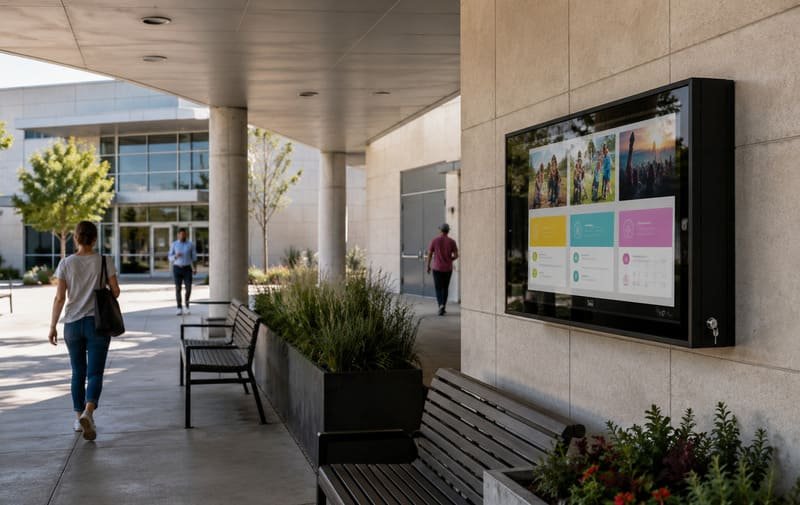
This is where site photos help more than product descriptions.
- A photo shows where people stand.
- It shows where rain comes from.
- It shows whether the wall is exposed to sun.
- It shows if the TV is near a pool, gate, walkway, bar counter, or loading area.
- It shows whether staff can reach the lock safely.
- It shows whether cables are exposed.
A public TV should not be specified from screen size alone.
Public-Space Site Type Matrix
| Site Type | Main Risk | Protection Priority |
|---|---|---|
| School Courtyard | Touching, tampering, repeated contact | Lockable access, protected cables, front shield |
| Prison / Institutional Common Area | Controlled access, impact, tampering | Tamper-resistant design, staff-only access, secure mount |
| Hotel Pool Area | Splash, guest contact, humid air, appearance | Front shield, corrosion-aware hardware, clean profile |
| Transport / Station Area | Dust, vibration, public access, long runtime | Secure mounting, cable protection, service access |
| Outdoor Bar / Public Terrace | Water, crowd contact, after-hours access | Lock, front shield, airflow, cable control |
| Factory / Warehouse Entrance | Dust, tools, carts, impact | Impact shield, strong mount, vent cleaning |
| Coastal Public Venue | Salt air, humidity, wind-driven rain | Polycarbonate body, corrosion-aware hardware, inspection |
| Outdoor Advertising Point | Unattended exposure, cable access, weather | Lockable shell, sealed exits, service recovery plan |
This table changes the discussion.
Instead of asking only “what size enclosure,” the buyer can ask:
- What is the dominant risk here?
- What is the secondary risk?
- Who maintains the unit?
- How often should it be inspected?
- What happens if the TV fails?
That is how a public-space protection plan becomes practical.
What Can an Enclosure Realistically Do Against Water and Heat?
An enclosure can help reduce water and dust exposure, but it should not be treated as a magic weather shield. Heat, condensation, cable exits, installation angle, and maintenance still matter.
A well-designed outdoor TV enclosure can reduce direct exposure to rain, splash, dust, and insects. It can also support fan-assisted airflow to reduce heat buildup. But IP rating and fans have limits. The enclosure still needs correct cable routing, gasket compression, shade planning, vent cleaning, and periodic inspection.
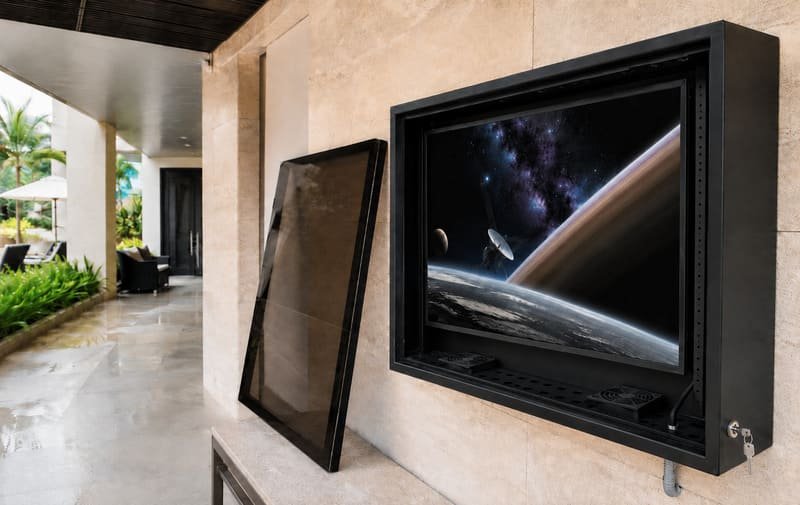
Water protection usually starts with the enclosure body and front panel, but the weak points are often smaller details.
- Cable exits.
- Door seals.
- Fan vents.
- Mounting holes.
- Wall interface.
- Gasket pressure.
- Maintenance after opening.
If those details are weak, the headline rating is not enough.
Heat is similar. A sealed enclosure may reduce rain exposure, but if air cannot move around the TV, heat can build up. Sony advises using TVs within a temperature range of 0°C to 40°C / 32°F to 104°F and avoiding direct sunlight. Sony TV temperature guidance
A fan-assisted enclosure can help move warm air away from the TV, but it is not air conditioning. Shade, wall temperature, internal clearance, operating hours, fan cleaning, and the TV manufacturer’s guidance still matter.
For coastal or poolside sites, hardware needs extra attention. Salt air and high humidity can accelerate corrosion of exposed or untreated metal parts, especially screws, fasteners, brackets, locks, hinges, and mounting hardware. FEMA guidance on coastal construction notes that salt accumulation and high humidity can accelerate corrosion of untreated steel connectors and fasteners. FEMA coastal corrosion guidance
Water and Heat Protection Checklist
| Check | Why It Matters |
|---|---|
| IP Rating | Gives a defined dust and water intrusion baseline |
| Cable Exits | Common weak point after installation |
| Gasket Compression | Helps maintain sealing after opening and closing |
| Fan Airflow Path | Helps reduce stagnant warm air |
| Internal Clearance | Gives heat room to move around the TV |
| Sun Direction | Direct sun can increase heat and glare |
| Hardware Material | Coastal or humid sites can attack metal parts |
| Inspection Routine | Keeps vents, seals, locks, and cable areas working |
In my experience, the best public-space installations do not rely on one feature. They combine enclosure sealing, airflow, placement, hardware choice, and inspection.
What Can It Realistically Do Against Theft and Tampering?
A public-space TV enclosure can reduce casual access and make unauthorized removal harder, but it should never be described as theft-proof or vandal-proof.
A lockable enclosure adds friction. It can make casual opening, cable pulling, and opportunistic removal harder. A front shield can reduce direct screen contact. But no enclosure should be described as impossible to break, impossible to open, or guaranteed against deliberate vandalism. Site placement, lighting, supervision, mounting, and staff routines still matter.
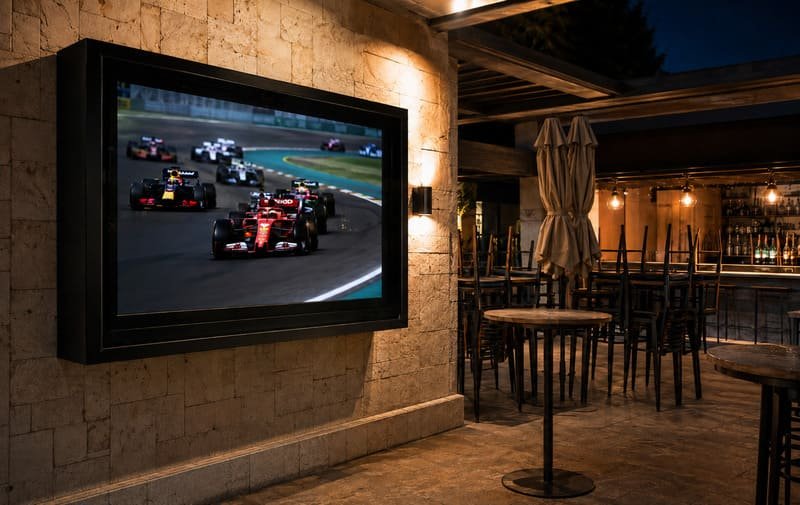
This is where honest language is important.
- A lock is not a full security plan.
- A front panel is not a promise against every impact.
- A strong mount is not a guarantee against every attempt.
- An enclosure is not a security vault.
Its realistic role is to reduce casual interference and make access less convenient.
The UK National Protective Security Authority describes protective security principles such as deter, detect, delay, mitigate, and respond as part of asset protection thinking. NPSA Protecting Your Assets
For public-space TVs, I translate that into a practical rule:
The enclosure should make the TV less exposed, harder to access casually, easier for staff to control, and easier to recover if something still happens.
Realistic Protection Limits
| Claim to Avoid | Better Wording |
|---|---|
| Theft-proof | Helps reduce opportunistic removal risk |
| Vandal-proof | Helps reduce casual impact and tampering risk |
| Waterproof forever | IP-rated under defined conditions |
| Corrosion-proof | Body may not rust like steel; hardware still needs inspection |
| Impact-proof | Helps reduce direct screen contact; not unbreakable |
| Maintenance-free | Service access and inspection still matter |
| Works anywhere | Must match the site, climate, access risk, and installation |
Polycarbonate can be useful for front protection because it combines transparency and impact resistance. Covestro describes Makrolon polycarbonate as robust, lightweight, glass-like in transparency, and impact resistant even at low temperatures. Covestro Makrolon polycarbonate
But material name alone is not enough. Actual performance depends on thickness, coating, UV stability, optical quality, mounting structure, frame support, and the force involved.
The goal is not to promise zero damage.
The goal is to reduce the number of easy failure paths.
What Should Buyers Check Before Installation?
The best time to solve public-space TV protection problems is before installation. Once the screen is on the wall, weak placement, exposed cables, poor service access, and wrong material choices become harder to fix.
Before installing a TV in a public space, buyers should check water direction, sun exposure, who can reach the screen, what can hit it, cable exit position, lock access, mounting strength, corrosion risk, fan clearance, service space, and replacement workflow.
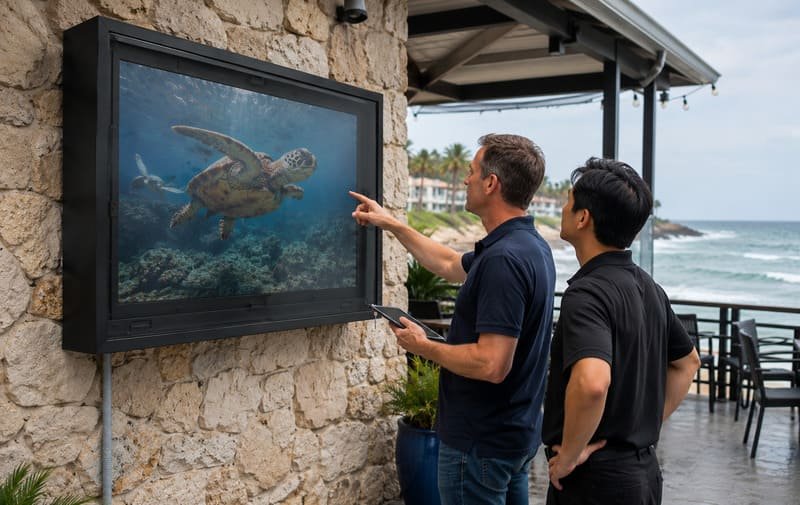
When I review a public-space TV project, I prefer to receive site photos before final configuration.
Photos show things that a specification sheet cannot show.
- They show the walkway.
- They show the roof edge.
- They show the pool area.
- They show the mounting wall.
- They show whether people can touch the screen.
- They show whether cables can be pulled.
- They show if staff can open the enclosure safely.
- They show whether the TV is in sun, shade, dust, salt air, or rain.
For cost planning, I also want buyers to think beyond the first screen. CIPS defines Total Cost of Ownership as an end-to-end view that includes purchase price, acquisition cost, usage cost, and end-of-life cost. CIPS Total Cost of Ownership
For public-space TVs, the real cost of a failure is not only the screen. It can include service access, emergency replacement, wall or mount repair, cable repair, staff time, and downtime.
Public-Space TV Installation Checklist
| Check | What to Confirm | Why It Matters |
|---|---|---|
| Water Direction | Rain, roof-edge drip, splash, cleaning water | Helps choose placement and sealing |
| Sun and Heat | Direct sun, hot wall, long runtime | Affects airflow and TV temperature risk |
| Public Reach | Can guests, students, workers, or visitors touch it? | Determines height, lock, front protection |
| Impact Path | Chairs, carts, tools, balls, doors, bags | Determines front shield and mounting position |
| Cable Exits | Power, HDMI, network, media player | Prevents weak points and cable pulling |
| Lock Access | Who controls the key and service routine? | Reduces unauthorized opening |
| Mounting Surface | Wall strength, bracket, vibration, anchors | Supports safety and long-term stability |
| Corrosion Exposure | Coastal, poolside, humid, cleaning chemicals nearby | Guides material and hardware choices |
| Fan Clearance | Intake and exhaust paths remain clear | Supports heat management |
| Service Recovery | Can the TV be reset, cleaned, removed, or replaced? | Reduces downtime after a problem |
A good public-space TV protection plan is not only about preventing damage.
It is also about making maintenance possible.
When Does a Commercial Enclosure Make Sense?
A commercial enclosure makes the most sense when the TV needs to stay in a public or semi-public space for a long period and the buyer wants to control weather, access, impact, and service risk together.
A commercial enclosure is useful when the TV must stay installed in a public space, face outdoor or semi-outdoor exposure, resist casual contact, protect cables, allow staff-only access, and remain serviceable over time. It is not always the cheapest first purchase, but it can reduce practical risk in the right environment.
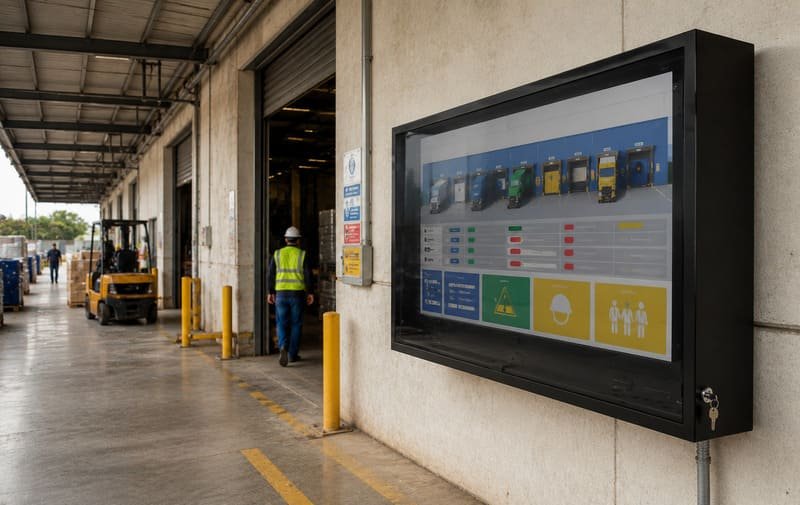
I do not recommend using an enclosure as a universal answer for every TV.
If the screen is temporary, indoors, supervised, and low-risk, a simpler setup may be enough. If the screen is a full-sun premium display, a dedicated outdoor commercial display may make more sense.
But if the TV is in a public or semi-public place, and the buyer wants to use a standard TV with stronger physical and environmental protection, then a commercial enclosure becomes worth reviewing.
When to Review a Commercial Enclosure
| Situation | Why an Enclosure May Help |
|---|---|
| Outdoor or semi-outdoor public screen | Helps reduce water, dust, and access risk |
| School, campus, or institutional area | Helps protect ports, cables, and front screen |
| Hotel pool or resort area | Helps manage splash, guest contact, and appearance |
| Warehouse or factory entrance | Helps reduce dust and accidental contact |
| Restaurant terrace or outdoor bar | Helps with rain, crowd contact, and after-hours access |
| Coastal or humid public venue | PC body and hardware review can reduce corrosion pathways |
| Multi-screen public project | Standardized enclosures can simplify service and replacement |
The key is matching the enclosure to the site.
Not every site needs the same specification.
Not every TV needs the same protection.
Not every enclosure solves the same problem.
The best result comes from matching the triangle: environment, access, and recovery.
Frequently Asked Questions
Is IP65 enough for a public-space TV?
IP65 can be a useful baseline for dust and water-jet protection under defined test conditions. But public-space TVs also face access, impact, tampering, heat, cable exposure, service needs, and hardware corrosion. IP65 is not the whole protection plan.
Can an enclosure stop theft completely?
No. An enclosure should not be described as theft-proof. A lockable enclosure can add friction and reduce opportunistic removal or casual access, but site security, mounting strength, lighting, supervision, and staff routines still matter.
Can a TV enclosure prevent vandalism?
It can help reduce casual impact and tampering risk, but it cannot guarantee protection against deliberate sustained damage. Avoid “vandal-proof” language unless supported by specific tested standards and site conditions.
What is the difference between public-space and private patio protection?
A private patio TV is usually supervised by the owner and used in a controlled setting. A public-space TV may be touched by strangers, cleaned by staff, exposed after hours, and serviced by different people. That means access control and service recovery matter more.
Can I use a standard indoor TV inside a public-space enclosure?
Yes, in some projects, if the TV fits the enclosure, airflow is planned, cables are protected, and the site risk is suitable. The enclosure does not change the TV manufacturer’s original outdoor-use rating or warranty terms.
What matters most in coastal or poolside public spaces?
Material and hardware details matter. A polycarbonate body does not rust like steel, but locks, hinges, screws, anchors, cable exits, and wall mounts still need corrosion-resistant design and inspection. Splash, humidity, cleaning routines, and service access should also be reviewed.
How often should public-space TV enclosures be inspected?
Inspection frequency depends on exposure. High-traffic, coastal, poolside, dusty, or outdoor locations should be checked more often. Inspect front panel condition, locks, hinges, screws, cable exits, gaskets, fan vents, and mounting hardware.
What information should I send before requesting a quote?
Send the TV size and model, full TV dimensions, VESA pattern, installation photos, location type, exposure level, public access level, cable direction, operating hours, and whether the site is coastal, poolside, dusty, hot, or high-traffic.
Conclusion
Protecting a public-space TV is not the same as protecting a private patio screen.
A public TV sits inside a risk triangle.
The environment can reach it.
People can reach it.
Staff still need to service it.
That is why the best protection plan is not built around one word like “waterproof,” “anti-theft,” or “vandal-proof.”
It should answer three practical questions:
What can the environment do to the TV?
Who can access or damage the screen?
How will the site recover if something still goes wrong?
A good enclosure can help reduce water exposure, protect cable paths, add lockable access, reduce direct screen contact, and keep service possible. But it should be described realistically.
It is not a vault.
It is not maintenance-free.
It is not a guarantee against every deliberate attack.
It is a controlled protection layer for a screen that has to survive in a public or semi-public environment.
For public-space TV projects, that is the real goal: not perfect protection, but better risk control before installation, during daily use, and after the first service problem appears.