

To maintain a competitive edge, modern hotels and resorts must provide premium outdoor entertainment experiences across expansive footprint areas, including pool decks, private cabanas, and al fresco dining patios. However, scaling an outdoor audiovisual (AV) network across dozens of endpoints creates a complex matrix of financial and operational challenges. Exposing standard commercial displays to environmental stressors ensures rapid hardware degradation, while purchasing specialized, all-in-one outdoor televisions at fleet volume requires a very large initial capital commitment and can complicate long-term maintenance.
To reduce these enterprise risks and stabilize the Total Cost of Ownership (TCO), procurement teams and chief engineers should adopt a hardware decoupling strategy utilizing IP65-rated enclosures paired with standard commercial displays. This guide is focused on outdoor common-area deployments rather than in-room guest TV systems.
In the hospitality sector, technology must support the guest experience without becoming a constant operational liability. When outfitting public spaces, the focus must shift from purchasing single units to managing a fleet. This requires a rigorous evaluation of initial Capital Expenditure (CapEx), ongoing Operational Expenditure (OpEx), and the agility of the engineering team to resolve issues quickly.
How we evaluate enterprise hotel TV deployments at Outvion:
- TCO modeling (Total Cost of Ownership) across CapEx and OpEx
- Fleet serviceability and minimizing amenity downtime
- IP65 protection against chlorine moisture, spilled beverages, and weather
- Physical security and tamper deterrence in high-traffic public zones
Last Updated: Mar 14th. 2026 | Estimated Reading Time: 8 Minutes
By Smith Chen, Outdoor TV Enclosure Engineer at Outvion
The Procurement Trap: All-In-One vs. Decoupling
Purchasing dedicated outdoor TVs at scale creates an unsustainable Capital Expenditure (CapEx). The decoupling strategy separates the weatherproof infrastructure from the digital display, drastically reducing initial costs and future replacement burdens.
When outfitting a new property or executing a large-scale renovation, procurement directors frequently solicit quotes for dedicated “outdoor televisions.” These specialized units integrate the LCD panel directly into a heavy, weatherproof chassis. While functionally sound, deploying these units at an enterprise scale presents significant financial vulnerabilities that impact the property’s bottom line.
The Fleet CapEx Burden
The initial procurement phase is often where budgets are derailed.
-
The Cost of Specialization: A high-brightness, dedicated 55-inch outdoor television routinely costs thousands of dollars. Equipping a 20-cabana pool deck with these units represents a massive baseline hardware CapEx.
-
Budget Strain: This substantial upfront commitment drains development budgets, often forcing properties to compromise on other guest amenities or reduce the total number of screens deployed, which diminishes the overall guest experience.
The 5-Year Hardware Refresh Cycle
The most critical flaw of the all-in-one approach becomes apparent during the standard hospitality hardware refresh cycle. In the hotel industry, electronics endure continuous, heavy use. Properties typically plan to refresh commercial displays every five to seven years to keep pace with resolution standards (like the shift from 1080p to 4K) and processing requirements.
-
The Replacement Penalty: When the digital display panel or internal processor of an all-in-one unit fails or becomes obsolete, the hotel cannot simply replace the screen. The entire expensive unit, including the still-functional weatherproof chassis, must be discarded.
-
Unsustainable OpEx: This forces the property to repeatedly incur high capital costs just to maintain the baseline amenity, destroying the long-term ROI of the outdoor space.
The Decoupling Strategy Advantage
The engineered alternative is the hardware decoupling strategy. By separating the protective infrastructure from the digital display, procurement teams regain total control over their AV budgets. The strategy involves purchasing a permanent, heavy-duty IP65 enclosure and mounting a standard commercial indoor display within it.
-
Financial Restructuring: This approach can be significantly lower in a typical 50–55″ fleet scenario compared to buying dedicated outdoor models.
-
Isolating the Consumable: Under this strategy, the Outvion enclosure becomes a long-term architectural asset. The internal commercial display becomes a manageable, swappable consumable. When the internal screen reaches the end of its lifecycle, the property only incurs the cost of replacing the standard commercial display.
Fleet Procurement Financial Modeling (Illustrative 20-unit example using 50–55″ endpoints)
| Financial Metric | Dedicated Outdoor TVs (All-in-One) | Decoupling Strategy (Enclosure + Commercial TV) |
| Initial Hardware (Per Unit) | ~$3,000+ | Enclosure (mid/high-$400s) + Display (example $400-$600) |
| Total Initial CapEx (Fleet of 20) | ~$60,000+ | ~$18,000 – $22,000 |
| Replacement Strategy | Discard and replace entire heavy unit | Retain enclosure; swap internal display only |
| Replacement Cost (Per Incident) | ~$3,000+ | Example $400 – $600 |
| Long-Term TCO Profile | Very High (Unsustainable refresh cycle) | Optimized / Predictable OpEx |
Defending Against Hospitality Environmental Stressors
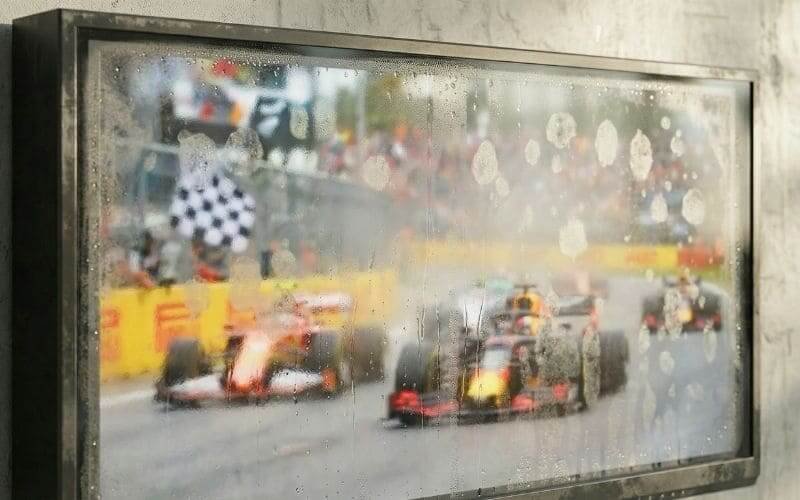
Hotel outdoor displays face unique threats, including vaporized pool chlorine, spilled food, and daily housekeeping washdowns. An IP65 enclosure acts as a sealed physical barrier that helps isolate the electronics from these corrosive elements.
The environmental profile of a luxury resort differs significantly from a standard residential patio. Hotel hardware must survive relentless, high-traffic commercial use and specific chemical exposures that accelerate hardware degradation.
The Poolside Threat (Chlorine & Condensation)
Commercial pool decks are some of the most hostile environments for sensitive electronics.
-
Chemical Humidity: Large heated pools and hot tubs generate massive volumes of humidity mixed with aerosolized chlorine and pool chemicals.
-
The Condensation Cycle: When this humid, chlorinated air is drawn into the passive ventilation slots of a standard commercial display, the moisture condenses onto the internal printed circuit boards (PCBs) as the ambient temperature drops at night.
-
Hardware Degradation: This introduces conductive electrolytes directly to the electrical pathways, accelerating corrosion and increasing the risk of premature board failure.
The Patio Threat (Spills & Residue)
In al fresco dining areas, swim-up bars, and busy patios, hardware is constantly exposed to accidental guest interactions.
-
Liquid Hazards: Displays are vulnerable to spilled cocktails, sugary sodas, and food debris. If a sticky beverage permeates the bezel of a standard display, it creates a conductive film that inevitably causes a short circuit and attracts pests.
-
The Polycarbonate Defense: The optical-grade polycarbonate front shield of an Outvion enclosure helps keep liquids on the exterior surface under proper installation, preventing accidental spills from reaching the commercial display inside.
Standardizing Housekeeping Washdowns
Maintaining rigorous cleanliness standards is non-negotiable for premium hospitality brands.
-
Sanitation Protocols: Daily patio sanitation often involves low-pressure hoses, damp cloths, and surface cleaners to remove pollen, spilled food, and fingerprints.
-
IP65 Integration: The IP65 rating signifies that the enclosure is evaluated to protect against dust and low-pressure water jets. This allows the hotel’s housekeeping or facilities team to safely wipe down or gently rinse the exterior of the AV equipment during routine area cleaning, without requiring delicate handling or risking water ingress into the high-voltage electronics.
Theft, Tampering, and Liability in Public Zones
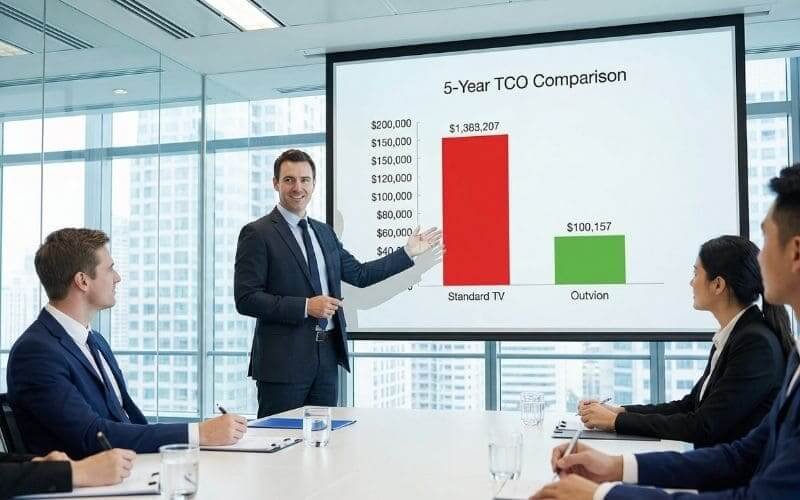
Displays in public hotel spaces are vulnerable to opportunistic theft and unauthorized guest tampering. Engineered enclosures mitigate this by utilizing concealed mounting hardware and optional keyed locks, allowing properties to significantly limit direct physical access to ports and controls.
Deploying consumer or commercial electronics in unsecured, high-traffic public zones introduces immediate operational liabilities. Hardware must be protected not just from the weather, but from the guests themselves.
Mitigating Opportunistic Theft
A standard television mounted on a basic wall bracket presents a tempting target for opportunistic theft, particularly in sprawling resort layouts where continuous security monitoring of every endpoint is impossible.
-
Concealed Infrastructure: The Outvion enclosure design inherently helps deter theft. The heavy-gauge steel rear backplane is bolted directly to the facility’s architecture.
-
Restricting Removal: Because the television is secured to internal VESA rails within the casing, a potential thief cannot access the structural mounting hardware or easily detach the unit from the wall when the optional locks are engaged.
Beyond theft, a primary frustration for hotel IT departments is unauthorized guest tampering, which disrupts the digital ecosystem of the property.
-
The Vulnerability: Without a physical barrier, guests frequently attempt to unplug HDMI, optical, or network cables to connect their own personal gaming consoles, streaming sticks, or laptops.
-
The Operational Cost: This disrupts the hotel’s carefully configured digital signage network or centralized IPTV broadcasting. When the next guest arrives, the TV displays a “No Signal” error, requiring the hotel to dispatch an IT technician or engineer to manually restore the correct inputs, costing the hotel valuable labor hours.
-
Access Control: By deploying enclosures equipped with optional keyed lock configurations, the property can significantly limit direct physical access to ports and controls. The physical configuration remains exactly as the hotel engineering team established it, ensuring consistent content delivery and eliminating nuisance service calls.
Scaling Thermal Management for Resort Climates
A completely sealed box creates a thermal trap. To prevent fleet-wide component failure, hotter or more sun-exposed resort installations require ventilated versions sized to the heat load to actively remove waste heat from the enclosure cavity.
While sealing an enclosure resolves moisture and tampering vulnerabilities, it introduces a critical thermodynamic challenge that must be addressed during the procurement and installation planning phase.
The Greenhouse Effect in Commercial Spaces
Operating commercial displays generate significant internal waste heat from their power supplies and high-brightness LED backlights.
-
Thermal Accumulation: If this heat is trapped within a sealed polycarbonate and steel box, the internal ambient temperature will quickly rise.
-
Solar Strain: This thermal strain is compounded by solar loading. Dark enclosure surfaces mounted in direct sunlight absorb solar radiation, drastically increasing the internal heat volume. A passive, unventilated box deployed on a sun-drenched pool deck will inevitably cause the internal display to experience thermal strain, darkening, or failure.
Active Fan Airflow Mechanics
To maintain safe operating parameters across a diverse fleet of locations, precise thermal management is required.
-
Evaluating the Fleet: In shaded, lower-heat installations (like deep covered dining patios), lighter-duty configurations may be sufficient. However, hotter or more sun-exposed sites should favor ventilated Pro or Ultra versions.
-
Sizing the Airflow: The cooling capacity must scale with the physical volume of the enclosure. In the current Outvion line, ventilated configurations use 2 fans for 28–55″ models and 4 fans for 60″+ models.
-
Stabilizing the Micro-Climate: Ventilated versions use active fan airflow that helps remove waste heat from the enclosure cavity, drawing cooler ambient air in and exhausting the heated air out. This engineered airflow ensures reliable fleet performance even during peak seasonal temperatures.
Resort Micro-Climate Thermal Matrix
| Installation Location | Environmental Solar Exposure | Thermal Risk Level | Recommended Ventilation Approach |
| Fully Covered Dining Patio | Deeply shaded, indirect light | Low Risk | Lighter-duty configurations may be sufficient. |
| Semi-Open Cabana | Partial afternoon sun exposure | Moderate Risk | Ventilated configurations (2 fans for 28-55″ models). |
| Uncovered Pool Deck | Direct, intense solar radiation | High Risk | Ventilated Pro or Ultra versions (4 fans for 60″+ models). |
Standardizing Fleet Maintenance and SOPs
The primary operational advantage of the decoupling strategy is serviceability. If a display fails, the hotel engineering team can swap the internal commercial screen from their own inventory, substantially reducing amenity downtime and protecting rental revenue.
The true measure of an enterprise AV deployment is its maintainability. When a display inevitably fails during a busy holiday weekend, the speed of resolution directly impacts guest satisfaction scores and, in the case of rentable cabanas, direct revenue.
The Cost of Amenity Downtime
If a hotel rents a luxury pool cabana for $500 a day, the outdoor television is a core part of that premium expectation.
-
The RMA Bottleneck: If a property utilizes dedicated, all-in-one outdoor televisions, a failure triggers a complex Return Merchandise Authorization (RMA) process. The heavy unit must be uninstalled, crated, and shipped via freight back to the manufacturer.
-
Revenue Loss: This process routinely leaves a glaring blank space on the cabana wall for weeks, forcing the hotel to discount the cabana rental or issue guest compensation, resulting in direct revenue loss.
Implementing the Localized Swap Protocol
The decoupling strategy enables rapid, localized serviceability, empowering the on-site engineering team.
-
Inventory Management: The hotel engineering department simply maintains a small inventory of standardized, inexpensive commercial indoor displays on-site in their tech room.
-
The Repair Process: When an endpoint fails, a technician unlocks the enclosure, unbolts the failed screen from the internal VESA mount, and installs the replacement screen.
-
Maximized Uptime: The repair can usually be completed much faster because the enclosure remains installed and only the display is swapped. The amenity is fully restored before the next guest rotation, protecting the daily rental revenue.
Standardizing Installation Protocols
To ensure the fleet maintains its IP65 integrity over time, the initial installation Standard Operating Procedures (SOPs) must be rigorous and standardized across the property.
-
Cable Gland Sealing: The most critical failure point is cable routing. Technicians must be trained to properly utilize the enclosure’s compression glands or high-density foam blocks at the bottom cable exit points, ensuring a tight seal around the wire jackets.
-
Drip Loops: Furthermore, they must implement a “drip loop” on all exterior cabling to prevent water from traveling along the cord, utilizing gravity to force condensation to drip away from the enclosure chassis.
Maintenance SOP Comparison
| Maintenance Action | Dedicated Outdoor TVs (All-in-One) | Decoupled Enclosure Strategy |
| Issue Diagnosis | Requires specialized manufacturer support | Standard IT/AV troubleshooting |
| Hardware Replacement | Weeks of downtime for freight shipping | Fast (Local swap of internal screen) |
| Spare Parts Inventory | Impossible (Units are too expensive to stock) | Easy (Stock 1-2 affordable commercial displays) |
| Exterior Housekeeping | Variable (Depends on screen coating) | Safe for routine mild soap/water wipe downs |
Conclusion: A Sustainable AV Infrastructure
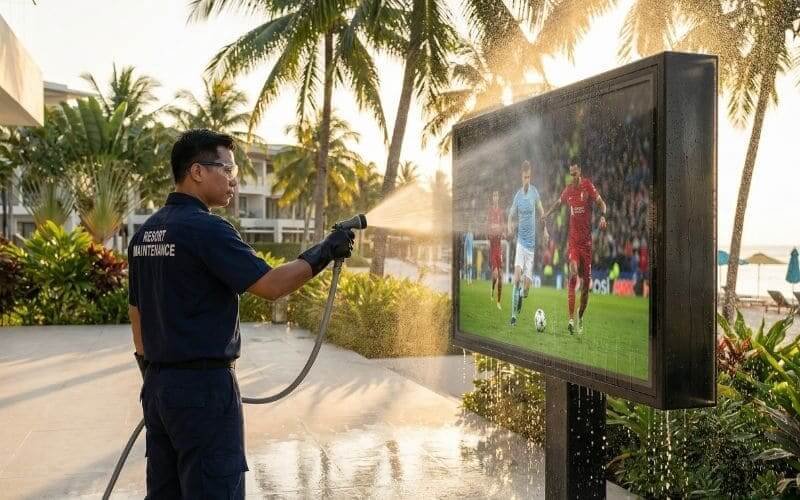
Equipping a luxury resort or hotel property with outdoor digital entertainment is a necessary step in modern hospitality design, but it must be executed with a rigorous focus on long-term sustainability and budget protection. Deploying unprotected commercial displays outdoors is a guaranteed path to hardware failure, while investing fleet-wide in specialized all-in-one outdoor televisions creates a severe Capital Expenditure burden and paralyzes maintenance efficiency.
True enterprise weatherproofing requires evaluating the Total Cost of Ownership across the entire lifecycle of the hardware. The decoupling strategy provides the necessary physical isolation—protecting against moisture, chemical vapors, and unauthorized tampering—while maintaining the operational agility required by modern hotel engineering teams.
By adopting an infrastructure-first approach, procurement directors can deploy scalable, resilient, and highly serviceable AV networks that protect the hotel’s bottom line and consistently deliver the premium experiences guests demand.
Hotel AV Procurement FAQ
1. Does this strategy support commercial digital signage displays?
Yes. The enclosures feature standard VESA mounting patterns on the internal steel backplane. This universal compatibility allows hotels to deploy high-brightness, 24/7 commercial displays, or standard consumer units, including hospitality-grade TVs that support systems such as Pro:Idiom, if the selected hospitality display supports those features.
2. How do we manage audio across a large pool deck?
The sealed nature of the IP65 enclosure inherently dampens the audio output from the television’s internal speakers. For large, open-air environments like a resort pool deck, relying on TV speakers is inadequate. Hotels should route the audio outputs from the display or the media player to a centralized 70V distributed outdoor speaker system. This ensures even, high-fidelity audio coverage across the entire amenity zone without creating localized noise complaints.
3. Are the enclosures difficult for housekeeping to clean?
No. The exterior of the enclosure, including the optical-grade polycarbonate front window, is designed for easy maintenance. Housekeeping staff can clean the unit using mild dish soap, warm water, and clean microfiber cloths to remove pollen, fingerprints, or beverage splashes. Harsh industrial solvents, ammonia-based glass cleaners, or abrasive scouring pads should be strictly avoided.
4. Can we use pneumatic air dusters to clean the enclosure?
Pneumatic air dusters or compressed air nozzles can be used to clear loose debris from the solid exterior surfaces of the enclosure. However, maintenance staff must be trained not to aim high-pressure air directly into the fan openings, air paths, or cable-exit seals. High-velocity air can overcome the mechanical seals or force particulate matter deep into the internal chassis.
Recommended Technical Reading & Resources
-
Ingress Protection Standards: IEC 60529: IP Ratings Explained
-
The official international standard defining the rigorous testing methodologies for evaluating protection against dust and water ingress.
-
-
Material Durability: Material Science of Polycarbonate (ScienceDirect)
-
Academic resources detailing the modulus of elasticity, UV resistance, and impact characteristics of engineering thermoplastics used in commercial protective barriers.
-