
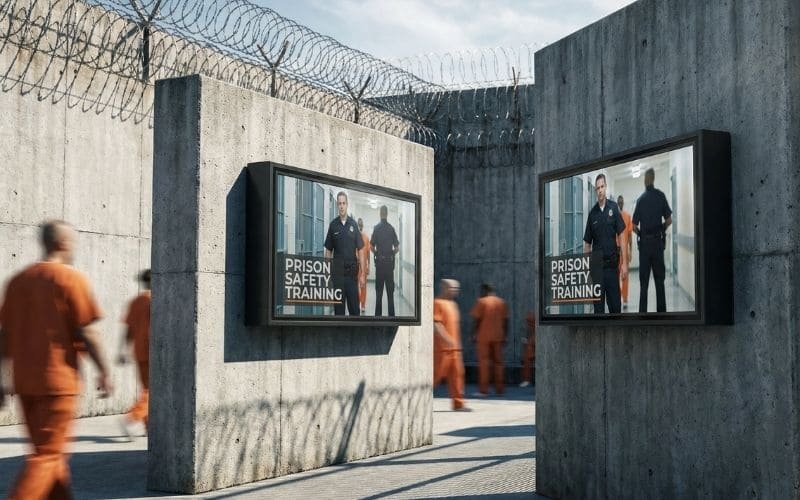
Deploying digital displays, educational monitors, and recreational televisions within correctional facilities and juvenile detention centers introduces extreme operational and safety risks. Placing unmodified commercial electronics in common dayrooms or cell blocks exposes the hardware to deliberate vandalism, tampering, and severe physical impacts.
In high-security institutional environments, standard commercial displays represent a critical safety hazard due to fragile glass components and exposed cavities. To mitigate these threats, facility administrators should utilize engineered IP65-rated enclosures equipped with heavy-duty polycarbonate front windows and secure locking mechanisms. This approach establishes a controlled protective barrier that helps reduce shattering, tampering, and liquid-related risks while protecting the hardware investment.
Standard consumer and commercial displays are engineered for benign, climate-controlled environments. They feature thin silicate glass, easily removable plastic bezels, and open ventilation slats. When deployed in a correctional setting, these delicate components become significant vulnerabilities. To maintain operational visibility, provide recreational programming, and protect institutional budgets, facility managers must implement professional protective infrastructure designed specifically for high-risk zones.
Scope Note: This guide focuses on vandal, tamper, fluid, and serviceability risks for correctional common areas and institutional dayrooms. Specialized anti-ligature psychiatric specifications (often required in behavioral health or strict mental health wards) involve different regulatory frameworks and should be evaluated separately.
How we evaluate correctional facility monitor protection at Outvion:
- Impact resistance and shatter-reduction capabilities
- Access control to prevent contraband concealment and tampering
- IP65 sealing compliance against thrown fluids and sanitation routines
- Secure, concealed mounting hardware to prevent unauthorized removal
Last Updated: Mar 11th. 2026 | Estimated Reading Time: 10 Minutes
By Smith Chen, Outdoor TV Enclosure Engineer at Outvion.
The Vandalism Risk: Mitigating Shattered Glass
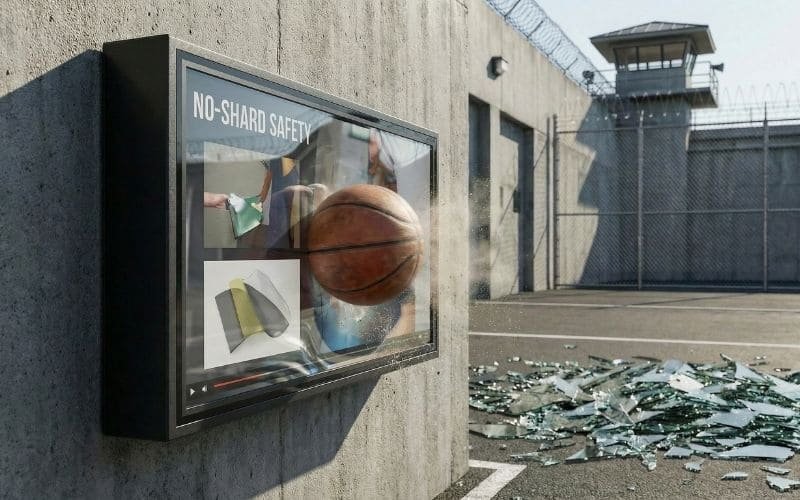
Standard display glass shatters under blunt force, creating dangerous fragments. Outvion enclosures utilize an optical-grade polycarbonate shield engineered to yield, flex, and absorb massive kinetic energy, acting as a critical sacrificial barrier to help prevent glass-related safety incidents.
The most immediate and severe threat of deploying televisions in a correctional dayroom is the physical fragility of the display screen itself. In environments where fights, riots, or targeted vandalism can erupt, the screen becomes a primary target for blunt force trauma using thrown objects or improvised tools.
The Reality of Standard Displays
The viewing surface of a standard television or monitor is constructed from silicate glass or basic rigid plastics.
-
Brittle Failure Mechanics: These standard materials possess a extremely low modulus of elasticity. When struck by a heavy, dense object, standard glass suffers catastrophic brittle failure because it cannot distribute the kinetic energy.
-
The Safety Hazard: In a correctional setting, a shattered television is not merely a broken asset; it is an immediate security crisis. The resulting glass fragments create a severe safety and security risk in institutional common areas.
-
Total Asset Loss: Once the glass fractures, the LCD or OLED panel behind it is irreparably destroyed, requiring the immediate removal of the unit and the dispatch of a cleanup team to clear the micro-shards from the common area.
The Polycarbonate Engineering Solution
To deploy screens safely in high-risk institutional zones, the physical barrier must be capable of surviving severe, deliberate blunt force trauma without fracturing into sharp pieces. Outvion addresses this kinetic risk by utilizing an optical-grade polycarbonate front window.
-
Extreme Ductility: Polycarbonate is an advanced thermoplastic polymer renowned in the security engineering community for its high impact resistance. Unlike silicate glass, the molecular structure of polycarbonate allows it to deform elastically under mechanical stress.
-
Kinetic Energy Dispersion: When a heavy object strikes the polycarbonate shield, the material flexes inward, absorbing the massive kinetic energy of the impact, and then rebounds. It effectively disburses the localized force across the wider surface area of the front shield.
-
The Sacrificial Layer Principle: In institutional security engineering, this polycarbonate window acts as a sacrificial protective layer. If a severe, sustained impact strikes the enclosure, the polycarbonate may suffer localized denting, deep scratching, or structural crazing (white stress lines).
-
Preserving Institutional Safety: Crucially, its primary engineering function is to avoid shattering into dangerous shards. By absorbing the destructive energy, the polycarbonate shield helps protect the delicate LCD panel housed safely behind it, maintaining the safety of the cell block.
Material Impact Risk Matrix
| Screen Material | Reaction to Severe Blunt Force | Institutional Suitability |
| Standard Silicate Glass | Shatters instantly upon impact into sharp fragments. | Unacceptable. High safety liability in common areas. |
| Standard Acrylic (Plexiglass) | More brittle than polycarbonate; may crack under severe deliberate impact. | Poor. Insufficient for targeted, deliberate vandalism. |
| Optical-Grade Polycarbonate | Flexes, yields, and absorbs kinetic energy; resists shattering. | Optimal. Acts as a safe, sacrificial protective barrier. |
Tamper Control and Contraband Concealment
Naked televisions provide numerous open cavities for individuals to hide illicit materials. Enclosures help mitigate this security breach by utilizing keyed side locks, concealed mounting hardware, and sealed cable exits to deny physical access to the display’s internal cavities and input ports.
Beyond physical violence, correctional facility administrators fight a constant battle against the circulation of contraband and the unauthorized modification of facility equipment.
The Vulnerability of Open Architecture
Standard commercial televisions are designed with open architecture. They feature wide passive ventilation slats on the rear chassis, exposed I/O (Input/Output) ports on the sides, and a gap between the wall and the mounting bracket.
-
The Concealment Problem: The open ventilation slats of a naked television provide a dark cavity to hide small packages or illicit materials.
-
Port Tampering: Exposed HDMI and USB ports allow individuals to potentially plug in unauthorized devices, attempt to alter the programming, or damage the television by jamming materials into the active ports.
-
Mounting Vulnerabilities: A standard, exposed VESA wall mount allows individuals to study the bracket mechanism, potentially attempting to unhook the heavy television during a disturbance.
Establishing Strict Access Control
By encasing the television within a locked Outvion enclosure, facility security teams establish strict physical access control over the electronic asset.
-
Sealed Cavities: An IP65-rated enclosure eliminates the exposed ventilation slats entirely. The TV is sealed within a smooth, locked box, removing the ability to slip items into the chassis.
-
Concealed Mounting Hardware: Security enclosures are designed to conceal their mounting points. The heavy-duty front bezel is secured to the wall-mounted backplane. Once locked, the internal mounting bolts that hold the entire unit to the concrete or masonry wall are inaccessible.
-
Keyed Locking Mechanisms: The system can be specified with anti-theft lock options and concealed mounting hardware. These keyed side locks ensure that only authorized correctional officers or facility maintenance staff can open the enclosure to access the television’s physical buttons, input ports, or internal cavity. This introduces a level of mechanical friction that severely delays and deters tampering attempts.
Liquid Isolation: Protection Against Thrown Fluids
In correctional settings, televisions are occasionally targeted with thrown liquids, including beverages and cleaning solutions. An IP65-rated enclosure provides a tight seal that protects the internal electronics from liquid damage and allows for rigorous, safe exterior sanitation.
While industrial facilities worry about rain or manufacturing washdowns, correctional facilities face a unique liquid threat profile where electronics may be intentionally targeted.
The Threat of Thrown Fluids
In high-tension environments, it is possible for individuals to throw liquids at electronic fixtures mounted on the walls.
-
The Hazards: These liquids can range from cups of water and sticky sugary beverages to institutional cleaning chemicals.
-
The Electrical Risk: If a thrown liquid strikes a naked television, it immediately seeps through the bezel gaps and ventilation slats. This liquid will coat the mainboard and power supply, rendering the unit inoperable and creating immediate reliability and sanitation problems.
-
The Sanitation Challenge: If a naked TV is struck by fluids, it is incredibly difficult to sanitize safely. The liquid enters the internal chassis, often forcing the complete disposal of the equipment due to the inability to clean the internal circuitry.
The IP65 Engineering Defense
To effectively protect displays from directed liquid assaults, the enclosure must meet strict engineering standards. For this use case, an IP65-rated enclosure is a strong practical target because it is dust-tight and resistant to low-pressure water jets under proper installation.
-
The Liquid Barrier: The “5” in the IP65 rating signifies that the enclosure has been tested to withstand directed water from a nozzle. In a correctional setting, this means that a cup of liquid thrown forcefully at the screen will strike the polycarbonate window and drip down the sealed exterior casing.
-
Cable Gland Sealing: This protection relies heavily on the proper installation of the bottom cable exit. Technicians must ensure that the provided compression glands are tightly secured around the power cables, preventing liquids from traveling up the cord and breaching the internal cavity.
Institutional Liquid Threat & Defense Matrix
| Liquid Threat Type | Risk to Naked Commercial TV | Enclosure Defense Strategy (IP65) |
| Thrown Beverages / Water | Immediate seepage; catastrophic short circuit of mainboard. | Repelled by sealed polycarbonate and steel casing. |
| Cleaning Solvents / Chemicals | May melt thin consumer plastics or corrode internal wiring. | Cleaning agents used on the exterior should still be compatible with polycarbonate and follow the enclosure care guidance. |
| Biological Hazards | Enters chassis; creates sanitation issues; usually requires disposal. | Kept entirely on the exterior shell; enables safe surface sanitation by maintenance staff. |
The Decoupling Strategy in Corrections (CapEx vs. OpEx)
Pairing a standard commercial display with a heavy-duty IP65 enclosure lowers initial CapEx and drastically simplifies future hardware replacements compared to purchasing specialized, all-in-one institutional detention televisions.
When outfitting a new cell block, dayroom, or recreation area, procurement directors must carefully evaluate the Total Cost of Ownership (TCO) of their AV assets. A common administrative decision is evaluating whether to purchase highly specialized, all-in-one “detention-grade” televisions or to utilize a decoupling strategy.
The Financial Burden of Specialized Hardware
While dedicated institutional televisions are robust, they present specific financial and logistical considerations for state and private facility budgets.
-
High Capital Expenditure (CapEx): Because these units are niche, low-volume products manufactured specifically for institutions, they often command a massive initial premium.
-
The Fused Hardware Trap: In these all-in-one units, the heavy-duty protective housing is permanently fused to the display panel.
-
Extended Downtime: If the internal screen is severely damaged, or if the logic board simply fails due to age, the facility often loses the entire expensive unit. Replacing it involves a procurement process that can leave the dayroom without programming for extended periods.
The Decoupling Advantage
The engineered alternative is the hardware decoupling strategy. By separating the protective infrastructure from the digital display, facility managers gain more control over their AV budget and maintenance timelines.
-
The Setup: The strategy involves purchasing a heavy-duty IP65 enclosure and mounting a standard commercial display inside of it. The enclosure acts as the rugged institutional barrier, allowing the commercial screen to function safely in a high-risk environment.
-
Financial Logic: For a 50–55″ setup, Outvion enclosure reference pricing typically starts in the mid-$400s for Basic configurations, with higher-spec Pro or Ultra versions designed for heavier thermal loads priced higher. When combined with a standard commercial display, the total deployment cost is often a fraction of the price of a dedicated institutional television.
-
OpEx Maintenance: When the commercial display inside the enclosure eventually requires replacement, the maintenance protocol is straightforward. The facility technician unlocks the enclosure, unbolts the failed display from the internal VESA mount, and installs a new commercial screen purchased locally. This shifts the ongoing maintenance from a high-cost CapEx replacement to a low-cost Operational Expenditure (OpEx), reducing replacement downtime because the heavy enclosure remains securely bolted to the concrete wall.
Correctional Display Deployment Options
| Deployment Strategy | Initial CapEx | Hardware Replacement Process | Uptime & Serviceability Impact |
| Naked Commercial TV | Low | Discard and replace entire unit upon failure. | Unacceptable security risk; constant replacements needed. |
| Dedicated Institutional TV | Very High | Lengthy procurement or expensive full unit replacement. | High disruption to programming during failure events. |
| Enclosure + Commercial TV | Moderate | Unlock enclosure, swap inexpensive internal screen locally. | High security; minimal disruption; enclosure remains mounted. |
Institutional Micro-Climates & Heat Load Management
Matching the enclosure’s ventilation to the specific thermal load of the institutional zone is critical. High-heat areas like unconditioned gymnasiums require fan-equipped versions sized to flush out waste heat and maintain safe operating temperatures.
A sealed IP65 enclosure successfully blocks external liquids and physical attacks, but it also traps the internal heat generated by the display. Without a thermal management strategy, the internal temperature of the enclosure can rapidly exceed the operational threshold of the display, causing premature hardware failure.
Evaluating Facility Micro-Climates
Correctional facilities contain vastly different micro-climates. A climate-controlled administrative wing operates differently than an unconditioned recreation area.
-
Low-Heat Zones: In lower-heat indoor zones, lighter-duty configurations may be sufficient, but hotter areas should favor ventilated versions.
-
High-Heat Zones: Unconditioned gymnasiums, older cell blocks without central air, or enclosures mounted in direct sunlight require active thermal management. Facilities with elevated thermal loads require fan-equipped versions sized for the thermal load.
-
Configuration Rules: In the current Outvion line, ventilated configurations use 2 fans for 28–60″ models and 4 fans for 65″+ models. These active ventilation systems continuously draw cooler ambient air into the enclosure and exhaust the heated air out using forced convection. By choosing a ventilated Pro or Ultra version for higher-heat zones, engineers help prevent thermal strain and prolong the life of the enclosed hardware.
Standard Operating Procedures (SOP) for Institutional AV
Maintaining hardware protection requires strict adherence to installation and cleaning protocols, specifically regarding secure masonry mounting, keyed access control, and using appropriate non-abrasive cleaners on the polycarbonate front window.
Deploying an IP65 enclosure provides a robust physical defense, but the integrity of that defense relies entirely on proper installation and routine institutional maintenance. Facility managers must establish strict Standard Operating Procedures (SOP) for the deployment and upkeep of AV hardware.
1. Secure Masonry Installation
In an institutional facility, the wall mount itself is a critical security point.
-
Anchoring: Technicians must utilize heavy-duty concrete masonry anchors (such as sleeve anchors or wedge anchors) to secure the enclosure’s backplane directly to the cinderblock or concrete walls of the dayroom.
-
Flush Mounting: The enclosure should be mounted as flush to the wall as possible to minimize leverage points where an individual could attempt to wedge a tool behind the unit.
2. Controlled Key Management
The security provided by the Outvion enclosure is highly dependent on controlling access to the locking mechanisms.
-
Protocol: Physical keys must be strictly managed by correctional officers or the head of facility maintenance. Keys should never be left on open desks or attached to highly accessible key rings.
-
Risk Mitigation: Establishing a strict sign-out log for enclosure keys ensures accountability and helps prevent unauthorized access to the internal hardware.
3. Safe Cleaning Protocols for Polycarbonate
The optical-grade polycarbonate window provides immense impact resistance, but it is susceptible to chemical hazing if treated with improper institutional cleaning solvents.
-
Prohibited Chemicals: Maintenance crews or inmate work details must never use harsh industrial solvents, bleach concentrates, ammonia-based glass cleaners, or heavy abrasive scrubbers on the clear front shield. These will degrade the material and cloud the optical clarity.
-
Approved Methods: Cleaning should be performed exclusively with mild, non-abrasive detergents, warm water, and clean microfiber cloths.
4. Routine Visual Inspections
Security personnel should incorporate the AV enclosures into their routine visual inspections.
-
Actionable Checks: Staff should physically verify that the side locks are fully engaged and have not been tampered with.
-
Barrier Integrity: The sacrificial polycarbonate layer should be inspected for deep gouging or severe crazing resulting from unrecorded vandalism. Identifying a compromised shield early allows management to evaluate if a replacement panel is needed before the structural integrity is fully breached.
Conclusion: Securing Assets and Personnel
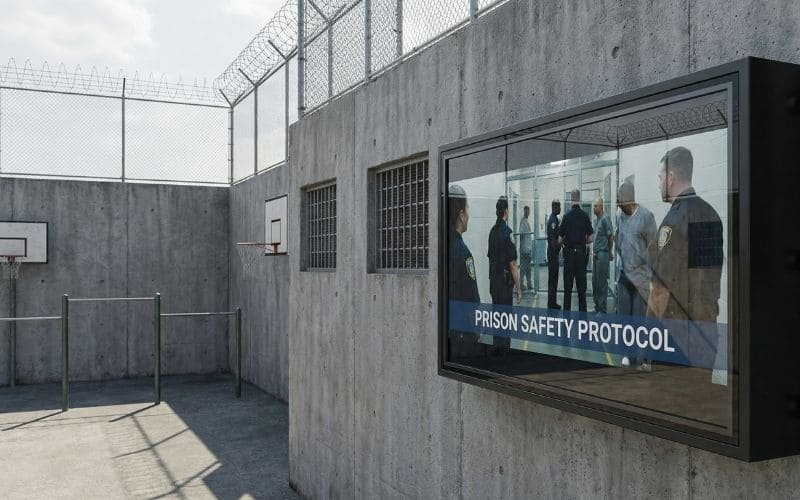
In the highly demanding environment of a correctional facility, providing reliable digital programming is often part of maintaining daily schedules and facility operations. However, deploying sensitive commercial displays without engineered protection guarantees rapid hardware destruction and introduces severe risks to the institutional population.
Relying on naked televisions is a critical safety failure, while purchasing specialized all-in-one institutional monitors can restrict budget flexibility. By utilizing the decoupling strategy with an IP65 polycarbonate enclosure, facility administrators achieve a practical balance of rugged physical security, environmental protection, and operational agility. Implementing this engineered barrier helps ensure that recreational programming remains manageable, hardware lifespans are extended, contraband concealment opportunities are reduced, and the overall safety of the facility common areas is supported.
In a correctional facility, safety is about minimizing variables. You cannot control the population perfectly. You cannot control the weather. But you can control the infrastructure.
Installing unprotected TVs is introducing a variable of weaponization. It is providing materials that can—and eventually will—be used against your staff or other inmates.
The Outvion Enclosure removes that variable. It converts a potential hazard into a secure, manageable asset. It allows you to provide the necessary distraction of television without compromising the security of the block. It fits the budget, it fits the safety protocols, and it survives the reality of the environment.
Correctional Display Protection FAQ
1. Does this replace detention-grade TVs?
Not necessarily. Dedicated detention TVs may still be preferred in certain facility standards or procurement frameworks, but pairing an enclosure with a commercial TV is often the more flexible and serviceable option where policy allows. Administrators should evaluate their specific departmental regulations before procurement.
2. Can the polycarbonate window be completely broken?
While optical-grade polycarbonate is exceptionally tough and designed to absorb massive kinetic energy, extreme, deliberate force with a heavy, manufactured tool can eventually scratch, craze, or crack the shield. However, it is engineered as a sacrificial layer; even if it cracks under severe abuse, it resists shattering into the sharp glass fragments associated with standard televisions.
3. How does the facility manage audio if the TV is inside a sealed box?
Because an enclosure is designed to seal out fluids and prevent tampering, it naturally muffles the sound produced by the television’s internal speakers. While sound will still transmit through the front window, it may be insufficient for a noisy dayroom. Facilities typically route the television’s audio output to secure, ceiling-mounted PA speakers or wall-mounted, vandal-resistant institutional speakers that are out of reach.
4. Can individuals plug USB drives or devices into the TV?
No, the enclosure is designed specifically to prevent this. The unit can be specified with keyed side locks that secure the front bezel. Once locked by facility management, individuals do not have direct physical access to the TV’s manual controls, HDMI ports, or USB inputs while the enclosure remains locked.
5. Will the enclosure protect against thrown bodily fluids?
Yes, under proper installation. The Outvion enclosure targets an IP65 rating, meaning it is resistant to low-pressure water jets and liquid splashes. If fluids are thrown at the screen, the sealed design helps isolate the internal television from direct exposure. Sanitation crews can then safely clean the exterior of the polycarbonate shell following approved guidelines.
Recommended Technical Reading & Resources
To further understand the security standards and material science discussed in this guide, we recommend reviewing the following authoritative resources:
-
Correctional Facility Design Standards: American Correctional Association (ACA) Standards
-
Review the national guidelines and best practices regarding the safe deployment of physical fixtures in institutional environments.
-
-
Ingress Protection (IP) Codes: IEC 60529: Degrees of Protection Provided by Enclosures
-
The official international standard defining the rigorous testing methodologies required to classify an enclosure as resistant to dust and thrown liquids.
-
-
Material Science of Polycarbonate: Polycarbonate vs. Acrylic Impact Properties (Curbell Plastics)
-
A technical breakdown explaining the modulus of elasticity and why polycarbonate yields and absorbs kinetic energy, making it the superior choice for high-impact security environments.
-