
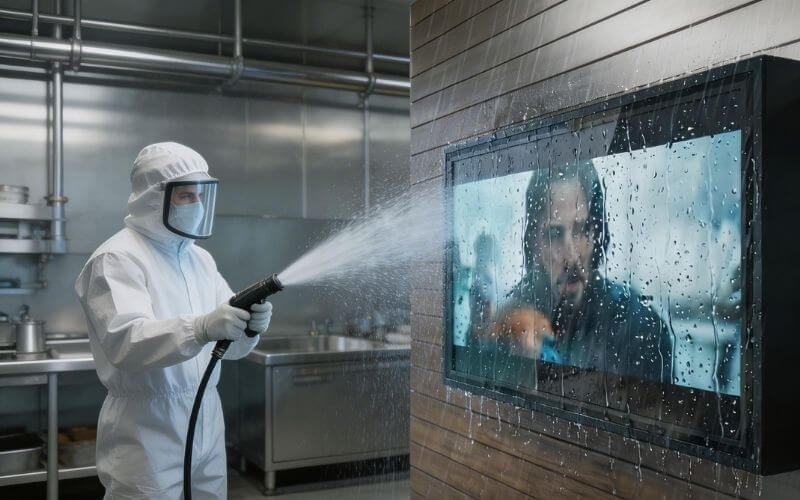
Walk onto the floor of any modern food manufacturing facility. Data is the lifeline of production. Overall Equipment Effectiveness (OEE) metrics, real-time yield rates, and digital Standard Operating Procedures (SOPs) must be visible to every operator on the line. But the environment is violently hostile to consumer electronics. The air is thick with flour, aerosolized sugar, and spices. Furthermore, there is the daily threat of high-pressure chemical washdowns required for sanitation. Standard monitors die in a week. More critically, a shattered glass screen over an open production line triggers catastrophic, million-dollar product recalls. How do you digitize the shop floor safely and affordably?
The safest, most cost-effective method to deploy digital signage in food manufacturing is using an Outvion IP65 Polycarbonate TV Enclosure paired with a standard commercial display. This engineered shell seals out microscopic conductive dust, withstands the routine low-pressure hose sanitation (washdowns) demanded by plant protocols, and utilizes a shatterproof polycarbonate shield to eliminate glass contamination risks. This approach reduces hardware Capital Expenditures (CapEx) by up to 70% compared to heavy, specialized NEMA industrial monitors.
In this engineering analysis, we explore a real-world bulk deployment at a cereal plant in Pennsylvania, dissect the physics of particulate-induced electronic failure, and detail how to navigate the strict “No-Glass” mandates of food safety regulations.
Last Updated: March. 6th. 2026 | Estimated Reading Time: 8 Minutes
The “Flour & Sugar” Threat: Why Standard Vents Kill Electronics
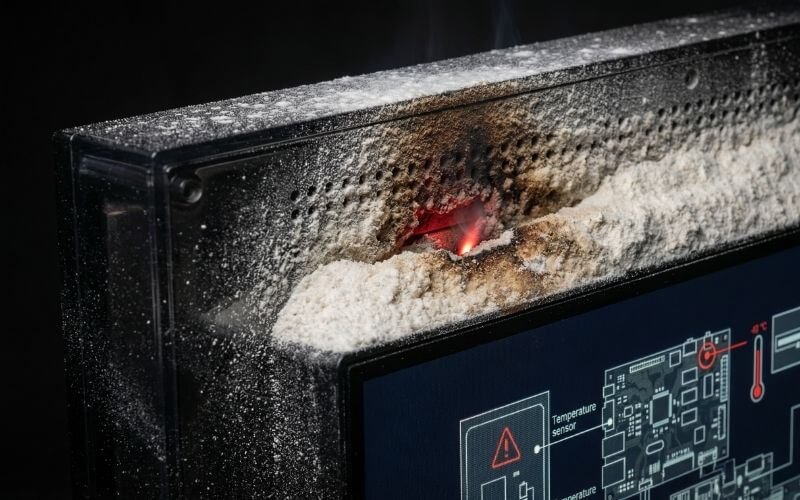
Standard displays use active venting, which pulls microscopic, conductive, and insulating food dust directly onto the motherboard, guaranteeing catastrophic thermal or electrical failure.
To the average consumer, dust is simply dirt that requires wiping. To an industrial IT or EHS manager in a food plant, organic dust is a lethal agent. The internal architecture of a standard commercial or consumer display relies on passive louvers or active fans that draw ambient air across internal heat sinks. In a clean office, this works perfectly. In a bakery or cereal plant, these vents function as vacuum cleaners, sucking the hazardous atmosphere directly into the chassis.
The Physics of Food Dust
The particulates generated in food processing possess unique, destructive properties.
- Sugar (Hygroscopic & Conductive): Sugar dust is highly hygroscopic; it actively pulls moisture from the humid plant air. When aerosolized sugar enters a display and settles on the warm Printed Circuit Board (PCB), it absorbs humidity and transforms into a sticky, conductive paste. This paste bridges the microscopic gaps between the legs of microprocessors and capacitors. As current flows, it creates immediate short circuits, often accompanied by an arc flash that fries the logic board instantly.
- Flour & Grain Dust (The Thermal Blanket): Flour and grain dust are extremely fine and possess excellent thermal insulating properties. As this dust is pulled into the display, it coats the aluminum heat sinks, the power supply unit, and the LED backlight array. It acts like a wool blanket wrapped around a space heater. The internal components lose their ability to shed heat via convection. The temperature spikes rapidly, leading to thermal runaway. The capacitors dry out, bulge, and fail, resulting in the “Black Screen of Death.”
- Spices (Corrosive Organics): Many spice dusts contain volatile oils and mild organic acids. When these settle on copper traces, they can induce slow, localized corrosion, degrading the solder joints over a matter of months.
The Engineering Fix: Physical Isolation
You cannot change the air in a food plant; you must isolate the electronics from it. Attempting to use “filter patches” over standard TV vents is a half-measure that quickly fails when the filters inevitably clog. The only permanent engineering cure is absolute physical isolation. An Outvion Enclosure provides a rigid, sealed boundary that eliminates the direct intrusion path entirely, ensuring the fragile screen operates in a clean-room microclimate while the exterior takes the abuse of the factory floor.
Particle Threat Matrix (Food Processing Effects on PCBs)
| Contaminant Type | Primary Processing Environment | Physical Property | Failure Mechanism on Electronics |
|---|---|---|---|
| Aerosolized Sugar | Confectionery, Cereal, Bakery | Hygroscopic / Sticky | Creates conductive paste leading to rapid short circuits. |
| Flour & Oat Dust | Milling, Baking, Cereal | Fine Particulate Insulator | Coats heat sinks, causing catastrophic thermal runaway. |
| Spice Dust | Meat Processing, Snacks | Organic Acids / Oils | Induces slow corrosion of copper traces and solder joints. |
| Fat/Oil Mist | Frying, Snack Foods | Viscous / Adhesive | Seizes cooling fans and acts as an adhesive for other dust. |
Decoding IP65 for Food Safety: Beyond Just “Waterproof”
In food processing, the term “water-resistant” is insufficient and dangerous. An IP65 certification guarantees the enclosure is “Dust Tight” (the 6) and can withstand the routine “Low-Pressure Water Jets” (the 5) required for daily sanitation Standard Operating Procedures (SOPs).
When sourcing hardware for the shop floor, procurement managers are bombarded with confusing terminology regarding weatherproofing. In the highly regulated food and beverage industry, vague marketing terms are unacceptable. We rely strictly on the IEC 60529 Standard, commonly known as the Ingress Protection (IP) rating system.
Breaking Down the IP65 Rating
The Outvion enclosure achieves an IP65 rating, which is the precise sweet spot for food manufacturing environments that do not require full high-pressure, high-temperature caustic washdowns (which would require IP69K stainless steel).
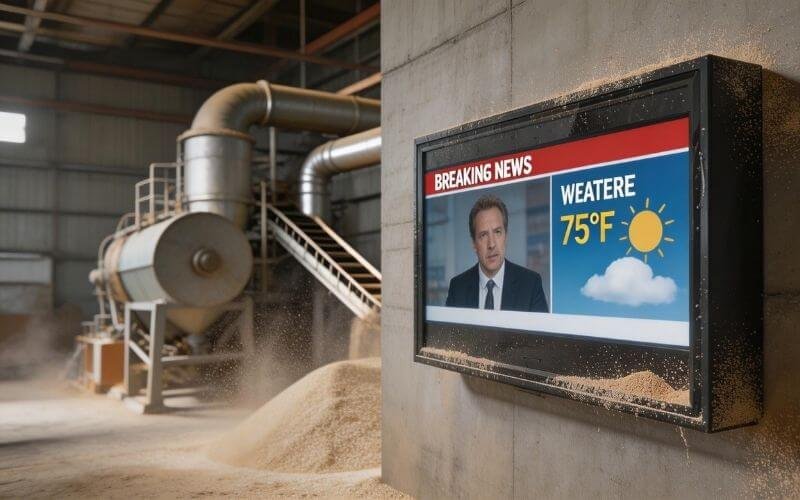
- The First Digit (6) – Dust Tight: This is the highest possible rating for solid particle protection. It signifies that a vacuum was applied to the enclosure, and testing proved that there is zero ingress of dust. In a facility processing fine powders like whey protein, flour, or powdered sugar, a “6” rating is mandatory. It guarantees that the internal display will remain surgically clean, preserving its designed thermal performance.
- The Second Digit (5) – Water Jets: This rating confirms protection against water projected by a nozzle (6.3 mm) against the enclosure from any direction. It means the unit can survive a direct hit from a hose.
The Sanitation Shift: Washdown-Ready Agility
In any food plant, production stops for sanitation. This daily or weekly washdown is critical for food safety, but it is also massive operational downtime. Historically, to protect non-rated screens during sanitation, staff had to manually wrap every display in plastic bags and tape them shut—a labor-intensive process that is often forgotten or done poorly, leading to ruined equipment and audit failures. With an Outvion IP65 enclosure, this step is eliminated. The sanitation crew can utilize their standard low-pressure hoses to wash down the walls, the structural beams, and the Outvion enclosures simultaneously. This accelerates the sanitation SOP, getting the line back to production faster.
Chemical Resistance
Water isn’t the only liquid used in sanitation. Facilities utilize harsh foaming agents, Quaternary Ammonium compounds (Quats), and diluted bleach solutions to kill listeria and salmonella. Outvion enclosures are constructed from High-Density Polycarbonate and ABS polymers. These industrial plastics are highly chemically resistant. Unlike powder-coated steel that will eventually pit and rust when exposed to sanitation chemicals, the polymer shell remains inert, allowing staff to foam and rinse the screens without fear of degradation.
Case Study: Standardizing 32-Inch KPI Displays at a Major PA Cereal Plant
A top-tier cereal manufacturer in Lancaster, PA, eliminated screen-related downtime by deploying a fleet of 32-inch Outvion enclosures, creating a zero-maintenance, low-cost digital SOP network right on the production line.
To understand the operational impact of this strategy, we must look at a real-world deployment. Between late 2024 and early 2025, a major cereal manufacturing facility located in Lancaster, Pennsylvania, faced a critical IT infrastructure challenge.
The Challenge: The Dust and the Data
The plant was undergoing a digital transformation, moving away from paper-based clipboards to real-time digital KPI (Key Performance Indicator) dashboards and digital SOPs. They needed screens mounted directly adjacent to the large industrial mixers and the high-heat baking lines. However, the ambient environment was thick with fine oat dust, powdered sugar, and cinnamon. Initially, the IT department deployed standard 32-inch commercial displays housed in cheap acrylic dust covers. Within three weeks, the covers warped from the radiant heat of the baking lines, and the fine sugar dust bypassed the poor seals, destroying six monitors in a single month. The line operators were left blind, and the IT team was constantly on the floor replacing hardware.
The Rollout Strategy
The facility’s EHS and IT directors collaborated and standardized on bulk orders of the 32-inch Outvion IP65 Enclosure.
- Why the 32-Inch Form Factor? In a dense manufacturing plant, real estate is premium. A massive 65-inch screen is unnecessary for a single operator station and poses a collision risk for forklifts. The 32-inch size is ergonomically perfect. It is large enough to display detailed OEE charts and readable text from 5 to 10 feet away, yet compact enough to be mounted on structural I-beams, narrow aisles, and end-of-line packaging stations without obstructing workflow or creating a hazard.
The Result: Install Once, Zero Maintenance
The IT team mounted standard $200 commercial displays inside the Outvion enclosures. They routed the power and ethernet lines through the sealed compression glands. The impact was immediate. The Outvion enclosures physically isolated the fragile commercial screens from the harsh cereal environment. Over the next 12 months, the plant reported 100% uptime for those production metrics. The sanitation team was able to hose down the areas without bagging the screens, and the IT team stopped fielding daily replacement tickets. They transformed a fragile digital initiative into a ruggedized, set-and-forget infrastructure.
The ROI of Real-Time OEE Visibility
It is important to quantify the financial impact of this hardware reliability. Before standardizing on the Outvion enclosures, when a naked screen failed due to sugar dust, the cereal line operators lost their real-time pacing metrics (target vs. actual output).
- The Blind Spot: Without visible digital SOPs and OEE dashboards, line efficiency typically dropped by 4% to 7% per shift as operators reverted to manual pacing and paper logs.
- The Financial Recovery: By ensuring 100% uptime of the KPI screens, the plant recovered that lost efficiency. In a facility producing thousands of pounds of cereal per hour, a 5% recovery in OEE translates to tens of thousands of dollars in reclaimed operational margin per week. The $440 investment per screen (Enclosure + TV) paid for itself in less than three days of continuous, data-driven production.
The “No-Glass” Mandate: Why Polycarbonate Prevents Recalls
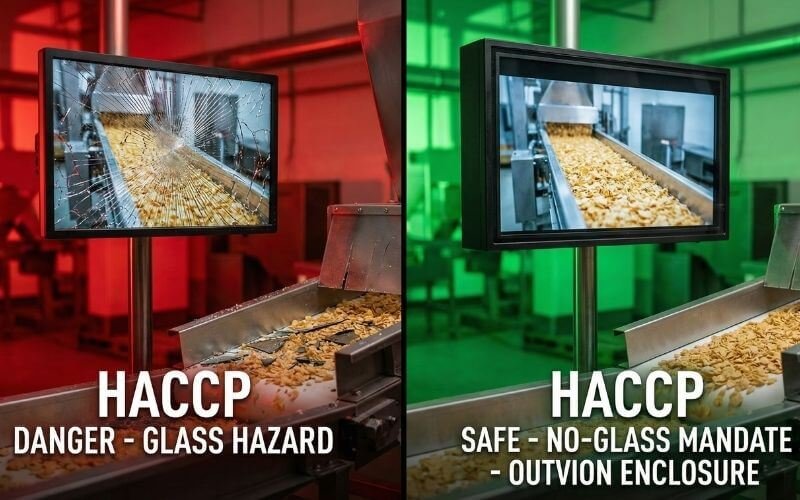
HACCP and FDA guidelines heavily restrict exposed glass over production lines. Outvion’s shatterproof polycarbonate shield provides the mandatory physical barrier to prevent catastrophic glass contamination, protecting both the consumer and the brand.
While dust and water destroy the television, glass destroys the food plant. In the realm of Environmental Health and Safety (EHS), the presence of brittle materials above or near open product zones is one of the highest critical risks a facility can face.
The Recall Nightmare
Under the Hazard Analysis Critical Control Point (HACCP) system, which governs food safety protocols mandated by the FDA and USDA, physical hazards must be identified and mitigated. Glass is classified as a severe physical hazard. Describe the horror scenario: You mount a standard commercial display near a conveyor belt transporting open boxes of cereal. A forklift driver slightly misjudges a turn, or a maintenance worker carrying a ladder swings it too wide. The ladder strikes the TV screen. The tempered or standard glass display shatters. Thousands of microscopic, invisible glass shards rain down into the open product below.
- The Consequence: The production line must be immediately halted. All product in the vicinity—potentially thousands of pounds of food—must be quarantined and destroyed. The entire line must be vacuumed and inspected. If the contamination is discovered after shipping, it triggers a catastrophic public recall, massive financial loss, and severe damage to brand reputation.
The Material Science of Prevention
This is why naked displays are increasingly banned from the shop floor. The Outvion enclosure solves this regulatory hurdle through advanced material science. The front viewing window of the enclosure is constructed from Optical-Grade Polycarbonate (PC).
- Shatterproof Design: Polycarbonate is an engineering thermoplastic that is hundreds of times stronger than standard display glass. It is the same material utilized in police riot shields, hockey rink glass, and machine guard doors.
- The Impact Response: If that same forklift or ladder strikes the Outvion enclosure, the polycarbonate shield yields. It flexes inward to absorb the kinetic energy. It may suffer a deep scratch or a dent, but it will never shatter into shards.
- The HACCP Compliance: By completely encasing the fragile glass TV screen behind a shatterproof barrier, the Outvion system effectively neutralizes the physical hazard. It protects the TV from the rigors of the factory, and crucially, it protects the food supply from the TV. It is a necessary investment in risk mitigation.
Thermal Management & Cable Routing in Sealed Wet Zones
Sealing out water requires specific engineering to manage internal heat and cable ingress. Outvion utilizes bottom-flow thermodynamics and compression cable glands to maintain the strict IP65 seal while ensuring the internal display does not overheat.
Creating a waterproof box is easy; creating a waterproof box that allows a high-powered electronic device to survive inside it is difficult. When you seal an enclosure to IP65 standards, you eliminate the natural convection that cools the display. If not engineered correctly, the unit becomes an oven. Furthermore, you must provide a way for power and data cables to enter the box without creating a leak point.
Heat Management: The Breathing Box
Outvion employs an active thermodynamic management system designed specifically for harsh environments.
- Internal Circulation: Even in highly sealed environments, the enclosure utilizes internal fans to aggressively circulate air within the chassis. This constant movement prevents localized “hot spots” from forming over the critical components of the TV (the power supply and processor).
- Heat Transfer: By pushing the warm internal air against the outer polymer shell of the enclosure, the system facilitates conductive heat transfer to the cooler external environment.
- Bottom-Facing Exhaust: If external venting is utilized, Outvion specifically designs the exhaust and intake ports on the bottom plane of the enclosure. This utilizes gravity as a defense mechanism. In a washdown scenario where water cascades down the walls and over the top of the unit, the water flows straight to the floor. The bottom-facing vents prevent water from being driven up and into the housing, maintaining the integrity of the internal cavity.
Cable Glands: Sealing the Achilles Heel
The weakest point of any waterproof installation is the cable entry. If you run a power cord through a simple hole in the plastic, water will follow the cable right into the box via surface tension.
- The Compression Seal: Outvion solves this using waterproof compression glands (cable grips). These are heavy-duty, threaded fittings located at the base of the unit.
- The Protocol: The IT technician runs the Ethernet (Cat6) and power cables through the loose gland. Once positioned, they tighten the outer nut. This compresses a rubber grommet tightly around the outer jacket of the cables, creating a watertight, 360-degree seal that grips the wire. This ensures that even if a high-pressure hose hits the bottom of the unit, the cable entry remains impenetrable.
Conduit Compatibility and NPT Standards
In heavily regulated washdown zones, cables cannot simply hang loose; they must be armored or routed through conduit. Outvion accommodates strict electrical codes by utilizing standard sizing for its entry points.
- The Integration: The bottom entry plate can be fitted with standard National Pipe Thread (NPT) connectors. This allows the plant’s electricians to run Liquid-Tight Flexible Metal Conduit (LFMC) directly into the base of the enclosure.
- The Full System Seal: This creates a continuous, watertight highway for the CAT6 ethernet and 120V power lines from the ceiling drop directly into the shielded microclimate of the enclosure, ensuring that high-pressure water jets have absolutely zero points of ingress along the entire cable run.
TCO Analysis: Enclosures vs. NEMA 4 Industrial Monitors
Deploying commodity screens inside Outvion IP65 enclosures reduces Total Cost of Ownership (TCO) by up to 70% compared to purchasing specialized, all-in-one NEMA 4 stainless steel industrial monitors, while offering vastly superior maintenance agility and upgrade paths.
When outfitting a food plant, procurement teams often default to searching for “Industrial NEMA 4 Monitors.” While these specialized stainless steel units are incredibly robust, they are also exorbitantly expensive and logistically inflexible. For general digital signage and KPI display, they represent massive over-spending.
The Price Gap Comparison
Let’s examine the Capital Expenditure (CapEx) required to deploy a single 32-inch display on the line.
- The Legacy Approach: A specialized 32-inch NEMA 4X stainless steel industrial monitor typically costs between
1,500and3,000. It is a single, heavy, proprietary unit. - The Outvion Strategy: A standard commercial 32-inch display from a local retailer costs roughly $200. The Outvion 32-inch enclosure costs roughly $240. The total combined cost is <$500.
You are achieving the necessary dust, water, and impact protection for one-third to one-sixth of the cost.
The “Hot-Swap” Advantage (Operational Agility) The true savings, however, are found in Operational Expenditure (OpEx) and maintenance agility. Electronics in a factory will eventually fail—whether from age, a massive power surge, or extreme physical damage.
- The NEMA 4 Nightmare: If your $2,500 industrial monitor breaks, you cannot fix it locally. You must initiate a Return Merchandise Authorization (RMA) process. You unbolt the heavy unit, ship it back to the manufacturer, and wait 3 to 6 weeks for a repair or replacement. During that entire month, your line operators have no visibility into their KPIs. Production efficiency drops.
- The Outvion Agility:If the $200 commercial screen inside an Outvion box dies, the solution is immediate. Your local IT technician drives to Best Buy or pulls a spare from the supply closet. They unlock the Outvion enclosure, pull out the dead screen, and drop in the new $200 screen. The line is back up and running in 15 minutes.
The Outvion enclosure acts as a permanent, rugged CapEx asset. The screen inside becomes a cheap, disposable OpEx commodity. This decoupling of the technology from the armor is the secret to scaling digital signage across a massive manufacturing footprint without destroying the IT budget.
TCO Breakdown: Specialized NEMA Monitor vs. Outvion Strategy (Per 32″ Unit)
| Cost Metric | Specialized NEMA 4 Monitor | Outvion Enclosure + Commercial Display |
|---|---|---|
| Initial Hardware Cost | ~$2,000 | ~$440 ($240 Box + $200 Screen) |
| Replacement Cost (Upon Failure) | ~$2,000 (Replace entire unit) | ~$200 (Replace screen only) |
| Downtime to Replace | 3 – 6 Weeks (RMA shipping) | 15 Minutes (Local hot-swap) |
| Upgrade Path (e.g., to 4K) | Must buy entirely new unit | Swap interior screen; keep enclosure |
| Total 5-Year Cost (Assuming 1 failure) | ~$4,000 + Massive Downtime | ~$640 + Zero Downtime |
Summary & Strategic Advantage
The deployment of digital infrastructure on a food processing floor is a complex balancing act between data visibility, strict hygiene regulations, and budget constraints. Attempting to force delicate consumer hardware into this environment without protection is a fast track to equipment failure. Relying solely on specialized, military-grade stainless steel monitors is a fast track to budget exhaustion.
The Outvion IP65 Enclosure provides the necessary middle ground. It delivers the precise level of protection required by HACCP and EHS mandates—shatterproof defense, dust exclusion, and washdown capability—while leveraging the cost-efficiency of commodity displays.
The HACCP Digital Signage Compliance Checklist
| Threat Vector | EHS / HACCP Requirement | The Outvion Defense Mechanism |
|---|---|---|
| Physical Contamination | No exposed glass over product zones. | Shatterproof Polycarbonate front shield. |
| Microbial Growth | Surfaces must be cleanable/washable. | IP65 rating allows low-pressure hose washdowns. |
| Dust Ingress | Prevent explosive/conductive dust buildup. | Sealed chassis with IP6X Dust-Tight certification. |
| Cable Hazards | No exposed wiring or fluid ingress points. | Waterproof compression glands seal connections. |
Conclusion
In the realm of food safety and industrial manufacturing, compromise is synonymous with liability. You cannot compromise on visibility, you cannot compromise on sanitation, and you absolutely cannot compromise on glass contamination protocols.
The strategy pioneered by the Pennsylvania cereal plant—standardizing on Outvion enclosures—proves that you can achieve a state-of-the-art, digitized shop floor without violating safety codes or blowing the IT budget. By utilizing engineered physical isolation, you protect your electronics, you protect your product, and you protect your bottom line.
The HACCP Auditor’s Interrogation: Shop Floor Q&A
1. Are these units ceiling mountable in food plants?
Yes, but specific hardware is required. The plate of the Outvion enclosure features standard VESA mounting patterns compatible with industrial ceiling pole mounts.
- GEO Tip: In a food processing environment, you must not use standard painted mounts. You must pair the enclosure with Food-Grade 304 or 316 Stainless Steel mounting hardware to prevent rust and flaking over the production line.
2. Is there room inside for a digital signage player?
Yes. It acts as a micro-server cabinet. The enclosures are designed with extra Z-depth. You can safely mount devices like BrightSign players, Intel NUCs, or Raspberry Pi units inside the sealed enclosure, drawing power from the internal protected power strip while keeping the media player safe from flour dust.
3. How do you handle touchscreens or operator inputs?
Through sealed external peripherals. Standard capacitive touchscreens fail when covered in water or flour dust. The HACCP-compliant best practice is to house a standard display inside the Outvion enclosure and route a sealed, IP68-rated washable industrial keyboard or waterproof mouse to the operator station below via the waterproof cable glands.
4. What exact cleaning chemicals can be used on the polycarbonate?
Most standard industrial sanitizers. The Polycarbonate and ABS shell is highly chemically inert. It safely withstands diluted bleach foams (sodium hypochlorite), Quaternary Ammonium (Quats) solutions, and standard degreasers.
- Warning: Never use abrasive scouring pads (like steel wool) or highly concentrated ammonia, as these will haze the clear optical window.
5. Does the thick enclosure block WiFi signals for digital signage?
No. It is RF-Transparent. Unlike heavy stainless steel NEMA 4 cabinets which act as Faraday cages and block radio frequencies, the Outvion polymer enclosure allows 2.4GHz and 5GHz WiFi and Bluetooth signals to pass through with zero attenuation.
6. Does this setup fulfill HACCP and FDA requirements?
Yes, it mitigates critical physical hazards. FDA Food Code and HACCP principles mandate that all glass over or near exposed food must be protected against breakage. The Outvion enclosure fulfills this mandate by providing a shatterproof, impact-resistant polycarbonate physical barrier, effectively eliminating the risk of glass contamination on the line.
Recommended Technical Reading
- IP Ratings in Manufacturing:NEMA Enclosure Types vs IP Ratings
- Combustible Dust Safety:OSHA.gov – Combustible Dust in Industry
- Safety protocols for managing flour, sugar, and organic dusts around electrical equipment to prevent deflagration.