
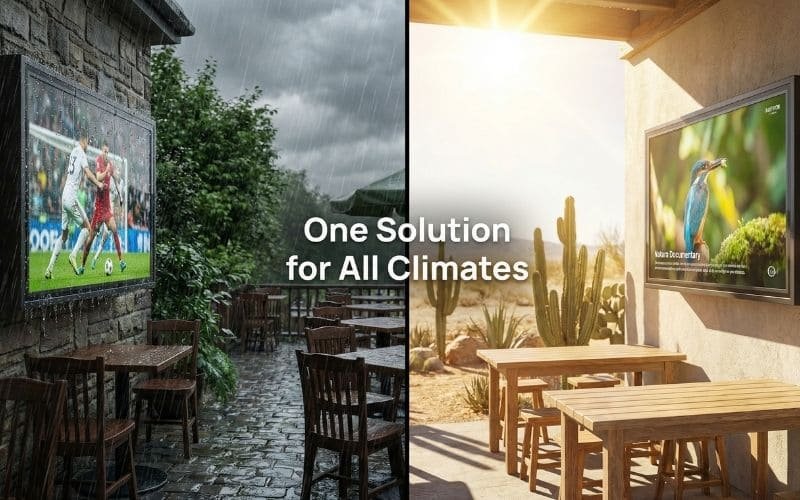
If you are the Director of Operations or Procurement for a regional or national restaurant chain, you know the nightmare of regional disparity. Managing 50 locations across five states means managing 50 different micro-climates. What works flawlessly on a patio in Miami might fail catastrophically in Seattle, and a system that survives a Chicago winter might literally melt in Dallas.
When it comes to outdoor entertainment—specifically patio TVs—this regional variation creates a massive supply chain headache. You have franchise owners complaining that their expensive “Weatherproof” TVs are dying after 18 months. You have maintenance teams struggling to source replacement parts for four different brands of outdoor displays. The lack of uniformity kills efficiency and inflates your Total Cost of Ownership (TCO).
You do not need a different solution for every city. You need a “Universal Key.” You need standardization.
Smart restaurant chains standardize their patio entertainment by utilizing Outvion IP65 Enclosures paired with commodity indoor TVs. This “Universal Enclosure” strategy leverages a sealed Polycarbonate shell to defeat constant moisture in wet climates (like Seattle) and an Active Airflow System to prevent overheating in hot climates (like Texas). By decoupling the screen from the protection, chains reduce replacement costs by roughly 75% and simplify their maintenance Standard Operating Procedures (SOPs) across all franchises.
Last Updated: Feb 28th. 2026 | Estimated Reading Time: 10 Minutes
Case Study A: Surviving the “Eternal Drizzle” (Fadó Irish Pub, Seattle)
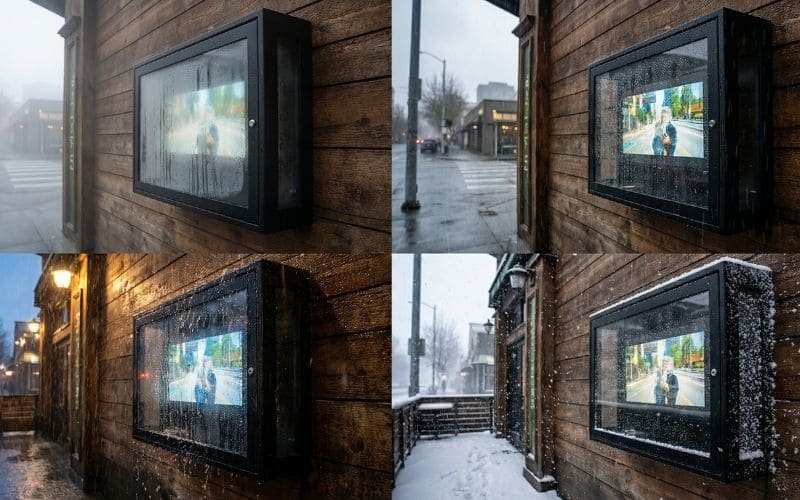
The Challenge: In the Pacific Northwest, the problem isn’t usually violent storms; it is constant, pervasive moisture. It is 24/7 mist, fog, and drizzle that seeps into the smallest crevices of electronics.
The Context Fadó Irish Pub in Seattle is a cornerstone for international sports. Their patio is prime real estate for Six Nations Rugby and Premier League mornings. They cannot afford to have a black screen on a Saturday morning because it rained on Friday night.
The Failure of “Weather Resistance”
Prior to standardizing, many pubs in this region relied on consumer-grade TVs placed under awnings or used mid-tier “water-resistant” outdoor TVs. The failure mechanism in Seattle is slow but inevitable. The constant high humidity degrades the rubber gaskets of standard outdoor TVs. Once a gasket dries out or shifts, the “Eternal Drizzle” finds its way in via capillary action. Moisture condenses on the motherboard, leading to the dreaded “Green Death” (copper oxidation) and eventual short circuits.
The Outvion Solution: The Labyrinth Seal
Fadó shifted to Outvion Enclosures because of the specific geometry of the IP65 defense system.
- The Shell: The body is constructed from High-Density Polycarbonate plastic, which is completely impervious to water and will not rust or rot.
- The Labyrinth Seal: The front bezel overlaps the rear housing in a “Labyrinth” design. Even if wind drives rain horizontally, the water must travel up and over multiple physical barriers to breach the main gasket. Gravity prevents this. The water simply hits the outer shell and drains away.
The Washdown Advantage The IP65 rating (Water Jets) provides an operational advantage beyond weather. Patios get dirty. In Seattle, moss and algae can grow quickly. The Outvion enclosure allows the opening crew to literally hose down the patio—and the TV enclosures—with low-pressure water to remove grime, bird droppings, and spilled beer. It turns a delicate, 10-minute microfiber cleaning process into a 10-second spray.
Case Study B: Beating the Texas Heatwave (Morton’s Tavern, Fort Worth)
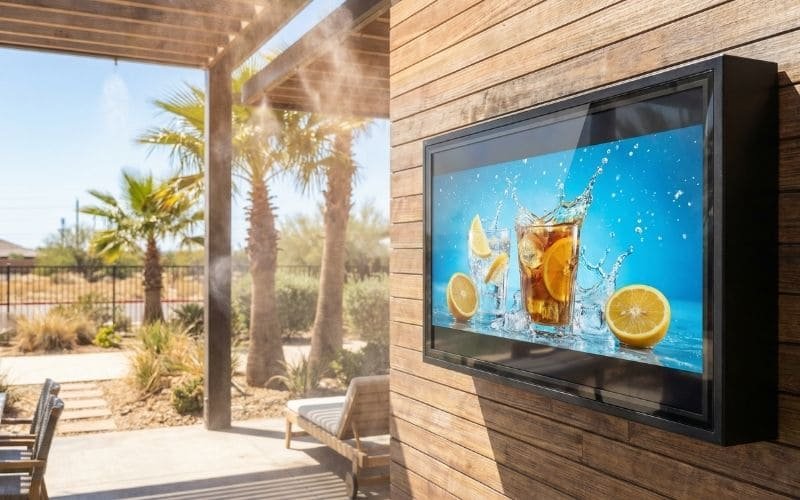
The Challenge: Extreme, unrelenting heat (105°F+) combined with direct sun exposure and fine, abrasive dust. In this environment, a sealed box becomes a convection oven that cooks electronics alive.
The Context Morton’s Tavern in Fort Worth, Texas, faces a radically different threat profile. Their patio is the place to be for college football tailgates in September, but the ambient air temperature can easily hover at 100°F (38°C). When the sun hits a black TV screen, the surface temperature can spike past 140°F (60°C).
The Failure: The Black Screen of Death
If you put a TV in a passive, unventilated box in Texas, it will fail within hours. The liquid crystals in the display reach their isotropic phase—they lose their structure and the screen turns pitch black. Furthermore, the electrolytic capacitors on the power board dry out and burst from the trapped heat.
The Outvion Solution: Active Thermodynamic Cooling
Morton’s standardized on Outvion because we do not build passive boxes; we build environmental management systems.
The Result: Even when the patrons on the patio are sweating in 100°F heat, the TV inside the Outvion enclosure remains within its safe operating temperature margin, ensuring the game stays on without the dreaded “thermal shutdown.”, ensuring the game stays on through the 4th quarter.
The Lungs: The enclosure features an Active Airflow System. When the internal thermostat detects rising temperatures, it engages dual or quad high-velocity fans (depending on the Pro/Ultra model).
The Mechanism: Unlike competitors that use top vents (which inevitably leak rain), Outvion utilizes a Sealed-Top, Bottom-Flow Architecture. The fans create a high-pressure air cycle inside the case. They continuously circulate air across the hot TV panel, preventing heat from stagnating at the top of the unit. This turbulence forces the accumulating warm air downwards and expels it efficiently through the designated exhaust ports located at the base of the enclosure.
The Filtration: Texas is dusty. The intake vents at the bottom are protected by High-Density Micromesh Filters. These trap the red dirt and pollen before it enters the chassis, preventing the internal heatsinks from clogging up while maintaining clean airflow.
The “Happy Hour” Hazard: Impact & Alcohol Protection
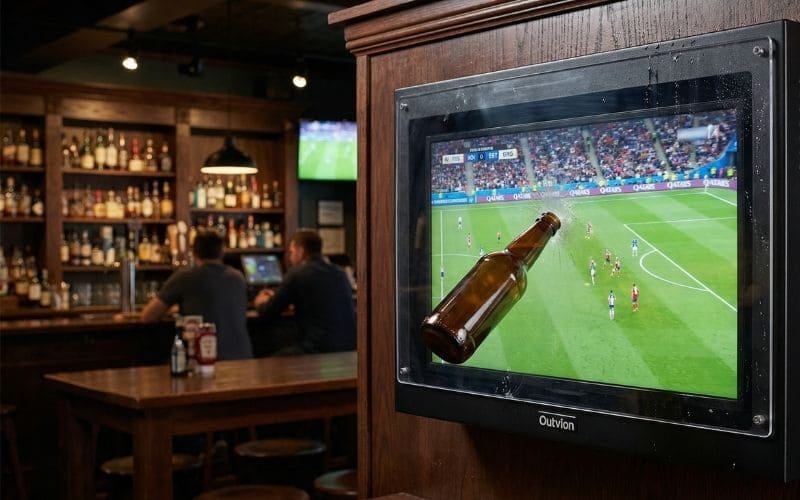
The Risk: Weather is predictable; drunk patrons are not. The patio environment introduces kinetic hazards—flying beer bottles, slipped pool cues, and enthusiastic high-fives—that standard glass screens cannot survive.
It is Friday night. Happy Hour is in full swing. A patron has had three IPAs and is wildly gesturing during an argument about a referee’s call. He accidentally flings his heavy glass pint glass. It sails across the patio and strikes the center of your 55-inch TV.
The Comparison: Glass vs. Polymer
- Standard TV (Glass): The screen is brittle. One direct hit from a pint glass, and it shatters instantly. The game turns off. You have sharp, dangerous shards on the floor, posing a severe liability risk to guests and staff. You are immediately out $1,500 for a replacement
- Outvion Enclosure (Polycarbonate): The pint glass strikes the front shield. Because the shield is made of Optical-Grade Polycarbonate (a material significantly tougher than standard acrylic or glass), it absorbs the impact energy. While it is not indestructible—a hammer would certainly break it—it is engineered to survive the common “Happy Hour Hazards” like thrown bottles or pool cues without shattering. It acts as a sacrificial shield; it might get scratched or dented, but the expensive TV inside remains safe and the party continues without a medical emergency.
Liquid Defense: The Sticky Spill It isn’t just impacts; it is spills. A champagne spray or a spilled soda is disastrous for a naked TV. The sugary liquid seeps into the bottom bezel, drying into a sticky, acidic residue that corrodes the circuit boards over time. With the Outvion enclosure, the seam is sealed. The beer hits the plastic window and runs down the front, never touching an electronic component.
Standardization Strategy: The “Inventory Logic”
Stop buying specialized, expensive assets that are difficult to replace. Decouple the “Screen” (a cheap consumable) from the “Protection” (a permanent asset). This is the key to lowering your Total Cost of Ownership (TCO).
The Procurement Headache If you operate 50 locations and buy dedicated “Outdoor TVs,” you have a logistical mess. If a unit dies in Austin, you have to source that exact model, wait 2 weeks for freight shipping, and pay $3,000. It requires specialized purchasing.
The “Universal Key” Fix
By adopting the Outvion strategy, corporate procurement simplifies everything.
- The Asset: You buy the Outvion Enclosure for every location. This is a one-time Capital Expenditure (CapEx). It lasts 10+ years.
- The Commodity: You instruct your local franchise managers to buy a standard 55-inch indoor TV from their local Best Buy or Costco (Samsung, TCL, LG). Cost: ~$300.
The “Future-Proofing” Protocol
In the restaurant industry, technology moves faster than renovation cycles.
- The Problem: If you buy a dedicated Outdoor TV today, in 3 years it will be obsolete (low resolution, slow smart features). To upgrade, you have to rip the entire unit off the wall and buy another $3,000 unit.
- The Outvion Fix: By separating the “Brain” (TV) from the “Body” (Enclosure), you future-proof your patio.
- The Scenario: In 2026, when 8K TVs become standard for sports bars, you don’t need new enclosures. You simply open the Outvion case, swap the old 4K TV for a new $400 8K TV, and close it back up. The enclosure remains the same. Your upgrade cost is trivial compared to your competitors.
The ROI Analysis If a TV fails—whether from old age or a power surge—the local manager drives 10 minutes to the store, buys a new $300 TV, opens the enclosure, and swaps it in 30 minutes. Zero downtime. Zero freight costs. Zero corporate PO approvals needed for a massive purchase.
Capital Expenditure (CapEx) Comparison (Per Location)
| Cost Item | Dedicated “Outdoor TV” Route | The Outvion Standardization Route |
|---|---|---|
| Initial Hardware | $3,500 (Pro Outdoor Unit) | 760(460 Box + $300 TV) |
| Replacement TV | $3,500 (Must buy whole unit) | $300 (Swap internal TV only) |
| Lead Time | 2-4 Weeks (Freight) | Same Day (Local Retailer) |
| Installation Labor | High (Heavy, two-man lift) | Low (Modular installation) |
| Total 5-Year Spend | $7,000+ (Assuming one failure) | $1,060 |
| Corporate Savings | 85% Reduction in CapEx |
Installation Standardization: The SOP for Franchisees
Scalability requires replicability. If a technician in Boston installs the unit differently than a technician in Austin, you introduce variables that lead to failure. Outvion enclosures allow for a rigid Standard Operating Procedure (SOP).
When rolling out a new technology across a franchise network, the installation must be foolproof. The Outvion system is designed with standard, universal mounting hardware that makes writing an SOP easy for your facilities team.
The SOP Blueprint:
- The Mount: Every Outvion enclosure utilizes a standard VESA pattern. The SOP dictates: “Mount the rear steel backplane to the masonry or wood studs using provided 3/8-inch lag bolts. Do not use drywall anchors.”
- The Power: Standardize the electrical requirement. “All units must be powered by a dedicated 15-Amp GFCI protected exterior outlet.”
- The Cable Path: Specify the use of the foam compression gland at the bottom of the unit to ensure all power and HDMI cables exit the box with a proper “Drip Loop” to prevent water ingress.
- The Lock Down: “After installing the TV on the internal rails, secure the front bezel and engage the integrated key lock. Retain the key in the manager’s safe to prevent unauthorized access.”
Because the enclosure itself is the structural mount, it doesn’t matter if the local manager buys a Samsung or an LG. The physical footprint on the wall remains exactly the same, ensuring visual consistency across your entire brand portfolio.
The “Tamper-Proof” Mounting Detail
Public spaces require a higher level of security than a backyard.
- The Risk: Drunk patrons or vandals trying to unscrew the unit from the wall.
- The Solution: We recommend specifying Torx Security Screws (pin-in-head) for the external mounting points. These screws cannot be removed with a standard screwdriver or coin.
- The Cable Management: Specify the use at the bottom of the unit to ensure all power and HDMI cables exit the box with a proper “Drip Loop” to prevent water ingress.
43″ vs 55″: Choosing the Right Size for Your Pub
The Usage: Form follows function. Do not default to the biggest screen if the space dictates a utility approach. Understand the difference between an “Event Screen” and a “Utility Screen.”
The 43″ Utility Player (The Morton’s Choice)
Morton’s Tavern utilized several 43-inch Outvion units strategically.
- The Application: These are not meant for watching the Super Bowl from 30 feet away. These are perfect for Digital Menu Boards, displaying Live Betting Odds near the bar, or mounting on narrow structural columns where a larger TV would impede foot traffic.
- The Fit: At 43 inches, the unit is compact enough to fit in tight nooks but large enough to display readable text for patrons standing 5 to 10 feet away.
The 55″ Crowd Pleaser
This is the workhorse of the hospitality industry.
- The Application: The 55-inch is the sweet spot for primary sports viewing on a patio. It provides enough surface area for a group of 10-15 people to clearly see the puck or the football.
- The Economy: Because 55-inch is the most heavily mass-produced TV size globally, the cost of the internal TV drops to its lowest price-per-inch ratio, maximizing your ROI.
Size Selection Guide based on Viewing Distance
| Screen Size | Outvion Model | Ideal Viewing Distance | Primary Hospitality Use Case |
|---|---|---|---|
| 32″ – 43″ | Outvion 43″ | 5 to 10 Feet | Digital Menus, Betting Odds, Tap Lists. |
| 49″ – 55″ | Outvion 55″ | 10 to 15 Feet | Booth seating, small patio sections. |
| 60″ – 65″ | Outvion 65″ | 15 to 20 Feet | Main patio focal point, sports viewing. |
| 70″ – 75″ | Outvion 75″ | 20+ Feet | Large beer gardens, “Jumbotron” effect. |
Summary & Strategic Advantage
When you operate across multiple climate zones, you are fighting a multi-front war.
- The Northern Front (Seattle/Chicago): Your enemy is moisture ingress and freezing temperatures.
- The Southern Front (Texas/Florida): Your enemy is solar loading, UV degradation, and salt air corrosion.
Attempting to fight these different enemies with different weapons (different TV models) is a recipe for logistical failure. The Outvion “Universal” Enclosure is the only weapon that works on every front. It seals out the wet, vents out the heat, and blocks the salt.
The following matrix illustrates why a single hardware standard beats region-specific procurement every time
Region-Specific vs. Universal Solution Matrix
| Climate Challenge | Dedicated “Outdoor TV” | Outvion Enclosure System |
|---|---|---|
| Seattle (Constant Rain) | Rubber gaskets degrade over time. | IP65 Labyrinth Seal blocks ingress. |
| Texas (Extreme Heat) | Passive vents trap heat, screen turns black. | Active Thermostatic Fans flush heat. |
| Florida (Salt Air) | Aluminum body pits and corrodes. | Polycarbonate Shell is chemically inert. |
| Chicago (Freezing) | Requires manual unmounting in winter. | Traps Standby Heat, operates to -30°C. |
Conclusion
You cannot control the weather in the cities where you operate, but you can control the infrastructure you deploy to combat it.
The Outvion Enclosure System provides a unified, highly engineered defense against rain, heat, impact, and theft. By decoupling the expensive protective shell from the inexpensive TV, you empower your franchise owners to maintain high-quality outdoor entertainment without the paralyzing CapEx burden of specialized outdoor displays.
It is time to stop treating patio TVs as a liability and start treating them as a standardized asset.
“If you are a franchisee outfitting a single location or simply looking to upgrade your own backyard setup, check out our definitive guide on [How to Use an Indoor TV Outside Safely] using the $800 enclosure hack.”
Spills, Sun & Security: The Patio Defense Q&A
1. How does the enclosure prevent theft on an open patio?
Physical Deterrence. The Outvion enclosure features an integrated key lock that secures the front bezel to the wall-mounted backplane.
- The Logic: While it isn’t a bank vault, it effectively eliminates “opportunity theft.” A thief cannot simply lift the TV off the mount like they can with a standard consumer bracket. To access the TV or the mounting bolts, they would need the specific key. This turns a 10-second “snatch-and-grab” into a difficult, noticeable attempt, which is usually enough to deter casual theft in a busy pub environment.
2. How do we handle glare in bright sun?
Strategic Placement & Customization. Direct sunlight is the enemy of any screen. We recommend a two-pronged approach:
Custom Solutions: For locations where direct sun is unavoidable, please contact our commercial sales team. We offer Anti-Reflective (AR) Film upgrades as a custom order to help mitigate reflections in high-exposure zones.
Placement First: During installation, orient the screens to face away from direct morning or evening sun (North/South facing is best), or utilize patio awnings to create shade.
3. Can we clean beer spills off the screen?
Yes, easily. Because the front shield is made of optical-grade polycarbonate, it is impervious to liquids. If a patron spills a drink or throws food, your staff can use a mild soap solution and a microfiber cloth, or simply a low-pressure hose, to wash the front of the unit without any risk to the electronics inside.
4. What is the warranty for commercial use?
Outvion stands behind its engineering. We typically offer a robust warranty on the structural integrity of the enclosure, the polycarbonate shield, and the active cooling fans. Because you supply the internal TV, the TV itself falls under its own manufacturer warranty. Please consult our commercial sales team for specific multi-year warranty terms on bulk orders.
5. Is it compatible with Digital Menu Board software?
Absolutely. The enclosure has extra internal depth designed specifically to house small form-factor PCs, Apple TVs, Rokus, or specialized digital signage players (like BrightSign). These devices sit safely inside the climate-controlled box, plugged directly into the TV via HDMI.
6. What is the lead time for bulk orders for a franchise rollout?
Fast. Unlike specialized outdoor TV manufacturers who often have 4-8 week lead times, Outvion maintains substantial stock in our US-based warehouses. For typical bulk orders (10-50 units), we can usually palletize and ship via LTL freight within 3-5 business days to meet your renovation schedules.
Recommended Technical Reading
- Ingress Protection Standards:IEC 60529: IP Ratings Explained
- Understanding the difference between IP54 splash resistance and IP65 jet resistance.
- Total Cost of Ownership:Hospitality Technology TCO Analysis
- How decoupling hardware layers reduces long-term CapEx in restaurants.
- Thermal Management:Electronics Cooling Magazine
- The physics of forced convection cooling in sealed electronic enclosures.