
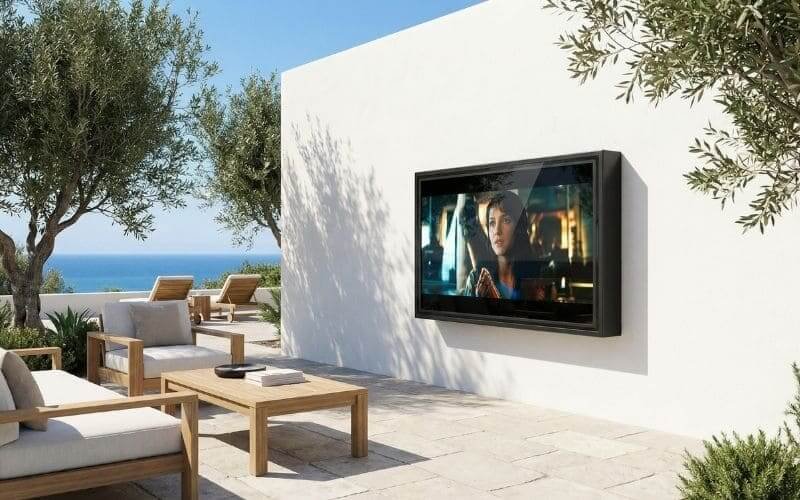
In modern landscape architecture, the goal is often subtraction, not addition. You have meticulously curated every element of the outdoor living space: the grain of the horizontal cedar fencing, the texture of the silver travertine pavers, the negative space created by a sculptural agave plant.
Then comes the “Black Box Problem.”
Most outdoor entertainment solutions are additives. A bulky, 6-inch-deep television mounted on an articulating arm protrudes into the space, breaking the clean sightlines and disrupting the visual flow. It feels like an afterthought—a piece of technology invading a natural sanctuary.
To achieve a truly seamless aesthetic, the answer lies in Recessed (Flush) Installation. This architectural technique involves framing a dedicated niche into the masonry or timber wall and inserting an Outvion Enclosure flush with the surface plane. Unlike standard outdoor TVs that overheat when confined, Outvion’s active front-facing airflow system allows the unit to be “buried” in the wall while maintaining optimal thermal regulation. The result is not just a TV; it is an intentional design element that respects the architecture.
Last Updated: JAN 26th 2026 | Estimated Reading Time: 8 Minutes
The Art of the “Flush Mount”: Engineering a Recessed Niche
The Design Rule: In high-end integration, the television should be treated like a built-in appliance (akin to a Sub-Zero fridge), not a picture frame. The goal is Coplanarity—ensuring the face of the display sits on the same plane as the surrounding wall material.
Achieving the perfect flush mount requires precise collaboration between the architect, the framer, and the integrator. It starts with the Rough Opening (RO).
The Geometry of the Void
You are not just cutting a hole; you are building a socket.
- The Tolerance: The Rough Opening should be framed exactly 0.5 inches (12mm) wider and taller than the physical dimensions of the Outvion Enclosure.
- The Shadow Gap (The Reveal): This 0.5-inch gap is not sloppy framing; it is a deliberate design detail. In architecture, a “reveal” creates a shadow line that visually separates the materials. It allows the matte black steel of the enclosure to “float” within the stone or wood. It also provides the necessary clearance for thermal expansion and contraction of the different materials.
Depth Control: The Z-Axis
The magic of a flush installation is in the Z-Axis (Depth).
- The Target: The Outvion Enclosure is approximately 5 to 6 inches deep (depending on the model).
- The Framing: Standard 2×4 framing (3.5 inches deep) is insufficient for a full flush mount. To achieve a true flush finish, you typically need 2×6 framing or a masonry block wall.
- The “Proud” Mount: If you are retrofitting into a thinner wall, a popular design choice is to let the bezel sit “proud” (protrude) by 1 inch. This creates a subtle relief and adds dimension without the bulk of a full surface mount.
- Waterproofing the Niche: Even though the Outvion unit is waterproof, the niche itself must be flashed. We recommend lining the Rough Opening with a self-adhered flashing membrane (like Vycor or flashing tape) to prevent moisture from entering the wall cavity behind the enclosure.
The “Airflow Paradox”: Why Most TVs Fail in Niches
The Engineering Truth: You cannot bury a passive radiator. Standard outdoor TVs rely on the ambient air moving across their back panel to cool down. If you bury the back of the TV in stone or insulation, you create a heat trap. The TV suffocates and fails.
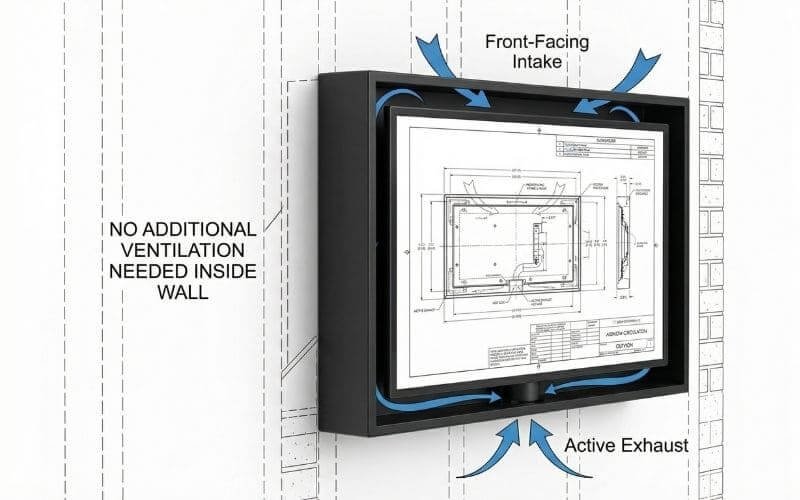
This is the most critical technical constraint of recessed installation. A TV generates heat—often upwards of 200 Watts for large 4K displays. If you place it in a tight stone box, that heat has nowhere to go.
The “Chimney Effect” Trap Some installers try to solve this by leaving a large air gap behind the TV. However, unless there is a physical vent at the top and bottom of the wall to create a chimney draft, the air remains stagnant. The niche becomes an oven, and the internal temperature will quickly exceed the TV’s operating limit (usually 104°F/40°C).
The Outvion Advantage: Front-Breathing Lungs The Outvion system is uniquely engineered for recessed applications because it separates the TV’s cooling needs from the wall cavity.
- Intake: Cool air is drawn in from the bottom-front of the bezel through micromesh filters.
- Exchange: The fans circulate this air across the TV face and chassis.
- Exhaust: Hot air is ejected from the top-front of the bezel.
Because the intake and exhaust ports are located on the face of the unit (or the forward-facing edges), the enclosure can be completely surrounded by insulation, stone, or wood without compromising performance. As long as the face is exposed to the air, the TV can breathe. This is the only safe methodology for fully recessed installations.
CFM Calculation (For Engineers)
For those asking about flow rates: Our active fan system moves approximately 40-60 CFM (Cubic Feet per Minute) of air. Given the internal volume of the enclosure is less than 3 cubic feet, this means the entire air volume inside the box is replaced every 3-5 seconds. This rapid turnover prevents heat soak, even in a recessed stone wall baking in the sun.nce. As long as the face is exposed to the air, the TV can breathe. This is the only safe methodology for fully recessed installations.
Material Integration: Stone, Stucco, & Wood
The Material Palette: A successful recessed installation considers the dialogue between materials. The enclosure should either disappear into the void or act as a deliberate contrasting element.
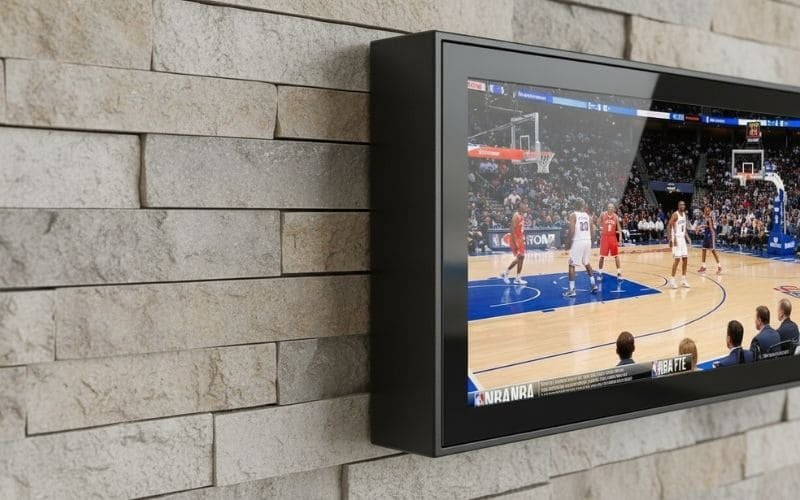
Scenario A: The Rustic Contrast (Stacked Stone)
Imagine a massive fireplace wall clad in rough-hewn limestone or slate.
- The Aesthetic: The texture of the stone is organic and chaotic. The Outvion Enclosure provides a sharp, geometric counterpoint.
- The Execution: The mason must be precise. They should use corner pieces to return the stone into the niche, creating a finished edge. The matte black steel bezel against the gray or cream stone creates a stunning, modern-industrial contrast. It feels grounded and solid.
- Critical Detail: Ensure the mason does not mortar the enclosure in. The stone must stop at the reveal line. If you mortar it in, you can never service the unit.
Scenario B: The Linear Rhythm (Wood Slats)
The “Japandi” or “California Modern” style often utilizes horizontal cedar or ipe slat walls.
- The Aesthetic: Warmth, rhythm, and linearity.
- The Execution: This requires high-precision carpentry. The wood slats should terminate cleanly against the metal bezel with a consistent 1/4-inch gap. The dark TV screen acts as a “void” in the rhythm of the wood, creating a focal point that feels calm and ordered.
- Pro Tip: If using wood, ensure the niche is flashed properly to prevent water from getting behind the siding. Use black flashing tape behind the gaps so you don’t see the house wrap.
Scenario C: The Minimalist Canvas (Stucco)
For Mediterranean or modern minimalist homes, white stucco is king.
- The Aesthetic: Purity and light.
- The Execution: A stark white wall with a sharp, black rectangular void. This is the most “gallery-like” application. The crisp lines of the enclosure frame the moving image like a piece of video art. The lack of visible cables or brackets maintains the visual purity of the white plane.
The “Hidden” Lift: Technology that Rises (Motorized Solutions)
The Ultimate Stealth: Sometimes, the best design choice is invisibility. If a large black rectangle detracts from the view of the ocean or the garden, the solution is to bury it completely and summon it only when needed.
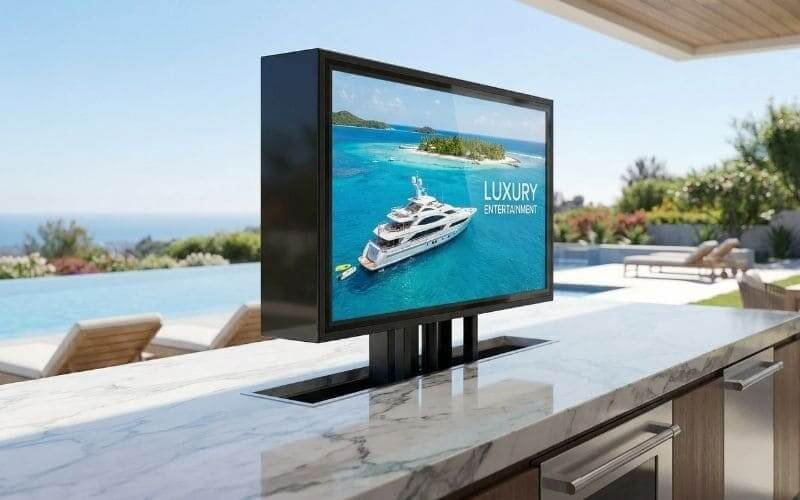
The Mechanism: The TV Lift This involves pairing the Outvion Enclosure with a motorized lift mechanism (such as those from Nexus 21 or Future Automation).
- The Application: An outdoor kitchen island or a low retaining wall.
- The Flow: The TV is hidden inside the granite countertop or the stone wall. With the press of a button, a section of the countertop rises, lifting the Outvion Enclosure up into the viewing position.
Why Outvion is Critical Here Standard indoor TVs cannot survive inside an outdoor cabinet.
- The Damp Environment: Even inside a “weatherproof” cabinet, humidity and condensation are killers. The cabinet sits on the ground; rising damp is inevitable. A naked TV inside a dark, damp cabinet will corrode within months.
- The Protection: By mounting the TV inside an Outvion Enclosure before attaching it to the lift, you ensure that even when the TV is retracted into the damp, dark cabinet, it is sealed in its own micro-climate. It is double-protection for the ultimate stealth luxury.
- Winterization: When winter comes, simply lower the lift. The TV is now protected by the cabinet and the enclosure, buried under a layer of snow, safe and sound until spring.
The “Zero-Wire” Philosophy: Cable Management
The Clean Line: In luxury design, a visible wire is a failure. It breaks the illusion. For a recessed installation, cable management must be planned during the rough-in phase, long before the stone is laid.
The Recessed Box Strategy Do not put a standard outlet behind the TV enclosure. The plug head sticks out 2 inches, pushing the TV forward and ruining your flush mount.
- The Fix: Install a “Recessed Media Box” (like a Legrand or Arlington box) deep into the framing behind the niche. This allows the power plug and HDMI heads to sit inside the wall cavity, allowing the Outvion enclosure to push all the way back flush with the wall.
The “Media Tunnel” (Conduit) We advocate for the “Headless” display approach. Do not stick Roku sticks or cable boxes behind the TV where they are hard to reach.
- The Solution: Run a 2-inch flexible conduit (often called “Smurf Tube”) from the TV niche to a remote AV rack located in a closet or weatherproof cabinet nearby.
- The Benefit: You run a single, high-speed fiber HDMI cable through the conduit. All the messy boxes (Apple TV, Cable Box, Sonos Amp) live in the rack. This keeps the TV installation impossibly thin and allows for easy servicing of the sources without unscrewing the TV.
Conduit & Wiring Checklist for Architects
| Component | Specification | Purpose |
|---|---|---|
| Conduit | 2-inch PVC (Schedule 40 or Flex) | Allows future-proofing (pulling 8K cables later). |
| Power | Recessed Outlet (GFCI) | Sits flush in wall; safety compliant. |
| Data | Cat6 or Fiber Optic | Hardline internet for zero-buffering 4K streaming. |
| Location | Remote AV Rack | Keep sources accessible and dry; keep niche clean. |
Why “Matte Black” is the New Neutral
The Aesthetic: Good design should be timeless. It should not scream for attention, nor should it look cheap. The finish of the hardware dictates the perceived value of the installation.
The Finish Philosophy Outvion utilizes a specific Fine-Texture Powder Coat.
- Light Absorption: Unlike glossy plastic or brushed aluminum (which can flare in the sun), the matte texture absorbs light. It is anti-reflective. This allows the frame to recede visually.
- Materiality: It feels like architectural steel, akin to high-end window mullions or luxury light fixtures. It does not feel like “consumer electronics plastic.”
Comparison: The DIY Box We often see homeowners attempt to build wooden boxes to hide their TVs.
- The Result: A bulky, coffin-like structure that warps, rots, and must be painted every year. It looks like a shed hanging on the wall.
- The Outvion Difference: The slim, metallic profile of the Outvion enclosure reads as a deliberate architectural detail—a frame for content—rather than a box for storage.
Visual Comparison
| Feature | DIY Wooden Cabinet | Outvion Flush Mount Enclosure |
|---|---|---|
| Depth | 8-10 Inches (Bulky) | 5-6 Inches (Slim) |
| Sightlines | Protrudes into space | Recedes into wall |
| Finish | Painted Wood (Visible Grain) | Powder Coated Steel (Architectural) |
| Maintenance | High (Repainting/Staining) | Zero (Wipe clean) |
| Aesthetic | “Rustic/Shed” | “Modern/Gallery” |
Conclusion
True luxury is technology that serves you without cluttering your space. It is the invisible speaker, the hidden light source, and the recessed screen.
By treating the outdoor television as an architectural element rather than an add-on appliance, you elevate the entire outdoor living experience. The Recessed Installation is the hallmark of a thoughtful, high-design patio. It requires planning, engineering, and the right hardware.
With the Outvion Enclosure, you have the engineering solved. The airflow, the weatherproofing, and the mounting geometry are built-in. All that remains is for you to frame the niche and create the seamless view you envisioned.
FAQ for Architects & Builders
1. What is the exact Rough Opening (RO) formula?
The formula is Enclosure Width + 0.5″ and Enclosure Height + 0.5″. This provides a 0.25″ reveal on all sides. This tolerance is critical for allowing the unit to be inserted squarely even if the framing is slightly out of plumb, and allows for thermal expansion of materials.
2. Can I paint the enclosure bezel to match the wall?
Yes. While the factory finish is a durable powder coat, it can be painted. We recommend lightly sanding the bezel surface with fine-grit sandpaper to create a key, applying a high-quality metal primer, and then painting with an exterior-grade enamel or spray paint to match the stucco or siding color.
3. How do I handle water drainage in a stone niche?
Even with a flush mount, wind-driven rain can enter the reveal gap. You must design the niche with a slight slope (1/4 inch per foot) on the bottom sill, pitching outward to shed water. Additionally, we recommend installing small weep holes or not caulking the bottom edge of the enclosure to allow any trapped moisture to escape gravity-fed.
4. Is the bezel removable for service?
Yes. The Outvion Enclosure is designed with a removable front bezel. The main box is bolted to the framing, but the front frame (holding the glass) can be unlocked and removed to access the TV for service or replacement without damaging the surrounding stone or stucco work.
5. Can this be installed in a fire-rated wall?
Yes. The enclosure is primarily steel and polycarbonate. However, if penetrating a fire-rated assembly (like a garage firewall), you must ensure the niche framing behind the box maintains the fire rating (e.g., using Type X drywall layers). Consult local fire codes.
6. Does the metal bezel block Wi-Fi?
No. While the sides are steel, the large front face is Polycarbonate, which is RF-transparent. This allows Wi-Fi and Bluetooth signals to pass through the front of the unit. However, if the unit is fully recessed in dense stone or concrete, we strongly recommend a hardwired Ethernet connection as the stone itself will block the signal from the sides and back.
Recommended Technical Reading
- AV Design:AV Design Reference Manual (AVIXA)
- Thermal Management:Electronics Cooling – Enclosure Design
- Principles of active vs. passive cooling in recessed electronics.