
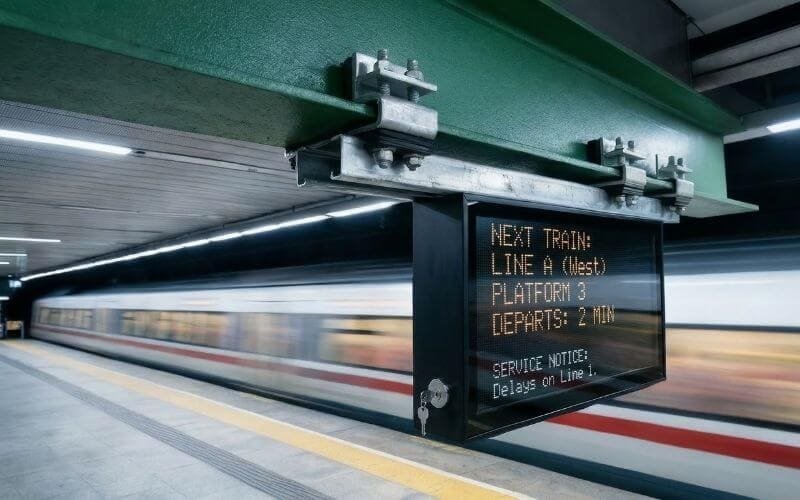
In modern public transportation networks, Passenger Information Display Systems (PIDS), sometimes referred to in agency standards as passenger information displays (PID), are the lifeline of the commuter experience. Urban transit authorities rely heavily on digital signage across subway platforms, elevated train stations, and bus hubs to broadcast real-time arrivals, delay alerts, and emergency routing information. For transit agencies, a failed PIDS screen is not only an AV problem; it is a rider-information, operations, and public-trust problem. However, deploying sensitive commercial electronics into the brutal, semi-open environment of a transit hub introduces extreme operational vulnerabilities that can paralyze station communications.
Deploying unprotected commercial displays on transit platforms exposes them to conductive brake dust, extreme weather, and high-intensity public vandalism. To protect taxpayer funding and ensure continuous PIDS visibility, transit authorities should adopt a hardware decoupling strategy. By housing standard commercial screens inside shatter-resistant, lockable IP65 outdoor TV enclosures, agencies establish a rugged physical security layer that drastically lowers the Total Cost of Ownership (TCO) across the network.
Unlike climate-controlled corporate environments, a transit platform is a violently kinetic and harsh industrial zone. A digital screen mounted on an elevated platform is subjected to wind-driven storms, constant micro-vibrations from passing trains, and deliberate acts of vandalism. More insidiously, subterranean subway stations are filled with conductive metallic brake dust that can silently degrade standard circuit boards. In this comprehensive technical guide, we will analyze the unique environmental threats of public transit, review an illustrative urban deployment scenario, and provide a verifiable engineering blueprint for securing PIDS networks using heavy-duty TV cabinets while optimizing municipal transit budgets.
How we evaluate public transit TV deployments at Outvion:
- Particulate mitigation against highly conductive ferrous brake dust (magnetite)
- Kinetic impact resistance for high-intensity public vandalism scenarios
- Environmental sealing against wind-tunnel storms and low-pressure cleaning (IP65)
- Fleet scalability and taxpayer TCO optimization using CapEx decoupling
- Strict adherence to ADA protruding-object guidance for circulation paths
Last Updated: March. 24h. 2026 | Estimated Reading Time: 7 Minutes
By Smith Chen, Outdoor TV Enclosure Engineer at Outvion
The Financial Reality of Transit Authority Budgets
Public transit technology upgrades are funded by rigid municipal bonds and federal grants. The decoupling strategy separates the heavy-duty physical protection from the digital display, helping transit agencies stretch limited capital funds across more stations while significantly lowering future replacement costs.
To understand the engineering constraints of transit hardware, facility engineers and system integrators must first understand how municipal transportation is funded. Transit authorities operate on strict, highly regulated budgets heavily scrutinized by taxpayers, city councils, and federal oversight committees.
The Federal Grant and CapEx Trap
In the United States, large-scale technology upgrades in public transit are frequently funded through specific municipal bonds or Federal Transit Administration (FTA) grants.
- The Procurement Cycle: These funding vehicles provide a massive, one-time injection of Capital Expenditure (CapEx) designed to modernize station infrastructure and procure initial hardware. However, once the grant cycle closes, the agency’s localized Operational Expenditure (OpEx) budget for daily maintenance is often severely limited.
- The Proprietary Hardware Burden: Historically, to combat platform environments, transit agencies have procured specialized, proprietary “transit-grade” outdoor monitors. These all-in-one units command extreme premiums, draining project funds rapidly.
- The Maintenance Deadlock: When a proprietary unit suffers a shattered screen from vandalism or fails due to electrical age, replacing it requires a lengthy public procurement process and massive capital outlay. This often results in dead PIDS screens hanging over platforms for months, frustrating commuters and degrading the agency’s operational efficiency.
The Hardware Decoupling Solution
The fiscally responsible engineering alternative is the hardware decoupling strategy.
- Separating the Infrastructure: Transit agencies purchase a heavy-duty, permanent Outvion polycarbonate TV cabinet and securely bolt it to the platform architecture. Inside, they mount a standard, high-brightness commercial display.
- Optimized Fleet Pricing: For a 50–55″ PIDS setup, Outvion enclosure reference pricing typically starts in the mid-$400s for Basic configurations. When combined with a commercial-grade high-brightness display, the total deployment cost is highly optimized, allowing the agency to digitize more stations with the exact same pool of grant funding.
- Protecting the OpEx: If the internal screen is eventually damaged by an extreme power surge or simply reaches the end of its lifecycle, the station’s maintenance crew unlocks the permanent protective outdoor TV box and swaps in a readily available replacement screen. This shifts long-term maintenance from an unsustainable hardware repurchase to a predictable, low-cost consumable swap.
Transit Network TCO Financial Modeling
(Illustrative scenario for a large urban transit deployment of 500 units)
| Deployment Strategy | Initial CapEx Burden | Hardware Replacement Mechanism | Long-Term TCO Viability |
| Naked Commercial Display | Low | Discard and replace entire unit frequently due to brake dust and vandalism. | Unsustainable. Rapid attrition drains localized maintenance budgets. |
| Proprietary Transit Monitor | Very High | Lengthy procurement; requires replacing the entire expensive unit. | Poor. Severely limits the number of stations that can be modernized. |
| Enclosure Decoupling Strategy | Moderate | Unlock TV cabinet, swap inexpensive internal screen locally. | Optimal. Maximizes federal grants; lowest ongoing OpEx burden. |
Modeled Urban Scenario: High-Volume Transit Network
A composite scenario modeled on heavy-rail urban transit deployments demonstrates that transitioning to protective polycarbonate enclosures mitigates the extreme attrition caused by metallic dust and vandalism, ensuring continuous commuter communication.
To illustrate the operational impact of this deployment strategy, we examine a modeled, composite scenario based on challenges commonly faced by massive municipal networks, similar to the Chicago Transit Authority (CTA) or the New York MTA.
The Infrastructure Challenge
In this composite scenario, a transit agency initiates a modernization project to deploy new PIDS screens across a mix of underground subway tunnels and open-air elevated (L-train) platforms.
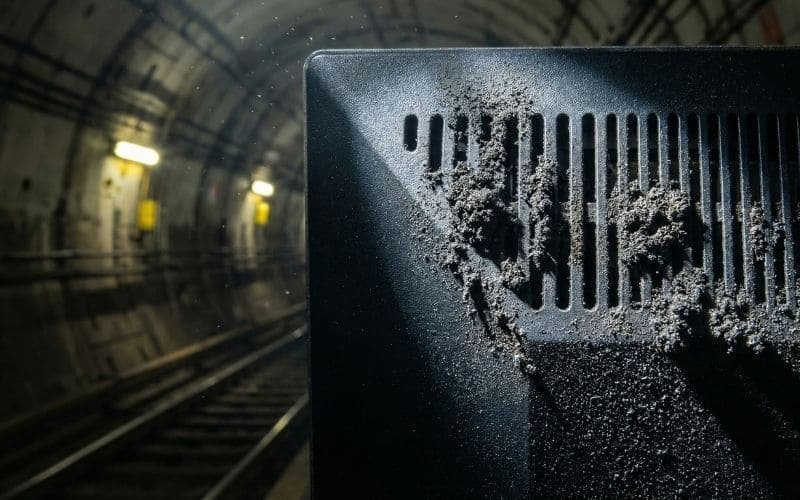
- The Subterranean Failure: Within months of the initial rollout, unprotected screens deployed in the underground stations begin experiencing high failure rates. Diagnostics reveal that standard displays actively pulled in airborne brake dust through their cooling vents, creating conductive films across internal components and increasing the risk of arcing, insulation breakdown, and logic-board failure over time.
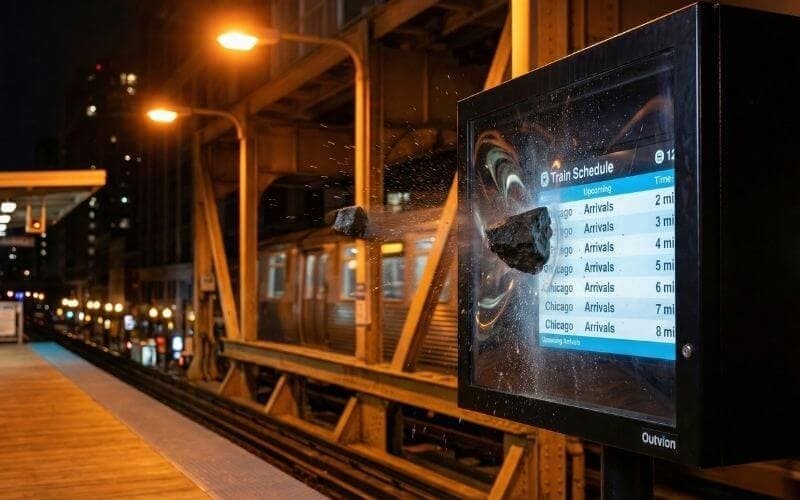
- The Elevated Platform Attrition: Simultaneously, screens on the unsupervised open-air platforms suffered heavy physical abuse. Deliberate vandalism with baseball bats, thrown track ballast (rocks), and spray-paint tagging rendered dozens of informational screens unreadable or physically destroyed.
The Retrofit Intervention
Facing commuter backlash and maintenance budget depletion, the agency’s facility engineers implement a network-wide retrofit utilizing IP65 protective outdoor TV boxes.
- The Execution: The remaining functional screens, alongside new commercial replacements, are housed inside rugged Outvion polycarbonate enclosures. These units are securely clamped to structural I-beams overhead.
- The Operational Results: Over the subsequent deployment phases, the hardware attrition rate drops significantly. The IP6X dust-tight seals block the conductive iron dust in the tunnels, reducing the risk of conductive dust-related electrical failure. Concurrently, the polycarbonate shields help preserve display integrity after impacts that would normally shatter standard glass on the elevated platforms. The digital signage network remains functional, restoring rider trust and preserving the agency’s maintenance budget.
The Invisible Threat: Conductive Brake Dust
Subway tunnels are saturated with conductive, magnetic iron dust generated by train braking systems. An IP6X-rated TV cabinet provides a dust-tight barrier that physically isolates the display from this hazardous environment, preventing metallic bridging across sensitive circuit boards.
While public vandalism is the most visible threat to transit displays, the primary cause of electrical failure in underground or enclosed stations is an insidious environmental factor: ferrous particulate matter.
The Physics of Transit Dust and Magnetite
The air quality and particulate composition within a subway tunnel are fundamentally different from a dusty warehouse or a typical outdoor patio.
- Metallic Particulates: Extensive environmental studies of subway air quality indicate that a massive portion of airborne particulate matter is composed of iron and steel flakes. This material is generated continuously by the mechanical friction of heavy train wheels grinding against steel tracks, and specifically, the actuation of cast-iron or composite brake shoes.
- The Intake Vulnerability: Standard commercial displays rely on passive ventilation slots to draw in ambient air for internal component cooling. In a subterranean station, these vents act as localized vacuums, actively pulling this iron-rich dust into the chassis of the display.
- Conductivity and Electrical Risk: Unlike organic dust (such as wood or cardboard) which acts primarily as a thermal insulator, transit brake dust is highly conductive and often magnetic (presenting as magnetite). When this metallic dust settles on warm printed circuit boards (PCBs), the fine particles can bridge the microscopic gaps between surface-mounted components. As the dust accumulates, it can bridge circuits, reduce insulation reliability, and increase the risk of arcing or board failure over time.
Dust-Tight Isolation (IP6X)
To survive in a subterranean rail network, the display must be physically isolated from direct exposure to tunnel particulates and moisture.
- The Physical Barrier: By utilizing a sealed IP65-rated TV enclosure system, transit engineers remove the display’s internal components from the particulate path entirely.
- The IEC Testing Standard: The “6” in the IP65 rating signifies that the enclosure is evaluated as “dust-tight.” This means the enclosure is designed to block fine dust ingress under strict IP test conditions, effectively managing the threat of conductive iron particulates. The standard display operates safely within the enclosed micro-climate, protected from the hazardous metallic atmosphere of the train tunnel.
Kinetic Hazards and High-Intensity Vandalism
Transit platforms are highly kinetic, unsupervised spaces prone to vandalism. Outvion enclosures utilize an optical-grade polycarbonate shield engineered to yield elastically, absorbing kinetic energy from thrown objects and blunt instruments to prevent glass fragmentation.
Public transit platforms, especially those operating 24/7 or located in remote urban sectors, are frequently unsupervised by staff. Mounting brittle electronics in these zones introduces severe asset vulnerability and public safety liabilities.
The Brittleness of Standard Display Glass
The primary viewing surface of standard commercial monitors is constructed from silicate glass.
- Low Modulus of Elasticity: Glass is highly rigid. When subjected to a deliberate impact from a blunt instrument, a swinging bag, or track ballast (rocks) thrown by vandals, the glass cannot flex to disperse the kinetic energy.
- Safety Liabilities: The material suffers catastrophic brittle failure, shattering into razor-sharp shards. On a transit platform, this presents an immediate laceration hazard to commuters waiting below and creates a hazardous, time-consuming cleanup scenario for station staff.
The Polycarbonate Defense Mechanism
To mitigate this liability and protect the public hardware investment, the physical barrier protecting the screen must be capable of surviving severe blunt-force trauma.
- Advanced Material Science: Outvion outdoor TV boxes feature an optical-grade polycarbonate front window. Polycarbonate is widely used in high-impact security applications and is substantially more resilient than standard display glass.
- Elastic Deformation: Unlike glass, the molecular structure of polycarbonate allows it to deform elastically under mechanical stress. When struck by a heavy object, the shield acts as a sacrificial protective layer. It flexes inward, absorbs the kinetic energy of the impact, and then rebounds.
- Preserving Asset Integrity: While an extreme, malicious attack with a heavy instrument may cause localized scratching, crazing, or denting on the surface, the polycarbonate resists shattering. By absorbing the destructive energy, the shield protects the delicate LCD panel behind it, helping preserve display integrity after impacts that would normally shatter standard glass.
Extreme Weather and Platform Wind Tunnels
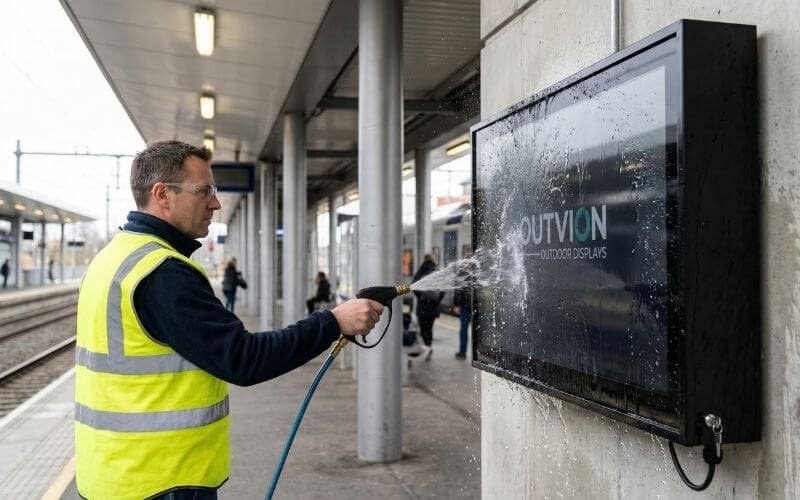
Elevated and open-air transit platforms act as aerodynamic wind tunnels, driving rain horizontally. The IP65 rating ensures the TV cabinet can withstand low-pressure water spray, protecting the hardware during severe storms and routine station maintenance.
While subterranean stations deal with ferrous brake dust, open-air elevated platforms, light-rail stops, and suburban bus hubs are entirely exposed to severe weather elements and aggressive cleaning protocols.
The Wind Tunnel Effect
Transit platforms often feature long, narrow architectural designs bordered by heavy trains moving at high speeds.
- Aerodynamic Pressure: This layout creates a severe wind-tunnel effect. During a storm, rain does not merely fall vertically; it is driven horizontally at high velocities across the platform.
- The Moisture Threat: If a standard commercial display is mounted under a basic platform canopy, the horizontal wind-driven rain will easily bypass the roof structure and penetrate the TV’s rear ventilation slats, shorting out the electronics.
The IP65 Environmental Seal
The Outvion enclosure achieves an IP65 rating, providing the necessary defense against horizontal liquid ingress and maintenance routines.
- Water Jet Resistance (IPX5): The “5” rating confirms protection against low-pressure water jets from any direction. This ensures that the interlocking bezels, compression gaskets, and cable entry points are designed to repel wind-driven storms and horizontal rain.
- Station Washdowns: Furthermore, transit stations require intense sanitation to remove grime, bird droppings, and biological waste. Maintenance crews frequently utilize water hoses to clean platforms. The IPX5 rating allows crews to execute routine hose-down or low-pressure washdown cleaning around the structural pillars and the exterior of the enclosure without risking water ingress into the high-voltage display components.
Thermal Sizing for Transit Micro-Climates
Subway tunnels retain massive amounts of ambient heat, while elevated platforms face direct solar loading. To prevent component failure, hotter installations require ventilated configurations sized to the heat load to actively remove waste heat from the enclosure cavity.
A sealed IP65 TV cabinet successfully isolates the display from external brake dust and driven rain, but it introduces a secondary engineering challenge: thermal management. An operational commercial display generates internal waste heat that must be addressed.
Thermal Dynamics in Public Transit
Transit hubs experience extreme thermal profiles depending on their specific architectural layout.
- Subterranean Heat Sinks: Underground subway tunnels are notorious for retaining heat. The constant braking of heavy trains, massive passenger volumes, and the lack of natural ventilation mean that ambient temperatures in the summer can easily exceed 95°F (35°C), even deep underground.
- Solar Loading on Elevated Platforms: Conversely, displays mounted on open-air platforms are subjected to direct solar loading. Dark enclosure surfaces absorb solar radiation, drastically increasing the internal heat volume.
- Hardware Strain: If this ambient heat is combined with the internal heat generated by the TV inside a sealed box, the internal temperature will rapidly exceed the operational threshold of the display, causing screen blackouts or permanent panel degradation.
Active Airflow Sizing for Platforms
To combat elevated thermal loads in transit environments, the installation must utilize active, forced-air ventilation to stabilize the micro-climate.
- Configuration Sizing: The cooling capacity must scale with the physical volume of the cabinet. In the current Outvion line, ventilated configurations use 2 fans for 28–55″ models and 4 fans for 60″+ models.
- Thermal Relief: Ventilated versions use active fan airflow that helps remove waste heat from the enclosure cavity, drawing cooler ambient air in and forcefully exhausting the heated air out. This engineered airflow ensures that the internal components rema
in within safe operating parameters, maintaining critical PIDS visibility during peak summer commuting hours.
Transit Hub Environmental & Thermal Threat Matrix
| Transit Zone | Primary Environmental Threat | Thermal Risk Level | Recommended Enclosure Configuration |
| Indoor Transit Concourses | High pedestrian traffic, minor tampering | Low Risk | Basic Series (Focus on locking mechanics). |
| Subterranean Platforms | Conductive brake dust, trapped ambient heat | Moderate Risk | Ventilated configurations (2 fans for 28–55″ models). |
| Open-Air Elevated Hubs | Direct solar loading, wind-driven rain, vandalism | High Risk | Ventilated Pro or Ultra versions (4 fans for 60″+ models). |
Structural Anchoring, Vibration, and ADA Protocols
Transit installations are subjected to constant micro-vibrations from heavy trains. Installations require heavy-duty mechanical clamping to steel I-beams, strict cable gland sealing, and adherence to ADA protrusion limits for pedestrian safety.
Deploying an IP65 enclosure provides a robust physical defense, but the integrity of that defense relies entirely on proper installation protocols adapted specifically for the intense vibrations and public safety codes of a railway environment.
Mitigating Train Vibration
The passage of a multi-ton commuter train generates massive low-frequency vibrations that travel directly through the station’s architecture.
- Heavy-Duty Anchoring: Transit installations should rarely rely on standard concrete wall anchors alone. Facility engineers typically utilize heavy-duty metal strut channels (unistrut) and beam clamps to anchor the enclosure’s backplane directly to the structural steel I-beams of the station canopy. Furthermore, utilizing vibration-dampening washers on all VESA mounting bolts helps isolate the internal display from structural shock and prevents hardware from loosening over time.
Cable Routing and Drip Loops
The physical entry point into the outdoor TV box must be tightly sealed.
- Compression Sealing: Outvion utilizes specialized foam blocks or compression glands at the bottom exit points. During final assembly, technicians must ensure the grommets are tightly compressed around the power and data cables. Conductive brake dust can bypass the primary seal through the cable exit if a gap is left open.
- The Drip Loop Technique: On open-air platforms, installers must implement a “Drip Loop.” This requires leaving a slack, U-shaped loop of cable hanging below the entry port. Gravity forces storm rainwater to drip harmlessly off onto the platform, preventing it from traveling along the cable into the enclosure.
Finally, installations on crowded passenger platforms must comply with strict accessibility codes.
- The ADA Standard: Under ADA protruding-object guidance, wall-mounted objects with leading edges between 27 inches and 80 inches above the finished floor generally may not protrude more than 4 inches into a circulation path.
- Overhead Deployment: Because protected display cabinets exceed that depth, PIDS screens in transit environments are overwhelmingly mounted via ceiling poles or clamped to overhead structural beams, positioning the lowest edge of the enclosure above the 80-inch height threshold. This ensures ample head clearance for all commuters and prevents white-cane hazards for visually impaired passengers. Final mounting height and support details should still be reviewed against the project’s local accessibility and station design requirements.
Conclusion: Hardening the Transit Data Network
In modern public transportation, real-time data visibility is critical for managing passenger flow, ensuring commuter safety, and mitigating the chaos of service delays. However, deploying unprotected commercial screens into the highly kinetic, particulate-heavy environment of a transit hub is a critical failure of infrastructure planning. It exposes the hardware to destructive conductive brake dust and leaves the system highly vulnerable to public vandalism.
Relying on naked commercial displays is financially risky, while purchasing specialized, all-in-one proprietary transit monitors restricts budget flexibility and prevents network-wide scalability. By utilizing the decoupling strategy with an IP65 polycarbonate outdoor TV box, transit authorities achieve the optimal balance. This strategy provides rugged physical security against vandalism, establishes a dust-tight seal against metallic particulates, and maintains the operational agility required by maintenance teams. Implementing this engineered barrier helps ensure that critical PIDS networks remain operational, maximizing federal transit grants and serving the daily needs of the commuting public.
Transit PIDS Protection FAQ
1. Does the enclosure block cellular or WiFi signals for remote PIDS updates?
The polymer and polycarbonate enclosure design often allows wireless media players and cellular modems (4G/5G) to function normally, though actual signal performance depends heavily on the station’s architecture. Unlike heavy stainless steel cabinets that act as Faraday cages, the Outvion shell allows transit IT departments to utilize wireless data transmission for PIDS updates, provided there is adequate signal penetration into the subterranean or platform level.
2. Can the polycarbonate window survive an attack with a baseball bat?
Optical-grade polycarbonate is an engineering thermoplastic designed to yield elastically, absorbing massive kinetic energy. While extreme, deliberate force with a heavy blunt instrument like a bat may scratch, craze, or dent the shield, it acts as a sacrificial layer. It protects the fragile display inside and resists shattering into the dangerous, sharp glass fragments associated with standard commercial monitors.
3. Will the enclosure prevent graffiti damage?
While the polycarbonate shield protects the LCD panel from physical breakage, the exterior surface can still be tagged with spray paint or markers by vandals. However, transit maintenance crews can use approved, polycarbonate-safe graffiti removers to clean the smooth exterior surface without damaging the actual electronic display inside.
4. How quickly can a maintenance crew swap a failed screen on the platform?
The primary operational advantage of the decoupling strategy is localized serviceability. If the internal commercial display eventually fails, the transit maintenance crew can simply unlock the cabinet bezel, unbolt the failed display, and install a new screen directly on the platform. This minimizes PIDS downtime and eliminates the need to uninstall and ship a massive, heavy industrial monitor back to the manufacturer.
Recommended Technical Reading & Resources
To further understand the engineering standards and physical phenomena discussed in this guide, we recommend reviewing the following authoritative resources:
- Transit Infrastructure Guidelines:American Public Transportation Association (APTA)
- Industry standards and best practices for deploying resilient passenger information systems (PIDS) across bus and rail networks.
- Ingress Protection (IP) Codes:IEC 60529: Degrees of Protection Provided by Enclosures
- The official international standard defining the rigorous testing methodologies required to classify an enclosure as “dust-tight” (IP6X) against conductive metallic particulates.
- Material Science of Polycarbonate:Polycarbonate vs. Acrylic Impact Properties (Curbell Plastics)
- A technical breakdown explaining the modulus of elasticity and why polycarbonate yields and absorbs kinetic energy, making it a superior choice for high-vandalism transit environments.