
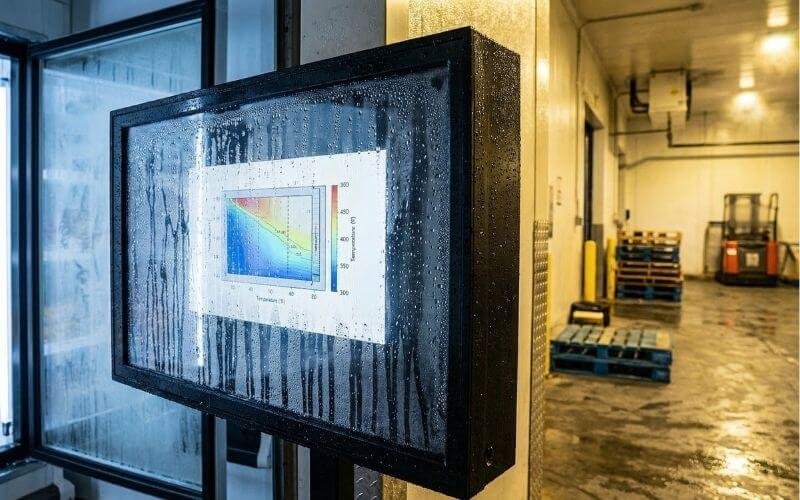
In the modern supply chain, distribution centers and fulfillment hubs operate on razor-thin margins and stringent efficiency metrics. To maintain peak throughput, facility managers deploy digital dashboards across the warehouse floor to display real-time Key Performance Indicators (KPIs), loading dock assignments, and inventory tracking data. However, bringing sensitive commercial electronics into an active industrial warehouse introduces severe operational vulnerabilities.
Deploying standard commercial displays in warehouses and cold storage facilities can lead to rapid hardware degradation from corrugate dust, temperature swings, and forklift impacts. To protect the hardware investment and ensure continuous data visibility, logistics operators should utilize an IP65-rated polycarbonate enclosure paired with a standard commercial display. This decoupling strategy establishes a controlled micro-climate that physically isolates electronics from industrial stressors while keeping fleet deployment costs manageable.
Warehouse IT directors constantly battle environmental attrition. Standard indoor displays are engineered for clean, climate-controlled offices. When mounted above a loading dock or near a sorting conveyor, these delicate monitors are immediately subjected to insulating cardboard dust, extreme temperature fluctuations, and kinetic hazards. In this technical guide, we will analyze the precise environmental threats present in logistics hubs and provide an actionable, scalable blueprint for deploying digital signage safely across sprawling distribution networks.
How we evaluate logistics and warehouse TV deployments at Outvion:
- Foreign material mitigation (specifically insulating corrugate and packaging dust)
- Temperature swing and condensation risk management for cold storage transition zones
- Impact resistance against kinetic hazards like forklifts and swinging pallets
- Fleet scalability and budget optimization using CapEx decoupling
Last Updated: March. 19th. 2026 | Estimated Reading Time: 8 Minutes
By Smith Chen, Outdoor TV Enclosure Engineer at Outvion
Why This Topic Matters to Logistics Operations
Protecting digital displays in a warehouse is not merely an IT concern; it is a critical component of maintaining supply chain throughput and facility efficiency. When screens fail, the resulting data blind spots directly impact dock turnaround times, line balancing, and overall facility pacing.
Before examining the engineering mechanics of enclosure protection, it is vital for facility managers and procurement directors to understand the operational stakes. Modern distribution centers run on complex Warehouse Management Systems (WMS). However, the immense computational power of a WMS is only valuable if its real-time data is continuously visible to the floor staff, forklift operators, and dock managers.
The Cost of the Data Blind Spot
When a KPI screen goes dark due to corrugate dust accumulation or a forklift impact, supervisors and sorters lose their real-time visibility.
- Loss of Pacing: They can no longer see active pick rates, conveyor belt capacities, or shift-target metrics.
- Induced Latency: This immediate blind spot forces workers to revert to manual radio communication or requires them to physically walk to a centralized computer terminal. This introduces severe latency into a fulfillment process where efficiency is measured in seconds.
Disrupting Line Balancing and Dock Turnaround
In high-volume fulfillment or cold-chain logistics, maintaining operational rhythm is everything. A broken monitor is an immediate roadblock to that rhythm.
- Line Balancing Bottlenecks: If a dashboard displaying line-balancing metrics fails, floor supervisors cannot immediately see which packing stations are overwhelmed and which are starving for product. This imbalance leads to rapid localized bottlenecks on the sorting floor.
- Loading Dock Delays: On the loading dock, overhead screens dictate which inbound truck is assigned to which bay and track the loading progress. A broken screen here means drivers wait longer, yard congestion increases, and the carefully orchestrated dock turnaround time (TAT) degrades.
The Hidden IT Maintenance Drain
Furthermore, deploying unprotected screens creates an unsustainable drain on facility maintenance and IT resources.
The Continuity Imperative: Therefore, screen protection in logistics is fundamentally an operations continuity issue, not just an AV hardware problem. Protecting the physical display with an engineered enclosure means protecting the continuous flow of data that dictates the entire facility’s pacing and profitability.
Maintenance Logistics: Replacing a broken monitor mounted 15 feet high on a structural steel pillar is not a simple task. It requires deploying a scissor lift, securing a safety zone on an active forklift floor, and pulling IT technicians away from critical network infrastructure tasks.
The Insulation Threat: Corrugate and Packaging Dust
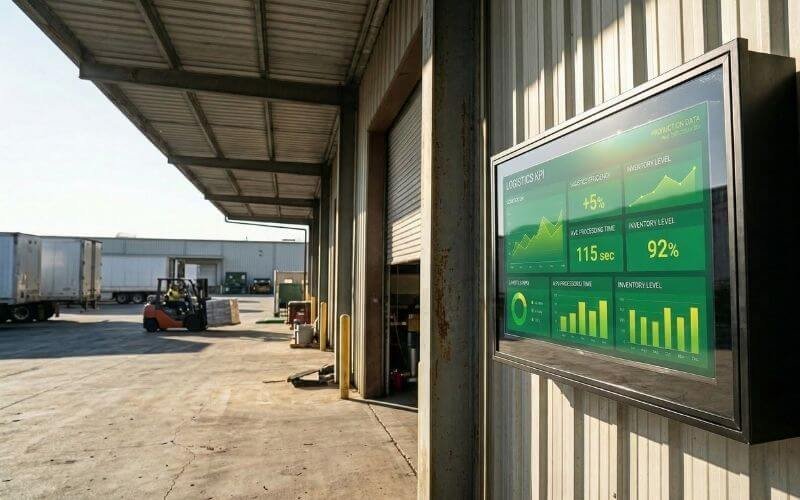
Airborne corrugate dust generated by thousands of cardboard boxes acts as a thermal insulator. An IP6X-rated enclosure provides a dust-tight physical barrier that isolates the sensitive electronics from the ambient warehouse air, helping prevent severe thermal strain and electrical failure.
While falling inventory or forklift collisions are visible threats, the most pervasive and silent killer of electronics in a fulfillment center is airborne particulate matter, specifically corrugate dust.
The Physics of Corrugate Dust
Fulfillment centers process thousands of cardboard boxes, pallets, and packaging materials hourly. The constant friction of cardboard sliding on conveyor belts and the movement of wooden pallets generate a massive volume of fine, airborne organic particulate matter.
- The Intake Vulnerability: Standard commercial displays utilize passive ventilation slots or small internal fans to draw in ambient air for component cooling. In a warehouse setting, these vents function as intake pathways, actively pulling microscopic corrugate dust into the chassis.
- Thermal Blanketing: Unlike metallic dust, corrugate and wood dust are non-conductive but highly insulating. When this dust is drawn into the monitor, it settles directly onto the grooved aluminum heat sinks, the power supply unit, and the LED backlight array.
- Hardware Strain: This layer of dust acts as a thermal blanket, increasing thermal stress and reducing cooling efficiency. As the dust layer thickens over months of 24/7 operation, the internal components experience severe thermal strain, eventually exceeding their maximum safe operating temperatures. This results in premature capacitor degradation and logic board failure.
Dust-Tight Isolation (IP6X)
To ensure continuous operational uptime, the display must be physically isolated from the ambient warehouse air.
- The Physical Barrier: By utilizing a sealed IP65-rated enclosure system, facility managers remove the display’s internal components from the particulate path entirely.
- The IEC Testing Standard: The “6” in the IP65 rating dictates that the enclosure is evaluated as “dust-tight.” This means the enclosure is designed to block fine dust ingress under IP test conditions, which is highly relevant in corrugate-heavy warehouse environments. This prevents microscopic cardboard fibers from penetrating the outer protective shell, preserving the thermal efficiency of the commercial display inside.
Cold Storage and Loading Dock Thermodynamics
Moving between deep-freeze cold storage and ambient loading docks creates massive temperature differentials that trigger internal condensation. An IP65 enclosure acts as a thermal buffer, physically isolating the display and stabilizing the internal micro-climate to reduce moisture-induced corrosion.
Logistics hubs often manage complex temperature zones, ranging from deep-freeze storage for pharmaceuticals or food products to completely unconditioned, open-air loading docks. These transition zones create severe thermodynamic challenges for standard electronics.
The Dew Point and Condensation Cycles
The primary threat in cold chain logistics is not just the cold itself, but the rapid transition of air masses and humidity.
- Temperature Swings: When a display is mounted near the transition doors between a cold storage freezer and an ambient loading dock, it is subjected to massive temperature swings. Warm, humid air from the loading dock constantly clashes with the freezing surfaces near the door.
- Moisture Ingress: If a naked commercial display is placed in this zone, the humid ambient air is drawn into its passive vents. When this warm air contacts the cold internal metal chassis and printed circuit boards (PCBs) of the television, it reaches its dew point.
- Galvanic Corrosion: The water vapor undergoes a phase change, condensing into liquid droplets directly onto the copper traces and microprocessors. Repeated cycles of this condensation lead to microscopic galvanic corrosion, degrading solder joints and permanently destroying the logic board over time.
The Enclosure as a Thermal Buffer
Standard displays lack the engineering to survive these dynamic moisture cycles.
- Micro-Climate Stabilization: An IP65-rated enclosure provides critical physical isolation. By establishing a sealed perimeter, the enclosure significantly reduces the volume of humid ambient air that can interact with the internal display.
- Moisture Exclusion: This breaks the cycle of internal condensation, helping protect the sensitive electrical pathways from moisture-induced corrosion in harsh transition zones.
Warehouse Environmental Threat Matrix
| Warehouse Threat Vector | Mechanism of Hardware Damage | Outvion Defense Strategy |
| Corrugate & Pallet Dust | Acts as an insulator; increases thermal stress and reduces cooling efficiency. | IP6X (Dust-Tight) Seal. Reduces the interaction of ambient dust with internal components. |
| Cold Storage Condensation | Rapid temperature shifts reach dew point; creates internal moisture. | Physical Isolation. The sealed chassis helps stabilize the internal micro-climate. |
| Loading Dock Humidity | Ambient moisture induces slow galvanic corrosion on PCBs. | Sealed Enclosure Design. Prevents humid air drafts from passing through the TV vents. |
| Forklift / Pallet Impacts | Blunt force destroys brittle silicate glass screens. | Polycarbonate Front Shield. Yields and absorbs kinetic energy to prevent shattering. |
Forklift Kinetic Hazards and Impact Resistance
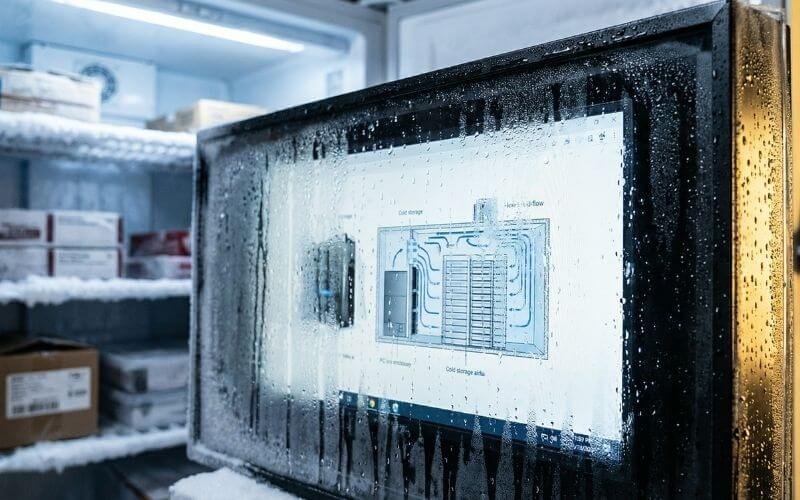
Warehouses are highly active kinetic environments. Standard display glass shatters easily when struck by forklifts or swinging pallets. Outvion enclosures utilize an optical-grade polycarbonate shield engineered to yield and absorb kinetic energy, protecting the screen and preventing dangerous glass shards.
In a fulfillment center, efficiency demands speed. Forklifts, pallet jacks, and automated guided vehicles (AGVs) operate at high pacing. In this kinetic environment, mounting fragile glass screens on structural pillars or at the end of narrow aisles introduces a significant operational vulnerability.
The Fragility of Standard Commercial Displays
The viewing surface of a standard commercial monitor is constructed from silicate glass or basic rigid acrylic.
- The Kinetic Threat: These materials possess a low modulus of elasticity. When subjected to an unintended impact from a swinging wooden pallet, a misjudged forklift turn, or a dropped scanning device, standard glass suffers catastrophic brittle failure.
- Safety Liabilities: A shattered screen in a warehouse presents an immediate safety hazard and compliance concern. Glass shards can fall onto active conveyor belts, contaminate packaged goods, and require a halt of the sorting line for hazardous cleanup protocols.
The Polycarbonate Engineering Defense
To deploy screens safely in high-traffic logistics zones, the physical barrier must be capable of surviving blunt force trauma without fracturing into sharp pieces.
- Material Ductility: Outvion addresses this kinetic risk by utilizing an optical-grade polycarbonate front window. Polycarbonate is an advanced engineering thermoplastic renowned for its extreme impact resistance and structural ductility.
- The Sacrificial Layer: Unlike silicate glass, the molecular structure of polycarbonate allows it to deform elastically under mechanical stress. When struck by a blunt object, the polycarbonate shield acts as a sacrificial protective layer. It flexes inward, absorbs the kinetic energy of the impact, and then rebounds to its original shape.
- Risk Reduction: While a severe, direct impact from heavy machinery may cause localized scratching or denting on the polycarbonate surface, it resists shattering into dangerous shards. By absorbing the destructive energy, the shield protects the delicate LCD panel housed safely behind it, preserving the hardware and supporting warehouse safety protocols.
The Decoupling Strategy for Massive Fleets
Equipping a massive distribution center with specialized, all-in-one industrial monitors creates an unsustainable Capital Expenditure. The decoupling strategy separates the weatherproof infrastructure from the digital display, drastically reducing initial costs and simplifying fleet maintenance.
When tasked with digitizing a sprawling 500,000-square-foot fulfillment center, procurement teams must evaluate the Total Cost of Ownership (TCO) across dozens or hundreds of endpoints. A frequent administrative decision involves evaluating whether to purchase highly specialized, all-in-one “industrial monitors” or to utilize a decoupling strategy.
The Financial Burden of Specialized Hardware
Dedicated, all-in-one industrial monitors are robust, but they present specific financial and logistical considerations for enterprise IT budgets.
- High Capital Expenditure (CapEx): Because these units are niche products manufactured specifically for harsh environments, they command a massive initial premium. Outfitting 50 loading dock doors with these specialized monitors drains IT budgets rapidly.
- The Fused Hardware Trap: In these all-in-one units, the heavy-duty protective housing is permanently fused to the display panel.
- Extended Fleet Downtime: If a forklift manages to severely damage the internal screen, or if the logic board simply fails due to age, the facility loses the entire expensive unit. Replacing it involves a lengthy procurement process, leaving the loading dock blind to critical logistics data.
The Decoupling Advantage
The engineered alternative is the hardware decoupling strategy. By separating the protective infrastructure from the digital display, facility managers gain total control over their AV budget and maintenance timelines.
- The Setup: The strategy involves purchasing a heavy-duty IP65 enclosure and mounting a standard commercial display inside of it.
- Financial Logic: For a 50–55″ setup, Outvion enclosure reference pricing typically starts in the mid-$400s for Basic configurations. When combined with a standard commercial display, the total deployment cost is usually a fraction of the price of a dedicated all-in-one industrial monitor.
- Streamlined OpEx Maintenance: When the commercial display inside the enclosure eventually requires replacement, the maintenance protocol is straightforward. The facility IT technician unlocks the enclosure, unbolts the failed display from the internal VESA mount, and installs a new commercial screen sourced from local inventory. This shifts the ongoing maintenance to a low-cost Operational Expenditure (OpEx).
Logistics Fleet Deployment Options & Financial Modeling
| Deployment Strategy | Initial CapEx Burden | Hardware Replacement Process | Uptime & Serviceability Impact |
| Naked Commercial Display | Low | Discard and replace entire unit frequently. | Unacceptable downtime; constant replacements needed due to dust/impacts. |
| Dedicated Industrial Monitor | Very High | Lengthy procurement or expensive full unit replacement. | High disruption to loading dock data during failure events. |
| Enclosure Strategy | Moderate | Unlock enclosure, swap inexpensive internal screen locally. | Substantially less replacement downtime because the enclosure remains installed. |
Thermal Sizing for High-Ceiling Warehouses
Heat rises, subjecting monitors mounted near high warehouse ceilings to extreme thermal loads. To prevent component failure, hotter installations require ventilated versions sized to the heat load to actively remove waste heat from the enclosure cavity.
A sealed IP65 enclosure successfully isolates the display from external corrugate dust and moisture, but it introduces a secondary engineering challenge: thermal management. An operational commercial display generates internal waste heat from its power supply and LED backlight array.
Thermal Stratification in High-Bay Warehouses
Modern logistics hubs feature high ceilings, often reaching 30 to 40 feet. This architectural design creates a specific thermodynamic phenomenon known as thermal stratification.
- Heat Accumulation: Warm air is less dense than cold air, causing it to rise. The temperature near the ceiling of an unconditioned warehouse can be significantly hotter than the temperature on the floor.
- The Hardware Strain: When KPI dashboards are mounted high on walls or suspended from ceiling trusses for maximum visibility, they are forced to operate in this elevated heat zone. If this ambient heat is combined with the internal heat generated by the TV inside a sealed enclosure, the internal temperature will rapidly exceed the operational threshold of the display.
Active Fan Airflow Mechanics
To combat elevated thermal loads in unconditioned warehouses, the installation must utilize active ventilation.
- Evaluating the Zone: In lower-heat installations (such as air-conditioned packing rooms or cold storage areas), lighter-duty configurations may be sufficient. However, unconditioned high-bay areas, mezzanine levels, or loading docks exposed to direct afternoon sun should favor ventilated Pro or Ultra versions.
- Configuration Sizing: The cooling capacity must scale with the physical volume of the enclosure. In the current Outvion line, ventilated configurations use 2 fans for 28–55″ models and 4 fans for 60″+ models.
- Thermal Relief: Ventilated versions use active fan airflow that helps remove waste heat from the enclosure cavity, drawing cooler ambient air in and exhausting the heated air out. This engineered airflow helps ensure that the internal components remain within safe operating parameters.
Warehouse Thermal Management Matrix
| Warehouse Installation Environment | Ambient Heat Profile | Thermal Risk Level | Recommended Ventilation Approach |
| Cold Storage / AC Packing Room | Cool and stable | Low Risk | Lighter-duty configurations may be sufficient. |
| Standard Loading Dock | Fluctuating, moderate heat | Moderate Risk | Ventilated configurations (2 fans for 28–55″ models). |
| High-Bay Trusses / Mezzanines | High heat due to stratification | High Risk | Ventilated Pro or Ultra versions (4 fans for 60″+ models). |
Industrial Installation & Mechanical Sealing SOPs
Warehouse installations require heavy-duty structural anchoring, strict cable gland sealing, and proper drip loops. Dust and humidity can bypass the primary seal through the cable exit if a gap is left open.
Deploying an IP65 enclosure provides a robust physical defense, but the integrity of that defense relies entirely on proper installation protocols adapted specifically for the industrial logistics environment.
Structural Anchoring in the Warehouse
The mechanical bond between the wall mount and the facility structure must withstand the ambient vibration generated by heavy machinery and conveyors.
- Mounting Substrates: In a warehouse, displays are rarely mounted to standard drywall. Installers must utilize heavy-duty hardware to anchor the enclosure’s backplane directly to structural steel I-beams, concrete pillars, or specialized unistrut framing.
- Hardware Selection: Use high-grade industrial fasteners appropriate for the substrate to ensure the heavy cantilevered load remains secure despite the constant vibrations of the facility.
Cable Routing and Drip Loops
The physical entry point into the enclosure must be tightly sealed to maintain the IP65 rating.
- Compression Sealing: Outvion utilizes specialized foam blocks or compression glands at the bottom exit points. During final assembly, technicians must route all power and ethernet cables neatly through these pathways and ensure the grommets are tightly compressed around the wire jackets. Corrugate dust and humidity can bypass the primary seal through the cable exit if a gap is left open.
- The Drip Loop Technique: If the display is mounted near an open loading dock door where rain or condensation is present, installers must implement a “Drip Loop.” This requires leaving a slack, U-shaped loop of cable hanging below the level of the wall outlet. Gravity forces any moisture to drip harmlessly off onto the ground, preventing it from traveling along the cable.
Conclusion: Securing the Logistics Data Network
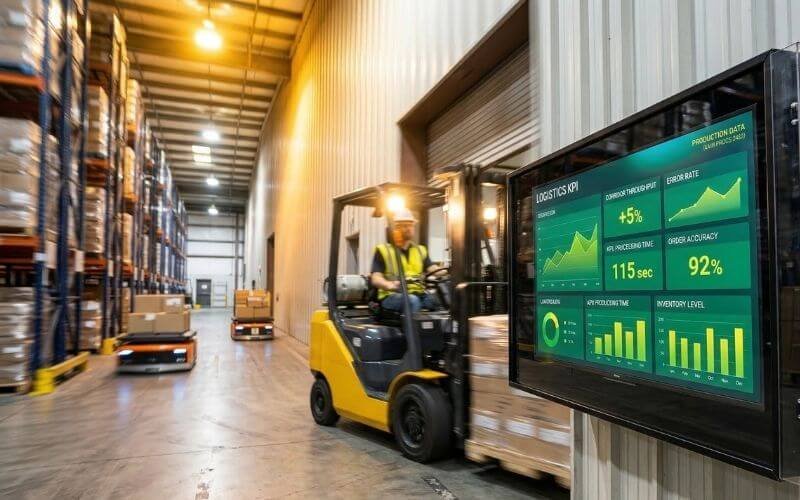
In the relentless environment of a modern logistics and fulfillment center, providing reliable digital data visibility is essential for maintaining throughput, tracking inventory, and managing dock schedules. However, deploying sensitive commercial displays without engineered protection can lead to rapid hardware degradation and introduces severe operational liabilities.
Relying on naked commercial displays is a critical failure of asset management, while purchasing specialized all-in-one industrial monitors restricts budget flexibility across a massive fleet. By utilizing the decoupling strategy with an IP65 polycarbonate enclosure, facility managers achieve a practical balance of rugged physical security, environmental protection, and operational agility. Implementing this engineered barrier helps ensure that critical KPI dashboards remain operational, hardware lifespans are extended, replacement downtime is minimized, and the overall continuity of the supply chain is preserved.
Warehouse TV Protection FAQ
1. Does this strategy support commercial digital signage displays?
Yes. The enclosures feature standard VESA mounting patterns on the internal steel backplane. This universal compatibility allows logistics hubs to deploy high-brightness commercial displays or centrally managed signage screens that support standard IT management systems, depending on the facility’s specific software requirements.
2. Can the polycarbonate window be completely broken by a forklift?
While optical-grade polycarbonate is exceptionally tough and designed to absorb massive kinetic energy, extreme, deliberate force with heavy industrial machinery can eventually scratch, craze, or crack the shield. However, it is engineered as a sacrificial layer; even if it cracks under severe abuse, it resists shattering into the sharp glass fragments associated with standard commercial displays.
3. Do I need to seal the enclosure with silicone caulking?
No. Engineered enclosures use specialized internal gaskets designed to maintain the seal under mechanical compression. Adding aftermarket silicone to the exterior can block intended drainage pathways, fan openings, air paths, and ventilation components, causing moisture retention and severe overheating in unconditioned warehouses.
4. How quickly can a failed screen be swapped on the loading dock?
The decoupling strategy allows maintenance to unlock the bezel and swap the internal display with substantially less replacement downtime because the enclosure remains installed on the pillar or wall. It is usually much faster and less expensive than uninstalling, shipping, and replacing a full all-in-one industrial monitor.
Recommended Technical Reading & Resources
- Ingress Protection Standards:IEC 60529: IP Ratings Explained
- The official international standard defining the rigorous testing methodologies required to classify an enclosure as “dust-tight” against fine industrial particulates.
- Condensation Physics:Thermodynamics of the Dew Point (National Weather Service)
- A scientific explanation of how relative humidity and ambient temperature drops intersect to create condensation on cool surfaces in transition zones.
- Material Science of Polycarbonate:Polycarbonate vs. Acrylic Impact Properties (Curbell Plastics)
- A technical breakdown explaining the modulus of elasticity and why polycarbonate yields and absorbs kinetic energy, making it a superior choice for high-impact logistics environments.