
A gym does not have one indoor environment.
- The reception area may feel dry.
- The main fitness floor may be controlled by HVAC.
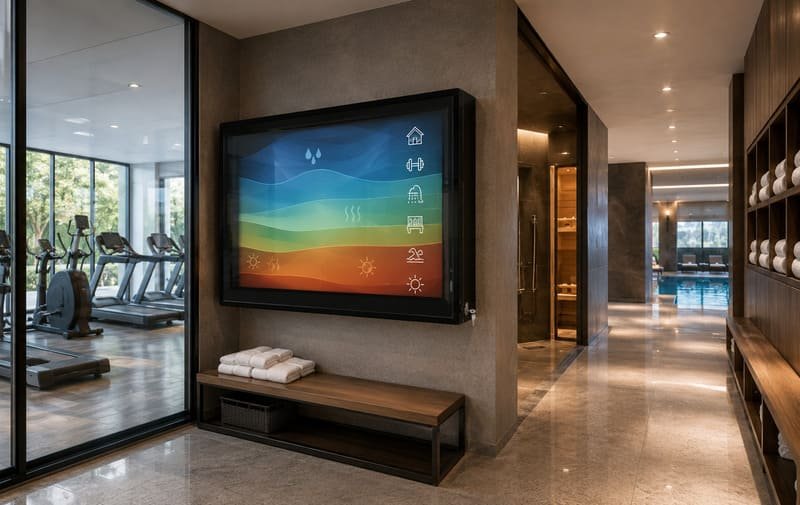
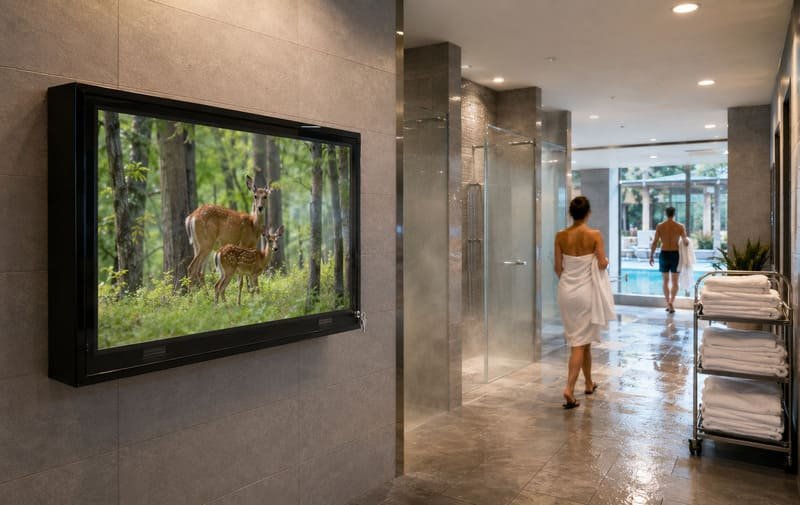
- The shower corridor may stay damp after every busy period.
- The sauna wall may face warm humid air for hours.
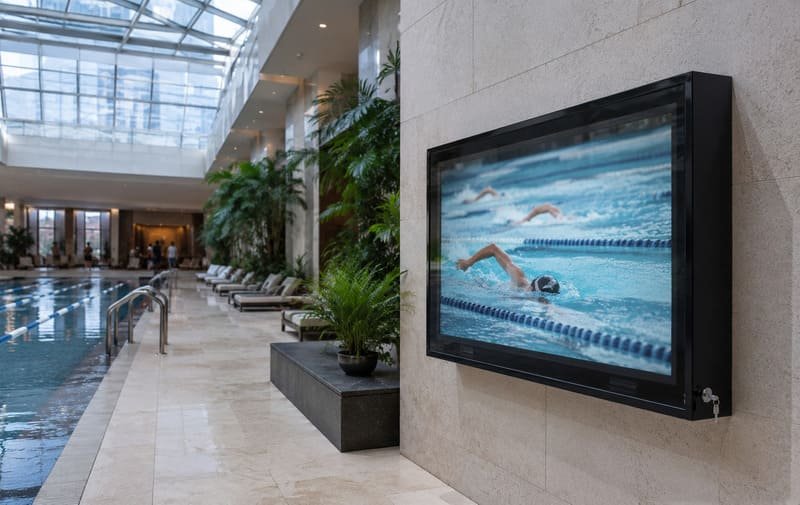
- The indoor pool hall may carry moisture all day.
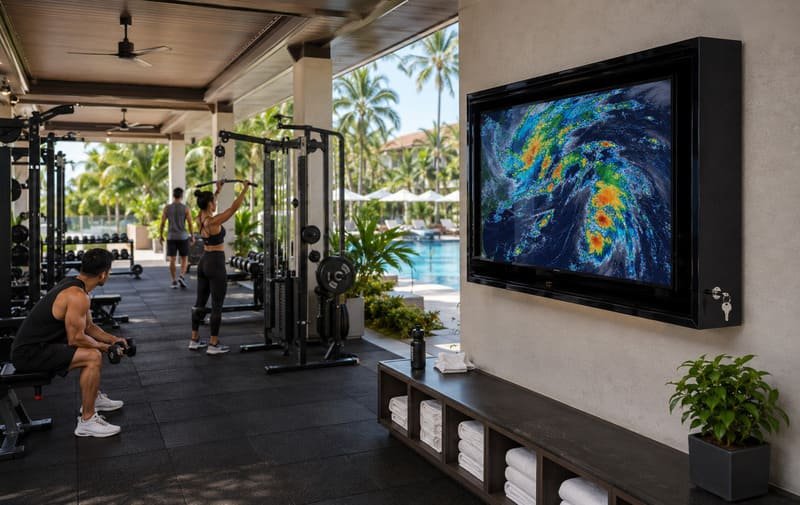
- The outdoor deck may add splash, sunlight, cleaning spray, and wind.
That is why TV protection in gyms and pool clubs should start with humidity zoning. A screen near a treadmill wall, an indoor pool, a shower corridor, a sauna entrance, and an outdoor pool deck does not face the same moisture, heat, cleaning, or service risk.
When I review a gym or pool club TV project, I do not begin with the screen size.
I begin with the zone.
- Where does humid air collect?
- Where do staff use cleaning spray?
- Where are members walking, sweating, showering, or carrying wet towels?
- Where does the TV receive direct sun or heat from windows?
- Where can the enclosure be opened safely for service?
- Who will inspect vents, cables, locks, and front panels after installation?
Those questions are more useful than simply asking whether the screen is “waterproof.”
A humidity-prone facility is not one environment.
It is a collection of environments that need different protection decisions.
Last Updated: June 29th 2026 | Estimated Reading Time: 8 Minutes
By Smith Chen, Outdoor TV Enclosure Engineer at Outvion
Why Should TV Protection Start With Humidity Zones?
A facility manager should not protect every gym or pool club TV in the same way. The moisture source, air movement, cleaning routine, and staff access can change dramatically from one area to another.
Gym and pool club TV protection should start with humidity zoning because a standard fitness floor, shower corridor, sauna wall, indoor pool hall, and outdoor pool deck create different moisture, heat, cleaning, and service risks. A suitable enclosure setup should match the actual zone, not only the TV size.
This is where many projects go wrong.
A buyer may see a TV mounted in a gym and assume it is an ordinary indoor installation. But a screen beside a pool, changing room, shower corridor, or sauna entrance may experience a much more demanding environment than the same TV mounted on a dry reception wall.
The difference is not always visible on the first day.
It appears over time through moisture around cable areas, dirt trapped near vents, repeated cleaning exposure, condensation cycles, heat buildup, and difficult service access.|
Gym and Pool Club Humidity Zone Map
| Zone | Typical Moisture Source | Main TV Protection Priority |
|---|---|---|
| Standard Fitness Floor | Sweat vapor, HVAC variation, dust | Placement, glare control, basic ventilation |
| Cardio Wall Near Windows | Sun, heat, HVAC changes | Heat path, glare review, wall clearance |
| Shower Corridor | Steam bursts, damp traffic, cleaning spray | Distance from steam path, protected cable entry |
| Sauna-Adjacent Wall | Warm humid air, temperature changes | Avoid direct steam path, airflow, service access |
| Indoor Pool Hall | Evaporation, condensation cycles, chlorine-related cleaning routines | Enclosure, airflow, regular inspection |
| Outdoor Pool Deck | Splash, rain, sunlight, public contact | IP-rated enclosure, shade, cable protection |
| Coastal Pool Club | Salt air plus humidity | Corrosion-aware hardware and inspection schedule |
| Covered Outdoor Training Area | Morning dew, dust, warm air, occasional rain | Placement, airflow, cable exits, front-panel cleaning |
A useful rule is simple:
The closer the TV is to steam, splash, humid air, chemical cleaning, or public contact, the more the project should be treated as a controlled protection installation rather than a normal wall-mounted TV setup.
Does a TV Need Direct Water Contact to Be Damaged?
No. Direct rain or splash can create obvious problems, but long-term humidity exposure can also become a reliability issue when moisture, condensation, dust, and contaminants reach vents, connectors, cable areas, or internal electronics.
A TV does not need to be soaked to face humidity-related risk. In gyms and pool clubs, repeated exposure to warm humid air, condensation cycles, steam, and cleaning routines can create a more gradual maintenance problem than one dramatic water event.
This is why I do not describe humidity as simply “water in the air.”
Humidity matters because it can interact with other conditions.
Warm air can carry moisture around the screen.
Cooler surfaces can create condensation conditions.
Dust can stick more easily to damp surfaces.
Cleaning chemicals can reach cable areas or front panels.
Salt air can increase corrosion risk in coastal locations.
Repeated opening and closing can affect gaskets and service points.
The National Weather Service explains how dew point relates to the point where moisture can condense from the air. That concept is useful for pool halls and sauna-adjacent areas because the temperature around the screen may change throughout the day, especially after evening cooling or HVAC changes.
A standard indoor TV is usually designed for controlled indoor conditions. It is not automatically designed for persistent pool-hall humidity, shower steam, splash-prone cleaning routines, or a semi-outdoor gym environment.
Humidity Is Not One Risk
| Humidity Pattern | What It Means | Practical Protection Response |
|---|---|---|
| Constant Humid Air | Indoor pool hall or warm pool area | Enclosure planning, airflow, inspection routine |
| Short Steam Bursts | Shower corridor or sauna entrance | Avoid direct steam path and tight recesses |
| Splash Exposure | Outdoor or indoor pool deck | Mounting height, front protection, cable control |
| Cleaning Spray | Daily floor and deck maintenance | Keep high-pressure spray away from seams and vents |
| Condensation Cycle | Day-night or HVAC temperature change | Clearance, airflow, service checks |
| Salt Plus Humidity | Coastal gym or pool club | Corrosion-aware hardware and regular inspection |
| Sweat and Member Traffic | Busy fitness floor | Safe height, front-panel cleaning, cable protection |
The key point is not that every humid area needs the same enclosure.
The key point is that each area needs the right level of protection for the way moisture actually reaches the screen.
What Does IP65 Help With — and What Does It Not Solve?
IP ratings are important because they give buyers a defined reference point. But IP65 should be treated as one layer of the protection plan, not as the full answer to humidity.
IP65 can indicate dust-tight protection and protection against water jets under defined test conditions. It can help with rain, splash, and dust exposure, but it does not mean steam-proof, condensation-proof, chemical-proof, pressure-wash-proof, heat-proof, or maintenance-free.
The International Electrotechnical Commission explains that IP ratings classify enclosure protection against dust and liquids. This makes IP65 a useful starting point for pool decks, covered outdoor gym zones, and other exposed commercial locations.
But humid air and condensation are separate planning issues.
An enclosure can carry an IP65 rating and still need proper placement.
A cable exit still needs sealing and strain relief.
A fan area still needs inspection.
A gasket still needs to be checked after repeated service access.
Cleaning staff still need to know where not to direct pressure spray.
That is why I ask buyers to think beyond the rating.
What I Check Beyond the IP Rating
| Buyer Question | What I Review | Why It Matters |
|---|---|---|
| Is it weather-protected? | IP rating, gasket design, cable exits | Establishes the basic exposure level |
| Can it handle humid air? | Zone type, airflow, clearance, steam path | Humidity is not the same as rain |
| Can it handle splash? | Mounting height, pool distance, screen orientation | Water may come from below or the front |
| Can staff clean around it safely? | Cleaning routine and spray direction | Prevents avoidable seal and vent damage |
| Can it be serviced without disruption? | Door opening clearance, lock access, cable plan | Helps reduce downtime |
| Is it near the coast? | Hardware material and corrosion plan | Salt can affect small metal parts first |
For a gym or pool club, the practical question is not:
“Does it have IP65?”
The more useful question is:
“Does the rating, installation, and service routine match this humidity zone?”
How Should Enclosures Manage Heat, Airflow, and Steam?
A TV enclosure cannot simply be sealed shut and forgotten. A running display creates heat, and a humid facility creates moisture-management challenges at the same time.
Gym and pool club TV enclosures need a controlled airflow plan. Fan-assisted airflow can help reduce heat buildup and stagnant air, but it is not air conditioning and does not eliminate condensation, steam, or environmental humidity.
I think about airflow differently in a humid facility.
In a dry office, airflow is often discussed only as a heat issue.
Near pools, showers, saunas, and semi-outdoor gyms, airflow also affects how long warm humid air remains trapped around the TV. That does not mean fans “remove humidity” in every condition. It means stagnant air is usually less helpful than managed air movement.
Sony advises using TVs within their recommended temperature range and avoiding unnecessary direct sunlight exposure. This is why heat planning should include sun direction, TV runtime, wall temperature, enclosure clearance, fan access, and the practical ability to clean vents.
Airflow and Steam Review Checklist
| Factor | What I Look For | Why It Matters |
|---|---|---|
| Fan Function | Fans operate and can be inspected | Helps move accumulated warm air |
| Vent Path | Intake and exhaust are not blocked | Maintains usable airflow |
| Internal Clearance | TV is not pressed tightly against enclosure surfaces | Gives air room to circulate |
| Steam Path | Screen is not directly beside sauna or shower exhaust | Reduces repeated direct vapor exposure |
| Sun Exposure | Direct afternoon sun is avoided where possible | Reduces heat load before operation |
| Operating Hours | Daily runtime is realistic for the TV and site | Longer use increases thermal demand |
| Cleaning Access | Vents can be cleared without removing the full installation | Supports long-term serviceability |
For humid facilities, I would not place a screen in a tight recess just because the space looks neat.
A tight recess can reduce service access, restrict airflow, and make inspection harder.
The cleanest-looking installation is not always the easiest installation to keep reliable.
What Should Facility Managers Check Before Installation?
A successful TV installation begins before ordering. The facility manager, installer, and supplier should agree on the humidity zone, mounting location, cable route, airflow path, cleaning routine, and long-term service plan.
Before approving a gym or pool club TV project, facility managers should confirm humidity zone, cleaning routine, viewing distance, mounting height, service access, fan maintenance, TV fit, cable path, and who owns the inspection schedule after installation.
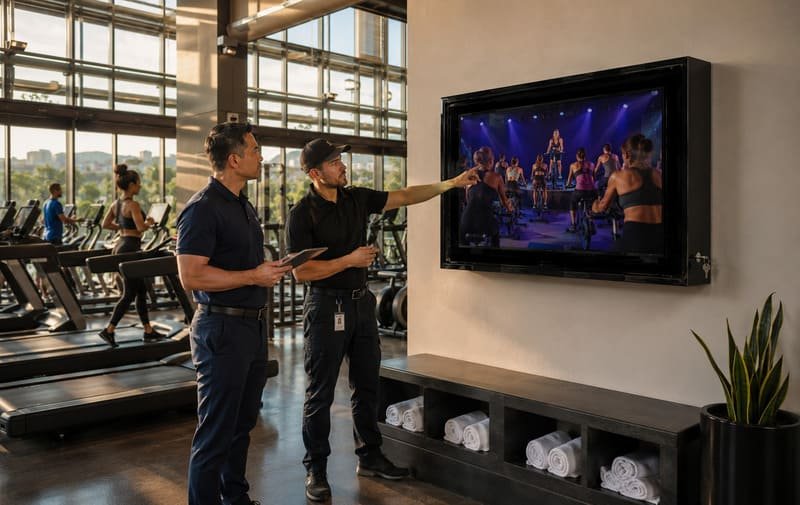
This is where photos and basic site drawings are valuable.
A product specification sheet cannot show:
- Whether shower steam drifts toward the wall
- Whether cleaning staff use direct spray near the screen
- Whether the TV faces afternoon sun
- Whether a pool deck is crowded during peak hours
- Whether the enclosure can be opened without moving furniture or equipment
- Whether the wall surface can support the full weight safely
- Whether cable access is protected from public contact
TV size is also more than a diagonal measurement. LG explains that buyers should review the full width, height, and depth of a specific TV model rather than relying only on the screen-size label.
Mounting needs the same attention. Ergotron explains the VESA mounting standard used for the four-hole display attachment interface. The TV must not only fit the enclosure; it must mount safely, leave room for cables, and allow airflow around the body.
Facility Manager Pre-Installation Checklist
| Check Item | What to Confirm | Why It Matters |
|---|---|---|
| Humidity Zone | Pool hall, shower corridor, sauna wall, cardio floor, outdoor deck | Determines the real exposure level |
| TV Model | Exact brand and model number | Prevents guessing based on screen size |
| TV Dimensions | Width, height, depth, port position | Confirms internal fit and cable clearance |
| VESA Pattern | Mounting-hole layout and screw type | Supports safe enclosure mounting |
| Wall Structure | Concrete, brick, steel, timber, or custom structure | Determines anchors and installation method |
| Cleaning Routine | Wipe-down, mop, low-pressure wash, or chemical spray | Helps protect seams, vents, and cable exits |
| Steam or Splash Path | Where moisture travels during normal operation | Supports placement decisions |
| Sun and Heat Exposure | Direct sun, hot windows, warm deck surface | Supports airflow and brightness planning |
| Service Access | Space to open, inspect, clean, reset, or replace | Reduces future labor and downtime |
| Inspection Owner | Staff member, facility manager, AV contractor, or maintenance team | Prevents maintenance responsibility from being unclear |
This checklist is not bureaucracy.
It is how a facility avoids buying the right enclosure for the wrong wall.
When Does an Enclosure-Based System Make Sense for Gyms and Pool Clubs?
An enclosure-based system is often useful when a facility wants to use standard TVs while adding a fixed protection layer, controlled access, serviceability, and future replacement flexibility.
Gyms and pool clubs often choose enclosure-based systems when they need several screens, want repeatable installation standards, need physical protection around member areas, or prefer to replace the TV inside later rather than replace an entire specialized outdoor display.
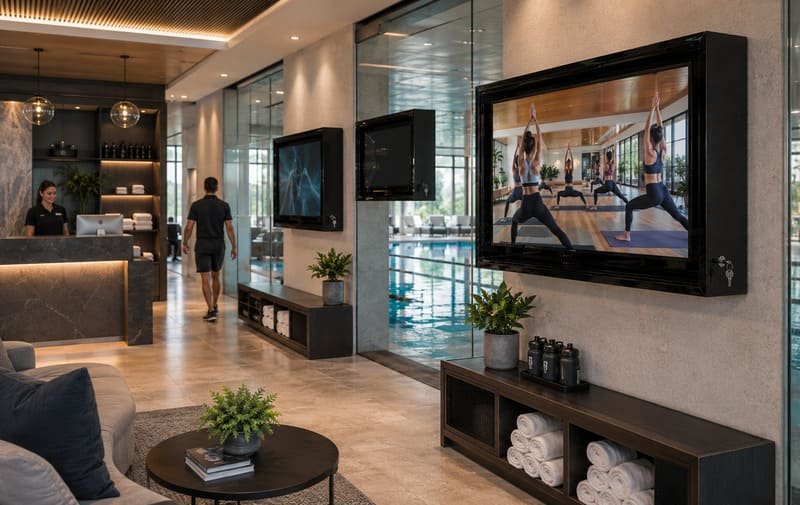
A single premium outdoor TV may be the right decision for a flagship full-sun screen or a location that needs an integrated outdoor-rated display.
But many facilities are not planning one screen.
They may need displays in:
- Cardio zones
- Pool halls
- Spin studios
- Outdoor training areas
- Pool bars
- Reception-facing workout spaces
- Multi-location fitness clubs
Once multiple screens are involved, standardization becomes more important.
The enclosure can remain in place.
The TV inside may be replaced later if the fit remains compatible.
Staff can follow the same lock, cleaning, cable, and inspection routine across locations.
Maintenance teams can hold compatible spare TVs or cables more easily.
CIPS describes Total Cost of Ownership as an end-to-end view that includes purchase, acquisition, use, and end-of-life costs. That concept is useful here because a facility manager should compare more than the first display price.
Why Commercial Facilities May Prefer Enclosure-Based Planning
| Facility Need | Enclosure-Based System Benefit |
|---|---|
| Multiple Screens | Supports repeatable layouts and service routines |
| Future TV Replacement | May allow replacement of the inner TV if fit remains compatible |
| Member and Guest Traffic | Adds a physical layer around the screen and cables |
| Cleaning Operations | Defines where staff can clean and where spray should be avoided |
| Mixed Humidity Zones | Allows enclosure configuration to follow the specific location |
| Budget Control | Helps buyers plan replacement and maintenance separately from the protective shell |
| Facility Standardization | Simplifies procurement and staff training across sites |
The goal is not to claim that an enclosure is always better than a dedicated outdoor display.
The goal is to choose the system that fits the facility’s zones, staffing model, exposure level, and replacement plan.
Questions Facility Managers Ask Before Protecting Gym and Pool Club TVs
Can I use a standard indoor TV inside a gym or pool club enclosure?
In many projects, yes. A standard TV can be practical if it fits the enclosure, the VESA pattern matches, cable clearance is available, airflow is planned, and the humidity zone is realistic. The enclosure does not change the TV manufacturer’s original outdoor-use category or warranty terms.
Is IP65 enough for an indoor pool area?
IP65 can be a useful baseline for dust and water-jet protection under defined conditions. But indoor pool areas also need airflow, placement, steam-path review, cable protection, cleaning discipline, and inspection. IP65 alone does not solve condensation or maintenance issues.
Can an enclosure protect a TV from shower or sauna steam?
It can help reduce direct exposure when installed outside the main steam path, but it should not be treated as steam-proof. Placement matters. I would avoid putting the screen directly in front of sauna exits, shower vents, or areas where warm vapor repeatedly reaches the enclosure.
Will an enclosure affect picture quality or remote control?
A clear front panel adds another viewing surface, so glare, light angle, and panel cleanliness should be reviewed. Remote performance depends on the TV’s IR receiver position and the enclosure material or design. Confirm remote-control compatibility with the supplier for the selected TV and enclosure model.
How often should staff inspect the enclosure?
Inspection frequency depends on the humidity zone. Pool halls, outdoor decks, coastal clubs, shower corridors, and sauna-adjacent areas should be checked more often than dry fitness floors. Review front-panel cleanliness, vents, fans, locks, hinges, gaskets, cable exits, and mounting hardware before peak periods and after major weather events.
What information should I send before requesting a quote?
Send the exact TV model, full TV dimensions, VESA pattern, installation photos, location type, humidity zone, cleaning routine, sun exposure, expected operating hours, cable direction, wall type, and whether the site is coastal, indoor poolside, outdoor poolside, sauna-adjacent, or shower-adjacent.
Conclusion
A gym TV is not always in a dry indoor room.
- Sometimes it is near a pool hall.
- Sometimes it faces shower steam.
- Sometimes it sits above a cardio area where HVAC and heat shift all day.
- Sometimes it is outdoors beside a pool deck.
- Sometimes it is close enough to a sauna corridor that warm humid air becomes part of normal operation.
That is why I would not protect every gym or pool club screen the same way.
I would map the zone first.
Then I would choose the enclosure, airflow, placement, cable route, mounting method, cleaning routine, and service plan around that zone.
Humidity protection starts with knowing where the screen really lives.
Not with a generic product label.
Not with a single IP rating.
And not with the assumption that every TV wall inside a gym is an ordinary indoor wall.