Can You Use an Indoor TV Outside Safely? What Actually Works
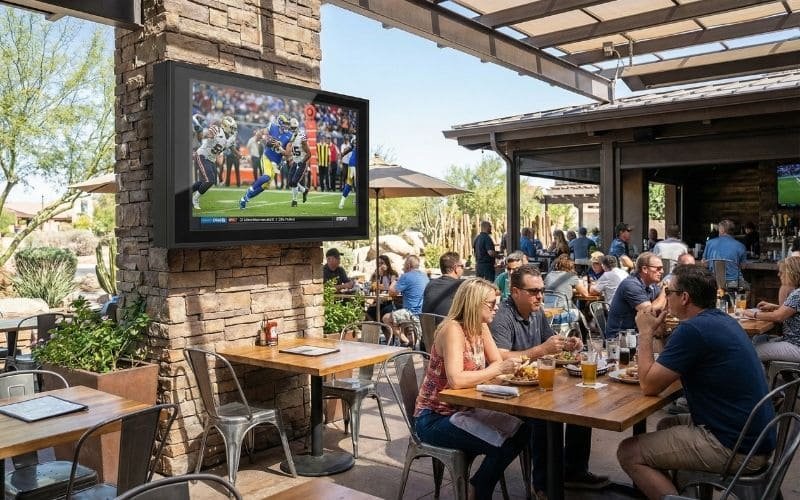
Yes, you can use a standard indoor TV outside, but only under specific conditions.
Placing a regular flat-screen television outdoors requires it to be housed inside a weatherproof enclosure, installed with safe outdoor power routing, positioned to minimize direct sun exposure, and matched with the correct ventilation level for your specific local climate. Without meeting these baseline conditions, outdoor elements such as high heat, condensation, dust, and insects will drastically shorten the television’s lifespan or create serious electrical reliability risks.
As an engineer specializing in outdoor AV protection, I frequently consult with homeowners and commercial integrators who want to maximize their patio entertainment budget without sacrificing safety. The transition from a climate-controlled living room to an outdoor patio exposes sensitive electronics to a volatile mix of thermodynamic and environmental stressors.
How This Guide is Different?
If you are browsing the Outvion engineering blog, you may notice we cover outdoor AV setups extensively. This specific guide acts as the foundational starting point. It focuses strictly on the basic decision: whether a standard indoor TV can be used outdoors at all, the core engineering conditions required, and how to evaluate your options objectively.
How we evaluate outdoor TV feasibility at Outvion:
A standard indoor TV can work safely outside only if it is secured inside a weatherproof barrier, connected to safe outdoor power, positioned to minimize direct sun, and actively ventilated according to the local climate.
An indoor television is engineered for a controlled indoor environment, not for repeated outdoor humidity swings and heat loading. Its internal components, particularly the power supply and delicate ribbon cables, assume this stability. To safely transition this hardware to an outdoor patio, backyard, or commercial bar, you must artificially recreate that safe operating environment.
A standard indoor TV can work safely outside only if the following four foundational conditions are met:
1. Secured Inside a Weatherproof Barrier
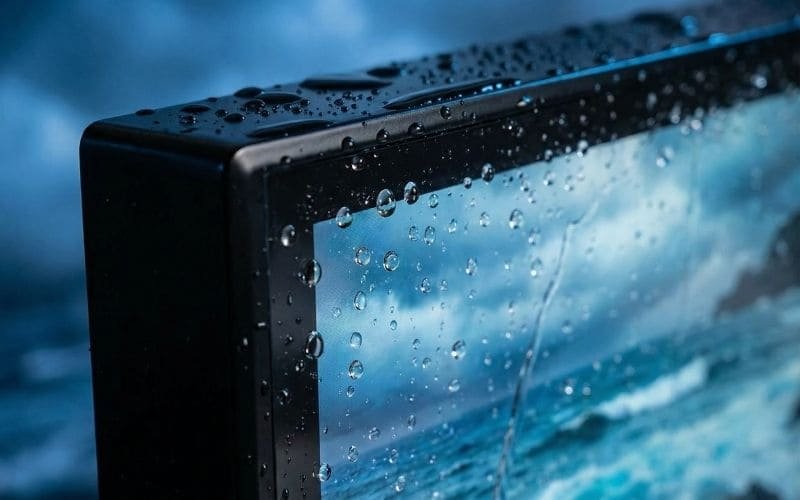
A roof or a patio awning is insufficient protection. The television must be isolated from the ambient environment using an engineered enclosure. For this use case, an IP65-rated enclosure is a strong practical target because it is dust-tight and resistant to low-pressure water jets under proper installation. This barrier is the primary defense against wind-driven rain, morning dew, and airborne debris.
2. Safe and Compliant Outdoor Power Routing
Running a standard indoor extension cord across a wet patio to power a television is an unacceptable safety risk. Outdoor AV installations must adhere to local electrical codes. This typically requires routing power through weather-sealed conduit and utilizing GFCI (Ground Fault Circuit Interrupter) protected outlets. Furthermore, the enclosure itself must feature sealed bottom cable exits to ensure that moisture cannot travel up the power cord and enter the protective chassis.
3. Minimized Direct Sun Exposure
Standard consumer televisions are not designed to absorb direct solar radiation. The black plastic bezels and the LCD/OLED panels themselves absorb heat rapidly. Prolonged direct sun exposure can push the internal components past their thermal limits. When planning the installation, orient the screen and mount position to minimize prolonged direct afternoon sun and reduce glare.
4. Appropriate Active Ventilation
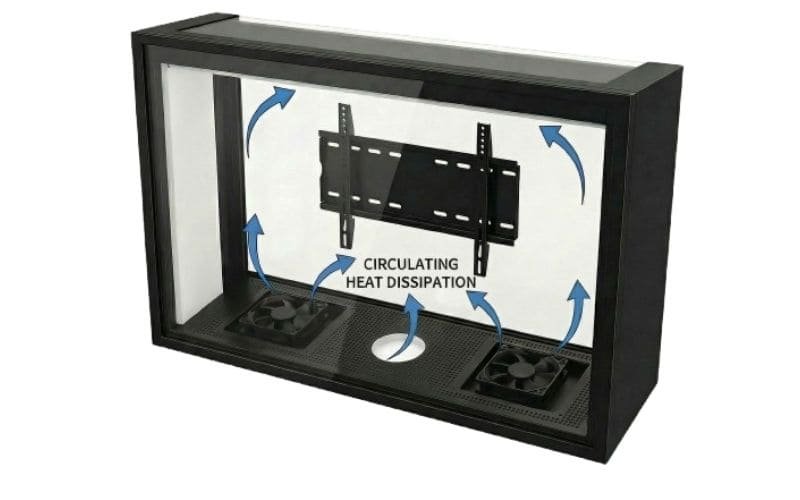
Placing a heat-generating electronic device inside a sealed box creates a thermal trap. To safely use an indoor TV outside, the protective enclosure must feature active thermal management that matches your climate. This means choosing active fan ventilation matched to the climate and screen size, drawing ambient air in and exhausting hot air out to help keep the internal temperature within safe operating specifications.
The Engineering Risks of “Naked” Outdoor Placement
Leaving an indoor TV exposed outdoors without a protective enclosure inevitably leads to rapid hardware failure due to condensation causing electrical shorts, extreme heat damaging the display panel, and insects nesting inside the warm chassis.
Why do indoor TVs fail so predictably when left unprotected outside? It is not simply a matter of getting rained on; the failures are driven by basic thermodynamics, material limitations, and biological factors.
1. The Condensation Cycle and Electrical Risks
An indoor TV’s rear chassis is covered in open ventilation slats designed for passive convective cooling. Outdoors, even if a TV is mounted deep under a waterproof roof and completely shielded from rain, these open vents leave the internal circuitry highly vulnerable to humidity.
As outdoor temperatures drop overnight and rise in the morning, ambient humidity enters the open chassis and condenses into microscopic water droplets directly on the mainboard, capacitors, and power supply. Over time, this recurring condensation cycle causes rapid oxidation and corrosion of the exposed copper traces. Eventually, this moisture bridging can lead to electrical shorts, rendering the television permanently inoperable and creating severe reliability risks.
2. Thermal Degradation of the Display Panel
Indoor TVs do not possess the heavy-duty, oversized aluminum heat sinks found in specialized industrial displays. They rely on the ambient air of a cool living room to shed waste heat.
If a naked indoor television is exposed to high ambient summer temperatures, its internal operating temperature can quickly exceed the manufacturer’s safe limits. High continuous heat places immense stress on the electrolytic capacitors within the power supply. Furthermore, excessive heat can cause the liquid crystals in the display panel to suffer from thermal strain, resulting in display darkening, color shifting, image distortion, or permanent panel damage.
3. Particulate Ingress and Biological Threats
The outdoors is filled with airborne particulates—pollen, dust, and coastal salt air—that indoor environments filter out. When drawn into a naked TV, this debris coats the internal components, acting as a thermal insulator that traps even more heat.
Additionally, the warmth generated by a TV’s standby power actively attracts local wildlife. It is highly common for wasps, spiders, and mud daubers to utilize the open ventilation slats of naked indoor TVs to build nests inside the warm, dry chassis. These biological intrusions can block cooling fans, damage fragile wiring, and create significant maintenance headaches.
Weatherproof outdoor TV enclosure with waterproof sealed frame and rain protection.
Ingress Protection (IP) Ratings Explained for AV
Not all outdoor covers are created equal. When evaluating enclosures for an indoor TV, an IP65 rating is the recommended engineering target, as it ensures complete protection against dust ingress and resistance to multi-directional water splashes.
When evaluating how to protect your indoor TV outside, you will frequently encounter the term “IP Rating.” IP stands for Ingress Protection, an international engineering standard (IEC 60529) used to define levels of sealing effectiveness against foreign bodies (tools, dirt, dust) and moisture.
Understanding this rating is critical because a simple canvas cover or a loosely built wooden box does not meet the necessary standards to protect high-voltage electronics. The rating consists of two numbers: the first indicates protection against solids (dust), and the second indicates protection against liquids (water).
Common IP Ratings for Outdoor AV Environments
IP Rating
Solid Protection (1st Digit)
Liquid Protection (2nd Digit)
Suitability for Outdoor TVs
IP44
Protected against objects > 1mm (wires, ants)
Protected against splashing water from any direction
Low. Allows fine dust and humidity to enter easily.
IP54
Dust-protected (limited ingress permitted)
Protected against splashing water
Moderate. Fine for highly protected, deep-cover patios.
IP55
Dust-protected
Protected against low-pressure water jets
Good. Standard for many commercial outdoor displays.
IP65
Dust-tight (No ingress of dust allowed)
Protected against low-pressure water jets
Excellent. The target standard for professional TV enclosures.
For this use case, an IP65-rated enclosure (like those designed by Outvion) is a strong practical target. The “6” ensures that microscopic pollen and dust cannot enter the enclosure to blanket the TV’s motherboard, while the “5” ensures that blowing rain or a misdirected garden hose will not penetrate the internal cavity, provided the bottom cable glands are properly sealed during installation.
The Protective Solution: Enclosures vs. Dedicated Outdoor TVs
While dedicated outdoor TVs are built for full-sun exposure, they carry a massive upfront cost. For most residential and commercial patios, decoupling the hardware by placing an affordable indoor TV inside an IP65-rated enclosure provides robust protection at a much more practical price point.
If leaving an indoor TV naked is not a viable engineering option, homeowners and commercial operators generally must choose between two primary deployment paths: purchasing a dedicated, all-in-one outdoor television, or utilizing a decoupling strategy by placing a standard indoor TV inside a protective enclosure.
Outdoor AV Deployment Options Comparison
Deployment Option
Best Suited For
Primary Engineering Limitation
Naked Indoor TV
None.
Not suitable outdoors. Extreme risk of electrical failure, moisture corrosion, and rapid hardware degradation.
Indoor TV + Enclosure
Most residential patios, covered backyards, and commercial hospitality settings.
Requires correct sizing, proper installation, and matching fan ventilation configurations to the local climate.
Dedicated Outdoor TV
Full-sun applications; specialty premium luxury installs with unlimited budgets.
Significantly higher upfront Capital Expenditure (CapEx) and expensive full-unit replacement if internal components fail.
The Decoupling Strategy (TV + Enclosure)
For the vast majority of patio setups, pairing a commercial or standard indoor TV with an engineered enclosure is the most practical and financially sound approach. In commercial AV integration, this is referred to as a “decoupling strategy”—separating the expensive, long-lasting weather protection hardware from the rapidly aging digital display technology.
The Physical Protective Barrier: Professional enclosures (like those engineered by Outvion) utilize an impact-resistant polycarbonate front window. They target the IP65 standard to act as a barrier against dust ingress and low-pressure water jets under proper installation. This physical barrier effectively mitigates the condensation, dust, and insect problems by isolating the television from the ambient environment.
Active Thermal Management: To solve the heat accumulation problem, high-quality enclosures utilize active airflow. They feature integrated fan systems that cycle fresh air through the internal cavity, stripping away the TV’s operational waste heat and keeping the internal temperature stabilized within safe operating ranges.
Cost-Effective Procurement: Rather than allocating thousands of dollars for a single dedicated outdoor TV, an enclosure allows you to protect a standard, affordable screen. For a standard 50–55″ setup, Outvion enclosure pricing typically starts in the mid-$400s (for Basic configurations), with higher-spec Pro or Ultra versions designed for heavier thermal loads priced higher. The cost of the internal indoor TV itself varies by your preferred brand and desired brightness level.
Site Assessment & Thermal Management
Before installing a TV outdoors, evaluate your patio’s specific micro-climate. Deeply shaded areas require standard brightness TVs, while partial sun demands high-nit displays and tilted mounts. High-heat regions necessitate enclosures with upgraded multi-fan ventilation systems.
Before purchasing any equipment, it is critical to conduct a brief site assessment of your patio. The specific micro-climate of your installation location will dictate the type of indoor TV you should buy and the level of ventilation your enclosure requires.
Thermal Management & Ventilation Matrix
Patio Micro-Climate
Recommended TV Brightness
Required Enclosure Ventilation (Outvion Example)
Deep Shade / Cool Climate
Standard (300 – 400 nits)
Basic Series. Passive or minimal airflow is often sufficient.
Partial Shade / Mild Summer
Moderate (400 – 600 nits)
Pro Series (2-Fan). Active airflow required to flush out standard waste heat.
High Heat / Direct Ambient Glare
High (700+ nits / Commercial)
Ultra Series (4-Fan). Maximum CFM airflow required to combat high ambient temperatures.
Assessing Sun Exposure and Glare
Track the sun’s movement across your intended mounting location throughout the day. If the location is under a deep overhang and receives minimal direct sunlight, a standard indoor TV paired with a Basic enclosure is often sufficient. However, if the location receives strong indirect glare or brief periods of morning sun, you will need an indoor TV with a higher brightness rating to ensure the picture remains visible.
Choosing Active Fan Ventilation
In regions with moderate summer temperatures, a standard active ventilation system (like a 2-fan setup) is typically adequate. However, if you live in a region where summer temperatures regularly push higher, or if you are mounting the enclosure against a brick wall that absorbs and radiates heat, you must upgrade your thermal management. In these scenarios, you must choose active fan ventilation matched to the climate and screen size, utilizing multi-fan systems to flush hot air from the chassis more aggressively.
Safe Outdoor Power & Electrical Compliance
Powering an outdoor TV requires strict adherence to safety protocols. All installations should utilize GFCI-protected receptacles, weather-rated “in-use” covers, and properly executed drip loops to prevent water from traveling down power cords into electrical outlets or the enclosure.
Protecting the television itself is only half the equation; protecting your home’s electrical grid and ensuring personal safety is paramount. Using an indoor TV outside safely requires professional or highly competent electrical routing.
GFCI Protection: Any outdoor electrical receptacle used to power a patio TV must be equipped with a Ground Fault Circuit Interrupter (GFCI). These devices are designed to instantly cut power if they detect a ground fault or current leakage (such as water interfering with the connection), preventing severe electrical shocks.
In-Use Weather Covers: A standard outdoor outlet cover that only protects the outlet when nothing is plugged in is insufficient. You must install a “while-in-use” or “extra-duty” weather cover. This allows the TV to remain plugged in while a clear plastic dome closes completely over the cord and the receptacle, sealing out rain.
The Drip Loop Technique: When routing the power cord from the TV enclosure to the wall outlet, always create a “drip loop.” This means allowing the cable to dip below the level of the outlet (or the enclosure’s cable exit) before coming back up to plug in. If condensation or rain runs down the cable, gravity will force the water to drip off at the lowest point of the loop, rather than traveling straight into the electrical socket or the TV enclosure.
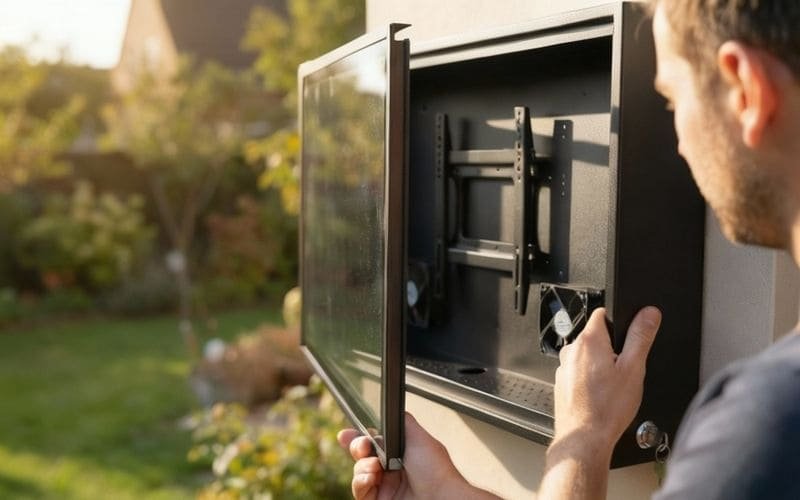
Outdoor TV enclosure with front-opening maintenance door and secure TV mounting bracket.
Conclusion: Making the Right Choice for Your Space
Ultimately, using an indoor TV outside is a highly viable, practical, and cost-effective strategy, provided you do not ignore the fundamental engineering requirements. You must respect the physical limitations of consumer electronics by providing a secure, actively ventilated, and IP-rated barrier against the outdoor elements.
By utilizing an engineered enclosure, adopting the decoupling strategy, adhering to outdoor electrical safety standards, and matching your ventilation to your local climate, you can safely bring high-definition entertainment to your patio without exposing your home or your budget to unnecessary risks.
Where to go next: Ready to finalize your setup? Choose the guide that best fits your current stage of planning:
To provide complete clarity on this deployment strategy, here are objective answers to the most common questions our engineering team receives regarding outdoor TV setups.
1. Do I need to bring the TV inside during the winter?
Check the specific TV model’s operating and storage temperature range first. In severe freezing climates, seasonal removal may still be the safer choice for standard indoor TVs. Extreme freezing temperatures can affect the liquid crystals in the LCD panel or the electronic components. The enclosure itself can remain bolted to the wall year-round.
2. How does the audio work if the TV is inside a sealed box?
Because an enclosure is designed to seal out moisture and dust, it naturally muffles the sound produced by the television’s internal, rear-facing speakers. While sound will still transmit through the polycarbonate front window, the audio quality will be reduced. For the best outdoor viewing experience, we highly recommend utilizing the TV’s audio output ports to connect an external, weather-rated outdoor soundbar or a dedicated outdoor Bluetooth speaker system.
3. Can I use a smart TV inside the enclosure?
Yes. Smart TVs usually continue to work normally inside an enclosure, but wireless performance still depends on router distance, surrounding building materials, and the TV’s own antenna design. Most users can stream their favorite apps without issue, provided the outdoor Wi-Fi coverage is strong.
4. Will my remote control still work through the plastic shield?
Most common remotes work through the front window, but exact performance can vary by remote type, material thickness, and the TV’s sensor location. Standard infrared (IR), Bluetooth, and RF remotes generally function well, so you do not need to open the enclosure to change the channel or adjust the settings.
5. What if I want to mount the TV on a swivel bracket?
Outvion enclosures feature standard VESA mounting patterns on their exterior rear panels. This means the entire enclosure (with the TV safely locked inside) can be mounted to heavy-duty, articulating outdoor wall mounts. This allows you to pull the enclosed TV away from the wall and swivel it toward different seating areas. Ensure that the articulating mount you purchase is rated for the combined weight of the TV and the enclosure.
Smith Chen is an Outdoor TV Enclosure Engineer at Outvion. He works on enclosure sizing, ventilation planning, mounting compatibility, and application design for patio, bar, poolside, and public-space installations.