
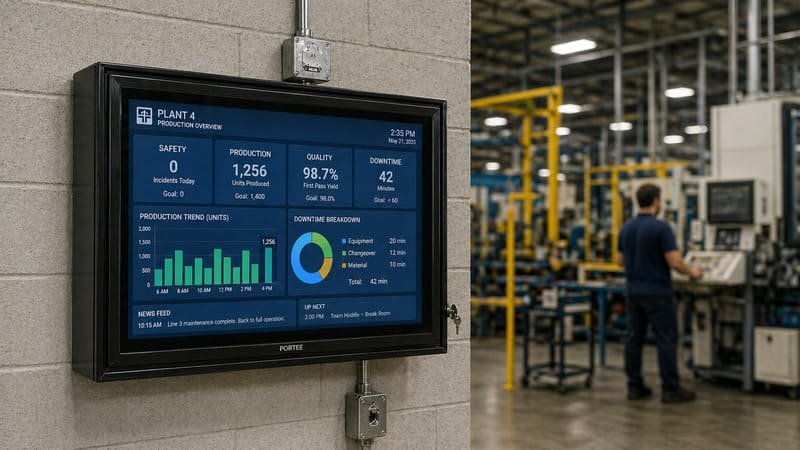
Your factory screens may fail for reasons that are not always obvious. It is not just rain or a direct splash of water. In factories, warehouses, loading docks, and industrial workshops, dust, moisture, heat, corrosive air, and cleaning routines can slowly damage a standard TV.
Factories and warehouses use IP65 TV enclosures to help shield standard TVs from industrial hazards such as dust, moisture, washdowns, and airborne contamination. This can reduce screen failures, lower replacement frequency, and keep critical operational information visible in harsh work environments.
When we talk to factory managers, their first concern is usually about rain or water. That makes sense. Water damage is easy to imagine.
But the real problems are often the ones you cannot see. Fine dust, humid air, chemical residue, forklift traffic, washdown routines, and heat buildup can all affect a display over time. Protecting a screen in an industrial setting is not only about keeping it dry. It is about keeping your workflow visible and your operation moving.
Let’s look at what these environments are really like.
Last Updated: April 28, 2026 | Estimated Reading Time: 7 minutes
By Smith Chen, Outdoor TV Enclosure Engineer at Outvion
Isn’t Industrial Damage Just Like Bad Weather?
You may think a covered loading dock or indoor factory wall is already safe enough for a screen. But fine airborne dust, moisture, and corrosive particles can still enter a standard TV through vents and openings.
No, industrial damage is different from ordinary bad weather. Rain is usually a direct water threat, while industrial environments often create long-term exposure to airborne dust, moisture, heat, and corrosive contaminants. These particles can enter a standard TV, build up on internal components, reduce cooling, and increase the risk of failure over time.
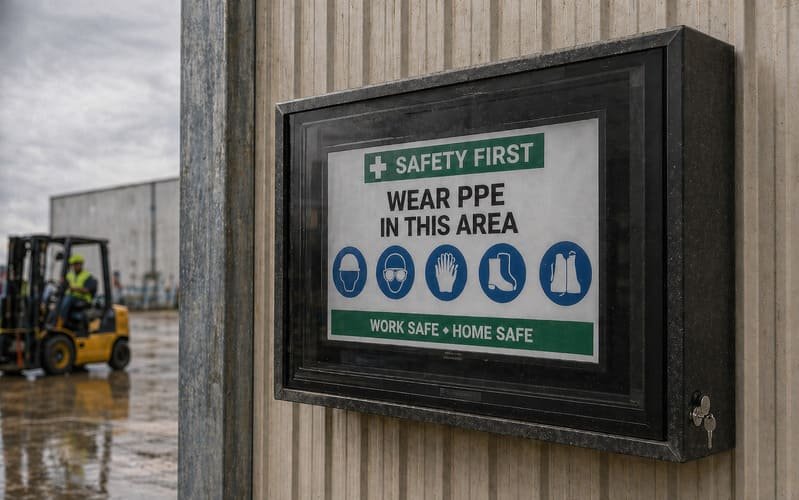
In our conversations with chemical plant, logistics, and mining-related customers, we learned a key lesson. The biggest long-term threat is not always a sudden storm. Sometimes, the air itself is the problem.
A standard TV is designed for a cleaner indoor environment, not a factory floor. It has vents to help move heat away from internal parts. In an industrial setting, those same vents can pull in dust, moisture, and airborne contaminants.
The CDC/NIOSH Pocket Guide describes coal dust as a dark-brown to black solid dispersed in air, which is a useful reminder that industrial dust is not just dirt sitting on a surface. It can be airborne and persistent in the work environment. CDC/NIOSH Coal Dust Pocket Guide
In factories, the dust may come from packaging, wood, metal processing, textiles, food production, coal handling, concrete, or warehouse traffic. In chemical plants or coastal industrial locations, moisture and corrosive air may become additional concerns. Research on printed circuit boards has shown that moisture, particulates, and corrosive contaminants can affect electronic reliability over time. PCB corrosion and airborne contamination research
This is why we often see buyers focus on rain first, while dust and corrosion become the bigger long-term issue.
An IP65-rated enclosure is designed to help create a protected space around the TV. The International Electrotechnical Commission explains that IP ratings grade the resistance of an enclosure against the intrusion of dust or liquids. IEC IP Ratings
For a factory or warehouse, the “6” in IP65 matters because it indicates dust-tight protection under defined test conditions. The “5” indicates protection against water jets under defined test conditions. However, I always explain IP65 carefully: it does not mean vapor-proof, condensation-proof, chemical-proof, or suitable for immersion. Real performance still depends on gasket compression, cable exits, installation quality, and maintenance.
Comparing Environmental Threats
| Threat Type | How it Damages a TV | Why a Simple Roof Isn’t Enough |
|---|---|---|
| Rain / Water Jets | Direct water contact can cause short circuits or screen damage. | A roof helps, but wind-driven rain, sprinklers, or washdowns may still reach the screen. |
| Industrial Dust | Enters through vents, coats components, blocks airflow, and traps heat. | Dust is airborne and circulates through the work area. A roof does not stop it. |
| Moisture / Humidity | Can increase corrosion risk and affect circuit reliability over time. | Humidity is part of the surrounding air, not only a direct splash problem. |
| Corrosive Air | Chemical residue, salt air, or industrial gases may affect contacts and boards. | Corrosive air can move through the facility and enter unprotected equipment. |
| Heat Buildup | Dust and poor airflow can raise internal temperature around the TV. | A covered area can still become hot if airflow is poor. |
| Cleaning Exposure | Washdowns, sprays, or cleaning chemicals may reach the display area. | Cleaning routines may create water exposure even indoors. |
This is why I do not treat factory screen protection as simple “weatherproofing.” A factory TV enclosure needs to deal with the industrial air around the screen, not only the weather above it.
Why Is Operational Uptime a Bigger Concern Than a Broken TV?
A broken TV may look like a small hardware problem. But if that screen shows loading dock assignments, production targets, safety alerts, or warehouse status, the failure can disrupt the workflow around it.
In warehouses and factories, TVs are often used as operational displays, not entertainment screens. When a screen fails from dust, heat, or moisture exposure, the cost is not only the replacement TV. The bigger risk is delayed work, lost visibility, idle labor, and avoidable downtime.
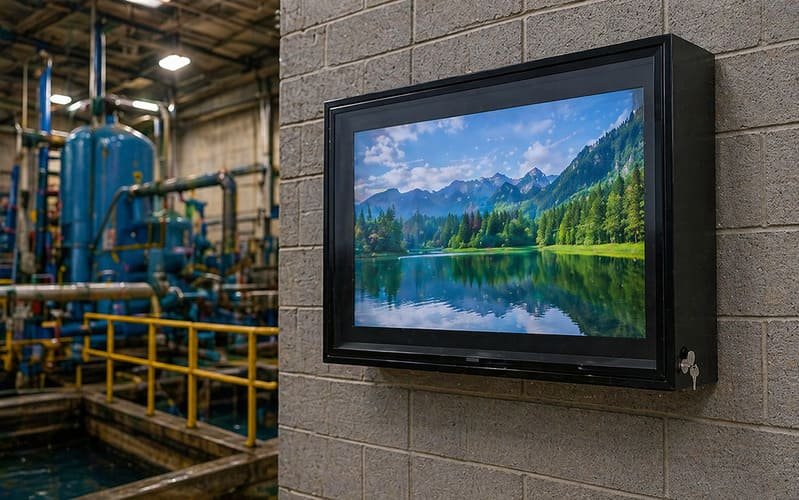
The real question is not “Can the TV survive outside?” The better question is:
Can the display keep working as part of daily operations?
Think about what happens when a warehouse screen goes black. The display that shows truck assignments, loading bay status, safety instructions, or production metrics is suddenly gone. Workers may need to ask supervisors for information manually. Drivers may wait. Shipments may slow down. The team may lose the visual information that normally keeps the process moving.
In manufacturing and logistics environments, visual information is part of the workflow. Research on visual management in Industry 4.0 discusses how visual tools and information displays can support production processes and operational awareness. Visual Management in Industry 4.0
The screen is not just a display. In many warehouses, it becomes part of the workflow.
We have had logistics managers tell us this is their main reason for using enclosures. They are not only protecting a piece of hardware. They are protecting the flow of information that their team depends on every day.
A reliable screen means fewer interruptions. The enclosure helps by creating a more stable operating environment around the TV, reducing direct exposure to dust, moisture, cleaning spray, and impact.
The True Cost of a Black Screen
A screen failure is not always a single event. It can trigger a chain reaction that costs your business money at several points.
- Initial Failure: A TV overheats from dust buildup or fails after moisture exposure.
- Workflow Disruption: The loading bay or production team loses visible instructions.
- Labor Inefficiency: Workers spend time asking for updates or waiting for direction.
- Replacement Delay: A new TV must be ordered, delivered, and installed.
- Maintenance Time: Staff or contractors need to diagnose, remove, and replace the unit.
- Schedule Impact: Shipments, production tasks, or safety messaging may be delayed.
NIST notes that manufacturing maintenance costs have a wide range and may include issues such as repair costs, lost production, and unplanned downtime. NIST Manufacturing Machinery Maintenance
That is why I usually recommend looking at the screen as part of the operation, not as a standalone device. If the display supports shipping, production, or safety communication, downtime risk matters more than the purchase price of the TV alone.
Is an IP65 Enclosure a Better Value Than a Specialized Industrial Display?
Industrial-grade displays can be very expensive, but replacing cheap consumer TVs again and again also adds up in cost and hassle. An IP65 enclosure can create a practical middle ground for many factory and warehouse applications.
For many uses, an IP65 enclosure paired with a standard TV can be a cost-effective solution. It does not replace every specialized industrial display, but it can reduce exposure risk, lower replacement frequency, and make future TV upgrades easier when the application does not require a fully rugged industrial monitor.
Many buyers first think that replacing a cheap TV when it breaks is the most affordable plan. That may work in a clean office. It does not always work in a factory or warehouse.
In industrial environments, you have to consider total cost of ownership, not only the initial purchase price. The full cost includes:
- TV price
- Enclosure cost
- Installation labor
- Replacement labor
- Downtime risk
- Maintenance access
- Cleaning exposure
- Future upgrade flexibility
A specialized industrial display may be the right choice for some environments, especially where there are extreme temperatures, strict industrial certifications, heavy vibration, or process-critical controls. I do not want to suggest that an enclosure replaces every industrial display.
But for many factory dashboards, warehouse status screens, loading dock displays, and internal communication screens, an IP65 enclosure plus a standard TV can be a practical middle option. You protect the TV from dust, water jets, and daily industrial exposure while keeping the screen itself easier to replace or upgrade later.
This is one reason we often describe the enclosure as the long-term protective asset and the TV as the replaceable screen inside it.
Calculating Total Cost of Ownership (TCO)
| Solution | Initial Cost | Replacement Frequency | Downtime Risk | Best Fit |
|---|---|---|---|---|
| Unprotected TV | Low | High in harsh areas | High | Clean indoor spaces with low risk |
| TV + IP65 Enclosure | Medium | Lower if installed and maintained correctly | Lower | Warehouses, loading docks, dusty or wet areas |
| Industrial Display | High | Low | Low | Highly specialized industrial environments |
The goal is not always to buy the most expensive screen. The goal is to choose the protection level that matches the real risk of the environment.
For many buyers, the best value comes from reducing avoidable failures, not from choosing the cheapest hardware on day one.
How Do You Choose the Right IP65 TV Enclosure for a Factory or Warehouse?
You know your screen needs protection, but not every industrial location has the same risk. A warehouse loading dock, food processing area, chemical plant, and dusty workshop all need different levels of protection.
To choose the right IP65 TV enclosure, first identify the main environmental risk: dust, moisture, washdowns, heat, corrosion, or impact. Then check the TV size, enclosure internal dimensions, airflow design, cable sealing, mounting method, and whether the enclosure material fits the industrial environment.
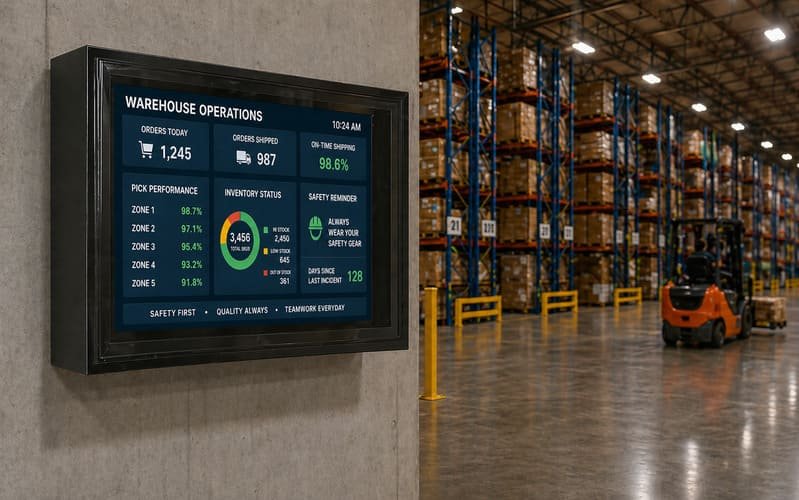
When I help factory or warehouse buyers, I do not start by asking only for the TV size. I ask about the environment first.
Where will the screen be installed?
Is there airborne dust?
Will the area be washed down?
Is it near a loading dock door?
Is the TV exposed to chemical air, salt air, or high humidity?
Will workers need to see the screen from far away?
Can maintenance staff access the enclosure safely?
These details matter because the enclosure is not just a shell. It is part of the installation system.
Step 1: Match the Enclosure to the Industrial Risk
| Environment | Main Risk | Recommended Enclosure Focus |
|---|---|---|
| Warehouse Loading Dock | Dust, vehicle traffic, temperature swings | IP65 sealing, strong mounting, visible screen placement |
| Food Processing Area | Moisture, cleaning spray, hygiene routines | IP65 protection, sealed cable exits, easy-clean surface |
| Chemical Plant | Corrosive air, humidity, residue | Non-metallic body, sealed design, careful hardware choice |
| Mining / Coal Handling | Fine airborne dust | Dust-tight enclosure and protected ventilation path |
| Workshop / Fabrication Area | Metal dust, debris, accidental impact | Impact-resistant front shield and sealed body |
| Outdoor Factory Yard | Rain, sun, dust, wind | IP65 rating, active cooling, secure wall mounting |
Step 2: Check the TV Fit and Internal Space
Do not choose an enclosure only by diagonal TV size. A 55-inch TV from one brand may be thicker, wider, or deeper than another 55-inch TV.
You need to check:
- TV width
- TV height
- TV depth
- VESA mounting pattern
- Cable position
- Plug direction
- Space for airflow behind the TV
The TV should not be forced tightly into the enclosure. There needs to be enough internal space for air movement, cable routing, and maintenance.
Step 3: Confirm Cooling and Cable Sealing
In factories and warehouses, cooling and cable exits are two of the most important details.
A standard TV generates heat during operation. Dust buildup can make heat management worse. Research on dust and printed circuit assembly reliability shows that dust deposition can affect electronic reliability and contribute to failure mechanisms under certain conditions. Dust and electronics reliability research
For this reason, an enclosure should not simply trap the TV inside a sealed box. It needs a designed airflow path, and in hot locations, active fans may be needed to help move warm air out.
Cable exits also matter. If the enclosure body is sealed but the cable opening is poorly handled, dust and moisture can still enter through the weak point. Look for sealed cable exits, compression foam, or cable glands that match the installation environment.
Step 4: Think About Maintenance Access
Factories and warehouses are not always easy places to service equipment. A display may be mounted high on a wall, near a loading area, above a production line, or in a location where stopping work is inconvenient.
A good enclosure should allow authorized staff to access the TV when needed without exposing the screen to unnecessary risk every day.
| Checklist Item | What to Confirm | Why It Matters |
|---|---|---|
| IP Rating | IP65 for dust and water-jet exposure | Helps protect against dust, rain, washdowns, and cleaning spray |
| TV Fit | Width, height, depth, VESA pattern | Ensures the TV can be mounted safely inside |
| Cooling | Fan system and airflow path | Helps reduce heat buildup around the TV |
| Cable Exit | Sealed cable routing | Prevents the cable area from becoming the weak point |
| Material | Polycarbonate or corrosion-resistant structure | Reduces long-term maintenance in humid or corrosive areas |
| Mounting | Strong wall or structure | Prevents vibration, sagging, or unsafe installation |
| Maintenance Access | Lockable but serviceable design | Allows authorized replacement or inspection when needed |
FAQ
What does IP65 mean for a factory TV enclosure?
IP65 means the enclosure is dust-tight and protected against water jets under defined test conditions. It is useful for factories, warehouses, loading docks, and industrial areas where screens may face dust, rain, sprinklers, cleaning spray, or washdowns. It does not mean vapor-proof, condensation-proof, chemical-proof, or submersible.
Is IP65 enough for a warehouse display?
For many warehouse displays, IP65 is a strong and practical level of protection. It helps protect against dust and water jets. However, the full installation still matters. Cable exits, gasket compression, mounting, fan design, and maintenance access all affect real-world performance.
Can factory dust damage a regular TV?
Yes, factory dust can damage or shorten the life of a regular TV over time. Dust can enter through vents, build up on internal components, reduce airflow, trap heat, and increase the risk of failure. This is why dust-tight protection is often more important in factories than buyers first expect.
Do IP65 TV enclosures need fans?
Not always, but fans are strongly recommended for hot areas, direct-sun locations, large TVs, or displays that run for long hours. A sealed enclosure without airflow can trap heat. Fans help move warm air away from the TV and reduce heat buildup inside the enclosure.
Is a TV enclosure cheaper than an industrial display?
In many applications, a standard TV plus an IP65 enclosure can have a lower upfront cost than a specialized industrial display. It also gives buyers flexibility to replace or upgrade the TV later. However, industrial displays may still be better for extreme temperatures, special certifications, touch control, or process-critical environments.
What should factories check before ordering an enclosure?
Factories should check the TV size, VESA pattern, installation environment, dust level, moisture exposure, washdown routines, heat conditions, cable routing, wall strength, and maintenance access. The best enclosure is the one matched to the real industrial risk, not only the TV size.
Conclusion
IP65 TV enclosures in factories and warehouses are for more than weather protection. They help protect screens from dust, moisture, washdowns, airborne contamination, heat buildup, and operational disruption.
A standard TV may work well in an office or meeting room, but a factory floor is different. The air is different. The cleaning routines are different. The cost of downtime is different.
That is why I see IP65 TV enclosures as a practical investment for many industrial display applications. They help protect the screen, reduce avoidable failures, and keep critical operational information visible.
The way I explain it to factory buyers is simple:
In a factory, the screen is not just a TV. It is part of the workflow.
If that display supports production, logistics, safety, or warehouse coordination, protecting it is not only about saving hardware cost. It is about keeping the operation moving.