
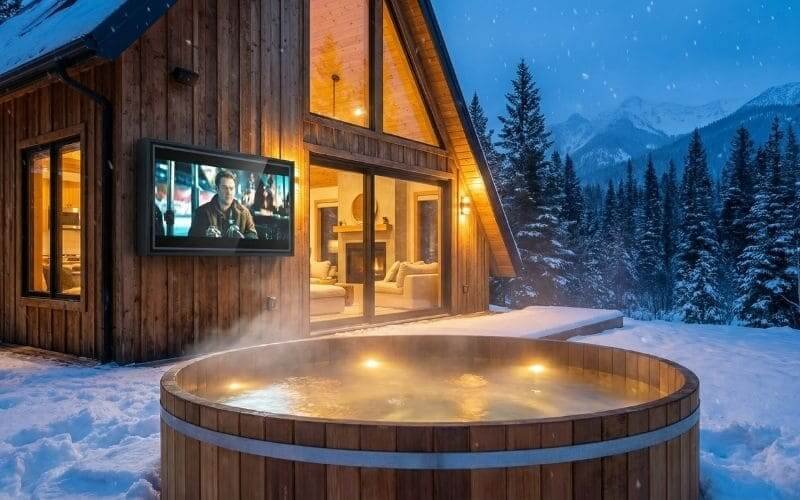
The outdoor hospitality sector is currently experiencing rapid capitalization as consumers seek immersive nature experiences without sacrificing modern comforts. For glamping site owners, luxury cabin operators, and RV resort managers, offering outdoor digital entertainment can support premium positioning, improve perceived amenity value, and help some properties justify higher ADRs when packaged correctly.
Deploying standard commercial displays in semi-open, natural environments exposes the hardware to extreme environmental stressors, including high humidity, insect nesting, and guest-related damage. To mitigate these risks, operators should utilize an IP65-rated TV enclosure equipped with a polycarbonate front window. This approach establishes a controlled micro-environment that preserves the operational lifespan of the internal display technology while elevating the guest experience.
High humidity, heavy morning dew, aggressive biological threats, and the inevitable wear-and-tear from hospitality usage present significant reliability risks to unprotected electronics. To ensure continuous uptime and protect the initial capital investment, facility managers must transition away from naked displays and adopt engineered protective infrastructure tailored for the hospitality sector.
How we evaluate glamping and resort TV protection at Outvion:
- Biological threats (insect nesting) and high-humidity condensation risks
- Impact resistance against accidental guest damage and sporting equipment
- Access control to prevent theft and unauthorized port tampering
- CapEx optimization for multi-unit resort deployments
Last Updated: Mar 11th. 2026 | Estimated Reading Time: 7 Minutes
By Smith Chen, Outdoor TV Enclosure Engineer at Outvion.
The Business Case: Elevating ADR and Guest Experience
Adding outdoor digital entertainment can elevate a property’s market positioning, but the investment must be protected by engineered enclosures to ensure a profitable Return on Investment (ROI) and avoid crippling operational maintenance costs.
In the highly competitive luxury outdoor hospitality market, standard amenities are often no longer sufficient to differentiate a property. Guests paying premium rates increasingly expect a seamless convergence of rustic surroundings and high-end technological conveniences.
The Financial Mechanics of Outdoor Amenities
The installation of a private, outdoor viewing area—typically situated on a cabin deck, adjacent to a private hot tub, or within a screened-in glamping porch—transforms a standard accommodation into a highly marketable suite.
-
ADR Support: The potential ADR (Average Daily Rate) uplift depends heavily on the property tier, the local market competition, seasonality, and how the amenity is packaged within the guest’s overall stay.
-
Occupancy Drivers: Properties featuring “outdoor living rooms” often demonstrate improved occupancy rates during shoulder seasons, particularly during major televised sporting events or autumnal weekend getaways.
-
The Reliability Requirement: The financial viability of this upgrade relies entirely on hardware reliability. If a resort installs unprotected commercial displays, the rapid failure rate due to environmental exposure will generate a recurring Operational Expenditure (OpEx) that quickly negates any increased revenue.
Strategic Capital Allocation
To protect the bottom line, the initial Capital Expenditure (CapEx) must be strategically allocated toward environmental defense.
-
Asset Protection: By investing in an engineered protective enclosure, operators safeguard the initial hardware investment.
-
Long-Term ROI: This strategy ensures the amenity generates long-term, positive ROI without incurring unsustainable maintenance downtime or requiring constant hardware replacement.
Hospitality ROI & Amenity Positioning (Illustrative Scenario)
| Amenity Tier | Initial Setup Cost | Example Premium Positioning | Guest Experience Impact | OpEx Maintenance Burden |
| Standard Glamping Tent | Baseline | Baseline Market Rate | Standard rustic experience | Low |
| Tent with Naked Outdoor TV | Moderate | Potential moderate increase | Frustrating (Subject to frequent breakdowns) | Very High (Constant replacements) |
| Tent with Protected Outdoor Cinema | Optimized | Supports top-tier ADR packaging | Premium (High reliability and uptime) | Low (Enclosure protects the asset) |
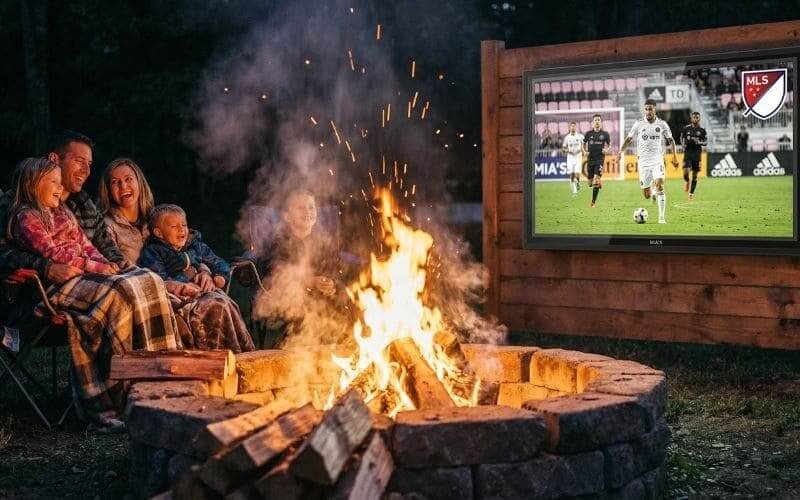
Nature’s Threats: Morning Dew, Salt Air, and Insect Ingress
Glamping sites present severe environmental stressors. Morning dew causes internal condensation and corrosion in naked TVs, while the warmth of the standby power supply actively attracts insects. Engineered enclosures physically isolate the electronics from these biological and moisture threats.
Standard commercial displays are designed for climate-controlled interiors with stable humidity levels. When deployed in a forest, lakeside, or coastal glamping environment, the hardware faces immediate degradation from complex environmental factors that go far beyond simple rainfall.
Thermodynamic Condensation (The Dew Point)
The most pervasive, yet invisible, threat to outdoor electronics is thermodynamic condensation, commonly experienced as morning dew.
-
The Moisture Cycle: During the day, the ambient air in a forest or near a body of water holds significant moisture. As the sun sets and the ambient temperature drops, the metal chassis and internal printed circuit boards (PCBs) of the television cool rapidly.
-
Condensation Mechanics: When the humid night air contacts these cool internal surfaces, it reaches the dew point, causing water vapor to condense into microscopic liquid droplets directly onto the copper traces of the motherboard.
-
Electrical Degradation: This process introduces moisture across sensitive electrical pathways, which can lead to corrosion, logic board failure, and eventual short circuits over time.
Biological Threats and Insect Ingress
Simultaneously, the natural environment introduces aggressive biological threats that target exposed electronics.
-
The Heat Beacon: Modern commercial displays are rarely completely powered down; they remain in a standby state to maintain network connectivity. This standby power generates a localized heat signature.
-
Nesting Behaviors: In a natural environment, this warmth acts as a beacon for local fauna. Wasps, mud daubers, and spiders actively seek out the dark, warm, and protected space inside the television chassis, entering through the passive cooling louvers on the rear of the display.
-
The Hardware Risk: Nests, webs, and organic debris can interfere with airflow, contaminate internal components, and increase the risk of electrical failure over time.
The IP65 Isolation Strategy
To ensure operational reliability, the display must be physically isolated from both the humidity and the local fauna.
-
The Dust-Tight Standard: An IP65-rated enclosure establishes a rigid, sealed boundary. The dust-tight enclosure and sealed cable exits make insect ingress far more difficult in normal resort operation.
-
Moisture Mitigation: The sealed chassis also significantly reduces the volume of humid ambient air that can interact with the display’s internal components, breaking the cycle of internal condensation and protecting the asset from moisture-induced electrical failure.
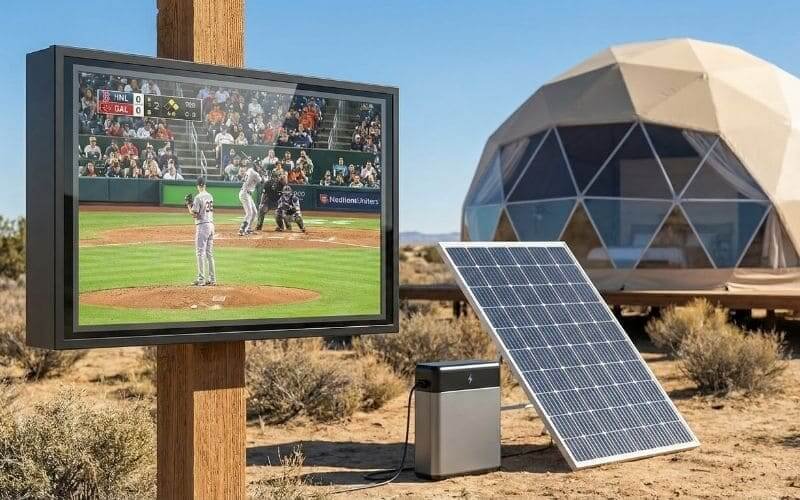
Guest Reliability: Accidental Damage & Tamper Deterrence
Standard display glass shatters easily when struck, posing a safety hazard. Outvion enclosures utilize an optical-grade polycarbonate shield engineered to yield and absorb kinetic energy, protecting the screen while optional locks deter unauthorized guest tampering.
In a hospitality setting, resort operators must engineer solutions that account for unpredictable guest behavior. Glamping decks and cabin patios are active environments where families play, luggage is moved, and accidental impacts frequently occur.
Mitigating Accidental Kinetic Damage
The viewing surface of a standard commercial display is constructed from silicate glass or basic rigid acrylic.
-
The Brittleness Problem: These materials possess a low modulus of elasticity. When subjected to an unintended impact from a thrown baseball, a swinging hiking pole, or a bumped patio chair, standard glass suffers catastrophic brittle failure.
-
Safety Liabilities: A shattered screen is not merely a broken asset; it presents an immediate safety hazard requiring a lengthy cleanup protocol to ensure no sharp glass shards remain on the guest deck.
-
The Polycarbonate Solution: Outvion enclosures address this specific kinetic risk by utilizing an optical-grade polycarbonate front window. Polycarbonate is an advanced engineering thermoplastic renowned for its extreme impact resistance and structural ductility.
-
The Sacrificial Layer: When struck by a blunt object, the polycarbonate shield acts as a sacrificial protective layer. It flexes inward, absorbs the kinetic energy of the impact, and then rebounds. While a severe impact may cause localized scratching on the surface, it resists shattering into dangerous shards, preserving the hardware and supporting guest safety.
Beyond accidental damage, operators of semi-open glamping cabins must consider the risk of opportunistic theft and unauthorized configuration changes.
-
The Vulnerability: A standard television mounted on a basic wall bracket is vulnerable to removal during periods of low occupancy. Furthermore, guests frequently attempt to access the television’s HDMI or USB ports to connect personal devices, which can damage fragile input connections or alter the display’s network settings.
-
Strict Access Control: The enclosure can be specified with optional keyed lock configurations and concealed mounting hardware for guest-facing installations.
-
Tamper Prevention: When these locks are engaged, the internal mounting bolts holding the unit to the structure are completely inaccessible, significantly deterring theft attempts. This locked configuration also denies guests direct physical access to the television’s manual control buttons and input ports.
The Decoupling Strategy for Multi-Unit Resorts (CapEx vs. OpEx)
Pairing standard commercial displays with heavy-duty IP65 enclosures drastically lowers initial costs and simplifies future hardware replacements compared to outfitting multiple glamping tents with expensive, dedicated outdoor televisions.
When tasked with deploying digital amenities across a sprawling resort property, procurement teams frequently evaluate dedicated “outdoor televisions.” These specialized, all-in-one units feature heavy, integrated weatherproof housings.
The Drawbacks of All-In-One Hardware
While dedicated outdoor units are robust, they present significant financial and operational drawbacks for multi-unit hospitality rollouts.
-
High CapEx Burden: They require a massive initial Capital Expenditure (CapEx), limiting the number of units a resort can deploy within a given budget.
-
The Fused Hardware Dilemma: Because the protective armor is permanently fused to the rapidly aging digital display panel, the entire expensive unit must be discarded and replaced when the internal screen eventually fails or becomes technologically obsolete.
-
Lengthy RMA Processes: Replacing a specialized outdoor TV often involves a lengthy procurement or Return Merchandise Authorization (RMA) process, leaving the cabin without its premium amenity for weeks.
The Financial Logic of Decoupling
The engineered alternative is the hardware decoupling strategy. By separating the rugged protective infrastructure from the digital display, resort operators gain total control over their AV budget and maintenance timelines.
-
The Setup: The strategy involves purchasing a heavy-duty, permanent IP65 enclosure and mounting a standard commercial display inside of it.
-
Pricing Advantages: For a 50–55″ setup, Outvion enclosure reference pricing typically starts in the mid-$400s for Basic configurations, with higher-spec Pro or Ultra versions designed for heavier thermal loads priced higher. When combined with a standard commercial display, the total deployment cost is highly optimized.
-
OpEx Maintenance Efficiency: In a hospitality setting, rapid issue resolution is paramount. When the commercial display inside the enclosure requires replacement, the maintenance protocol is remarkably efficient. A resort technician simply unlocks the enclosure bezel, unbolts the failed display, and installs a new commercial screen sourced from local inventory.
-
Maximized Uptime: This strategy shifts ongoing maintenance to a low-cost Operational Expenditure (OpEx), reducing replacement downtime substantially because the enclosure remains installed while only the screen is swapped.
Resort AV Deployment Options & Financial Modeling
| Deployment Strategy | Initial CapEx Burden | Hardware Replacement Process | Long-Term TCO (Total Cost of Ownership) |
| Naked Commercial TV | Low | Discard and replace entire unit frequently. | Poor. High failure rate in humid environments drives up OpEx. |
| Dedicated Outdoor TV | Very High | Replace entire expensive unit upon failure or obsolescence. | Poor. High initial cost combined with high replacement costs. |
| Enclosure Strategy | Moderate | Unlock enclosure, swap inexpensive internal screen locally. | Optimal. Low ongoing OpEx and minimal replacement downtime. |
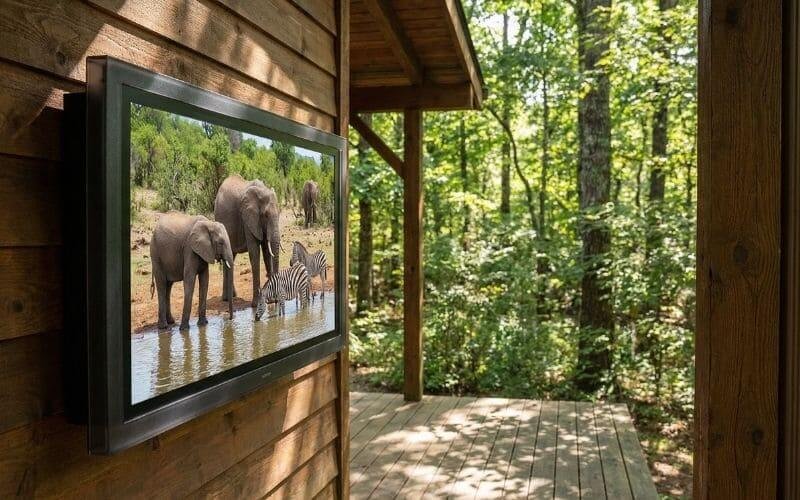
Outdoor Thermal Planning for Glamping Tents and Cabins
Matching the enclosure’s ventilation to the resort’s specific micro-climate is critical. Shaded forest cabins may utilize lighter-duty configurations, while hotter, sun-exposed sites require fan-equipped versions to flush out waste heat.
A sealed IP65 enclosure successfully isolates the display from external moisture and insects, but it also traps the internal heat generated by the television’s backlight and power supply. Without a thermal management strategy, the internal temperature of the enclosure can rapidly exceed the operational threshold of the display.
Evaluating Resort Micro-Climates
Selecting the correct enclosure configuration requires a thorough assessment of the property’s specific micro-climate and the solar load on the installation site.
-
Shaded Environments: In shaded, lower-heat installations (such as deep forest cabins or heavy-canopy glamping sites), lighter-duty configurations may be sufficient.
-
Sun-Exposed Environments: However, hotter or more sun-exposed sites should favor ventilated versions. Glamping sites located in high-desert environments or installations facing intense, direct afternoon sun generate substantial ambient heat and severe solar loading on the enclosure surface.
Active Airflow Mechanics
To combat elevated thermal loads, operators must utilize active thermal management.
-
The Cooling Mechanism: Ventilated versions use active fan airflow to help remove waste heat from the enclosure cavity, drawing cooler ambient air in and exhausting the heated air out.
-
Configuration Sizing: In the current Outvion line, ventilated configurations use 2 fans for 28–60″ models and 4 fans for 65″+ models.
-
Prolonging Hardware Life: This high-volume air exchange ensures that the internal micro-climate remains stable, mitigating thermal strain and prolonging the life of the enclosed hardware, regardless of the external environmental extremes.
Resort Thermal Management Matrix
| Resort Micro-Climate | Solar Exposure | Thermal Risk Level | Recommended Ventilation Configuration |
| Deep Forest Cabin | Minimal direct sunlight; heavy shade | Low | Basic Series (Lighter-duty configuration) |
| Standard Covered Deck | Partial afternoon sun | Moderate | Pro Series (Active fan airflow based on size) |
| High-Desert / Coastal Sun | Intense, direct solar radiation | High | Ultra Series (Maximum-capacity active ventilation) |
Standard Operating Procedures (SOP) for Housekeeping
Maintaining hardware protection requires strict adherence to housekeeping protocols, specifically regarding the use of non-abrasive cleaners on the polycarbonate front window and routine visual inspections of the enclosure seals.
Deploying an IP65 enclosure provides a robust physical defense, but the long-term integrity of that defense relies entirely on proper routine maintenance by resort staff. Facility managers must establish strict Standard Operating Procedures (SOP) for the housekeeping and engineering teams.
1. Cleaning Protocols for Polycarbonate
The optical-grade polycarbonate window provides immense impact resistance, but its surface must be treated correctly to maintain a premium aesthetic for the guests.
-
Prohibited Chemicals: Housekeeping staff must never use harsh industrial solvents, acetone, ammonia-based glass cleaners, or abrasive scouring pads on the clear front shield. These chemicals will degrade the material and permanently cloud the optical clarity.
-
Approved Methods: Cleaning should be performed exclusively with mild, non-abrasive dish soap, warm water, and clean microfiber cloths to remove pollen, dust, or fingerprints without inducing micro-scratching.
2. Routine Visual Inspections
The most critical step in maintaining the IP65 seal occurs at the penetration points.
-
Cable Gland Checks: During the turnover between guest stays, maintenance staff should visually inspect the cable exit pathways. Data and power cables must exit the enclosure through compression glands. Staff must ensure these remain tightly compressed to prevent insect and moisture ingress from the bottom.
-
Airflow Checks: Staff should also periodically check the fan openings, air paths, and any serviceable intake protection included on the selected model to ensure airflow is not obstructed by debris or pollen buildup.
3. Key Management for Resort Staff
The physical security of the internal hardware depends on strict access control.
-
Access Protocols: The physical keys to the Outvion enclosures must be strictly managed. Only designated maintenance supervisors or the property general manager should have access to these keys.
-
Security Enforcement: Ensuring the enclosures remain securely locked prevents guest tampering and deters opportunistic theft during periods of low occupancy.
Conclusion: Protecting the Guest Experience
In the luxury outdoor hospitality sector, deploying digital amenities is a strategic requirement for maximizing property revenue and guest satisfaction. However, placing delicate commercial displays into natural environments characterized by heavy condensation, insect activity, and kinetic guest interactions guarantees high hardware failure rates without rigorous engineered protection.
Relying on specialized all-in-one outdoor televisions restricts budget flexibility and complicates maintenance logistics across multi-unit properties. By utilizing the decoupling strategy with an IP65 polycarbonate enclosure, glamping operators achieve a practical balance of rugged environmental protection and operational agility. Outvion enclosures provide the critical moisture exclusion, impact resistance, and active thermal management required to safeguard hardware assets. Implementing this engineered barrier ensures that the premium guest experience remains uninterrupted, hardware lifespans are extended, and costly maintenance downtime is effectively mitigated.
Glamping & Resort Display Protection FAQ
1. Will the enclosure protect against coastal salt air?
The enclosure significantly reduces direct exposure of the internal TV to salt-laden moisture, but coastal installations still benefit from routine exterior cleaning and inspection. While the enclosure acts as a robust physical barrier against wind-driven saline mist, keeping the exterior shell and fan ports clean helps maintain optimal long-term performance in harsh coastal environments.
2. How do we manage audio in a noisy outdoor environment?
While the internal television speakers will function, the sealed enclosure naturally dampens the audio output. For a premium guest experience on a glamping deck or cabin patio, we highly recommend using the TV’s audio outputs to connect an external, weather-rated outdoor soundbar. This ensures clear, directed audio delivery even in the presence of ambient environmental noise.
3. Can guests tamper with the TV controls or USB ports?
No. When equipped with optional keyed lock configurations, the enclosure secures the front bezel to the rear mounting plate. This denies guests direct physical access to the TV’s manual controls, power buttons, and input ports while the enclosure remains locked, preventing unauthorized tampering and configuration changes.
4. How quickly can resort maintenance swap a failed screen?
The primary operational advantage of the decoupling strategy is maintenance speed. This approach allows maintenance staff to unlock the bezel and swap the internal display with a backup unit, allowing faster screen replacement between stays and ensuring the amenity is fully functional before the next guest checks in.
Recommended Technical Reading & Resources
To further understand the hospitality metrics and engineering standards discussed in this guide, we recommend reviewing the following authoritative resources:
-
Hospitality Revenue Metrics: Understanding Hotel ADR and RevPAR (STR Data)
-
Industry definitions and strategies for increasing Average Daily Rate (ADR) through the implementation of premium, high-reliability amenities.
-
-
Ingress Protection (IP) Codes: IEC 60529: Degrees of Protection Provided by Enclosures
-
The official international standard defining the testing methodologies and requirements for classifying an enclosure as resistant to dust and water.
-
-
Material Science of Polycarbonate: Polycarbonate vs. Acrylic Impact Properties (Curbell Plastics)
-
A technical breakdown explaining the modulus of elasticity and why polycarbonate yields and absorbs kinetic energy, making it the superior choice for high-traffic resort environments.
-