
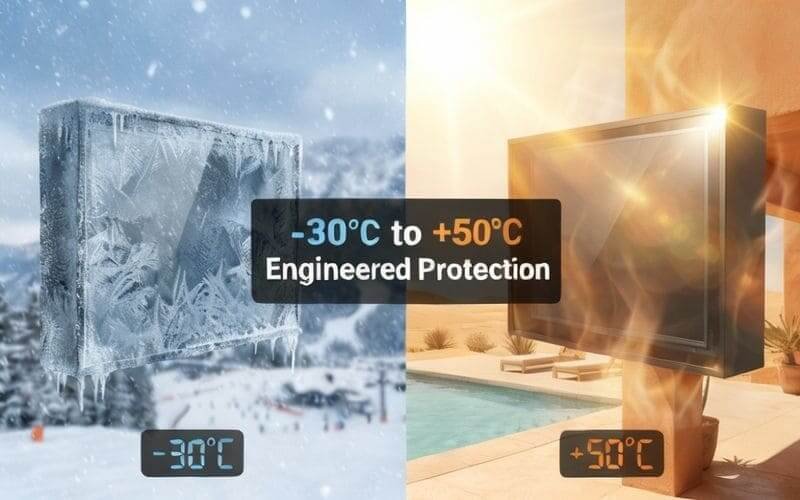
Deploying digital displays outdoors fundamentally changes the operational parameters of the hardware. Weatherproofing electronics is not merely about erecting a canopy to block vertical rain; it requires managing a complex intersection of environmental variables. Engineers must account for microscopic moisture ingress, diurnal temperature shifts that trigger condensation, and the kinetic impacts of the surrounding environment. Standard indoor displays lack the structural and environmental defenses necessary to survive these conditions, leading to rapid component degradation.
To reduce these outdoor risks, operators should use an IP65-rated TV enclosure with ventilation matched to the installation environment. This approach establishes a controlled, isolated micro-climate that helps preserve the operational lifespan of the internal display technology while ensuring continuous outdoor performance.
When consumer electronics are placed outside, they are subjected to thermodynamic and material stressors they were never designed to endure. To successfully transition a television to an outdoor patio or commercial space, we must apply rigorous engineering principles rather than relying on improvised, unsealed covers.
How we evaluate outdoor TV weatherproofing at Outvion:
- Moisture mitigation (capillary action, condensation, and wind-driven rain)
- Thermal management and the prevention of trapped greenhouse heat
- UV degradation resistance and optical clarity preservation
- Cable ingress sealing and mechanical friction deterrence
Last Updated: Dec 11th. 2026 | Estimated Reading Time: 9 Minutes
By Smith Chen, Outdoor TV Enclosure Engineer at Outvion.
The Mechanics of Moisture Ingress and Condensation
Water damages TVs not just through direct rain, but via high ambient humidity and condensation. An IP65-rated enclosure establishes a physical barrier that drastically reduces the volume of moisture interacting with the internal logic boards, breaking the destructive cycle of electrical corrosion.
When discussing weatherproofing, the layman often focuses entirely on macroscopic water—falling rain or splashing pool water. However, to an electronics engineer, the primary threat is microscopic water vapor. Humidity and condensation are responsible for a vast majority of outdoor display failures.
The Dew Point Phenomenon
The atmosphere inherently holds water vapor, and the amount it can hold is entirely dependent on temperature.
-
The Thermal Shift: During the day, warm ambient air can hold significant moisture. As the sun sets, the ambient temperature drops rapidly. The metal chassis and internal printed circuit boards (PCBs) of the television cool down as they lose heat to the surrounding environment.
-
Phase Change: When the humid ambient air contacts these cooled internal surfaces, the air reaches its “Dew Point.” The water vapor undergoes a phase change, condensing into microscopic liquid droplets directly onto the copper traces, capacitors, and microprocessors.
-
Galvanic Corrosion: This process introduces conductive fluid across sensitive electrical pathways. If the television remains powered or in standby mode, this moisture can cause immediate electrical shorts. Even if the television is unpowered, repeated cycles of daily condensation lead to microscopic galvanic corrosion, degrading solder joints and permanently destroying the logic board over time.
Capillary Action and Seam Ingress
Standard televisions feature numerous structural seams, screw holes, and passive ventilation louvers designed to let heat out.
-
The Physics of Water: If wind-driven rain or dense morning mist strikes the exterior of a naked television, water does not just sit on the surface. Through a physics principle known as capillary action, water is actively drawn into narrow gaps and seams against gravity.
-
The Danger of Open Architecture: This pulls moisture deep into the chassis where it cannot easily evaporate, creating localized pools of water that inevitably reach the power supply.
An engineered enclosure counters these threats through physical isolation. By creating a sealed perimeter, the enclosure significantly reduces the volume of humid air that can interact with the display, preventing liquid water from being drawn into the chassis.
Moisture Threat Matrix
| Threat Vector | Mechanism of Ingress | Impact on Unprotected Electronics | Enclosure Defense Strategy |
| Direct Rainfall | Gravity-fed macroscopic droplets | Rapid short circuiting via exposed top vents | IP65-rated enclosure under proper installation |
| Wind-Driven Rain | Horizontal, high-velocity moisture | Water forced past side seams and ports | Sealed enclosure and bottom cable-exit design |
| Ambient Humidity | Water vapor reaching Dew Point | Internal condensation and PCB corrosion | Physical barrier reduces interaction with ambient air |
| Coastal Salt Mist | Aerosolized electrolytes in coastal areas | Accelerated galvanic corrosion of metal components | Reduced direct exposure to salt-laden moisture |
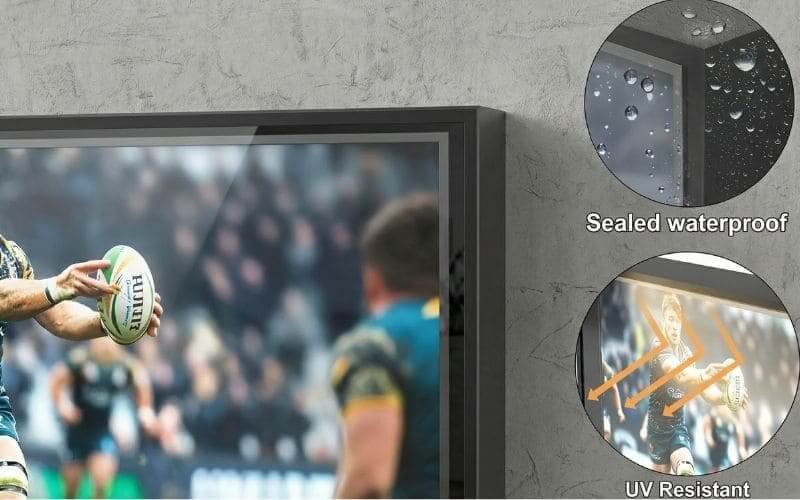 Sealed waterproof and UV-resistant outdoor TV enclosure, weatherproof screen protection for direct-sun and rain exposure
Demystifying the IP65 Standard for Outdoor Displays
Effective weatherproofing requires measurable standards. IP65 is a practical target for many outdoor TV enclosures because it combines dust-tight protection with resistance to low-pressure water jets, balancing environmental isolation with the ability to integrate necessary cooling.
In the consumer electronics market, the term “waterproof” is frequently utilized as a vague marketing claim. For professional installations, engineers rely on the IEC 60529 Standard, commonly referred to as the Ingress Protection (IP) code. This international standard provides a quantifiable, objective measurement of a mechanical casing’s ability to exclude solid objects and liquid water.
The Solid Ingress Standard: The “6” (Dust-Tight)
The first digit indicates protection against solid particles. A rating of “6” is the highest possible designation for solid ingress.
-
Testing Methodology: During certification testing, a vacuum is applied to the enclosure within a closed chamber filled with circulating fine talcum powder. The unit is monitored for several hours.
-
Pass Criteria: The enclosure passes only if there is zero measurable ingress of dust inside the cavity.
-
Outdoor Relevance: This is critical for outdoor environments, as it prevents microscopic pollen, landscaping debris, and abrasive dust from entering the enclosure, which could otherwise foul internal cooling mechanisms or settle on the display screen.
The Liquid Ingress Standard: The “5” (Water Jets)
The second digit specifies protection against liquids. A rating of “5” indicates protection against low-pressure water jets.
-
Testing Methodology: Specifically, the enclosure must withstand water projected by a 6.3mm nozzle from any direction, at a rate of 12.5 liters per minute, for a sustained period without suffering harmful effects.
-
Outdoor Relevance: This rating ensures the enclosure can survive heavy, wind-driven rainstorms or routine hose-down cleaning by facility maintenance staff without risking water damage to the internal electronics.
IP65 represents a highly practical engineering balance for display enclosures. It provides strict dust exclusion and the ability to withstand heavy rain, while still permitting the structural design necessary to integrate active ventilation systems required to cool the internal hardware.
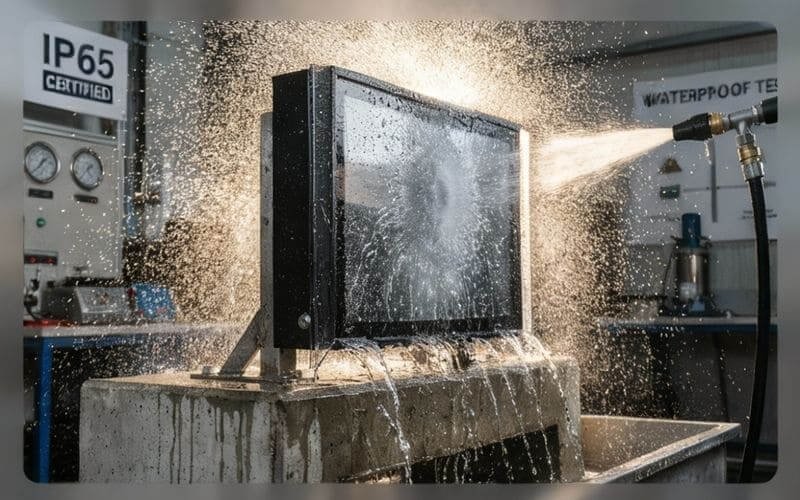 IP65 waterproof TV cabinet under high-pressure spray test, industrial-grade outdoor TV enclosure for rain and storm environments
UV Degradation and Material Science of the Front Shield
Prolonged exposure to ultraviolet radiation degrades consumer plastics. Outvion uses a polycarbonate front window with 99% UV blocking, which helps protect both the shield and the TV behind it from outdoor UV exposure while acting as a kinetic safety barrier.
Weatherproofing extends beyond moisture management; it must actively address the constant bombardment of solar radiation. The sun emits Ultraviolet (UV) light, which possesses enough energy to break the chemical bonds in many standard polymers.
Photo-Oxidation and Hazing
When standard plastics—such as the polystyrene used in consumer TV bezels or basic acrylic covers—are exposed to UV light outdoors, they undergo a process called photo-oxidation.
-
Material Degradation: The material molecularly degrades over time, causing it to become brittle and lose its structural integrity.
-
Optical Failure: Furthermore, it develops a cloudy, yellowish haze. This hazing rapidly destroys the optical clarity required for viewing a high-definition display, rendering the protective cover visually useless.
The Polycarbonate Advantage
To combat this, Outvion utilizes an optical-grade polycarbonate front viewing window.
-
UV Blocking Properties: This material is engineered with inherent properties that provide 99% UV blocking. This acts as a permanent sunscreen, preventing solar radiation from degrading the shield itself, and crucially, preventing that same UV light from reaching and degrading the fragile plastic bezel of the television housed inside.
-
Kinetic Impact Resistance: Beyond UV protection, the material must survive the kinetic realities of the outdoors. The viewing surface of a standard commercial display is constructed from highly brittle silicate glass. When struck by a stray baseball, a swinging branch, or landscaping equipment, standard glass suffers catastrophic brittle failure.
-
The Sacrificial Layer: Polycarbonate exhibits high ductility. When struck, the material flexes elastically, absorbing the kinetic energy, and then rebounds. It functions as a sacrificial protective layer; it may suffer a localized scratch during a severe impact, but it resists shattering into dangerous shards, preserving the delicate LCD panel behind it.
The Decoupling Strategy: Protecting OpEx
Instead of purchasing an expensive, integrated dedicated outdoor TV, facility managers and homeowners can decouple the hardware. Pairing a standard commercial display with an IP65 enclosure lowers initial CapEx and drastically simplifies future hardware replacements.
When tasked with deploying outdoor entertainment, consumers and procurement teams frequently evaluate dedicated “outdoor televisions.” These specialized, all-in-one units feature heavy, integrated weatherproof housings. While durable, they present significant financial and operational drawbacks for both residential and commercial applications.
The Financial Burden of All-In-One Units
Dedicated outdoor TVs require a massive initial Capital Expenditure (CapEx).
-
The Fused Hardware Dilemma: Because the protective armor is permanently fused to the rapidly aging digital display panel, the entire expensive unit must be discarded and replaced when the internal screen inevitably reaches the end of its lifecycle or suffers a non-warrantied electrical failure.
-
High Replacement Costs: This means the ongoing maintenance of the outdoor space remains a high-cost endeavor, forcing operators to repurchase the expensive weatherproofing armor every time the screen technology needs an upgrade.
The Decoupling Advantage
The engineered alternative is the hardware decoupling strategy. By separating the rugged protective infrastructure from the digital display, operators gain total control over their AV budget and maintenance timelines.
-
The Setup: The strategy involves purchasing a heavy-duty, permanent IP65 enclosure and mounting a standard, commoditized commercial display inside of it.
-
Optimized Pricing: For a 50–55″ setup, Outvion enclosure reference pricing typically starts in the mid-$400s for Basic configurations, with higher-spec Pro or Ultra versions designed for heavier thermal loads priced higher. When combined with a standard commercial display, the total deployment cost is highly optimized.
-
Streamlined OpEx: Furthermore, when the internal display eventually requires replacement due to age or an extreme power surge, the maintenance protocol is remarkably efficient. The technician simply unlocks the enclosure bezel and installs a new, inexpensive screen. This shifts the ongoing maintenance from a high-cost CapEx replacement to a low-cost Operational Expenditure (OpEx).
Weatherproofing Deployment Options & Financial Modeling
| Deployment Strategy | Initial CapEx Burden | Weatherproofing Mechanism | Long-Term Replacement Cost |
| Naked Commercial TV | Low | None (High failure rate outdoors) | High OpEx due to constant, repeated failures |
| Dedicated Outdoor TV | Very High | Integrated sealed chassis | Very High (Requires replacing the entire unit) |
| Enclosure Strategy | Moderate | IP65 Polycarbonate Barrier | Low (Replace internal screen only when needed) |
The Thermodynamics of Outdoor AV: Defeating Trapped Heat
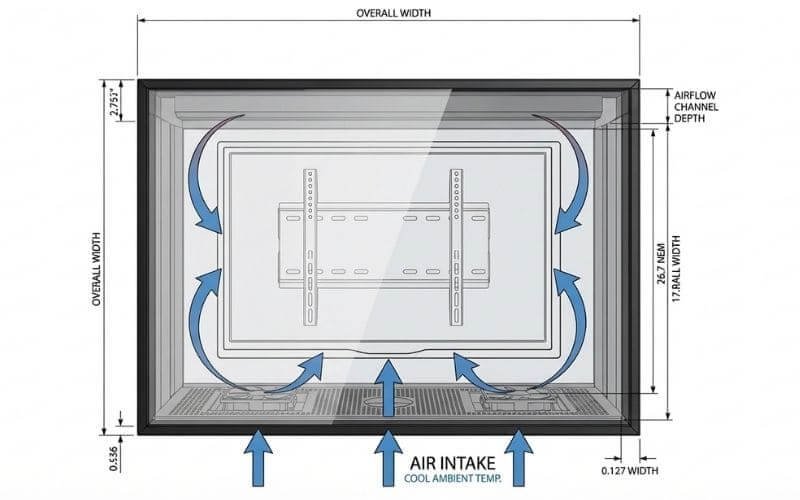
A completely sealed box creates a thermal trap. To prevent component failure, hotter or more sun-exposed installations require active fan ventilation matched to the internal heat load to flush out waste heat and stabilize the micro-climate.
As established, an IP65 enclosure successfully isolates the display from external moisture, but it introduces a secondary engineering challenge: thermal management. An operational television generates internal waste heat from its power supply and LED backlight array. If placed within a completely sealed box, this heat has no escape path.
The Greenhouse Effect
When an enclosure is installed outdoors, it is also subjected to solar loading (insolation).
-
Heat Accumulation: The dark surfaces of the enclosure absorb solar radiation, transferring that heat to the internal air volume. The combination of internal component heat and external solar gain creates a severe greenhouse effect.
-
Hardware Strain: Without an engineered thermal management strategy, the internal temperature will rapidly exceed the maximum operational threshold of the display, causing display darkening, image distortion, shutdown, or permanent panel stress.
Active Ventilation Requirements
To combat this, the installation must account for airflow and heat removal.
-
Evaluating the Site: In shaded, lower-heat installations, lighter-duty configurations may be sufficient. However, in hotter or more sun-exposed sites, choose ventilated versions.
-
Fan Configuration Logic: In the current Outvion line, ventilated configurations use 2 fans for 28–55″ models and 4 fans for 60″+ models.
-
Thermal Relief: Ventilated versions help remove waste heat from the enclosure cavity and reduce thermal strain by drawing cooler ambient air in and exhausting the heated air out, ensuring the internal micro-climate remains within safe operating parameters.
Environmental Thermal Management Matrix
| Environment Type | Solar Exposure Level | Thermal Risk Assessment | Recommended Ventilation Approach |
| Covered / Deep-Shade Patio | Minimal direct sunlight | Low Risk | Lighter-duty configurations may be sufficient |
| Standard Open Deck | Partial afternoon sun | Moderate Risk | Ventilated configurations (2 fans for 28-55″ models) |
| High-Desert / Direct Sun | Intense, direct radiation | High Risk | Pro/Ultra versions with maximum active ventilation |
Cable Routing and Mechanical Sealing SOP
An enclosure is only as weather-resistant as its weakest penetration point. Installers must properly utilize compression glands and implement drip loops to prevent water from traveling along power cords into the chassis.
Deploying an IP65 enclosure provides a robust physical defense, but the integrity of that defense relies entirely on proper installation protocols. The most vulnerable point of any weatherproof installation is the necessary egress point for power and data cabling. If these penetrations are not sealed correctly, water will bypass the primary defenses.
The Drip Loop Technique
Water travels down cables via gravity and surface tension.
-
The Hazard: If a power cord runs straight from a high wall outlet directly down into the top or side of an enclosure, rainwater will ride that cable like a slide, flowing directly into the electrical socket or the unit itself.
-
The Solution: Installers must always implement a “Drip Loop.” This requires leaving a slack loop of cable that hangs below the level of the entry port before curving back up to enter the enclosure. Water runs down to the bottom of the “U” loop and drips harmlessly off onto the ground, unable to travel upward against gravity into the enclosure’s ports.
Mechanical Compression Sealing
The physical entry point into the enclosure must be securely sealed to maintain the IP rating.
-
Bottom Exits: Professional enclosures position their cable exits at the bottom of the unit, utilizing gravity to their advantage.
-
Compression Glands: Outvion utilizes specialized foam blocks or compression glands at these bottom exit points. During installation, technicians must route the cables through these glands and ensure they are tightly compressed around the outer jackets of the wires.
-
Maintaining the Seal: This mechanical pressure creates a tight seal around the wire, helping maintain the seal against rain exposure and low-pressure water spray under proper installation.
Conclusion: Engineering Reliable Outdoor Entertainment
Weatherproofing a commercial display or a consumer television for outdoor use is an exercise in applied physics. It cannot be achieved with passive fabric covers or partial, unsealed wooden cabinets. True weatherproofing requires respecting the laws of thermodynamics, material science, and fluid dynamics.
By utilizing a highly engineered IP65-rated physical barrier constructed with optical-grade polycarbonate, operators isolate sensitive electronics from the primary threats of moisture ingress, UV degradation, and kinetic impact.
Furthermore, by choosing the correct ventilation configuration for the specific environmental load and adhering to strict mechanical sealing protocols, facility managers can help ensure continuous operational uptime. The decoupling strategy provides the final strategic advantage, ensuring that when the internal commodity hardware eventually requires replacement, the protective infrastructure remains a permanent, reliable asset on your patio or commercial property.
Weatherproofing Electronics FAQ
1. Can I just build a wooden cabinet to weatherproof my TV?
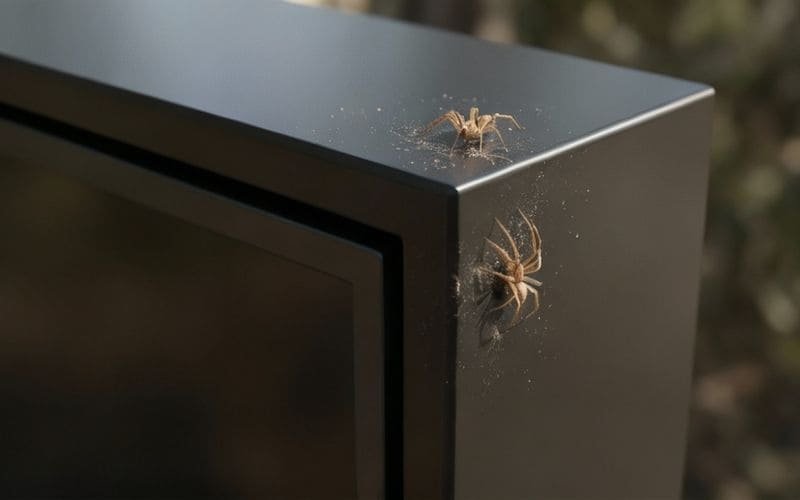
Wood can absorb moisture, warp over time, and usually lacks the sealing and ventilation control required for outdoor electronics. Wood is a naturally hygroscopic material, meaning it expands and contracts with ambient humidity, causing joints to fail and providing an ideal environment for insect nesting rather than offering engineered IP-rated protection.
2. Will the enclosure protect the TV in freezing winters?
Check the specific TV model’s operating and storage temperature range first. In severe freezing climates, seasonal removal may still be the safer choice for standard indoor TVs. Extreme sub-zero temperatures can cause the liquid crystals in standard displays to become sluggish, freeze, or suffer permanent damage regardless of a standard enclosure.
3. Do I need to seal the enclosure with silicone caulking?
No. Engineered enclosures use specialized gaskets designed to maintain the seal under compression. Adding aftermarket silicone can block intended drainage pathways, fan openings, air paths, and ventilation components, causing moisture retention and severe overheating.
4. How quickly can a failed screen be swapped?
The decoupling strategy allows maintenance to unlock the bezel and swap the internal display with substantially less downtime because the enclosure remains installed. A technician can typically unbolt the failed display from the internal VESA mount and install a replacement screen directly on the wall without removing the heavy protective infrastructure.
Recommended Technical Reading & Resources
To further understand the engineering principles discussed in this guide, we recommend reviewing the following authoritative resources:
-
Ingress Protection Standards: IEC 60529: IP Ratings Explained
-
The official international standard defining the testing methodologies for evaluating the degree of protection provided by mechanical casings against dust and water.
-
-
Condensation Physics: Thermodynamics of the Dew Point (National Weather Service)
-
A scientific explanation of how relative humidity and ambient temperature drops intersect to create condensation on cool surfaces.
-
-
Polymer Durability: Material Science of Polycarbonate (ScienceDirect)
-
Academic resources detailing the modulus of elasticity, UV resistance, and impact absorption characteristics of engineering thermoplastics.
-