
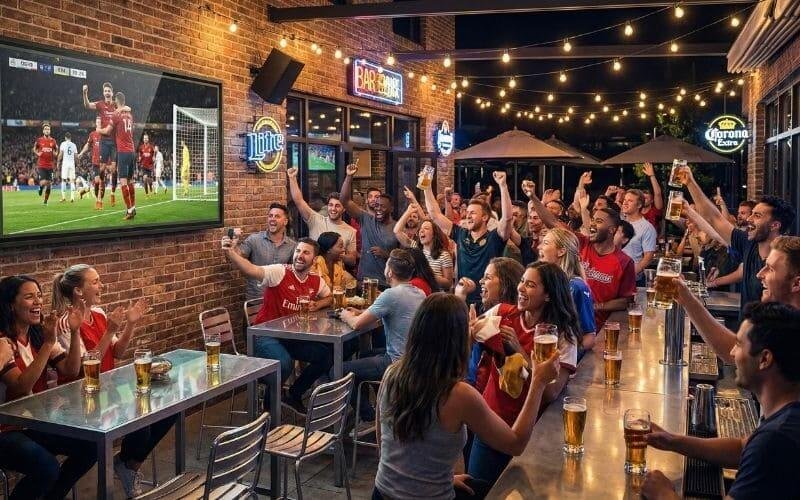
A commercial bar patio on an NFL Sunday, during a major soccer tournament, or on a warm summer evening is prime hospitality real estate. If you do not have televisions outside, your customers will simply walk across the street to the competitor who does. You are leaving measurable revenue on the table by allowing your patio to remain a digital dead zone.
BLUF: Equipping a bar patio with televisions dramatically increases customer “Dwell Time” and high-margin beverage sales. However, purchasing dedicated outdoor TVs creates a severe Capital Expenditure (CapEx) burden. As an Outvion engineer specializing in commercial outdoor AV deployments, I recommend the “Decoupling Strategy”: pairing commercial indoor TVs with professional IP65 Polycarbonate Enclosures. This strategy reduces upfront hardware costs, protects against physical hazards like spilled drinks, and accelerates your Return on Investment (ROI).
In the post-pandemic hospitality landscape, outdoor seating is no longer a seasonal luxury; it is a fundamental pillar of a restaurant’s operating model. However, deploying electronics in an environment subjected to weather, intoxicated patrons, and rigorous cleaning protocols requires precise engineering and careful financial planning. In this guide, we will break down a hypothetical financial model of patio entertainment, expose the depreciation trap of expensive dedicated outdoor displays, and demonstrate how smart operators are standardizing their AV infrastructure to protect their bottom line.
Last Updated: Jan 9th. 2026 | Estimated Reading Time: 7 Minutes
The “Dwell Time” Metric: A Hypothetical Revenue Model
In the hospitality industry, line-of-sight to screens directly correlates with customer retention. Based on standard hospitality modeling, adding patio TVs can increase average customer Dwell Time during sporting events, directly translating to additional rounds of high-margin beverage and appetizer sales.
In the bar and restaurant business, maximum seating capacity is a fixed physical metric, but the revenue generated per seat over a given shift is highly variable. The driving force behind maximizing that revenue is a metric known as “Dwell Time”—the length of time a party occupies a table and actively consumes products.
The Psychology of the Sports Consumer
Sports fans are highly predictable consumers. They plan their weekends, their afternoons, and their evenings around specific broadcasts. If your outdoor patio lacks visual entertainment, it ceases to be a destination; it simply becomes a waiting area for an indoor table. Customers will sit down, have one drink, realize they cannot monitor the game, and ask to close out their tab.
When you install high-definition screens in your outdoor spaces, you fundamentally alter the psychology of the environment. Fans actively want to be outside enjoying the weather, but they refuse to sacrifice the broadcast to do so. By providing the screens, you lock those customers into their seats for the duration of the event. A standard NFL game lasts roughly three hours and fifteen minutes. If a group is invested in the game, they are not leaving at halftime.
Modeling the Extra Revenue
Let us examine a hypothetical revenue model based on standard hospitality metrics. Suppose you operate a patio with 15 tables. We can model the financial impact of extending the average Dwell Time by 45 to 60 minutes.
-
The Consumption Assumption: If a table of four decides to stay an additional 45 minutes to finish watching a game, it is highly probable they will order at least one more round of drinks and potentially an additional appetizer to share.
-
The Math: Assuming four draft beers at $8 each and a $15 appetizer, you have generated an additional $47 in gross revenue from a single table.
-
The Multiplier: Multiply that $47 by 15 patio tables over the course of a Saturday college football marathon or a Sunday NFL lineup. You are modeling hundreds of dollars in purely incremental revenue per event day.
Because draft beer and fountain beverages operate on incredibly high gross margins (often exceeding 75% to 80%), a significant portion of this incremental revenue flows directly to your Net Operating Income (NOI). In this model, the screens are not merely an operational expense; they act as passive sales agents driving your most profitable inventory.
The CapEx Trap: Why Dedicated Outdoor TVs Strain Bar Budgets
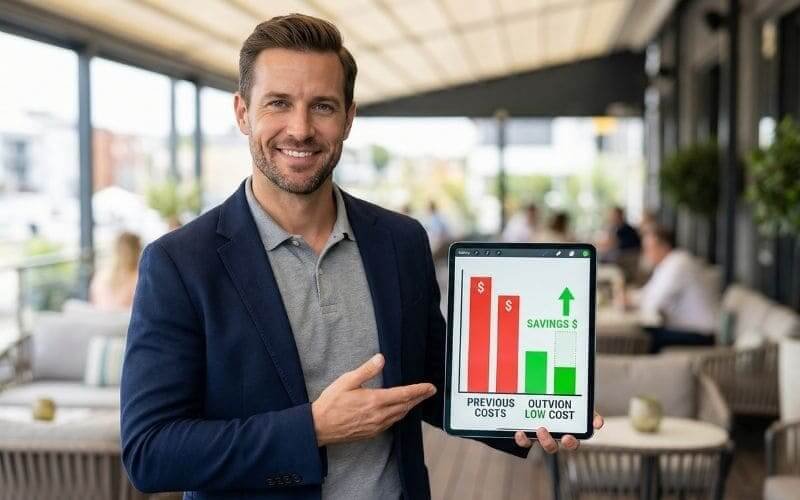
Purchasing dedicated luxury outdoor TVs requires a massive upfront Capital Expenditure that severely extends your ROI timeline. More dangerously, it ties your capital to rapidly depreciating, all-in-one technology that forces you to replace the entire expensive unit when a single internal component fails.
Once a hospitality group realizes they need televisions on the patio to drive Dwell Time, they often make a critical financial misstep. They consult a commercial AV integrator and request quotes for “Outdoor TVs.” The integrator typically returns with a proposal featuring monolithic, dedicated outdoor displays engineered with heavy metal chassis and internal weatherproofing.
While these units are robust, they are also astronomically expensive. A decent 55-inch dedicated outdoor television can command a retail price ranging from $3,000 to $4,000 or more.
1. The Upfront Capital Drain & Opportunity Cost
To adequately cover a medium-sized commercial patio so that every table has a clear sightline, you typically need a minimum of four screens. That is an estimated $12,000 allocated strictly for the display hardware.
-
The Hidden Installation Costs: Because dedicated outdoor TVs are extraordinarily heavy (often exceeding 70 lbs due to internal metal heat sinks), they require expensive, specialized heavy-duty commercial wall mounts and additional labor to install safely.
-
The Opportunity Cost: Committing $12,000+ in Capital Expenditure (CapEx) to a patio entertainment system radically extends your breakeven timeline. It ties up vital liquid capital that could have been deployed toward high-yield investments, such as upgrading your Point of Sale (POS) system, purchasing commercial patio heaters to extend the outdoor season, or funding local marketing campaigns.
2. The Depreciation Reality of SoC Architecture
Furthermore, hospitality operators must face the steep depreciation curve inherent in all modern electronics. Televisions are not static physical assets like real estate or commercial kitchen prep tables; they are rapidly aging computers.
-
Processor Obsolescence: Modern displays rely on internal System-on-Chip (SoC) processors to decode high-resolution video and manage networking applications. In three to five years, that processor architecture will inevitably become sluggish as broadcast standards evolve.
-
The Brutal Commercial Duty Cycle: In a sports bar environment, televisions often run 12 to 16 hours a day. Displaying static images (like the ESPN bottom-line ticker or fixed scoreboard graphics) for prolonged periods causes LED backlights to degrade and LCD panels to suffer from temporary or permanent image retention (burn-in).
3. The “Fused Hardware” Dilemma
The ultimate financial trap of the dedicated outdoor television lies in its all-in-one construction. The expensive weatherproof armor is permanently fused to the degrading digital screen.
When the logic board fails, or the backlight burns out outside of the manufacturer’s warranty period, you cannot simply open the chassis and replace the screen. You are forced to unmount and dispose of the entire $3,000 unit. Treating a high-cost, depreciating tech asset as a disposable consumable item is a severe, unnecessary blow to a restaurant’s Operational Expenditure (OpEx).
The Lifecycle Cost Analysis of All-In-One Outdoor TVs
| Lifecycle Stage | Financial Impact on the Bar | Why it Strains the Budget |
| Initial Purchase (CapEx) | -$3,000 to -$4,000 per screen | Drains liquid capital; extends the time required to achieve profitability on the patio. |
| Years 1-3 (Operation) | High depreciation rate | Internal processors age rapidly; screen brightness begins to degrade from 16/7 heavy usage. |
| Year 4+ (Hardware Failure) | -$3,000 for full replacement | The Sunk Cost Trap: The metal chassis is still perfectly weatherproof, but it must be thrown away because the internal screen died. |
The Decoupling Strategy: A Financial Hack for Hospitality
By decoupling the weather protection (the Outvion enclosure) from the digital display (a commercial indoor TV), bar owners create a long-term protective asset while slashing initial setup costs and future maintenance liabilities.
The most financially sophisticated operators in the hospitality sector refuse to fall into the all-in-one CapEx trap. Instead, they utilize a strategy well-known in industrial engineering: Decoupling. You must physically separate the rugged, long-lasting protective infrastructure from the fragile, rapidly depreciating digital technology.
This is precisely the engineering philosophy behind the Outvion IP65 Polycarbonate Enclosure. By implementing this strategy, you build a robust, commercial-grade AV system that makes future maintenance highly predictable and significantly cheaper.
How Decoupling Works in a Bar Setting
-
The Permanent Asset: You purchase an Outvion IP65 enclosure. This is your permanent infrastructure. It is constructed from dimensionally stable polycarbonate and utilizes an IP65-rated labyrinth seal to protect against dust and water ingress. It does not contain rapidly aging microchips or fragile LCD panels. It is a protective shell designed for a long outdoor service life.
-
The Consumable Tech: Inside this permanent shell, you install a standard commercial indoor television. Because the Outvion enclosure manages the environmental threats (moisture, impacts, and insects), you can safely deploy much more affordable indoor displays.
-
The Hot-Swap Advantage: In the hospitality industry, screens take abuse. They run all day and eventually wear out. When your enclosed commercial television inevitably requires replacement after years of grueling 16-hour shifts, you do not face a $3,000 financial crisis. Your maintenance technician simply unlocks the Outvion enclosure, removes the old screen, drops a new commercial display onto the universal internal VESA mount, and locks the door. You maintain a modern viewing experience with near-zero downtime for your patio patrons, at a fraction of the traditional cost.
Engineering the Setup: Outvion Hardware Configuration for Bars
Not all patios are created equal. Outvion offers Basic, Pro, and Ultra configurations to match the specific thermal loads of your environment, ensuring that the enclosed commercial TVs remain within safe operating temperatures.
When selecting enclosures for a commercial bar, it is critical to match the hardware configuration to the environmental reality of your patio. Outvion engineers have designed specific tiers (Basic, Pro, and Ultra) to handle varying levels of thermal stress.
The Importance of Active Cooling
When an LCD or LED television operates, its power supply and backlight array generate waste heat. If you place a television inside a sealed box without active ventilation, that heat is trapped, causing the internal temperature to rise rapidly. High heat places severe thermal strain on the television’s capacitors and can cause the liquid crystals in the display to temporarily fail.
To combat this, Outvion enclosures are engineered with active airflow systems.
-
Size Dictates Airflow: As a general engineering rule for Outvion products, enclosures designed for screens ranging from 28 inches to 60 inches are equipped with a 2-fan active ventilation system. Larger enclosures designed for screens 65 inches and above require higher airflow and are equipped with a 4-fan system to effectively cycle the larger internal air volume.
-
Climate-Specific Tiers: * The Basic Series: Ideal for deeply shaded, covered patios in mild climates where ambient heat and direct solar radiation are not major concerns.
-
The Pro & Ultra Series: For standard bar patios exposed to higher temperatures or indirect sunlight, Outvion strongly recommends the Pro or Ultra series. These models are equipped with enhanced ventilation systems designed to actively push hot air out and draw cooler ambient air in, supporting safe operating temperatures across a much wider environmental range (rated for environments from -30°C to +50°C).
The Real Cost of Patio Entertainment: A Financial Model
Based on a modeled 4-screen patio setup, the Outvion enclosure strategy can significantly reduce upfront CapEx compared to buying dedicated outdoor screens, while drastically lowering the cost of future hardware replacements.
To truly grasp the impact of the decoupling strategy on your restaurant’s balance sheet, we must look at a clear financial model. Let us assume a scenario where a sports bar is outfitting a new patio that requires four 50-to-55-inch displays.
We will compare the traditional route of buying dedicated outdoor televisions against the strategic route of deploying the Outvion Pro Enclosures. For this model, we will use Outvion’s referenced pricing for a 50-55″ Pro Enclosure (approx. $460) and assume a purchase price of $350 for a mid-tier commercial indoor display. We will also model the inevitable cost of replacing a single failed unit in Year 3.
Example Scenario – 4-Screen Patio Setup CapEx & TCO
| Investment Category | Dedicated Outdoor TVs (4 Nodes) | Outvion Decoupling Strategy (4 Nodes) |
| Display Hardware (4x) | $12,000 (Approx. $3,000 per unit) | $1,400 (Approx. $350 per commercial indoor TV) |
| Weather Protection (4x) | $0 (Integrated into TV cost) | $1,840 (Outvion 50-55″ Pro @ $460 each) |
| Total Initial CapEx | $12,000 | $3,240 |
| Cost to Replace 1 Dead TV | $3,000 (Must replace entire unit) | $350 (Keep enclosure, swap internal TV only) |
| Estimated 3-Year Hardware Cost | $15,000 | $3,590 |
Note: This model strictly compares display hardware costs. It excludes variable costs such as local commercial AV installation labor, GFCI electrical routing, and audio integration, which would apply to both scenarios.
The financial model presents a compelling business case. By choosing the Outvion enclosure strategy in this scenario, the hospitality operator reduces their initial display hardware CapEx by over 70%. Furthermore, the ongoing operational liability of maintaining the system drops from a high-stakes $3,000 replacement to a highly manageable $350 operational expense.
The Commercial Risk Matrix: Defending Your Investment
Bar patios feature unique hazards far beyond standard weather. Outvion enclosures utilize impact-resistant polycarbonate shields, IP65-rated seals, and physical locks to protect screens from physical strikes, spilled liquids, and tampering.
Weather is predictable; a crowded sports bar on a Saturday night during a championship game is not. You are introducing high-voltage electronics into a highly kinetic space filled with food, beverages, and enthusiastic crowds. A standard television features a relatively fragile glass or thin plastic screen that simply cannot survive this environment naked.
1. Impact Resistance and Projectiles
If a patron aggressively celebrates or a heavy object is accidentally knocked over, a naked screen is highly susceptible to immediate impact damage. To mitigate this operational risk, Outvion enclosures rely on advanced material science.
-
The Fragility of Glass and Acrylic: Standard TV glass shatters instantly. While many DIY protective boxes use acrylic (plexiglass) for its good optical clarity, acrylic remains a brittle material that can easily crack or splinter under sharp, focused impact.
-
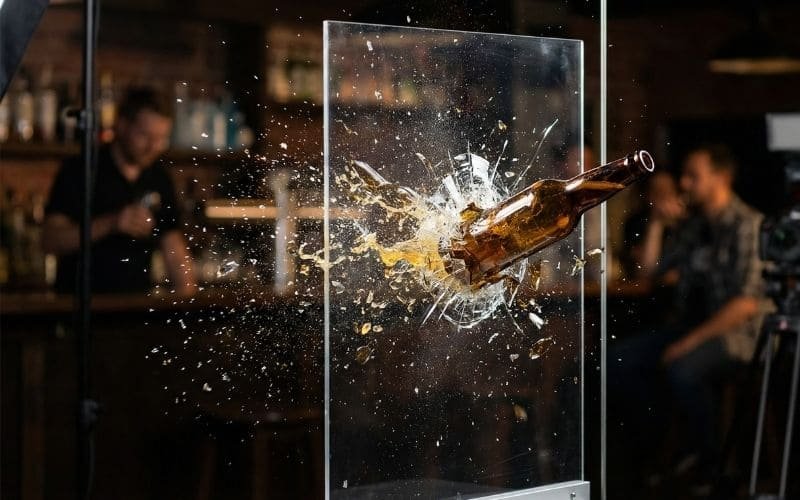
The Polycarbonate (PC) Defense: Outvion utilizes a front viewing window made of Polycarbonate. This is an advanced thermoplastic explicitly designed to yield, flex, and absorb massive kinetic energy.
-
Kinetic Energy Disbursement: When a heavy object (like a thrown glass or a pool cue) strikes the front of the Outvion enclosure, the polycarbonate shield is engineered to resist shattering. It physically repels the object, providing a robust physical barrier that ensures the fragile LCD screen sitting safely behind it remains untouched.
-
Solar Degradation Defense: Beyond physical impacts, this optical-grade PC window provides 99% UV blocking to protect the internal plastics and the TV’s bezel from cracking under long-term solar exposure.
2. Spills, Syrups, and Commercial Washdowns
In a high-volume hospitality setting, the threat of liquid damage is not limited to rain. The real dangers are spilled beer, sticky cocktail syrups, and the rigorous commercial cleaning protocols required to maintain a sanitary patio.
-
The Spilled Beverage Threat: If a sticky, sugary drink splashes onto a naked television, it immediately seeps into the ventilation grilles, corroding the motherboard and attracting pests.
-
The IP65-Rated Seal: Outvion enclosures are engineered to an IP65 rating under proper installation. This industrial standard guarantees a high level of protection against both fine dust ingress and low-pressure water jets from any direction.
-
Sealed Cable Exits: The enclosure utilizes a specialized, sealed bottom cable exit. This allows your power and HDMI cords to leave the box securely without creating open, unsealed holes that invite moisture or nesting insects.
-
The Washdown Protocol: Because of this robust IP65 rating, your closing staff can safely wash down the surrounding patio brickwork. (Crucial Note: While highly water-resistant, maintenance staff must be trained to avoid spraying high-pressure industrial power washers directly into the enclosure’s ventilation fan ports, and they should never use harsh abrasive chemicals on the UV-coated polycarbonate window).
3. Physical Security and Authorized Tampering
Outdoor electronics are prime targets for after-hours theft and in-service tampering. A standard television mounted on a basic wall bracket can be lifted and stolen in under thirty seconds.
-
The 2 AM Theft Risk: To prevent expensive hardware from walking off the property overnight, Outvion enclosures feature heavy-duty architectural shells that completely encase the internal VESA mounting points.
-
Operating Hours Tampering: During business hours, you must prevent patrons from accessing the TV’s HDMI ports (to plug in their own devices) or manually adjusting the volume and power buttons.
-
Managerial Control: The front bezel of the enclosure features an optional anti-theft locking mechanism. Once locked, it keeps your digital assets securely bolted to the wall and ensures that your chosen broadcast remains under strict managerial control at all times.
Hospitality Hazard & Protection Matrix
| Patio Hazard | Risk to Standard Naked TV | The Outvion Enclosure Defense |
| Physical Impacts | Cracked screen; total hardware failure. | Polycarbonate window absorbs impact; resists shattering. |
| Spilled Beverages | Liquid seeps into bezel; corrodes mainboard. | IP65 design and sealed cable exits repel liquid ingress. |
| Patio Cleaning | Washdown splashes destroy power supplies. | IP65 rating protects against low-pressure water splashes. |
| Unauthorized Tampering | Guests changing channels or inputs. | Locked front bezel restricts access to TV controls/ports. |
Conclusion & Final Verdict: Maximize Revenue, Minimize Risk
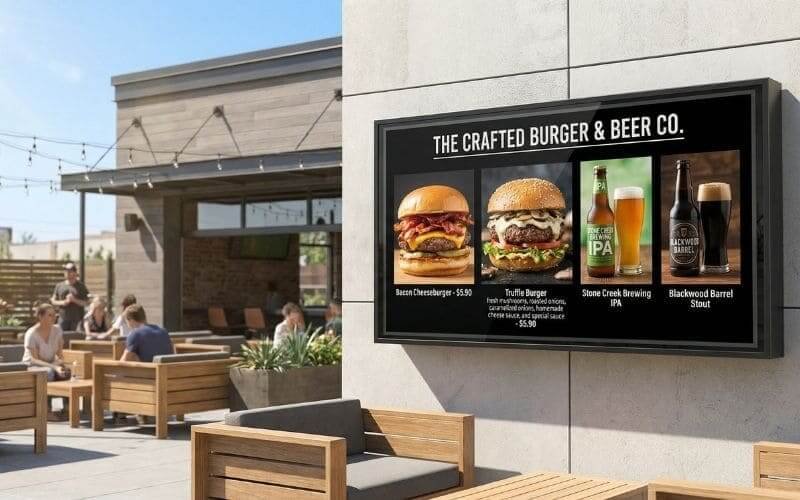
The goal of any commercial AV installation is to enhance the guest experience and drive revenue without crippling the balance sheet. In the competitive hospitality sector, maximizing patio Dwell Time is essential. However, blindly committing massive capital to rapidly depreciating, all-in-one outdoor technology is a highly inefficient use of a restaurant’s budget.
The Bar Owner’s ROI Decision Matrix
| Patio AV Strategy | Upfront CapEx Model | Maintenance Liability | Overall Business Verdict |
| No TVs on Patio | $0 | $0 | Loss of Revenue. Reduced dwell time during major events. |
| Dedicated Outdoor TVs | Very High | Replace entire $3k+ unit upon failure | High Risk. Traps capital in depreciating tech assets. |
| Outvion Decoupling Strategy | Moderate / Low | Swap out inexpensive internal TV only | Optimal Choice. Protects assets, lowers CapEx, speeds ROI. |
Smart hospitality owners build robust, permanent infrastructure and treat the digital displays inside them as swappable, upgradeable components. By deploying Outvion IP65 Enclosures paired with commercial displays, you achieve the ultimate operational objective: maximizing your beverage revenue while aggressively minimizing your physical risk and capital outlay.
Don’t leave your patio silent. Turn it into the most profitable square footage in your venue.
The Bar Owner’s Patio TV FAQ
1. Can I use standard consumer TVs for my bar patio?
While you can physically use standard consumer televisions if they are placed inside an actively cooled Outvion enclosure, it is not best practice for commercial venues. For a high-volume sports bar, we strongly recommend purchasing “Commercial Indoor Displays.” These are rated for 16/7 or 24/7 continuous runtime and generally offer higher brightness levels suited for overcoming patio glare.
2. How do I clean the front of the enclosure after a busy weekend?
Cleaning is straightforward. Because the unit is IP65 rated, you can use a damp cloth or low-pressure water splash to rinse away dust and dried liquids. For stubborn smudges, use a mild soap solution and a clean microfiber cloth. You must avoid harsh abrasive chemicals, industrial solvents, or rough scrub pads, as these will permanently scratch the polycarbonate and degrade its 99% UV-blocking optical coating.
3. Do I need special permits to install these on a commercial patio?
The mounting of the enclosures utilizes standard VESA hardware and typical commercial anchoring techniques. However, the electrical routing must strictly adhere to local commercial building codes. It is highly recommended to have a licensed electrician install dedicated, weather-rated GFCI (Ground Fault Circuit Interrupter) outlets to power the enclosures safely.
4. Will the enclosures survive staff washing the patio?
Yes, under normal cleaning conditions. The IP65 rating provides protection against dust and low-pressure water jets from any direction. This makes routine patio washdowns and splashing perfectly safe for the enclosed electronics. However, staff should be trained never to aim high-pressure industrial power washers directly at the enclosure’s seal lines or ventilation fan ports.
5. What if the patio is fully exposed to direct afternoon sun?
Direct solar radiation causes significant internal heat buildup. To combat this, you must select the Outvion Pro or Ultra series enclosures, which feature active fan ventilation (2-fan or 4-fan systems depending on the size). These systems flush hot air out to prevent thermal strain. Furthermore, ensure your chosen commercial TV has a sufficient “nit” brightness rating to be visible in high-ambient-light conditions.
Recommended Technical Reading
To further understand the engineering and commercial principles discussed in this guide, we recommend reviewing the following resources:
-
Financial Metrics: Maximizing Revenue: How to Improve Your Restaurant’s Table Turnover Rate (Toast POS)
-
Why it matters: Explains the correlation between customer retention, table turnover rates, and incremental revenue in the hospitality sector.
-
-
Plastics & Material Science: Polycarbonate vs. Acrylic: Material Comparison (Curbell Plastics)
-
Why it matters: A technical breakdown of why polycarbonate yields and absorbs kinetic energy, making it the superior choice for high-impact environments compared to brittle acrylics.
-
-
Ingress Protection Standards: IEC 60529: Degrees of protection provided by enclosures (IP Code)
-
Why it matters: The official international engineering standard defining exactly what constitutes “dust-tight” and “water jet resistant” protection for commercial enclosures.
-