
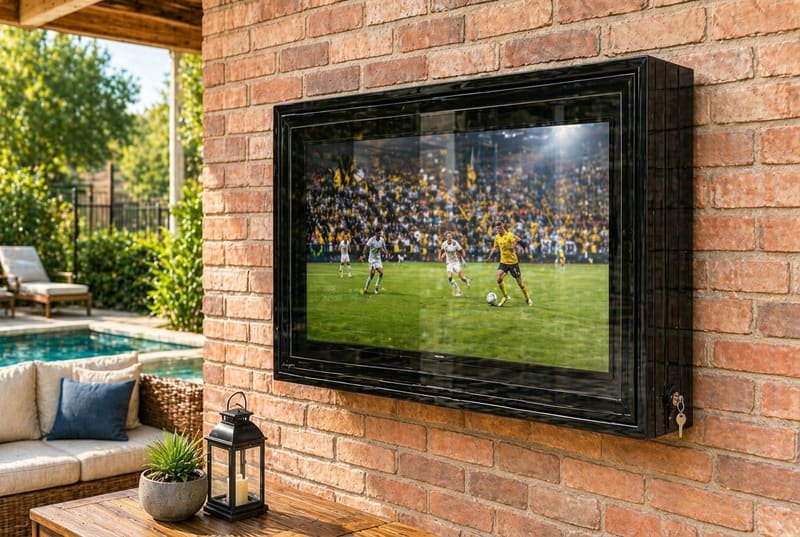
You want a TV on your patio, restaurant terrace, hotel pool area, or outdoor business space, but you know rain, dust, sun, humidity, and theft can damage it. A dedicated outdoor TV can be expensive. So, what is the practical middle ground?
An outdoor TV enclosure is a specially designed protective case that helps create a safer operating environment for a standard indoor TV in outdoor or semi-outdoor spaces. It protects the TV from rain, dust, moisture, heat buildup, impact, and unauthorized access, while allowing you to use a more affordable and replaceable screen inside.
It sounds simple, like just a box. But from my experience manufacturing these units and helping customers choose the right size, I can tell you that not all enclosures are created equal.
The material it is made from, the way the front panel opens or stays sealed, the cooling system, the gasket design, and the internal mounting layout are the real differences between a TV that lasts for years and one that fails during the first hot season.
Let’s dig into what really makes an outdoor TV enclosure work, so you can make a choice that protects your investment.
Last Updated: April 30, 2026 | Estimated Reading Time: 9 minutes
By Smith Chen, Outdoor TV Enclosure Engineer at Outvion
What Does an Outdoor TV Enclosure Actually Protect Against?
You may think an outdoor TV enclosure is only for rain. But in real outdoor installations, water is only one part of the problem. Heat, dust, insects, salt air, impact, and unauthorized access can be just as important.
A good outdoor TV enclosure protects the TV from multiple environmental and physical risks at the same time. It is not just a rain cover. It should help manage water exposure, dust, heat, humidity, cable access, impact, and long-term maintenance risk.
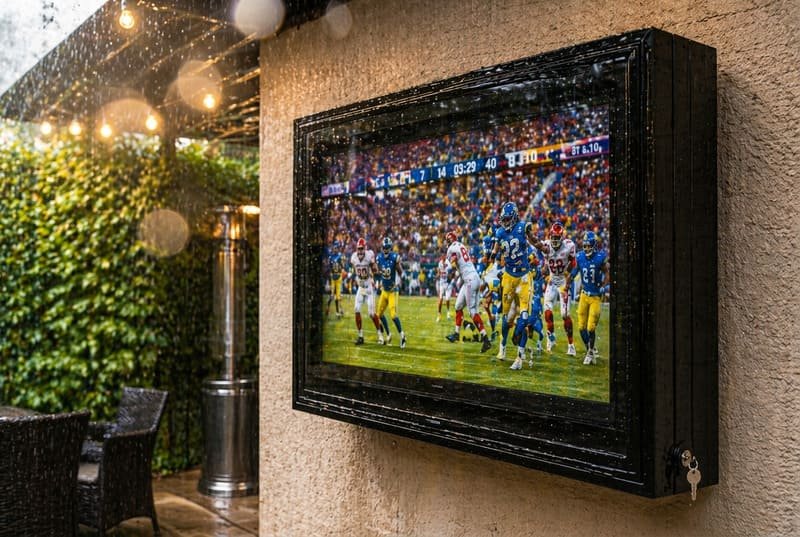
When customers first contact us, they usually ask, “Is it waterproof?” That is a fair question. But after we talk through the installation location, the real concerns often become more specific.
Is the TV near a swimming pool?
Is the location coastal?
Will the TV face direct afternoon sun?
Is the screen mounted in a bar, school, restaurant, or public venue?
Will customers, students, or guests be able to touch the TV?
Will the installation be exposed to dust, insects, or cleaning spray?
Those details matter because an outdoor TV enclosure is really a protection system.
The International Electrotechnical Commission explains that IP ratings grade the resistance of an enclosure against intrusion by dust or liquids. IEC IP Ratings For outdoor TV enclosures, an IP65 rating is commonly used because it indicates dust-tight protection and protection against water jets under defined test conditions. I always explain this carefully: IP65 does not mean vapor-proof, condensation-proof, chemical-proof, or submersible. Real protection also depends on gasket compression, cable sealing, installation angle, and maintenance.
Here is the way I usually explain the main risks:
| Outdoor Risk | Why It Matters | What the Enclosure Should Do |
|---|---|---|
| Rain / Splashing Water | Direct water contact can damage electronics. | Use sealed body design, gasket compression, and protected cable exits. |
| Dust / Pollen / Insects | Particles can enter vents and build up around internal components. | Reduce direct exposure through sealed construction. |
| Heat | TVs generate heat, and outdoor sun adds more. | Use internal spacing, airflow paths, and active fans when needed. |
| Humidity / Salt Air | Moisture and salt can accelerate corrosion on parts and contacts. | Use corrosion-resistant materials and protected hardware. |
| Impact | Balls, tools, guests, or public contact can crack screens. | Use an impact-resistant front shield and strong enclosure body. |
| Unauthorized Access | People may press buttons, unplug cables, or remove devices. | Use lockable design and managed cable routing. |
This is why I do not like describing an enclosure as just a “box.” A box only surrounds something. A proper outdoor TV enclosure manages risk.
What Are Enclosures Made Of, And Does It Really Matter?
You’re shopping around and see enclosures made of wood, metal, and plastic. They all claim to be weatherproof, so does the material really matter? It absolutely does, and choosing the wrong material can become expensive over time.
The material directly affects long-term durability, especially in humid, coastal, hot, or high-traffic environments. Wood can look attractive but may warp or decay when exposed to moisture. Metal feels strong but may corrode at scratches, seams, and screw holes. Engineered polycarbonate can offer a strong balance of impact resistance, corrosion resistance, lighter weight, and visibility.
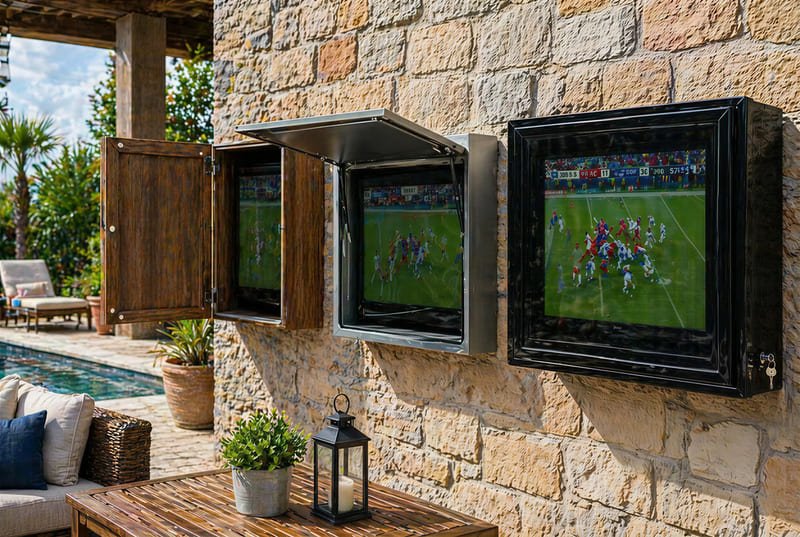
From our manufacturing and customer support experience, the environment should guide the material choice.
A beautiful wooden box may look great for the first few months on a covered porch in a dry climate. But wood is sensitive to moisture. The USDA Forest Service notes that wood decay becomes possible when wood moisture content is high enough, and moisture conditions are a key factor in wood deterioration. USDA Forest Service wood decay research
We have heard from customers in humid or coastal areas who found wooden enclosures warping, growing mold, or losing paint. Once wood warps, the seal can become uneven, and moisture may find a path inside.
Metal, such as steel or aluminum, feels sturdy and premium. It can be a good material in some applications. But in coastal or humid areas, the weak points are often scratches, drilled holes, seams, locks, and fasteners. FEMA guidance on coastal construction highlights the need for corrosion-resistant connectors and fasteners in coastal areas, which is a reminder that salt air can be aggressive on metal components. FEMA corrosion protection guidance
I do not want to say metal is always bad. A well-designed aluminum or stainless enclosure with the right coating and hardware can work in many environments. But if the coating gets scratched during installation, or if corrosion starts around hinges and seams, the long-term seal can be affected.
This is why we primarily work with high-strength polycarbonate. Covestro describes Makrolon polycarbonate as robust, lightweight, glass-like in transparency, and impact resistant even at low temperatures. Covestro Makrolon polycarbonate
From a practical standpoint, polycarbonate helps solve several common outdoor enclosure problems:
- It does not rust like steel. This matters for beachside resorts, coastal restaurants, pools, and humid patios.
- It is lighter than many metal structures. This makes handling, shipping, and wall mounting easier.
- It can be transparent and impact-resistant. This allows the enclosure to protect the screen while keeping the TV visible.
- It does not transfer heat in the same way as metal. This does not remove the need for cooling, but it changes how the enclosure behaves in direct sun.
Here’s a simple breakdown based on what we’ve seen over the years:
| Material | Key Advantage | Common Failure Point We See | Best Environment |
|---|---|---|---|
| Wood | Natural look, easy to customize | Warping, mold, paint peeling, seal failure | Dry, mild climates with full cover |
| Metal | Strong feel, premium appearance | Corrosion at scratches, seams, locks, and screw holes | Cool, dry, non-coastal areas or well-maintained commercial projects |
| Polycarbonate | Corrosion-resistant body, impact-resistant, lighter weight | Requires good UV stability, thickness, and proper design | Coastal, humid, hot, public, and high-traffic environments |
Choosing the right material is not about which one is “best” in every situation. It is about which material best matches your specific location, climate, and maintenance expectations.
Does The Enclosure’s Design Affect How I Watch TV?
You just want to sit down and turn on the TV. You probably assume that’s how every enclosure works, but a simple design choice can make a big difference in your daily experience.
Yes, the design is critical. Some cabinet-style enclosures have solid fronts that must be unlocked and opened before viewing. This can be inconvenient, and it exposes the TV whenever the cover is open. A sealed transparent-front enclosure keeps the TV visible and protected while you watch.
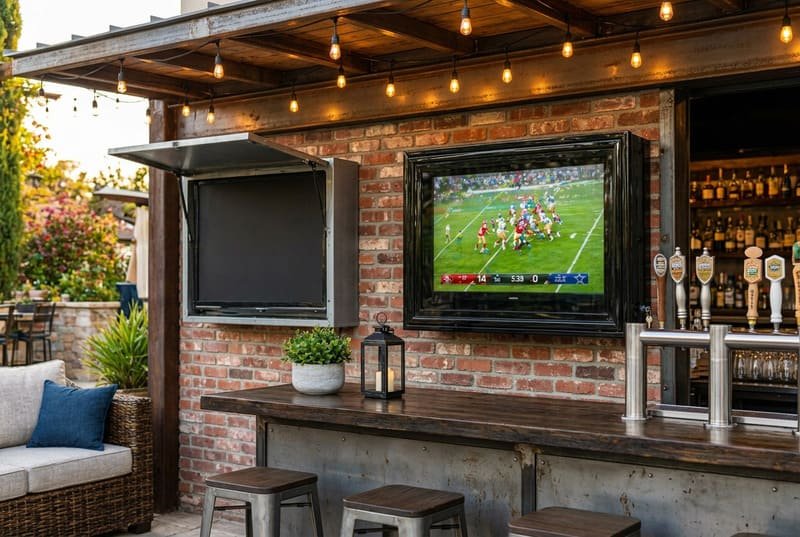
In our early days, we studied many designs on the market. We noticed a major split in how they worked, and it directly affects usability.
The first type is what I call the “cabinet-style” enclosure. These often have a solid, opaque front panel made of the same material as the box itself, such as wood or metal. To watch TV, you have to unlock it and lift or swing the cover open.
Think about the practical problems. You are having a barbecue and want to put the game on. You have to walk over, unlock the latches, and open the front door. If a surprise rain shower comes, you have to close it quickly. If staff at a bar forget to close it at the end of the night, the TV may be left exposed.
Every time you open the front, you also let in dust, pollen, insects, and humid air. For a customer who wants “set it and forget it” protection, that can become frustrating.
The other approach is the sealed transparent-front design. With this style, the front panel is made of a high-clarity, durable material such as polycarbonate. The TV is installed inside and remains visible through the clear shield. You do not need to open the enclosure to watch TV.
That design has several advantages:
| Design Feature | Why It Matters |
|---|---|
| Transparent Front Panel | The TV remains visible while protected. |
| Lockable Body | Limits unauthorized access to TV controls and cables. |
| Sealed Cable Exit | Helps reduce dust, moisture, and insect entry. |
| Front Shield | Adds impact protection for public or high-traffic spaces. |
| Internal Mounting Bracket | Holds the TV securely inside the enclosure. |
| Cooling Fans | Helps reduce heat buildup around the TV in hot locations. |
This design philosophy is about providing protection without adding a daily chore. The TV stays protected while it is on and while it is off.
Will Any TV Fit Inside My Enclosure?
You found an enclosure that says it fits “up to 55-inch TVs.” Your TV is 55 inches, so it should be a perfect fit, right? This is one of the biggest and most frustrating traps we see customers fall into.
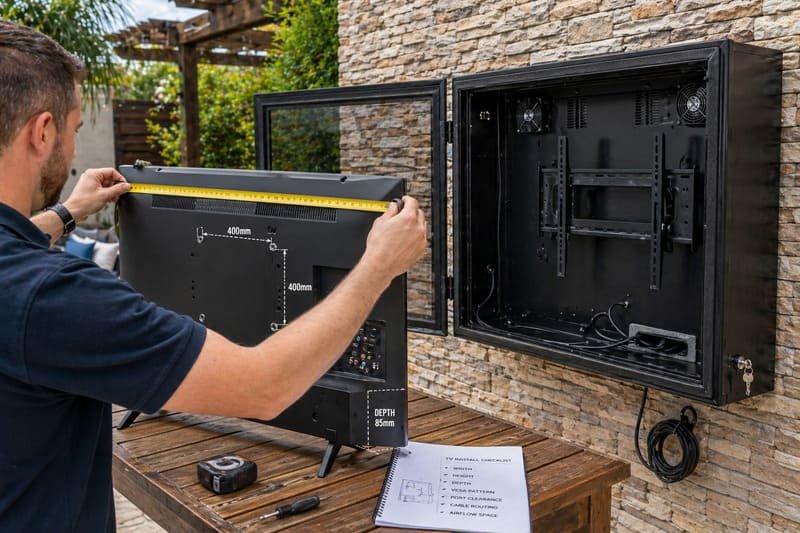
No, screen size is only the first step. You must check your TV’s actual width, height, and depth, then compare them to the enclosure’s internal dimensions. VESA mounting pattern, port position, cable clearance, and airflow space are also critical for a successful installation.
During our customer support calls, compatibility issues are probably the most common problem we help people solve before they buy.
Screen size, like “55 inches,” is just a diagonal measurement of the screen. It tells you very little about the TV’s actual outside dimensions. One 55-inch TV may be slim and easy to install. Another may have a thicker lower section, rear-facing ports, or a deeper speaker area.
To avoid this headache, you need to compare both the TV and enclosure specifications.
Here is the checklist we walk our own customers through:
- Internal Dimensions vs. External TV Dimensions
Find the enclosure’s maximum internal width, height, and depth. Then find your TV’s external dimensions without the stand. The TV should be smaller in all three measurements, with enough room for airflow and cable routing. - TV Depth
This is often the hidden problem. Some TVs are much thicker at the bottom. We have seen cases where the TV fit width-wise but was too deep for the enclosure front cover to close correctly. - VESA Mounting Pattern
On the back of your TV, there are four screw holes. The distance between these holes is the VESA pattern, such as 400mm × 400mm. Ergotron explains that the VESA mount standard defines the dimensions of the four-hole attachment interface on the back of displays and the screws used for those holes. Ergotron VESA Mount Guide - Port and Cable Clearance
Look at the back of your TV. Where are the HDMI, power, USB, and network ports? You need enough space for the cables to plug in and bend without being sharply crimped. - Airflow Space
A TV generates heat during operation. If it is pressed tightly against the enclosure wall with no space around it, heat can build up more easily.
Sony advises using TVs within a temperature range of 0°C to 40°C / 32°F to 104°F and avoiding direct sunlight. Sony TV temperature guidance This is why fit and airflow are not just installation details. They affect the TV’s operating environment.
Thinking through these details beforehand turns installation from a gamble into a predictable process. It is why we provide detailed spec sheets for our enclosures and urge customers to compare them against their TV model before ordering.
Is An Enclosure Just A Cheaper Outdoor TV?
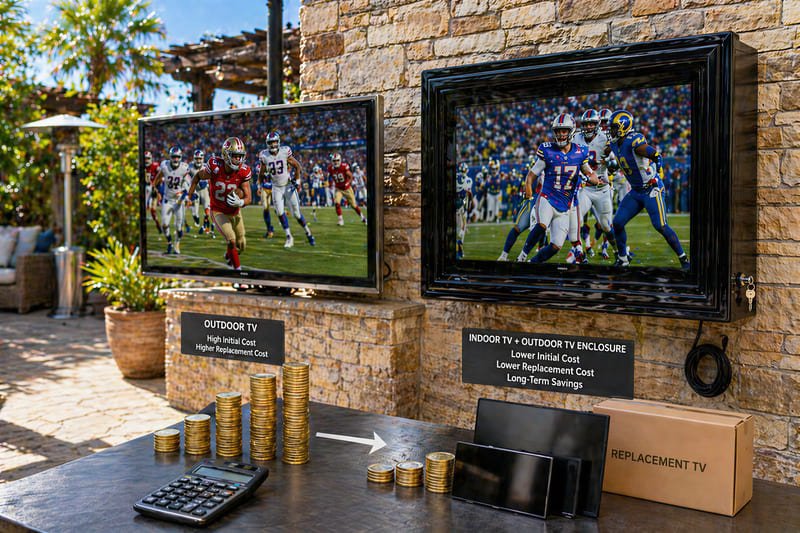
You see a dedicated outdoor TV priced much higher than a standard indoor TV, and then you see an enclosure that costs less. It is easy to think the enclosure is just the “cheap” option. But that misses the bigger picture.
An outdoor TV enclosure is not only a cheaper alternative. For many buyers, it is a long-term protection strategy. It protects an affordable, replaceable indoor TV while keeping the weatherproof shell as a longer-term asset. When TV technology improves, you can upgrade the TV inside instead of replacing the entire outdoor-rated unit.
From a business perspective, our clients in hotels, restaurants, bars, resorts, schools, and industrial facilities often think about total cost over several years, not only the upfront price.
A dedicated outdoor TV can be a strong option when the buyer wants an integrated product and prefers a single finished unit. But it can also be expensive, and when the screen technology becomes outdated, the whole unit may need to be replaced.
A good enclosure takes a different approach.
The expensive part is the protective shell: the sealed body, impact-resistant front, lockable design, gasket system, cable exit, and cooling system. The TV inside becomes the replaceable screen.
Total Cost of Ownership, or TCO, is a procurement concept that looks beyond purchase price and includes ownership-related costs such as acquisition, operation, maintenance, and replacement. CIPS Total Cost of Ownership overview
Here is the logic we often discuss with commercial buyers:
| Option | Upfront Cost | Replacement Flexibility | Maintenance Logic | Best Fit |
|---|---|---|---|---|
| Unprotected Indoor TV | Low | Easy to replace | High failure risk outdoors | Temporary or fully sheltered spaces |
| Dedicated Outdoor TV | High | Replace the whole unit | Integrated solution | Buyers who want a finished outdoor-rated TV |
| Indoor TV + Enclosure | Medium | Replace only the TV inside | Enclosure becomes long-term asset | Bars, hotels, patios, schools, resorts, industrial sites |
This is the core of the TCO argument. The initial savings can be helpful, but the bigger benefit is flexibility. When TV technology changes, you can replace the screen inside the enclosure instead of replacing the entire weather-protected system.
I do not like saying this is always the best option for everyone. If a project requires very high brightness, a specific outdoor display certification, or a manufacturer-backed outdoor TV warranty, a dedicated outdoor TV may make sense.
But for many outdoor patios, restaurants, pool areas, schools, and B2B installations, an enclosure gives the buyer a practical balance of protection, flexibility, and long-term value.
How Do You Choose the Right Outdoor TV Enclosure?
You understand what an enclosure does, but the options still feel confusing. Size, material, IP rating, fans, lock type, and installation location all matter.
To choose the right outdoor TV enclosure, start with the environment first, then match the TV size, internal dimensions, cooling system, IP rating, material, and security level to that location. The best enclosure is not just the one that fits the screen. It is the one that fits the risk.
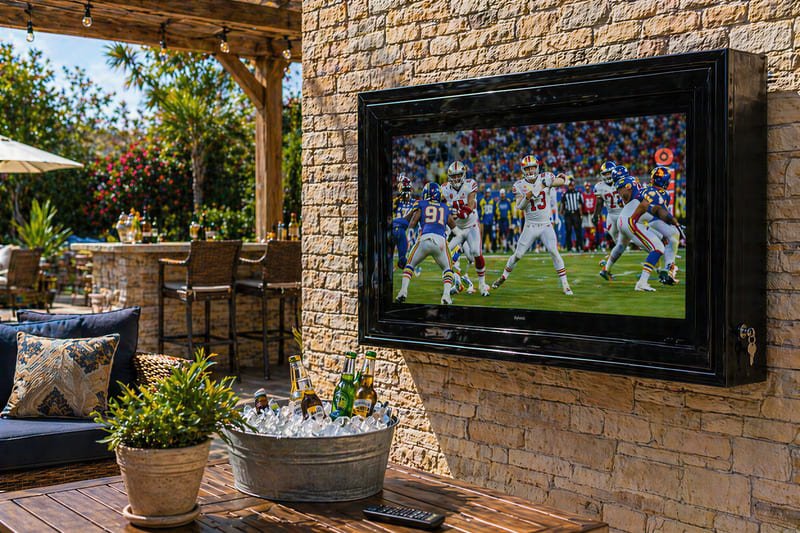
When I help customers choose, I do not start only with the TV size. I ask where the TV will be installed.
A hotel pool area is different from a backyard patio. A school courtyard is different from a coastal restaurant. A factory display is different from a sports bar wall. The environment determines the protection level.
Step 1: Identify the Location Risk
| Location | Main Risk | Recommended Enclosure Focus |
|---|---|---|
| Backyard Patio | Rain, sun, insects | IP-rated protection and basic cooling |
| Restaurant / Bar Patio | Long daily use, spills, tampering | Lockable design, fans, impact-resistant front |
| Hotel / Resort Pool Area | Humidity, guests, cleaning routines | Sealed cable exits, corrosion-resistant material |
| Coastal Location | Salt air, humidity, wind-driven rain | Polycarbonate body, strong gasket design |
| School / Campus | Impact, tampering, public access | Lockable, slim, impact-resistant structure |
| Factory / Warehouse | Dust, washdowns, heat | IP65 protection, fan cooling, sealed cable exits |
Step 2: Confirm Size and Mounting
Check:
- TV width
- TV height
- TV depth
- VESA pattern
- Cable direction
- Wall structure
- Viewing height
- Installation clearance
Do not choose only by diagonal screen size.
Step 3: Check Weather and Cooling
If the TV faces direct sun or runs many hours per day, active cooling is strongly recommended. ENERGY STAR notes that TVs consume energy in active use, and in practical terms, that energy becomes heat that must be managed inside an enclosure. ENERGY STAR televisions
A completely sealed box with no airflow plan can trap heat. Look for an enclosure that has a designed air path and fan system appropriate for the screen size.
Step 4: Check Security and Maintenance
For public or commercial spaces, the enclosure should protect the TV from more than weather. It should also limit access to ports, cables, and buttons.
Look for:
- Lockable front access
- Protected cable exits
- Secure wall mounting
- Easy authorized maintenance
- Impact-resistant front shield
- Proper gasket compression
A good enclosure should be protective but still serviceable. Eventually, someone will need to clean it, inspect it, or replace the TV inside.
FAQ
What is an outdoor TV enclosure?
An outdoor TV enclosure is a protective case designed to help a standard TV operate in outdoor or semi-outdoor spaces. It usually includes a sealed body, transparent front shield, internal TV mount, cable exits, locks, and sometimes cooling fans.
Can I use a regular indoor TV outside with an enclosure?
In many cases, yes, but you still need to check TV size, depth, VESA pattern, heat output, warranty limitations, and installation conditions. An enclosure reduces environmental exposure, but it does not change the TV manufacturer’s original outdoor-use rating.
Is an outdoor TV enclosure waterproof?
A good outdoor TV enclosure can be weather-resistant and IP-rated, but it is better to be precise. IP65 means dust-tight and protected against water jets under defined test conditions. It does not mean submersible, vapor-proof, or condensation-proof.
Does an outdoor TV enclosure need fans?
If the TV is exposed to heat, direct sun, or long operating hours, fans are strongly recommended. Fans help move warm air out of the enclosure and reduce heat buildup around the TV.
Is polycarbonate better than metal for outdoor TV enclosures?
For humid, coastal, poolside, or public spaces, polycarbonate is often a lower-maintenance choice because the body does not rust like steel and can provide impact resistance with visibility. Metal may still work in certain dry or well-maintained locations, especially if coating and hardware are carefully selected.
What size outdoor TV enclosure do I need?
Do not choose only by screen size. Measure the TV’s full width, height, and depth, then compare those numbers with the enclosure’s internal dimensions. Also confirm the VESA pattern, port locations, and cable clearance.
Is an outdoor TV enclosure cheaper than buying an outdoor TV?
Usually, the initial cost is lower than many dedicated outdoor TVs, especially for larger screen sizes. The bigger advantage is upgrade flexibility: you can keep the enclosure and replace the TV inside when needed.
Conclusion
An outdoor TV enclosure is a complete protective system, not just a box. The right enclosure should protect against rain, dust, heat, impact, humidity, insects, and unauthorized access while still allowing the TV to be watched comfortably.
From my experience, the best enclosure is not chosen by screen size alone. It is chosen by environment.
Material matters.
Front design matters.
Cooling matters.
Internal dimensions matter.
Cable sealing matters.
Long-term cost matters.
The way I explain it to customers is simple:
A standard TV was built for a controlled indoor room. An outdoor TV enclosure helps create a more controlled space around that TV when the room no longer exists.
For patios, hotels, restaurants, schools, resorts, factories, and public spaces, that protective layer can make the difference between a short-term screen and a long-term display solution.