
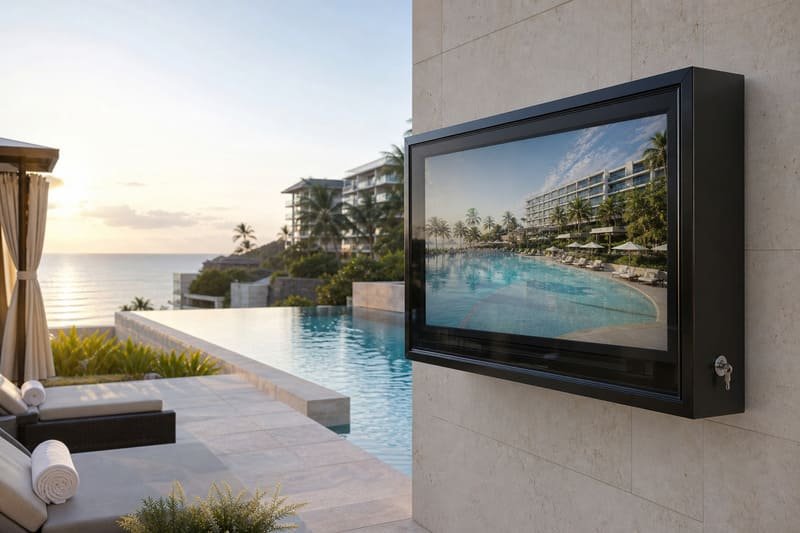
Most outdoor TV discussions focus on rain.
Pool areas are different.
A swimming pool creates its own environment around the screen. Warm water evaporates all day. Humid air lingers after sunset. Cleaning chemicals become part of normal maintenance. Guests create splash patterns that weather forecasts never predict.
That is why I treat a poolside TV installation differently from an ordinary patio installation. A 65-inch outdoor TV enclosure is not simply dealing with weather. It is dealing with a poolside microclimate.
When I review a poolside TV project, I rarely start with the enclosure itself.
I start with the environment.
- How close is the screen to the water?
- Does the pool create constant evaporation?
- Will guests splash directly toward the display?
- Does the site face coastal salt air?
- Can staff easily inspect the enclosure?
- Is the screen exposed to afternoon sun?
Those questions often matter more than the product brochure.
Because a poolside TV is exposed to more than rain.
It faces humidity, splash exposure, cleaning chemicals, heat, guest traffic, and seasonal maintenance—all at the same time.
Last Updated: June 22th 2026 | Estimated Reading Time: 9 Minutes
By Smith Chen, Outdoor TV Enclosure Engineer at Outvion
Why Is Poolside Humidity Different From Normal Outdoor Exposure?
Most buyers think about rain.
Poolside environments create a different challenge.
A swimming pool creates a localized microclimate where humidity, evaporation, splash exposure, cleaning chemicals, and temperature changes occur almost every day. These conditions are different from those found on most patios, decks, or garden walls.
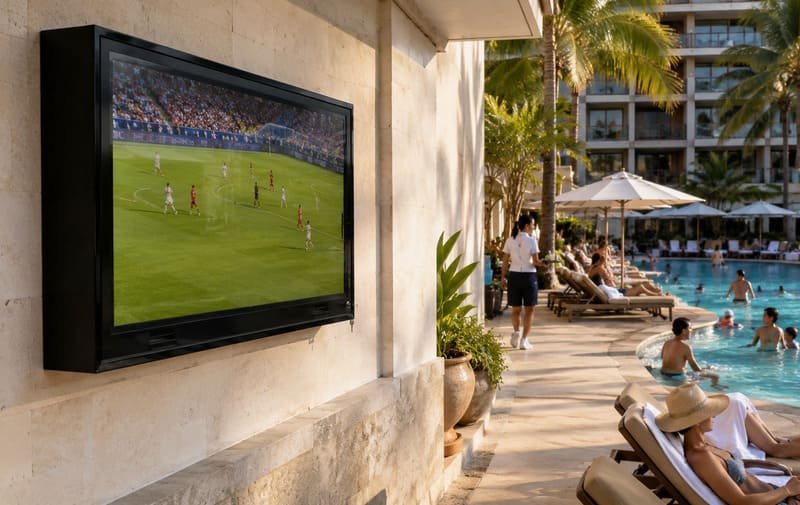
Rain is an event.
Poolside humidity is a condition.
Rain may last an hour. Poolside humidity can remain around the enclosure for months.
Warm water continuously evaporates. Guests generate splash exposure. Pool maintenance introduces chemicals. Evening temperature drops can create completely different air conditions than those experienced during the day.
This is why I avoid evaluating a poolside enclosure using only a “waterproof” label.
A poolside TV needs a broader protection strategy.
Poolside Microclimate Risk Map
| Environmental Factor | Typical Poolside Source | Potential Concern |
|---|---|---|
| Humidity | Continuous evaporation | Moisture accumulation |
| Splash Exposure | Swimming activity | Water reaching enclosure surfaces |
| Cleaning Chemicals | Pool maintenance routines | Long-term material stress |
| Heat | Direct sunlight and warm deck surfaces | Higher operating temperatures |
| Salt Air | Coastal resort locations | Accelerated hardware corrosion |
| Guest Activity | Public pool and bar areas | Accidental impact and cleaning wear |
For me, this is where a serious poolside project begins.
Not with the enclosure.
With the environment around it.
Is IP65 Enough for Poolside Humidity?
IP ratings are important.
But they should not be treated as guarantees.
IP65 can indicate dust-tight protection and protection against water jets under defined test conditions. It is a useful starting point, but poolside performance still depends on installation quality, airflow, cable protection, material selection, and maintenance.
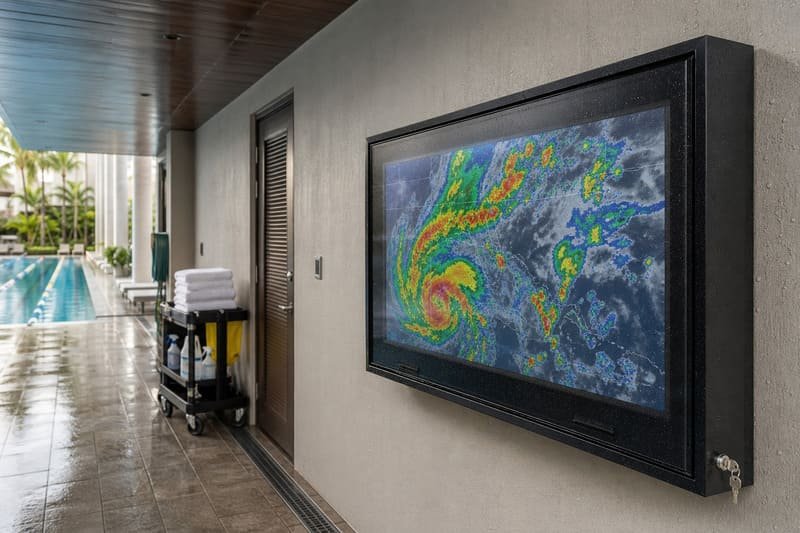
The International Electrotechnical Commission explains that IP ratings classify protection against dust and liquids
That makes IP65 a valuable reference point.
But a real pool environment is not a laboratory.
Water may arrive from unusual directions. Cleaning crews may spray surfaces from below. Guests may splash directly toward the screen. Humid air may surround the enclosure for hours.
This is why I never answer the question:
“Is it waterproof?”
Instead, I ask:
“How will it be installed?”
Because installation often determines performance.
What I Check Beyond IP65
| Buyer Question | What I Review | Why It Matters |
|---|---|---|
| Is it waterproof? | IP rating and sealing design | Confirms defined water-resistance level |
| Can it manage humidity? | Airflow and placement | Humid air needs movement and clearance |
| Can it handle splash exposure? | Mounting height and orientation | Pool splash often comes from below or the front |
| Is it suitable near the ocean? | Material and hardware selection | Salt air can increase corrosion risk |
| Can it be serviced easily? | Access and maintenance clearance | Staff must inspect, clean, and reset the system |
What Materials Help Reduce Corrosion Near Pools?
Pool environments are hard on equipment.
Especially over time.
Material selection plays a major role in reducing corrosion risk. Near pools, I pay attention not only to the enclosure body but also to hinges, locks, screws, brackets, cable glands, and mounting hardware.
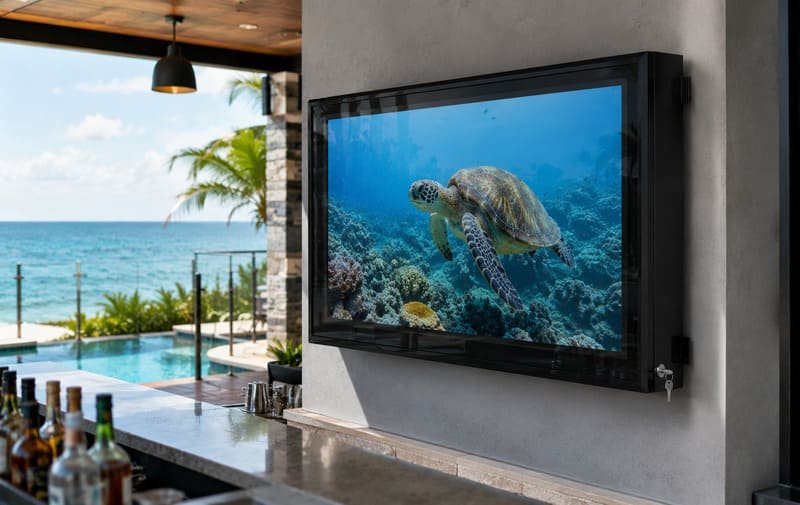
Many buyers focus only on the main enclosure shell.
I focus on every exposed component.
FEMA notes that high humidity and salt accumulation can accelerate corrosion of untreated steel components in coastal environments.
This matters because many poolside installations are also located near beaches and resorts.
A polycarbonate body does not rust like steel, which removes one corrosion pathway at the enclosure body level.
Covestro describes Makrolon polycarbonate as lightweight, impact-resistant, and highly durable for demanding applications.
That makes polycarbonate attractive for hospitality environments where appearance, durability, and corrosion resistance all matter.
Material Areas I Review
| Component | Why It Matters |
|---|---|
| Polycarbonate Body | Removes the steel-rust pathway at body level |
| Front Viewing Panel | Needs clarity, UV stability, and cleaning tolerance |
| Locks and Hinges | Face daily humidity, cleaning, and service use |
| Cable Entry Hardware | Helps manage moisture paths around cables |
| Mounting Brackets | Support structural reliability and long-term safety |
| Gaskets | Help maintain sealing performance after opening and closing |
| Fasteners | Small parts often show corrosion before the main body |
Why Placement Matters More Than Many Buyers Expect
A good enclosure installed in a bad location can still create problems.
Placement affects humidity exposure, splash direction, solar heat load, airflow performance, maintenance access, and long-term reliability.
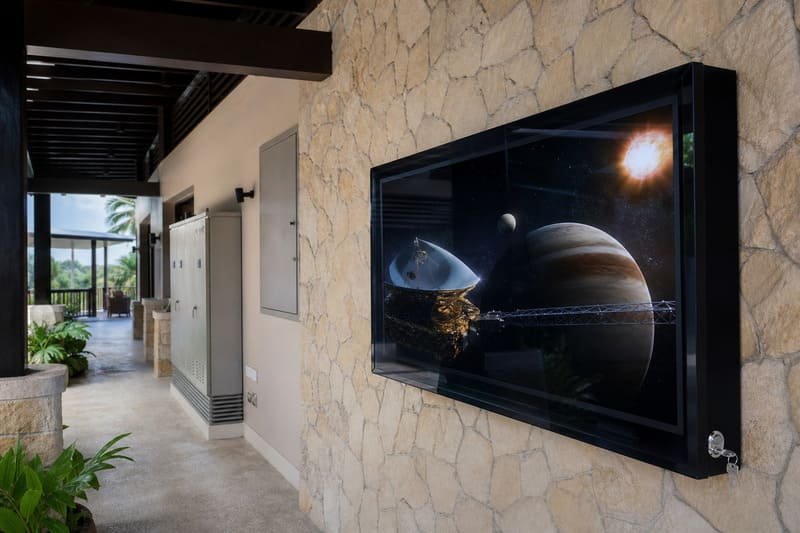
When reviewing a project, I always request photos.
Photos reveal details specifications cannot.
I look for:
- Distance from pool edge
- Splash patterns
- Sun direction
- Roof overhangs
- Wall construction
- Service access
- Guest circulation paths
A screen mounted directly beside active splash zones faces very different conditions from one positioned under a covered hospitality structure.
Placement Priorities
| Area | Recommended Approach | Risk If Ignored |
|---|---|---|
| Height | Above normal splash zone | More direct splash exposure |
| Shade | Covered or partially shaded | Higher heat load and glare |
| Airflow | Clear vent access | Poor heat movement |
| Cable Routing | Protected cable entry | Water can follow cable paths |
| Service Access | Space to open enclosure safely | Higher maintenance cost |
| Guest Traffic | Avoid narrow walkways and impact zones | More contact and cleaning wear |
Many poolside reliability problems begin with placement decisions made before installation.
How Does Airflow Help Manage Heat and Humidity?
Many buyers think airflow is only about cooling.
I disagree.
At poolside locations, airflow is also part of humidity management because stagnant humid air tends to remain trapped longer than moving air.
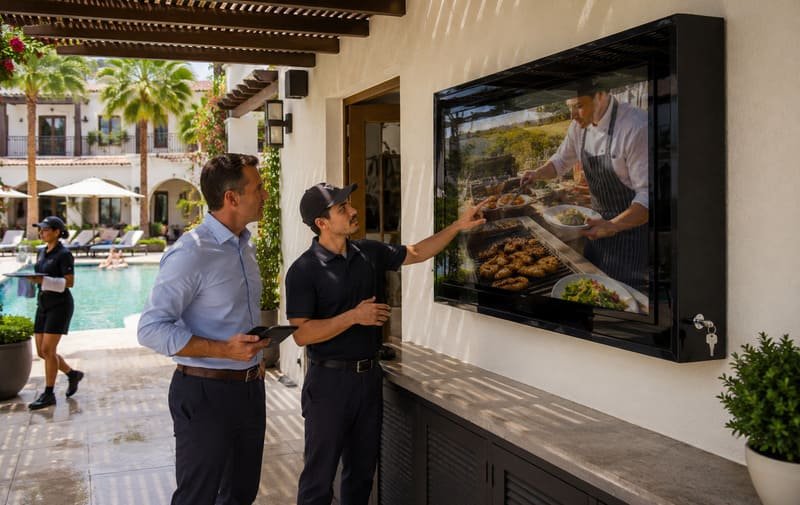
A TV generates heat.
Sunlight generates heat.
Warm deck surfaces generate heat.
Humidity makes heat management more complicated.
Sony advises operating TVs within recommended temperature ranges and avoiding unnecessary direct sunlight exposure.
Fan-assisted airflow can help reduce heat buildup.
But fans are not air conditioning.
They do not eliminate condensation.
They do not override environmental conditions.
What they do is support air movement.
Airflow Review Checklist
| Item | Why It Matters |
|---|---|
| Fan Function | Helps remove accumulated warm air |
| Vent Design | Maintains a clear airflow path |
| Shade Availability | Reduces solar heat load |
| Internal Clearance | Allows air to circulate around the TV |
| Seasonal Inspection | Helps catch blocked vents or fan problems early |
| Operating Hours | Longer runtime increases heat load |
For poolside projects, airflow should be viewed as both a heat-management tool and a moisture-management tool.
Why Do Hotels and Pool Bars Often Prefer Enclosure-Based Systems?
This is where commercial buyers think differently from homeowners.
Many hospitality operators prefer enclosure-based systems because they simplify future upgrades, standardize installations, and reduce the cost of replacing displays over time.
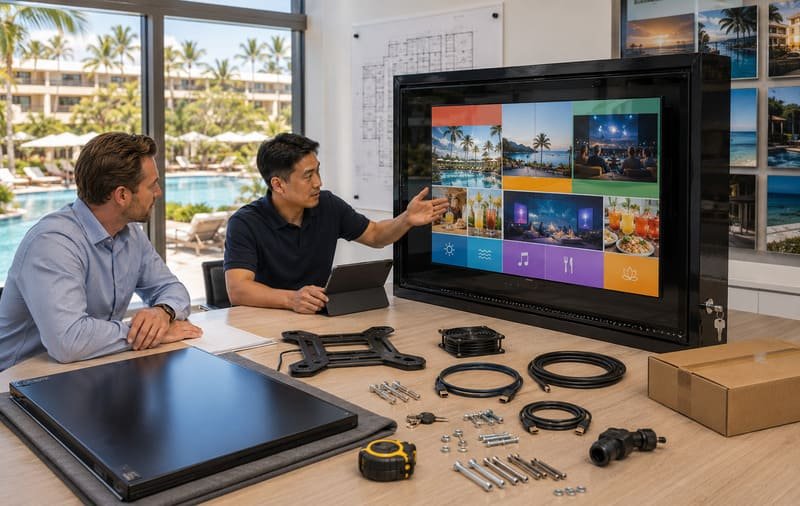
A hotel may install 6 screens, 12 screens, or 20 screens across multiple pool bars and recreation areas.
Over five years, televisions may change.
The enclosure often remains.
This creates operational advantages.
Hospitality Benefits
| Factor | Enclosure-Based System Advantage |
|---|---|
| TV Replacement | Replace display only if the enclosure still fits |
| Multi-Site Standardization | Easier inventory and service planning |
| Upgrade Flexibility | Future screen changes remain possible |
| Physical Protection | Adds a barrier against splash, contact, and light impact |
| Budget Control | Helps reduce lifecycle replacement pressure |
| Service Access | Staff can inspect, clean, and replace components more easily |
For many hospitality projects, that flexibility becomes more valuable than the initial purchase price alone.
What Should Buyers Confirm Before Ordering?
A successful project starts before payment.
Before ordering a 65-inch poolside TV enclosure, buyers should verify TV dimensions, VESA pattern, mounting structure, splash exposure, cable routing, airflow clearance, maintenance access, and environmental conditions.
My Pre-Order Checklist
| Check Item | Why It Matters |
|---|---|
| TV Dimensions | Confirms physical fit inside the enclosure |
| VESA Pattern | Confirms mount compatibility |
| Wall Structure | Supports safe installation |
| Cable Routing | Helps reduce moisture paths |
| Sun Exposure | Supports heat planning |
| Pool Distance | Helps estimate splash risk |
| Service Access | Makes future maintenance practical |
| Site Photos | Speeds up project review and reduces mistakes |
| Coastal Exposure | Helps select suitable hardware and material details |
| Operating Hours | Helps review heat and airflow needs |
The more information I receive before production, the fewer surprises appear during installation.
Questions Hotel and Poolside Buyers Usually Ask
Can I use a standard indoor TV inside a poolside enclosure?
In many cases, yes. The enclosure helps reduce weather exposure, but installation quality, airflow, and environmental conditions still matter. The enclosure does not change the TV manufacturer’s original outdoor-use rating or warranty terms.
Does IP65 mean moisture can never enter?
No. IP65 indicates defined dust and water resistance under testing conditions. It should not be interpreted as a guarantee against every humidity or condensation scenario.
Will polycarbonate help near coastal resorts?
Yes. A polycarbonate body does not rust like steel, although hardware and mounting components still require corrosion-resistant design and inspection.
How close can an enclosure be installed to a swimming pool?
There is no universal distance. Splash patterns, local codes, guest activity, electrical safety requirements, and service access all influence placement decisions.
Can staff clean the enclosure using pressure washers?
I do not recommend directing high-pressure water toward seals, vents, cable entries, or hardware. Gentle cleaning methods are usually safer.
How often should the enclosure be inspected?
I recommend inspections before peak season, after major storms, and during regular maintenance schedules. Check fans, vents, seals, locks, cable entry points, and front panel cleanliness.
Conclusion
A poolside TV is exposed to more than weather.
It operates inside a constantly changing environment created by water, evaporation, people, cleaning routines, and daily operation.
That is why I rarely evaluate a 65-inch enclosure by its IP rating alone.
- I look at the microclimate around the screen.
- Where the humidity comes from.
- Where the heat goes.
- How water reaches the enclosure.
- How staff maintain it.
- How future screen replacements will be handled.
- The enclosure is only one part of the solution.
- The poolside environment is the other half.