
Dust does not usually damage an outdoor TV in one dramatic moment.
It builds up quietly.
- It collects around vents.
- It sticks to damp surfaces.
- It scratches clear panels during cleaning.
- It reaches cable exits.
- It blocks airflow.
- It mixes with salt air near beaches and heat near desert patios.
That is why protecting an outdoor TV in dusty or sandy environments should start with particle pathway management. The real question is not only whether the enclosure has an IP rating. The question is whether dust, sand, heat, humidity, cleaning, and maintenance can be managed together over time.
When I review a dusty or sandy outdoor TV project, I do not start with the TV size.
I trace the particle path first.
- Where can dust enter?
- Where can sand collect?
- Where can airflow clog?
- Where do cables exit the enclosure?
- How will staff clean the front panel without scratching it?
- Will the site face beach sand, desert dust, construction dust, warehouse dust, or sports-field sand?
Those questions matter because dust and sand are not only cosmetic problems.
They can become airflow problems, cleaning problems, sealing problems, corrosion problems, and service problems.
A good outdoor TV enclosure for dusty or sandy areas is not just a box.
It is a system for controlling particle pathways.
Last Updated: June 16, 2026 | Estimated Reading Time: 8 minutes
By Smith Chen, Outdoor TV Enclosure Engineer at Outvion
Why Is Dust and Sand Different from Ordinary Outdoor Dirt?
Ordinary dirt may sit on the surface. Fine dust and sand behave differently because they move with wind, collect in small gaps, and create repeated maintenance pressure.
Dusty and sandy outdoor TV protection is not only about blocking visible sand. It is about managing particle pathways: cable exits, vents, filters, gaskets, front-panel cleaning, service openings, and airflow. If those paths are ignored, a screen can look protected from the outside while the weak points keep collecting dust over time.
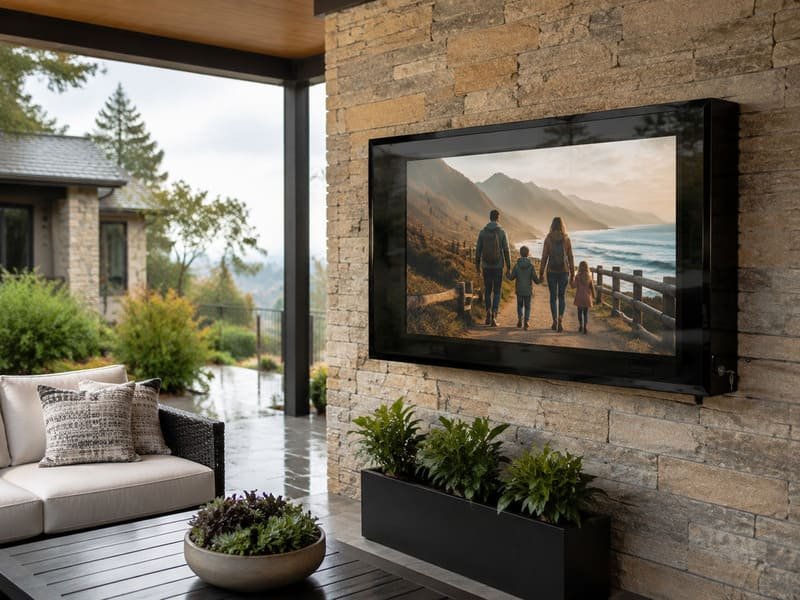
This is why I do not treat a beach patio, desert terrace, sandy sports venue, and dusty warehouse entrance as the same environment.
They may all involve particles, but the particles behave differently.
Beach sand often comes with salt air and humidity.
Desert dust often comes with heat and long dry periods.
Sports venues may have sand, wind, balls, bags, and impact risk.
Construction-adjacent spaces may have fine dust that needs frequent cleaning.
Warehouse entrances may have airborne dust, vehicle movement, and vibration.
If the protection plan only says “dustproof,” it is not specific enough.
Dust Is Not One Thing
| Environment | Main Particle Problem | Extra Risk |
|---|---|---|
| Beachfront Patio | Sand, salt aerosol, humid air | Corrosion, front-panel abrasion, gasket inspection |
| Desert Terrace | Fine dust, high heat, dry wind | Vent blockage, thermal load, frequent cleaning |
| Sandy Sports Venue | Blown sand, balls, bags, guest movement | Front-panel scratching, accidental impact |
| Construction-Adjacent Site | Fine construction dust | Cleaning abrasion, vent buildup |
| Dusty Warehouse Entrance | Airborne dust, carts, tools | Vent clogging, vibration, impact |
| Poolside Sandy Area | Sand, splash, cleaning routines | Hardware inspection, cable exit protection |
A buyer who asks only for a higher IP rating may miss the practical issue:
- Where does the dust go after one month?
- Where does it go after one season?
- Who cleans it?
- Can the enclosure still breathe?
- Can the front panel still be wiped safely?
That is the real dust and sand question.
Where Do Dust and Sand Actually Enter an Outdoor TV Setup?
Dust usually enters through weak points, not through the strongest part of the enclosure. Cable exits, vents, door gaskets, service openings, and cleaning routines often matter more than the main body material.
The most important dust-control points are not always visible in product photos. Buyers should check cable exits, vent paths, filter access, gasket pressure, front-panel cleaning method, mounting clearance, and what happens when the enclosure is opened for service.
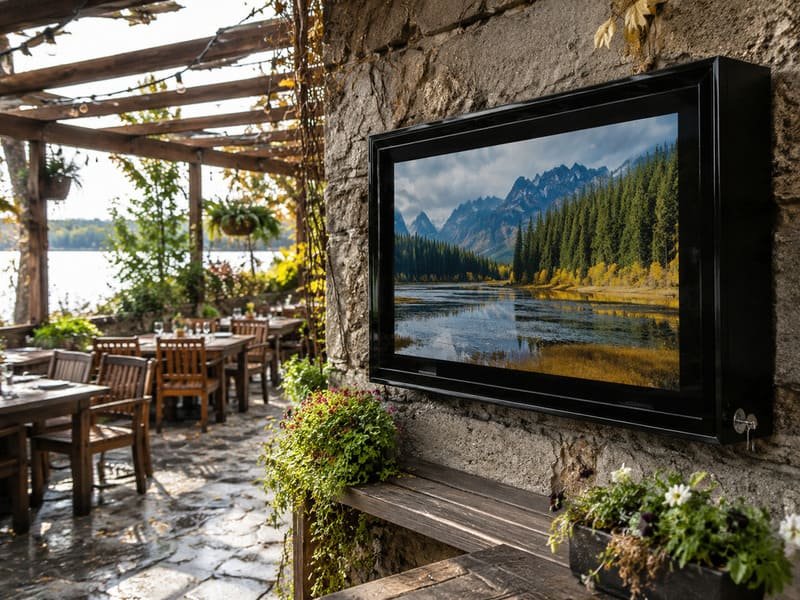
A lot of buyers focus on the front face.
That makes sense, because it is the visible part. But in dusty and sandy locations, the front panel is only one part of the risk.
Fine particles look for gaps.
A small cable opening can matter.
A loose gasket corner can matter.
A fan vent that cannot be cleaned can matter.
A service door opened on a windy day can matter.
A front panel cleaned with the wrong cloth can matter.
This is why DIY covers and generic cabinets often fall short. They may block visible debris, but they usually do not provide controlled sealing, filtered airflow, cable-exit protection, or repeatable maintenance access.
Particle Pathway Map
| Particle Pathway | What Can Happen | What to Check |
|---|---|---|
| Front Panel Surface | Sand can scratch during wiping | Cleaning method, soft cloth, coating guidance |
| Cable Exits | Fine dust can enter through gaps | Sealed cable ports, bend space, strain relief |
| Fan Vents / Filters | Dust can block airflow | Vent design, filter access, cleaning routine |
| Door Gasket | Sand can interrupt or wear the seal | Gasket pressure, inspection, replacement plan |
| Mounting Gap | Debris can collect behind the enclosure | Wall clearance, drainage, cleaning access |
| Service Opening | Dust can enter during maintenance | Clean opening routine, avoid windy service timing |
| Media Device Area | Dust can collect around HDMI, LAN, and power | Protected compartment, cable labeling |
| Lower Frame Edge | Sand can settle and remain after wind | Drainage path and cleaning access |
This table is more useful than asking only whether the enclosure is “dustproof.”
A dusty environment is not one problem.
It is several small entry points working together.
Why Is IP65 Important but Not the Whole Dust Strategy?
IP rating matters because it gives buyers a more specific standard than vague claims like dustproof or waterproof. But it should be treated as the starting point, not the whole answer.
IP65 can indicate dust-tight protection and protection against water jets under defined test conditions. But it does not mean sandstorm-proof, filter-maintenance-free, condensation-proof, salt-proof, pressure-wash-proof, heat-proof, or lifecycle-proof. Real performance still depends on cable exits, gaskets, vents, installation, repeated opening, and maintenance.
The International Electrotechnical Commission explains that IP ratings grade the resistance of enclosures against intrusion by dust and liquids. IEC IP Ratings
That makes IP65 useful for dusty outdoor TV projects because the first digit “6” is the highest dust-ingress level in the IP code.
But the rating is still a defined test condition.
A real beach or desert patio is not a laboratory.
Wind direction changes.
Cable routing changes.
Doors are opened for service.
Filters collect dust.
Gaskets age.
Installers may change the intended orientation.
Staff may clean the unit differently from the manual.
IP65: Useful Baseline, Not the Whole Plan
| Area | What IP65 Helps With | What Still Needs Planning |
|---|---|---|
| Dust Ingress | Dust-tight protection under defined test conditions | Cable exits, gasket wear, service openings |
| Water Jets / Splash | Water-jet resistance under defined test conditions | Drainage, installation angle, pressure cleaning limits |
| Cable Areas | Can be protected if designed correctly | Port sealing, bend space, installer discipline |
| Vents / Filters | May be designed into the enclosure system | Cleaning access and airflow monitoring |
| Long-Term Use | Gives a baseline at shipment or test stage | Maintenance, repeated opening, gasket condition |
| Sandstorm / Extreme Dust | Not a guarantee for every event | Site shielding, cleaning schedule, usage limits |
The main point is simple:
Use IP65 as a baseline.
Then review the particle pathways.
How Do You Balance Dust Sealing With Heat and Airflow?
Dust protection wants sealing. Heat protection wants airflow. A good outdoor TV box must solve both without turning vents and filters into the next weak point.
A sealed enclosure helps reduce dust and sand entry, but a running TV still produces heat. Fan-assisted airflow can help move warm air away from the TV, but it is not air conditioning. In dusty or sandy sites, the airflow path must be protected, accessible, and cleaned on a schedule.
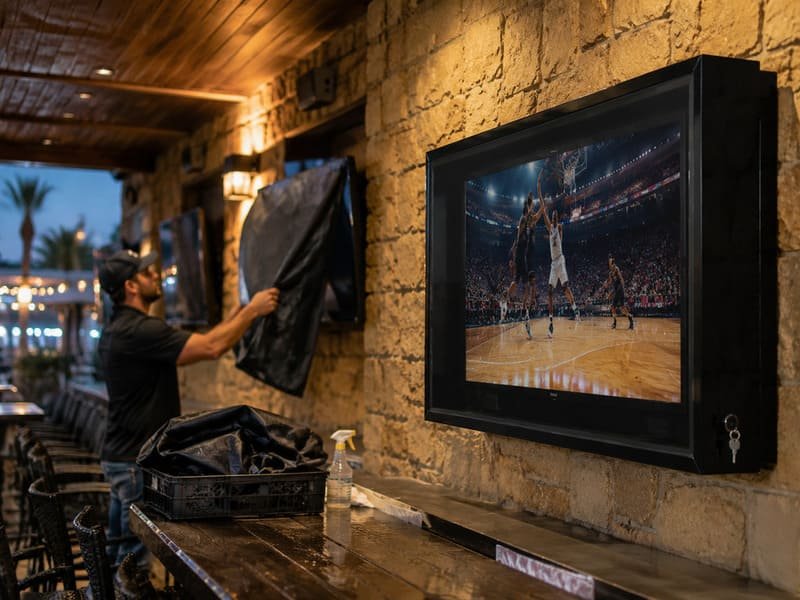
This is the design conflict that many simple cabinets miss.
- If you seal everything tightly, heat can build up.
- If you open too many vents, dust enters.
- If you add fans but cannot clean the vent path, airflow drops over time.
- If the enclosure sits in direct sun, the heat load increases before the TV even turns on.
Sony advises using TVs within a temperature range of 0°C to 40°C / 32°F to 104°F and avoiding direct sunlight. Sony TV temperature guidance
That does not mean every outdoor installation fails outside those conditions. It means buyers should respect the TV manufacturer’s guidance and reduce unnecessary heat load.
In a dusty environment, I look at the heat path and the dust path together.
- Where does air enter?
- Where does warm air leave?
- Can dust collect on the vent?
- Can staff reach the filter or vent area?
- Is the enclosure installed in shade or direct sun?
- Will the TV run for two hours or twelve hours?
The Sealed-but-Breathing Problem
| Need | Risk if Ignored | Design Response |
|---|---|---|
| Keep Particles Out | Dust enters through gaps and cable ports | Sealed cable exits, gaskets, protected seams |
| Let Heat Out | TV overheats or runs under stress | Fan-assisted airflow and internal clearance |
| Keep Airflow Clean | Dust blocks vents and reduces cooling | Accessible filters, vent inspection, cleaning routine |
| Allow Service | Dust enters during opening or maintenance | Clear service routine and protected access |
| Control Sun Load | Direct sun adds heat before operation | Shade, placement review, wall temperature check |
I avoid saying that fans “solve” heat.
Fans help move air.
They do not change the outdoor climate.
They do not replace shade.
They do not eliminate maintenance.
In dusty or sandy environments, airflow is useful only when it remains clean enough to work.
What Materials and Maintenance Details Matter in Sandy Sites?
Material choice matters, but it should not be treated as a magic shortcut. The body, front panel, hardware, vents, gaskets, and cleaning routine all matter in sandy environments.
A polycarbonate body can be useful because it does not rust like steel and can provide a practical balance of clarity, weight, and impact resistance. But locks, hinges, screws, brackets, anchors, cable exits, fan screws, and wall mounts still need corrosion-resistant design and inspection, especially near beaches or pools.
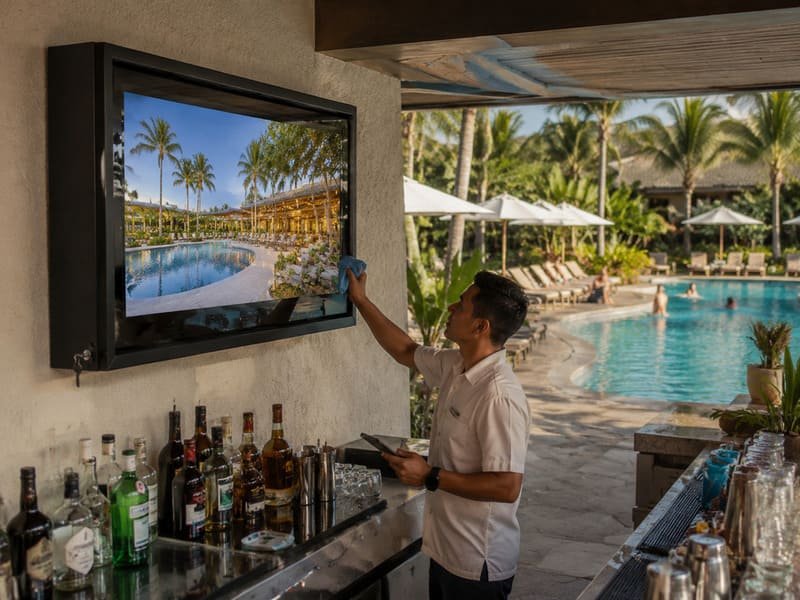
For coastal and sandy sites, the environment is often mixed.
Sand alone is abrasive.
Salt air can accelerate corrosion around metal parts.
Humidity can help particles stick to surfaces.
Heat can make material and gasket quality more important.
Public spaces add impact and cleaning pressure.
FEMA guidance on coastal construction notes that salt accumulation and high humidity common in coastal areas can accelerate corrosion of untreated steel connectors and fasteners. FEMA coastal corrosion guidance
A polycarbonate body does not rust like steel, which removes one corrosion pathway at the enclosure body level. But the whole installation is not corrosion-proof.
Covestro describes Makrolon polycarbonate as robust, lightweight, glass-like in transparency, and impact resistant even at low temperatures. Covestro Makrolon polycarbonate
That makes polycarbonate useful for many outdoor TV enclosure designs, but actual performance still depends on grade, thickness, coating, UV stabilization, optical quality, frame support, and installation.
Material and Maintenance Review
| Part / Detail | Why It Matters in Dusty or Sandy Sites |
|---|---|
| Polycarbonate Body | Does not rust like steel at the body level |
| Clear Front Panel | Needs clarity, scratch awareness, and proper cleaning |
| Locks and Hinges | Can face salt air, sand buildup, and repeated service use |
| Cable Exits | Common weak point for dust and moisture |
| Fan Vents / Filters | Need access for inspection and cleaning |
| Gaskets | Can collect sand or lose pressure if not maintained |
| Mounting Hardware | Must match wall type, load, vibration, and corrosion risk |
| Cleaning Routine | Wrong wiping method can scratch the front panel |
For sand, cleaning method matters a lot.
If staff wipe a sandy front panel with a dry rough cloth, the sand can act like an abrasive. The better routine is usually to remove loose particles gently first, then clean with suitable soft materials according to the supplier’s guidance.
That sounds small, but in sandy sites, cleaning is part of the protection system.
What Should Buyers Check Before Installing in Dusty Areas?
The best time to solve dust and sand problems is before installation. After the screen is on the wall, weak cable exits, poor vent access, and bad cleaning routines become harder to fix.
Before installing an outdoor TV in a dusty or sandy environment, buyers should check particle source, wind direction, cable exits, fan airflow, filter access, front-panel cleaning method, mounting clearance, heat exposure, hardware material, and service routine.
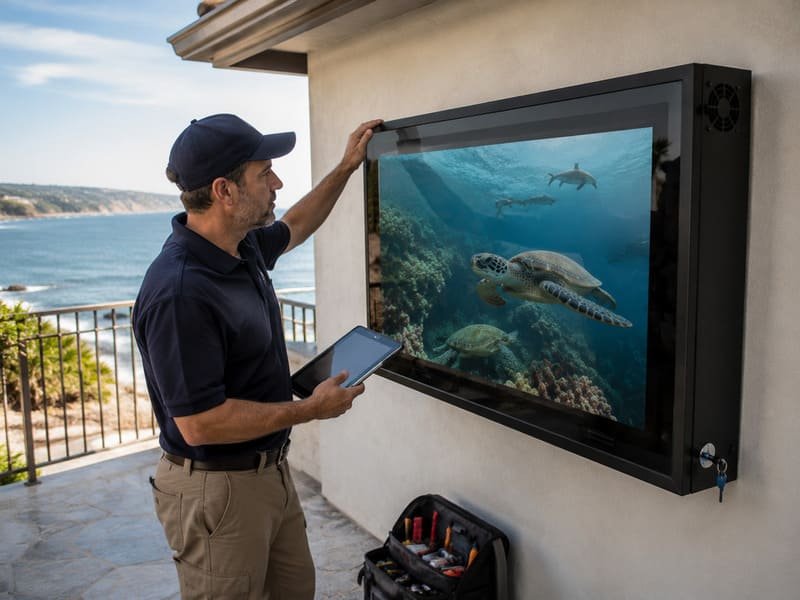
When I review a dusty site, I prefer to see photos.
Photos show what a spec sheet cannot show.
- They show the wall.
- They show the wind side.
- They show whether the TV faces a beach, court, patio, road, or loading area.
- They show whether sand can collect below the enclosure.
- They show whether staff can clean vents safely.
- They show whether cables need to enter from below, behind, or the side.
VESA compatibility should also be checked before ordering. Ergotron explains that the VESA mount standard defines the four-hole attachment interface on the back of displays and the screws used for those holes. Ergotron VESA mount guide
That matters because the TV must fit not only by screen size. It also needs correct mounting, depth, cable direction, airflow space, and service access.
For B2B buyers, cost should also include maintenance and downtime. CIPS defines Total Cost of Ownership as an end-to-end cost view that includes purchase price, acquisition cost, usage cost, and end-of-life cost. CIPS Total Cost of Ownership
In dusty sites, low first cost can become expensive if the enclosure is hard to clean, traps heat, scratches easily, or requires frequent service.
Pre-Installation Checklist for Dusty and Sandy Sites
| Check | What to Confirm | Why It Matters |
|---|---|---|
| Particle Source | Beach, desert, sports field, road dust, warehouse dust | Determines cleaning and sealing priority |
| Wind Direction | Where particles hit the enclosure most often | Affects placement and vent exposure |
| Cable Entry Point | Below, behind, side, or custom route | Common weak point for dust and water |
| Fan / Vent Access | Can staff inspect and clean? | Keeps airflow useful over time |
| Front-Panel Cleaning | How loose sand is removed before wiping | Reduces scratching risk |
| Mounting Clearance | Space behind and below enclosure | Prevents debris buildup and trapped moisture |
| Heat Exposure | Direct sun, hot wall, long runtime | Affects airflow and TV temperature risk |
| Hardware Material | Locks, screws, hinges, anchors, brackets | Important for coastal or poolside sites |
| Service Opening Routine | When and how the enclosure is opened | Prevents dust entry during maintenance |
| TV Fit and VESA | Dimensions, depth, mount pattern, ports | Prevents installation and airflow problems |
This checklist is where the article becomes practical.
The goal is not only to buy a dustproof-sounding enclosure.
The goal is to install a system that can keep dust, sand, heat, and cleaning under control.
Buyer Questions About Dusty and Sandy Outdoor TV Protection
Dust and sand protection raises different questions from ordinary patio TV protection. The best answers depend on exposure level, installation location, and service routine.
Buyers should ask whether IP65 is enough, how vents are cleaned, whether sand can scratch the front panel, how beach sand differs from desert dust, and what site information a supplier needs before recommending an enclosure.
Is IP65 enough for dusty or sandy outdoor TV locations?
IP65 can be a strong baseline because it indicates dust-tight protection and water-jet resistance under defined test conditions. But sandy environments also need cable-exit control, vent cleaning, gasket inspection, proper mounting, and realistic maintenance. IP65 is important, but it is not the whole dust strategy.
Can I use a standard indoor TV inside an enclosure in dusty areas?
Yes, in many projects, if the TV fits correctly and the enclosure is designed for the environment. The enclosure helps reduce dust, sand, weather, and access exposure, but it does not change the TV manufacturer’s original intended-use category or warranty terms. Heat, airflow, and service access still matter.
How often should vents or filters be checked?
It depends on exposure. Beachfront, desert, sports-field, construction-adjacent, and dusty warehouse sites should be checked more often than mild covered patios. A practical approach is to inspect vents after dusty events and set a regular cleaning schedule based on how quickly buildup appears.
Can sand scratch the front panel?
Yes, sand can scratch surfaces during cleaning if it is rubbed across the panel. The safer approach is to remove loose particles gently before wiping and follow the supplier’s recommended cleaning method. Front-panel coating, material quality, and cleaning tools all matter.
Is beach sand worse than desert dust?
They are different. Beach sand may come with salt air and humidity, increasing corrosion and sticky buildup risks. Desert dust may come with higher heat and very fine particles that collect around vents. The right enclosure plan depends on the exact site, not only the word “sand.”
What should I send before requesting a quote?
Send the TV model, full TV dimensions, VESA pattern, installation photos, location type, wind direction, dust or sand source, sun exposure, operating hours, cable direction, and whether the site is coastal, desert, sports-related, construction-adjacent, or dusty commercial space.
Conclusion
Dusty and sandy outdoor TV protection is not only about keeping the screen clean.
It is about managing pathways.
- The path into cable exits.
- The path through vents.
- The path around gaskets.
- The path across the front panel during cleaning.
- The path into media device areas.
- The path that heat needs to leave the enclosure.
A strong enclosure for dusty environments should combine IP-rated sealing, protected cable exits, fan-assisted airflow, accessible vent cleaning, suitable materials, front-panel cleaning guidance, and realistic maintenance.
It should also avoid overpromising.
IP65 is useful, but it is not sandstorm-proof.
Fans help airflow, but they are not air conditioning.
Polycarbonate can help the body avoid steel-like rust, but hardware still needs inspection.
A clear front panel protects the screen, but sand can still scratch if cleaned incorrectly.
That is the honest way to protect outdoor TVs in dusty and sandy environments.
Do not only ask whether the enclosure blocks dust.
Ask where the particles will go, how the heat will leave, and who will maintain the system after the first sandy week.