
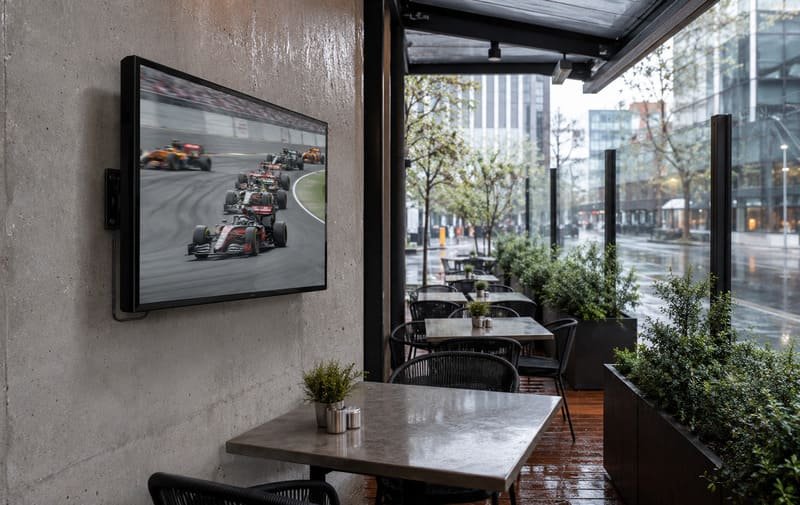
A covered patio can make an indoor TV look protected.
The part people do not see is usually the part that remains exposed.
The front of the screen may stay dry. But the rear vents, HDMI ports, power inlet, cable entries, mounting area, and cooling path can still face humid outdoor air every day.
That is why a roof is not the same thing as an outdoor protection plan. Indoor TVs are designed around relatively controlled room conditions. In a humid outdoor space, the parts built to release heat into normal indoor air may instead face moisture, temperature swings, dust, insects, salt air, and wind-driven exposure.
When I review an indoor TV for an outdoor site, I do not start by looking at the screen.
I start at the back of the TV.
- Where are the vents?
- Where do the HDMI, LAN, and power cables enter?
- Can humid air reach the rear housing?
- Will the wall hold heat after afternoon sun?
- Does the TV sit near a pool, garden, water feature, or coastal terrace?
- Can someone inspect the cable area after rain, cleaning, or a humid night?
Those questions reveal the real risk.
A covered pergola, patio roof, or awning may reduce direct rain from above. But it does not turn outdoor air into controlled indoor air. It does not stop morning dew cycles, rising moisture from nearby water, wind-driven humidity, or repeated temperature changes after sunset.
That is the design gap many buyers miss.
Last Updated: July 3, 2026 | Estimated Reading Time: 11 Minutes
By Smith Chen, Outdoor TV Enclosure Engineer at Outvion
Why Can an Indoor TV Look Protected While Its Weak Points Remain Exposed?
An indoor TV can appear safe under a roof because the front screen is not being hit by direct rain. But outdoor exposure usually reaches the less visible areas first: vents, ports, cable openings, rear seams, mounting points, and the air path around the TV body.
A bare indoor TV can remain exposed even when its screen stays dry. The weak points are often the rear vents, cable connections, cooling path, and back-panel seams—areas designed for stable indoor air rather than repeated outdoor humidity, airborne particles, or wind-driven moisture.
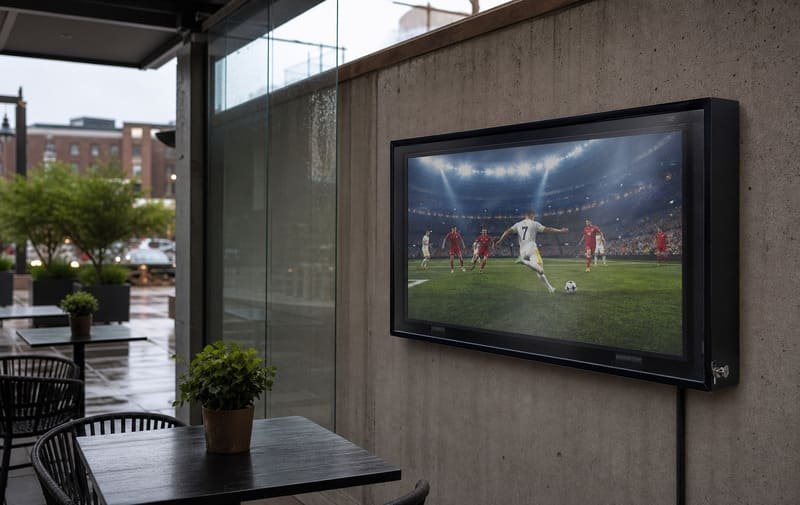
This is why I avoid treating “under a roof” as a complete protection category.
A roof can help with one exposure direction: falling rain from above.
It does not necessarily protect against:
- Humid air moving around the rear of the TV
- Morning or evening condensation conditions
- Wind-driven rain from the side
- Dust and insects entering through ventilation areas
- Moisture travelling along poorly planned cables
- Salt air in coastal locations
- Heat trapped between the TV and a warm wall
- Cleaning spray directed toward the mounting area
An indoor TV is not an enclosed appliance. It needs vents and clearances so it can release heat. Those same openings become more important when the TV is moved outside.
Indoor TV Exposure Map
| Indoor TV Area | What It Is Usually Designed For | What Changes in a Humid Outdoor Space |
|---|---|---|
| Rear Vents | Releasing heat into relatively controlled room air | Humid air, dust, insects, and warm outdoor air may reach the cooling path |
| HDMI / LAN / Power Ports | Indoor cable routing with limited environmental exposure | Moisture, cable movement, dirt, and exposed entry points become more important |
| Back-Panel Seams | Normal room dust and indoor air | Wind-driven moisture and airborne contaminants may reach gaps |
| Internal Cooling Path | Stable room temperatures and predictable airflow | Higher ambient heat and damp air can make heat release more difficult |
| Cable Area | Dry wall mounting and simple cable management | Water can follow cable routes if entry points are poorly planned |
| Mounting Hardware | Indoor brackets and normal wall conditions | Outdoor mounting may require corrosion review, drainage awareness, and service clearance |
| Remote Receiver Area | Living-room viewing conditions | Front-panel material, installation angle, and light conditions can affect usability |
This is the first decision point for buyers:
Do not only ask whether the TV will get wet.
Ask whether you would be comfortable leaving its vents, ports, cable entries, and rear housing exposed to that outdoor air every day.
What Conditions Does an Indoor TV Usually Assume?
Most indoor TVs are intended for rooms where temperature, humidity, dust, cleaning methods, and cable exposure are relatively predictable. Outdoor conditions are less controlled, even under a roof.
Indoor TVs are generally built around stable operating assumptions: controlled room air, limited contaminants, predictable temperature changes, and no repeated direct exposure to outdoor moisture paths. A humid patio, pergola, poolside bar, coastal terrace, or covered garden wall can challenge several of those assumptions at once.
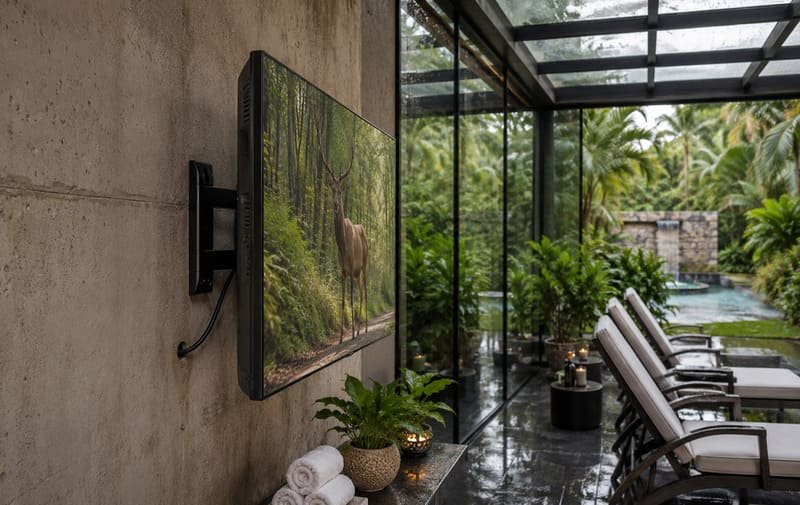
This does not mean every indoor TV will fail immediately outside.
Some sheltered installations may operate for a period without visible problems. The real issue is that the TV is being used in an environment different from the one its housing, vent layout, ports, and intended-use guidance were designed around.
The difference becomes more important when the TV is:
- Used for long daily hours
- Installed near a pool, spa, or water feature
- Mounted in a coastal area
- Exposed to morning dew or humid evenings
- Positioned against a heat-retaining wall
- Left outdoors throughout changing seasons
- Located in a restaurant, bar, hotel, gym, resort, or public venue
- Cleaned around frequently by staff using water or cleaning products
The National Weather Service explains how dew point relates to condensation risk. This matters because a surface can become more vulnerable to condensation conditions when its temperature drops to or below the dew point. Whether condensation forms inside or around a TV depends on temperature, airflow, local humidity, enclosure design, and the exact site conditions.
The point is not to predict condensation in every installation.
The point is to recognize that outdoor air does not behave like living-room air.
Indoor Assumptions vs. Outdoor Reality
| Indoor TV Assumption | Humid Outdoor Reality |
|---|---|
| Relatively stable room temperature | Sun, wall heat, evening cooling, and seasonal temperature swings |
| Controlled indoor humidity | Humid air from gardens, pools, rain, dew, or coastal conditions |
| Limited airborne particles | Dust, pollen, insects, salt air, and wind-driven debris |
| Protected cable routing | Cables may become environmental entry paths |
| Gentle cleaning nearby | Outdoor areas may be washed, sprayed, or maintained more aggressively |
| Low corrosion pressure on hardware | Coastal humidity, splash, and chemical exposure may affect metal parts |
| Easy access for service | TV may sit high, behind furniture, or inside a difficult outdoor location |
A roof can reduce one part of the problem.
It cannot change all of these assumptions.
What Does a Covered Patio Protect — and What Does It Not Protect?
Covered outdoor spaces are useful. They can reduce direct rain exposure and sometimes provide shade. But they are still outdoor spaces, with outdoor air, outdoor moisture cycles, and outdoor maintenance conditions.
A roof helps reduce vertical rain and may create shade during part of the day. It does not block humid air, salt air, wind-driven moisture, condensation cycles, dust, insects, reflected sunlight, or cleaning spray. Covered does not mean climate-controlled.
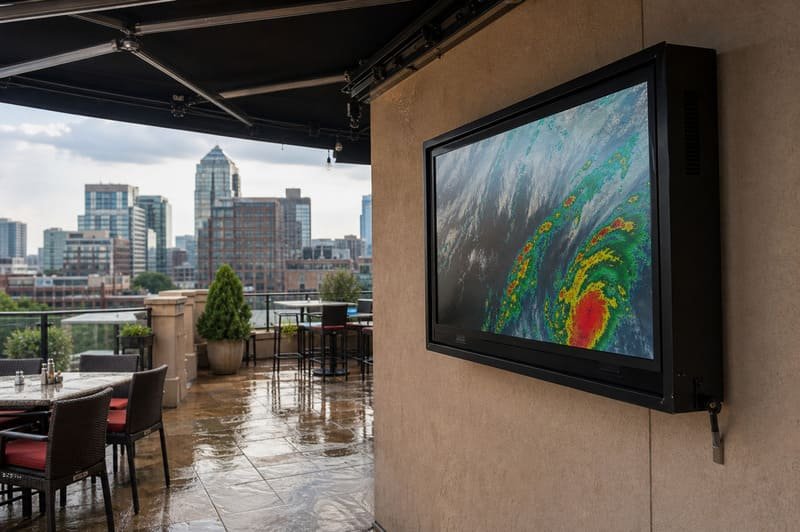
This is especially important for buyers who describe a patio as “fully covered” without looking at the sides, rear wall, cable route, or daily operating conditions.
A TV can be under a deep roof and still face:
- Rain entering sideways during wind
- Warm humid air rising from nearby landscaping or water
- Condensation conditions after a hot day and cool evening
- Afternoon heat reflected from a wall, deck, or glass surface
- Dust and pollen building up around rear vents
- Salt air entering an open terrace
- Cleaning crews directing spray toward the wall and cable area
Roof vs. Outdoor Environment
| Condition | What a Roof Can Help With | What It Does Not Solve |
|---|---|---|
| Direct Vertical Rain | Can reduce rain falling from above | Wind-driven rain, splash, and side exposure |
| Direct Sunlight | May provide shade at certain hours | Reflected light, wall heat, afternoon sun, and glare |
| Humid Outdoor Air | Very little | Humidity, dew point, and condensation cycles |
| Salt Air | Very little | Corrosion pressure around hardware and connections |
| Dust and Insects | Some limited shielding | Airborne particles, vent buildup, and cable-area exposure |
| Cleaning Routine | May keep some water off the TV face | Spray direction, chemical residue, and staff behavior |
| Service Access | Can make wall installation easier | Need for protected access, cable management, and inspection |
The useful phrase here is simple:
Covered is not the same as indoor.
That distinction is one of the main reasons indoor TVs can struggle in humid outdoor spaces.
How Do Humidity, Heat, and Contaminants Reach an Indoor TV?
Humidity alone is not always the full problem. It can combine with heat, dust, salt, insects, cleaning residue, and poor airflow to create a more demanding environment around the TV.
Outdoor humidity becomes more significant when it combines with temperature changes, contaminants, dust, salt, and restricted airflow. A TV may not show obvious damage at first, but its ports, vents, cable areas, and metal hardware can face repeated exposure over time.
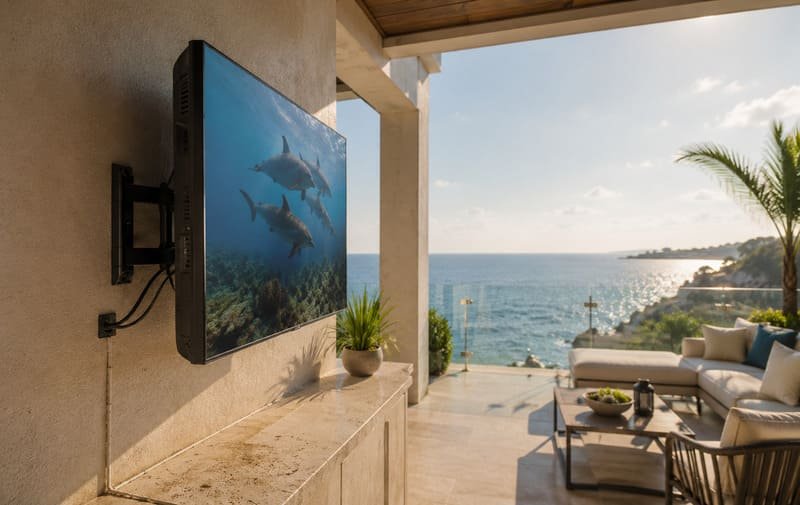
When I inspect a site, I look for what I call the exposure chain.
The first link may be humid air.
The second may be a hot wall.
The third may be dust stuck to a damp rear vent.
The fourth may be a cable route that directs water toward the TV.
The fifth may be a cleaning routine that nobody discussed before installation.
Each detail may look small in isolation.
Together, they can make an indoor TV installation much harder to maintain.
Outdoor Exposure Chain
| Exposure Factor | What It Can Change | Why Buyers Should Review It |
|---|---|---|
| Humid Air | Moisture level around vents, ports, and rear housing | Can persist even when the screen is protected from rain |
| Temperature Swing | Condensation conditions and thermal stress | Outdoor surfaces can cool or heat faster than indoor walls |
| Sun and Wall Heat | Ambient temperature around the TV | Raises the heat load before the TV even starts operating |
| Dust and Pollen | Vent buildup and cleaning need | Can collect faster when mixed with moisture |
| Salt Air | Corrosion pressure on hardware and contacts | Especially relevant for coastal patios and resorts |
| Cleaning Spray | Water and chemical exposure around seams and cables | Common in restaurants, hotels, gyms, and pool areas |
| Insects | Vent and cable-area buildup | Often overlooked in covered but open spaces |
| Long Runtime | Heat and service demand | More hours create more thermal load and maintenance need |
For coastal sites, hardware deserves special attention. FEMA guidance notes that salt accumulation and high humidity can accelerate corrosion of untreated steel connectors and fasteners.
That does not mean every coastal TV installation will fail.
It means the lock, hinge, screw, bracket, anchor, cable gland, and wall mount should be reviewed as carefully as the TV itself.
What Can a Professional Outdoor TV Enclosure Help With — and What Can It Not Change?
A professional enclosure can create an external protection layer around a compatible TV. It can reduce direct exposure to rain, splash, dust, contact, and cable-area risk. But it should not be described as a device that automatically makes any indoor TV outdoor-rated.
A professional outdoor TV enclosure can help reduce direct environmental exposure and support a more controlled installation. It cannot automatically change the TV’s original intended-use category, manufacturer warranty terms, screen brightness, full-sun performance, or every humidity and condensation risk.
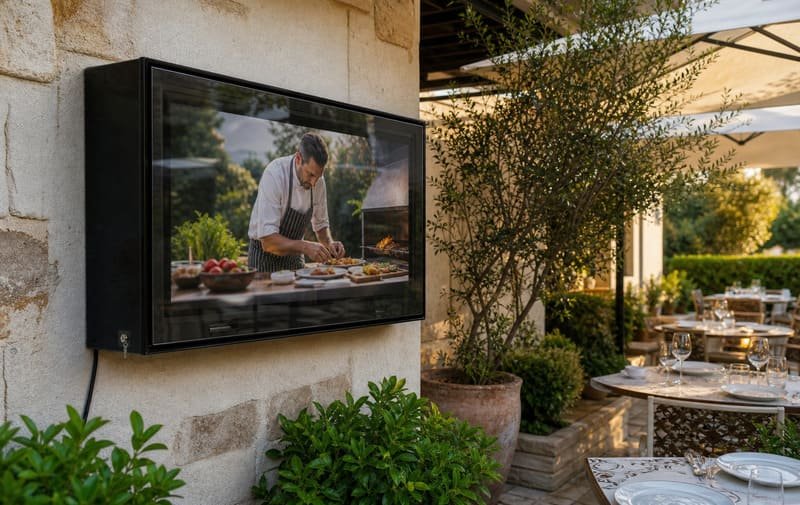
This boundary matters for trust.
I do not recommend telling a buyer that a standard indoor TV becomes a dedicated outdoor TV simply because it is placed inside a protective enclosure.
The enclosure has a different role.
It can help protect the TV from the outside.
The TV inside still has its own brightness, thermal design, operating guidance, ports, screen type, and warranty conditions.
The International Electrotechnical Commission explains how IP ratings classify enclosure protection against dust and liquids. This makes IP65 a useful protection baseline for many outdoor enclosure projects. But IP65 should not be interpreted as steam-proof, condensation-proof, pressure-wash-proof, salt-proof, heat-proof, or maintenance-free.
What an Enclosure Can and Cannot Change
| An Enclosure Can Help With | An Enclosure Cannot Automatically Change |
|---|---|
| Reducing direct rain, splash, dust, and casual contact exposure | The TV’s original intended-use category |
| Protecting cable routes and access points | Manufacturer warranty terms |
| Adding a front panel and lockable access | Screen brightness or full-sun readability |
| Supporting planned airflow | Extreme outdoor temperature conditions |
| Reducing direct exposure around the rear housing | Every condensation, salt, or maintenance risk |
| Creating a serviceable external protection layer | The need for correct installation and periodic inspection |
| Supporting future TV replacement if fit remains compatible | Compatibility of every future TV model |
A well-designed enclosure must also manage heat responsibly.
Sony advises using TVs within their recommended temperature range and avoiding unnecessary direct sunlight exposure. Fan-assisted airflow can help reduce heat buildup around the TV, but it is not air conditioning.
Fans move air.
They do not remove every humidity risk.
They do not make full-sun conditions disappear.
They do not replace shade, clearance, maintenance, or correct installation.
When Is a Covered Outdoor Space Still Too Exposed for a Bare Indoor TV?
A roofed area can be low-risk in some cases, but exposure rises quickly when humid air, splash, salt, heat, long runtime, or frequent cleaning enter the picture.
A bare indoor TV under a roof may be workable only in mild, low-exposure, occasional-use settings. Once the site adds persistent humidity, pool or coastal conditions, long daily runtime, direct sun, cleaning spray, or commercial service expectations, the buyer should review an enclosure-based system or a dedicated outdoor display.
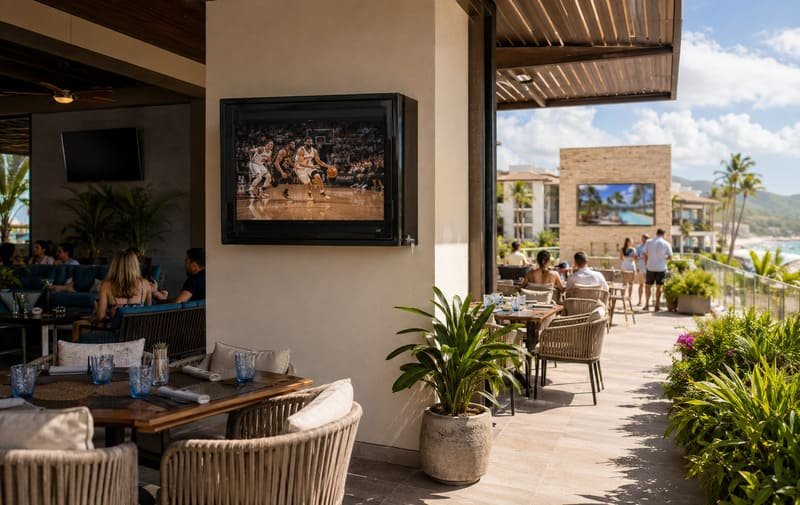
I prefer to think in terms of exposure level rather than a simple yes-or-no answer.
A covered residential patio in a dry climate is not the same as a pool bar.
A garden pergola is not the same as a beachfront restaurant.
A shaded weekend screen is not the same as a TV running twelve hours a day in a humid hotel terrace.
Exposure Decision Map
| Site Condition | Bare Indoor TV Under a Roof | Enclosure Review | Dedicated Outdoor TV Review |
|---|---|---|---|
| Mild Covered Patio, Occasional Use | May be workable with caution | Useful if exposure increases | Usually not necessary |
| Humid Garden or Pergola, Frequent Use | Risk rises over time | Worth reviewing | Depends on sun and runtime |
| Poolside, Pool Bar, or Water Feature Area | Usually not ideal | Strongly worth reviewing | Depends on brightness needs |
| Coastal Terrace | Higher risk from salt and humidity | Hardware and material review essential | Worth comparing for premium sites |
| Shower or Sauna-Adjacent Area | Not recommended without protection planning | Review placement and enclosure approach | Depends on direct steam exposure |
| Dusty Outdoor Work Area | Risk from particles and heat | Worth reviewing | Depends on operating hours and sunlight |
| Full-Sun Commercial Screen | Limited by brightness and thermal load | May not be enough alone | Often the safer category |
This is not a sales table.
It is a planning table.
The right solution depends on the air around the TV, not only the roof above it.
What Should Buyers Check Before Putting an Indoor TV Outside?
Before buying an enclosure or mounting a TV under a patio roof, the buyer should confirm the TV’s real dimensions, mounting details, environmental exposure, cable route, service access, and operating expectations.
Before placing an indoor TV outdoors, buyers should check the exact TV model, full dimensions, VESA pattern, port locations, cable direction, humidity source, sun exposure, wall heat, cleaning routine, service clearance, and whether the site is coastal, poolside, dusty, or semi-public.
One of the most common mistakes is ordering an enclosure based only on diagonal TV size.
A “65-inch TV” is not a complete fit specification.
LG explains why buyers should review the full TV width, height, and depth—not only the diagonal label. Port placement, rear housing depth, power plug direction, and cable bend space can all affect fit inside an enclosure.
The mounting pattern matters too. Ergotron explains the VESA mounting interface used by displays. A TV should not only fit the enclosure cavity; it should mount safely, allow cable clearance, and leave room for airflow around the body.
Pre-Installation Review Sheet
| Check Item | What to Confirm | Why It Matters |
|---|---|---|
| Exact TV Model | Brand and model number | Avoids sizing by screen label alone |
| Full TV Dimensions | Width, height, depth, rear housing | Confirms actual enclosure fit |
| VESA Pattern | Hole layout and mounting position | Supports safe installation |
| Port and Cable Direction | HDMI, LAN, power, media device location | Prevents cable pressure and weak entry points |
| Humidity Source | Pool, garden, rain, dew, coast, water feature | Defines environmental exposure |
| Sun and Wall Heat | Direct sun, reflected light, hot wall surface | Supports heat and glare planning |
| Cleaning Routine | Wipe-down, spray, washdown, chemicals nearby | Helps protect seams, vents, and cable areas |
| Service Access | Door clearance and ability to inspect | Reduces future maintenance labor |
| Mounting Surface | Concrete, brick, timber, steel, or custom wall | Determines anchor and bracket requirements |
| Operating Hours | Evening use, daily use, long commercial runtime | Helps review heat and service demand |
The best time to solve these issues is before the TV is on the wall.
Once the cables are routed, the bracket is installed, and the patio is finished, small mistakes become expensive to correct.
Buyer Questions Before Leaving an Indoor TV Outdoors
Is a covered patio enough for an indoor TV?
A covered patio can reduce direct rain from above, but it does not block humid air, temperature swings, dew conditions, wind-driven moisture, dust, insects, or side exposure. Whether it is enough depends on the climate, use frequency, sun exposure, nearby water, and maintenance routine.
Can a professional enclosure make an indoor TV outdoor-rated?
No. A professional enclosure can reduce direct exposure and support a more controlled installation, but it does not change the TV manufacturer’s original intended-use category or warranty terms.
Does IP65 stop humidity and condensation?
No. IP65 can indicate dust-tight protection and protection against water jets under defined test conditions. Humidity and condensation are separate issues influenced by temperature, dew point, airflow, enclosure design, placement, and service conditions.
Do fans prevent condensation inside an enclosure?
Fans can help move warm air and reduce stagnant air, but they are not a guarantee against condensation. Humidity conditions, temperature changes, vent design, placement, and maintenance still matter.
When should I choose a dedicated outdoor TV instead?
A dedicated outdoor TV may be the safer choice when direct-sun visibility, high brightness, integrated outdoor positioning, long commercial runtime, or strict outdoor-use requirements matter more than future TV replacement flexibility.
What information should I send before requesting an enclosure quote?
Send the exact TV model, full dimensions, VESA pattern, installation photos, cable direction, expected operating hours, sun exposure, nearby water or humidity source, cleaning routine, wall type, and whether the site is coastal, poolside, dusty, covered, or fully exposed.
Conclusion
The practical test is not whether rain can reach the screen.
It is whether you would be comfortable leaving the TV’s vents, ports, cable entries, rear housing, and mounting area exposed to that air every day.
A roof can keep the front of the TV dry.
It cannot make humid outdoor air behave like controlled indoor air.
It cannot prevent salt from reaching hardware.
It cannot stop dust from collecting near vents.
It cannot remove heat from a sun-facing wall.
It cannot protect cable entries from poor routing.
It cannot replace an inspection and service plan.
That is why an indoor TV under a roof is not automatically an indoor installation.
When the air around the TV includes humidity, dew cycles, splash, salt, dust, heat, or commercial cleaning routines, the project needs a protection plan built for the environment around the screen.