
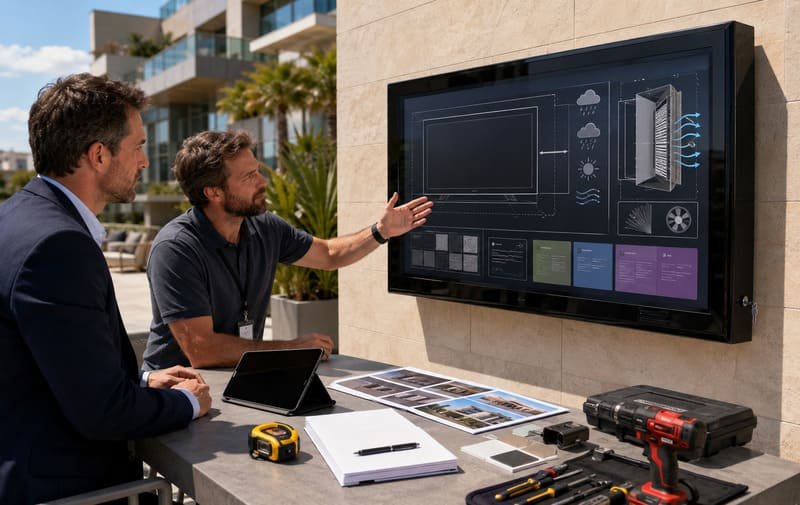
An outdoor TV enclosure order can fail before the product is even shipped.
Not because the enclosure is bad.
Because one specification was never checked.
- The TV fits by diagonal size, but not by real width.
- The VESA pattern is different from the internal bracket.
- The HDMI port exits on the wrong side.
- The screen runs too hot because there is no airflow clearance.
- The project deadline assumes local stock that does not exist.
That is why I treat outdoor TV enclosure buying specs as a pre-order checklist, not a simple product page detail. The five specs buyers should confirm are fit clearance, weather exposure, cooling path, material and signal behavior, and delivery timing.
I have answered many pre-order questions from hotel buyers, restaurant owners, school administrators, gym operators, villa homeowners, and public-space contractors. The questions are usually not about color or appearance first. They are about whether the enclosure will fit the TV, survive the weather, control heat, allow wireless use, and arrive before the installation date.
Those are not small details. They are the buying specs that decide whether the project works smoothly after delivery.
Last Updated: July 8th 2026 | Estimated Reading Time: 8 Minutes
By Smith Chen, Outdoor TV Enclosure Engineer at Outvion
Why Should Outdoor TV Enclosure Specs Be Checked Before Quotation?
A good outdoor TV enclosure quotation is not based only on the TV inch label. It should confirm the real installation risk before the buyer pays: fit, exposure, heat, material behavior, and delivery schedule.
Many buyers ask for a price like this:
“How much for a 55 inch outdoor TV enclosure?”
That is a normal first question, but it is not enough to confirm the right enclosure.
A 55 inch TV label only tells us the diagonal screen class. It does not tell us the full body width, height, depth, VESA position, cable direction, rear bump-out, speaker shape, remote sensor position, or the space needed for air movement inside the cabinet.
This is why I prefer to review outdoor TV enclosure specs as a project checklist.
| Buying Spec | What Buyers Usually See | Real-World Risk It Prevents |
|---|---|---|
| Size and VESA | “Fits 50–55 inch TV” | TV does not fit, bracket does not align, ports are blocked |
| IP rating | “Weatherproof” | Rain, dust, splash, insects, and poor cable sealing |
| Cooling | “2 fans” or “4 fans” | Heat buildup, shutdown risk, shorter TV life |
| Material | “PC / metal / acrylic” | Impact, wireless signal, weight, maintenance |
| Delivery | “In stock” or “factory shipment” | Project delay, high freight cost, installation rescheduling |
This article is not meant to make buying more complicated. It is meant to help you avoid the wrong order.
Spec 1: Does the TV Fit With Enough Clearance?
The correct enclosure size is not decided by diagonal screen size alone. A working fit needs internal clearance for the TV body, VESA adjustment, cable hiding, airflow, and future service access.
A TV’s advertised inch size is measured diagonally across the screen. It is not the same as the full outer size of the TV body. LG’s TV measurement guide also explains TV size by diagonal screen measurement and practical dimensions, which is why width, height, and depth still need to be checked before installation. Source: LG TV size guide
For an outdoor TV enclosure, I normally ask buyers to send:
- TV brand and model number
- TV width, height, and depth without stand
- TV weight
- VESA mounting pattern
- Port position and cable direction
- Whether the TV has a thick rear housing or bottom speaker bulge
- Whether a media box, HDMI extender, USB device, or streaming stick will stay inside the enclosure
The enclosure must fit the TV as a working system, not just as an object placed inside a box.
| Fit Check | Why It Matters | What to Confirm |
|---|---|---|
| TV width and height | Must fit the internal cavity | Exact TV model dimensions |
| TV depth | Affects front shield and door clearance | Rear housing, speaker bulge, cable head |
| VESA pattern | Affects internal mounting compatibility | 200×200, 400×400, 600×400, or other |
| Cable direction | Affects hidden routing | Side, rear, or down-facing ports |
| Airflow clearance | Helps avoid heat pockets | Space around the TV body |
| Service space | Affects future maintenance | Door opening, lock access, staff access |
VESA is one of the most overlooked details. The VESA mounting interface is the common standard used for mounting flat-panel displays, but each TV model can still have a different pattern or hole position. Source: VESA mounting standard
For most modern flat-panel TVs, a well-designed adjustable VESA system can support common mounting patterns. But I do not recommend assuming compatibility without checking the exact model. The TV may have a compatible VESA pattern, but the rear shape, port position, or cable direction can still create installation problems.
The Clearance Rule I Use
If the TV barely fits, it may not fit as a working outdoor system.
This is one of the most useful rules from real projects.
For example, if a customer has an 86 inch TV and asks whether it can be placed inside an 80–85 inch enclosure, I would not only check whether the width fits on paper. I would review whether there is still enough space for cables, bracket adjustment, airflow path, door clearance, and future maintenance.
In many cases, I would suggest reviewing a 98 inch or 100 inch enclosure instead of forcing the 86 inch TV into the smallest possible cabinet.
| Situation | Risk | Better Decision |
|---|---|---|
| TV fits only by width | No room for cables or service access | Choose a larger enclosure |
| TV depth nearly touches the front shield | Poor airflow or pressure on the panel | Review internal clearance |
| Side ports face the enclosure wall | Cable bending or blocked ports | Use right-angle cables or larger size |
| 86 inch TV into 80–85 inch enclosure | Too little redundancy | Review 98 inch / 100 inch enclosure |
| Long daily runtime | Heat buildup around the TV body | Add airflow clearance |
Below are the external dimensions of common Outvion enclosure size ranges. These are outer housing dimensions, not the exact internal cavity. The TV must be smaller than the usable inside space.
| Enclosure Size Range | External Dimensions (W × H × D) |
|---|---|
| 28–32″ | 31.5 × 19.7 × 6.3 inch |
| 40–43″ | 44.1 × 27.6 × 7.9 inch |
| 50–55″ | 53.1 × 31.5 × 7.9 inch |
| 60–65″ | 61.0 × 39.4 × 7.9 inch |
| 70–75″ | 70.9 × 43.3 × 7.9 inch |
| 80–85″ | 78.7 × 46.9 × 8.3 inch |
| 98″+ | 88.5 × 51.5 × 8.5 inch |
My advice is simple: before placing an order, send the TV model number and installation photo. That one step can prevent most enclosure sizing mistakes.
Spec 2: Does the IP Rating Match the Real Exposure?
IP65 is a useful outdoor protection benchmark because it classifies dust-tight protection and resistance to water jets under defined test conditions. But IP rating still needs to be matched with installation position, cable sealing, drainage, vents, and maintenance.
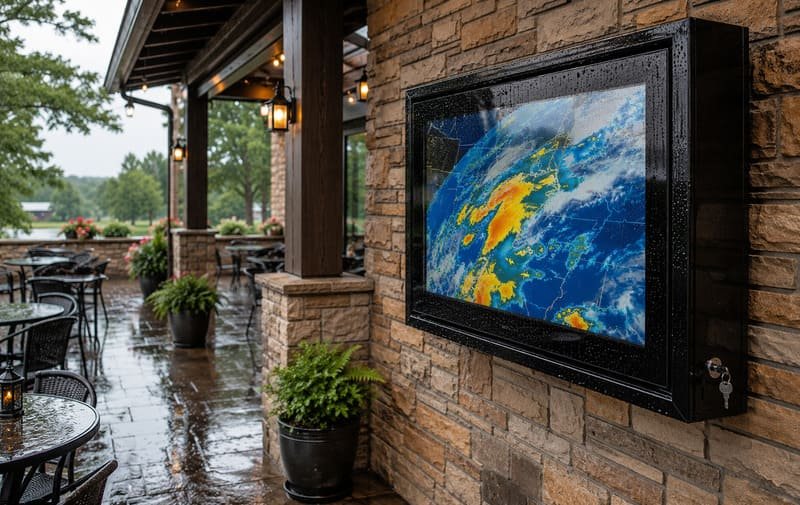
Many buyers ask, “Is this enclosure waterproof?”
I understand the question, but I prefer a more precise answer.
The IEC describes IP ratings as a system for classifying the protection an enclosure provides against intrusion of solids and liquids. Source: IEC IP ratings
For outdoor TV enclosure buyers, IP65 can indicate strong dust protection and protection against water jets under defined test conditions. It is suitable for many rain, dust, splash, humidity, and insect-entry risk situations when the enclosure is properly installed.
But it does not mean the enclosure can be submerged. It also does not mean installation details no longer matter.
A few real-world details still decide long-term protection:
| Exposure Detail | Why It Matters |
|---|---|
| Rain direction | Side rain can reach seams differently from vertical rain |
| Cable entry | Poor sealing can create the weakest point |
| Vent design | Airflow openings need protected paths |
| Mounting angle | Water should not collect around openings |
| Poolside splash | Chlorinated moisture may affect hardware over time |
| Coastal air | Salt exposure increases corrosion risk on metal parts |
| Cleaning method | Pressure washing directly at openings should be avoided |
| Seasonal inspection | Gaskets, screws, and cable fittings should be checked |
For coastal locations, poolside installations, and humid climates, I would also ask about hardware and fittings. Even if the enclosure body is polycarbonate, locks, screws, hinges, brackets, fan guards, and cable glands still need to be suitable for outdoor use.
What About UV Protection?
Strong sunlight creates two problems: heat and material exposure.
For the front shield, buyers should ask whether the transparent panel is UV-stable or UV-protective, and whether the supplier can provide material information or test data when needed. I do not recommend relying on vague claims like “sunproof” without asking what material is used and how it behaves outdoors.
A smoked transparent front shield can also help create a cleaner appearance when the TV is off, but buyers should still consider screen brightness, glare, and viewing angle.
For full-sun sites, weather protection and UV stability are only part of the decision. Heat and glare must be reviewed together.
Spec 3: Does the Cooling System Match the Screen Size and Runtime?
A professional outdoor TV enclosure should manage heat, not only block rain. Fan-assisted airflow helps reduce heat buildup, but it is not air conditioning. Screen size, sun direction, runtime, and internal clearance all matter.
Heat is the specification that many first-time buyers underestimate.
A TV already produces heat while running. When it is placed inside a protective enclosure, the cabinet blocks rain and dust, but it also changes how heat escapes. Add direct sun, a dark surface, still air, and long daily operation, and the internal temperature can rise faster than expected.
Sony’s support guidance notes that operating temperature varies by model and also advises using TVs within the specified temperature range and avoiding direct sunlight for certain TV guidance pages. Source: Sony TV temperature guidance
That point is important for enclosure buyers: the TV manufacturer’s own temperature guidance still matters.
For hot regions such as Texas, Florida, Australia, the Middle East, Southeast Asia, or desert-adjacent areas, I would review:
- Is the TV in direct afternoon sun?
- How many hours per day will it run?
- Is the screen used for residential viewing or commercial signage?
- Is there shade or a roof above it?
- Is there enough wall clearance behind the enclosure?
- Are the vents protected but not blocked?
- Can the fans be cleaned or serviced later?
- Does the TV model itself tolerate the expected temperature range?
Fan quantity should scale with enclosure size and use case.
| Enclosure Size Range | Typical Outvion Fan Configuration |
|---|---|
| 28–32″ | 2 fans |
| 40–43″ | 2 fans |
| 50–55″ | 2 fans |
| 60–65″ | 4 fans |
| 70–75″ | 4 fans |
| 80–85″ | 4 fans |
| 98″+ | 4 fans |
For Outvion-style configurations, smaller and mid-size models often use 2 fans, while 65 inch and larger models use 4 fans to support airflow across a larger enclosure cavity.
This does not mean fans solve every heat problem automatically. They help move air, but they cannot remove the need for good installation planning.
If the enclosure is installed against a wall with no breathing space, if vents are blocked by a decorative frame, or if the TV runs all day in full sun, the buyer should not treat fan count as a magic number.
My Practical Heat Check
Before confirming an order, I like to ask one simple question:
Would a person be comfortable standing in that exact sun for several hours?
If the answer is no, the TV and enclosure need a heat plan.
That plan may include shade, a better mounting location, more internal clearance, shorter runtime, a brighter commercial display, or a different screen strategy.
Spec 4: Does the Material Support Durability, Signal, and Service?
The enclosure material affects more than appearance. It influences impact resistance, weight, wireless signal behavior, corrosion risk, front shield clarity, maintenance, and the long-term user experience.
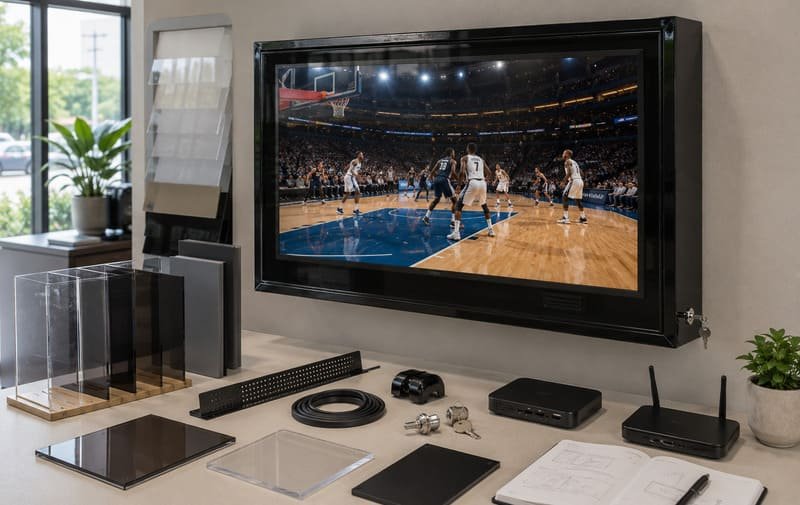
Some buyers prefer metal because it feels strong. Some prefer wood because it looks natural. Some prefer polycarbonate because it is lighter and more practical for outdoor electronics.
The right material depends on the project.
For Outvion, high-strength polycarbonate is one of the main materials we use because it offers a useful balance of impact resistance, lower weight, weather practicality, and wireless signal friendliness. Covestro describes Makrolon polycarbonate as robust, lightweight, transparent, impact resistant, dimensionally stable, and heat resistant. Source: Covestro Makrolon polycarbonate
For outdoor TV enclosure buyers, the material decision should be reviewed through practical questions.
| Material Factor | Why It Matters |
|---|---|
| Impact resistance | Helps protect the TV from knocks, public traffic, and accidents |
| Weight | Affects wall mounting, shipping cost, and installation labor |
| Wireless signal behavior | Smart TVs, Wi-Fi updates, Bluetooth, and media boxes may depend on signal quality |
| Corrosion risk | Coastal, poolside, and humid sites expose hardware to more stress |
| Front shield clarity | Affects viewing, reflection, and off-screen appearance |
| Service access | Affects cleaning, TV replacement, and fan maintenance |
| Visual finish | Matters for hotels, villas, restaurants, and customer-facing areas |
Polycarbonate vs Metal for Wireless Signal
I would avoid saying polycarbonate “does not block Wi-Fi at all,” because real signal performance depends on many factors: router distance, wall material, TV antenna location, enclosure design, and local interference.
A more accurate way to say it is this:
Polycarbonate generally creates less wireless signal shielding risk than metal.
That can be useful for:
- Smart TVs
- Wi-Fi content updates
- Bluetooth audio devices
- Streaming sticks
- Media boxes
- Digital signage players
- RF remote controls
Metal can still be a valid material for certain projects, especially when buyers prioritize a specific appearance or structural feel. But with metal enclosures, wireless signal planning, weight, corrosion treatment, and installation support should be reviewed more carefully.
Front Shield and Visibility
The front shield is also part of the material decision.
A clear front panel may show more brightness, but it may also show more fingerprints, dust, reflections, and the TV frame behind the panel. A smoked transparent front shield can look cleaner and more premium when the TV is off, but screen brightness and viewing environment still matter.
For bars, hotels, restaurants, villas, and resort terraces, I usually recommend checking:
- Daytime screen brightness
- Glare direction
- Off-screen appearance
- Cleaning frequency
- Fingerprint visibility
- Viewing distance
- Whether guests or staff may touch the front panel
This is why material should not be treated as a cosmetic choice only. It affects the whole operating experience.
Spec 5: Does the Delivery Plan Match the Project Schedule?
For commercial buyers, delivery time is a specification, not an afterthought. Large outdoor TV enclosures are bulky goods, so stock location, shipping method, packaging, customs, and unloading should be confirmed before project scheduling.
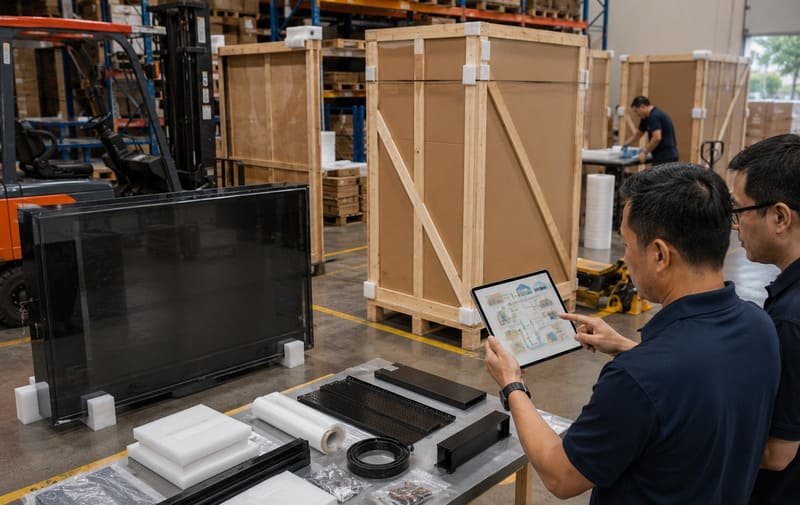
This is the spec that many buying guides ignore.
But for B2B projects, it can decide whether the installation happens on time.
A homeowner buying one enclosure may only need courier delivery and a simple schedule. A hotel, school, restaurant chain, stadium, resort, or contractor buying multiple units needs a more serious delivery plan.
Outdoor TV enclosures are large-volume products. A 70–85 inch enclosure takes up much more carton space than many buyers expect. Oversize models may need wooden crate packaging, pallet base, forklift handling, warehouse storage, and delivery access planning.
Outvion Delivery Planning by Region
Current stock and shipping options should always be confirmed before quotation or project scheduling, because warehouse availability changes.
| Buyer Region | Stock / Delivery Logic | Planning Note |
|---|---|---|
| United States | Local warehouse may cover many sizes | Best option for faster project fulfillment when stock is available |
| United Kingdom / Germany / EU | Smaller sizes, often 55 inch and below, may ship from local warehouse | Confirm stock before setting installation date |
| Large EU sizes, 60 inch and above | May need factory shipment | Sea freight + final delivery may take around 45–50 days; rail can be faster depending on route |
| Rest of the world | Usually shipped from the factory | Check freight cost, customs, and delivery access early |
| Oversize models | Wooden crate / pallet packaging recommended | Confirm unloading ability before delivery |
For international long-distance shipment, especially large enclosures, packaging is not a minor detail. For factory shipments, we normally use reinforced export packaging such as fumigation-free wooden crates or wooden frames with pallet-style bases for easier forklift handling.
Before ordering, commercial buyers should confirm:
- Current stock location
- Quantity available
- Production lead time if not in stock
- Shipping method
- Estimated transit time
- Packaging method
- Import duty and tax responsibility
- Delivery address access
- Whether a forklift or unloading support is needed
- Whether the project deadline has enough buffer
I have seen project buyers spend a lot of time comparing enclosure features, but then forget to confirm the delivery window. That is risky.
A good enclosure delivered too late can still damage the project.
Buyer Questions Before Confirming Outdoor TV Enclosure Specs
These questions are more useful than a generic FAQ because they match the real decisions buyers need to make before ordering.
What TV measurements should I send before ordering?
Send the TV brand, model number, width, height, depth without stand, weight, VESA pattern, and photos of the back panel. If you plan to keep a media box, streaming stick, HDMI extender, or extra cable inside the enclosure, mention that too.
Should I choose a larger enclosure if my TV barely fits?
Yes, in many cases. If the TV only fits by width or height on paper, there may not be enough room for cables, VESA adjustment, airflow, or service access. A slightly larger enclosure can be safer than forcing a tight fit.
Is IP65 enough for rain, dust, insects, and poolside splash?
IP65 is suitable for many outdoor TV enclosure projects because it indicates strong dust protection and resistance to water jets under defined test conditions. But cable sealing, vent design, installation angle, drainage, and maintenance still matter.
How many fans should an outdoor TV enclosure have?
It depends on enclosure size and runtime. Smaller and mid-size enclosures often use 2 fans, while larger models such as 65 inch and above usually use 4 fans to support airflow across a larger cavity. Buyers in hot climates should also review shade, daily runtime, and TV temperature guidance.
Does polycarbonate affect Wi-Fi or Bluetooth signals?
Polycarbonate generally creates less wireless signal shielding risk than metal. This can help smart TVs, streaming devices, Bluetooth accessories, and signage players. Real signal quality still depends on router distance, wall material, TV antenna position, and local interference.
Should I ask about UV protection?
Yes, especially for strong-sun locations. Ask whether the front shield and body material are UV-stable or UV-protective, and whether material data or test information is available when needed. Do not rely only on vague “sunproof” claims.
How early should commercial buyers confirm delivery time?
For local-stock sizes, confirm stock before setting the installation date. For larger units or factory shipments, confirm production time, shipping method, packaging, customs, and unloading plan as early as possible. For sea freight projects, buyers should usually plan with a larger time buffer.
Pre-Order Spec Sheet You Can Send to a Supplier
If you want a faster and more accurate quotation, send this information in your first inquiry instead of only asking for the price of a TV size.
Outdoor TV Enclosure Inquiry

1. TV brand and model:
2. TV size:
3. TV width × height × depth:
4. TV weight:
5. VESA pattern:
6. Installation location:
7. Covered / semi-covered / fully exposed:
8. Direct sun exposure:
9. Poolside, coastal, dusty, humid, public, or normal patio:
10. Daily runtime:
11. Cable exit preference:
12. Need lockable access:
13. Quantity:
14. Delivery country / city / postal code:
15. Project deadline:
16. Photos of installation wall:
A good supplier should be able to review these details and tell you whether the size, mount, ventilation, material, and delivery method are suitable.
Conclusion
A product page can tell you the model size.
It cannot confirm your TV depth.
It cannot see your cable direction.
It cannot know your wall clearance.
It cannot judge your afternoon sun.
It cannot unload a wooden crate at the jobsite.
It cannot fix a project schedule after the wrong size arrives.
That is why the best outdoor TV enclosure order is not always the fastest order.
It is the confirmed order.
Before you buy, check five things:
- Fit clearance — TV dimensions, VESA pattern, cable direction, airflow, and service space
- Weather exposure — IP rating, cable sealing, rain direction, UV exposure, and outdoor hardware
- Cooling path — fan quantity, sun direction, runtime, shade, and internal clearance
- Material behavior — impact resistance, wireless signal, front shield, weight, and maintenance
- Delivery timing — stock location, shipping method, packaging, customs, and unloading plan
At Outvion, we manufacture outdoor TV enclosures for residential patios, restaurants, hotels, schools, gyms, factories, public spaces, and commercial display projects. If you already have a TV model and installation location, we can help check the correct enclosure size, VESA compatibility, ventilation layout, cable exit, material choice, and shipping plan before you order.