
A commercial outdoor display changes identity after business hours.
During the day, it is a screen for guests, students, visitors, workers, or customers. After closing, it becomes an exposed asset on a wall: visible, reachable, valuable, and sometimes unattended.
That is why theft and impact protection should be part of the first procurement discussion, not a late security add-on. For commercial outdoor displays, the goal is not to make the screen impossible to damage. The goal is to deter casual interference, delay unauthorized access, reduce everyday impact damage, and make replacement easier if something still happens.
When commercial buyers ask me about outdoor displays, the first questions are usually familiar:
- Is it waterproof?
- Is the screen bright enough?
- Can it handle rain?
- What size TV will fit?
Those questions matter. But in many public-facing projects, I also ask a different question:
What happens when the screen is left alone?
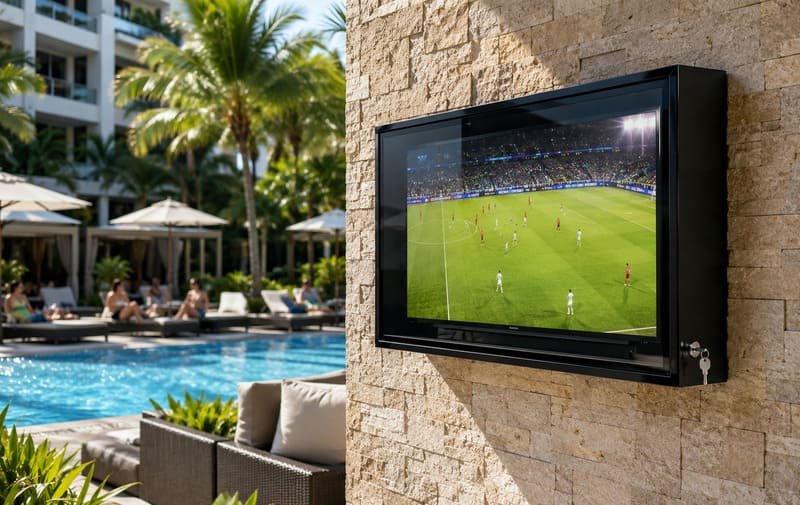
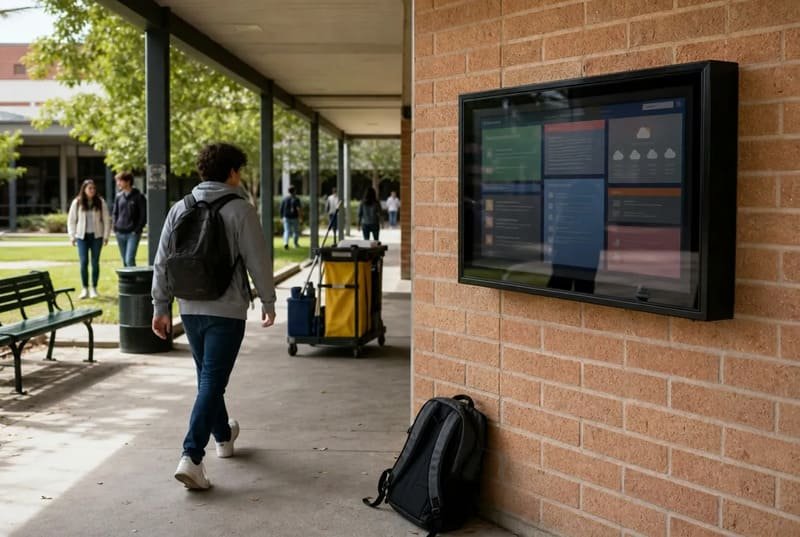
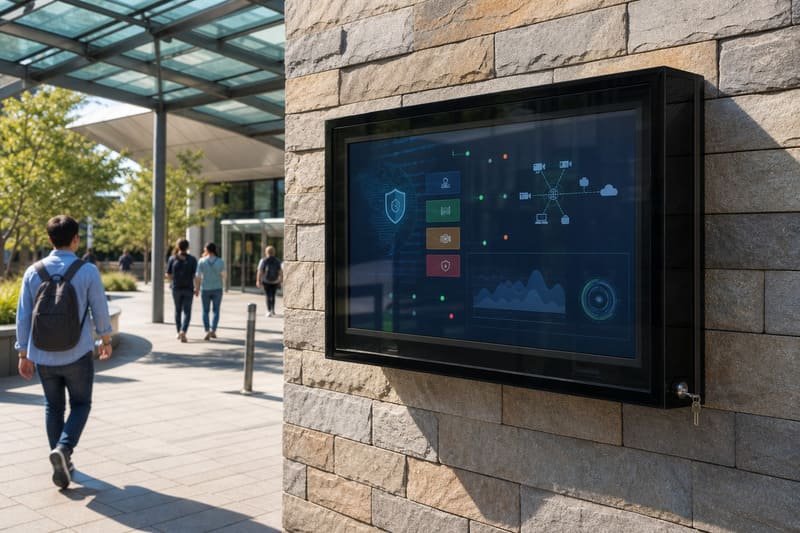
A display on a hotel pool wall, a sports bar patio, a school courtyard, a warehouse entrance, or an outdoor public information point is not only exposed to weather. It is also exposed to people, movement, curiosity, accidents, and sometimes intentional interference.
That does not mean every site is dangerous. It means the buyer should treat the display as a public or semi-public asset, not as a normal indoor TV.
Last Updated: May 29, 2026 | Estimated Reading Time: 8 minutes
By Smith Chen, Outdoor TV Enclosure Engineer at Outvion
Why Is Physical Risk Different From Weather Risk?
Weather risk comes from the environment. Physical risk comes from people, movement, access, and the way a display is used in real commercial space.
A weatherproof enclosure may help protect against rain and dust, but theft and impact protection require a different layer of thinking. Commercial displays need to be protected from casual contact, accidental bumps, exposed cables, unauthorized access, and replacement downtime—not only from water.
This is where many projects become too narrow.
A buyer asks for IP65 protection, and everyone focuses on rain. But the display may also be mounted in a place where people walk close to it, lean near it, move equipment around it, or leave it unattended overnight.
An IP rating does not answer those questions.
The International Electrotechnical Commission explains that IP ratings grade the resistance of electrical and electronic enclosures against the intrusion of dust and liquids. IEC IP Ratings
That makes IP rating useful, but it has a clear boundary.
IP65 can indicate dust-tight protection and protection against water jets under defined test conditions. It does not mean theft-proof, impact-proof, tamper-proof, vandal-proof, condensation-proof, salt-proof, or maintenance-free.
Weather Risk vs. Physical Risk
| Risk Type | What It Comes From | What It Can Affect | Protection Logic |
|---|---|---|---|
| Rain / Dust | Weather and environment | TV body, ports, cables | IP rating, sealing, cable exits |
| Impact | Guests, staff, carts, tools, furniture | Front screen, mounting, frame | Polycarbonate front, frame strength, safe placement |
| Theft / Removal | Unattended access | Entire display, cables, media devices | Locks, enclosed access, mounting security |
| Tampering | Curiosity, misuse, public contact | Ports, remotes, settings, cables | Lockable doors, hidden cables, staff control |
| Service Downtime | Damage, replacement, poor access | Operations and guest experience | Fast access, replaceable TV, spare parts |
| Site Exposure | Dark corners, low traffic, poor lighting | Security risk level | Placement, lighting, supervision, enclosure design |
This is why I do not like describing a commercial enclosure only as a weatherproof box.
In public-facing spaces, it also acts as a physical-risk management layer.
How Should Buyers Think in Deter, Delay, Protect, and Recover Layers?
Theft and impact protection should not be described as one absolute promise. A better way to think is in layers: deter, delay, protect, and recover.
For commercial outdoor displays, physical protection should make casual interference less attractive, make unauthorized access harder, reduce direct screen damage, and simplify replacement if the display still fails. This layered approach is more realistic than claiming any enclosure is theft-proof or unbreakable.
The UK National Protective Security Authority describes protective security principles such as deter, detect, delay, mitigate, and respond as part of asset protection thinking. NPSA Protecting Your Assets
For outdoor display procurement, I simplify that into four practical layers:
Deter.
Make the display look less like an easy target.
Delay.
Make unauthorized access require more effort, time, tools, and visibility.
Protect.
Reduce the chance that everyday impact reaches the TV screen directly.
Recover.
If the TV still needs replacement, make the service path manageable.
This framework keeps the conversation honest. No enclosure should be called theft-proof. No front panel should be called unbreakable. But a well-designed enclosure can change the risk profile.
Deter / Delay / Protect / Recover
| Protection Goal | What It Means | Enclosure Feature |
|---|---|---|
| Deter | Make casual interference less attractive | Visible hard shell, tidy cable routing, lockable design |
| Delay | Make unauthorized access take more time | Lockable access, protected screws, enclosed cables |
| Protect | Reduce direct screen contact damage | Polycarbonate front, structural frame, secure mounting |
| Recover | Make replacement easier if damage still occurs | Service access, reusable shell, TV swap path |
| Control | Keep access limited to authorized staff | Key control, clear maintenance routine |
| Inspect | Find issues before they become downtime | Scheduled checks for locks, panels, fans, and mounts |
This is different from saying “buy a stronger box.”
The stronger question is:
What physical risk layer is missing from this installation?
A bar patio may need impact and overnight access control.
A school courtyard may need tamper-resistant access.
A warehouse screen may need collision awareness.
A hotel pool screen may need guest-contact protection without looking industrial.
The answer changes by site.
What Does Impact Protection Actually Do?
Impact protection does not mean the display can survive every possible hit. It means the enclosure reduces the chance that ordinary commercial contact reaches the TV panel directly.
Impact protection in an outdoor TV enclosure usually depends on the front panel material, frame design, mounting method, and installation location. A quality polycarbonate front can help reduce direct screen contact, but real protection still depends on thickness, structure, impact direction, mounting strength, and the type of force involved.
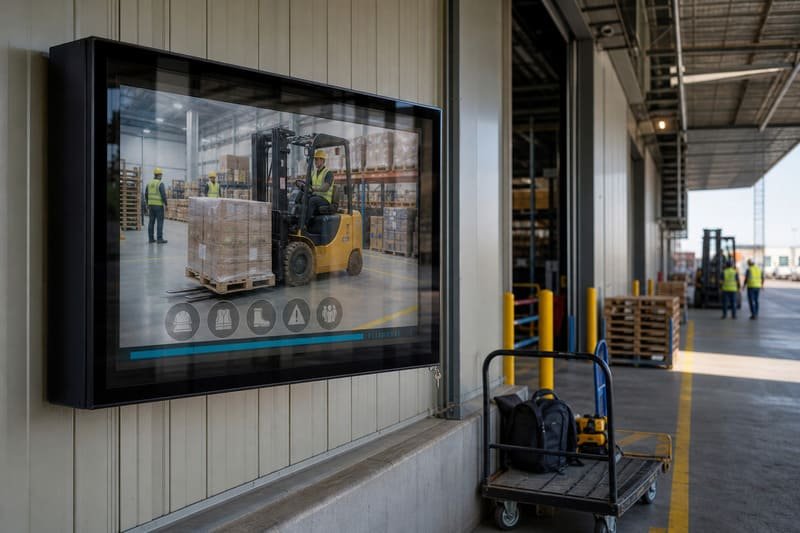
In many commercial environments, the most common impact is not dramatic.
- It is a cart.
- A chair.
- A tool bag.
- A sports bag.
- A cleaning trolley.
- A guest leaning into the wall.
- A worker moving equipment too close to the screen.
A standard indoor TV is not designed for this kind of public-facing contact. Its screen assembly is designed for controlled indoor use, not for repeated contact risk in a commercial area.
Polycarbonate can be useful because it combines transparency with impact resistance. Covestro describes Makrolon polycarbonate as robust, lightweight, glass-like in transparency, and impact resistant even at low temperatures. Covestro Makrolon Polycarbonate
But I still avoid overpromising.
A polycarbonate front panel is not magic. Actual performance depends on material grade, thickness, coating, frame support, mounting, and the force involved.
What Impact Protection Can and Cannot Do
| Scenario | Enclosure Contribution | Realistic Outcome |
|---|---|---|
| Guest or staff bump | Front panel separates TV from direct contact | Reduces risk of direct screen damage |
| Low-force cart or equipment contact | Frame and front panel absorb part of the contact | May reduce damage if force stays within design limits |
| Repeated public-area contact | Hard front discourages touching the TV surface | Helps reduce wear and direct screen exposure |
| Falling object or debris | Front shield takes initial contact | Outcome depends on weight, angle, speed, and panel support |
| Deliberate sustained attack | Physical deterrent and delay only | Not a guarantee; depends on tools, time, and force |
| Poor mounting surface | Enclosure cannot solve weak wall or bracket choice | Mounting must be reviewed separately |
The important sentence is this:
Impact protection reduces probability and severity. It does not guarantee zero damage.
That wording may sound cautious, but it is exactly the kind of language I prefer for B2B buyers. It helps them make a real procurement decision instead of trusting a vague “vandal-proof” claim.
What Does Theft Protection Realistically Do?
A lockable enclosure does not make theft impossible. Its practical value is to add friction: time, tools, effort, and visibility.
Theft protection for commercial outdoor displays should be understood as deterrence and delay, not absolute prevention. A lockable enclosure, protected cable route, secure mounting, and visible hard shell can reduce opportunistic removal or tampering, especially when combined with good site placement, lighting, supervision, and staff routines.
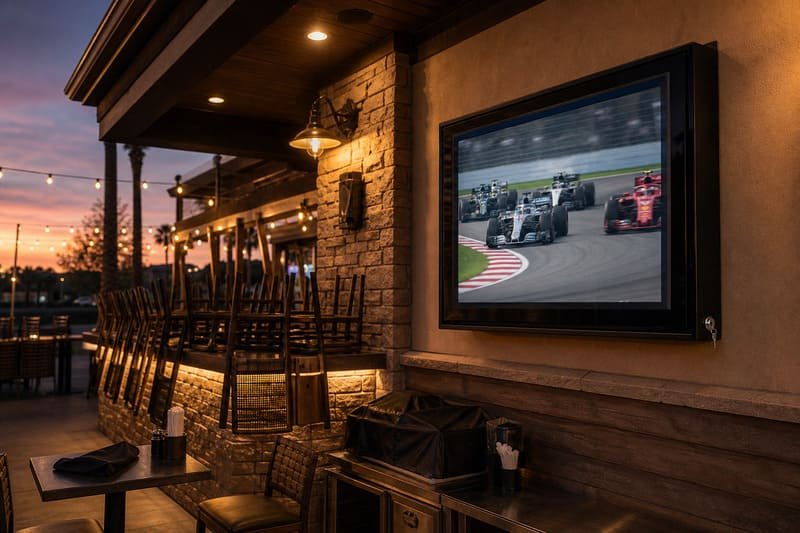
This is where I try to be very clear with buyers.
A determined person with tools, time, and no oversight can defeat many physical security measures. A TV enclosure is not a bank vault.
But that is not the realistic everyday goal.
The realistic goal is to make the display a harder target than an unsecured TV. A visible enclosure, locked access, protected screws, and enclosed cables can make casual interference less attractive.
On Outvion commercial enclosures, the lock is positioned on the lower part of the right side panel so authorized staff can access the enclosure without exposing the front display area. The goal is serviceable access for the right people and additional friction for the wrong people.
Theft and Tamper Protection Layers
| Protection Layer | What It Helps With | What It Does Not Replace |
|---|---|---|
| Lockable Access | Reduces casual opening and port access | Site security and supervision |
| Enclosed Cables | Makes cable pulling or unplugging harder | Proper cable routing and strain relief |
| Protected Mounting | Reduces easy removal from the wall | Strong wall and bracket design |
| Hard Shell | Makes the display look less exposed | Full theft prevention |
| Key Control | Limits who can open the unit | Staff training and procedure |
| Lighting / Visibility | Increases perceived risk for interference | Physical locks and mounting |
A lock should not be treated as the entire security plan.
- Placement matters.
- Lighting matters.
- Foot traffic matters.
- Camera coverage may matter.
- Staff closing routines matter.
- Mounting hardware matters.
The enclosure is one physical layer in the security plan, not the whole plan.
How Do Physical Incidents Change the Real Cost?
The cost of theft or impact is rarely only the price of a new TV. The real cost includes diagnosis, labor, remounting, cable repair, downtime, emergency freight, and the operational gap while the screen is unavailable.
Physical incidents create a cost stack. A damaged or missing commercial display may require hardware replacement, technician labor, wall or mount repair, cable repair, urgent shipping, and lost screen availability. This is why theft and impact protection should be evaluated as part of total cost, not only as an accessory cost.
CIPS defines Total Cost of Ownership as an end-to-end cost view that includes purchase price, acquisition cost, usage cost, and end-of-life cost. CIPS Total Cost of Ownership
That framework is useful here, but this article is not only about lifecycle cost. It is about incident cost.
- What happens after the display is hit?
- What happens after the front panel cracks?
- What happens after a cable is pulled?
- What happens after the screen is missing?
- What happens when the wall bracket is bent?
- What happens when a replacement must be shipped quickly?
These are not abstract costs. In a commercial venue, downtime is visible.
- A bar may lose a game-night screen.
- A hotel may lose a poolside guest feature.
- A campus may lose an announcement display.
- A warehouse may lose a work instruction screen.
- An integrator may receive the complaint even if the damage happened on site.
Physical Incident Cost Stack
| Cost Layer | Why It Matters |
|---|---|
| Replacement Hardware | TV, panel, media device, or accessory may need replacement |
| Labor | Technician visit, diagnosis, unmounting, reinstalling |
| Wall / Mount Repair | Impact may damage bracket, anchors, wall surface, or frame |
| Cable Repair | HDMI, power, network, and cable exits may be pulled or exposed |
| Downtime | Screen is unavailable during service, event, or operating hours |
| Emergency Freight | Urgent replacement parts can raise cost |
| Procurement Time | Approval, ordering, and model matching take time |
| Reputation Risk | Guests, clients, or site managers notice the missing screen |
A protective enclosure does not eliminate this cost stack. But it can reduce the chance that small incidents become full screen failures, and it can make replacement easier if the TV inside still needs to be swapped.
This is where the enclosure strategy connects with recovery.
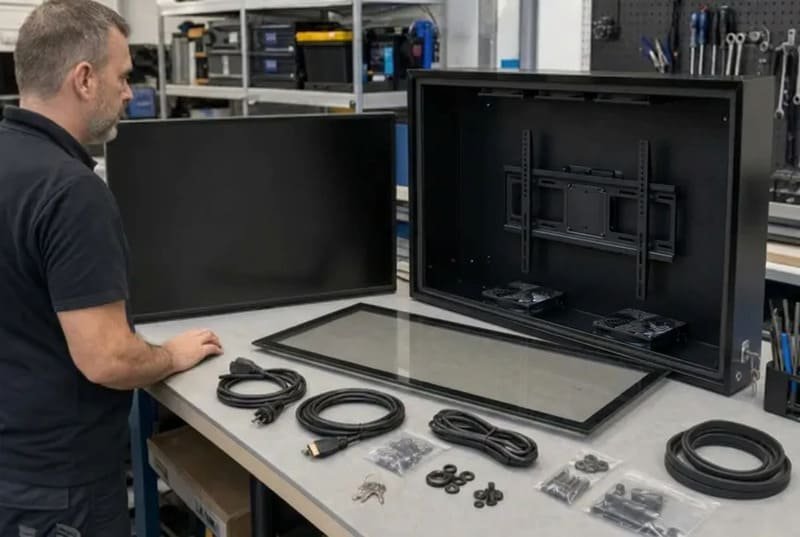
If the enclosure, mounting position, lock system, and cable route remain usable, the buyer may only need to replace the display module inside. That is a different recovery path from replacing the whole outdoor installation.
What Should Buyers Check Before Installation?
The best time to plan theft and impact protection is before the display goes on the wall. Once the display is installed, weak placement, exposed cables, and poor service access are harder to fix.
Before installing commercial outdoor displays, buyers should check who can reach the screen, what can hit it, whether it is unattended after hours, how cables are protected, how the enclosure opens, how the TV can be replaced, and how the site supports deterrence through lighting, visibility, and staff routines.
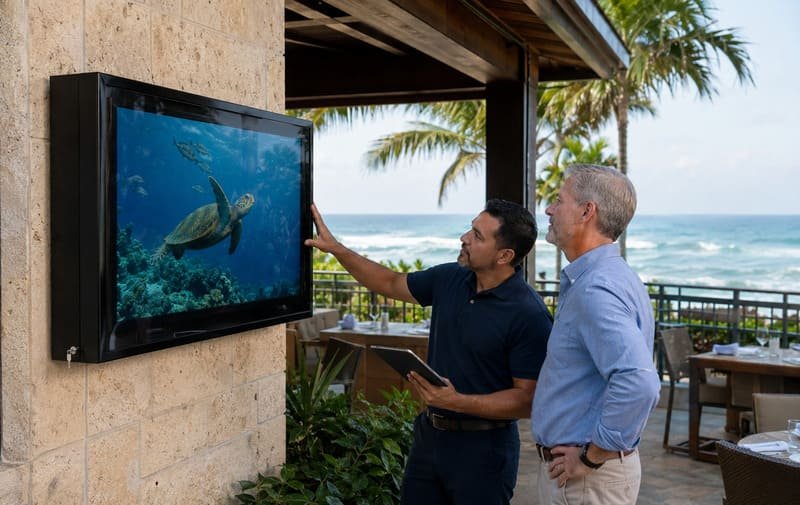
When I review a commercial display project, I like to see site photos before finalizing the enclosure recommendation.
Photos show what a specification sheet cannot show.
- They show the walkway.
- They show the bar counter.
- They show the loading area.
- They show the pool edge.
- They show the wall height.
- They show cable paths.
- They show whether people can reach the screen easily.
- They show whether staff can open the enclosure safely.
For coastal or poolside commercial sites, I also check hardware exposure. A polycarbonate body does not rust like steel, which removes one corrosion pathway. But locks, hinges, screws, anchors, cable exits, and wall mounts still need corrosion-resistant design and inspection.
FEMA guidance on coastal construction notes that salt accumulation and high humidity can accelerate corrosion of untreated steel connectors and fasteners. FEMA Coastal Corrosion Guidance
Heat should not be ignored either. Sony advises using TVs within 0°C to 40°C / 32°F to 104°F and avoiding direct sunlight. Sony TV Temperature Guidance
A fan-cooled enclosure can help move warm air away from the TV, but it is not air conditioning. Shade, airflow, operating hours, and maintenance still matter.
Installation Checklist
| Check | What to Ask | Why It Matters |
|---|---|---|
| Reachability | Can guests, students, workers, or visitors touch the screen? | Determines height, front shield, and lock need |
| Impact Path | Can carts, chairs, tools, doors, or bags hit the display? | Determines placement and impact protection |
| After-Hours Exposure | Is the screen unattended overnight? | Determines theft and tamper risk |
| Cable Access | Are HDMI, power, network, or media devices exposed? | Prevents unplugging and cable pulling |
| Lock Access | Who controls the key and service routine? | Prevents unauthorized opening |
| Mounting Surface | Is the wall or structure strong enough? | Prevents movement, vibration, or detachment |
| Lighting / Visibility | Is the display in a dark or hidden area? | Affects deterrence and monitoring |
| TV Replacement Path | Can the TV be removed without rebuilding the installation? | Supports recovery after damage |
| Hardware Exposure | Is the site coastal, poolside, or humid? | Determines corrosion inspection needs |
| Maintenance Plan | Who checks locks, panels, vents, and cables? | Keeps protection working over time |
This checklist is what turns theft and impact protection from a product feature into a procurement plan.
Frequently Asked Questions
Does IP65 protect against theft or impact?
No. IP65 is about dust and water intrusion under defined test conditions. It does not describe theft resistance, tamper resistance, impact resistance, or unauthorized access control. Those require separate design features such as locks, front panels, mounting structure, and cable protection.
Can an enclosure stop theft completely?
No enclosure should be described as theft-proof. A lockable enclosure can add friction and reduce opportunistic removal or tampering, but site security, lighting, supervision, mounting strength, and staff routines still matter.
What does impact protection actually mean?
Impact protection means placing a physical barrier and supporting structure between the TV and common contact risks. It may reduce damage from bumps, carts, tools, bags, or public contact. It does not guarantee survival under every force or deliberate attack.
Is polycarbonate better than glass or acrylic for front protection?
Polycarbonate is often a strong option because it combines transparency with impact resistance. However, the actual performance depends on thickness, grade, coating, frame support, mounting design, and supplier test data. Material name alone is not enough.
Where does lock placement matter?
Lock placement matters because authorized staff need practical access while the front display area stays protected. On Outvion commercial enclosures, the lock is positioned on the lower part of the right side panel for service access. The full security effect still depends on mounting, key control, lighting, and site supervision.
Can the TV inside be replaced after damage?
Yes, if the enclosure remains usable and the replacement TV fits the internal dimensions, VESA pattern, cable route, and airflow requirements. This is one reason modular enclosures can be useful in commercial projects.
What venues need theft and impact protection most?
Semi-public and high-traffic venues usually need it most: sports bars, hotel pool areas, schools, campuses, warehouses, public plazas, transport areas, outdoor dining zones, and any site where the screen is reachable or unattended.
How should buyers combine enclosure security with site security?
Use the enclosure as one layer. Combine it with proper mounting height, lighting, visible placement, key control, cable routing, staff routines, and site monitoring where needed. The best result comes from layered protection, not one product feature alone.
Conclusion
A commercial outdoor display is not only a screen.
It is an exposed asset.
It may face weather, but it may also face contact, curiosity, misuse, impact, cable pulling, after-hours access, and replacement downtime.
That is why theft and impact protection should not be pushed to the end of the buying process.
The better question is not only:
“Is this display weatherproof?”
The better questions are:
- Who can reach it?
- What can hit it?
- Can the cables be pulled?
- Can unauthorized people open it?
- Can staff service it safely?
- Can the TV be replaced if something still happens?
- Does the site help deter casual interference?
A strong protection plan does not promise that nothing will ever go wrong.
It does something more realistic.
- It deters casual interference.
- It delays unauthorized access.
- It protects the screen from everyday contact.
- It supports recovery if the display still needs replacement.
That is why theft and impact protection matter for commercial outdoor displays—not because they remove every risk, but because they make the risk easier to manage before it becomes downtime.