
A wrong outdoor TV enclosure order usually does not fail on the product page. It fails later — when the TV arrives, the cables do not clear, the fan path is blocked, or the site turns out to be hotter, wetter, or more corrosive than the buyer described.
Before buying an outdoor TV enclosure, I prefer to treat the order like a pre-installation approval sheet. The buyer should confirm five things before payment: the real TV dimensions, the IP rating boundary, the heat path, the corrosion exposure, and the actual use environment.

When I review an outdoor TV enclosure inquiry, I do not treat the TV diagonal as the final specification.
I treat it as the first line of a fit sheet.
For bulk orders, I prefer to confirm the fit sheet before discussing final price, because a wrong depth, cable exit, or fan path can turn a normal order into an installation problem. For homeowners, the same logic applies: the enclosure has to match the TV, the wall, the weather, and the way the screen will actually be used.
That is why this article is not only a product feature list.
It is a pre-order checklist.
Last Updated: 1th June, 2026 | Estimated Reading Time: 8 minutes
By Smith Chen, Outdoor TV Enclosure Engineer at Outvion
Check 1: Will This Enclosure Fit the Actual TV Body, Not Just the Screen Size?
Most buyers measure screen size in inches and assume that settles it. It usually does not.
A 55-inch TV label only tells you the diagonal screen category. It does not confirm the full body width, height, depth, rear port position, VESA pattern, cable bend space, or whether the next TV replacement will fit the same enclosure.
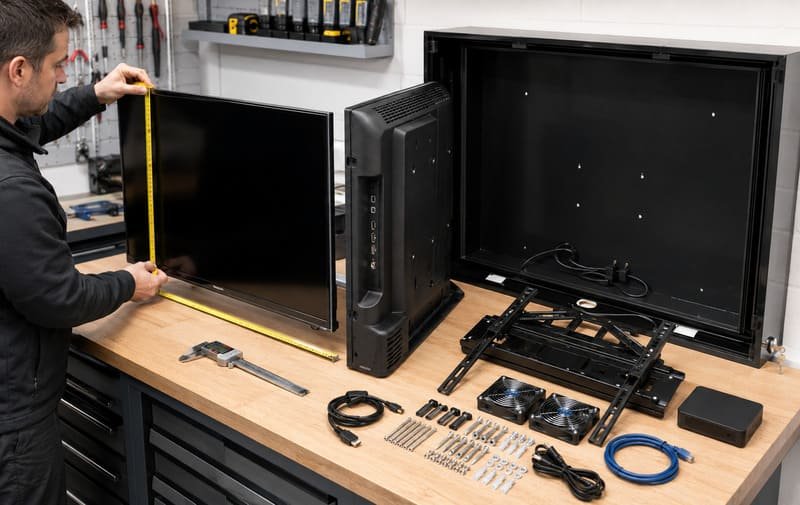
This is the single most common source of installation problems I hear about.
Someone orders an enclosure based on screen size, gets it on site, and discovers that the TV body, rear ports, power plug, VESA position, or cable direction does not clear the internal space properly.
LG explains that TV size is measured diagonally, while the buyer still needs to check the full width, height, and depth of the specific TV model. LG TV size guide
That matters even more inside an enclosure.
A living room wall may forgive a few extra centimeters.
An enclosure will not.
TV Fit Sheet Before Ordering
| What to Measure | Why It Matters |
|---|---|
| TV Outer Width and Height | Confirms the TV fits the internal cavity, not just the size category |
| TV Depth | Rear housing, ports, and plugs may need extra clearance |
| VESA Mount Pattern | Must match or adapt safely to the internal mounting plate |
| Cable Direction | Power, HDMI, LAN, and media cables need a clean route |
| Port Position | Rear-facing ports may require more depth than side-facing ports |
| Bezel / Frame Shape | Affects how the screen aligns behind the front viewing window |
| Remote Signal / Receiver Position | May affect how the TV is controlled inside the enclosure |
| Future Replacement Space | Helps the enclosure support another compatible TV later |
Common enclosure size families usually cover 28–32 inch, 40–43 inch, 50–55 inch, 60–65 inch, 70–75 inch, 80–85 inch, and 90–100 inch projects. Very large screens may need custom review.
There is also a future-fit question worth asking:
If you upgrade the TV two or three years from now, can the new TV still fit the same enclosure?
That is not only a convenience issue. It can become a total cost issue, especially for restaurants, hotels, schools, factories, and other multi-unit commercial deployments.
Check 2: Does the IP Rating Match the Real Weather Exposure?
Waterproofing gets listed on many outdoor enclosure product pages. But buyers should be careful with vague language like “weatherproof” or “water-resistant.”
For most weather-exposed outdoor TV enclosure projects, I treat IP65 as a practical baseline, not a premium feature. But IP65 has limits. It can indicate dust-tight protection and protection against water jets under defined test conditions, but it does not mean vapor-proof, condensation-proof, salt-proof, flood-proof, pressure-wash-proof, or maintenance-free.
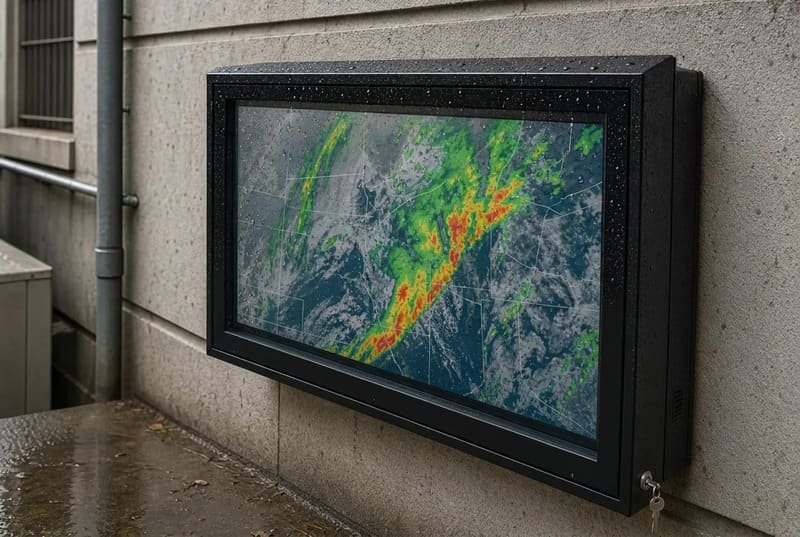
The International Electrotechnical Commission explains that IP ratings grade the resistance of electrical and electronic enclosures against intrusion by dust and liquids. IEC IP Ratings
That makes IP rating useful, because it is more specific than a marketing word like “waterproof.”
But IP rating should not be treated as the whole outdoor protection plan.
In real installation, the weak points are often not the front panel itself. They are the cable exits, gasket compression, fan vents, mounting angle, wall interface, and maintenance routine.
What IP65 Helps With and What It Does Not Solve
| Exposure Question | What IP65 Helps With | What Still Needs Checking |
|---|---|---|
| Dust and Windblown Debris | Dust-tight protection under defined test conditions | Fan vents, cable exits, cleaning routine |
| Rain and Splash | Water-jet resistance under defined test conditions | Roof edge, wind direction, installation angle |
| Snow or Frost Conditions | May reduce direct water intrusion | Freeze-thaw moisture, drainage, TV storage/operating limits |
| Humidity and Condensation | Reduces direct exposure but does not dry the air | Airflow, dew risk, gasket condition, inspection |
| High-Pressure Cleaning | Not something to assume from IP65 alone | Keep pressure spray away from the enclosure |
| Flooding or Submersion | Not covered by IP65 | Avoid flood-prone placement |
| Coastal Salt Air | IP rating is not a corrosion rating | Material, hardware, inspection schedule |
When sourcing at volume, I suggest asking the manufacturer a few direct questions:
- How are cable exits sealed?
- How is gasket compression controlled?
- How are units checked before shipment?
- How should the enclosure be inspected after installation?
- What parts need maintenance over time?
A rating is helpful. A rating plus installation discipline is better.
Check 3: Is There a Clear Heat Path Around the TV?
Rain is visible, so buyers think about it first. Heat is less obvious, but it can be just as important.
Heat should be checked separately from water protection. A sealed enclosure can reduce weather exposure, but it can also hold warm air if airflow is not planned. Fan-assisted airflow can help reduce heat buildup around the TV, but it is not air conditioning and should not be described as making a standard TV safe at every high ambient temperature.
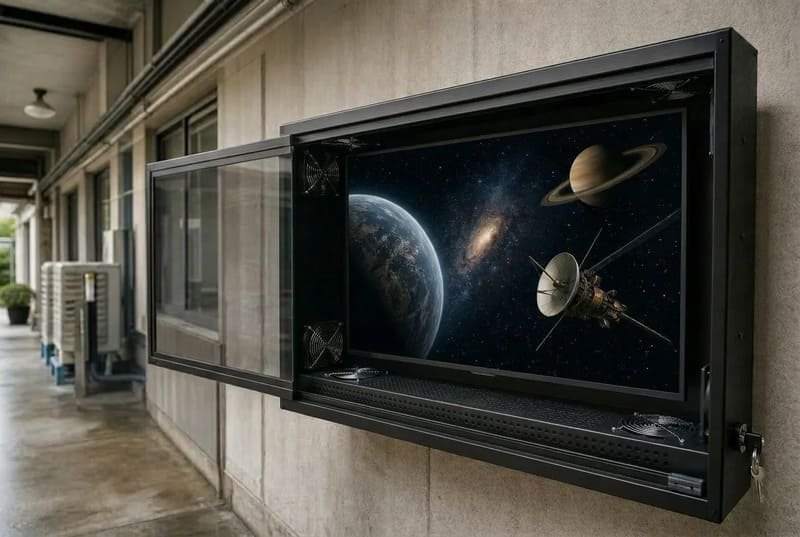
I have seen buyers install outdoor TV enclosures in partially shaded locations and assume cooling is not a concern. Then summer arrives, afternoon sun shifts, and the TV starts facing heat problems during the hours when the screen matters most.
Sony advises using TVs within a temperature range of 0°C to 40°C / 32°F to 104°F and avoiding exposure to direct sunlight. Sony TV temperature guidance
That does not mean every outdoor installation will fail outside that comfort zone. It means buyers should respect the TV manufacturer’s guidance and reduce unnecessary heat load.
- Shade matters.
- Internal clearance matters.
- Fan path matters.
- Operating hours matter.
- Vent cleaning matters.
- The wall behind the enclosure matters.
Heat Path Checklist
| Heat Factor | What to Confirm Before Ordering |
|---|---|
| Sun Direction | Does afternoon sun hit the enclosure directly? |
| Wall Surface | Does the wall absorb and radiate heat? |
| TV Size and Power Use | Larger screens often need more airflow planning |
| Internal Clearance | Air needs room to move around the TV body |
| Fan Intake / Exhaust Path | Air should enter and leave without being blocked |
| Accessory Heat | Media boxes, adapters, and receivers add heat |
| Operating Hours | Long daily use increases thermal load |
| Maintenance Access | Fans and vents must be reachable for cleaning |
In the product lines I work with, smaller models may use a 2-fan airflow system, while larger 60-inch and above models often need stronger airflow planning. But fan count alone is not enough.
A fan with blocked intake is not a cooling system.
A four-fan enclosure with no clearance can still trap heat.
A shaded, well-ventilated installation may perform better than a direct-sun installation with more fans.
So before asking only “how many fans,” ask:
Where does the heat go?
Check 4: Will the Material and Hardware Survive the Local Environment?
Material choice matters most when the installation is coastal, humid, poolside, dusty, hot, or public-facing.
Salt air and high humidity can accelerate corrosion of exposed or untreated metal parts. A polycarbonate body does not rust like steel, which removes one corrosion pathway. But locks, hinges, screws, brackets, anchors, cable exits, and wall mounts still need corrosion-resistant design and regular inspection.

This comes up regularly with beachfront resorts, waterfront restaurants, marinas, poolside bars, and coastal villas.
The body material is important, but it is not the whole system.
A body may resist corrosion better than painted metal, but the installation can still fail around small parts: screws, hinges, locks, anchors, fan screws, cable glands, or mounting brackets.
FEMA guidance on coastal construction notes that salt accumulation and high humidity can accelerate corrosion of untreated steel connectors and fasteners. FEMA coastal corrosion guidance
For front panels and transparent bodies, polycarbonate can be useful because it combines clarity, light weight, and impact resistance. Covestro describes Makrolon polycarbonate as robust, lightweight, glass-like in transparency, and impact resistant even at low temperatures. Covestro Makrolon polycarbonate
Still, I do not recommend buying by material name alone.
The grade, thickness, UV stability, coating, molding quality, gasket design, and hardware details all matter.
Material and Hardware Review
| Material / Part | What It Can Do | What Still Needs Checking |
|---|---|---|
| Painted Steel | Can provide strong structure if coated correctly | Coating damage, edge corrosion, weight, maintenance |
| Aluminum | Lighter than steel and often better corrosion behavior | Grade, coating, galvanic corrosion, hardware compatibility |
| Polycarbonate Body / Front | Does not rust like steel; can provide clarity and impact resistance | UV grade, thickness, coating, optical clarity, scratch resistance |
| Locks and Hinges | Control access and service routine | Corrosion resistance and replacement availability |
| Screws and Anchors | Hold the enclosure safely in place | Coastal grade, wall type, inspection schedule |
| Cable Exits | Protect one of the most common weak points | Seal design, cable bend, service access |
One practical rule I use:
If the site is near the sea, pool, or high humidity, inspect the hardware plan as carefully as the enclosure body.
That is usually where long-term problems begin.
Check 5: Does the Configuration Match How the Enclosure Will Be Used?
The right enclosure is not always the one with the most features. It is the one that matches the exposure tier and use pattern.
Do not choose by feature tier first. Choose by exposure tier first. A covered residential patio, open restaurant wall, poolside bar, coastal resort, and public institution do not need the same enclosure configuration. The correct configuration depends on weather exposure, heat, corrosion, access control, service routine, and operating hours.
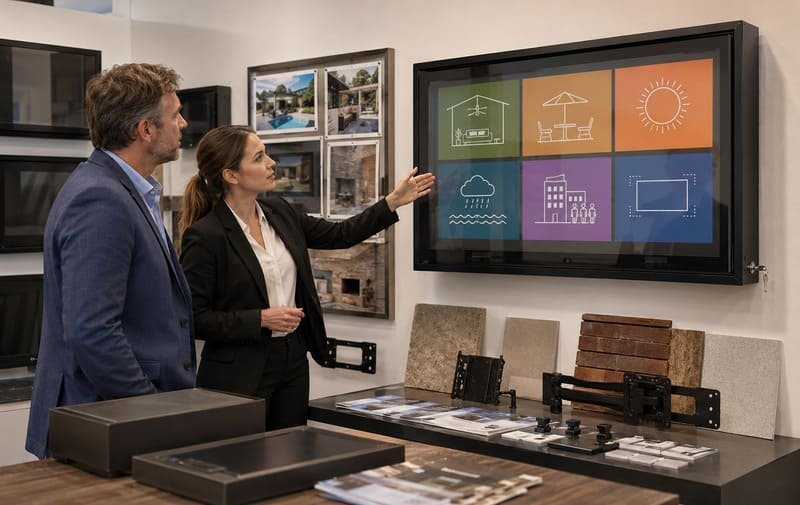
From a factory configuration standpoint, I prefer to classify the site before recommending the version.
- Is the enclosure under a roof?
- Is it exposed to direct rain?
- Is the site hot or sunny?
- Is it near salt air or pool moisture?
- Is it in a public or semi-public space?
- Will staff need regular access?
- Will the buyer replace the TV later?
Those questions matter more than simply choosing the highest-priced option.
Exposure Tier Selection Guide
| Exposure Tier | What It Means | What to Confirm Before Order |
|---|---|---|
| Covered / Low Exposure | Roofed patio, mild climate, low public contact | Fit, basic sealing, cable path, service access |
| Open / Moderate Exposure | Rain, dust, insects, seasonal outdoor use | IP rating, gasket, cable exits, mounting angle |
| Heat / Sun Exposure | Direct sun, long runtime, hot wall surface | Fan path, shade, internal clearance, vent cleaning |
| Coastal / Humid Exposure | Salt air, pool area, high humidity | PC body, corrosion-aware hardware, inspection plan |
| Public / Commercial Exposure | Guests, staff, students, workers, tampering risk | Lock, front shield, mount strength, service routine |
| Large-Screen Exposure | 70-inch and above, heavier TV, more heat | Internal dimensions, bracket strength, airflow planning |
This is also where total cost matters.
CIPS defines Total Cost of Ownership as an end-to-end cost view that includes purchase price, acquisition cost, usage cost, and end-of-life cost. CIPS Total Cost of Ownership overview
For outdoor TV enclosures, TCO is affected by more than the first quote.
It includes wrong-size returns, installation delays, fan service, hardware corrosion, TV replacement, downtime, and whether the enclosure can support future compatible screens.
A cheaper enclosure that does not fit the site may become expensive later. A higher-spec enclosure may be unnecessary if the site is mild and covered.
That is why the configuration should match the actual environment, not the buyer’s fear or the salesperson’s upsell.
What Should Buyers Confirm Before Approving the Order?
Before approving payment or production, I like to turn the decision into a simple sign-off sheet. This reduces misunderstanding between the buyer, supplier, installer, and end user.
Before approving an outdoor TV enclosure order, confirm the TV model, full TV dimensions, VESA pattern, cable direction, IP rating, fan system, material and hardware plan, exposure tier, mounting location, service access, and replacement strategy. A clear pre-order sign-off prevents many installation problems.
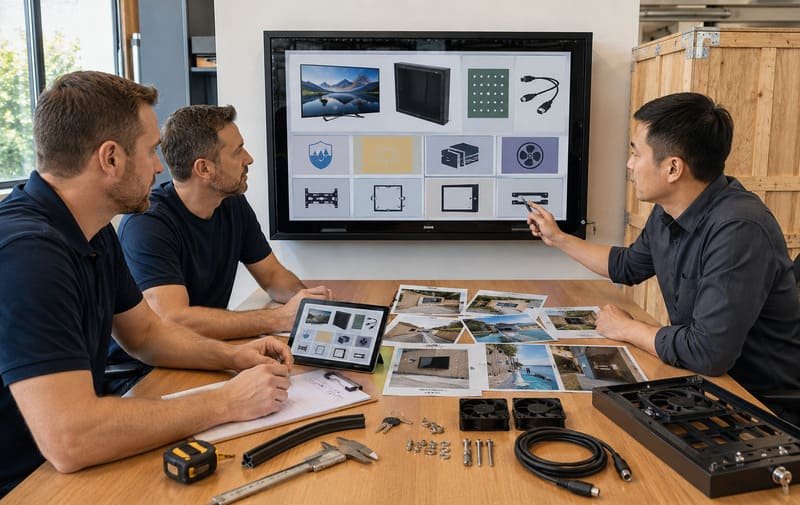
This section is especially useful for B2B buyers.
A distributor may be quoting for a hotel.
An AV installer may be ordering for a restaurant.
A buyer may be forwarding dimensions from an end customer.
A factory may be matching an enclosure size without seeing the site.
Every handoff creates a chance for error.
Pre-Order Approval Sheet
| Approval Item | What to Confirm | Why It Matters |
|---|---|---|
| TV Model | Exact brand and model number | Avoids guessing from screen size only |
| TV Width / Height / Depth | Full body dimensions, not just diagonal size | Confirms real fit |
| VESA Pattern | Mounting hole layout and position | Confirms safe internal mounting |
| Cable Direction | Power, HDMI, LAN, media player space | Prevents cable pressure and weak exits |
| Enclosure Size Family | 50–55, 60–65, 70–75, etc. | Matches product range to TV body |
| IP Rating Need | Covered, open, rain, dust, splash | Sets weather protection baseline |
| Heat Exposure | Shade, sun direction, operating hours | Determines airflow and fan planning |
| Material / Hardware | PC body, locks, hinges, screws, anchors | Reduces corrosion and service risk |
| Mounting Surface | Wall, pole, bracket, structure | Ensures safe installation |
| Service Access | Room to open, clean, inspect, replace | Reduces future labor problems |
| Future TV Replacement | Will a similar TV fit later? | Supports long-term value |
If a buyer cannot answer these questions yet, I usually suggest pausing the order rather than rushing the quote.
Outdoor TV enclosure mistakes are easier to prevent than to fix.
Frequently Asked Questions
Can I use any indoor TV inside an outdoor enclosure?
Not every indoor TV is automatically suitable. It must fit the enclosure, allow airflow, match the VESA mount, leave cable clearance, and support the intended use pattern. The enclosure helps reduce outdoor exposure, but it does not change the TV manufacturer’s original outdoor-use rating or warranty terms.
How do I measure my TV before ordering an enclosure?
Measure the full TV width, height, and depth, including rear housing and port areas. Check the VESA pattern, cable direction, power plug position, and whether the remote receiver can still work inside the enclosure. Do not rely on diagonal screen size alone.
Is IP65 enough for outdoor TV enclosures?
For many weather-exposed outdoor TV enclosure projects, IP65 is a practical baseline because it indicates dust-tight protection and protection against water jets under defined test conditions. But IP65 does not cover every outdoor risk, such as condensation, salt air, heat, impact, pressure cleaning, flooding, or maintenance quality.
Does IP65 protect against condensation or salt air?
No. IP65 describes dust and water-jet intrusion resistance under defined test conditions. It does not mean condensation-proof or salt-proof. Humidity, dew point, cable exits, airflow, material choice, and hardware inspection still matter.
Do outdoor TV enclosures need fans?
Many outdoor TV enclosures benefit from fan-assisted airflow, especially in hot, sunny, large-screen, or long-runtime installations. Fans help move warm air, but they are not air conditioning. Shade, internal clearance, vent access, and the TV manufacturer’s temperature guidance are still important.
Is polycarbonate better than metal for outdoor TV enclosures?
It depends on the site. A polycarbonate body does not rust like steel and can offer clear viewing and impact resistance. Metal may work if grade, coating, hardware, and maintenance are suitable. In coastal or humid locations, hardware corrosion must be reviewed no matter which body material is used.
Should I choose a larger enclosure for future TV replacement?
Sometimes, yes. A slightly larger internal cavity may make future TV replacement easier, especially for commercial projects. But it should not be oversized blindly. The TV still needs correct mounting, screen alignment, airflow, and front viewing position.
What information should I send before requesting a quote?
Send the TV brand and model, full TV width, height, depth, VESA pattern, cable direction, installation photos, location type, exposure level, sun direction, whether the site is coastal or poolside, expected operating hours, and whether lockable access or active cooling is needed.
Conclusion
Buying an outdoor TV enclosure should not feel like guessing from a size chart.
The safer process is a pre-order check.
- Confirm the real TV body size.
- Confirm the IP rating boundary.
- Confirm the heat path.
- Confirm the local corrosion risk.
- Confirm the actual use environment.
Those five checks do more than help you choose a product.
They prevent the most common order problems: wrong fit, blocked cables, weak sealing, trapped heat, hardware corrosion, overbuying, underbuying, and future replacement trouble.
A good enclosure is not only the one that looks weatherproof in a photo.
It is the one that fits the TV, matches the site, can be installed cleanly, can be serviced later, and still makes sense after the first screen is replaced.
Before you buy, do the checks.
That is where a successful outdoor TV enclosure project really begins.