
A tropical climate does not attack an outdoor TV in one straight line. It works in cycles: humid nights, hot afternoons, sudden rain, salt-laden air, insects, pollen, and long daily operating hours.
To choose an outdoor TV enclosure for tropical and coastal climates, do not look at waterproof rating alone. The right enclosure should balance sealing, airflow, corrosion resistance, UV exposure, TV fit, fan maintenance, cable protection, and service access across the full tropical exposure cycle.
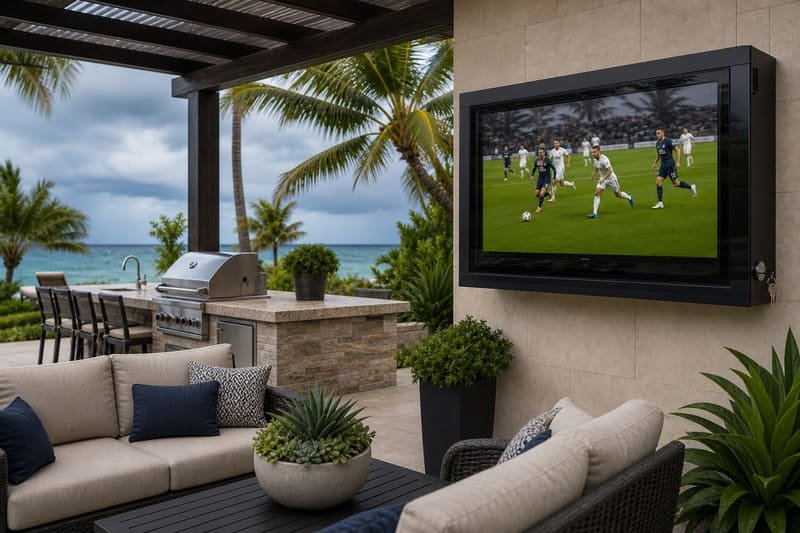
When a resort buyer asks me what enclosure works best in a tropical climate, I do not start by asking only about TV size.
I ask a different set of questions:
- Is the screen near the sea?
- Does the TV face afternoon sun?
- Is the area covered or open?
- Will the screen run all day or only at night?
- Does the wall trap heat?
- Can staff clean the fan vents?
- Are the cables entering from below, behind, or above?
- Will the enclosure be inspected after heavy rain or storm season?
These questions matter because tropical environments are not just “wet.” They are wet, hot, salty, sunny, and alive with insects and dust at the same time.
In my view, the best tropical outdoor TV enclosure is not simply the tightest waterproof box. It is the enclosure that balances sealing, airflow, UV resistance, corrosion control, TV clearance, and service access.
That balance is what makes the difference between a screen that only survives the first season and a display system that can be maintained over time.
Last Updated: May 25, 2026 | Estimated Reading Time: 8 minutes
By Smith Chen, Outdoor TV Enclosure Engineer at Outvion
Why Is Tropical Weather a Combined Exposure Problem?
Tropical weather is difficult because several risks happen together. A screen may face high humidity overnight, direct sun during the afternoon, sudden rain, salt air in the evening, and long operating hours during business service.
Tropical climates create a combined exposure cycle. The enclosure must handle water, heat, humidity, salt air, UV, insects, dust, and maintenance access together. If the buyer chooses only by IP rating or material name, important long-term risks may be missed.
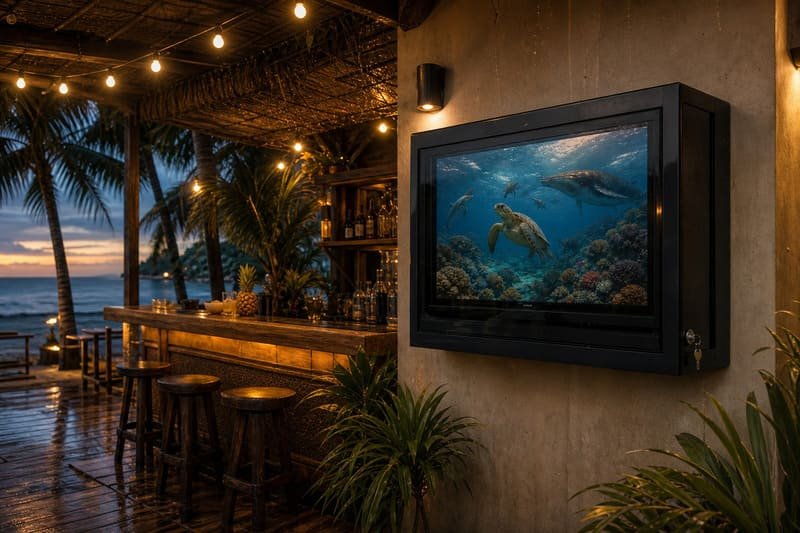
This is where many buyers make the wrong assumption.
They think the problem is rain. So they ask only:
“Is it waterproof?”
Rain matters, of course. But in a tropical resort, beach bar, poolside restaurant, island hotel, or coastal villa, rain is only one part of the environment.
- The screen may be dry in the afternoon but exposed to humid night air after closing.
- The enclosure may block rain but still trap heat if airflow is poor.
- The body may not rust, but locks, hinges, screws, and brackets still need inspection.
- The TV may fit physically but leave too little room for airflow.
- The front panel may protect the screen but still reflect strong sunlight if placement is poor.
That is why I prefer to think in terms of a tropical exposure cycle.
Tropical Exposure Cycle
| Tropical Exposure Stage | What Happens | Enclosure Priority |
|---|---|---|
| Humid Night | Air cools, relative humidity rises, condensation risk may increase | Cable exits, gasket condition, inspection access |
| Hot Afternoon | Solar heat and TV heat combine | Shade, fan airflow, internal clearance |
| Sudden Rain | Heavy water exposure can happen quickly | IP-rated sealing, gasket compression, drainage thinking |
| Coastal Evening | Salt-laden humid air settles on hardware | Corrosion-resistant hardware and regular inspection |
| Long Operating Hours | Heat builds during daily service | Fan access, vent cleaning, airflow path |
| Insects / Dust / Pollen | Vents and openings collect debris | Front shield, protected vents, cleaning routine |
| Storm Season | Wind-driven rain and debris may stress weak points | Mounting strength, cable routing, service checks |
This is the core difference between choosing an enclosure for a mild backyard and choosing one for a tropical coastal business.
In mild climates, a buyer may focus mostly on rain and dust.
In tropical climates, the buyer has to think about cycles.
The enclosure needs to protect the TV, but it also needs to remain serviceable after months of heat, humidity, insects, and salt exposure.
Why Is IP65 Important but Not Enough by Itself?
An IP rating is important because it gives buyers a clearer standard than vague words like “waterproof.” But IP rating does not describe the full tropical operating environment.
IP65 can be a useful baseline for outdoor TV enclosures because it indicates dust-tight protection and protection against water jets under defined test conditions. But IP65 does not mean vapor-proof, condensation-proof, salt-proof, UV-proof, heat-proof, storm-proof, or maintenance-free.
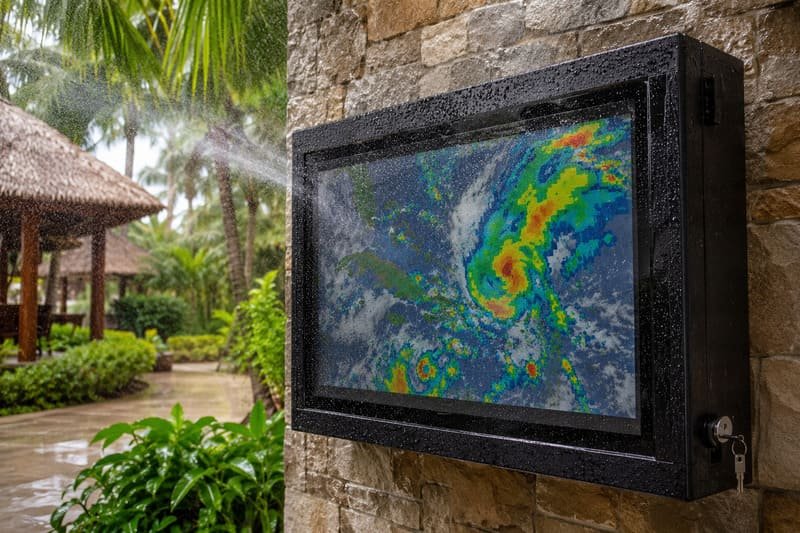
The International Electrotechnical Commission explains that IP ratings grade the resistance of enclosures against the intrusion of dust and liquids. IEC IP Ratings
That makes IP rating a useful starting point.
But in tropical climates, an IP rating does not answer every practical question:
- Can heat escape?
- Can damp air be managed?
- Can staff inspect cable exits?
- Can salt-exposed hardware be checked?
- Can fan vents be cleaned?
- Can insects collect around openings?
- Can the front panel handle strong sun exposure?
These questions sit outside the basic IP number.
For example, an enclosure may resist water jets under defined test conditions, but real tropical use may involve humid nights, strong sun, salty wind, insects, cleaning spray, and long TV runtime.
I usually explain it this way:
IP rating tells you how the enclosure performs against dust and water entry under test conditions. It does not tell you whether the whole installation is ready for tropical daily use.
What IP65 Helps With and What It Does Not Solve
| Area | What IP65 Helps With | What Still Needs Planning |
|---|---|---|
| Dust and Rain | Helps reduce dust and water-jet intrusion | Cable exits, gasket compression, installation angle |
| Humidity | Reduces direct exposure but does not dry the air | Condensation risk, airflow, inspection |
| Salt Air | Not designed as a salt-corrosion rating | Hardware material, screws, locks, brackets |
| Heat | IP rating does not describe cooling | Fan system, shade, internal clearance |
| UV Exposure | IP rating does not describe UV stability | Front-panel grade, coating, supplier data |
| Maintenance | IP rating does not mean maintenance-free | Fan cleaning, gasket checks, hardware inspection |
| Storm Conditions | Test conditions are not the same as every storm | Mounting, wind exposure, debris protection |
This is why I would never choose an enclosure for a tropical site by IP rating alone.
IP65 may be a strong baseline.
But it is not the whole selection method.
How Should You Balance Sealing, Airflow, and Condensation Risk?
In a tropical climate, the enclosure should not be only a sealed box. If the box blocks rain but traps heat and damp air, it may create a new problem around the TV.
The goal is to reduce water and dust entry while still allowing heat and trapped air to be managed. A good tropical outdoor TV enclosure should balance sealing, fan-assisted airflow, cable protection, internal clearance, and service access. The tightest box is not always the best box.
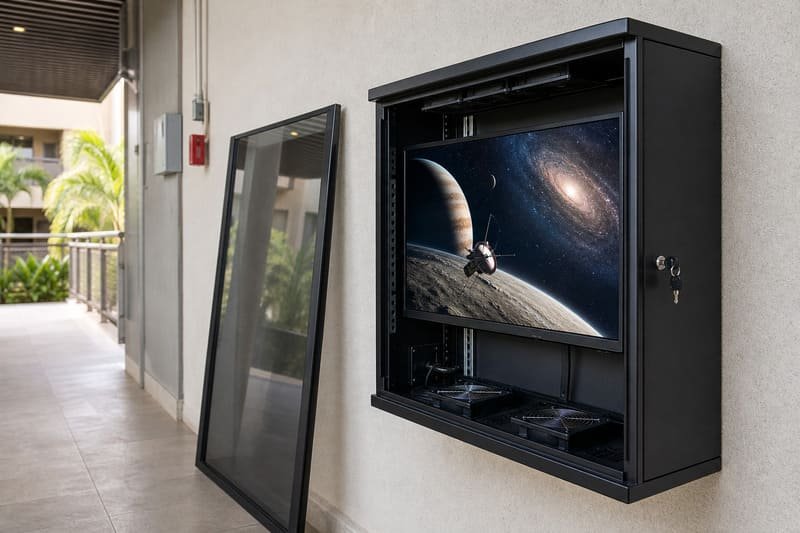
This is one of the most important points for humid tropical areas.
Buyers often ask for “fully sealed” protection. I understand why. Nobody wants rain inside the enclosure.
But if the enclosure becomes a sealed heat pocket, the TV may face a different risk. The TV produces heat during operation, the sun adds more heat, and humid air can remain around the electronics if airflow is poor.
The National Weather Service explains that dew point is the temperature air must be cooled to in order to reach 100% relative humidity; if air cools further, water vapor can come out as liquid water. National Weather Service dew point explanation
That matters for tropical nights. A screen may run warm during the day or evening, then cool down overnight while humidity remains high. If the enclosure, cables, and vents are poorly designed, moisture risk can increase even when no direct rain touches the TV.
Fan-assisted airflow can help reduce stagnant warm air and heat buildup. But fans do not turn the enclosure into an air-conditioned space. They also do not guarantee condensation prevention.
Sealing, cable exits, airflow, shade, drainage thinking, and inspection all need to work together.
Sealing, Airflow, and Service Balance
| Design Area | Why It Matters in Tropical Climates | What to Check |
|---|---|---|
| Gasket Sealing | Helps reduce rain, splash, dust, and insects | Even compression, lock pressure, gasket condition |
| Cable Exits | Often the weakest point in real installations | Cable glands, seals, drip loops, service access |
| Fan Airflow | Helps move warm air away from the TV | Intake/exhaust path, fan count, vent clearance |
| Internal Clearance | Allows air to move around the TV | TV depth, rear housing, power plug, media device space |
| Drainage Thinking | Reduces risk from trapped moisture or bad routing | Installation angle, cable direction, low points |
| Service Access | Staff must inspect fans, locks, cables, and gaskets | Door access, keys, fan cleaning, maintenance routine |
For tropical climates, I prefer to describe the enclosure as a protection-and-airflow system, not only a waterproof case.
That wording is more accurate.
Which Materials and Hardware Matter in Salt, UV, and Humidity?
Material choice matters in tropical climates, but the body material alone does not solve everything. The enclosure body, front panel, locks, hinges, screws, brackets, cable exits, and wall mounts all need to be considered as one system.
For tropical and coastal climates, a polycarbonate body can be useful because it does not rust like steel and can provide impact resistance and clear viewing. However, the full enclosure system is not automatically corrosion-proof. Locks, hinges, screws, anchors, cable exits, and mounting hardware still need corrosion-resistant design and regular inspection.
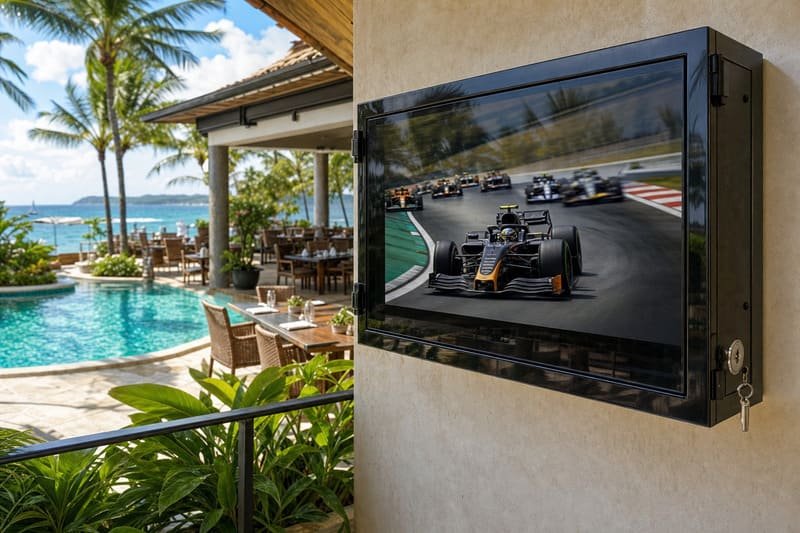
When buyers compare enclosure materials, they often ask a simple question:
“Is polycarbonate better than metal?”
My answer is more careful.
Polycarbonate can be a very strong option for tropical and coastal environments. Covestro describes Makrolon polycarbonate as robust, lightweight, glass-like in transparency, and impact resistant even at low temperatures. Covestro Makrolon polycarbonate
A polycarbonate body does not rust like steel, which removes one corrosion pathway. That is useful near beaches, pools, and coastal restaurants.
But I do not say the entire enclosure is “100% immune” to salt air.
The body may not rust like steel, but locks, hinges, screws, anchors, brackets, wall mounts, cable exits, and fan areas still need the right design and inspection.
FEMA coastal corrosion guidance notes that salt accumulation and high humidity can accelerate corrosion of untreated steel connectors and fasteners. FEMA coastal corrosion guidance
That is why hardware matters as much as the enclosure body.
Tropical Material and Hardware Checklist
| Part | What to Look For | Why It Matters |
|---|---|---|
| Body Material | Polycarbonate or other outdoor-suitable material | Reduces body-rust risk and supports impact protection |
| Front Panel | Clear, durable, UV-stable or tested UV-protective grade | Helps protect screen while preserving visibility |
| Locks and Hinges | Corrosion-resistant design | Salt air and humidity can attack small metal parts |
| Screws and Anchors | Suitable for coastal or humid installation | Weak hardware can fail before the body does |
| Cable Glands / Exits | Sealed and serviceable | Cable paths are common weak points |
| Fan Vents | Protected, cleanable, not easily blocked | Dust, insects, and salt residue may build up |
| Mounting Bracket | Strong enough and corrosion-aware | Tropical installations often face wind and storms |
The front panel also deserves careful wording. A UV-stable or tested UV-protective front panel may help reduce UV exposure, but actual performance depends on material grade, coating, thickness, and supplier test data.
So instead of asking only “what material is best,” I suggest asking:
Which parts of the enclosure system will still be serviceable after one tropical season?
That question is much more useful.
How Should Cooling Be Planned for Hot and Humid Sites?
Cooling in tropical climates is not only about fan count. It is about heat sources, shade, airflow path, internal clearance, operating hours, and whether fans can still work after months of dust, insects, and humidity.
Fan-assisted ventilation can help reduce heat buildup around the TV, but it is not air conditioning. In tropical climates, cooling should be planned together with shade, TV size, internal clearance, operating hours, fan access, and vent maintenance.
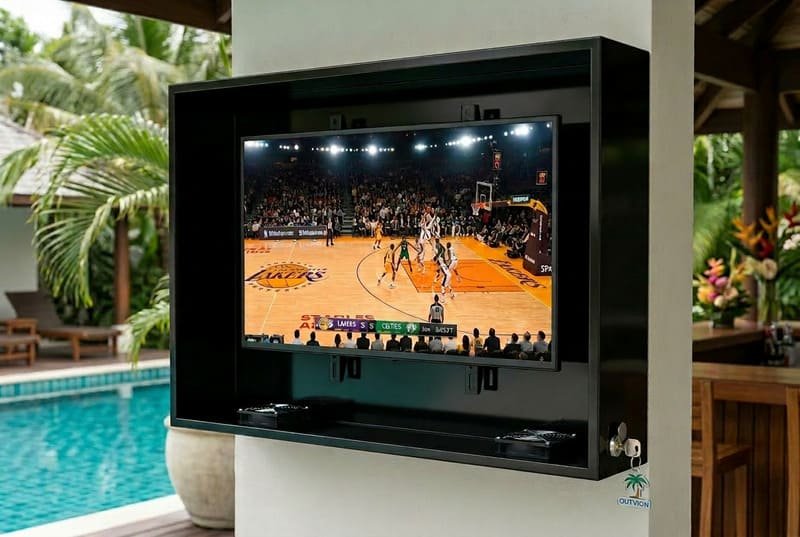
Heat is a serious issue in tropical climates, especially for pool bars, beach restaurants, resorts, and outdoor sports areas.
Sony advises using TVs within a temperature range of 0°C to 40°C / 32°F to 104°F and avoiding exposure to direct sunlight. Sony TV temperature guidance
That does not mean every tropical installation fails. It means the buyer should respect the TV’s operating guidance and reduce unnecessary heat load.
For hot and humid sites, I check:
- Is the screen shaded?
- Does the wall absorb afternoon sun?
- How many hours will the TV run?
- Is the enclosure large enough for airflow?
- Are fans blocked by walls, plants, dust, or insects?
- Can staff clean fan vents?
- Is there a media player or adapter adding heat inside?
I do not recommend choosing only by “dual fan” or “quad fan” labels. Fan count matters, but airflow path matters more.
A fan with blocked intake is not a cooling system.
A larger TV with tight clearance can still trap heat.
A shaded screen with clean airflow may perform better than a direct-sun screen with more fans.
Cooling Planning for Tropical Enclosures
| Cooling Factor | Why It Matters | Practical Check |
|---|---|---|
| Shade | Reduces solar heat before it reaches the enclosure | Roof, awning, pergola, wall recess |
| TV Size | Larger screens often need more airflow planning | Width, height, depth, power/heat profile |
| Internal Clearance | Allows air to move around the TV | Avoid tight fit around rear housing and plugs |
| Fan Layout | Moves warm air away from the TV | Intake/exhaust path, vent position |
| Operating Hours | Longer use increases heat load | Daily schedule, peak service hours |
| Accessories Inside | Media boxes and adapters add heat | Keep devices organized and ventilated |
| Vent Maintenance | Dust and insects reduce airflow | Cleaning access and inspection routine |
In tropical climates, cooling should be treated as a maintenance issue, not only a product feature.
Fans need access.
Vents need cleaning.
Cables need space.
The TV needs room to breathe.
What Should Buyers Check Before Ordering?
The buyers should not order tropical outdoor TV enclosures from photos alone. A correct decision needs site conditions, TV model details, climate exposure, operating hours, quantity, installation plan, and service expectations.
Before ordering outdoor TV enclosures for tropical climates, B2B buyers should confirm the TV model, internal enclosure dimensions, VESA pattern, cable direction, IP rating, fan system, material grade, hardware design, salt exposure, sun direction, service access, packaging, and spare parts. Tropical projects fail when buyers treat them like ordinary patio installations.
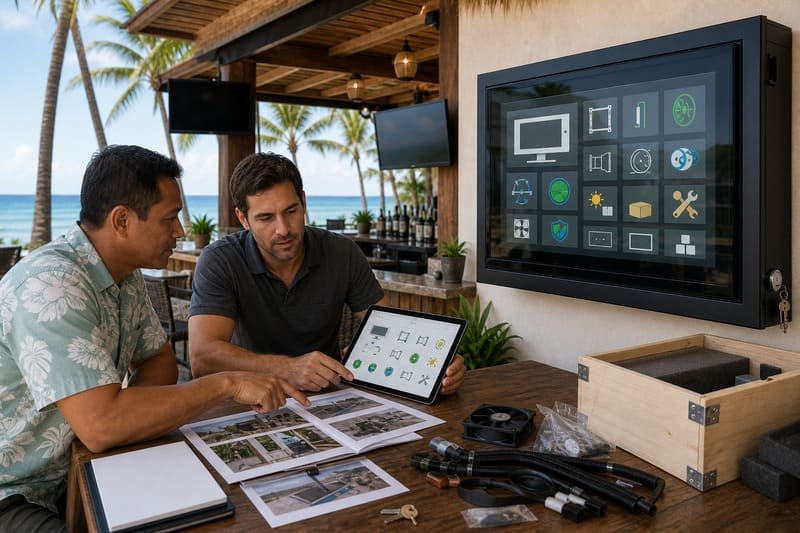
For tropical and coastal orders, I usually ask for site photos before I recommend a configuration.
Photos show things a spec sheet cannot show:
- Is the wall under shade?
- Is the site near water?
- Is the enclosure exposed to wind-driven rain?
- Are there plants, insects, dust, or pool splash nearby?
- Will staff be able to open and clean the enclosure?
- Is there enough space around vents?
- Where will the cables enter?
TV size also needs checking carefully. LG explains that TV size is measured diagonally, so buyers should still check the full width, height, and depth from the TV specifications. LG TV size guide
For tropical enclosures, this matters because tight TV fit can affect both cable routing and airflow.
Total cost also matters, but I would not make this article only about cost. CIPS defines Total Cost of Ownership as an end-to-end cost view that includes purchase price, acquisition cost, usage cost, and end-of-life cost. CIPS Total Cost of Ownership overview
In tropical climates, TCO is affected by replacement cycles, fan maintenance, hardware corrosion, service access, and whether one enclosure can support future compatible TV replacements.
Tropical Buyer Checklist
| Check | What to Confirm | Why It Matters |
|---|---|---|
| TV Model | Exact brand, model, width, height, depth | Confirms fit and airflow clearance |
| VESA Pattern | Mounting hole layout | Ensures secure internal mounting |
| Cable Direction | HDMI, power, network, media device position | Prevents cable stress and weak exits |
| Climate Type | Coastal, poolside, rainforest, urban rooftop, island hotel | Changes corrosion, heat, rain, and service priorities |
| IP Rating | IP65 or suitable level for the site | Supports dust and water-jet protection |
| Fan System | Fan count, airflow path, vent clearance, service access | Helps reduce heat buildup |
| Material Grade | Body and front-panel material | Affects impact, clarity, UV exposure, and appearance |
| Hardware Design | Locks, hinges, screws, anchors, brackets | Critical in salt and humidity |
| Service Access | Can staff clean, inspect, and replace parts? | Supports long-term operation |
| Spare Parts | Fans, keys, locks, seals, hardware | Reduces downtime in remote tropical sites |
| Packaging | Export-safe packing and front-panel protection | Prevents shipping damage before installation |
This checklist is more useful than asking only:
“Is it waterproof?”
For tropical projects, the better question is:
Can this enclosure be installed, cooled, inspected, serviced, and reused in this exact tropical site?
Frequently Asked Questions
Is IP65 enough for tropical outdoor TV protection?
IP65 can be a strong starting point because it indicates dust-tight protection and protection against water jets under defined test conditions. But tropical climates also involve humidity, condensation risk, salt air, UV, insects, heat, and long operating hours. IP65 alone is not the full answer.
Do outdoor TV enclosures prevent condensation?
No enclosure should be described as fully condensation-proof. Condensation depends on humidity, dew point, temperature changes, sealing, airflow, cable exits, and installation conditions. A well-designed enclosure can help manage exposure and airflow, but it does not remove all condensation risk.
Is polycarbonate better than metal in coastal tropical climates?
Polycarbonate can be useful because the body does not rust like steel and can provide impact resistance and clear viewing. But the full system still needs corrosion-aware locks, hinges, screws, anchors, cable exits, and mounts. Metal can work if material grade, coating, and hardware are suitable for the environment.
Do tropical outdoor TV enclosures need fans?
In many tropical and hot-humid installations, fan-assisted airflow is strongly recommended. Fans help move warm air away from the TV, but they are not air conditioning. Shade, internal clearance, operating hours, vent cleaning, and TV temperature guidance still matter.
Can I use a standard indoor TV in a tropical outdoor enclosure?
Yes, many buyers use a standard indoor TV inside a suitable enclosure. But the TV must fit correctly, have airflow space, and be protected from rain, dust, insects, heat, and public access. The enclosure does not change the TV manufacturer’s original outdoor-use rating or warranty terms.
What should resorts and beach bars check before ordering?
They should check salt exposure, sun direction, wall strength, TV model, enclosure internal dimensions, fan system, cable exits, hardware corrosion resistance, guest access, service access, and spare parts. For remote island sites, replacement parts and packaging also matter.
How often should tropical outdoor TV enclosures be inspected?
Inspection frequency depends on exposure. Coastal resorts, poolside bars, and high-humidity venues should inspect more often than covered home patios. Check fan vents, front panel, cable exits, locks, hinges, screws, gaskets, and whether insects or salt residue are collecting around openings.
Is a dedicated outdoor TV better than an indoor TV with enclosure in tropical climates?
It depends on the site. A dedicated outdoor TV may be better for full-sun flagship screens or high-brightness locations. An indoor TV with a suitable enclosure may be practical for shaded or semi-covered areas where replacement flexibility and physical protection matter. Some B2B projects use a mixed strategy.
Conclusion
Choosing an outdoor TV enclosure for tropical and coastal climates is not about one feature.
- It is not only IP rating.
- It is not only polycarbonate.
- It is not only fan count.
- It is not only UV protection.
- It is not only price.
A tropical environment is a combined exposure cycle:
- Humid nights.
- Hot afternoons.
- Sudden rain.
- Salt-laden air.
- Strong UV.
- Insects and dust.
- Long operating hours.
- Service and cleaning routines.
The way I explain it to buyers is simple:
In tropical climates, the best outdoor TV enclosure is not simply the tightest waterproof box. It is the enclosure that balances sealing, airflow, corrosion control, UV resistance, TV fit, and service access.
- If you choose by waterproof rating alone, you may miss the real tropical risks.
- If you choose by material alone, you may miss hardware and airflow issues.
- If you choose by fan count alone, you may miss shade, clearance, and maintenance.
A good tropical enclosure strategy should protect the TV, manage heat, reduce direct moisture exposure, resist body corrosion, allow inspection, and stay serviceable after the first season.
That is what gives the installation a better chance of working in real tropical weather.