
Most homeowners do not start with a product problem. They start with a backyard habit.
Will the TV come outside only for Saturday night?
Will it stay under a covered patio all summer?
Will it sit near a pool, coast, grill area, or open yard?
For homeowners, the right outdoor TV protection is not chosen by price or waterproof claims alone. It should be chosen by a simple risk ladder: how long the TV stays outside, how exposed the location is, how much heat and moisture it faces, and how much daily maintenance you are willing to manage.
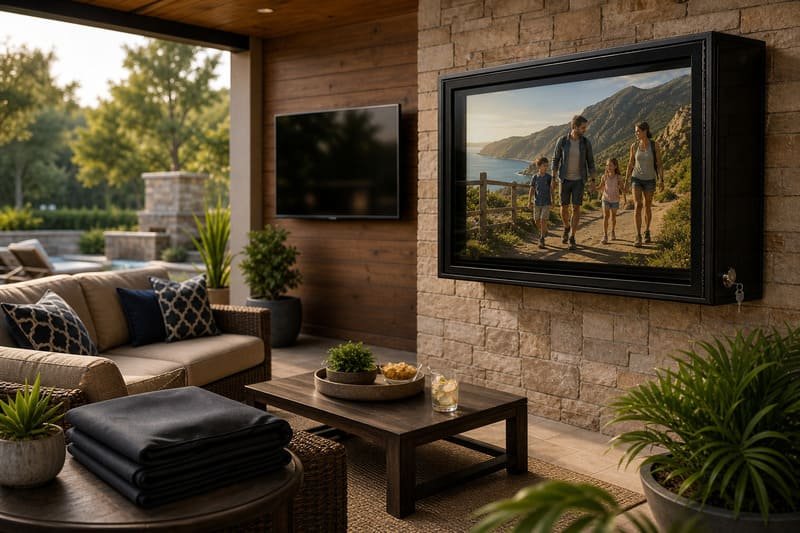
I do not start by asking whether a homeowner wants a cover, an enclosure, or an outdoor TV.
I first ask how the TV will live outside.
- A TV that comes out for one game and goes back indoors has one risk level.
- A TV mounted under a covered patio for the whole summer has another.
- A TV near a pool, coast, open yard, or hot wall has a different risk again.
That is why I do not like choosing outdoor TV protection by product name first. A soft cover, a hard enclosure, and a dedicated outdoor TV can all make sense in the right situation. They just do different jobs.
For homeowners, the better question is not only:
“What should I buy?”
The better question is:
“What kind of outdoor TV owner am I?”
Last Updated: May 27, 2026 | Estimated Reading Time: 8 minutes
By Smith Chen, Outdoor TV Enclosure Engineer at Outvion
What Kind of Outdoor TV Owner Are You?
A casual weekend setup and a year-round patio installation should not use the same protection logic. Time outside is the first filter.
If you move the TV indoors after use, indoor storage or a soft cover may be enough. If the TV stays outdoors for a season or year-round, you should look more seriously at a hard outdoor TV enclosure or a dedicated outdoor TV. The longer the TV stays outside, the less you should rely on temporary protection.
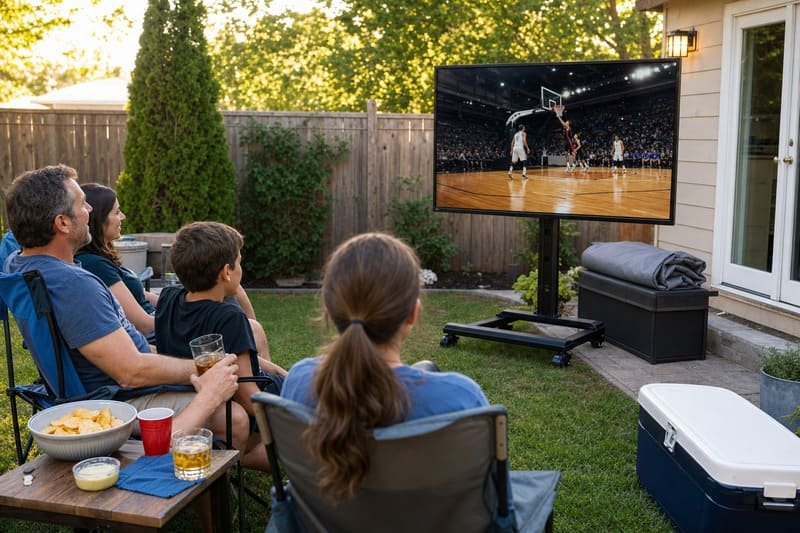
I usually separate homeowner projects into three groups.
The first group uses the TV occasionally. They bring it outside for a game, a movie night, or a party, then move it back indoors. For this group, careful storage and a basic cover may be enough because the TV is not living outside.
The second group mounts the TV on a patio for the season. This is where risk increases. Even under a roof, the TV may face humidity, dust, insects, heat, and sudden weather changes.
The third group wants the TV to stay outside long term. This is where I usually become much more careful about hard protection, airflow, cable routing, safe power, and service access.
Homeowner Risk Ladder
| Risk Level | Homeowner Situation | Better Starting Point |
|---|---|---|
| Low Risk | TV comes outside only for events and returns indoors | Indoor storage or soft cover |
| Light Seasonal Risk | TV stays under a covered patio for weekends or summer use | Better cover, hard enclosure, or outdoor TV depending on exposure |
| Medium Risk | TV stays mounted outdoors for the season | Hard enclosure or dedicated outdoor TV |
| High Risk | TV stays outside year-round in open or semi-open space | Hard enclosure or dedicated outdoor TV |
| Special Risk | Poolside, coastal, hot region, dusty area, or shared outdoor space | Corrosion-aware enclosure or dedicated outdoor TV |
This is why I do not see one “best” answer for every homeowner.
If you watch one game a month, you may not need the same setup as a family that uses the patio every night. If your TV is near the coast, pool, or direct afternoon sun, you need to think beyond a simple cover.
How Exposed Is Your Backyard TV Location?
A covered patio, open yard, pool wall, and coastal deck do not create the same risk. Location matters before product choice.
You should match TV protection to the exact outdoor environment. Covered patios still need moisture and heat planning. Open yards need stronger weather protection. Poolside and coastal areas need corrosion awareness. Hot regions need shade and airflow. The right product depends on the risk path around the TV.
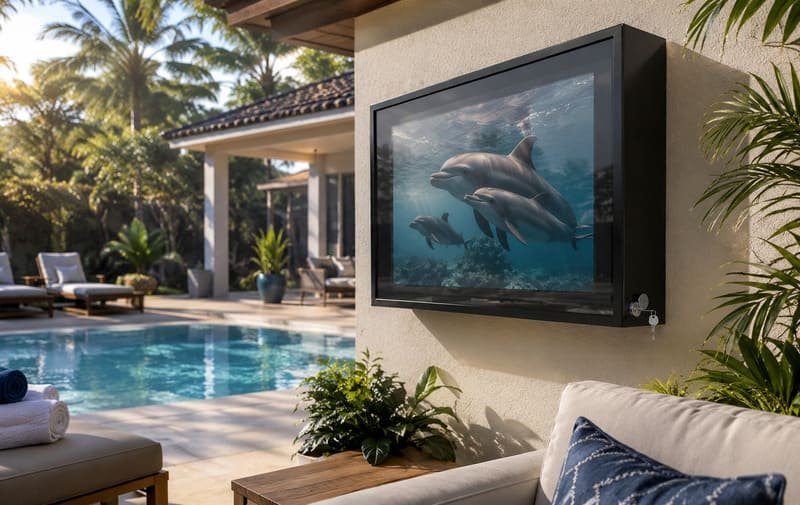
When a homeowner tells me the TV size first, I usually ask about location next.
A 55-inch TV on a shaded porch has a different risk profile from a 55-inch TV near a pool wall. The size matters, but the weather path matters more.
A covered patio helps, but it does not make the space indoor. Humid air can still collect around electronics, especially when temperatures drop at night. The National Weather Service explains that dew point is the temperature air must be cooled to in order to reach 100% relative humidity; if air cools further, water vapor may come out in liquid form. National Weather Service dew point explanation
An open backyard adds wind-driven rain, dust, pollen, insects, and sun. A poolside area adds splash, humidity, nearby cleaning routines, and corrosion-prone hardware concerns. A coastal home adds salt air, which can accelerate corrosion of exposed metal parts.
FEMA guidance on coastal construction notes that salt accumulation and high humidity can accelerate corrosion of untreated steel connectors and fasteners. FEMA coastal corrosion guidance
Location Risk Map
| Location | Common Risks | What I Check First |
|---|---|---|
| Covered Patio | Humidity, heat pocket, dust, insects | Ventilation, wall clearance, dew exposure |
| Open Backyard | Rain, wind, dust, sun, pollen | Weather sealing, shade, viewing angle |
| Poolside Area | Splash, humidity, impact, corrosion-prone hardware | Safe placement, material, cable route |
| Coastal Home | Salt air, humidity, corrosion | Body material, screws, hinges, locks, mounting hardware |
| Hot Region | Heat buildup, sun exposure, screen stress | Shade, fan airflow, internal clearance |
| Cold Region | Snow, freeze-thaw moisture, ice | Sealing, drainage thinking, TV storage/operating limits |
| Shared Patio / Rental Property | Guest access, tampering, accidental impact | Lockable access, hard front protection |
I do not reduce this to “higher protection number means better.”
A sealed box without airflow may create a heat problem. A light fabric cover in a salty coastal area may not be enough for long-term use. A dedicated outdoor TV may be overkill for a TV that only comes outside a few times per year.
The right protection starts with the local risk.
Is Waterproofing Enough, or Do You Also Need Heat and Service Access?
Waterproofing matters, but it is only one part of an outdoor TV setup. A TV can still have problems if heat, cables, fit, mounting, and access are ignored.
Waterproofing alone is not enough. A reliable outdoor TV setup should also consider airflow, heat buildup, cable routing, VESA fit, door clearance, impact risk, outdoor power safety, and room for future maintenance. Outdoor TV protection is a system, not just a cover or box.
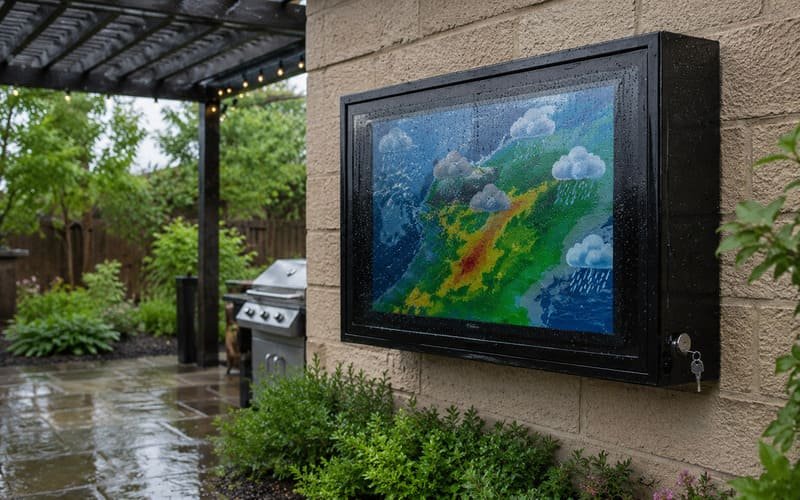
I like to think of outdoor TV protection as a system.
The system includes:
- the TV
- the mount
- the wall
- the cables
- the enclosure or cover
- the power route
- the weather around the installation
- the person who has to open and maintain it later
If one part is wrong, the whole setup becomes harder to live with.
IP ratings are useful, but they should not be misunderstood. The International Electrotechnical Commission explains that IP ratings grade the resistance of enclosures against intrusion by dust or liquids. IEC IP Ratings
For outdoor TV enclosures, IP65 can be a useful protection level because it indicates dust-tight protection and protection against water jets under defined test conditions. But IP65 does not mean vapor-proof, condensation-proof, salt-proof, heat-proof, flood-proof, or maintenance-free.
Heat is another common missed issue. A TV produces heat when it runs, and sunlight adds more heat. Sony advises using TVs within a temperature range of 0°C to 40°C / 32°F to 104°F and avoiding exposure to direct sunlight. Sony TV temperature guidance
Fans can help move warm air, but they are not air conditioning. Shade, vent clearance, internal space, and the TV manufacturer’s temperature guidance still matter.
Protection Is More Than Waterproofing
| Factor | Why It Matters | Practical Check |
|---|---|---|
| Airflow | Heat can build up during use | Check fan paths and open air around the unit |
| Cable Routing | Gaps can let moisture, dust, or pests in | Check port direction before buying |
| VESA Fit | Mount holes must line up safely | Compare TV specs with enclosure/mount specs |
| Door Clearance | You need room to install and service | Measure the opening and swing area |
| Screen Visibility | Glare can ruin the viewing experience | Check sun direction at viewing time |
| Impact Risk | Kids, guests, pets, and windblown objects matter | Consider a hard front panel in busy areas |
| Outdoor Power | Water and electricity require careful planning | Use proper outdoor-rated power and qualified help |
| Service Access | You may need to clean, reset, or replace the TV | Leave room to open and work safely |
The best protection is not the one that looks good only from the front.
It is the one you can install, open, clean, ventilate, service, and use safely.
Should You Buy a Soft Cover, Hard Enclosure, or Dedicated Outdoor TV?
Each option has a place. The right choice depends on exposure, budget, viewing habits, maintenance tolerance, and how long the TV will stay outside.
A soft cover is best for light and temporary use. A hard enclosure is usually stronger for long-term protection of a standard TV. A dedicated outdoor TV fits homeowners who want one integrated outdoor-rated product and fewer compatibility checks. None of the three is always the best answer.
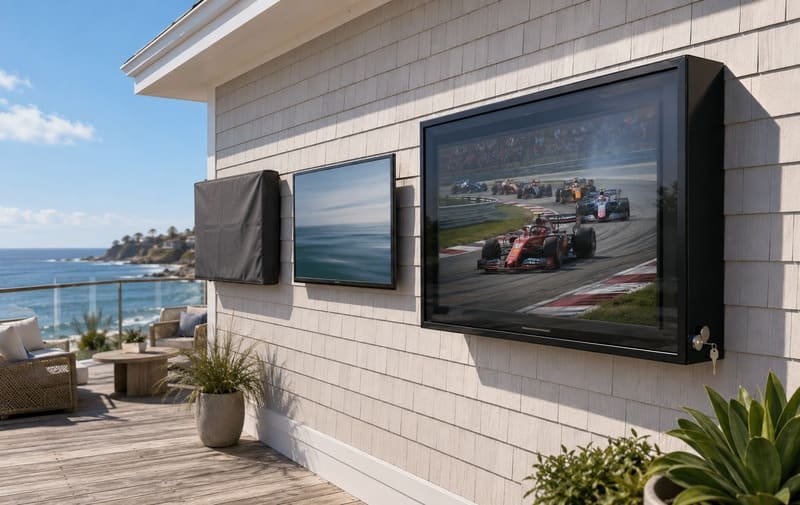
I do not think this choice should become a brand argument. I see it as a fit question.
A soft cover can be useful when the TV is under a roof, used only in fair weather, and not left outside during storms. It is simple and low cost. Its limit is also clear: it does not protect the TV while you are watching.
A hard enclosure works when you want to use a standard indoor TV outside for a longer period. It can help reduce rain, dust, impact, and casual access risks. It can also make future TV upgrades easier because the protective shell stays in place. The tradeoff is that you must measure carefully.
A dedicated outdoor TV can be a clean choice. It is built as one outdoor product. It can reduce compatibility questions. It may cost more, and replacement choices may be narrower.
Protection Options by Maintenance Style
| Your Maintenance Style | Better Fit | Why |
|---|---|---|
| I move the TV after use | Indoor storage or soft cover | The TV is not exposed full time |
| I can remove and reinstall a cover carefully | Soft cover for low-risk use | Works best when used correctly and kept dry |
| I want the TV mounted all season | Hard enclosure or outdoor TV | Reduces daily setup steps |
| I want future TV replacement flexibility | Hard enclosure + standard TV | Protection shell can stay in place |
| I want the simplest integrated product | Dedicated outdoor TV | Fewer fit and enclosure checks |
| I have poolside/coastal/high-heat exposure | Hard enclosure or outdoor TV | Needs stronger risk control |
Cover vs. Enclosure vs. Outdoor TV
| Option | Best Fit | Main Limits |
|---|---|---|
| Soft Temporary Cover | Occasional use under shelter | No protection during viewing |
| Hard Weatherproof Enclosure | Long-term outdoor use with standard TV | Needs careful sizing and installation |
| Dedicated Outdoor TV | Simple all-in-one outdoor setup | Higher product cost in many cases |
| Indoor TV With No Protection | Short indoor-only use | Not suited for outdoor exposure |
For many homeowners, the decision becomes clear after three questions:
- How often will the TV run?
- How exposed is the location?
- How much daily maintenance do you want?
If the TV matters for daily family use or regular weekend gatherings, I usually lean toward a more complete setup.
What Should You Measure Before You Buy?
A good product can still become a bad fit if you measure only the screen size. You need to check the whole TV body and the installation space.
Before buying protection, measure the TV width, height, depth, VESA pattern, cable port location, mount position, wall clearance, viewing angle, power route, and service space. A “55-inch TV” label is not enough information for choosing an enclosure or planning an outdoor setup.
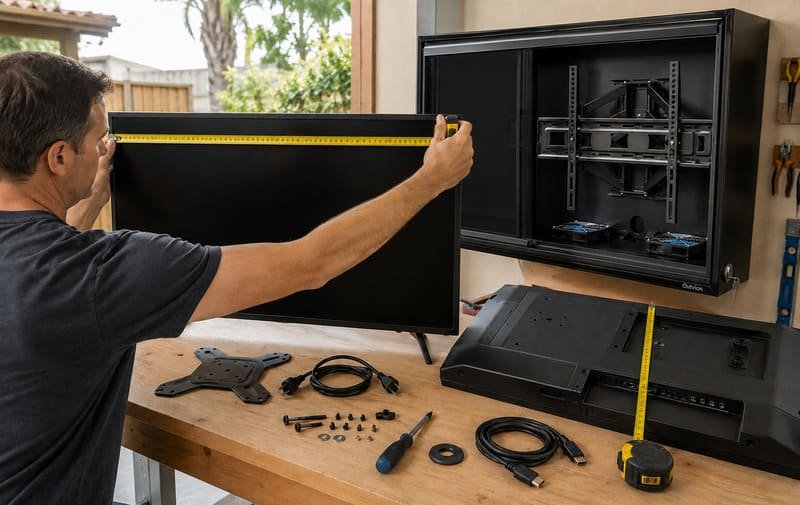
I have learned that “55-inch TV” is not enough information.
That number describes the diagonal screen size. It does not describe the full body shape.
LG explains that TV size is measured diagonally from corner to corner and that the screen size does not include the borders or bezels, so buyers should also check the total width, height, and depth of a particular model. LG TV size guide
This matters inside an enclosure because some TVs have thicker lower sections, rear ports that point straight back, side ports that need cable bend space, or speaker areas that change the body depth.
Viewing distance also matters. RTINGS recommends planning TV size and viewing distance together and uses about a 30-degree field of view for mixed usage. RTINGS TV size and viewing distance guide
The 5 Questions Before You Buy
| Question | Why It Matters |
|---|---|
| Will the TV stay outside overnight? | Longer exposure usually needs stronger protection |
| Is the wall shaded or exposed to afternoon sun? | Sun affects heat and glare |
| Is the site covered, open, poolside, or coastal? | Each location creates different risks |
| Can you safely power and service the TV? | Outdoor power and access need planning |
| Are you willing to remove, cover, clean, and inspect it regularly? | Maintenance tolerance changes the best product choice |
What to Measure
| Measurement | Why You Need It |
|---|---|
| TV Width and Height | The TV must fit inside the protection area |
| TV Depth | Rear bulges and ports may need extra room |
| VESA Pattern | The mount must line up correctly |
| Cable Direction | Cables should not press against the case |
| Door Swing Space | You need room for service and cleaning |
| Shade and Sun Path | Glare and heat change through the day |
| Outlet Location | Outdoor power should be planned safely |
| Seating Distance | Screen size should match viewing comfort |
I also think about future replacement.
If the TV fails or you upgrade later, you want access that does not require taking apart the whole patio wall. A little planning now can save a lot of frustration later.
What Safety and Installation Mistakes Should Homeowners Avoid?
Most mistakes are not dramatic. They are small choices that slowly create heat, moisture, glare, power risk, or service problems.
The biggest mistakes are choosing by screen size only, ignoring heat, blocking airflow, using weak cable openings, relying on indoor extension cords, forgetting service access, and assuming a covered patio means the TV is fully protected. Outdoor TV protection should be planned before the TV is mounted.
I see the same pattern often.
A homeowner buys a TV, mounts it outside, then looks for protection after the first storm, heat issue, or cable problem.
I think the order should be reversed.
- Choose the location.
- Judge the weather.
- Plan the protection.
- Plan power and mounting.
- Then choose the TV that fits that plan.
One common mistake is placing the TV in direct afternoon sun. This can create glare and raise heat load. Another mistake is sealing a TV too tightly without airflow. A third mistake is leaving cable gaps open. Small openings can let in moisture, insects, and dust.
Power deserves special attention. The Electrical Safety Foundation International recommends GFCI protection for outdoor outlets and weatherproof electrical boxes or covers on outdoor outlets; it also says extension cords should be temporary and that indoor extension cords should not be used outdoors. ESFI outdoor electrical safety
For permanent outdoor TV setups, I would not rely on indoor extension cords as the long-term power plan. Outdoor-rated power, GFCI protection, weatherproof covers, and qualified electrical work matter.
Common Mistakes and Better Habits
| Mistake | Better Habit |
|---|---|
| Buying by TV size only | Compare full TV dimensions and ports |
| Focusing only on rain | Also check heat, dust, humidity, insects, and sun |
| Blocking vents or fans | Leave space for airflow |
| Ignoring cable openings | Plan sealed and tidy routing |
| Mounting too tight to a wall | Leave room for service |
| Choosing the sunniest wall | Check glare and heat first |
| Using indoor extension cords outside | Plan outdoor-rated power with qualified help |
| Skipping professional help | Ask for help with mounting and power |
Outdoor setups reward simple planning. They punish assumptions.
You do not need a complicated project plan. You need a careful checklist.
Where Does a Product Like an Outvion Enclosure Fit?
A hard enclosure is not the only answer, but it can be the right answer when you want long-term protection for a standard indoor TV.
A product like an Outvion outdoor TV enclosure fits homeowners who want to use a standard TV outdoors while adding weather protection, impact resistance, fan-assisted ventilation, lockable access, and a more secure physical barrier. It is most useful when the TV will stay mounted outside for a season or longer.
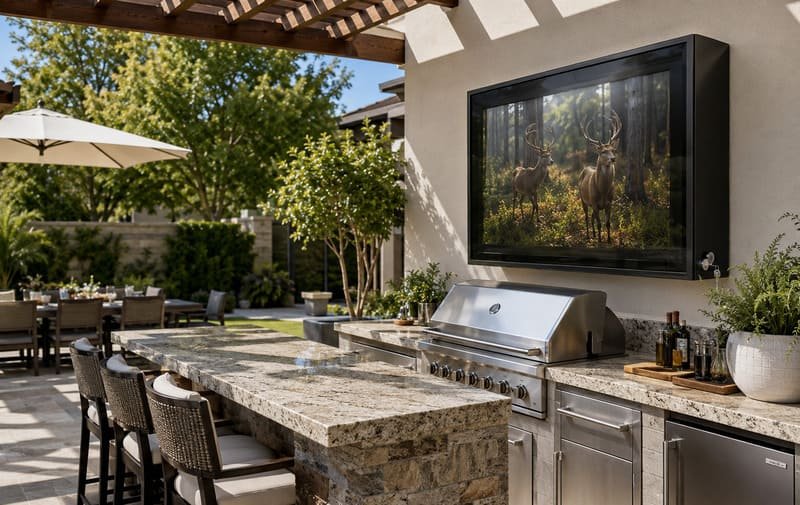
I mention Outvion here as a product category example, not as the only route.
A hard outdoor TV enclosure makes sense when the TV will stay mounted outside for a season or longer, and when the site has rain, dust, humidity, public access, or heat concerns. It can help create a protective shell around a standard TV. It can also help reduce the need to buy a dedicated outdoor TV in some projects.
For homeowners, I would still start with the same checks:
- TV size.
- Body depth.
- VESA pattern.
- Cable direction.
- Viewing location.
- Heat exposure.
- Coastal or poolside risk.
- Service access.
Material matters too. Covestro describes Makrolon polycarbonate as robust, lightweight, glass-like in transparency, and impact resistant even at low temperatures. Covestro Makrolon polycarbonate
A polycarbonate body does not rust like steel, which can be useful near pools and coastal patios. But the full system is not automatically corrosion-proof. Locks, hinges, screws, anchors, cable exits, and wall mounts still need corrosion-resistant design and inspection.
Features to Look For
| Feature to Look For | Why It Can Help |
|---|---|
| Weather-Sealed Body | Helps reduce rain and dust entry |
| Impact-Resistant Front | Helps protect the screen area |
| Ventilation or Fans | Helps manage internal heat |
| VESA Compatibility | Helps with cleaner mounting |
| Lockable Access | Helps in shared outdoor areas |
| Slim Profile | Helps the setup look less bulky |
| Service Access | Helps with cleaning and TV replacement |
| Cable Exit Protection | Reduces weak points around wiring |
I would not say an enclosure makes every indoor TV ready for every extreme condition.
I would say a proper enclosure can be a practical middle path when the environment, size, and installation plan all make sense.
Frequently Asked Questions
Can I put a normal indoor TV outside?
You can place a normal indoor TV outside for short supervised use, but you should not treat it as outdoor-rated equipment. If it stays outside, it needs a suitable protection plan. A soft cover may help for temporary covered use. A hard enclosure may be better for longer outdoor use. A dedicated outdoor TV may be better when you want an integrated outdoor-rated product.
Is a covered patio safe enough for a TV?
A covered patio helps a lot, but it does not remove all risk. Humidity, wind-driven rain, dust, insects, and heat can still reach the TV. A roof blocks direct rain, but it does not control dew point, trapped heat, cable openings, or airflow.
Is a soft TV cover enough?
A soft cover can be enough for low-risk, occasional use when the TV is under shelter and not used during bad weather. It is less suitable for long-term outdoor mounting because it does not protect the TV while you are watching, and it depends on careful daily use.
When do I need a hard outdoor TV enclosure?
You should consider a hard enclosure when the TV will stay outside for a season or longer, when the location has rain, dust, humidity, insects, poolside exposure, coastal air, public access, or impact risk, and when you want to use a standard indoor TV with stronger physical protection.
When is a dedicated outdoor TV better?
A dedicated outdoor TV may be better when you want a simple all-in-one product, full-sun brightness, fewer compatibility checks, or a cleaner integrated installation. It may also be better when the location is very exposed and the budget supports a purpose-built outdoor-rated display.
Do I need fans in an outdoor TV enclosure?
Fans are often helpful in warm regions or tight installations because they move air and help reduce heat buildup. Do not judge only by the presence of fans. Check airflow path, vent location, shade level, internal clearance, expected outdoor temperature, and whether vents can be cleaned later.
What should I measure before buying protection?
Measure TV width, height, depth, VESA pattern, port location, cable direction, mount position, door clearance, wall space, sun direction, seating distance, and outlet location. For an enclosure, the diagonal TV size alone is not enough.
How should I handle outdoor power safely?
Use outdoor-rated power planning, GFCI protection, weatherproof outlet covers, and qualified electrical help when needed. Do not rely on indoor extension cords as a permanent outdoor TV power solution.
Can I leave the TV outside all winter?
It depends on the TV, protection type, local weather, and installation. Snow, ice, moisture, and freeze-thaw cycles can be hard on outdoor electronics and hardware. A hard enclosure or dedicated outdoor TV may help reduce exposure, but you should still check the TV manufacturer’s operating and storage guidance.
What is the most budget-friendly choice?
The lowest upfront price is often indoor storage or a soft cover. It is not always the best long-term value. If you leave the TV outside often, a hard enclosure or outdoor TV may reduce risk and replacement hassle. Compare the full setup, not only the first purchase.
Conclusion
The best outdoor TV protection is not always the most expensive product.
It is the product that matches how your TV actually lives outside.
- A TV that comes out for one Saturday game has one risk level.
- A TV that stays under a patio roof all summer has another.
- A TV near a pool, coast, open yard, or hot wall has a different risk again.
Before you buy, answer three questions:
How long will the TV stay outside?
How exposed is the location?
How much daily maintenance are you willing to do?
Once those answers are clear, the choice becomes simpler.
- A soft cover is a light-use tool.
- A hard enclosure is a longer-term protection shell.
- A dedicated outdoor TV is an integrated outdoor product.
The right answer is not the one with the best product name.
It is the one that fits your backyard risk level, installation plan, power safety, maintenance habits, and viewing style.