
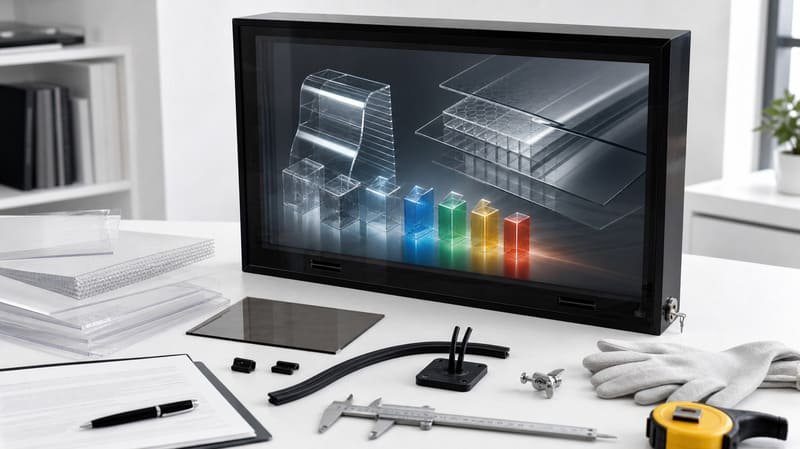
Polycarbonate is not the waterproofing.
That is the first thing I want buyers to understand.
A weatherproof outdoor TV enclosure becomes protective because of its structure: sealing, gaskets, cable exits, airflow, hardware, assembly quality, and installation. Polycarbonate does not replace those details. But it can make the whole enclosure system more practical because it brings a useful balance of impact resistance, optical clarity, lighter weight, and body-level corrosion resistance.
Polycarbonate works well for outdoor TV enclosures because it supports a practical balance of impact resistance, optical clarity, lighter weight, and body-level corrosion resistance. But real outdoor performance still depends on IP-rated sealing, airflow, hardware, cable exits, UV grade, and installation quality.
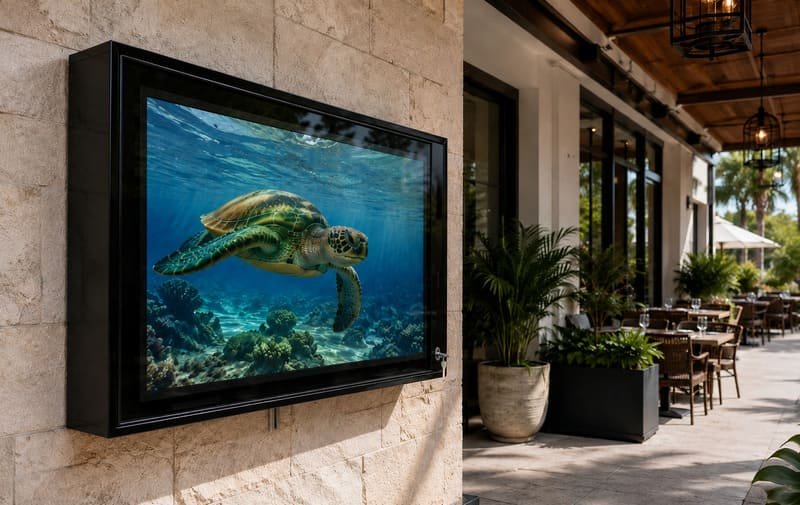
When I review an outdoor TV enclosure project, I do not ask only whether the enclosure is waterproof.
I ask what role the material has to play.
Does the body need to stay light enough for wall mounting?
Does the front panel need to protect the screen while staying clear?
Will the enclosure sit near salt air, pool humidity, dust, heat, or public contact?
Will staff need to open and close the door for maintenance?
Will the housing keep its shape well enough for gaskets to stay useful?
Those questions lead to a better discussion than simply saying “plastic” or “metal.”
For outdoor TV enclosures, polycarbonate is not chosen because it solves every outdoor problem. It is chosen because it solves several material problems at the same time.
Last Updated: June 11, 2026 | Estimated Reading Time: 9 minutes
By Smith Chen, Outdoor TV Enclosure Engineer at Outvion
Why Is Polycarbonate a Material Choice, Not the Waterproofing Itself?
A weatherproof TV enclosure is a system. Polycarbonate is one important part of that system, but it is not the seal, the gasket, the cable exit, the fan path, or the installation method.
Polycarbonate supports the enclosure structure, but waterproofing comes from design and assembly. The enclosure still needs an IP-rated sealing system, controlled gasket compression, protected cable exits, proper door closure, and inspection after installation.
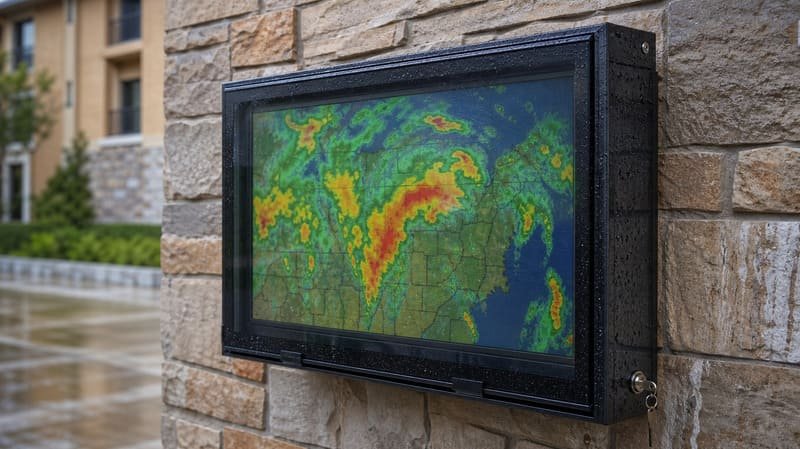
I use the word “weatherproof” carefully.
Many buyers search for “waterproof outdoor TV enclosure,” so the phrase is common. But technically, I prefer to talk about an IP-rated outdoor TV enclosure.
The International Electrotechnical Commission explains that IP ratings grade the resistance of electrical and electronic enclosures against intrusion by dust and liquids. IEC IP Ratings
That makes IP rating useful, because it gives buyers a more specific standard than a vague word like “waterproof.”
But IP rating has boundaries.
IP65 can indicate dust-tight protection and protection against water jets under defined test conditions. It does not mean vapor-proof, condensation-proof, salt-proof, flood-proof, pressure-wash-proof, heat-proof, impact-proof, or maintenance-free.
Polycarbonate helps the enclosure body and front panel perform their roles. It does not replace the engineering around the material.
Polycarbonate Is Not the Whole System
| What Polycarbonate Helps With | What Still Depends on Design |
|---|---|
| Body-Level Corrosion Resistance | Screws, locks, hinges, brackets, anchors, and mounts still need corrosion review |
| Impact Resistance | Thickness, frame support, impact direction, and installation still matter |
| Optical Clarity | Surface finish, coating, cleaning routine, and front-panel design still matter |
| Weight Reduction | Wall strength, bracket design, and mounting method still need review |
| Outdoor Durability | UV grade, forming quality, coating, and maintenance still matter |
| Sealing Support | Gaskets, cable exits, door pressure, and assembly quality still decide water resistance |
| Service Handling | Door design, lock position, hinge design, and staff access still matter |
This is why I do not describe polycarbonate as a magic material.
It is a strong material choice, but only when the enclosure around it is designed correctly.
Which Polycarbonate Properties Matter Most Outdoors?
Not every outdoor TV enclosure needs the same material performance. But in most commercial outdoor projects, five properties matter again and again: impact behavior, clarity, weight, body-level corrosion resistance, and dimensional stability.
Polycarbonate is useful for outdoor TV enclosures because it can combine transparent viewing, impact resistance, lighter weight, and stable housing performance better than many common alternatives. For B2B buyers, the real question is not “Is it polycarbonate?” but “What grade, thickness, UV treatment, forming process, and QC standard are being used?”
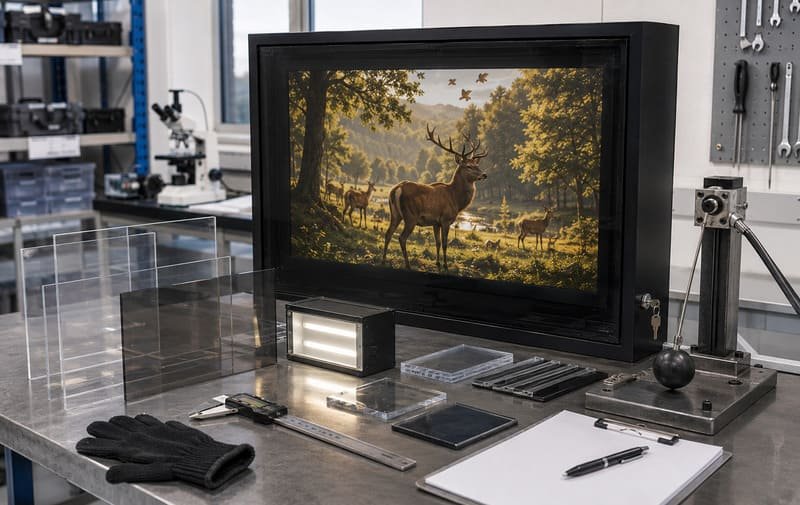
Covestro describes Makrolon polycarbonate as robust, lightweight, glass-like in transparency, and impact resistant even at low temperatures. Covestro Makrolon polycarbonate
Those properties are very relevant to outdoor TV enclosure design.
The front panel needs to stay clear enough for viewing.
The body needs to be light enough for practical mounting.
The housing needs to resist everyday contact and impact better than brittle plastics.
The material should not rust like steel.
The formed panels should support gaskets and door closure without deforming too easily.
This balance is why polycarbonate can be useful for outdoor enclosures.
But buyers should not stop at the material name. “Polycarbonate” is a category, not a guarantee. The actual performance depends on grade, thickness, UV stabilization, coating, forming stress, optical finish, and quality control.
Material Role Map
| Material Role | Why It Matters | What Polycarbonate Helps With |
|---|---|---|
| Housing Body | Holds the enclosure shape and affects installation weight | Lighter than metal and does not rust like steel |
| Front Viewing Panel | Protects the screen while allowing viewing | Transparency and impact resistance |
| Gasket Contact Surface | Supports sealing consistency around doors and joints | Dimensional stability can help maintain contact pressure |
| Service Door / Access Panel | Opened during cleaning, reset, or TV replacement | Lower weight can make service handling easier |
| Public-Facing Shield | Reduces direct screen contact in busy areas | Impact resistance and safer break behavior than glass |
| Coastal / Poolside Body | Faces humidity, splash, and salt exposure | Body avoids the steel-rust pathway, while hardware still needs inspection |
| Large Enclosure Shell | Affects wall load and shipping practicality | Lower weight can reduce handling and mounting complexity |
From a manufacturing view, I care about how the material behaves after forming and assembly.
A front panel that is clear but easily scratched may create viewing complaints.
A body that is strong but too heavy may create installation problems.
A sheet that forms poorly may create stress marks or weak gasket contact.
A low-grade sheet may look acceptable at shipment but age faster outdoors.
That is why the supplier’s material selection and processing experience matter.
How Does Polycarbonate Compare With Metal, Glass, and Acrylic?
Each material has a place. Metal can feel strong, glass can look optically clean, and acrylic can be clear and cost-effective. But outdoor TV enclosures need a balance of properties, not just one strong point.
Polycarbonate is often a practical enclosure material because it balances impact resistance, transparency, weight, and body-level corrosion resistance. Metal, glass, and acrylic can work in some applications, but each brings trade-offs in rust, weight, shattering, brittleness, or service handling.
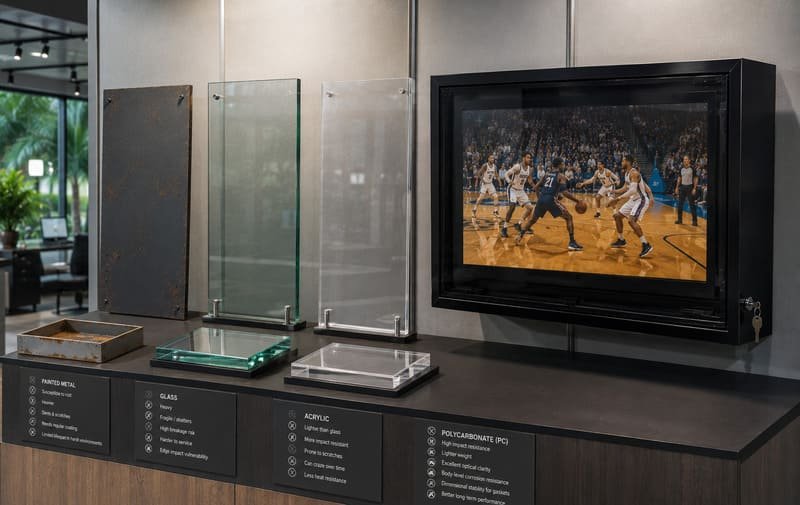
Metal is often the first material buyers trust because it feels strong. Steel can provide a rigid structure, and aluminum can be lighter than steel. But outdoor environments introduce corrosion questions, especially around scratches, edges, screws, hinges, cable exits, and mounting points.
A polycarbonate body does not rust like steel, which removes one corrosion pathway at the enclosure body level. That does not make the whole enclosure corrosion-proof. Locks, hinges, screws, anchors, brackets, cable exits, and wall mounts still need corrosion-resistant design and regular inspection.
FEMA guidance on coastal construction notes that salt accumulation and high humidity common in coastal areas can accelerate corrosion of untreated steel connectors and fasteners. FEMA coastal corrosion guidance
Glass has excellent optical clarity, but it can shatter under impact. That is a concern for public spaces, bars, hotels, schools, and restaurants where staff or guests may be nearby.
Acrylic can be clear and lighter than glass, but it is usually more brittle than polycarbonate. For protective front panels in high-traffic spaces, that difference matters.
Material Comparison for Outdoor TV Enclosures
| Material | What It Can Do Well | What Buyers Should Check |
|---|---|---|
| Painted Steel | Strong structure and rigid frame | Coating damage, edge corrosion, weight, rust around fasteners |
| Aluminum | Lighter than steel and often better corrosion behavior | Grade, coating, galvanic corrosion, hardware compatibility |
| Glass | Excellent optical clarity and scratch resistance | Shattering risk, weight, safety in public areas |
| Acrylic | Clear, light, and cost-effective in some uses | Brittleness, impact behavior, UV grade, scratching |
| Polycarbonate | Impact resistance, transparency, lighter weight, no steel-like body rust | UV grade, coating, thickness, optical clarity, scratch resistance, hardware design |
For many outdoor TV enclosure projects, polycarbonate sits in a useful middle position.
It is not as scratch-resistant as glass.
It is not as rigid as thick metal.
It still needs UV-stable grade selection and careful forming.
But it can provide a practical combination of impact resistance, viewing clarity, lower weight, and body-level corrosion resistance. That combination is hard to get from a single alternative material.
What Can Polycarbonate Not Solve by Itself?
Polycarbonate is useful, but it cannot carry the whole outdoor performance promise alone. A weak enclosure design can waste a good material.
Polycarbonate cannot make an enclosure waterproof by itself. It cannot replace gaskets, proper cable exits, fan-assisted airflow, corrosion-aware hardware, UV-grade selection, surface coating, mounting review, or maintenance. If those details are weak, the material alone will not save the installation.
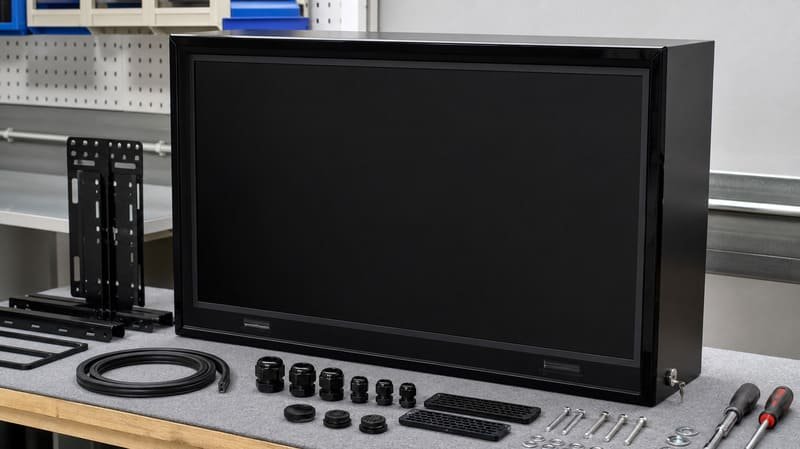
This is where I see some buyers make a mistake.
They ask whether the enclosure is made from polycarbonate, then assume the answer is enough.
It is not.
A polycarbonate enclosure with poor cable exits can still allow water problems.
A polycarbonate front panel with poor coating can still scratch or haze.
A polycarbonate body with weak hinges can still become a service problem.
A polycarbonate enclosure with blocked airflow can still trap heat.
A polycarbonate door with poor gasket pressure can still lose sealing performance.
Heat needs special attention. A fan-assisted airflow system can help reduce heat buildup around the TV, but it is not air conditioning. It should not be described as stabilizing the internal climate under every outdoor condition.
Sony advises using TVs within a temperature range of 0°C to 40°C / 32°F to 104°F and avoiding direct sunlight. Sony TV temperature guidance
That is why I review heat as a system issue:
Where is the sun?
How long will the TV run?
How much internal clearance is available?
Can air enter and exit properly?
Can staff clean the vents later?
Is the wall itself holding heat?
Polycarbonate helps with the enclosure body, but airflow design still decides whether the heat path makes sense.
What PC Helps With vs. What Design Must Still Solve
| PC Helps With | Design Must Still Solve |
|---|---|
| Body does not rust like steel | Locks, hinges, screws, brackets, and mounts still need corrosion review |
| Impact-resistant front protection | Thickness, frame support, impact angle, and mounting still matter |
| Clear viewing surface | Optical grade, coating, cleaning routine, glare, and reflection still matter |
| Lower enclosure weight | Wall loading, bracket selection, and installation safety still matter |
| Useful housing stability | Gasket pressure, door alignment, and forming quality still matter |
| Outdoor material potential | UV stabilization, coating, and supplier test data still matter |
| Service-friendly shell | Door design, key access, cable labels, and spare parts still matter |
This is the point that makes a material guide different from a sales pitch.
A good material supports a good system.
It does not replace the system.
What Should Buyers Ask Before Choosing a Polycarbonate TV Enclosure?
For B2B buyers, the most important step is not only choosing a material. It is confirming how that material is specified, formed, assembled, and supported after shipment.
Before choosing a polycarbonate TV enclosure, buyers should ask about PC grade, UV stabilization, front panel thickness, optical clarity, forming process, gasket design, cable exits, hardware material, fan path, and QC documentation. A serious supplier should be able to answer these questions clearly.
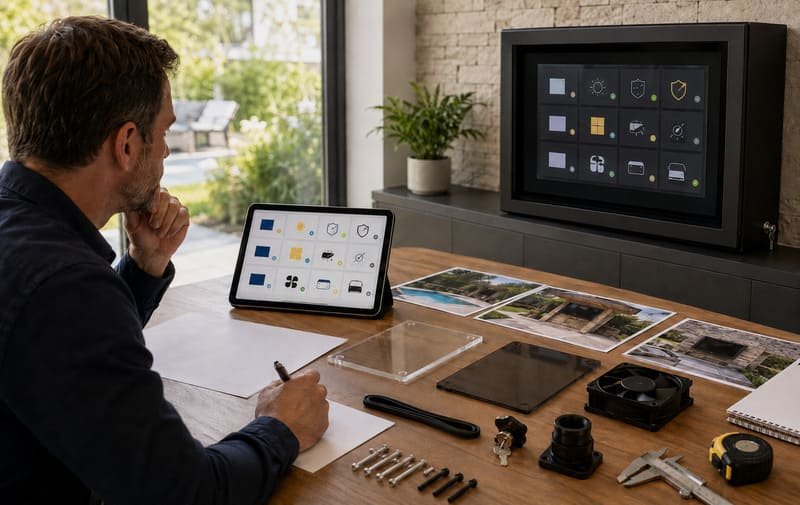
This section is especially important for distributors, hotel buyers, restaurant groups, AV installers, and public-space projects.
When the order is one unit, a mistake is annoying.
When the order is multiple units across a property or customer network, a material mistake becomes expensive.
CIPS defines Total Cost of Ownership as an end-to-end cost view that includes purchase price, acquisition cost, usage cost, and end-of-life cost. CIPS Total Cost of Ownership
That is how I think about material selection.
The cheapest material is not always the lowest-cost material after installation, service, cleaning, replacement, and complaints. A lighter enclosure may reduce handling difficulty. A clearer front panel may reduce viewing complaints. A better-formed shell may support sealing better. Better hardware may reduce service visits in coastal sites.
Supplier Questions Before Ordering
| Question | Why It Matters |
|---|---|
| What PC grade is used? | “Polycarbonate” alone is not enough information |
| Is the material UV-stabilized or coated? | Outdoor performance depends on grade and treatment |
| What is the front panel thickness? | Thickness affects impact behavior and rigidity |
| How is optical clarity checked? | Viewing quality matters through the front panel |
| How are panels formed? | Poor forming can create stress marks, warping, or weak fit |
| How are gaskets compressed? | Sealing depends on pressure and surface consistency |
| How are cable exits protected? | Cable exits are common weak points |
| Which parts are metal? | Locks, hinges, screws, and mounts need corrosion review |
| How is airflow designed? | Fans need intake, exhaust, and service access |
| Can the supplier provide material documentation? | Useful for commercial buyers and project approval |
A reliable enclosure supplier should not answer only with general words like “high quality plastic.”
The buyer should be able to understand the material role, the sealing method, the hardware plan, and the maintenance requirements.
Where Does Polycarbonate Make the Most Sense?
Polycarbonate is not required for every enclosure project, but it becomes especially useful when the site combines outdoor exposure, public contact, corrosion risk, and service needs.
Polycarbonate makes the most sense when the enclosure needs a clear protective front, lighter housing, impact resistance, body-level rust avoidance, and practical service handling. It is especially useful for poolside areas, coastal patios, restaurants, public spaces, schools, resorts, and multi-unit commercial projects.
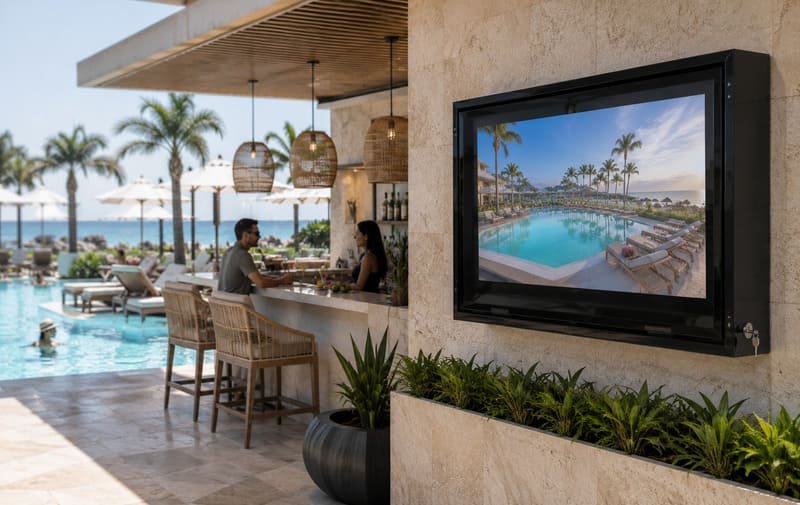
For a private covered patio, the material decision may be simpler. The TV may be used occasionally, and the enclosure may not face heavy public contact.
But commercial spaces change the material priority.
At a sports bar, the front panel may face guests, cleaning routines, and accidental contact.
At a hotel pool, the body may face splash, humidity, and a premium appearance requirement.
At a coastal resort, the housing and hardware need corrosion review.
At a school or public institution, the enclosure may need to reduce direct screen contact.
At a distributor project, weight and installation repeatability matter across multiple units.
Where PC Often Fits Well
| Site Type | Why Polycarbonate Can Help |
|---|---|
| Coastal Resort | Body does not rust like steel; hardware still needs inspection |
| Hotel Pool Area | Useful balance of clarity, impact resistance, and lower weight |
| Sports Bar Patio | Helps protect the screen from everyday contact |
| Restaurant Terrace | Supports a cleaner protective shell with service access |
| School / Public Institution | Front shield can reduce direct screen contact |
| Warehouse Entrance | Impact-resistant front can help against accidental bumps |
| Multi-Unit Commercial Rollout | Lighter enclosure can simplify handling and repeat installation |
The value of polycarbonate is not only one property.
It is the combination.
Clarity for viewing.
Impact resistance for protection.
Lighter weight for installation.
No steel-like rust at the body level.
Formability for enclosure structure.
That combination is why I like it for many outdoor TV enclosure projects.
Common Questions About Polycarbonate TV Enclosure Materials
Is polycarbonate itself waterproof?
Polycarbonate does not rust like steel and is not the same as a porous material that absorbs water like wood. But waterproofing an enclosure does not come from the material alone. It comes from IP-rated design, gaskets, cable exits, door pressure, assembly quality, and installation.
Does polycarbonate make an outdoor TV enclosure IP65?
No. Polycarbonate can support the enclosure structure, but IP65 depends on the full enclosure design and testing logic: seals, joints, cable exits, fan areas, door closure, gasket compression, and assembly. The material alone does not create an IP rating.
Is polycarbonate better than metal for coastal TV enclosures?
It can be better for the body because it does not rust like steel. However, a polycarbonate enclosure still includes hardware such as locks, hinges, screws, brackets, anchors, and mounts. Those parts still need corrosion-resistant design and inspection in coastal or poolside environments.
Can polycarbonate handle impact better than glass or acrylic?
In many protective enclosure applications, polycarbonate is preferred because it is more impact-resistant and less likely to shatter than glass. It is also generally tougher than acrylic. But real performance still depends on thickness, grade, frame support, and impact direction.
Does polycarbonate need UV treatment for outdoor use?
Yes, outdoor use should be reviewed by grade and treatment. A UV-stabilized or coated polycarbonate can perform better outdoors, but buyers should ask for material documentation or supplier test information rather than assuming all PC sheets perform the same.
What should I ask suppliers before choosing PC enclosures?
Ask for the PC grade, UV stabilization or coating information, front panel thickness, optical clarity control, forming process, gasket design, hardware material, cable exit design, fan layout, and material documentation. For B2B orders, these details matter more than the word “polycarbonate” alone.
Conclusion
Polycarbonate works well for weatherproof outdoor TV enclosures, but not because it magically makes a box waterproof.
Its value is more practical than that.
It helps the enclosure body stay lighter.
It does not rust like steel at the body level.
It can provide clear viewing through the front panel.
It can reduce direct screen contact better than brittle materials.
It can support a serviceable, commercial enclosure structure.
But polycarbonate is only one part of the system.
The enclosure still needs sealing.
It still needs gasket control.
It still needs protected cable exits.
It still needs airflow.
It still needs corrosion-aware hardware.
It still needs UV-grade selection.
It still needs proper installation and maintenance.
That is the honest reason polycarbonate works well.
It gives the enclosure a strong material foundation, while the design around it decides whether the product actually performs outdoors.
For B2B buyers, that is the real lesson:
Do not buy only the word “polycarbonate.”
Buy the whole system behind it.