
Most buyers compare outdoor display options at the wrong moment: before the first invoice.
That first quote matters, but it is not the full story.
For commercial outdoor screens, the real cost appears across three cycles: the first installation, the first screen replacement, and the first technology refresh. A setup that looks cheaper on day one may become expensive when the screen fails, apps become outdated, brightness needs change, or the buyer has to repeat the same installation across several locations.
A regular TV plus enclosure and a dedicated outdoor TV should not be compared only by purchase price. They should be compared by a 3-cycle cost model: installation cost, replacement cost, and upgrade cost. The cheapest outdoor display setup is not the one with the lowest first invoice. It is the one that still makes sense after the first installation, the first TV replacement, and the first technology refresh.
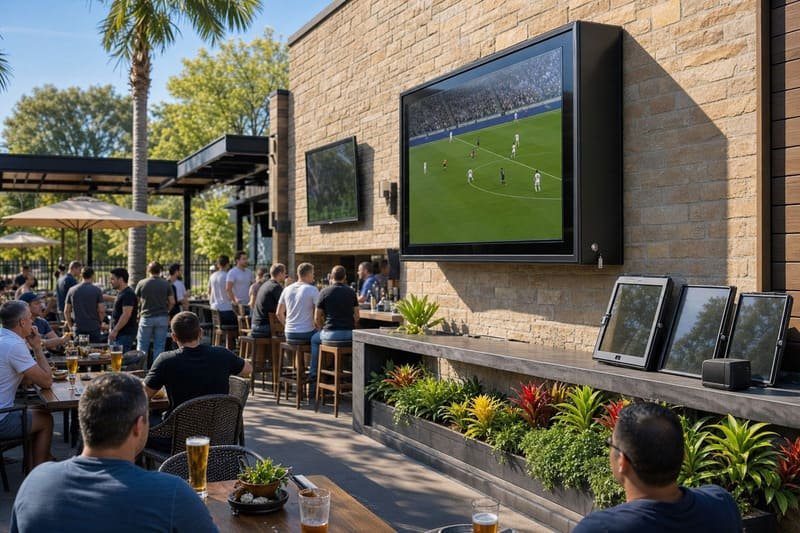
When I compare these two options for a buyer, I draw the cost timeline before I discuss the product.
- A sports bar with ten outdoor screens does not only need to know the first screen price. It needs to know what happens when three screens need replacement in different seasons.
- A hotel group does not only need a clean opening-day installation. It needs to know whether brand uniformity is worth more than replacement flexibility.
- An AV integrator does not only need a working first install. It needs to know whether the customer can service, replace, and upgrade the screens later without rebuilding the patio.
That is why I use a 3-cycle cost model.
Last Updated: May 26, 2026 | Estimated Reading Time: 9 minutes
By Smith Chen, Outdoor TV Enclosure Engineer at Outvion
Why Should You Compare Three Cost Cycles Instead of One Purchase Price?
A first quote can make one option look obvious. But outdoor screens are not indoor living room TVs. They face rain, heat, sun, humidity, salt air, theft risk, impact risk, cable exposure, and long operating hours.
The first purchase price is only one part of the outdoor display decision. A 3-cycle cost model compares the first installation, the first screen replacement, and the first technology refresh. This gives B2B buyers a more realistic view of long-term cost, downtime risk, and upgrade flexibility.
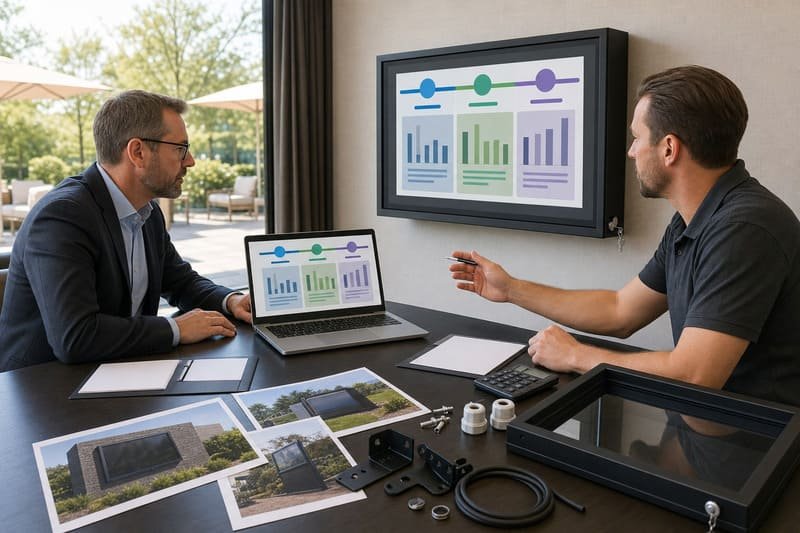
CIPS defines Total Cost of Ownership as an estimate used to help buyers understand the end-to-end cost of providing a product or service, including purchase price, acquisition cost, usage cost, and end-of-life cost. CIPS Total Cost of Ownership
That is exactly how I think about outdoor display projects.
A buyer should not only ask:
How much does the TV cost today?
The better questions are:
- What does the first installation require?
- What happens when the screen fails?
- What happens when the TV platform becomes outdated?
- What happens when the hotel wants a new brand standard?
- What happens when the bar needs to replace five screens, not one?
- What happens when the enclosure still works but the screen does not?
- What happens if full sun, salt air, or public access changes the risk?
The 3-Cycle Cost Model
| Cost Cycle | Regular TV + Enclosure | Dedicated Outdoor TV | What the Buyer Should Ask |
|---|---|---|---|
| Cycle 1: First Installation | Buy indoor TV + enclosure, check fit, mount, cable route, airflow | Buy outdoor-rated TV and mount it | Which setup fits this site risk with the least installation friction? |
| Cycle 2: First Replacement | Replace the TV if the enclosure still fits and works | Often replace the full outdoor TV unit | What is most likely to fail first: the screen, the mount, or the protection layer? |
| Cycle 3: Technology Refresh | Replace TV for better apps, brightness, OS, or procurement standard | Replace full unit if the outdoor TV is tied to old technology | How often will this site upgrade displays? |
This is the main difference between a simple cost comparison and a useful procurement comparison.
A regular TV plus enclosure separates the protection system from the display technology.
A dedicated outdoor TV combines the display and outdoor protection into one product.
Neither structure is always better. The better choice depends on the site, the number of screens, the brightness need, the service plan, and the buyer’s future replacement strategy.
Where Can a Regular TV + Enclosure Reduce Long-Term Cost?
A regular TV plus enclosure can look more complicated at first because the buyer must match the TV, enclosure, mounting, cable route, and airflow. But in many commercial projects, that separation creates long-term flexibility.
A regular TV plus enclosure can reduce long-term cost when the enclosure is reusable, the TV can be replaced separately, and the site needs weather, impact, theft, heat, or corrosion protection without buying a full outdoor-rated TV at every replacement cycle. The cost advantage depends on correct fit, airflow, service access, and installation quality.
For a bar with several outdoor screens, I do not ask only what one TV costs today.
I ask what happens after the first football season:
- What happens when one TV fails?What happens when the streaming app support changes?
- What happens when the buyer wants a brighter screen?
- What happens when a new TV model has a different depth or port position?
The enclosure model becomes interesting when the buyer wants to keep the outdoor installation stable while changing the screen inside.
The enclosure becomes the protection layer.
The indoor TV becomes the display module.
This is especially important in multi-screen projects. A single backyard screen may not justify a detailed TCO model. A sports bar, hotel pool bar, school courtyard, factory display wall, or resort patio with many screens should think differently.
Where the Cost Advantage Can Come From
| Cost Driver | Why Regular TV + Enclosure Can Help | Important Limit |
|---|---|---|
| Screen Replacement | The TV inside may be replaced without replacing the enclosure | New TV must fit width, height, depth, VESA, cables, and airflow |
| Technology Refresh | Buyer can upgrade TV platform, apps, resolution, or brightness more easily | The enclosure must support the new model |
| Multi-Screen Sites | Replacement economics multiply when there are many screens | Standardization becomes important |
| Inventory Flexibility | Distributors can match enclosures with available TV models | Compatibility must be controlled |
| Public Access Control | Enclosure can add lockable access and front protection | It is not vandal-proof |
| Weather Exposure | Enclosure reduces direct rain, dust, and impact exposure | Installation and maintenance still matter |
| Future Procurement Changes | Buyer may switch TV brands later | Internal clearance and VESA flexibility matter |
TV technology and product features change quickly. The U.S. Bureau of Labor Statistics notes that TV quality adjustment accounts for changing product characteristics such as screen size, resolution, and features when measuring TV prices. BLS television quality adjustment
That supports what I see in B2B projects: the screen inside is usually the faster-changing part.
The enclosure should not be selected as a temporary cover. It should be selected as the stable protection layer that can support future compatible TV replacements.
When Does a Dedicated Outdoor TV Still Make Better Business Sense?
A lower-cost path is not always the better path. Sometimes the buyer wants fewer decisions, one product, one brand specification, one warranty path, and a cleaner finished appearance.
A dedicated outdoor TV can make better business sense when the buyer wants an all-in-one outdoor-rated display, simplified procurement, known brightness class, brand uniformity, and fewer compatibility checks. It can also be stronger for full-sun flagship screens where brightness and integrated thermal design matter more than replacement flexibility.
I try not to attack outdoor TV brands. Many outdoor TVs are well engineered for their intended use.
They may include outdoor-rated housings, brightness classes, thermal design, weather sealing, and brand-backed support in one product. Some buyers value that more than the flexibility of choosing a separate TV and enclosure.
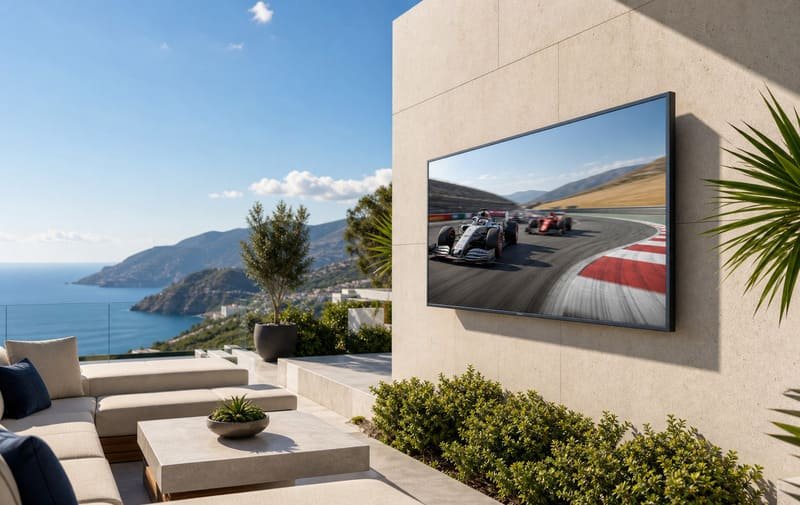
For a luxury villa, a dedicated outdoor TV may match the design expectation better.
For a hotel brand standard, one approved outdoor TV model may simplify procurement.
For a full-sun flagship screen, the outdoor TV’s brightness class may be more important than the cost difference.
For a small installation team, fewer compatibility checks may save time.
The outdoor TV option is not “wrong.” It is a different cost structure.
Where Outdoor TVs Can Win
| Buyer Priority | Better Direction May Be | Reason |
|---|---|---|
| Lowest decision complexity | Dedicated outdoor TV | Fewer compatibility checks |
| Full-sun brightness | Dedicated outdoor TV or high-brightness TV + carefully designed enclosure | Brightness is the key constraint |
| Clean premium appearance | Dedicated outdoor TV | Slim all-in-one design may look better |
| Brand uniformity across properties | Dedicated outdoor TV | Easier specification control |
| Fast single-screen installation | Dedicated outdoor TV | Less product matching work |
| Flexible future TV replacement | Regular TV + enclosure | Protection layer can remain |
| Multi-screen refresh cost control | Regular TV + enclosure | Replacement economics multiply |
| Public tamper control | Often enclosure | Lock and shield can help reduce casual access |
Sunlight rating changes the cost conversation. A full-shade outdoor TV and a full-sun outdoor TV should not be compared as if they are the same product. Full-sun screens often require higher brightness and stronger thermal design, which can make them much more expensive than shaded or partial-sun models.
I would not use a fixed multiplier for every project. Brand, size, market, brightness class, and availability all change the price.
The correct comparison is not:
Outdoor TV vs enclosure.
The correct comparison is:
Which outdoor display system fits this site’s sun, heat, rain, service, and replacement plan?
Which Site Risks Change the Cost Calculation?
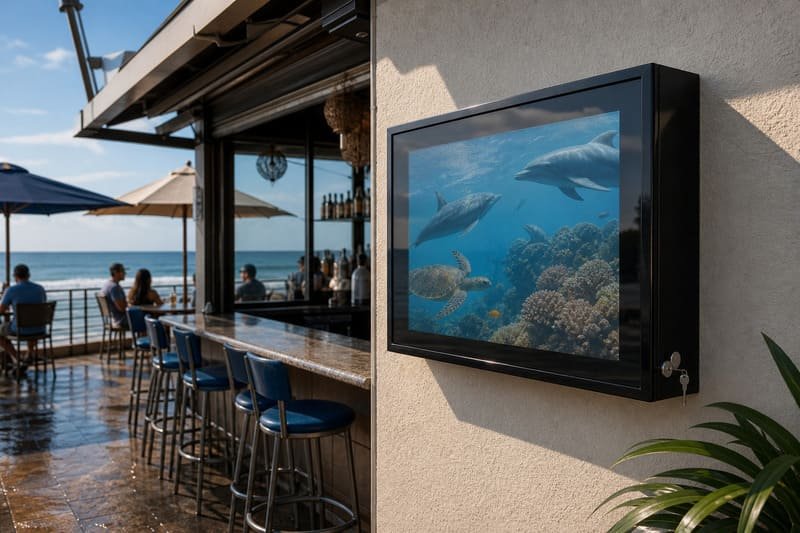
The same screen strategy can be smart in one location and risky in another. A shaded courtyard, coastal sports bar, public school yard, and full-sun pool deck should not use the same buying logic.
Climate, sunlight, operating hours, public exposure, theft risk, coastal air, installation difficulty, and downtime tolerance all change the cost calculation. A regular TV + enclosure often becomes stronger when replacement flexibility and physical protection matter. A dedicated outdoor TV often becomes stronger when full-sun brightness and simplified procurement matter more.
I call these risk multipliers.
They do not always appear on the first quote. But they often appear later in service cost, replacement work, downtime, and customer complaints.
Risk Multiplier Table
| Risk Multiplier | Why It Changes Cost | What I Check First |
|---|---|---|
| Full Sun | Brightness and heat requirements increase | Screen brightness, shade, sun direction |
| Coastal Air | Hardware corrosion and inspection needs increase | Body material, locks, screws, brackets |
| Public Access | Tampering, theft, and impact risk increase | Locking, front shield, mounting security |
| Multi-Screen Deployment | Replacement economics multiply | Standard TV model and enclosure size |
| Long Operating Hours | Heat, fan runtime, dust exposure, and screen aging increase | Cooling, service access, cleaning routine |
| Remote Location | Shipping and technician visits become expensive | Spare parts, service plan, replacement workflow |
| Luxury Design Requirement | Appearance and profile may matter more than pure cost | Slimness, finish, visual integration |
| Fast Project Timeline | Compatibility checks may slow procurement | Outdoor TV simplicity vs enclosure flexibility |
For coastal sites, I slow down the material discussion. A polycarbonate body does not rust like steel, which removes one corrosion pathway. However, locks, hinges, screws, anchors, cable exits, and mounting hardware still need corrosion-resistant design and inspection.
FEMA guidance on coastal construction notes that salt accumulation and high humidity can accelerate corrosion of untreated steel connectors and fasteners. FEMA coastal corrosion guidance
For hot sites, I slow down the cooling discussion. Sony advises using TVs within 0°C to 40°C / 32°F to 104°F and avoiding exposure to direct sunlight. Sony TV temperature guidance
A fan-cooled enclosure can help reduce heat buildup, but it is not air conditioning. It does not make an indoor TV immune to heat. Shade, airflow clearance, TV brightness, operating hours, and maintenance still matter.
For public sites, I slow down the security discussion. A locked enclosure can help reduce casual access and tampering, but I avoid saying “vandal-proof.” The mounting surface, fasteners, lighting, location, and site access control still matter.
What Makes an Enclosure Reusable Through Multiple TV Replacements?
The enclosure model only makes sense if the enclosure is designed as a reusable protection system. A weak box that traps heat, blocks service access, or fits only one TV too tightly can erase the cost advantage.
An enclosure becomes reusable through multiple TV replacements when it has practical internal clearance, VESA flexibility, planned airflow, serviceable fans, protected cable exits, lockable access, and a front panel that stays clear enough for real viewing. The enclosure must support future compatible screens, not just the first TV.
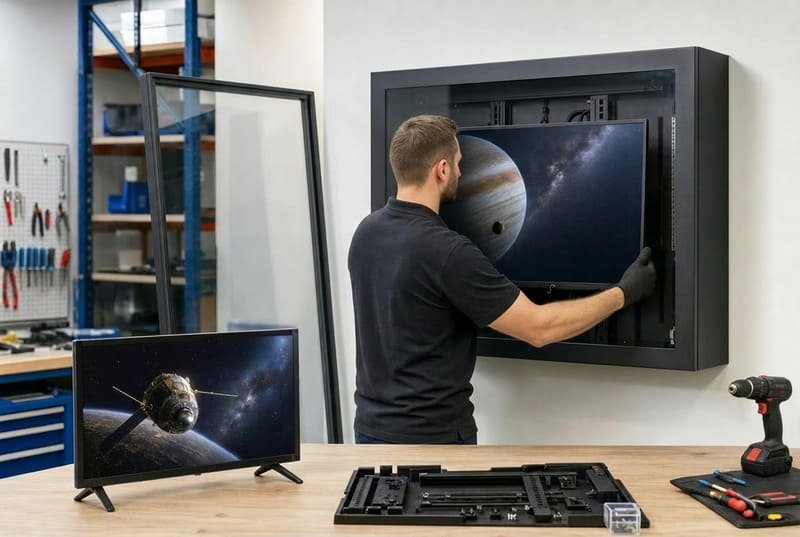
This is where I see many buyers make a mistake.
They check whether the first TV fits.
They do not check whether the second TV can fit later.
That is a problem.
A 55-inch TV is not always the same physical size as another 55-inch TV. LG explains that TV size is measured diagonally and that screen size does not include the borders or bezels, so buyers should also check the total width, height, and depth from product specifications. LG TV size guide
For enclosures, this matters even more because the TV also needs cable clearance, airflow space, mount compatibility, and service access.
Upgrade-Friendly Enclosure Checklist
| Upgrade Factor | Why It Matters |
|---|---|
| Internal Width and Height | Future TV must fit without side pressure |
| Internal Depth | New TV must not press the front panel or block airflow |
| VESA Flexibility | Mounting holes must align or allow safe adapter use |
| Cable Space | HDMI, power, LAN, and media devices must remain reachable |
| Heat Profile | Higher-brightness TVs may create more heat |
| Fan Location | Airflow should not be blocked by the new TV shape |
| Service Opening | Technician must remove and replace the screen safely |
| Remote / Signal Access | IR, Bluetooth, or Wi-Fi performance should be checked |
| Front Panel Clarity | The enclosure must still support acceptable viewing |
| Spare Parts | Fans, locks, keys, gaskets, and hardware should be serviceable |
Material also matters. Covestro describes Makrolon polycarbonate as robust, lightweight, glass-like in transparency, and impact resistant even at low temperatures. Covestro Makrolon polycarbonate
That kind of material profile can be useful for transparent protective enclosures. But the full system still depends on hardware quality, front panel design, gasket compression, cable exits, and installation.
An enclosure is only a cost-control asset if it remains usable when the first TV is no longer the right screen.
How Should Buyers Build a Real Cost Model?
A real cost model should not be a single price table. It should include purchase price, installation, risk level, service access, downtime, replacement cycle, upgrade cycle, and the cost of making the wrong choice.
The buyers should build a cost model by comparing both options across site risk, screen quantity, sun exposure, operating hours, replacement workflow, service access, and future upgrade plans. The right answer is not always the cheaper first purchase. It is the setup that creates the least long-term risk for that specific project.
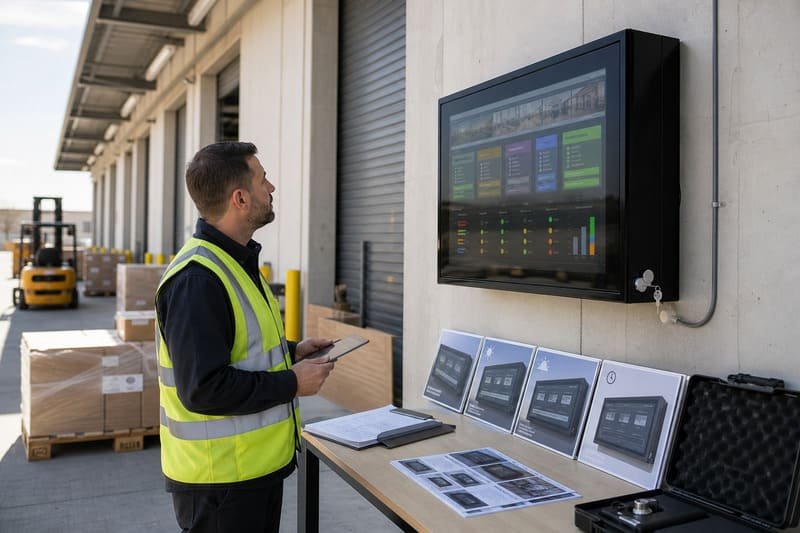
I do not recommend using generic market price ranges as final proof. Prices change too quickly by country, size, brand, brightness class, freight, duties, installation, and current inventory.
For early planning, I sometimes use broad cost ranges or low / medium / high bands. But before a buyer makes a decision, I want them to compare the specific project.
Practical Cost Model for Buyers
| Cost Question | Why It Matters |
|---|---|
| How many screens are involved? | Multi-screen projects magnify replacement cost |
| Is the site shaded, partial sun, or full sun? | Brightness and heat requirements change fast |
| How many hours will each screen run daily? | Long use increases heat and service demand |
| How exposed is the location? | Rain, humidity, salt air, dust, and public access affect risk |
| How costly is downtime? | A screen failure during game night, event, or service hours has business impact |
| Can the TV be replaced locally? | Local availability can reduce downtime |
| Can the enclosure support future TV models? | Upgrade flexibility depends on fit and clearance |
| Who will service the system? | Maintenance access affects long-term cost |
| Does the buyer need brand uniformity? | Outdoor TV may simplify procurement |
| Does the buyer need physical security? | Enclosure may provide more visible protection |
Early Direction Table
| Project Situation | Better Direction May Be | Reason |
|---|---|---|
| One premium full-sun flagship screen | Dedicated outdoor TV | Brightness and integrated outdoor design may matter most |
| Several shaded patio screens | Regular TV + enclosure | Replacement flexibility and cost control can be stronger |
| Coastal sports bar | Often enclosure or mixed plan | Salt, impact, public access, and service access matter |
| Hotel pool bar with many screens | Often regular TV + enclosure | Multi-screen replacement economics can be easier |
| Luxury villa with strict design rules | Depends on design | Slim appearance may outweigh replacement flexibility |
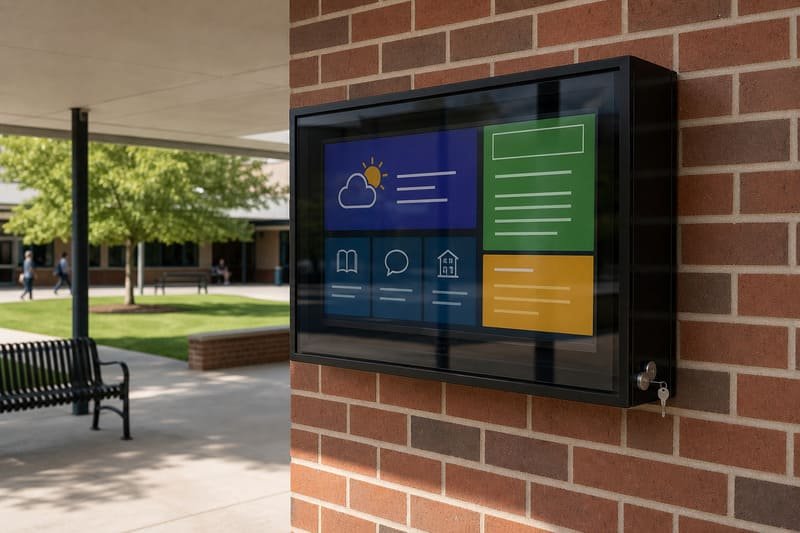
| Public school or institutional space | Often enclosure | Lockable access and physical protection matter |
| Distributor program | Regular TV + enclosure or mixed plan | TV availability and stock flexibility matter |
| Fast one-off install | Outdoor TV | Fewer compatibility checks may save time |
This table is not a rulebook. It is a starting point.
The final decision should come from the actual TV model, installation site, climate, screen quantity, service plan, and buyer priorities.
Frequently Asked Questions
Is a regular TV + enclosure cheaper than an outdoor TV?
It can be cheaper over time in many shaded or semi-outdoor commercial projects, especially when multiple screens are involved and the enclosure can stay in place through future TV replacements. But it is not always cheaper after installation, freight, duties, service, and maintenance are included. The best comparison is total cost of ownership, not only first purchase price.
When is a dedicated outdoor TV worth the higher price?
A dedicated outdoor TV may be worth it when the screen is in full sun, the buyer needs high brightness, the project requires one integrated outdoor-rated product, the design must stay very slim, or procurement wants one brand-approved specification with fewer compatibility checks.
Does an enclosure make an indoor TV the same as an outdoor TV?
No. An enclosure helps reduce outdoor exposure and can add physical protection, airflow, locks, and cable protection. But it does not turn the indoor TV panel into a high-brightness full-sun outdoor display, and it does not change the TV manufacturer’s original outdoor-use rating or warranty terms.
Can I replace the TV inside the enclosure later?
Yes, if the replacement TV fits the enclosure. You must check actual width, height, depth, VESA pattern, port positions, cable clearance, airflow space, remote control method, and heat output. The diagonal size label alone is not enough.
Is full sun the biggest cost factor?
Full sun is often one of the biggest cost factors because brightness and heat requirements increase. A shaded outdoor screen and a full-sun outdoor screen are not the same problem. Full-sun locations may justify a dedicated outdoor TV or a carefully selected high-brightness TV with a suitable enclosure and thermal plan.
Does the indoor TV warranty still apply outdoors?
That depends on the TV brand, model, region, and warranty terms. Many indoor TVs are not intended for outdoor use. An enclosure can reduce exposure, but it does not rewrite the original warranty. Buyers should check the TV warranty before using it outdoors.
Which option is better for sports bars and restaurants?
For sports bars and restaurants with several shaded or semi-covered screens, regular TVs inside professional enclosures can be a strong option because future replacement and screen refreshes are easier to control. For one full-sun hero screen, a dedicated outdoor TV may be more suitable.
Which option is better for hotels and resorts?
It depends on the zone. Pool bars, shaded patios, and multi-screen outdoor dining areas may benefit from regular TVs inside enclosures. Full-sun luxury cabanas, premium suites, or brand-sensitive locations may justify dedicated outdoor TVs. A mixed plan is often more practical than forcing one solution everywhere.
Is a higher IP rating always better?
A higher IP rating may help with water and dust resistance, but it is not the whole answer. The International Electrotechnical Commission explains that IP ratings grade resistance to dust and liquid intrusion. IEC IP Ratings For outdoor TV enclosures, IP65 can be useful, but it does not mean vapor-proof, condensation-proof, salt-proof, flood-proof, or maintenance-free. Airflow, cable exits, mounting, heat, and inspection still matter.
What is my final buying advice?
Do not choose by product label alone. Choose by risk and replacement plan. If the project needs flexible TV replacement, multi-screen cost control, physical protection, and serviceable hardware, study a professional enclosure. If the project needs one clean outdoor-rated product, full-sun brightness, simplified procurement, and brand uniformity, study dedicated outdoor TVs.
Conclusion
Regular TV + enclosure vs outdoor TV is not a simple “which is cheaper?” question.
It is a timeline question.
What happens during the first installation?
What happens during the first replacement?
What happens during the first technology refresh?
The way I explain it to buyers is simple:
The cheapest outdoor display setup is not the one with the lowest first invoice. It is the one that still makes sense after the first installation, the first TV replacement, and the first technology refresh.
A regular TV plus enclosure often makes sense when replacement flexibility, multi-screen deployment, lockable protection, service access, and long-term refresh cost matter.
A dedicated outdoor TV often makes sense when full-sun brightness, simplified procurement, premium appearance, and one integrated outdoor-rated product matter more.
The best choice depends on the site.
- A shaded hotel courtyard is different from a coastal sports bar.
- A full-sun pool deck is different from a covered restaurant patio.
- A public school yard is different from a private villa wall.
- A one-screen project is different from a ten-screen rollout.
If you compare only the first purchase price, you may choose the wrong system.
If you compare all three cycles—installation, replacement, and upgrade—you will make a much better outdoor display decision.