
A regular TV inside a waterproof enclosure can replace part of an outdoor TV, but not all of it.
It can replace the weather-protection layer in many shaded patios, covered restaurants, and moderate-use outdoor spaces. It cannot replace screen brightness, native full-sun visibility, anti-glare engineering, or the TV manufacturer’s outdoor-use design.
That is why I do not answer this question with a simple yes or no. I use a replacement boundary: what the enclosure can replace, what the TV inside must still provide, and when a dedicated outdoor TV is still the safer choice.
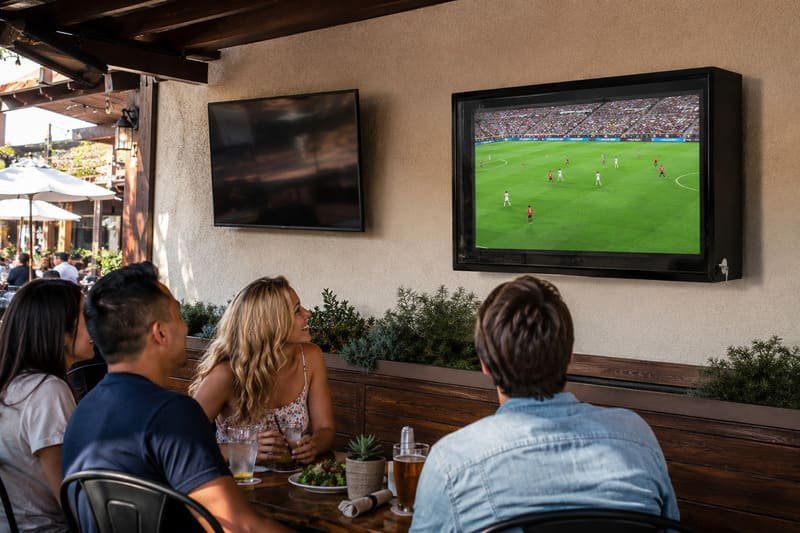
When I review this question, I do not compare two products first.
I separate the job into two parts:
What protects the TV from the outside?
And what does the TV panel itself still need to do?
That difference matters because many buyers think “waterproof” means the full outdoor TV problem is solved. It does not.
A waterproof enclosure can help reduce rain, splash, dust, insects, casual contact, cable exposure, and some physical access risk. But the TV inside still controls brightness, glare behavior, heat output, sound, operating design, smart features, and warranty terms.
So the real question is not:
“Can I save money by using a regular TV?”
The better question is:
“Which part of an outdoor TV am I trying to replace?”
Last Updated: June 4, 2026 | Estimated Reading Time: 8 minutes
By Smith Chen, Outdoor TV Enclosure Engineer at Outvion
What Part of an Outdoor TV Can an Enclosure Actually Replace?
A waterproof enclosure can replace the external protection layer in many projects. It cannot replace the display panel’s outdoor performance.
A waterproof enclosure can replace weather shielding, cable protection, physical separation, and lockable access in the right installation. It cannot replace the TV panel’s brightness, anti-glare performance, native thermal design, outdoor-use rating, or original warranty terms.
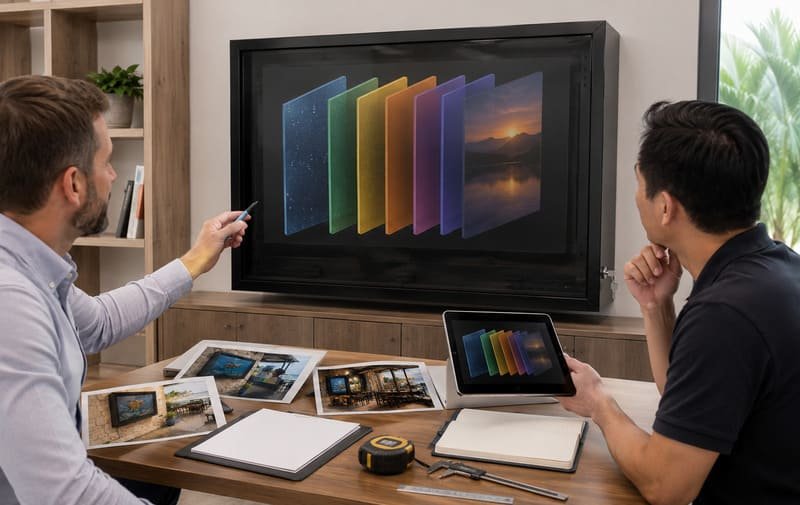
I use the word “waterproof enclosure” because many buyers search for that phrase. Technically, I prefer to talk about an IP-rated outdoor TV enclosure.
The International Electrotechnical Commission explains that IP ratings grade the resistance of electrical and electronic enclosures against dust and liquid intrusion. IEC IP Ratings
That makes IP rating useful, but it has limits.
An IP-rated enclosure can help reduce water and dust intrusion under defined test conditions. But “waterproof” should not be read as vapor-proof, condensation-proof, flood-proof, pressure-wash-proof, salt-proof, heat-proof, or maintenance-free.
The enclosure is protection.
It is not a screen upgrade.
If the indoor TV looks dim in daylight, the enclosure will not make it bright.
If the TV has a glossy panel, the enclosure will not remove all glare.
If the TV runs hot, the enclosure must manage heat carefully.
If the TV manufacturer does not rate that model for outdoor use, the enclosure does not rewrite the TV’s original intended-use terms.
Replacement Boundary Table
| Function | Can the Enclosure Replace This? | Why |
|---|---|---|
| Rain / Dust Barrier | Yes, when designed and installed correctly | The enclosure creates an external protection layer |
| Cable Protection | Yes, partly | Cable exits and routing can be planned inside the enclosure |
| Physical Separation | Yes, partly | Front shield and lockable access reduce casual contact |
| Screen Brightness | No | The TV panel still controls brightness |
| Anti-Glare Performance | Not fully | Placement and front material matter, but the TV panel still matters |
| Heat Design | Partly | Fans help, but they do not make it an outdoor-rated thermal system |
| Outdoor Warranty / Intended Use | No | The TV’s original terms still apply |
| Future Replacement Flexibility | Often yes | The TV can be changed if the enclosure still fits |
This is the replacement boundary.
A waterproof enclosure can replace the outdoor protection layer in many shaded or moderate-use sites. It cannot replace the TV panel’s brightness, anti-glare performance, thermal design, commercial duty cycle, or original outdoor-use rating.
When Is a Regular TV + Enclosure a Practical Substitute?
A regular TV inside an outdoor enclosure can be a smart choice when the environment is controlled enough for the TV panel to do its job.
A regular TV plus enclosure is usually a better candidate when the screen is shaded or semi-shaded, the operating hours are moderate, and full-sun daytime visibility is not the main requirement. In those conditions, the enclosure protects the TV while the regular TV still provides acceptable viewing performance.
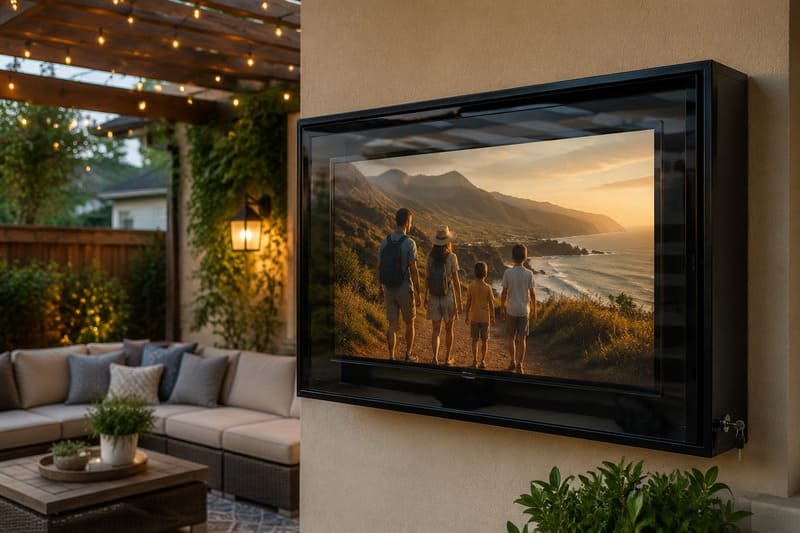
I usually feel more comfortable with this setup when the screen sits under a roof, pergola, awning, balcony cover, shaded wall, or semi-covered patio.
That is because shade reduces two problems that an enclosure cannot fully solve:
Glare.
Heat.
For a home patio used mostly at night, this setup can make sense. For a restaurant patio that shows games in the evening, it can make sense. For a hotel poolside menu screen used during morning and evening service, it may also be practical if the site is shaded and service access is planned.
I do not call this a cheap shortcut. I call it a site-matched system.
The TV, enclosure, wall, sun direction, airflow space, cable route, and operating hours all need to work together.
Three-Condition Test
| Question | Better Candidate for Regular TV + Enclosure | Warning Sign |
|---|---|---|
| Is the screen shaded? | Roof, pergola, awning, shaded wall | Direct sun hits the screen for long periods |
| Are operating hours moderate? | Evening use, events, shorter daily runtime | All-day commercial operation |
| Is full-sun visibility critical? | No, daylight readability is not the main need | Yes, viewers must see clearly at noon |
| Is service access practical? | Staff can open, inspect, clean, and replace | Enclosure is hidden in a tight recess |
| Is heat path clear? | Fans have intake and exhaust space | Airflow is blocked by wall or furniture |
Where It Often Works
| Scenario | Fit for Regular TV + Enclosure | Main Reason |
|---|---|---|
| Covered Home Patio | Often good | Shade reduces glare and heat |
| Balcony With Side Rain | Often good | Enclosure helps block wind-driven moisture |
| Small Restaurant Patio | Often good | Cost and service access matter |
| Sports Bar Evening Use | Often good | Lower sun exposure during use |
| Poolside Direct Noon Sun | Often poor | Brightness and heat become major issues |
| Outdoor Advertising All Day | Usually poor | Runtime and visibility demands are higher |
The key is controlled outdoor use.
If the screen is shaded, used for moderate hours, and not expected to perform like a high-brightness commercial outdoor display, regular TV + enclosure is worth reviewing.
When Is a Dedicated Outdoor TV Still the Safer Choice?
A dedicated outdoor TV is often the safer choice when the display requirement is really about brightness, full-sun visibility, and integrated outdoor performance—not only rain protection.
A dedicated outdoor TV is usually safer for direct sunlight, high daytime visibility needs, extreme heat, poor airflow, heavy commercial uptime, and projects where the buyer wants one integrated outdoor-rated product. A waterproof enclosure can protect a regular TV, but it cannot make a dim TV easy to see in bright sun.
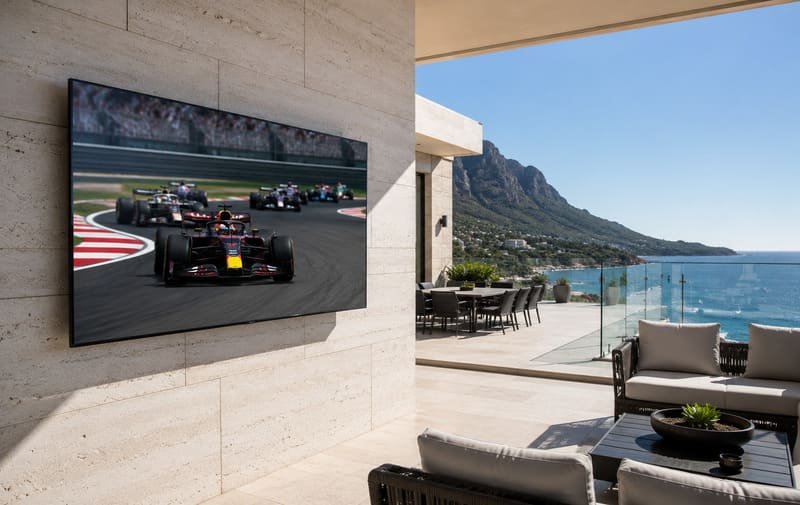
I do not attack dedicated outdoor TVs.
They solve real problems.
Their value is not only weather resistance. Their value is often the integrated package: brightness category, outdoor-facing panel design, thermal planning, weather sealing, and brand-backed outdoor positioning.
If a restaurant owner tells me the screen must show sports clearly during lunch service in direct sun, I slow the conversation down.
A waterproof enclosure can protect a regular TV from rain, but it cannot make that TV brighter. If the picture looks washed out, the customer experience still suffers.
Heat is another boundary.
Sony advises using TVs within a temperature range of 0°C to 40°C / 32°F to 104°F and avoiding exposure to direct sunlight. Sony TV temperature guidance
Fan-assisted airflow can help reduce heat buildup, but it is not air conditioning. It does not make every indoor TV safe in direct sun or high ambient temperature.
Where Dedicated Outdoor TVs Often Win
| Requirement | Regular TV + Enclosure | Dedicated Outdoor TV |
|---|---|---|
| Shaded Evening Viewing | Often suitable | Also suitable |
| Direct Sun Visibility | Often limited | Often better |
| Native High Brightness | Depends on indoor TV | Usually designed for this need |
| Anti-Glare Performance | Not upgraded by enclosure | Often part of product design |
| All-Day Commercial Runtime | Depends on TV, site, and cooling | Often better suited |
| Simplified Procurement | More fit and configuration checks | One integrated product |
| Lower Initial Hardware Cost | Often better | Often higher |
The dedicated outdoor TV is not always the cheaper path.
But it can be the cleaner path when the site needs full-sun performance, fewer compatibility checks, or a single outdoor-rated product.
How Should Buyers Test Sun, Heat, Runtime, and Visibility?
Rain is easy to imagine. Sun and heat are easier to underestimate.
Before choosing between regular TV + enclosure and dedicated outdoor TV, buyers should test four conditions: sun direction, heat exposure, daily runtime, and visibility requirement. These conditions often decide whether an enclosure plan is practical or whether a true outdoor TV is safer.
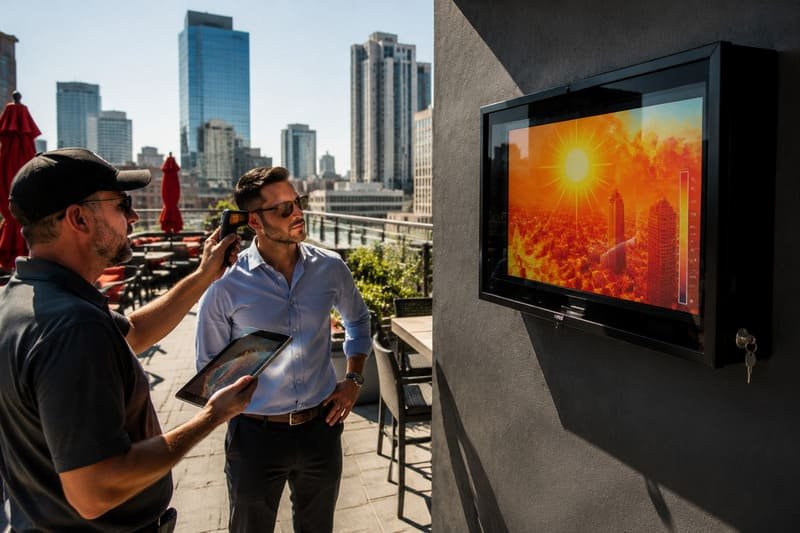
When I ask site questions, I am not trying to make the purchase complicated. I am trying to avoid a false yes.
A regular TV in an enclosure may work beautifully at night and disappoint at noon.
It may work on a shaded restaurant wall and struggle on a west-facing rooftop terrace.
It may run for two hours on weekends without issue, but face more heat stress when used twelve hours daily.
Site Test Before Buying
| Question I Ask | Why It Matters | What I Look For |
|---|---|---|
| Is the screen in direct sun? | Sun affects glare and heat | Shade is safer for regular TVs |
| What time is the TV used most? | Evening use is easier than noon use | Match screen type to viewing window |
| How hot does the area get? | Heat affects electronics | High heat needs stronger airflow planning |
| Is there space around the enclosure? | Fans need intake and exhaust air | Tight recesses raise thermal risk |
| How long will the TV run daily? | Longer use creates more heat | Shorter use is easier to manage |
| Is daytime readability critical? | Brightness may be the main issue | Outdoor TV or commercial display may be better |
| Is the site public-facing? | Impact and tampering matter | Lock and front shield may be needed |
I also look at the wall.
A dark wall can absorb more heat. A tight corner can trap warm air. A metal structure can radiate heat. A roof can block rain but still allow afternoon sun to hit the front panel.
Small details matter because they affect the real environment around the TV.
What Design Details Decide Whether the Enclosure Plan Works?
A regular TV + enclosure setup only works well when the enclosure is designed as a protective system, not just a cover.
The key design details are IP-rated sealing, fan-assisted airflow, front-panel clarity, material durability, lockable access, cable routing, VESA fit, internal space, and service access. A weak enclosure can erase the cost advantage by creating heat, fit, corrosion, or maintenance problems.
This is where I spend a lot of time in project reviews.
The outside may look simple, but the details decide whether the setup is practical.
- Can the TV fit without pressing against the front panel?
- Can cables bend without stress?
- Can fans move air freely?
- Can staff open the enclosure later?
- Can the front panel stay clear enough for viewing?
- Can the hardware survive the local environment?
TV size needs special attention. LG explains that TV size is measured diagonally, and the screen size does not include the borders or bezels; buyers should also check the total width, height, and depth of a specific model. LG TV size guide
That matters because a 55-inch label does not confirm enclosure fit.
One 55-inch TV may have a slim body. Another may have a thicker lower speaker area, rear bulge, or rear-facing ports. A TV that fits on a living room wall may still be difficult inside an enclosure if the cable path is wrong.
Enclosure Design Details That Matter
| Detail | Why It Matters |
|---|---|
| IP-Rated Sealing | Helps reduce rain, splash, and dust exposure |
| Fan-Assisted Airflow | Helps move heat away from the TV |
| Internal Clearance | Leaves room for air movement and cable bend |
| Front Panel Clarity | Keeps the picture usable through the shield |
| Polycarbonate Body / Front | Can combine clarity, light weight, and impact resistance |
| Lockable Access | Helps reduce casual tampering and improves staff control |
| VESA Accuracy | Makes installation safer and cleaner |
| Cable Exit Protection | Reduces water, dust, and strain around wiring |
| Service Access | Allows cleaning, fan checks, cable changes, and TV replacement |
Material choice matters too.
Covestro describes Makrolon polycarbonate as robust, lightweight, glass-like in transparency, and impact resistant even at low temperatures. Covestro Makrolon polycarbonate
For coastal sites, I avoid absolute wording. A polycarbonate body does not rust like steel, which removes one corrosion pathway. But locks, hinges, screws, anchors, cable exits, brackets, and wall mounts still need corrosion-resistant design and inspection.
FEMA guidance on coastal construction notes that salt accumulation and high humidity can accelerate corrosion of untreated steel connectors and fasteners. FEMA coastal corrosion guidance
A good enclosure is not just a shell. It is a fit, airflow, material, cable, and service system.
Is the Best Answer Sometimes a Mixed Strategy?
In B2B projects, the answer is not always “regular TV + enclosure” or “dedicated outdoor TV.” Sometimes the best decision is to use both in different zones.
A mixed strategy can be the most practical choice for hotels, restaurants, resorts, schools, and commercial venues. Use dedicated outdoor TVs where full-sun brightness and simple outdoor-rated procurement matter most. Use regular TVs inside professional enclosures where shade, service access, physical protection, and future replacement flexibility matter more.
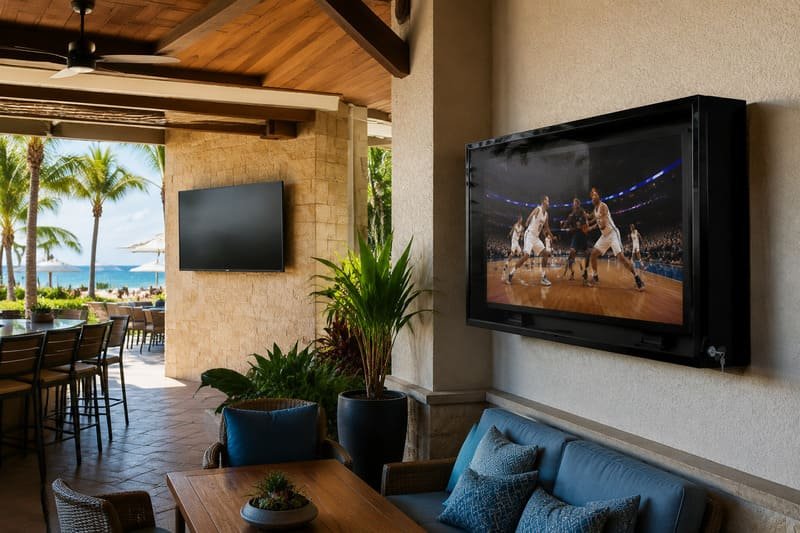
This is a useful point for larger projects.
- A hotel may not need the same solution in every location.
- A restaurant may have one full-sun hero screen and several shaded patio screens.
- A sports bar may run evening games where sunlight is not the main problem.
- A resort may have poolside zones, shaded lounge zones, and coastal exposure zones.
If every screen is treated the same, the buyer may overspend in some areas and under-protect others.
Mixed Strategy Matrix
| Site Zone | Better Direction May Be | Why |
|---|---|---|
| Full-Sun Hero Screen | Dedicated outdoor TV | Brightness and integrated thermal design matter most |
| Shaded Patio Side Screens | Regular TV + enclosure | Weather protection and replacement flexibility matter |
| Poolside but Shaded Area | Depends on splash, heat, and corrosion | Need material, hardware, and airflow review |
| Multi-Screen Sports Bar at Night | Regular TV + enclosure often worth reviewing | Lower sun exposure and future TV refresh flexibility |
| Outdoor Menu Board All Day | Commercial outdoor display may be safer | Uptime and readability may be the main requirement |
| Luxury Villa Feature Screen | Depends on design preference | Outdoor TV may look cleaner; enclosure may reduce replacement cost |
| Coastal Restaurant Patio | Often enclosure or mixed plan | Corrosion, hardware, and service access matter |
This approach is more realistic than forcing one answer.
The right strategy depends on the zone.
How Should Buyers Compare Cost Without Ignoring Replacement Risk?
Regular TV + enclosure can reduce cost, but only when the site fit is right. A low first price can become expensive if the screen is unreadable, overheats, or needs frequent service.
Cost saving is real only when the site fit is right. Buyers should compare the TV price, enclosure price, installation, service access, replacement path, downtime risk, and viewing performance. The cheapest first purchase is not always the best outdoor TV decision.
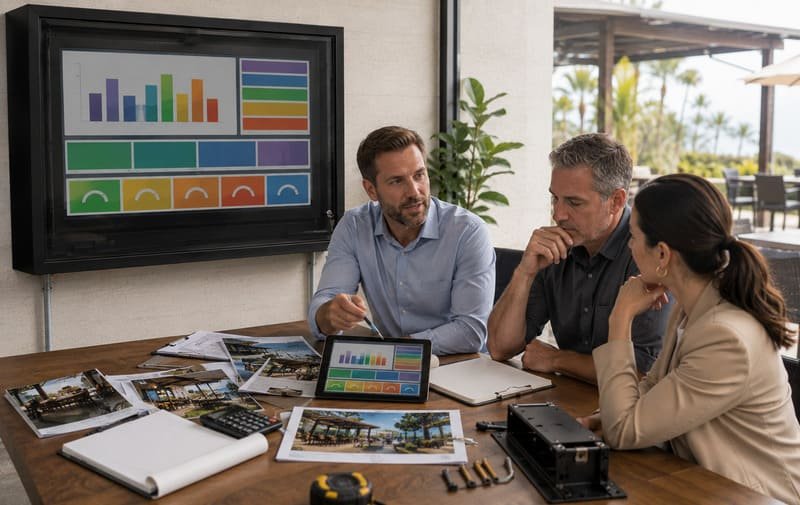
I separate cost savings from false savings.
A regular TV plus enclosure can reduce hardware cost, especially when the buyer already has preferred TV models or needs several screens. The enclosure can remain in place while the TV inside is replaced later, if the new TV still fits.
That is useful.
But I do not tell buyers to focus only on saving money.
- If the screen looks washed out in daylight, the customer experience suffers.
- If heat is trapped, service trouble follows.
- If the enclosure is too tight, future TV replacement becomes difficult.
- If the site needs all-day commercial uptime, a normal indoor TV may not be the right display module.
CIPS defines Total Cost of Ownership as an end-to-end cost view that includes purchase price, acquisition cost, usage cost, and end-of-life cost. CIPS Total Cost of Ownership
For this article, I would keep the cost discussion simple:
Do not compare only the screen price.
Compare the working system.
Cost and Risk Comparison
| Cost Factor | Regular TV + Enclosure | Dedicated Outdoor TV |
|---|---|---|
| Initial Hardware Cost | Often lower | Often higher |
| TV Replacement Flexibility | Often easier if enclosure still fits | Depends on model and product plan |
| Weather Protection | Comes from enclosure | Built into TV design |
| Bright Sunlight Viewing | Limited by TV panel | Often better |
| Heat Management | Depends on enclosure and installation | Designed as part of outdoor product |
| Service Approach | TV and enclosure are separate | Integrated product service |
| Project Risk | Fit, airflow, and site planning matter | Product selection and brightness class matter |
I see the strongest value when the site is shaded, the operating hours are moderate, and the buyer wants control over future TV replacement.
I see weaker value when the buyer needs the screen to perform like a full-sun commercial outdoor display.|
Frequently Asked Questions
Can a regular TV really replace an outdoor TV with an enclosure?
Yes, in some projects. A regular TV inside a suitable outdoor enclosure can replace an outdoor TV for shaded patios, covered terraces, moderate-use restaurant patios, and some budget-sensitive commercial projects. But it is not a full substitute for direct sun, high-brightness, all-day commercial use, or harsh heat exposure.
Does a waterproof enclosure make an indoor TV outdoor-rated?
No. The enclosure helps reduce outdoor exposure, but it does not change the TV manufacturer’s original design, intended-use category, or warranty terms. The TV remains an indoor TV inside a protective enclosure.
Can this setup work in direct sunlight?
I would be careful. The enclosure does not increase TV brightness or remove glare from the TV panel. Direct sun can also increase heat load. If clear daytime viewing is important, a dedicated outdoor TV or commercial outdoor display may be the safer choice.
Does an enclosure improve screen brightness or glare?
No. An enclosure protects the TV, but it does not make the TV panel brighter. It may include a clear front shield, but glare still depends on sun angle, screen finish, front-panel reflection, brightness, and viewing position.
Do waterproof TV enclosures need fans?
Many outdoor TV enclosures benefit from fan-assisted airflow, especially in warm, sunny, large-screen, or long-runtime installations. Fans help move warm air, but they are not air conditioning. Shade, internal clearance, vent access, and TV temperature guidance still matter.
Can restaurants and bars use regular TVs in enclosures?
Many can, especially shaded patios and evening-use areas. I still check operating hours, sun exposure, customer viewing expectations, heat, cable access, and public contact risk. If the screen must run all day in bright sun, I may recommend a dedicated outdoor TV or commercial outdoor display instead.
What should I measure before choosing an enclosure?
Measure the full TV width, height, depth, VESA pattern, cable port location, power plug direction, remote receiver position, and available wall space. The diagonal TV size alone is not enough.
When should I choose a dedicated outdoor TV instead?
Choose a dedicated outdoor TV when direct sunlight visibility, high brightness, integrated outdoor design, simplified procurement, or one-product outdoor rating matters more than replacement flexibility and lower first cost.
Conclusion
A regular TV in a waterproof enclosure can replace part of an outdoor TV.
But only part.
- It can replace the weather-protection layer.
- It can add a physical shell.
- It can protect cable paths.
- It can support airflow.
- It can make future TV replacement easier.
But it cannot turn a dim TV into a bright outdoor display.
- It cannot remove all glare.
- It cannot make direct sun disappear.
- It cannot rewrite the TV’s original intended use.
- It cannot make every hot, full-sun, all-day commercial site safe.
That is why I use a replacement boundary.
For shaded patios, covered restaurants, moderate-use bars, and many cost-sensitive projects, a regular TV inside a professional enclosure can be a practical and flexible solution.
For full-sun visibility, extreme heat, all-day commercial uptime, or premium integrated design, a dedicated outdoor TV or commercial outdoor display may be the better choice.
The best answer is not “yes” or “no.”
The best answer is:
Replace the outdoor protection layer when the site allows it. Do not expect the enclosure to replace the TV panel’s outdoor performance.
That is the decision that keeps the project practical, honest, and easier to maintain.