
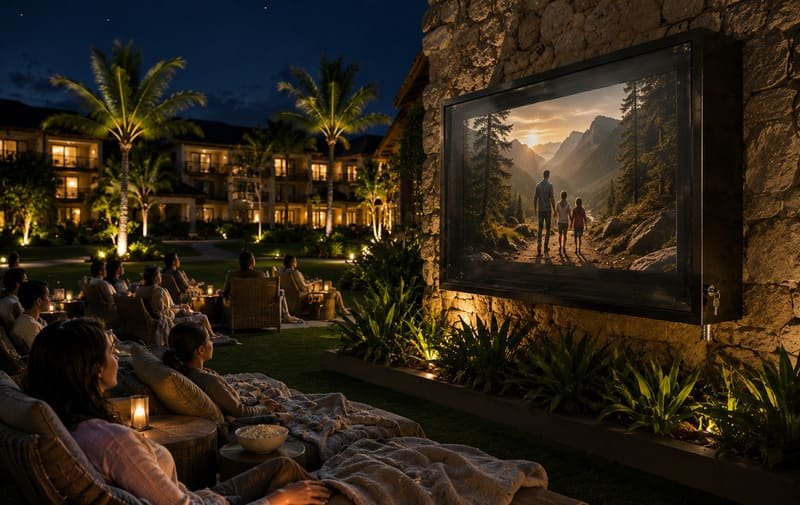
A resort outdoor theater starts before the movie begins.
Staff arrange seating. Guests arrive early. Food and drinks may already be served. The screen becomes part of the evening program, not just a piece of hardware on a wall.
That is why a resort outdoor theater needs a different protection plan from a normal patio TV. The enclosure is not only protecting the screen from rain. It is protecting the showtime window: the period when guests expect the movie, sports event, or resort program to work without a visible service problem.
When I review a resort outdoor theater project, I do not start with the enclosure size.
I start with the showtime plan.
- When does the screen run?
- Where do guests sit?
- Is the theater near a pool, beach, garden, rooftop, or restaurant terrace?
- Can staff access the media device?
- Where does rain or wind come from?
- What happens if weather changes one hour before the movie?
- If the screen fails, can the resort recover before the next event?
That is the difference between a simple outdoor TV setup and a resort outdoor theater.
A resort is not only buying a screen. It is planning a guest experience.
Last Updated: June 5, 2026 | Estimated Reading Time: 8 minutes
By Smith Chen, Outdoor TV Enclosure Engineer at Outvion
Why Is a Resort Outdoor Theater Different from a Patio TV?
A resort outdoor theater has a scheduled audience, staff routine, service expectation, and guest experience attached to the screen. That makes reliability more important than in a casual backyard setup.
A private patio TV can fail quietly. A resort outdoor theater fails publicly. Once guests are seated, food service is moving, and the evening program has started, a dark or unreadable screen becomes an operations problem, not just a hardware problem.
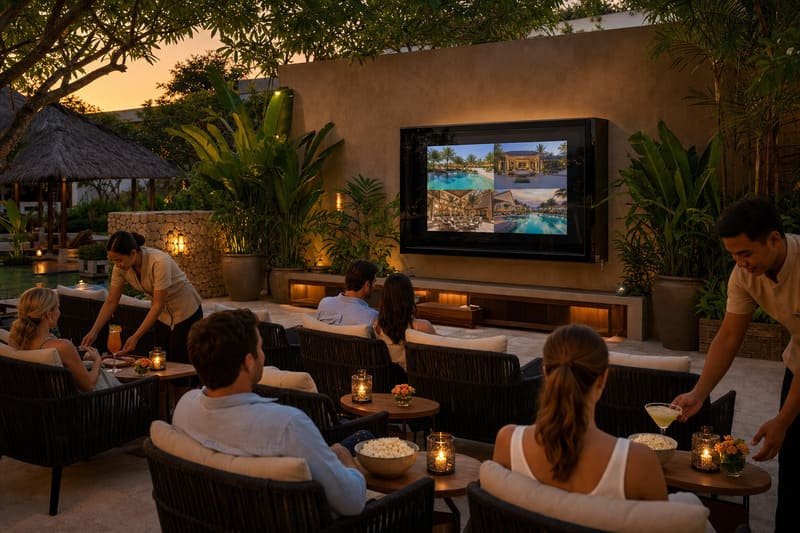
This is where many resort buyers underestimate the installation.
A backyard movie night can be postponed.
A resort program is different.
Guests may have seen the schedule.
Staff may have prepared the space.
The food and beverage team may already be serving.
Families may have walked from their rooms to the theater area.
The screen may be part of the resort’s evening entertainment value.
So the question is not only:
“Can this TV survive outside?”
The better question is:
“Can this screen stay ready during the guest showtime window?”
That changes how I think about protection.
Resort Showtime Reliability Map
| Showtime Risk | What Happens | Enclosure / Planning Priority |
|---|---|---|
| Weather Window Changes | Rain or wind arrives before showtime | IP-rated shell, protected cable exits, backup plan |
| Humid Night Air | Condensation risk may increase after sunset | Gasket design, airflow, inspection routine |
| Guest Movement | Guests walk near, touch, or bump the screen area | Front shield, lockable access, safe placement |
| Staff Service | Staff need to reset TV, media box, or cables | Door access, key control, cable labeling |
| Heat Before Sunset | Screen sits hot before evening show | Shade, fan-assisted airflow, vent cleaning |
| Replacement Need | Screen fails before the next event | Compatible spare TV, service access, fit review |
| Appearance Standard | Premium resort space must still look clean | Slim profile, clean cable routing, non-rusted hardware |
This is the main reason I separate resort outdoor theaters from ordinary outdoor TV installations.
The screen is part of a planned experience.
What Can Break the Showtime Experience?
Rain is only one way an outdoor theater can fail. Guest movement, humidity, heat, salt air, insects, cable access, media devices, and service delays can all interrupt the screening experience.
A resort outdoor theater can fail even if no heavy rain falls. A screen may overheat before sunset, a media cable may be exposed, humid air may collect overnight, salt air may attack hardware, or staff may not be able to open the enclosure quickly when something needs service.
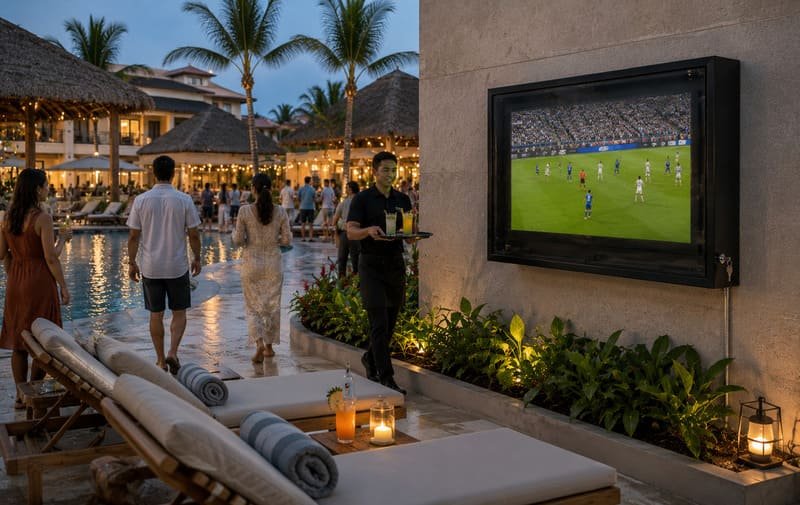
I prefer to look at the full showtime environment.
- A poolside movie area may face splash and guest movement.
- A beachfront cinema may face salt air, wind, and sand.
- A garden courtyard may face insects, dew, and light rain.
- A rooftop lounge may face wind, heat, and mounting stress.
- An indoor-outdoor restaurant screen may face staff movement and cleaning routines.
These are different theater zones.
They should not be treated as one generic outdoor screen project.
Resort Zone Matrix
| Resort Zone | Main Risk | Better Screen Strategy |
|---|---|---|
| Poolside Movie Area | Splash, humid night air, guest contact | Enclosure with front shield, airflow, corrosion-aware hardware |
| Beachfront Cinema | Salt air, wind, sand, humidity | Polycarbonate body, sealed cable exits, hardware inspection |
| Garden Courtyard | Insects, dew, light rain, evening moisture | Gasket, protected vents, fan access, service routine |
| Rooftop Lounge | Wind, heat, sun, mounting stress | Strong mount, shade planning, airflow path |
| Indoor-Outdoor Restaurant | Staff service path, cleaning, guest traffic | Lockable access, cable protection, wipeable front |
| Flagship Full-Sun Screen | High brightness need, heat, glare | Dedicated outdoor TV or commercial outdoor display may be safer |
| Multi-Screen Resort Program | Replacement and standardization pressure | Enclosure sizing plan, compatible spare TV strategy |
This matrix helps avoid a common mistake: choosing one display strategy for every resort zone.
A beachfront theater and a shaded garden theater may both need protection, but the reason is not the same.
Does a Covered Patio Actually Protect the Screen?
A covered patio helps, but it does not create an indoor environment. Wind-driven rain, humidity, dust, insects, heat, and salt air can still reach the screen over time.
A roof reduces direct rain exposure, but it does not seal the environment around a resort outdoor theater screen. Covered areas can still face angled rain, humid night air, condensation risk, dust, insects, heat buildup, guest contact, and cable exposure.
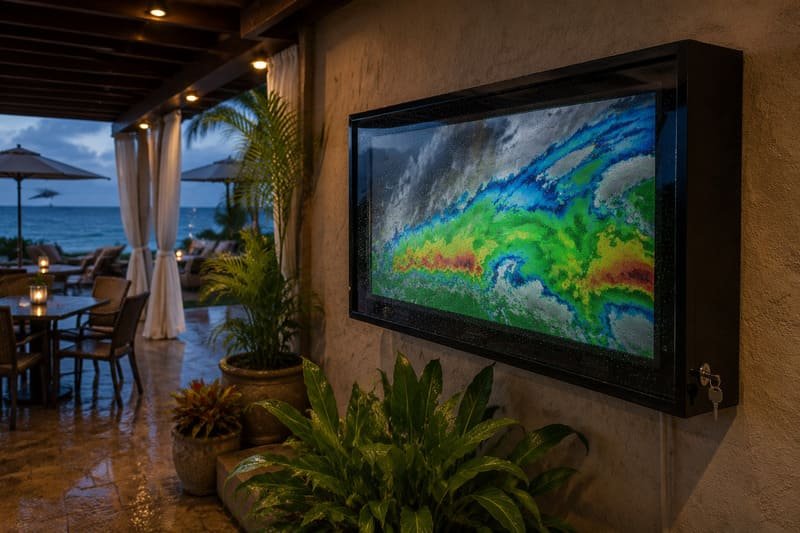
This is one of the most common questions I hear from resort and hotel buyers.
They describe a covered poolside bar, a gazebo, a pergola, or an open-air cinema under a large awning and ask:
“Is that enough?”
Sometimes it reduces risk enough for light use. But for long-term resort operation, I would not treat a covered area as the same as indoor space.
The National Weather Service explains that dew point is the temperature air must be cooled to in order to reach 100% relative humidity; if air cools further, water vapor may come out in liquid form. National Weather Service dew point explanation
That matters for evening theaters. A screen may be warm before sunset, then cool down at night while humid air remains around the installation.
For water and dust protection, IP rating is still useful. The International Electrotechnical Commission explains that IP ratings grade the resistance of enclosures against intrusion by dust and liquids. IEC IP Ratings
But IP rating has boundaries. IP65 can indicate dust-tight protection and protection against water jets under defined test conditions. It does not mean vapor-proof, condensation-proof, salt-proof, flood-proof, pressure-wash-proof, heat-proof, or maintenance-free.
Covered Patio vs. Enclosure Thinking
| Environmental Factor | What It Can Do to an Unprotected TV | Covered Area Protection | Enclosure Protection |
|---|---|---|---|
| Direct Rain | Water may reach vents, ports, and seams | Partial | Can help if IP-rated and correctly installed |
| Wind-Driven Rain | Moisture reaches from angles | Limited | Can help through sealing and cable protection |
| Salt Air | Can accelerate hardware corrosion | Low | Body may help; hardware still needs inspection |
| Humidity / Condensation | Moisture risk around ports and metal parts | Low | Can reduce direct exposure; not condensation-proof |
| UV Exposure | May affect plastics and front surfaces over time | Low to moderate | Depends on material grade and test data |
| Heat Buildup | May cause shutdown or shorter service life | Low | Fan-assisted airflow can help; not air conditioning |
| Dust / Insects | Can collect around vents and cables | Low | Can help if vents and cable exits are protected |
| Guest Contact | Touching, bumping, or cable access | Low | Front shield and lockable access can help |
The important point is not that an enclosure makes every outdoor theater risk disappear.
It does not.
The point is that a proper enclosure gives the resort a controlled layer between the TV and the outdoor theater environment.
Should Resorts Use Dedicated Outdoor TVs or TVs Inside Enclosures?
Dedicated outdoor TVs and indoor TVs inside enclosures can both make sense in resort projects. The right choice depends on the theater zone, brightness requirement, scale, budget, service access, and replacement strategy.
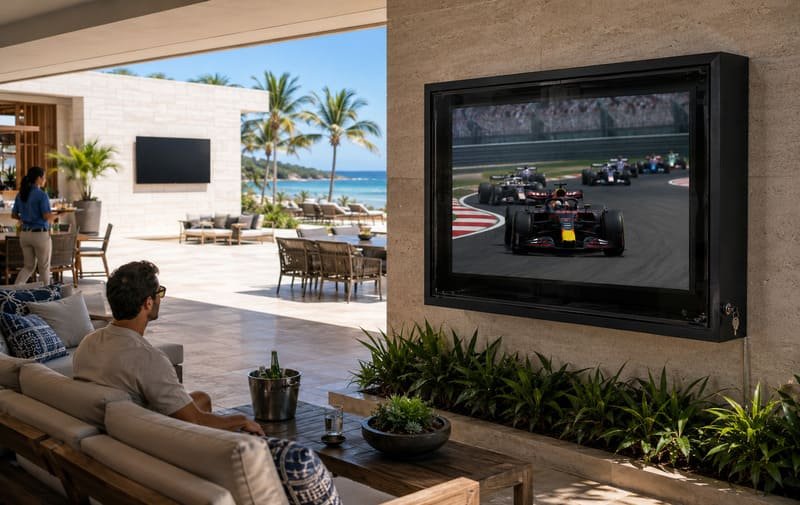
A dedicated outdoor TV may be better for one flagship full-sun screen where brightness and integrated outdoor design matter most. A standard TV inside a professional enclosure may be more practical for shaded or semi-covered resort theater zones where weather protection, physical protection, and future replacement flexibility matter.
I try not to turn this into a simple “which is better” argument.
Dedicated outdoor TVs can be a clean choice. Some models may offer outdoor-oriented brightness categories, weather protection, and a slimmer integrated appearance. For one high-visibility full-sun screen, that may be the right direction.
But resort projects often involve more than one screen or more than one zone.
- Poolside.
- Beach bar.
- Garden courtyard.
- Outdoor restaurant.
- Rooftop lounge.
- Event lawn.
Once a resort starts deploying multiple screens, the replacement logic changes. If the enclosure is designed for service access and the resort keeps a compatible spare TV, replacement may be faster than waiting for a specialized outdoor display model.
Compatibility still matters. LG explains that TV size is measured diagonally, so buyers should also check the full width, height, and depth of a specific model. LG TV size guide
A spare “55-inch TV” is not automatically a compatible replacement. The width, height, depth, VESA pattern, cable direction, and port position still need to match.
Resort Procurement Comparison
| Project Factor | Dedicated Outdoor TV | Standard TV + Enclosure |
|---|---|---|
| Full-Sun Brightness | Often stronger if the model is designed for full sun | Limited by the TV panel inside |
| Shaded Outdoor Theater | Can work | Often worth reviewing |
| Multi-Screen Resort Deployment | Can become costly across many zones | May be more manageable if fit is standardized |
| Replacement Workflow | Replace full outdoor unit | Replace inner TV if enclosure still fits |
| Service Access | Depends on TV and mount design | Can be planned through enclosure door and cable layout |
| Physical Protection | Depends on product and location | Front shield and lockable access can help |
| Appearance | Often slimmer | Depends on enclosure profile and installation |
| Custom Zone Planning | Less flexible | Enclosure can be configured by zone risk |
The enclosure approach is not always the better choice.
But for resorts with several shaded or semi-covered theater zones, it often deserves a serious review.
What Enclosure Features Matter for Resort Theater Zones?
A resort outdoor theater enclosure should be selected as a serviceable protection system, not just a waterproof box.
For resort outdoor theaters, the most important enclosure features are IP-rated sealing, fan-assisted airflow, front-panel clarity, corrosion-aware hardware, lockable access, cable protection, VESA compatibility, and enough service space for staff to reset, clean, inspect, or replace the TV.
From a product standpoint, I look at five details first.
- Can the enclosure reduce rain and dust exposure?
- Can heat escape?
- Can the front panel stay clear enough for viewing?
- Can staff open and service the unit?
- Can the material and hardware survive the resort environment?
Sony advises using TVs within a temperature range of 0°C to 40°C / 32°F to 104°F and avoiding direct sunlight. Sony TV temperature guidance
Fan-assisted airflow can help reduce heat buildup around the TV, but it is not air conditioning. Shade, internal clearance, vent cleaning, and the TV manufacturer’s guidance still matter.
For coastal resorts, hardware is just as important as the enclosure body. FEMA guidance on coastal construction notes that salt accumulation and high humidity can accelerate corrosion of untreated steel connectors and fasteners. FEMA coastal corrosion guidance
A polycarbonate body does not rust like steel, which removes one corrosion pathway. But locks, hinges, screws, anchors, cable exits, brackets, and wall mounts still need corrosion-resistant design and inspection.
Covestro describes Makrolon polycarbonate as robust, lightweight, glass-like in transparency, and impact resistant even at low temperatures. Covestro Makrolon polycarbonate
That makes polycarbonate useful for many enclosure designs, but actual performance still depends on grade, thickness, coating, optical clarity, UV stability, frame support, and installation.
Resort Theater Enclosure Feature Checklist
| Feature | Why It Matters in Resort Outdoor Theaters |
|---|---|
| IP-Rated Sealing | Helps reduce rain, splash, dust, and insects |
| Cable Exit Protection | Reduces weak points around power, HDMI, LAN, and media devices |
| Fan-Assisted Airflow | Helps manage heat before and during showtime |
| Front-Panel Clarity | Keeps the movie or event visible through the shield |
| Corrosion-Aware Hardware | Important for beachfront, poolside, and humid environments |
| Lockable Access | Helps reduce casual tampering and protects media devices |
| VESA Compatibility | Supports cleaner mounting and future TV replacement |
| Service Door Clearance | Lets staff inspect, reset, clean, or replace the TV |
| Large-Screen Fit Review | Important for outdoor theater sizes and replacement planning |
A resort enclosure should not only look durable in a product photo.
It should support the way the resort actually runs the outdoor theater.
What Should Staff Check Before Showtime?
The best enclosure still needs a simple operating routine. Resort outdoor theaters should have a short pre-show checklist so small problems are caught before guests arrive.
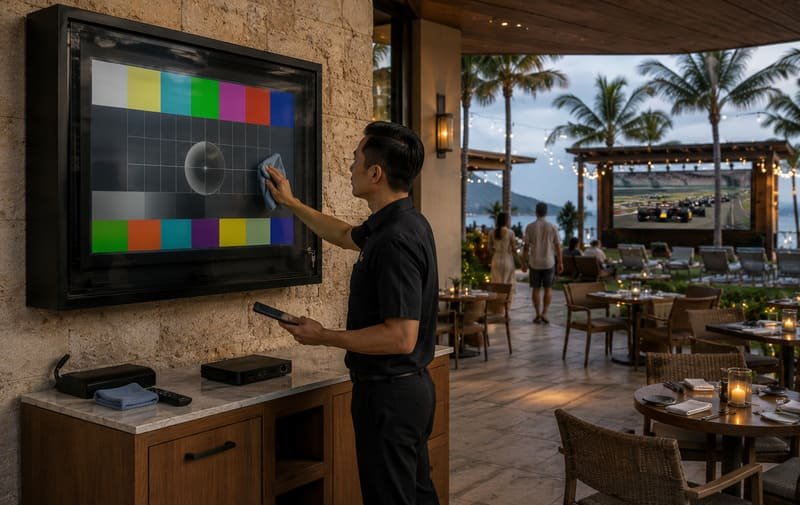
A resort outdoor theater should be checked before showtime, not only after something fails. Staff should confirm front-panel clarity, fan vents, cable connections, media device access, lock closure, weather direction, remote/control function, and backup options before the screening begins.
This is the part most product pages do not explain.
The enclosure protects the system, but staff routine protects the experience.
- A dirty front panel can reduce image clarity.
- A blocked vent can raise heat risk.
- A loose HDMI cable can stop the movie.
- A media box may need a reset.
- A lock left open can expose the TV and cables.
- A sudden wind direction change may bring rain from the side.
For a resort, the best time to find these problems is before the guests arrive.
Event-Day Maintenance Checklist
| Before Showtime | What Staff Should Check |
|---|---|
| Front Panel | Clean, clear, no heavy smudges or water marks |
| Fan Vents | Not blocked by dust, insects, leaves, or decorations |
| Media Device | Player, HDMI, network, and power are working |
| Remote / Control Access | Staff can control source, volume, and screen power |
| Locks and Doors | Enclosure is closed and locked after service |
| Weather Direction | Rain or wind is not blowing directly toward weak points |
| Cable Path | No exposed, loose, or pulled cables |
| Spare Plan | Compatible spare TV, cable, or media player available if event is critical |
This checklist is simple, but it matters.
A resort outdoor theater is an operational space, not just a mounted screen.
How Should Resorts Think About Total Cost?
The cost of a resort outdoor theater is not only the first screen or enclosure price. The real cost includes installation, service access, replacement planning, guest disruption, urgent parts, and staff time.
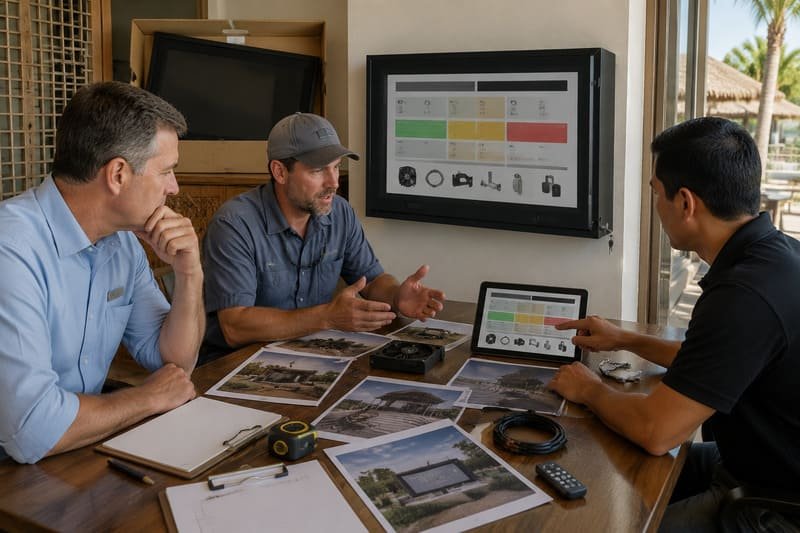
For resort buyers, total cost should include the full outdoor theater workflow: hardware, installation, maintenance, replacement, downtime, guest experience, and whether the same enclosure can support future compatible screens. The lowest first price is not always the lowest resort operating cost.
I keep this section shorter than a full TCO article, because this post is mainly about resort showtime reliability.
But cost still matters.
CIPS defines Total Cost of Ownership as an end-to-end cost view that includes purchase price, acquisition cost, usage cost, and end-of-life cost. CIPS Total Cost of Ownership
For resort outdoor theaters, that means the buyer should think beyond the first quote.
- How many screens are on the property?
- Can staff service the screen without calling a technician?
- Can the TV be replaced without replacing the enclosure?
- Are spare TVs available locally?
- Will a failed screen disrupt a scheduled guest event?
- Will rusted hardware or poor cable access create recurring maintenance issues?
Resort Outdoor Theater Cost Layers
| Cost Layer | Why It Matters |
|---|---|
| First Hardware Cost | TV, enclosure, mount, media device, cables |
| Installation Cost | Wall structure, power route, cable route, positioning |
| Service Cost | Cleaning, fan vent checks, lock/key control, inspection |
| Replacement Cost | Inner TV, media device, front panel, hardware |
| Downtime Cost | Missed screening, guest complaint, staff rescheduling |
| Urgent Freight | Fast replacement parts may cost more |
| Appearance Cost | Rust, scratches, cable clutter, or poor fit can hurt premium spaces |
For a resort, the enclosure is not only a protective housing.
It can become part of the property’s service and replacement strategy.
Frequently Asked Questions for Resort Buyer
Is a covered resort patio enough for an outdoor theater TV?
A covered patio helps reduce direct rain, but it is not the same as indoor space. Wind-driven rain, humid night air, insects, dust, heat, and guest contact can still reach the screen. For long-term resort use, I would usually review enclosure protection rather than relying only on a roof.
Can resorts use standard indoor TVs inside enclosures?
Yes, in some projects. A compatible standard TV inside a professional outdoor enclosure can work well in shaded or semi-covered resort theater zones. The TV still needs correct fit, airflow, cable clearance, and service access. The enclosure does not change the TV manufacturer’s original outdoor-use rating or warranty terms.
When should a resort choose a dedicated outdoor TV instead?
A dedicated outdoor TV may be better for a flagship screen in direct sun, a premium slim-design area, or a project where one integrated outdoor-rated product is preferred. It may also be better when daytime brightness is the main requirement.
What matters most for beachfront outdoor theaters?
Beachfront locations need extra attention to salt air, humidity, wind-driven rain, sand, and hardware corrosion. A polycarbonate body may remove one rust pathway, but locks, hinges, screws, brackets, cable exits, and mounts still need corrosion-aware design and inspection.
How should staff check the screen before showtime?
Staff should check front-panel clarity, fan vents, media player function, HDMI/network/power cables, remote or control access, locks, weather direction, and whether spare parts or backup cables are available for critical events.
Can very large screens be used in outdoor theater enclosures?
Yes, large-format outdoor theater enclosures can be practical, but they require careful fit review. The exact TV width, height, depth, VESA pattern, weight, cable direction, airflow path, and service clearance should be confirmed before ordering. Very large screens may need custom review.
Conclusion
A resort outdoor theater is not only a screen installation.
It is a scheduled guest experience.
The guests arrive.
The staff prepare the space.
The food and drink service may already be moving.
The movie, sports event, or resort program becomes part of the evening.
That is why protection should be planned around showtime reliability.
A good enclosure can help reduce weather exposure, protect cables, limit guest contact, support airflow, and make staff service easier. But it should not be described as a magic shield.
It does not remove every weather risk.
It does not make heat disappear.
It does not make every indoor TV suitable for every outdoor resort site.
It does not replace staff inspection or maintenance.
What it can do is more practical:
It can help the resort keep the screen ready during the hours when guests expect the show to work.
That is the real value of a resort outdoor theater TV enclosure.
Not just protecting the TV.
Protecting the showtime window.