
A restaurant patio TV does not live on a quiet outdoor wall. It lives in a service zone.
Servers carry drinks under it. Staff move chairs around it. Cleaning water passes near it. Guests touch the wall, kids run near the screen, and the TV may stay on for hours during sports nights.
For restaurants, outdoor TV protection is not only about waterproofing. It is about protecting the screen inside a working service zone where rain, splashes, cleaning routines, staff movement, guest contact, heat, cables, and maintenance all happen around the TV.
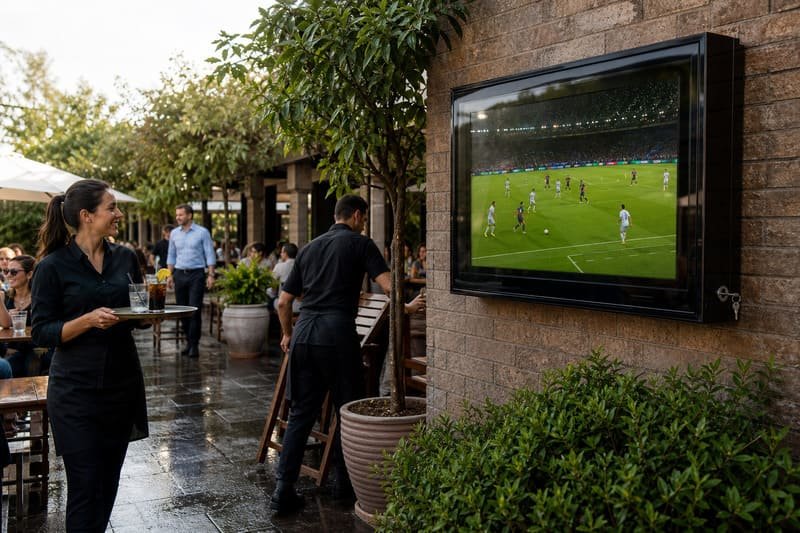
When a restaurant or bar buyer asks me how to protect an outdoor TV, I usually do not start with the TV size.
I start with the service path.
- Where do servers walk?
- Where does cleaning water go?
- Where do guests stand or lean?
- Where are tables moved after closing?
- Where can rain blow in from the roof edge?
- Where do cables enter the TV or enclosure?
- Can staff open the enclosure later without moving furniture?
A backyard TV mainly needs weather planning.
A restaurant patio TV needs weather planning and service-zone planning.
That difference changes the protection strategy.
Last Updated: May 28, 2026 | Estimated Reading Time: 8 minutes
By Smith Chen, Outdoor TV Enclosure Engineer at Outvion
Why Should Restaurants Start With a Service-Zone Risk Map?
A restaurant outdoor TV is surrounded by movement. It is not only exposed to rain. It is exposed to staff, guests, cleaning routines, furniture, wind, heat, and cable access.
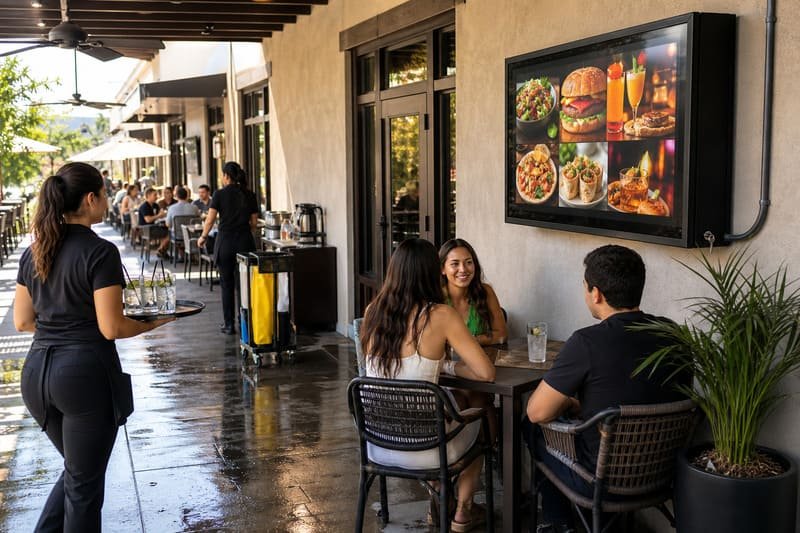
Restaurants should start with a service-zone risk map before choosing an outdoor TV or enclosure. A screen near a bar counter, poolside wall, rooftop terrace, or coastal patio faces different risks. The best protection plan comes from mapping where water, impact, heat, cables, and people reach the screen.
This is the part many buyers skip.
They ask, “Is it waterproof?”
But I ask, “Where is the TV actually working?”
- A TV above a patio dining wall may face guests, chairs, roof-edge rain, and insects.
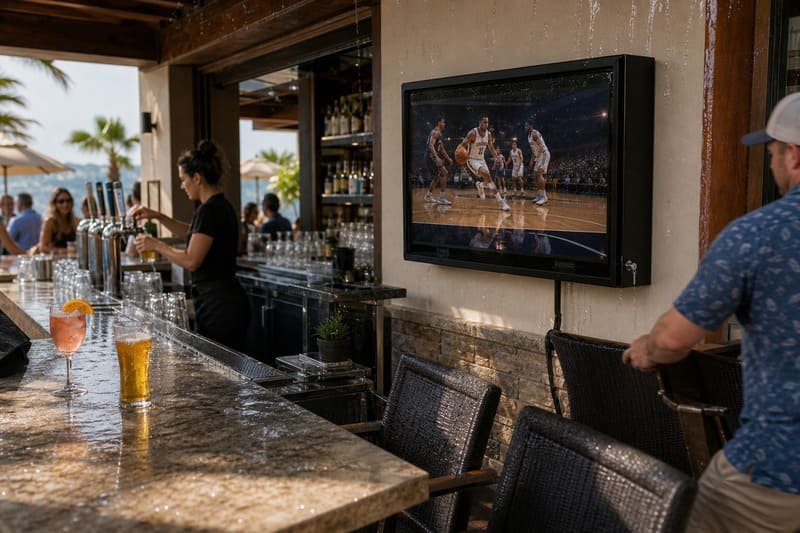
- A TV near a bar counter may face drink splashes, staff reach, and cable changes.
- A TV on a poolside bar may face splash, humidity, and guest movement.
- A TV on a rooftop terrace may face wind, sun, heat, and stronger mounting requirements.
- A TV near the coast may face salt-laden humid air and wind-driven rain.
Those are not the same installation.
Restaurant Service-Zone Risk Map
| Restaurant Zone | Common TV Risk | Protection Priority |
|---|---|---|
| Patio Dining Wall | Guests, chairs, roof-edge rain, insects | Front shield, weather sealing, lockable access |
| Bar Counter Area | Drink splash, staff reach, cable changes | Cable protection, wipeable front, service access |
| Poolside Bar | Splash, humid air, guest movement | Safe placement, sealed exits, corrosion-aware hardware |
| Rooftop Terrace | Sun, wind, mounting stress, heat | Shade, wall strength, airflow, secure mounting |
| Coastal Patio | Salt air, wind-driven rain, humidity | PC body, corrosion-resistant hardware, inspection |
| Cleaning Route | Hose spray, wet floors, moving furniture | Protected placement, staff cleaning routine |
| Public Walkway | Touching, tampering, accidental impact | Lock, front shield, mounting height |
The service-zone map helps prevent a common mistake: buying protection for “outdoor weather” while ignoring restaurant operation.
A patio TV does not fail only because of a storm. It can also be damaged by repeated small events: a chair hitting the wall, a cable being pulled, a cleaning routine changing, or a lock not being closed after service.
That is why I prefer to treat restaurant TV protection as an operational design problem, not only a product specification.
How Are Rain, Splash, and Impact Different Problems?
Rain, splash, and impact are often discussed together, but they are not the same risk. Each one reaches the TV in a different way and needs a different protection logic.
Rain protection is mainly about weather exposure and sealing. Splash protection is about cleaning, drinks, pools, and cable exits. Impact protection is about guests, staff, furniture, and public-area contact. A restaurant outdoor TV protection plan should separate these risks instead of treating them as one “waterproof” problem.
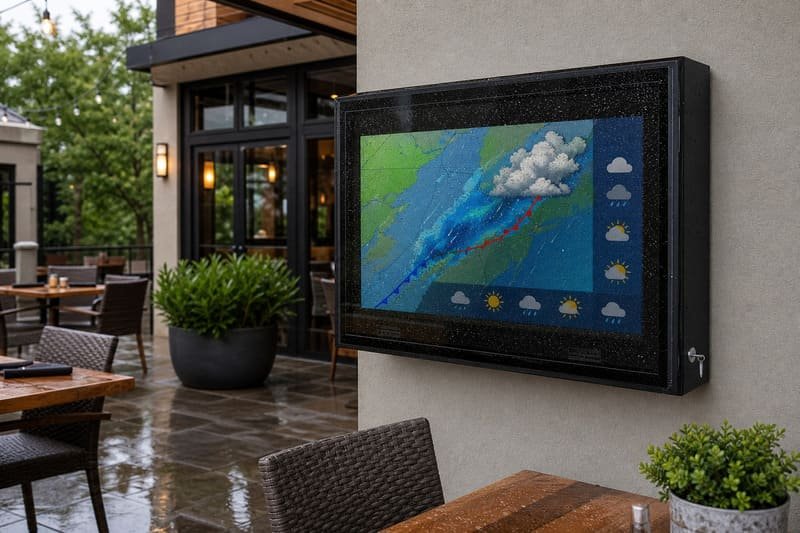
Direct rain is the easiest risk to picture. A screen on an open patio wall may face heavy rain during storms. Even under a roof, wind can push rain sideways under the roof edge.
Splash is different. Splash can come from a drink, pool area, wet cleaning floor, or nearby hose. It may not be heavy, but it may happen repeatedly.
Impact is different again. A guest may bump the screen. Staff may move furniture near the wall. A chair may hit the enclosure during cleaning. A child may throw a toy near the TV. None of these is a weather event, but all of them matter in a restaurant.
Moisture is also not always visible. The National Weather Service explains that dew point is the temperature air must be cooled to in order to reach 100% relative humidity; if air cools further, water vapor may come out in liquid form. National Weather Service dew point explanation
That is why a covered patio can still create moisture risk overnight, especially in humid or coastal locations.
Rain / Splash / Impact Are Different Problems
| Risk Type | What It Looks Like | Protection Logic |
|---|---|---|
| Rain | Storms, roof-edge drip, wind-driven rain | IP rating, gasket design, mounting angle, roof coverage |
| Splash | Cleaning water, drink splash, poolside exposure | Front shield, cable exits, placement away from direct spray |
| Humidity / Dew | Damp nights, morning condensation, coastal air | Sealing, airflow, inspection, cable routing |
| Impact | Guests, staff, chairs, toys, moving furniture | Polycarbonate front, secure mounting, safe placement |
| Heat | Sun + long runtime + tight enclosure | Shade, fan-assisted airflow, internal clearance |
| Access Risk | Ports, remotes, media boxes, cables | Lockable access, protected routing, staff control |
This table is more useful than asking only whether a TV is waterproof.
A screen that handles light rain may still be vulnerable to cleaning spray near cable exits.
A screen under a roof may still be vulnerable to chair impact.
A rigid front shield may protect against impact but still need airflow planning.
Restaurant protection needs all of these layers to work together.
Why Is IP65 Useful but Not Enough for Restaurant Patios?
IP ratings are useful because they make protection more specific than vague words like “waterproof.” But they do not describe the full restaurant environment.
IP65 can be a useful benchmark for restaurant outdoor TV enclosures because it indicates dust-tight protection and protection against water jets under defined test conditions. But IP65 does not mean vapor-proof, condensation-proof, chemical-proof, salt-proof, pressure-wash-proof, flood-proof, impact-proof, or maintenance-free.
The International Electrotechnical Commission explains that IP ratings grade the resistance of electrical and electronic enclosures against intrusion by dust and liquids. IEC IP Ratings
That makes IP rating important. I still want restaurant buyers to check it.
But I do not want them to stop there.
In a restaurant, real-world exposure can be messy:
- Wind-driven rain does not always hit from one direction.
- Cleaning water may be closer than expected.
- Cable exits may become weak points.
- Door gaskets may need inspection.
- Staff may open and close the enclosure during service.
- Fans and vents may collect dust, pollen, insects, or grease residue.
- The TV may run for long hours during sports nights.
If hose spray or pressure cleaning is used near the patio, the TV protection plan should keep the screen outside the direct spray path. IP ratings are defined test conditions, not a guarantee for every pressure-washing routine.
Heat also matters. Sony advises using TVs within a temperature range of 0°C to 40°C / 32°F to 104°F and avoiding direct sunlight. Sony TV temperature guidance
A fan-cooled enclosure can help move warm air away from the TV, but it is not air conditioning. Shade, vent clearance, TV model, operating hours, and maintenance still matter.
What IP65 Helps With and What It Does Not Solve
| Area | What IP65 Helps With | What Still Needs Planning |
|---|---|---|
| Rain / Dust | Helps reduce water-jet and dust intrusion under defined test conditions | Cable exits, gasket compression, installation angle |
| Cleaning Splash | May help with light splash exposure | Avoid direct pressure spray and chemical exposure |
| Humidity | Reduces direct exposure, but does not dry the air | Condensation risk, airflow, inspection |
| Heat | IP rating does not describe cooling | Fans, shade, internal clearance |
| Impact | IP rating is not an impact rating | Front panel material, mounting, location |
| Security | IP rating does not stop tampering | Locks, screws, cable control |
| Maintenance | IP rating is not maintenance-free | Gasket, fans, cable exits, hardware checks |
So my advice is simple: use IP65 as a protection baseline, not as the whole restaurant TV protection plan.
How Should Restaurants Plan Cleaning, Staff Access, and Guest Contact?
Restaurant TVs need a protection plan that staff can actually follow. A design that looks good on installation day may fail if cleaning, keys, cables, and access are not planned.
Restaurants should plan cleaning routines, staff access, and guest contact before installing outdoor TVs. The enclosure should be reachable for service, protected from direct cleaning spray, lockable against casual access, and placed where guests and furniture are less likely to hit the screen.
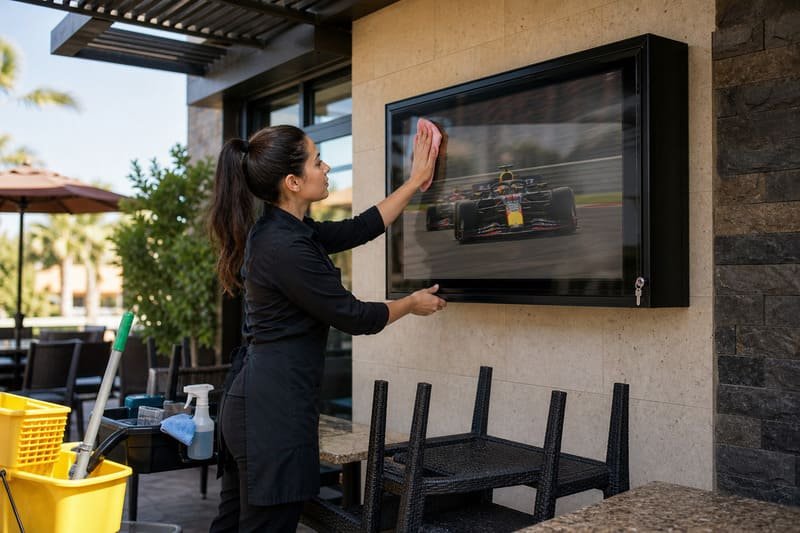
This is where restaurant projects are different from home patios.
In a restaurant, more people interact with the space.
Servers may need to move around the TV.
Cleaning staff may wash nearby floors.
A manager may need to reset a media box.
A guest may touch the screen or cables.
A technician may need to replace the TV later.
If the enclosure is hard to open, staff may take shortcuts.
If cable exits are exposed, someone may pull a cable.
If the TV is too close to a dining table, guests may touch the screen.
If the enclosure sits in the direct cleaning path, water exposure increases.
Polycarbonate can be useful for front protection. Covestro describes Makrolon polycarbonate as robust, lightweight, glass-like in transparency, and impact resistant even at low temperatures. Covestro Makrolon polycarbonate
That said, actual impact performance still depends on thickness, coating, mounting structure, enclosure design, and supplier test data. I do not treat “polycarbonate” as a magic word. I look at the whole front protection system.
Cleaning and Staff Routine Checklist
| Restaurant Routine | What to Avoid | Better Practice |
|---|---|---|
| Floor Cleaning | Aiming hose spray directly at the screen or cable exits | Keep spray path away from TV area |
| Pressure Washing | Treating IP rating as pressure-wash-proof | Protect or avoid the TV zone during cleaning |
| Wiping the Front Panel | Using harsh tools or chemicals without guidance | Use appropriate soft cleaning methods |
| Moving Furniture | Pushing chairs or tables into the enclosure | Keep a clear buffer zone |
| Opening the Enclosure | Leaving the door or lock unfinished after service | Assign key control and closing routine |
| Cable Adjustments | Pulling HDMI or power cables without checking exits | Route and label cables cleanly |
| Fan Vent Cleaning | Forgetting dust, pollen, insects, or grease buildup | Inspect vents on a schedule |
Impact-resistant front protection can help reduce screen damage and safety risk in high-traffic areas, but it does not replace safe placement, secure mounting, staff training, and local compliance review.
For restaurants, I like protection that is simple enough for staff to maintain.
A complicated setup may look impressive, but if nobody can open, clean, inspect, or close it correctly, long-term reliability suffers.
Should Restaurants Choose a Dedicated Outdoor TV or a Protective Enclosure?
Dedicated outdoor TVs and protective enclosures solve related problems, but they fit different restaurant situations. The best choice depends on exposure, brightness, impact risk, replacement strategy, and service access.
A dedicated outdoor TV may be better for one full-sun flagship screen or a buyer who wants an integrated outdoor-rated product. A protective enclosure may be better for restaurants that want to use standard TVs, control replacement cost, add physical protection, and keep the outdoor protection layer separate from the screen inside.
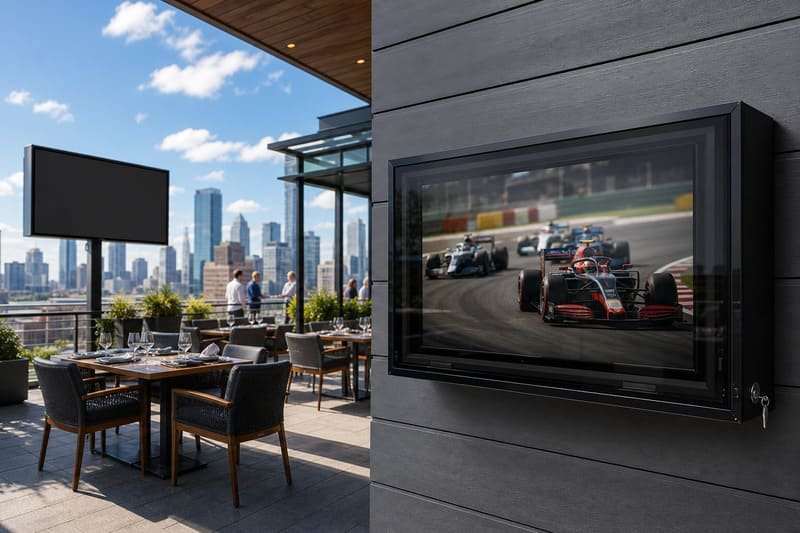
I try to keep this decision balanced.
Dedicated outdoor TVs can be a clean solution. They are built as outdoor products, may offer high brightness options, and can reduce compatibility questions. For one premium screen in a high-visibility area, that can make sense.
But restaurants often think in multiple screens.
A sports bar may need several TVs.
A patio dining area may need two or three viewing zones.
A hotel restaurant may want matching screens across a pool bar and terrace.
A chain restaurant may want a repeatable installation method.
In those cases, a protective enclosure can be useful because the enclosure becomes the long-term protection shell, while the TV inside can be replaced later if needed.
CIPS defines Total Cost of Ownership as an end-to-end cost view that includes purchase price, acquisition cost, usage cost, and end-of-life cost. CIPS Total Cost of Ownership overview
That is the right way to compare restaurant screen strategies. Do not compare only the first TV price. Compare installation, replacement, service, downtime, cleaning routines, and future upgrades.
Dedicated Outdoor TV vs Protective Enclosure
| Restaurant Need | Dedicated Outdoor TV May Fit | Protective Enclosure May Fit |
|---|---|---|
| One full-sun hero screen | Strong option if brightness is the priority | Possible, but thermal and brightness checks matter |
| Several shaded patio screens | Can become expensive across units | Often useful for replacement flexibility |
| High guest contact area | Depends on screen and mount | Front shield and lockable access can help |
| Fast single-screen install | Fewer compatibility checks | Needs TV/enclosure fit review |
| Future TV replacement | Replace full unit | Replace TV if enclosure still fits |
| Public-area cable control | Depends on installation | Cable exits and locks can be planned |
| Premium slim design | Often cleaner | Depends on enclosure profile |
| Budget-sensitive multi-screen project | May be harder | Often worth reviewing |
I would not say one is always better.
The dedicated outdoor TV is the integrated product route.
The protective enclosure is the modular protection route.
The restaurant should choose based on site risk, number of screens, viewing time, service routine, and long-term replacement plan.
What Should Buyers Check Before Installation?
The best time to solve outdoor TV protection problems is before installation. Once the screen is on the wall, access, cables, spray paths, and maintenance problems become harder to fix.
Before installing outdoor TVs in restaurants, buyers should check rain direction, splash exposure, guest contact, cleaning paths, cable exits, mounting strength, sun exposure, airflow, TV dimensions, lock access, service clearance, and replacement workflow. A good plan protects both the screen and the restaurant operation around it.
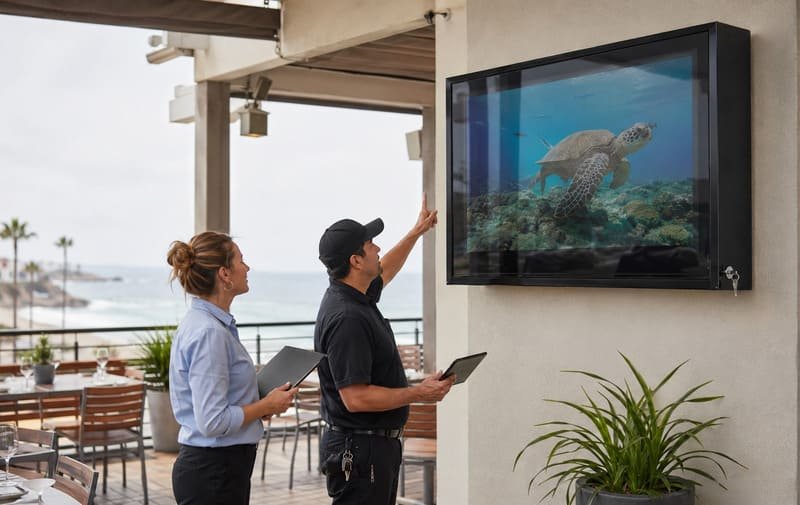
When I review a restaurant TV project, I prefer to see site photos before final recommendation.
Photos show what a spec sheet cannot show.
- They show the roof edge.
- They show the cleaning path.
- They show the tables and chairs.
- They show where guests stand.
- They show where the sun hits.
- They show whether staff can open the enclosure.
- They show whether cables will enter from above, behind, or below.
For coastal patios, hardware matters. A polycarbonate body does not rust like steel, which removes one corrosion pathway. But locks, hinges, screws, anchors, cable exits, and wall mounts still need corrosion-resistant design and inspection.
FEMA guidance on coastal construction notes that salt accumulation and high humidity can accelerate corrosion of untreated steel connectors and fasteners. FEMA coastal corrosion guidance
Restaurant Outdoor TV Installation Checklist
| Check | What to Confirm | Why It Matters |
|---|---|---|
| Rain Direction | Direct rain, roof-edge drip, wind-driven rain | Prevents wrong wall choice |
| Cleaning Path | Hose, mop, pressure-wash zone, furniture movement | Reduces splash and impact risk |
| Guest Contact | Seating distance, walkways, children, public access | Helps decide height, lock, and front shield |
| TV Fit | Width, height, depth, VESA, cable direction | Prevents tight fit and cable stress |
| Cable Exits | Power, HDMI, network, media player | Common weak point in real installation |
| Fan / Vent Clearance | Intake and exhaust paths stay open | Supports heat management |
| Sun Exposure | Afternoon sun, rooftop heat, glare | Affects brightness and cooling |
| Mounting Surface | Wall strength, bracket, vibration, access | Supports safe installation |
| Lock Access | Staff can open and close correctly | Reduces shortcuts and tampering |
| Service Clearance | Room to open, clean, reset, replace | Reduces future labor cost |
| Coastal / Poolside Risk | Salt air, humidity, splash, cleaning routines | Guides material and inspection plan |
This checklist is not only about protecting the TV.
It protects the restaurant from repeated service interruptions, messy wiring, unsafe access, and future replacement problems.
Frequently Asked Questions
Can a restaurant TV under a roof still need protection?
Yes. A roof helps reduce direct rain, but it does not remove wind-driven rain, humidity, cleaning spray, dust, insects, heat, guest contact, or cable exposure. A covered patio should still be treated as an outdoor environment.
Is IP65 enough for restaurant outdoor TVs?
IP65 can be a useful baseline because it indicates dust-tight protection and protection against water jets under defined test conditions. But restaurant patios also involve cleaning routines, guest contact, heat, cable exits, and maintenance. IP65 is not the whole protection plan.
How should restaurants handle cleaning spray around outdoor TVs?
Keep hose spray and pressure cleaning away from the screen, cable exits, locks, and fan vents whenever possible. Staff should avoid spraying directly at the TV or enclosure. After cleaning, inspect the front panel, gaskets, cable exits, and vents.
What protects outdoor TVs from guest or staff impact?
A hard enclosure with a quality polycarbonate front panel, secure mounting, rounded or protected edges, and lockable access can help reduce impact risk. Placement still matters. The TV should not sit where chairs, carts, or guests regularly hit it.
Can restaurants use a standard indoor TV inside an enclosure?
Yes, many restaurants use standard indoor TVs inside suitable outdoor TV enclosures. The TV must fit correctly, have airflow space, and be protected from rain, splash, heat, dust, and public access. The enclosure does not change the original TV manufacturer’s outdoor-use rating or warranty terms.
When is a dedicated outdoor TV better?
A dedicated outdoor TV may be better for one full-sun flagship screen, a premium slim installation, or a buyer who wants one integrated outdoor-rated product with fewer compatibility checks. A protective enclosure may be better for multi-screen patios, physical protection, and future TV replacement flexibility.
How often should restaurant outdoor TV enclosures be inspected?
Inspection frequency depends on exposure. Busy patios, coastal restaurants, poolside bars, dusty areas, and high-traffic locations should be checked more often. Inspect front panels, locks, hinges, cable exits, fan vents, gaskets, and mounting hardware.
Do restaurant outdoor TVs need fans?
In hot, sunny, or long-use locations, fan-assisted airflow is often useful. Fans help move warm air away from the TV, but they are not air conditioning. Shade, vent clearance, TV model, operating hours, and cleaning access still matter.
Conclusion
Restaurant outdoor TV protection starts with a simple truth:
The TV is not only outdoors.
It is inside a working service zone.
- Rain may reach it.
- Cleaning water may pass near it.
- Guests may touch the wall.
- Staff may move chairs around it.
- Cables may need service.
- Heat may build during long sports nights.
- Salt air may attack hardware near the coast.
- A technician may need access later.
That is why a restaurant should not choose protection by the word “waterproof” alone.
The better approach is to map the restaurant zone first.
- Where does water come from?
- Where do people move?
- Where do cables enter?
- Where does heat build?
- Where can staff open and inspect the unit?
After those answers are clear, the product choice becomes easier.
A dedicated outdoor TV can be the right answer for some flagship locations.
A protective enclosure can be the right answer for many service-heavy patios.
A mixed strategy may be the best answer for restaurants with multiple screens.
The right setup is not the one that looks strongest in a catalog.
It is the one that matches the restaurant’s rain path, splash path, impact path, cleaning routine, heat load, and long-term service plan.