
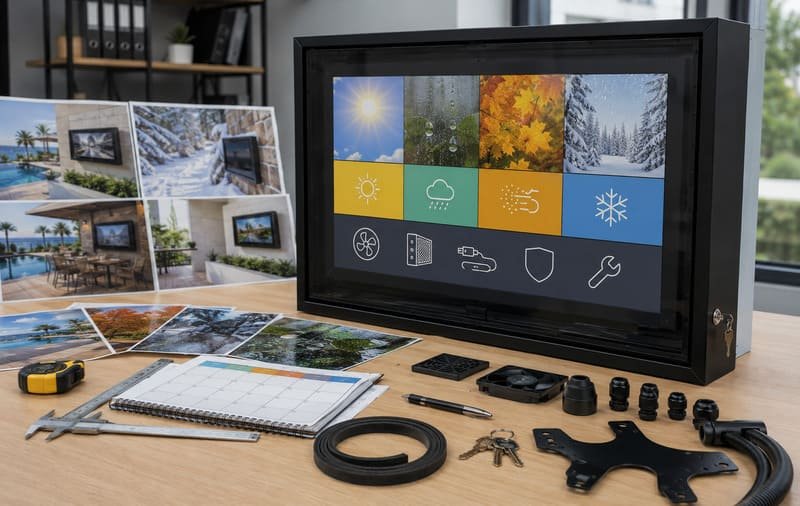
A year-round outdoor TV does not face one big problem.
It faces hundreds of small ones.
- One hot afternoon.
- One humid night.
- One forgotten cover.
- One dusty week.
- One storm from the side.
- One cable opening that was never checked.
- One winter morning when nobody wants to remove, dry, and reinstall a cover.
That is why permanent TV protection matters for year-round outdoor use. The real issue is not whether a cover can protect a TV once. The issue is whether the protection plan still works after months of weather, handling, heat, dust, access, and maintenance.
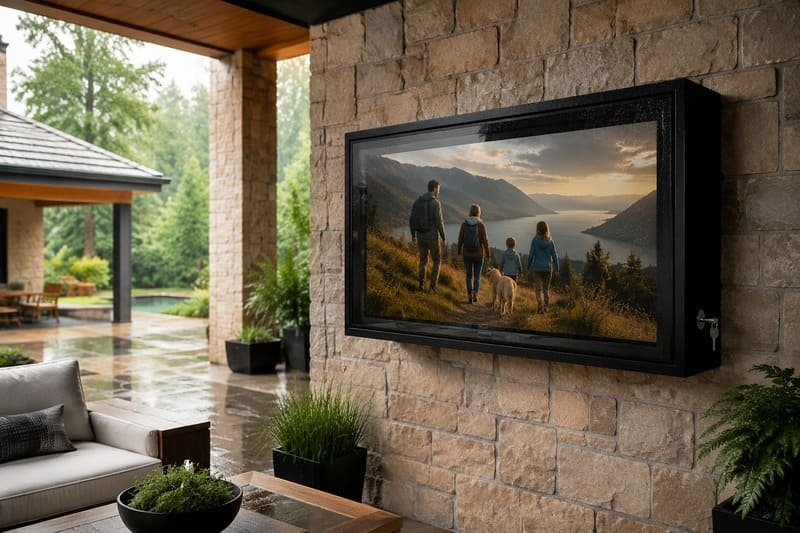
When I review a year-round outdoor TV project, I do not start with the cover or the enclosure.
I start with the calendar.
- What happens to this screen in summer?
- What happens during rainy season?
- What happens after closing hours?
- What happens when dust, insects, humidity, or salt air build up slowly?
- What happens when staff forget one small daily step?
- What happens when the TV needs service in winter?
A temporary cover may work for occasional outdoor use. A dedicated outdoor TV may work when the buyer wants one finished outdoor-rated product. A permanent enclosure becomes more important when the TV stays fixed outdoors through daily exposure, seasonal changes, and repeated use.
For year-round outdoor TV protection, the question is not only:
“Will this survive one storm?”
The better question is:
“Can this setup manage the full outdoor calendar?”
Last Updated: June 15, 2026 | Estimated Reading Time: 8 minutes
By Smith Chen, Outdoor TV Enclosure Engineer at Outvion
Why Is Year-Round Exposure Different from Occasional Outdoor TV Use?
Occasional outdoor TV use is about single events. Year-round outdoor TV use is about exposure that repeats day after day.
A TV used outdoors a few times per month can often rely on handling routines, temporary covers, or indoor storage. A TV fixed outside all year needs a different plan because rain, sun, heat, dust, humidity, insects, access risk covers, cleaning routines, and service needs keep returning even when the TV is not being watched.
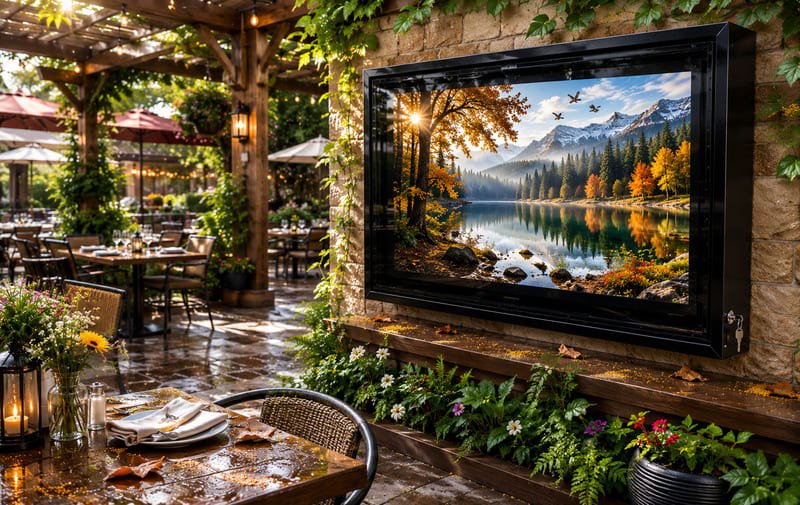
This is the part many buyers underestimate.
A cover may feel simple because it solves the problem in one moment. Rain is coming, so someone covers the TV. The TV is not being used, so someone covers it. The patio closes, so someone covers it.
That can work when the TV is used occasionally and one person is responsible.
But year-round outdoor use is different.
The TV stays outside through heat, humidity, night air, dust, pollen, insects, wind, cleaning routines, guests, staff schedules, and seasonal weather. The risk is not one dramatic event. It is the repetition of small exposures.
365-Day Exposure Cycle
| Exposure Cycle | What Happens Over Time | Why Temporary Covers Struggle |
|---|---|---|
| Daily Sun | Heat and glare repeat through the season | Cover is removed during use |
| Night Humidity | Damp air collects after sunset | Cover may trap moisture if used incorrectly |
| Weekly Dust / Pollen | Buildup can collect around vents and front surfaces | Cover only helps when installed correctly |
| Seasonal Storms | Wind-driven rain changes direction | Cover may shift, flap, or leave gaps |
| Winter Snow / Ice | Front surface and vents may become blocked | Cover needs removal, drying, and storage |
| After-Hours Access | TV remains visible and reachable | Soft cover offers little access control |
| Cleaning Routine | Staff may spray, wipe, move furniture, or open the area | Cover depends on consistent human behavior |
| Service Cycle | TV, cables, fans, and mounts need inspection | Permanent enclosure supports controlled access |
This is why I think “year-round” should change the buying decision.
The TV is not just outside.
It is living outside.
Why Do Temporary Covers Become Harder to Manage Over Time?
Temporary covers can be useful, but they depend heavily on human routine. The more often the TV is used, the harder that routine becomes.
A soft cover can make sense for occasional outdoor use, especially in covered or low-risk spaces. But for year-round fixed screens, it depends on someone removing, storing, reinstalling, drying, and checking the cover correctly every time. In busy homes, restaurants, resorts, schools, or shared spaces, that routine often becomes the weak point.
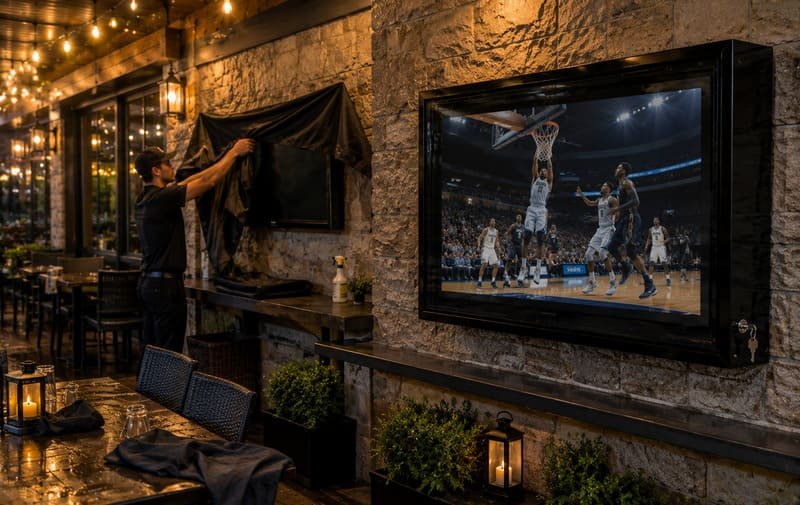
I do not think soft covers are useless.
They have a place.
A homeowner who rolls a TV out for a weekend game may use a cover successfully. A covered porch with very light exposure may not need a full enclosure. A TV that returns indoors after use has a different risk profile.
But a fixed year-round TV is a different project.
In commercial spaces, staff are busy. In restaurants, someone closes late. In resorts, different people may operate the same screen. In schools or public spaces, the TV may be reachable when no single person is watching it. In homes, people simply forget.
The cover routine sounds easy until it has to work every day.
Temporary Routine vs. Permanent Infrastructure
| Decision Point | Temporary Cover Routine | Permanent Enclosure Infrastructure |
|---|---|---|
| Who Protects the TV? | A person remembers the cover | The protective structure stays in place |
| During Viewing | TV is exposed while cover is removed | TV remains behind the front panel |
| After Closing / Use | Staff or owner must cover correctly | Staff lock and power down as planned |
| Bad Weather | Cover may flap, shift, or collect water | Enclosure stays mounted |
| Public Access | Little access control | Lockable access can help |
| Cable Protection | Often still exposed | Cable exits can be planned and protected |
| Long-Term Replacement | No fixed protective shell | Shell may support future TV replacement |
| Daily Consistency | Depends on behavior | Depends more on installation and maintenance |
A permanent enclosure does not remove all responsibility. It still needs cleaning, inspection, cable checks, fan maintenance, and correct installation.
But it reduces one of the biggest risks in year-round use: daily human handling.
That matters.
What Protection Layers Should Stay in Place All Year?
Permanent protection works best when it is treated as a system, not just a waterproof box.
Year-round outdoor TV protection should combine IP-rated sealing, fan-assisted airflow, front-panel protection, cable exit control, lockable access, corrosion-aware hardware, proper mounting, and a service routine. No single feature solves every outdoor risk.
I do not like reducing outdoor TV protection to one word.
“Waterproof” is not enough.
“Strong” is not enough.
“Covered” is not enough.
“Outdoor-rated” is not enough.
For water and dust protection, IP rating is useful because it gives buyers a defined reference. The International Electrotechnical Commission explains that IP ratings grade the resistance of enclosures against intrusion by dust and liquids. IEC IP Ratings
For many outdoor TV box projects, IP65 can indicate dust-tight protection and protection against water jets under defined test conditions. But it does not mean vapor-proof, condensation-proof, snow-proof, salt-proof, flood-proof, pressure-wash-proof, heat-proof, theft-proof, or maintenance-free.
Heat is another year-round concern. A TV can face heat during use, sunlight before use, and trapped warm air after installation. Sony advises using TVs within a temperature range of 0°C to 40°C / 32°F to 104°F and avoiding direct sunlight. Sony TV temperature guidance
Fan-assisted airflow can help reduce heat buildup, but it is not air conditioning. Shade, internal clearance, vent cleaning, operating hours, wall temperature, and the TV manufacturer’s guidance still matter.
Permanent Protection Layers
| Protection Layer | What It Helps Manage | What Still Needs Checking |
|---|---|---|
| IP-Rated Sealing | Rain, splash, dust, insects | Cable exits, gaskets, door pressure, installation angle |
| Fan-Assisted Airflow | Heat buildup during use | Shade, vent clearance, cleaning, operating hours |
| Front Panel Protection | Direct contact, splash, dust, light impact | Clarity, glare, coating, cleaning routine |
| Cable Exit Control | Water, dust, insects, cable strain | Bend space, seals, service access |
| Lockable Access | Casual opening and public access | Key control, staff routine, mounting security |
| Corrosion-Aware Hardware | Coastal, poolside, humid exposure | Locks, hinges, screws, brackets, anchors |
| Proper Mounting | Weight, vibration, wall safety | Wall structure, anchors, VESA fit |
| Service Routine | Long-term usability | Inspection schedule and replacement access |
A good permanent box is not only a shell around the TV.
It is a year-round protection layer that still allows the TV to be used, serviced, cleaned, and replaced.
How Does Permanent Protection Change Daily Use and Staff Routine?
A product that is strong but inconvenient can still fail in real life. Daily use matters.
A properly installed permanent enclosure can make year-round outdoor TV use more consistent because the TV usually stays inside the enclosure during viewing. Users do not need to remove and reinstall a cover each time, although they still need cleaning, inspection, weather-aware operation, and controlled access.
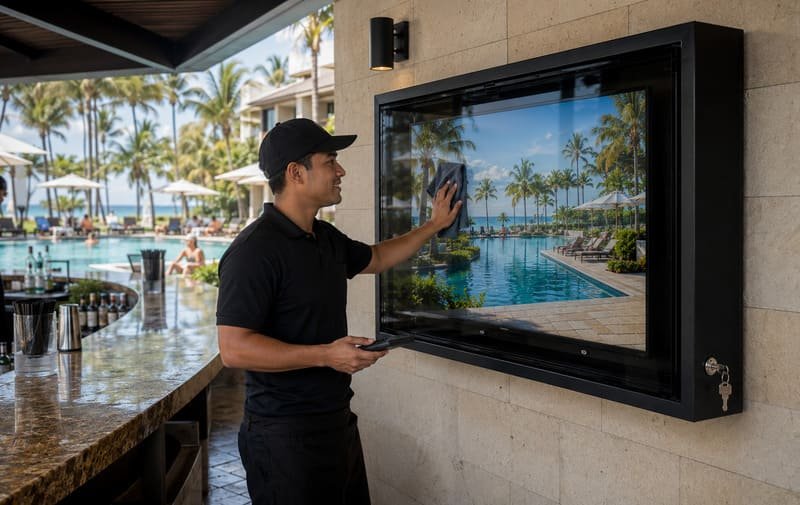
Many buyers picture an enclosure as a box that must be opened every time someone wants to watch TV.
That is usually not how a fixed outdoor TV enclosure is used.
The TV stays inside. Viewers watch through the transparent front panel. Staff open the cabinet mainly for installation, service, cleaning, media device access, cable changes, or TV replacement.
That changes the daily workflow.
For a homeowner, it means less handling.
For a sports bar, it means fewer closing steps.
For a resort, it means staff do not need to move covers around after every event.
For a school or public area, it means access can be controlled more easily.
Daily Use Comparison
| Daily Task | Soft Cover | Permanent Enclosure |
|---|---|---|
| Start Watching | Remove cover first | Usually watch through front panel |
| After Closing | Put cover back correctly | Lock and power down as planned |
| Bad Weather | Cover may need extra checking | Enclosure remains fixed |
| Staff Training | Repeated cover handling | Opening, locking, cleaning, inspection rules |
| Public Access | Cover offers little access control | Locking can help reduce casual access |
| Cable Protection | Cables may still be exposed | Cable exits can be protected |
| Long-Term Service | No structured service access | Door access can be planned |
Snow and winter conditions need careful wording.
I would not treat the TV’s own heat as a winter protection system. In freezing or snowy conditions, performance depends on the TV model, operating temperature guidance, storage limits, moisture, airflow, and whether snow or ice blocks the front panel or vents.
Sony states that TVs can be stored between -4°F and 140°F and 20–90% relative humidity, but storage guidance is not the same as outdoor operating guidance. Sony TV storage temperature guidance
For winter use, the buyer still needs a realistic plan: front clearance, safe access, snow removal, vent inspection, and local temperature review.
What Should Buyers Check Across Seasons?
Year-round protection should be selected by season, not only by product label. Summer, winter, rainy season, and coastal exposure all create different problems.
Before choosing permanent TV protection, buyers should check summer heat, winter access, rainy-season water direction, coastal or poolside corrosion risk, dust and pollen buildup, insect entry, cable exits, fan cleaning, and service access. A permanent enclosure should be planned for the full year, not only installation day.
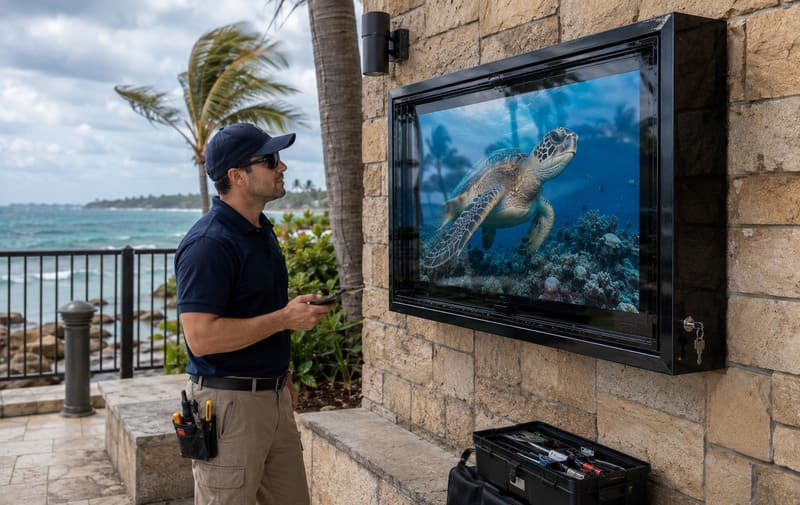
This is the most practical way to think about permanent protection.
Do not only ask whether the cabinet looks strong in a product photo.
Ask what happens across the calendar.
Before summer, heat and airflow matter.
Before rainy season, seals and cable exits matter.
Before winter, access and snow clearance matter.
In coastal areas, hardware inspection matters.
After service opening, gasket pressure and lock closure matter.
For coastal sites, I pay special attention to small metal parts. Salt accumulation and high humidity common in coastal areas can accelerate corrosion of untreated steel connectors and fasteners, according to FEMA guidance on coastal construction. FEMA coastal corrosion guidance
A polycarbonate body does not rust like steel, which removes one corrosion pathway at the enclosure body level. But locks, hinges, screws, anchors, brackets, cable exits, and wall mounts still need corrosion-resistant design and inspection.
Covestro describes Makrolon polycarbonate as robust, lightweight, glass-like in transparency, and impact resistant even at low temperatures. Covestro Makrolon polycarbonate
That makes polycarbonate useful for many enclosure designs, but material choice does not replace inspection.
Year-Round Maintenance Calendar
| Timing | What to Check |
|---|---|
| Weekly | Front panel clarity, dust, insects, lock condition |
| Monthly | Fan vents, cable exits, gasket condition, hinge movement |
| Before Rainy Season | Door closure, cable seals, drainage path, roof-edge water direction |
| Before Summer | Fan airflow, shade, wall heat, internal clearance |
| Before Winter | Snow clearance plan, access path, operating/storage guidance |
| After Storms | Mounting, water marks, cable exits, front panel, hardware |
| After Service Opening | Door closure, gasket pressure, lock, cable routing |
| Coastal / Poolside Review | Locks, hinges, screws, anchors, brackets, corrosion signs |
This calendar-style thinking is what makes the article different from a normal cover comparison.
Year-round protection is not only about what you buy.
It is about what stays reliable after months of outdoor conditions.
How Should Buyers Think About Long-Term Cost and TV Replacement?
The first price matters, but year-round outdoor TV projects should also consider maintenance, downtime, service access, and future TV replacement.
Permanent protection can improve long-term cost control when the enclosure remains part of the site and the TV inside can be replaced later. But this only works if the replacement TV fits the enclosure, VESA pattern, cable direction, depth, airflow needs, and service plan.
I do not claim that every dedicated outdoor TV is a poor purchase.
Some buyers want one integrated outdoor-rated display. That can be the right choice, especially for direct sun, high brightness, strict commercial operation, or a premium single-screen project.
But for many year-round installations, especially multi-screen projects, the cost structure deserves a second look.
CIPS defines Total Cost of Ownership as an end-to-end cost view that includes purchase price, acquisition cost, usage cost, and end-of-life cost. CIPS Total Cost of Ownership
For permanent outdoor TV protection, that means the buyer should compare more than the first screen price.
What does installation cost?
Can staff access the TV later?
Can the inner TV be replaced without rebuilding the wall?
Can the enclosure support future compatible TVs?
Will a service issue create downtime?
Are replacement parts or accessories easy to manage?
Long-Term Cost and Replacement Check
| Cost / Replacement Factor | Why It Matters |
|---|---|
| First Hardware Cost | TV, enclosure, mount, cables, media devices |
| Installation Labor | Wall structure, anchors, cable route, power route |
| Service Access | Cleaning, fan checks, cable changes, TV replacement |
| Future TV Fit | New TV must match size, depth, VESA, and cable direction |
| Downtime Risk | A failed screen may affect patio, restaurant, resort, or public use |
| Multi-Screen Standardization | Same enclosure family can simplify future planning |
| Hardware Maintenance | Locks, hinges, screws, and mounts may need inspection |
VESA compatibility should not be guessed. Ergotron explains that the VESA mount standard defines the four-hole attachment interface on the back of displays and the screws used for those holes. Ergotron VESA mount guide
That matters inside an enclosure because the TV must not only fit by screen size. It must mount correctly, leave cable clearance, and allow airflow.
A permanent enclosure can support long-term flexibility, but only when the fit and service plan are confirmed before ordering.
Buyer Questions Before Choosing Year-Round TV Protection
Good year-round protection decisions come from practical questions, not broad promises.
Before choosing permanent TV protection, buyers should ask how the TV will be used, whether the site is exposed all year, whether staff can maintain the enclosure, whether the TV can be replaced later, and whether a soft cover, permanent enclosure, or dedicated outdoor TV best matches the real site.
Do I need to open the enclosure every time I watch TV?
Usually no. A fixed enclosure is normally designed so viewers watch through the front panel. Access is mainly for setup, cleaning, cable changes, media device access, service, or TV replacement.
Is a soft cover ever enough for outdoor use?
Yes, a soft cover can be enough for occasional outdoor use, low-exposure covered spaces, or TVs that are moved indoors after use. I do not see it as the best match for fixed year-round commercial screens or high-exposure public areas.
Can I use a normal indoor TV inside permanent protection?
Often yes, if the TV fits the enclosure, airflow is planned, cable routing is safe, and the site conditions are suitable. The enclosure helps reduce outdoor exposure, but it does not change the TV manufacturer’s original intended-use category or warranty terms.
What should I check before summer and winter?
Before summer, check fan airflow, shade, sun direction, vent cleaning, and internal clearance. Before winter, check access, snow clearance, moisture, storage/operation guidance, cable exits, and whether ice or snow could block the front panel or vents.
Does fan-assisted airflow really matter?
Yes, especially for warm climates, direct-sun walls, large screens, and long operating hours. Fans help move warm air, but they are not air conditioning. Shade, wall temperature, vent cleaning, and TV temperature guidance still matter.
Is an outdoor TV still a better option in some cases?
Yes. A dedicated outdoor TV may be better when the buyer needs full-sun brightness, one integrated outdoor-rated product, fewer compatibility checks, or strict commercial display requirements. Permanent enclosure protection is strongest when the site benefits from a separate protective shell and future TV replacement flexibility.
Conclusion
Permanent TV protection matters because year-round outdoor use is not one event.
It is a calendar.
- Summer heat.
- Night humidity.
- Rainy season.
- Dust and pollen.
- Insects.
- Coastal air.
- Winter access.
- Staff routines.
- Service openings.
- Future TV replacement.
A soft cover may protect a TV during occasional use, but a fixed outdoor screen needs something more consistent if it will stay outside all year.
A permanent enclosure can help reduce rain, dust, heat buildup, casual access, cable exposure, and handling mistakes. It can also make the outdoor protection layer part of the site, while the TV inside remains replaceable if the enclosure still fits future models.
But permanent protection should not be sold as magic.
- It still needs proper installation.
- It still needs airflow.
- It still needs cable planning.
- It still needs hardware inspection.
- It still needs seasonal maintenance.
- It still needs realistic expectations in extreme weather.
The real value is not that it removes every outdoor risk.
The value is that it gives year-round outdoor TV use a stable protection system instead of a daily handling routine.
For fixed patios, resorts, restaurants, schools, pool areas, coastal spaces, and public viewing zones, that difference can matter a lot.