
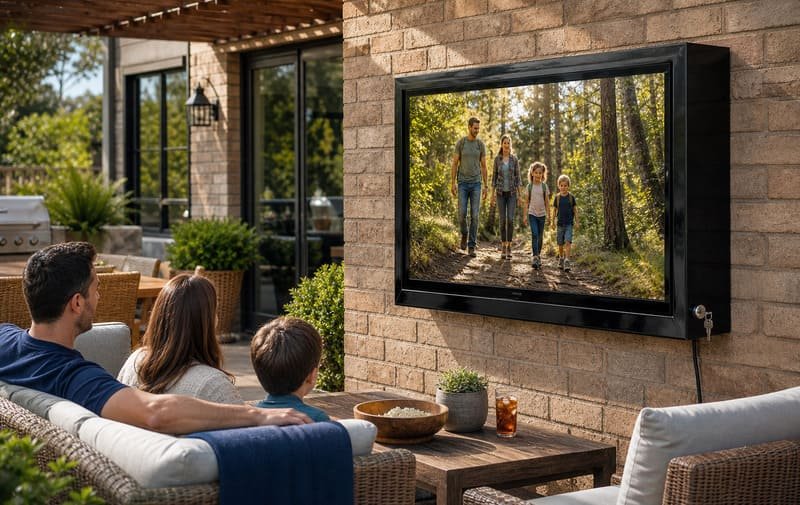
Want to watch the game, a movie night, or weekend sports in your backyard without worrying about rain, sun, humidity, insects, or accidental damage? A regular indoor TV can work well in a protected outdoor setup, but only when the screen size, enclosure fit, cooling, and installation location all match the space.
A 50–55 inch outdoor TV enclosure is often the practical sweet spot for home backyards because it matches common patio seating distances, keeps installation manageable, and provides a large enough screen for sports, movies, and family gatherings without overwhelming the space. It is not the biggest option, but for many patios, decks, pergolas, and garden walls, it offers the best balance of viewing comfort, cost, and protection.
Before you rush to buy one, there are a few common traps many homeowners fall into.
In my years of helping customers bring entertainment outdoors, I have seen the same issues again and again. A buyer chooses by diagonal screen size only. A TV fits the width but not the depth. A beautiful backyard wall gets too much afternoon sun. Or the enclosure is installed without enough airflow around the fan vents.
Choosing the right 50–55 inch outdoor TV enclosure is not only about matching a 55-inch TV label. It is about understanding your backyard seating distance, wall space, TV dimensions, weather exposure, cooling needs, and how the final setup will look.
Let’s break down why this size range works so well for many home backyards, and when you may need to go smaller or larger.
Last Updated: May 10, 2026 | Estimated Reading Time: 8 minutes
By Smith Chen, Outdoor TV Enclosure Engineer at Outvion
Is a 50–55 Inch Enclosure Really the Right Size for Your Backyard Viewing?
You found a 55-inch TV for your patio, but you are not sure whether it will feel right outdoors. Will it be big enough for sports and movie nights, or will it dominate the wall and make the space feel crowded?
For many casual backyard setups, a 50–55 inch screen works well around 7–10 feet of viewing distance, depending on seating layout, screen brightness, resolution, and how the TV is used. This makes it a strong fit for many patios, decks, pergolas, and garden seating areas where people sit across from a wall or outdoor sofa.
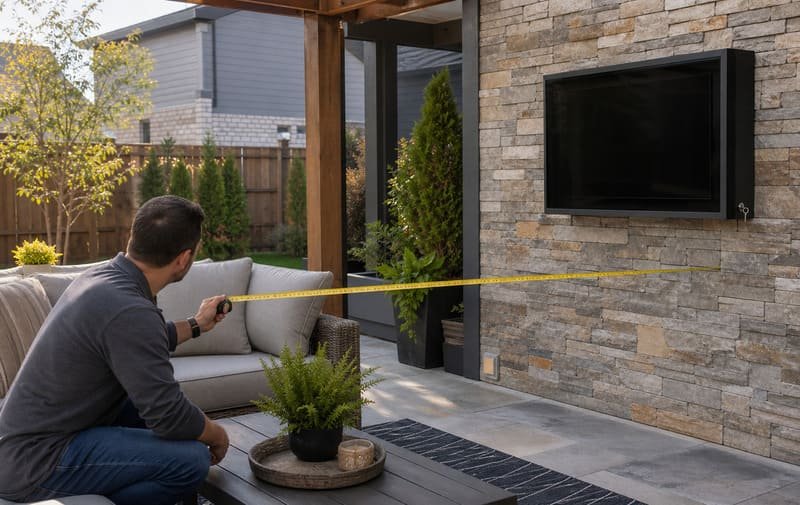
In my customer conversations, I often see homeowners get stuck on the screen size itself. But the real question is not only “Is 55 inches big enough?” The better question is:
How far will people actually sit from the screen?
A backyard TV is different from a living room TV. People may watch from a sofa, dining table, fire pit area, poolside chair, or outdoor kitchen. The seating is often more flexible, and people may not sit directly in front of the screen every time.
RTINGS suggests a field of view of about 30 degrees for mixed TV use and explains that viewing distance and screen size should be planned together rather than guessed by screen size alone. RTINGS TV size and viewing distance guide
From a practical backyard perspective, I usually see the 50–55 inch range work best when the main seating area is not too far away. It is large enough for a small group to enjoy a football game or movie night, but it does not require the same wall space, lifting effort, or budget as a 65-inch or 75-inch setup.
Backyard Viewing Size Guide
| Screen Size | Typical Backyard Viewing Fit | Best For | My Practical View |
|---|---|---|---|
| 40–43 Inches | Shorter seating distance | Small balconies, compact patios, narrow walls | Good for tight spaces, but may feel small for group viewing |
| 50–55 Inches | Common patio and deck seating distances | Most home backyards, pergolas, outdoor sofas, garden walls | Best balance of size, cost, and installation practicality |
| 60–65 Inches | Larger seating areas | Bigger patios, outdoor lounges, pool areas | More immersive, but heavier and needs more wall space |
| 70–75+ Inches | Long viewing distance | Large backyards, commercial patios, events | Impressive, but often too bulky for normal home patios |
A 50–55 inch enclosure also has a more manageable physical footprint. It is easier to ship, lift, position, and install than larger models. That matters when you are mounting it on a brick wall, wooden structure, pergola post, or outdoor kitchen wall.
The key is to choose based on your actual backyard, not just what looks impressive online.
Will Your 55-Inch TV Actually Fit Inside a 55-Inch Enclosure?
You bought a 55-inch TV and found a 55-inch outdoor TV enclosure. It sounds like a perfect match, but this is where many buyers make their first mistake.
Not always. A “55-inch TV” label refers to the diagonal screen size, not the TV’s full outside dimensions. Before buying an enclosure, you must check the TV’s actual width, height, depth, VESA mounting pattern, cable position, and power plug clearance against the enclosure’s usable internal dimensions.
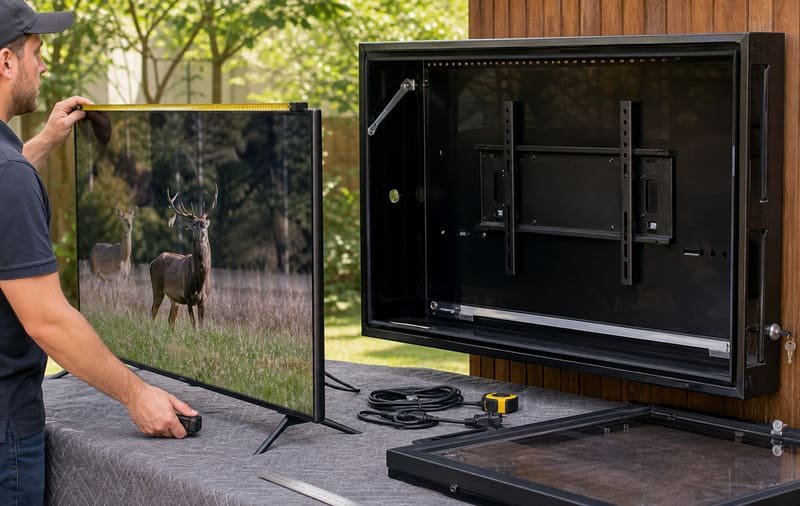
This is probably the number one mistake I see homeowners make.
A 55-inch TV is not always the same size as another 55-inch TV. The screen size is measured diagonally, but the physical TV body includes the bezel, speakers, lower housing, rear electronics area, and sometimes a thicker section near the bottom.
LG’s TV size guide explains that TV screen size is measured diagonally and does not include the borders or bezels, so buyers should also check the total width, height, and depth in the product specifications. LG TV size guide
That same logic applies when choosing an outdoor TV enclosure.
Do not look only at the enclosure’s exterior size. You need the usable internal dimensions. Your TV must fit inside those internal dimensions with enough room for mounting, cables, and airflow.
What to Measure Before Ordering
| Measurement | What to Check | Why It Matters |
|---|---|---|
| TV Width | Total left-to-right width, including bezel | The TV must be narrower than the enclosure’s usable internal width |
| TV Height | Total top-to-bottom height, including lower speaker or logo area | Some TVs are taller than expected even within the same screen size |
| TV Depth | Thickest part of the TV body | Rear bulges can stop the enclosure from closing properly |
| VESA Pattern | Mounting hole pattern such as 200×200, 300×300, or 400×400 mm | The enclosure’s internal bracket must support the TV |
| Cable Position | HDMI, power, USB, coaxial, and network port direction | Rear-facing cables need extra bend space |
| Airflow Gap | Space behind and around the TV | A tight fit can restrict cooling and service access |
I always recommend leaving a small margin instead of forcing the TV into the enclosure. A tight fit may look acceptable on paper, but once you add the VESA bracket, screw heads, cable plugs, and power cord, the real depth may be larger.
Doing this five-minute measurement gives you a much better chance of choosing the right enclosure the first time.
Can a 50–55 Inch Enclosure Protect Your TV from Rain, Heat, and Salt Air?
You are spending money to protect your TV, but you may wonder whether an enclosure can really handle real backyard conditions: rain, dust, insects, summer heat, humidity, and possibly coastal air.
A properly designed IP65 enclosure helps protect the TV from dust and water jets under defined test conditions, while gasket compression, sealed cable exits, fan cooling, material choice, and installation quality determine real-world performance. For warm, humid, or coastal backyards, protection is not only about waterproofing—it is also about heat management, airflow, and corrosion-resistant design.
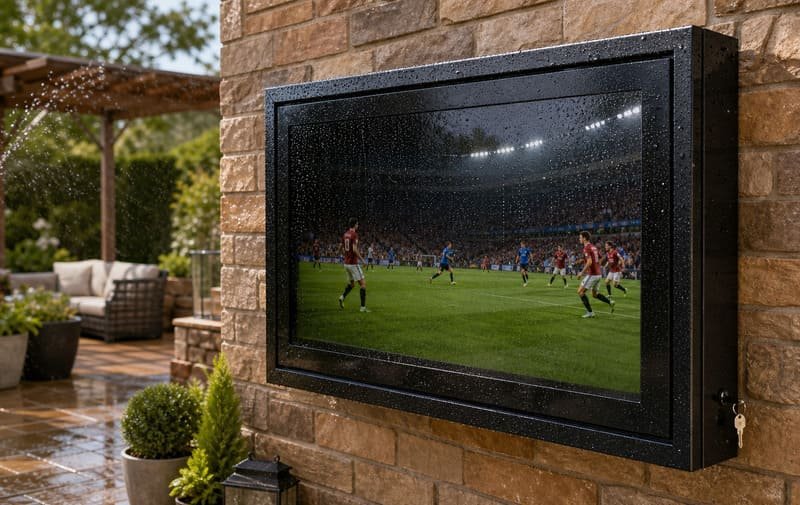
Technical specifications can sound confusing, but they matter because they address the biggest risks to a backyard TV.
What IP65 Really Means
The International Electrotechnical Commission explains that IP ratings grade the resistance of an enclosure against intrusion by dust or liquids. IEC IP Ratings
For outdoor TV enclosures, IP65 is a useful protection level because it means the enclosure is dust-tight and protected against water jets under defined test conditions.
But I always explain IP65 carefully.
IP65 does not mean vapor-proof, condensation-proof, chemical-proof, submersible, or maintenance-free. It also does not mean installation no longer matters. Cable exits, gasket compression, lock pressure, wall angle, and maintenance all affect real-world performance.
For a normal backyard, IP65 can help protect against many common exposures such as rain, sprinklers, dust, pollen, and insects. But the enclosure still needs to be installed correctly.
Why Material Matters
Many homeowners assume metal is always stronger. In some applications, metal can work well. But in wet, humid, or coastal backyards, coating scratches, screw holes, seams, and fasteners can become weak points.
A polycarbonate body does not rust like steel, which removes one common corrosion pathway. That is useful for poolside patios, coastal homes, humid gardens, and outdoor kitchens where moisture is common.
Covestro describes Makrolon polycarbonate as robust, lightweight, glass-like in transparency, and impact resistant even at low temperatures. Covestro Makrolon polycarbonate
I do not describe polycarbonate as magic. It still needs proper thickness, UV-stable material selection, forming quality, gasket design, hardware quality, and fan cooling. But for many backyard enclosures, it offers a strong balance of impact resistance, visibility, lower body-rust risk, and manageable installation weight.
For coastal homes, hardware still matters. FEMA guidance on coastal construction highlights that salt accumulation and high humidity can accelerate corrosion of untreated steel connectors and fasteners. FEMA coastal corrosion guidance
That is why locks, screws, hinges, anchors, and mounts should not be ignored.
The Hidden Risk: Heat
The most underestimated threat to an outdoor TV is heat.
A TV generates heat during operation. Outdoor sun adds more heat. If you put a TV inside a sealed box with no airflow plan, heat can build up around the screen and electronics.
Sony advises using TVs within a temperature range of 0°C to 40°C / 32°F to 104°F and avoiding exposure to direct sunlight. Sony TV temperature guidance
This is why active cooling is strongly recommended for warm, sunny, or long-use backyard installations. Fans do not make the enclosure cold, and they do not solve every installation problem. But they help reduce heat buildup around the TV when paired with a proper airflow path and enough internal clearance.
For our 50–55 inch enclosures, the design usually needs enough airflow space behind the TV, clear fan vents, and a shaded or partially shaded location whenever possible. A good enclosure protects the TV, but smart placement still matters.
Will an Enclosure Make My TV Look Bad or Hard to Use?
You want to protect your TV, but not at the cost of picture quality, remote control use, Wi-Fi connection, or your backyard design. This is a fair concern for homeowners.
A good 50–55 inch outdoor TV enclosure should protect the TV while keeping the setup clean and usable. A high-clarity polycarbonate front panel keeps the screen visible, a lockable body protects the TV and cables, and a slimmer design can fit better into backyard spaces. However, any transparent front shield can create some reflection, so placement and shade still matter.
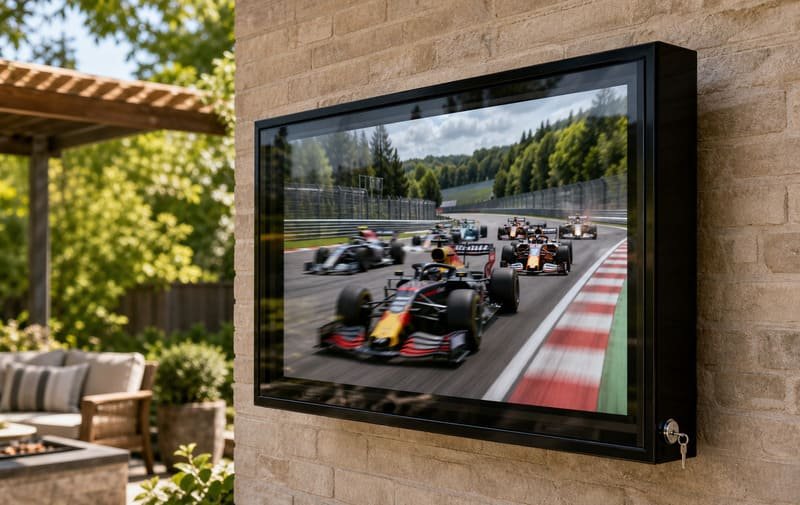
These are completely valid concerns that I discuss with homeowners all the time. An enclosure should solve problems, not create new ones.
Picture Quality and Glare
The transparent front shield is not just a simple plastic sheet. It needs to be clear enough for viewing and strong enough to protect the screen.
However, I prefer to be realistic. Any transparent surface can create some reflection outdoors. Even dedicated outdoor TVs can struggle with glare if they face the wrong direction.
The best way to protect picture quality is not only the front panel. It is also placement:
- Avoid direct afternoon sun.
- Use shade from a roof, pergola, eave, or awning.
- Avoid mounting the screen opposite bright white walls, pool water, or glass.
- Use a slight tilt if the mount allows it.
- Choose a TV with suitable brightness for the location.
An enclosure protects the TV; placement protects the viewing experience.
Remote Control and Wi-Fi
In most installations, IR remote signals can pass through a clear polycarbonate front panel, but sensor position, angle, distance, TV model, and front-panel clarity still matter. If the TV is mounted high or used in a commercial setting, an IR extender or smart control system may still be helpful.
Wi-Fi performance usually depends on router distance, wall materials, outdoor interference, and the TV’s own antenna position. A polycarbonate enclosure is not a metal Faraday cage, but I still recommend testing Wi-Fi strength at the installation point before final mounting.
The “Plastic” Look
I understand the hesitation when people hear the word “plastic.” They picture something flimsy or cheap-looking.
But high-strength polycarbonate is very different from thin disposable plastic. When formed correctly, it can create a durable, impact-resistant, transparent enclosure body that looks cleaner than older bulky cabinets.
For home backyards, the visual goal is simple: the enclosure should protect the TV without dominating the patio.
This is another reason the 50–55 inch range works well. It is large enough to feel like a real outdoor entertainment screen, but still compact enough to integrate into many backyard walls, pergolas, outdoor kitchens, and seating zones.
How Does a 50–55 Inch Enclosure Compare with 43″, 65″, and 75″ Options?
You may still wonder whether 50–55 inches is really the right size. Maybe 43 inches is cheaper, or 65 inches feels more impressive. The answer depends on your backyard layout.
A 50–55 inch enclosure is the balanced middle option. It is larger and more comfortable than 40–43 inch screens for group viewing, but easier to install, cool, and fit than 65–75 inch enclosures. For many home patios and decks, it offers the best mix of screen impact and practical installation.
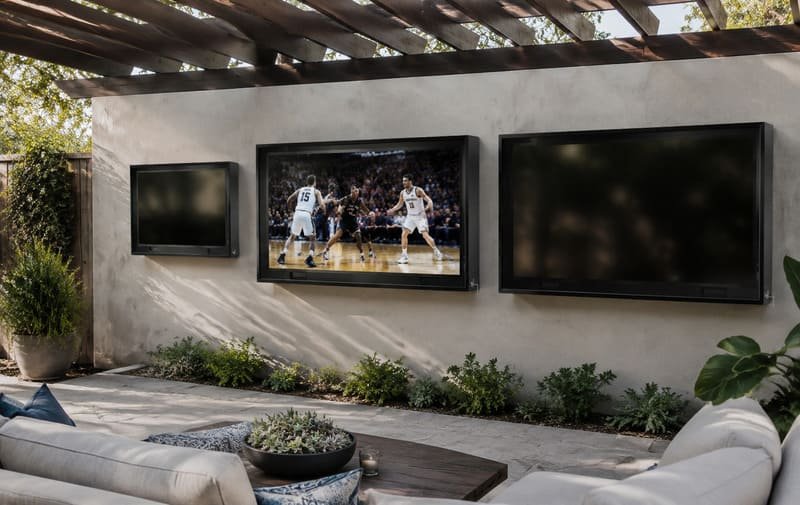
This is the main reason I call 50–55 inches the sweet spot.
A 43-inch TV can be useful in a small balcony or compact patio, but once people sit farther away or gather in a group, it can feel small.
A 65-inch TV gives a more cinematic experience, but the enclosure becomes larger, heavier, and more expensive. It also needs a wider wall, stronger mounting surface, and more planning for heat and airflow.
A 75-inch or larger setup can be impressive, but for many home backyards, it starts to feel more like a commercial installation. The wall space, lifting effort, shipping cost, and installation complexity all increase.
Outdoor TV Enclosure Size Comparison
| Enclosure Size Range | Best For | Backyard Limitation | My Take |
|---|---|---|---|
| 28–32 Inches | Small kiosks, compact displays, very tight spaces | Too small for most backyard movie or sports viewing | Niche use, not ideal for main patio entertainment |
| 40–43 Inches | Small patios, balconies, narrow walls | May feel small beyond short seating distances | Good for tight spaces |
| 50–55 Inches | Standard patios, decks, pergolas, garden walls | May not be enough for very large yards | Best all-around backyard balance |
| 60–65 Inches | Larger outdoor lounges, bigger seating areas | Heavier, more expensive, needs more wall space | Great if the space can support it |
| 70–75+ Inches | Large backyards, pool areas, commercial patios | Bulky and more complex to install | Better for large or semi-commercial spaces |
If a customer sends me photos of a standard backyard patio with an outdoor sofa, dining table, or pergola wall, I often find that 50–55 inches is the most realistic starting point.
It is not always the final answer. Some customers should go smaller. Some should go larger. But it is the size range that fits the highest number of ordinary home backyard layouts.
Backyard Buyer Checklist for a 50–55 Inch Outdoor TV Enclosure
Before buying, use this checklist to make sure the enclosure matches your TV, your wall, and your outdoor environment.
| Check | What to Confirm | Why It Matters |
|---|---|---|
| Viewing Distance | Main seating area is roughly suitable for a 50–55 inch screen | Prevents choosing a screen that feels too small or too large |
| TV Dimensions | Width, height, and depth without the stand | Confirms the TV fits inside the usable internal space |
| VESA Pattern | TV mounting hole pattern | Ensures the TV can mount securely inside the enclosure |
| Cable Clearance | HDMI, power, USB, and network cable direction | Prevents crushed cables and installation conflicts |
| IP Rating | IP65 or suitable protection for the location | Helps protect against dust, rain, and water jets |
| Cooling | Fan system, vent clearance, internal airflow | Helps reduce heat buildup around the TV |
| Wall Strength | Brick, concrete, studs, reinforced frame, or strong structure | Supports the combined weight of the TV and enclosure |
| Sun Exposure | Direct afternoon sun, shade, glare, and heat | Affects picture quality and thermal stress |
| Maintenance Access | Door opening, lock access, cable access, cleaning space | Makes long-term use easier |
A 50–55 inch enclosure can be very practical, but only if the full installation is planned correctly.
Frequently Asked Questions
Is a 55 inch TV big enough for a backyard patio?
For many home backyard patios, yes. A 55 inch TV is often large enough for sports, movies, and casual outdoor viewing when the main seating area is around 7–10 feet away. For very large seating areas or poolside lounges, a 65 inch or larger screen may be better.
What size enclosure do I need for a 55 inch TV?
You need an enclosure that supports the TV’s actual width, height, depth, VESA pattern, cable position, and airflow clearance. Do not choose only by diagonal screen size. Always compare your TV’s full physical dimensions with the enclosure’s usable internal dimensions.
Can I use a regular indoor TV in a 50–55 inch outdoor TV enclosure?
Yes, many buyers use a regular indoor TV inside a properly sized outdoor TV enclosure. However, the enclosure does not change the TV manufacturer’s original outdoor-use rating or warranty terms. You still need to check TV dimensions, operating temperature guidance, ventilation, cable routing, and local electrical requirements.
Does a 50–55 inch outdoor TV enclosure need fans?
For warm, sunny, or long-use outdoor installations, fan cooling is strongly recommended. A sealed enclosure without airflow can trap heat around the TV. Fans help reduce heat buildup, but they work best with shade, internal clearance, and clear vent paths.
Is a 50–55 inch enclosure too heavy for DIY installation?
Some experienced homeowners may install smaller models themselves, but a 50–55 inch enclosure still requires careful lifting, wall assessment, correct anchors, and safe cable routing. For brick, concrete, high walls, outdoor kitchens, or heavier TV models, professional installation is often safer.
Should I choose a 50–55 inch or 65 inch outdoor TV enclosure?
Choose 50–55 inches if your backyard seating distance is moderate, wall space is limited, or you want easier installation. Choose 65 inches if your seating area is farther away, the wall is wide enough, and you want a more immersive viewing experience. Bigger is not always better if the installation becomes difficult.
Is a 50–55 inch enclosure suitable for coastal backyards?
It can be, if the enclosure uses suitable materials, sealed cable exits, corrosion-resistant hardware, and regular maintenance. A polycarbonate body does not rust like steel, but locks, hinges, screws, anchors, and mounts still need inspection in coastal or humid environments.
Conclusion
A 50–55 inch outdoor TV enclosure is not the biggest option, and it is not always the cheapest. But for many home backyards, it is the most balanced size.
It is large enough for sports, movies, and family gatherings.
It fits many common patio and deck seating distances.
It is easier to install than larger 65–75 inch setups.
It is more useful for group viewing than smaller 40–43 inch screens.
It can protect a standard TV from rain, dust, insects, humidity, and heat when properly designed and installed.
The way I explain it to homeowners is simple:
A 50–55 inch enclosure is the backyard sweet spot because it gives you a real outdoor entertainment screen without turning the installation into a heavy commercial project.
Before buying, measure your TV carefully, check the internal enclosure dimensions, confirm VESA and cable clearance, plan for cooling, and choose a shaded or partially shaded wall whenever possible.
If your patio, pergola, deck, or garden wall has the right seating distance and mounting space, a 50–55 inch outdoor TV enclosure can be one of the most practical ways to bring protected entertainment outdoors.