
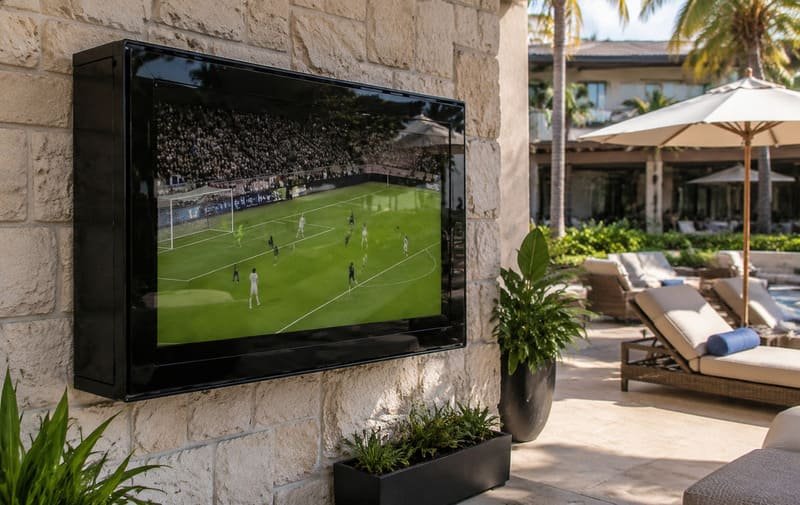
Your outdoor TV project is not only about buying a large screen. For pools, bars, hotels, resorts, and commercial patios, a 60–65 inch display needs to be visible from a distance, protected from weather and daily traffic, and easy enough for staff to operate and maintain.
A 60–65 inch outdoor TV enclosure works well for many pools, bars, and hotels because it offers a larger shared-viewing experience without becoming as difficult to install as 70–75 inch or larger systems. But the enclosure must be selected carefully: TV dimensions, VESA pattern, cable clearance, IP rating, fan cooling, wall strength, and service access all matter more than screen size alone.
It seems simple at first: choose a 65-inch TV, buy a 65-inch enclosure, mount it outside, and start showing the game. But in real projects, this is where many delays begin.
As someone who has helped bar owners, hotel managers, resort buyers, and AV installers select outdoor TV enclosures, I can tell you that the details matter more than most buyers expect. A 60–65 inch TV is already a serious asset for a business. If the enclosure is too tight, poorly ventilated, hard to service, or installed in the wrong location, the project can quickly become frustrating.
For a home backyard, 50–55 inches may often be the balanced size. But for a hotel poolside, rooftop bar, sports patio, resort courtyard, or outdoor dining area, 60–65 inches gives guests a stronger shared viewing experience.
The selection process is less about picking a box and more about building a durable outdoor display system.
Last Updated: May 11, 2026 | Estimated Reading Time: 7 minutes
By Smith Chen, Outdoor TV Enclosure Engineer at Outvion
Why Is 60–65 Inches a Strong Size for Pools, Bars, and Hotels?
A 60–65 inch screen feels more impressive than a backyard TV, but it is still manageable for many commercial walls, poolside patios, and hospitality spaces. That balance is why this size range often works so well.
For pools, bars, and hotels, 60–65 inches is often the point where a TV becomes large enough for shared viewing without creating the installation burden of a 75-inch or larger enclosure. It gives guests better visibility across outdoor seating areas while still keeping shipping, mounting, cooling, and maintenance more practical than oversized commercial displays.
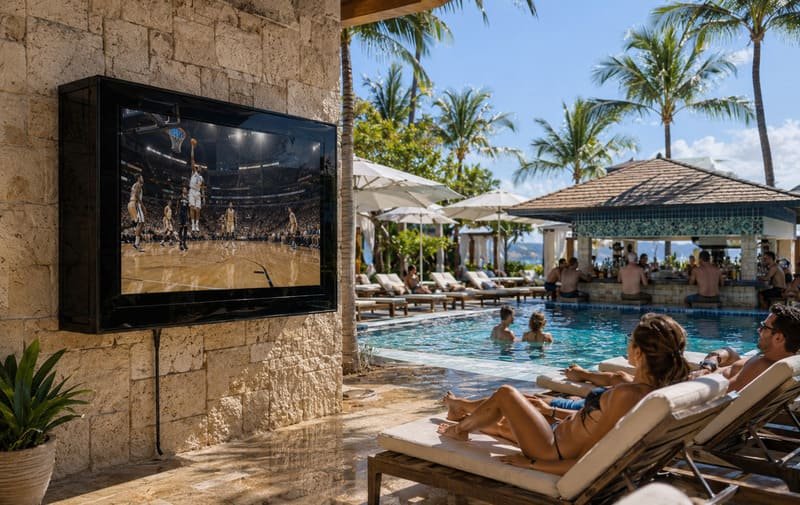
When I review a hotel or bar project, I do not start by asking only what TV size the buyer wants. I ask where people will watch from.
A 60–65 inch screen makes sense when viewers are not sitting directly in front of the TV like they would in a living room. In a bar patio, people may watch from multiple tables. At a hotel pool, guests may view from lounge chairs, cabanas, or a bar counter. In a restaurant terrace, the screen needs to be large enough for a group, not just one person.
That is where the 60–65 inch range becomes useful. It is not as compact as 50–55 inches, so it has more visual presence. But it is not as heavy, bulky, or costly to install as 70–75 inch and larger enclosure systems.
60–65 Inch vs Other Outdoor TV Enclosure Sizes
| Size Range | Best For | Limitation | My Practical View |
|---|---|---|---|
| 40–43 Inches | Small patios, kiosks, compact walls | Often too small for shared commercial viewing | Better for close-distance or narrow-space installations |
| 50–55 Inches | Home backyards, small patios, pergolas | May feel small in hotels, bars, or wider pool areas | Good residential balance, but not always enough for venues |
| 60–65 Inches | Pools, bars, hotels, resorts, outdoor dining | Needs stronger mounting and better cooling planning | Strong B2B venue size with practical installation limits |
| 70–75+ Inches | Large venues, big pool decks, event spaces | Heavier, more expensive, harder to install and ship | Impressive, but often moves into larger project planning |
For many B2B buyers, this is the real reason 60–65 inches works: it has enough size to improve guest experience, but it is still practical enough for repeat installation across multiple locations.
If a hotel wants several screens around a pool area, or a sports bar wants to upgrade an outdoor patio, 60–65 inches often becomes the most realistic commercial step up from residential-size displays.
Why Does “TV Size” Not Guarantee a Perfect Fit?
You bought a 65-inch enclosure for your 65-inch TV, but the TV does not fit. Now your installation is delayed, the client is frustrated, and the project schedule gets pushed back.
A TV’s “size” refers to the diagonal screen measurement, not the full outside dimensions. The bezel, speaker area, rear housing, lower electronics section, and cable positions all affect whether the TV fits inside the enclosure. For a 60–65 inch enclosure, you must compare the TV’s actual width, height, depth, VESA pattern, and cable clearance with the enclosure’s usable internal dimensions.
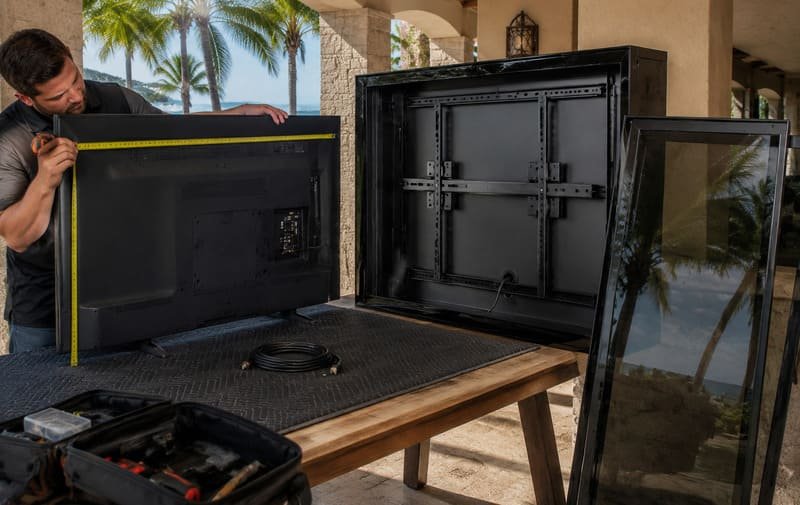
In my customer selection discussions, this is the first point I always clarify. Buyers naturally focus on screen size because that is how TVs are marketed. But an enclosure does not protect only the visible screen. It must house the entire physical TV body.
LG’s TV size guide explains that TV size is measured diagonally and that the screen size does not include the borders or bezels, so buyers should also check the total width, height, and depth from the product specifications. LG TV size guide
That same logic applies even more strongly to outdoor TV enclosures.
Think of the enclosure as a garage and the TV as your car. You would not buy a garage without checking whether the car can clear the door height, width, and depth. A 65-inch TV label is not enough.
The Critical Dimensions: Width, Height, Depth, VESA, and Cables
Before you even look at enclosure options, find the technical specification sheet for your TV model. You need these details:
- Overall Width
Measure from the left outer edge to the right outer edge, including the bezel. - Overall Height
Measure from the top edge to the bottom edge, including any speaker area, brand logo area, or lower housing. - Overall Depth
Check the thickest point of the TV, not only the thinnest edge. Some TVs have a thicker electronics section on the back. - VESA Mounting Pattern
Confirm the mounting hole pattern, such as 400×400 mm or 600×400 mm. - Cable and Plug Clearance
HDMI, power, USB, coaxial, network, and media device locations can all affect real fit.
Here is a simple example that shows why this matters:
| TV Model | Screen Size | Actual Width | Actual Height | Enclosure Internal Space | Fit Result |
|---|---|---|---|---|---|
| TV Model A | 65 inches | 57.1 inches | 32.8 inches | 58.0″ × 34.0″ | Likely fits |
| TV Model B | 65 inches | 57.8 inches | 34.5 inches | 58.0″ × 34.0″ | Too tall |
| TV Model C | 65 inches | 56.9 inches | 33.1 inches | 58.0″ × 34.0″ | Width/height fit, but depth still needs checking |
Both Model A and Model B are sold as 65-inch TVs, but one may fit and the other may not. Model C may fit in width and height but still fail if the rear housing or cable plugs are too deep.
This is why I always advise hotel and bar buyers to confirm their TV’s outside dimensions before discussing enclosure options. It gives the project a much better chance of moving smoothly the first time.
If you already have a TV model in mind, compare its width, height, depth, VESA pattern, and cable layout with the Outvion 60–65 inch outdoor TV box specifications before ordering.
What Real-World Risks Are You Protecting Against in Pools, Bars, and Hotels?
A simple cover may look like protection, but a commercial outdoor display faces much more than rain. Pools, bars, and hotels expose TVs to moisture, dust, guests, cleaning routines, heat, and sometimes coastal salt air.
At a pool, you are protecting against splashes, humidity, heat, and guest traffic. At a bar, you are protecting against drink spills, dust, tampering, long operating hours, and cleaning routines. At a hotel or resort, you are protecting the guest experience, brand image, maintenance schedule, and long-term display investment.
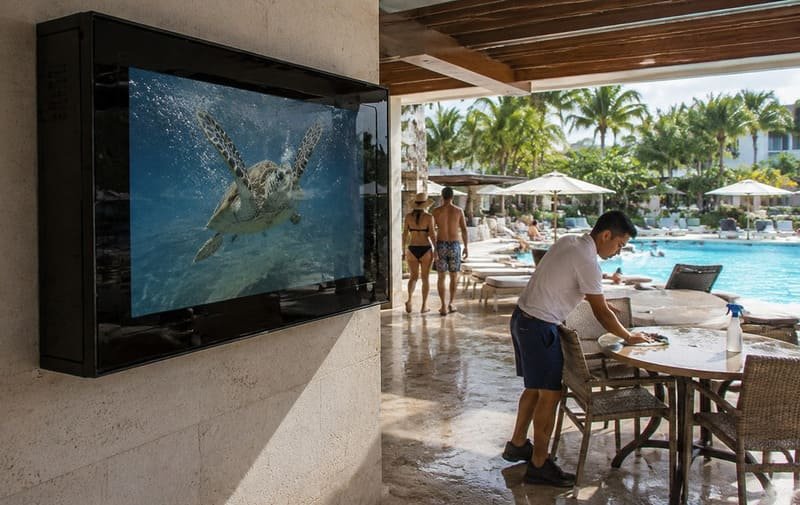
When sourcing managers or restaurant owners contact me, their first concern is usually rain. That makes sense, but rain is only part of the story.
A proper enclosure is not just a rain jacket. It is a protective operating environment for a screen that was usually designed for cleaner, more controlled indoor use.
The International Electrotechnical Commission explains that IP ratings grade the resistance of an enclosure against intrusion by dust or liquids. IEC IP Ratings
For outdoor TV enclosures, IP65 is useful because it means dust-tight protection and protection against water jets under defined test conditions. But IP65 does not mean vapor-proof, condensation-proof, chemical-proof, salt-proof, or submersible. Real-world protection still depends on gasket compression, cable exits, lock pressure, installation angle, and maintenance.
Scene 1: Poolside, Patio, or Resort Pool Area
For venues near water, the primary threats are direct splash, high humidity, sun exposure, and guest activity.
A poolside TV may be near splashing water, wet towels, cleaning spray, pool chemicals, and humid air. Even if the TV is not hit by rain, the surrounding environment can still be difficult for electronics.
High humidity and airborne contaminants can increase corrosion and reliability risks for electronic boards over time. Research on printed circuit boards has shown that humidity, salt spray, and corrosive contaminants can affect PCB reliability in atmospheric environments. PCB corrosion and airborne contamination research
A sealed enclosure with proper cable exits helps reduce direct exposure. But near pools, installation planning also matters: electrical safety, wall height, guest access, glare, and ventilation should all be considered.
Scene 2: Sports Bar, Beer Garden, or Alfresco Dining Area
In high-traffic commercial spaces, the risks change.
Yes, there is weather. But there are also guests, drinks, staff routines, dust, and long operating hours. A sports bar TV may run for many hours during games. A beer garden screen may face pollen, dust, and occasional drink splash. Restaurant staff may use cleaning sprays near outdoor surfaces.
In these environments, a front shield helps protect the screen surface from casual impact, dust, and daily cleaning exposure. A lockable enclosure also limits access to TV controls, cables, ports, and media devices.
I do not describe any enclosure as theft-proof or vandal-proof. But a lockable, impact-resistant shell can reduce casual tampering and make the installation easier to manage in a public-facing venue.
Scene 3: Coastal Hotels and Venues
Coastal environments are often the harshest.
The problem is not only rain. It is salt-laden moisture in the air. FEMA guidance on coastal construction notes that salt accumulation and high humidity can accelerate corrosion of untreated steel connectors and fasteners. FEMA coastal corrosion guidance
That is why material selection and hardware selection are so important.
A polycarbonate body does not rust like steel, which removes one major corrosion pathway in coastal venues. However, locks, hinges, screws, anchors, brackets, cable exits, and wall mounts still need corrosion-resistant design and regular inspection.
Covestro describes Makrolon polycarbonate as robust, lightweight, glass-like in transparency, and impact resistant even at low temperatures. Covestro Makrolon polycarbonate
For poolside hotels, coastal bars, and resort patios, I usually tell buyers to look at the entire system: body material, hardware, cable exits, cooling, lock access, and maintenance—not only the TV size.
Risk Comparison by Venue Type
| Venue Type | Main Risks | Enclosure Focus | Buyer Reminder |
|---|---|---|---|
| Poolside / Resort Pool | Splash, humidity, guest access, glare | IP-rated sealing, lockable access, airflow, safe placement | Coordinate electrical work with a qualified professional |
| Sports Bar / Beer Garden | Long use, drink spills, tampering, cleaning spray | Cooling fans, front shield, locks, cable protection | Consider service access for staff |
| Hotel Patio / Courtyard | Brand image, guest experience, dust, maintenance | Clean appearance, durability, easy inspection | A bulky enclosure may hurt the venue aesthetic |
| Coastal Venue | Salt air, high humidity, wind-driven moisture | Polycarbonate body, protected hardware, sealed cable exits | Inspect locks, hinges, screws, and vents regularly |
| Outdoor Restaurant | Food service traffic, cleaning, glare, weather | Front shield, easy-clean surface, shade planning | Placement affects both viewing and long-term durability |
This is why I do not like treating all outdoor projects the same. A 60–65 inch enclosure for a hotel pool is not the same installation as a backyard wall. The environment, operating hours, guest access, and maintenance plan all matter.
Will an Enclosure Affect Wi-Fi, Picture Quality, or Daily Guest Use?
Many buyers worry that putting a TV inside an enclosure will weaken Wi-Fi, block the remote, create glare, or make the screen look less premium. These are valid questions, especially for hotels and bars where guest experience matters.
A well-designed enclosure should protect the TV while keeping normal operation practical. Wi-Fi, remote control, picture clarity, glare, sound, and service access all depend on material, enclosure design, TV model, installation location, router distance, sun angle, and staff workflow. The enclosure should support daily use, not make it harder.
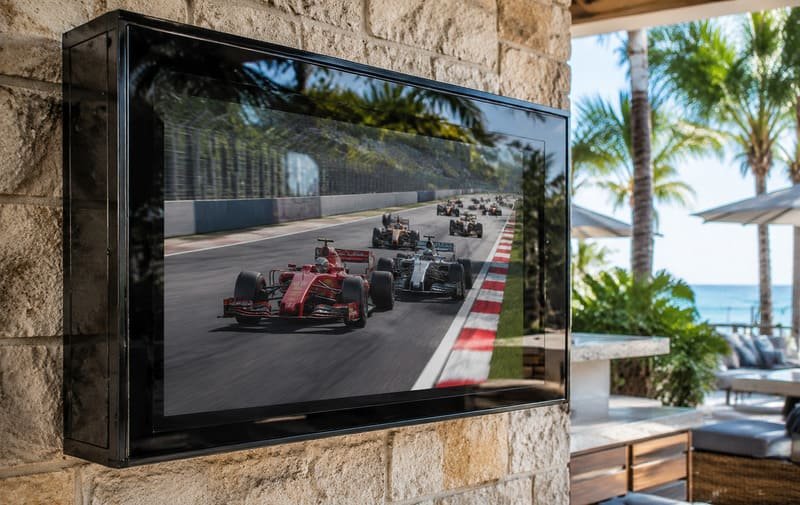
This is a very practical concern. You are adding a protective layer around the TV, so it is reasonable to ask what changes.
In my experience, the answer depends on the design of the enclosure and the installation site.
Wi-Fi, Bluetooth, and Remote Control
I do not like making absolute promises about signal performance. Wi-Fi depends on many things: router distance, wall material, interference, TV antenna location, enclosure structure, and whether the venue already has strong outdoor network coverage.
Because the enclosure body is not an all-steel sealed box, Wi-Fi and remote-control performance is usually manageable in many installations. But I still recommend testing streaming apps, remote control, and Bluetooth devices before final closing and cable sealing.
For commercial sites, a dedicated outdoor access point or wired network connection may be more reliable than depending on a weak indoor router signal.
Picture Quality, Reflection, and Glare
An enclosure adds a transparent front shield. That shield protects the TV screen from dust, impact, weather, and guest contact, but it can also introduce some reflection.
Any transparent surface outdoors can reflect sunlight, sky, glass, pool water, or bright walls. No enclosure should be treated as a magic anti-glare solution.
For best viewing, I usually recommend:
- Avoid direct afternoon sun.
- Mount under a roof, canopy, cabana, or shaded structure when possible.
- Avoid placing the screen opposite pool water, glass walls, or bright white surfaces.
- Test viewing angles from the main guest seating area.
- Use a tilting mount when glare control requires a small angle adjustment.
If the enclosure front panel uses a tested UV-protective grade or coating, it may help reduce UV exposure to the screen. But the exact UV performance depends on material grade, thickness, coating, and supplier test data. I would avoid claiming a universal UV percentage unless the specific product has test results.
Sound and Guest Experience
A sealed enclosure can affect the TV’s built-in speaker sound. For bars, hotels, and pool areas, I often recommend planning external outdoor-rated speakers or a venue sound system, especially if the TV is used for sports events.
This is not only about volume. Outdoors, sound dissipates quickly, and background noise from guests, water, traffic, music, or wind can make built-in TV speakers feel weak.
Staff Access and Serviceability
Hotels and bars need to think beyond first installation. Someone may need to clean the front panel, inspect cables, check fans, unlock the enclosure, replace the TV, or reset a streaming device.
A good enclosure should be lockable but serviceable.
If the TV is mounted too high, too close to a wall, or too close to other fixtures, maintenance becomes difficult. That may not matter on day one, but it matters when a screen needs attention during a busy weekend.
What Should Buyers Check Before Ordering a 60–65 Inch Enclosure?
The right 60–65 inch enclosure is not only the one that fits the TV. For pools, bars, and hotels, it also needs to match the environment, operating hours, installation structure, cooling needs, security requirements, and maintenance plan.
Before ordering, B2B buyers should check the TV’s full dimensions, VESA pattern, cable clearance, wall strength, IP rating, fan system, sun exposure, guest access, Wi-Fi plan, and service access. A 60–65 inch enclosure is large enough to become part of the venue experience, so the installation should be planned like a small AV project, not a simple wall-mounted TV.
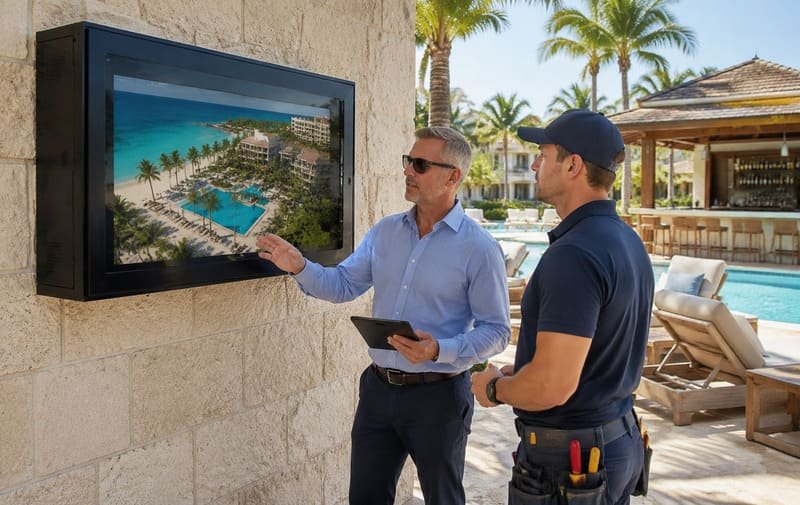
When I work with hotel, bar, and venue buyers, I try to slow the project down for a few minutes before the order is confirmed. That short pause can prevent expensive problems later.
Here is the checklist I would use.
| Check | What to Confirm | Why It Matters |
|---|---|---|
| TV Dimensions | Width, height, depth without stand | Confirms the TV fits the usable internal space |
| VESA Pattern | Mounting hole layout | Ensures the TV can be mounted securely inside |
| Cable Clearance | HDMI, power, USB, network, media device location | Prevents crushed cables and service problems |
| IP Rating | IP65 or suitable level for the site | Helps reduce dust and water-jet intrusion |
| Fan Cooling | Fan count, thermostat, airflow path, vent clearance | Helps reduce heat buildup during long operation |
| Wall Strength | Concrete, brick, structural frame, reinforced wall | Supports combined TV + enclosure weight |
| Guest Access | Can guests reach the screen, ports, or cables? | Determines lock and mounting height needs |
| Sun and Glare | Sun path, pool reflection, bright surfaces | Affects viewing comfort and heat stress |
| Network Plan | Wi-Fi strength or wired network | Reduces streaming problems after installation |
| Maintenance Access | Door swing, lock access, cleaning, fan inspection | Makes long-term operation easier |
For 60–65 inch outdoor displays, cooling deserves special attention.
A TV generates heat during operation, and direct sun can add more heat. Sony advises keeping TVs between 0°C and 40°C and avoiding direct sunlight. Sony TV temperature guidance
Fan systems help reduce heat buildup, but they are not air conditioning. Shade, internal clearance, vent position, operating hours, and fan maintenance all matter.
This is why I often recommend treating 60–65 inch venue projects as system design:
TV + enclosure + wall + cable route + network + cooling + guest access + maintenance.
If one part is ignored, the entire installation can become harder to manage.
Frequently Asked Questions
Is 60–65 inches too large for a hotel patio or bar?
Usually not, if the viewing distance and wall space are suitable. A 60–65 inch TV is often large enough for shared viewing in bars, hotels, and poolside areas without becoming as bulky as 75-inch or larger displays. However, smaller patios or close seating areas may be better served by 50–55 inches.
What TV measurements do I need before ordering?
You need the TV’s full width, height, and depth without the stand. You should also confirm the VESA pattern, cable port direction, power plug clearance, media device placement, and required airflow space. Do not choose only by diagonal screen size.
Do 60–65 inch enclosures need four fans?
Not always, but larger TVs and commercial venues usually need stronger airflow than smaller backyard installations. Fan count should depend on TV size, operating hours, sun exposure, climate, enclosure design, and internal airflow path. For hot regions or long daily use, a stronger fan configuration is usually safer.
Can a 60–65 inch enclosure protect a TV near a pool?
Yes, a properly designed IP-rated enclosure can help protect the TV from splash, dust, insects, and outdoor exposure. But poolside electrical safety must still be handled separately by a qualified electrician. The enclosure protects the TV; code-compliant wiring and GFCI/RCD protection protect people.
Will the enclosure affect Wi-Fi or remote control?
In many installations, Wi-Fi and remote control can work normally, but performance depends on router distance, TV model, enclosure structure, wall materials, signal strength, and installation angle. I recommend testing Wi-Fi, streaming apps, and remote control before final sealing.
Is a 60–65 inch enclosure better than a dedicated outdoor TV?
It depends on the project. A dedicated outdoor TV can be better when full-sun brightness, integrated outdoor warranty, and a slim finished product are the priorities. A standard TV plus enclosure can be better when cost control, upgrade flexibility, physical protection, and easier TV replacement matter more.
What should hotels and bars check before installation?
Hotels and bars should check wall strength, mounting height, guest access, cable routing, fan clearance, cleaning access, Wi-Fi signal, local electrical requirements, and how staff will service the screen later. The installation should support daily operation, not only first-day appearance.
Conclusion
Choosing the right 60–65 inch outdoor TV enclosure is about more than matching a screen size. For pools, bars, and hotels, this size becomes part of the guest experience and part of the venue’s daily operation.
It needs to be large enough for shared viewing.
It needs to fit the actual TV body, not just the diagonal screen size.
It needs to handle splash, dust, humidity, sun, guest access, and cleaning routines.
It needs enough airflow for long operating hours.
It needs to be secure, serviceable, and practical for staff.
The way I explain it to B2B buyers is simple:
A 60–65 inch outdoor TV enclosure is not just a larger backyard box. For pools, bars, and hotels, it becomes a commercial display system: large enough for shared viewing, protected enough for harsh environments, and serviceable enough for daily business operations.
If you plan the TV dimensions, wall structure, IP protection, cooling, cable exits, network, and maintenance access before ordering, the final installation has a much better chance of delivering long-term value.