
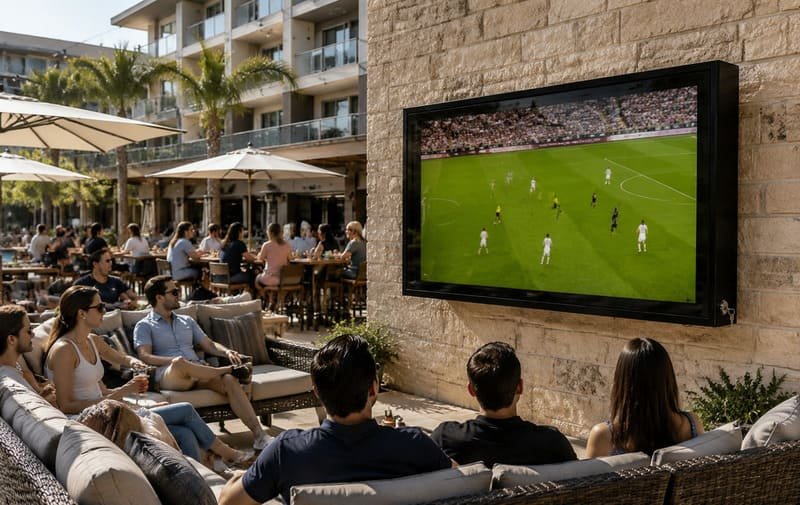
A 75-inch outdoor screen does more than make a patio look bigger. It changes how the whole space works.
In a large patio, sports bar, hotel courtyard, resort pool area, or commercial terrace, the TV is no longer just a screen on the wall. It becomes a visual anchor. Guests notice it from across the space. Customers gather around it during games. Staff may need to clean, unlock, inspect, and maintain it regularly.
A 70–75 inch outdoor TV enclosure makes sense when the space is large enough to support a bigger viewing zone, the wall or structure can handle the load, and the installation has a clear plan for heat, glare, wind exposure, cable routing, and service access. At this size, you are no longer choosing only a TV box. You are planning a large-format outdoor display system.
This is why I treat 70–75 inch projects differently from smaller backyard installations.
For a 50–55 inch enclosure, the main question is often: “Will this fit my patio?”
For a 60–65 inch enclosure, the question becomes: “Will this serve a pool, bar, or hotel space well?”
For a 70–75 inch enclosure, I usually ask for site photos before I ask for the TV model.
Where is the main viewing area?
How far away will guests sit?
Is the wall strong enough?
Will wind hit the enclosure directly?
Can staff access it for cleaning or service?
Will direct sun turn the screen into a mirror?
Those questions matter because a 70–75 inch outdoor TV enclosure is not just the next size up. It changes the project.
Last Updated: May 12, 2026 | Estimated Reading Time: 10 minutes
By Smith Chen, Outdoor TV Enclosure Engineer at Outvion
Why Is 70–75 Inches Different from a Standard Patio TV?
A 75-inch screen can look impressive, but it can also feel oversized if the space is not ready for it. The difference is not only screen size. It is viewing distance, wall scale, installation weight, wind exposure, and how the screen affects the whole outdoor area.
A 70–75 inch outdoor TV enclosure is best for large patios, commercial seating areas, sports bars, hotel courtyards, resort pools, and outdoor event spaces where people view the screen from a longer distance. It is usually too large for small patios, narrow walls, or close seating areas where a 50–55 or 60–65 inch enclosure may feel more natural.
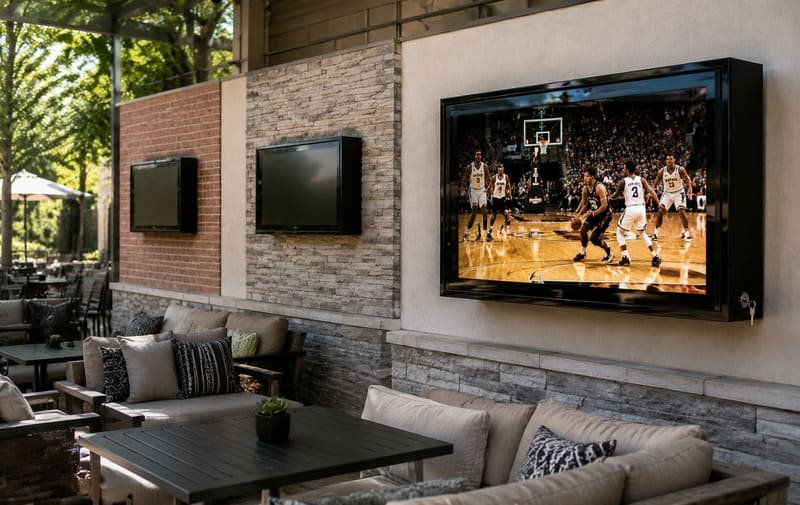
When a buyer asks me about a 75-inch enclosure, I first think about scale.
A large outdoor screen needs room around it. If you install it on a narrow wall or in a compact seating area, it can dominate the space in the wrong way. But if you place it on a wide patio wall, behind an outdoor bar, near a pool lounge, or in a commercial courtyard, it can become the center of the guest experience.
Viewing distance matters too. RTINGS explains that TV size and viewing distance should be planned together rather than guessed by screen size alone. RTINGS TV size and viewing distance guide
For outdoor commercial spaces, people rarely sit in one perfect living-room position. They may watch from lounge chairs, dining tables, a bar counter, a pool deck, or several seating zones. That is where a 70–75 inch screen can be useful.
Outdoor TV Enclosure Size Planning
| Size Range | Best Fit | When It May Not Be Enough | My Practical View |
|---|---|---|---|
| 50–55 Inches | Home backyards, pergolas, small patios | May feel small in wide commercial areas | Best residential balance |
| 60–65 Inches | Pools, bars, hotels, restaurants | May not be visible enough across large terraces | Strong B2B venue size |
| 70–75 Inches | Large patios, sports bars, resort courtyards, commercial terraces | Can be too large for close seating or weak walls | Large-format planning size |
| 80–85+ Inches | Large venues, events, public spaces | More complex shipping, lifting, wall load, and cost | Closer to commercial display planning |
The practical difference is this:
A 60–65 inch enclosure is still a manageable venue upgrade.
A 70–75 inch enclosure becomes a project that needs more planning.
When Should You Step Up from 60–65″ to 70–75″?
Many buyers ask whether 65 inches is enough or whether they should move up to 75 inches. The answer depends less on the TV and more on how the space is used.
You should consider stepping up to a 70–75 inch enclosure when the screen needs to be visible across a larger outdoor seating area, when several groups will watch from different angles, or when the TV becomes part of the commercial atmosphere. If viewers are close to the screen or the wall is limited, 60–65 inches may be the better choice.
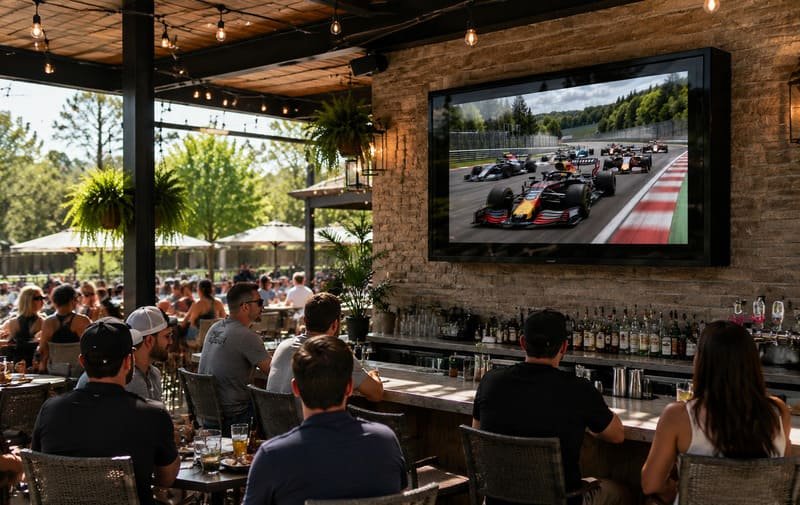
For sports bars, this is often a business decision. A larger screen can pull attention from farther away. During a game, customers may not all sit directly in front of the TV. Some are at side tables. Some are standing. Some are near the bar.
A 75-inch screen helps when you need that shared viewing effect.
For hotels and resorts, the question is different. The TV has to feel premium but not out of place. In a large courtyard or poolside lounge, 70–75 inches can make sense because the screen becomes part of the guest experience. But in a small cabana or narrow patio, it may feel too heavy visually.
For AV integrators, I usually frame the decision like this:
| Project Situation | Better Size Direction | Why |
|---|---|---|
| Small residential patio | 50–55″ | Easier to fit, lighter, less visually dominant |
| Standard hotel poolside or bar patio | 60–65″ | Strong shared viewing without oversized installation |
| Large commercial terrace | 70–75″ | Better visibility across a wider seating area |
| Outdoor event space | 70–75″ or larger | Screen becomes part of the venue experience |
| Narrow wall or close seating | Avoid 70–75″ | Screen may feel too large and harder to mount |
| High-wind exposed post mount | Plan carefully | Larger enclosure increases structural demands |
This is the main difference from smaller sizes. A 70–75 inch enclosure is not only a product choice. It affects the layout of the space.
Will My 75-Inch TV Actually Fit Inside a 75-Inch Enclosure?
A 75-inch TV label sounds like enough information, but it is not. At this size, a small measurement error can create a large installation problem.
No, a 75-inch TV does not automatically fit inside every 75-inch outdoor TV enclosure. The “75-inch” label refers to diagonal screen size, not the TV’s full width, height, depth, VESA pattern, rear housing shape, cable position, or media-device clearance. Always compare the TV’s actual dimensions with the enclosure’s usable internal dimensions before ordering.
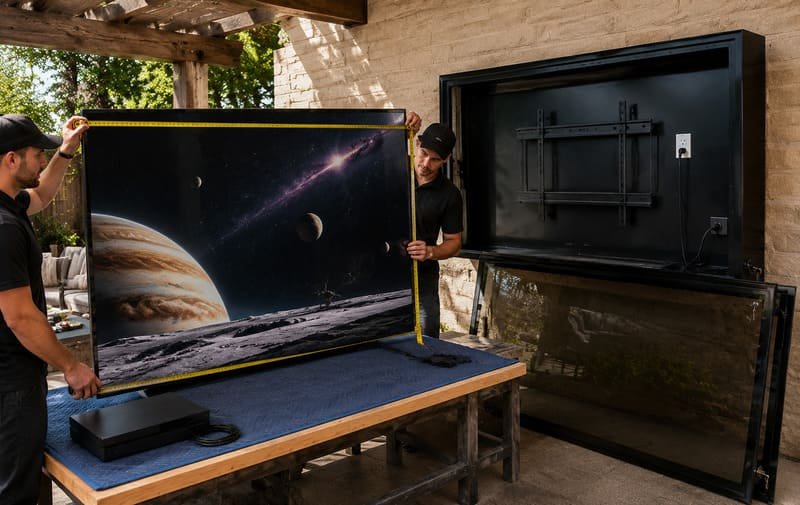
This is still one of the most important checks, even though I do not want every size article to begin with it.
LG’s TV size guide explains that TV screen size is measured diagonally and does not include the borders or bezels, so buyers should also check total width, height, and depth from the product specifications. LG TV size guide
For 70–75 inch projects, I recommend checking more than three numbers.
You need:
- Overall Width
The full left-to-right measurement, including bezel. - Overall Height
The full top-to-bottom measurement, including logo area, speakers, or lower frame. - Overall Depth
The thickest part of the TV body, not only the slim edge. - VESA Pattern
The mounting hole pattern, such as 400×400 mm, 600×400 mm, or similar. - Cable Direction
Rear-facing ports may need more space than side-facing ports. - Power Plug and HDMI Clearance
Large TVs often use thicker cables and larger plugs. - Media Device Space
If you plan to place a streaming box, receiver, or mini PC inside, that also needs room and airflow.
75-Inch Fit Checklist
| Measurement / Detail | What to Confirm | Why It Matters |
|---|---|---|
| TV Width | Full outside width | Prevents side clearance problems |
| TV Height | Full outside height | Prevents top/bottom fit problems |
| TV Depth | Thickest rear section | Prevents front panel closing issues |
| VESA Pattern | Mounting hole layout | Ensures secure internal mounting |
| Cable Clearance | HDMI, power, USB, network, coaxial | Prevents crushed cables |
| Airflow Gap | Space behind and around the TV | Helps reduce heat buildup |
| Service Space | Ability to access ports and media devices | Makes maintenance easier later |
For a 75-inch installation, I do not like “just enough” clearance. If the TV barely fits on paper, the real installation may still be difficult once brackets, cables, and airflow are considered.
What Installation Risks Become More Important at This Size?
A 75-inch outdoor TV enclosure is large enough that installation becomes part of the engineering decision. Wall strength, wind exposure, lifting, service access, and cable routing all become more serious.
At 70–75 inches, installation risk increases because the enclosure is larger, heavier, and more exposed to wind. Buyers should confirm wall strength, mounting hardware, lifting method, door-opening clearance, cable routing, and long-term service access before ordering. A weak wall or awkward location can turn a good enclosure into a difficult project.
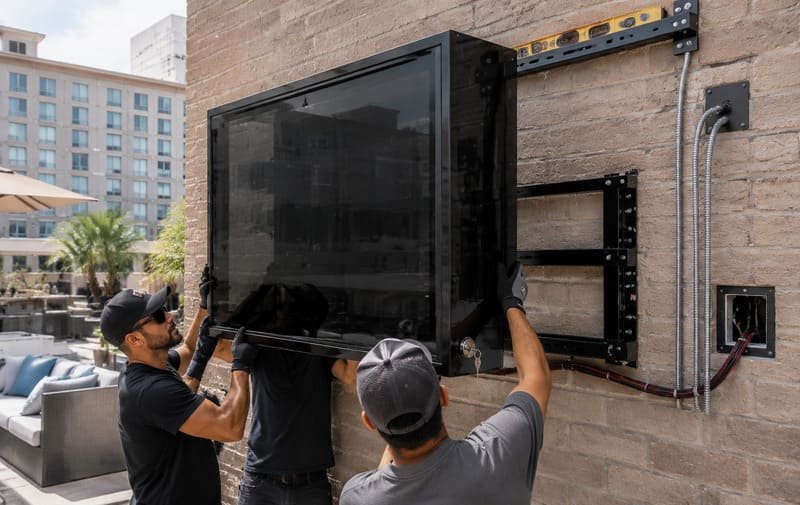
This is where large enclosures are very different from smaller backyard models.
A 75-inch enclosure may be mounted on a concrete wall, brick wall, structural frame, outdoor bar wall, resort column, or custom steel support. Each structure behaves differently. A decorative wall may look strong but may not be suitable for the combined weight of the TV, enclosure, mount, and hardware.
Wind is also more important at this size. A large enclosure has more surface area. If it is mounted on an exposed patio, rooftop bar, or open pool deck, the wall or post system must be planned carefully.
I usually tell commercial buyers to think through these questions before drilling:
- Can the wall support the combined weight?
- Is the mount attached to a structural surface?
- Will wind hit the enclosure directly?
- Can two or more people lift and align it safely?
- Can staff open the enclosure for service?
- Is there enough clearance for the front panel or access door?
- Can cables exit cleanly without breaking the seal?
Large-Format Installation Checklist
| Installation Factor | What to Check | Why It Matters |
|---|---|---|
| Wall Strength | Concrete, brick, steel frame, structural wood, reinforced post | Prevents unsafe mounting |
| Total Load | TV + enclosure + mount + hardware | Determines anchor and wall requirements |
| Wind Exposure | Rooftop, open patio, coastal site, pool deck | Larger screen area increases structural demand |
| Lifting Plan | Number of installers and lifting access | Reduces damage and installation risk |
| Door / Front Access | Space to open and service the enclosure | Important for maintenance |
| Cable Route | Power, HDMI, network, audio, sealed exits | Avoids weather and service issues |
| Cleaning Access | Can staff safely wipe and inspect it? | Matters for hotels and restaurants |
For some projects, the right answer may be to use a 60–65 inch enclosure instead. Bigger is not automatically better if the wall, wind exposure, or service access is not ready.
How Should You Plan Weather, Heat, Glare, and Security?
Large screens face the same outdoor risks as smaller screens, but the consequences are bigger. More screen area means more sun exposure, more heat management demand, and more impact on the guest experience.
A 70–75 inch outdoor TV enclosure should be planned for IP-rated weather protection, active airflow, shaded placement, glare control, corrosion-resistant hardware, and lockable access. IP65 helps with dust and water jets under defined test conditions, but it does not make the enclosure vapor-proof, heat-proof, salt-proof, submersible, or maintenance-free.
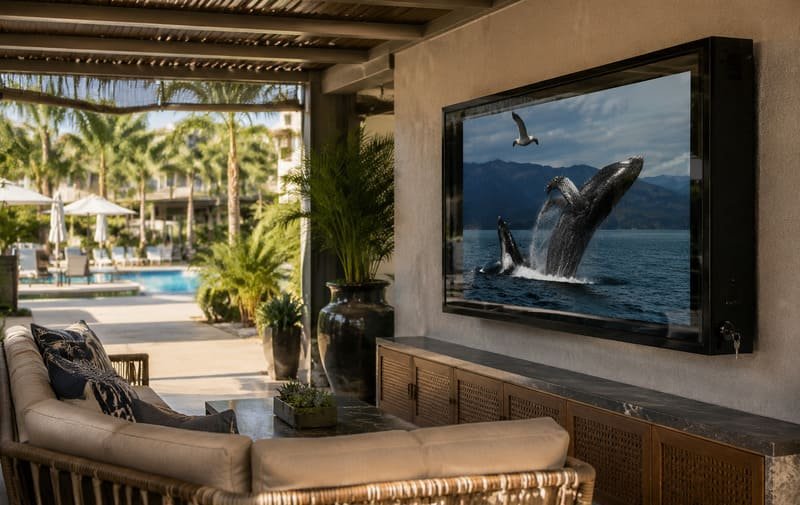
“Weatherproof” can sound simple, but I prefer to be more specific.
The International Electrotechnical Commission explains that IP ratings grade the resistance of an enclosure against intrusion by dust or liquids. IEC IP Ratings
For outdoor TV enclosures, IP65 means dust-tight protection and protection against water jets under defined test conditions. It can be a strong baseline for patios, hotels, bars, and commercial spaces. But it does not mean vapor-proof, condensation-proof, chemical-proof, salt-proof, submersible, or maintenance-free.
Cable exits, gasket compression, lock pressure, installation angle, and maintenance all affect real-world performance.
Heat and Cooling
A 75-inch TV generates heat during operation. Direct sun adds more heat. If the enclosure has poor airflow, heat can build up around the TV.
Sony advises using TVs within a temperature range of 0°C to 40°C / 32°F to 104°F and avoiding direct sunlight. Sony TV temperature guidance
For most 70–75 inch outdoor installations, especially commercial or warm-climate projects, active fan cooling is strongly recommended. Fans help reduce heat buildup, but they are not air conditioning. Shade, internal clearance, vent position, operating hours, and fan maintenance still matter.
Glare and Viewing
A large screen can still be hard to watch if it is placed in the wrong direction.
A transparent front panel protects the TV, but it can create some reflection. No enclosure should be sold as a magic anti-glare solution. The best approach is still smart placement:
- Avoid direct afternoon sun.
- Avoid facing bright sky, pool water, glass, or white walls.
- Use shade from a roof, pergola, cabana, or awning when possible.
- Consider a slight downward tilt where the mount allows it.
- Test the main viewing angles before final installation.
Material and Coastal Air
For coastal patios, rooftop bars, and resort spaces, material choice matters.
A polycarbonate body does not rust like steel, which removes one common corrosion pathway. However, locks, hinges, screws, anchors, cable exits, and wall mounts still need corrosion-resistant design and inspection.
Covestro describes Makrolon polycarbonate as robust, lightweight, glass-like in transparency, and impact resistant even at low temperatures. Covestro Makrolon polycarbonate
FEMA guidance on coastal construction also notes that salt accumulation and high humidity can accelerate corrosion of untreated steel connectors and fasteners. FEMA coastal corrosion guidance
Security and Public Access
For commercial spaces, security is not only about theft. It is also about tampering, ports, cables, media devices, and staff control.
A lockable enclosure can reduce casual access and help protect the TV from guest contact. I avoid calling any enclosure theft-proof or vandal-proof. But a locked, impact-resistant shell can make public-area installations easier to manage.
What Should Commercial Buyers Ask Before Ordering?
A 70–75 inch enclosure has enough size and cost that it deserves a short project review before purchase. The best buyers ask about fit, structure, cooling, placement, service, and long-term replacement before they place the order.
Before ordering a 70–75 inch outdoor TV enclosure, commercial buyers should confirm the viewing distance, TV dimensions, wall structure, wind exposure, IP rating, fan system, glare control, network plan, sound plan, and service access. The goal is not only to protect the TV, but to make the screen useful and manageable for daily operations.
For large projects, I like to separate the decision into three parts:
- Can the space support the screen visually?
- Can the structure support the screen physically?
- Can the staff support the screen operationally?
That third question is easy to forget. Hotels, bars, and commercial patios need service access. Someone must clean the front panel, check locks, clear fan vents, reset devices, inspect cables, and eventually replace the TV.
Long-term cost also matters. CIPS defines Total Cost of Ownership as a way to estimate the full end-to-end cost of providing a product or service, including purchase price, acquisition cost, usage cost, and end-of-life cost. CIPS Total Cost of Ownership overview
This is one reason an enclosure strategy can be attractive. The enclosure becomes the longer-term protective asset, while the TV inside remains the replaceable screen. But this only works well if the enclosure is easy to access and service.
Commercial Buyer Review Table
| Question | Why It Matters |
|---|---|
| Is the viewing distance suitable for 70–75 inches? | Prevents choosing a screen that feels too large or too small |
| Does the TV fit the internal dimensions? | Avoids installation delays and return costs |
| Can the wall support the total load? | Large enclosures need secure structural mounting |
| Is the site exposed to wind? | Larger surface area increases installation demands |
| Is the screen shaded from direct afternoon sun? | Helps reduce glare and heat stress |
| Does the enclosure have active airflow? | Helps manage heat during long operating hours |
| Are cable exits sealed and serviceable? | Prevents weak points and maintenance frustration |
| Can staff clean and inspect the unit safely? | Important for hotels, bars, and public spaces |
| Is Wi-Fi or wired network planned? | Reduces streaming problems after installation |
| Is sound handled separately if needed? | Large outdoor spaces often need external speakers |
This table is usually more helpful than asking only, “What size TV do you have?”
Frequently Asked Questions
Is a 70–75 inch outdoor TV enclosure too large for a home patio?
It can be too large for smaller patios or close seating areas. A 70–75 inch enclosure works best when the viewing distance is longer and the wall or structure has enough space. For compact patios, a 50–55 or 60–65 inch enclosure may feel more balanced.
When should I choose 70–75 inches instead of 60–65 inches?
Choose 70–75 inches when the screen needs to serve a larger viewing zone, multiple seating areas, a commercial patio, a sports bar, a resort courtyard, or an event terrace. Choose 60–65 inches when the space is more moderate or installation simplicity matters more.
What measurements do I need before ordering?
You need the TV’s full width, height, and depth without the stand. You should also confirm VESA pattern, cable port direction, power plug clearance, media device location, and airflow clearance. Do not choose only by diagonal screen size.
Do 70–75 inch outdoor TV enclosures need fan cooling?
For most warm, sunny, or commercial installations, fan cooling is strongly recommended. A large TV produces more heat, and the enclosure needs a planned airflow path. Fans help reduce heat buildup, but shade and proper vent clearance still matter.
Can a 75 inch enclosure handle wind and wall load?
It depends on the mounting surface, hardware, enclosure design, wind exposure, and installation method. Large enclosures should be mounted to a strong structural wall or engineered support. For exposed locations, a contractor or installer should confirm the mounting plan.
Will the front panel create glare?
Any transparent front panel can create some reflection outdoors. The enclosure protects the TV, but glare is mainly controlled by placement, shade, viewing angle, screen brightness, and what the screen faces. Avoid direct afternoon sun, pool reflections, and bright walls where possible.
Is a 70–75 inch enclosure better than a dedicated outdoor TV?
It depends on the project. A dedicated outdoor TV can be better when full-sun brightness, a slim finished product, and integrated outdoor-rated support are the top priorities. A standard TV plus enclosure can be better when physical protection, upgrade flexibility, and replacement cost control matter more.
What is the biggest mistake buyers make with 70–75 inch enclosures?
The biggest mistake is treating it like a normal wall-mounted TV. At this size, wall strength, wind exposure, lifting, cable exits, cooling, viewing distance, and service access all matter. The screen is large enough that the whole installation should be planned as a display project.
Conclusion
A 70–75 inch outdoor TV enclosure is not just a bigger version of a backyard TV box. It changes the scale of the project.
The screen becomes more visible.
The wall and wind load matter more.
The cooling system becomes more important.
Glare planning becomes harder to ignore.
Service access becomes part of the buying decision.
The installation starts to feel more like a commercial display project.
That is why I do not recommend choosing this size only because it sounds impressive. I recommend it when the space genuinely supports it.
For large patios, sports bars, hotel courtyards, resort pool areas, and commercial terraces, a 70–75 inch outdoor TV enclosure can create a strong visual center and a better shared viewing experience. But it only works well when the TV fits, the structure is ready, the airflow is planned, the placement is smart, and the unit can be maintained over time.
The simple way I think about it is this:
A 70–75 inch enclosure is not the next size up. It is the point where outdoor TV protection becomes large-format display planning.
If your project is ready for that level of planning, this size can be an excellent choice.