
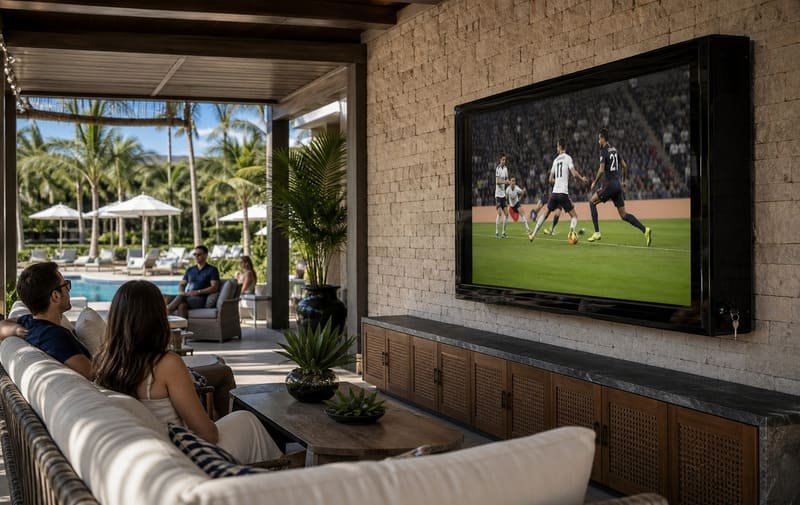
An 85-inch outdoor TV enclosure is not a normal accessory order. Once the screen size reaches 80–85 inches, the project starts to involve drawings, internal clearance, fan layout, wall structure, packaging, shipping risk, installation access, and future service planning.
For smaller screens, a buyer may recover from a sizing mistake quickly. For an 85-inch export order, a wrong assumption can affect the supplier, installer, freight cost, hotel opening schedule, or commercial rollout plan.
To plan an 80–85 inch waterproof TV enclosure project, I do not start with the screen label. I start with the TV model number, internal cabinet clearance, climate, operating hours, airflow path, mounting structure, site security, packaging method, and who will service the screen after installation.
I use the word “waterproof” here because that is how many buyers search for this product. Technically, I prefer the words IP-rated or weatherproof. A waterproof TV enclosure should not be understood as something submersible or maintenance-free. In real projects, IP rating, cable exits, gasket compression, fan cooling, mounting angle, and installation quality all matter.
I usually tell buyers that choosing an 80–85 inch outdoor TV enclosure is less like buying a TV bracket and more like planning a small outdoor equipment cabinet. The TV must fit. The air must move. The screen must stay protected from rain, dust, humidity, and touch damage. The enclosure must also look acceptable after installation.
For this size range, I treat every order as a project package, not just a product SKU.
Last Updated: May 13, 2026 | Estimated Reading Time: 9 minutes
By Smith Chen, Outdoor TV Enclosure Engineer at Outvion
Why Is an 80–85 Inch Enclosure More Like a Project Than a Product?
A small outdoor TV enclosure can sometimes be selected from a product page and installed with limited planning. An 80–85 inch enclosure is different. The size, weight, shipping, packaging, mounting structure, and service access all become part of the buying decision.
An 80–85 inch waterproof TV enclosure should be planned like a project because the screen is large, the cabinet is bulky, and mistakes are expensive to fix after shipment. Before confirming production or delivery, buyers should prepare TV model details, site photos, mounting information, climate conditions, operating hours, and installation responsibilities.
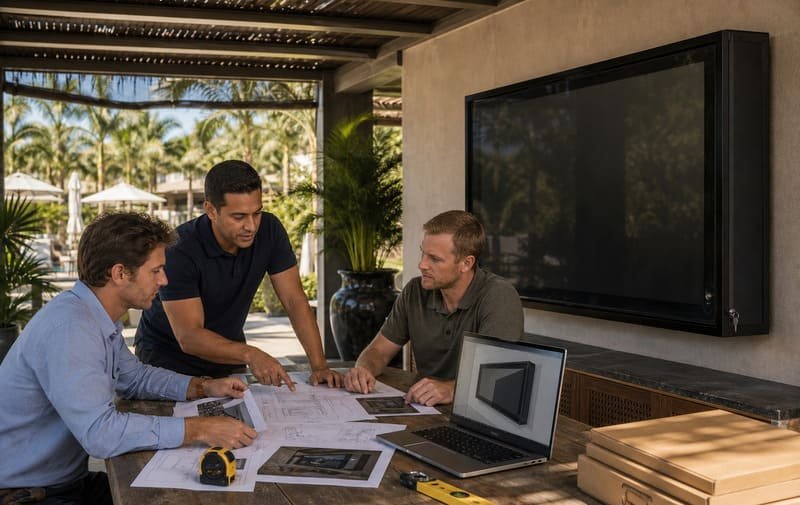
For this size range, I do not like relying on product photos alone. A photo can show the shape of the enclosure, but it cannot confirm whether the TV fits, whether the wall can support the total load, whether the fan vents will have clearance, or whether the cable route can stay protected.
When a buyer sends only “85 inch Samsung” or “80 inch LG,” I treat the project as incomplete. The brand and diagonal size are only the beginning. I still need the exact TV model number, the TV’s full dimensions, the VESA pattern, cable direction, and the installation site information.
For export orders, the planning burden is even higher. If the enclosure arrives and the TV does not fit, returning or replacing it is not like returning a small accessory. The freight cost, customs process, installation delay, and customer frustration can be much bigger than the original mistake.
That is why I like to separate this type of project into five stages:
| Project Stage | What to Confirm | Why It Matters |
|---|---|---|
| Before Quotation | TV model, site photos, climate, quantity | Prevents wrong assumptions before pricing |
| Before Production | Internal dimensions, VESA range, cable exits, fan layout | Reduces fit and installation risk |
| Before Shipping | Packaging method, drawings, accessories, spare parts | Reduces transport damage and missing-part issues |
| Before Installation | Wall structure, lifting method, power route, service access | Reduces site delays and safety problems |
| After Installation | Cleaning access, fan inspection, cable check, maintenance plan | Supports long-term outdoor use |
For smaller sizes, buyers often focus on the enclosure itself. For 80–85 inch projects, I focus more on the workflow around the enclosure.
Why Is “80–85 Inch” Not Enough for Enclosure Sizing?
An 85-inch TV sounds like one clear size, but it is not. Different brands and models can have different outside dimensions, rear shapes, speaker areas, and cable positions.
An 80–85 inch enclosure must be matched to the TV’s actual width, height, and depth. I also check cable space, plug position, VESA location, accessories, and internal airflow space before I say a model is suitable. The diagonal screen size alone is not enough.
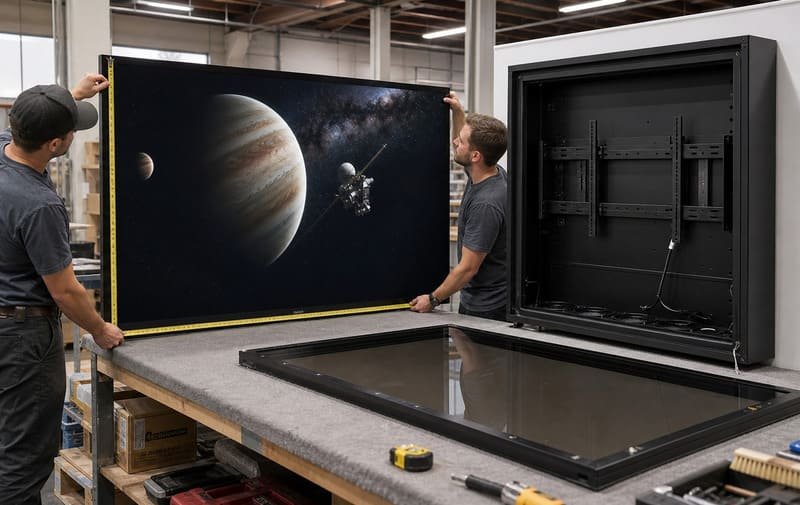
I always ask for the TV model number or the TV specification sheet before I confirm a large enclosure.
The diagonal screen size is only a marketing size. LG explains that TV screen size is measured diagonally and does not include the borders or bezels, so buyers should also check total width, height, and depth from the product specifications. LG TV size guide
That matters a lot for 80–85 inch screens. One 85 inch TV may have a slim frame. Another may have a thicker lower speaker area or a deeper rear bulge. Some models have rear-facing HDMI or power ports that need more cable bend space. Some buyers also want to place a media player, receiver, or mini PC inside the enclosure.
I also check the bracket and cable area. A rear power plug, HDMI cable, media player, or receiver can push the TV forward or block the rear panel. If the TV is too close to the transparent front panel, heat and pressure can become problems. If the TV is too close to the rear cover, cable stress can happen.
| Checkpoint | What I Look For | Why It Matters |
|---|---|---|
| TV Width | Must be smaller than usable inner width | Prevents side pressure and installation failure |
| TV Height | Must be smaller than usable inner height | Prevents top and bottom interference |
| TV Depth | Must include rear bulges and plugs | Protects cables and leaves space for airflow |
| VESA Pattern | Must match the enclosure mount range | Avoids drilling changes on site |
| Cable Direction | Rear-facing or side-facing ports | Prevents crushed cables and service problems |
| Accessory Space | Media player, receiver, mini PC, power adapter | Prevents heat and clutter inside the cabinet |
| Airflow Gap | Space behind and around the TV | Helps reduce heat buildup |
This small measurement process can save a lot of cost, especially for export orders, hotel projects, and large commercial rollouts where returns are difficult.
If you already have a TV model in mind, compare its dimensions and VESA pattern with the Outvion 80–85 inch outdoor TV cabinet specifications before ordering.
What Weather and Site Risks Should I Check Before Buying?
Rain is only one part of outdoor protection. Large outdoor screens also face dust, humidity, salt air, snow, wind-driven rain, public access, and cleaning routines.
Before choosing an 80–85 inch waterproof TV enclosure, I check the real site conditions, not just the product rating. IP65 can help against dust and water jets under defined test conditions, but coastal air, freezing seasons, humid patios, direct sun, and public exposure still affect the best enclosure choice.
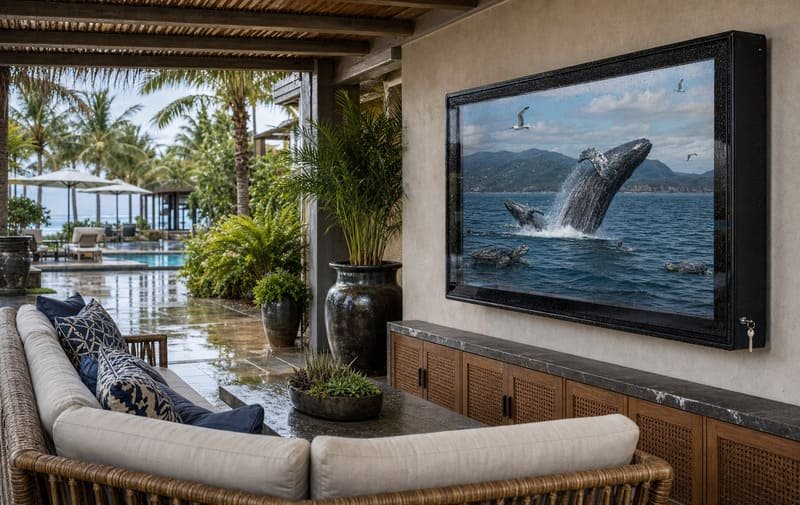
The International Electrotechnical Commission explains that IP ratings grade the resistance of an enclosure against intrusion by dust or liquids. IEC IP Ratings
For outdoor TV enclosures, IP65 is often a useful target because it means dust-tight protection and protection against water jets under defined test conditions. But IP65 does not mean vapor-proof, condensation-proof, chemical-proof, salt-proof, submersible, or maintenance-free.
When I talk with U.S. commercial buyers, the first concern is often rain on patios, sports bars, and hotel pool areas. In northern states, snow and freeze-thaw seasons may also affect mounting, cable routing, and service access.
In coastal areas, salt air becomes a major concern because metal hardware can corrode faster if the material or coating is not suitable. FEMA guidance on coastal construction notes that salt accumulation and high humidity can accelerate corrosion of untreated steel connectors and fasteners. FEMA coastal corrosion guidance
For European outdoor spaces, I often hear more questions about appearance and long-term material feel. A buyer may ask whether the enclosure looks too industrial on a terrace or restaurant wall. I still bring the discussion back to climate. Even a good-looking enclosure must handle rain, humidity, temperature changes, and maintenance.
| Environment | Main Risk | What I Usually Check |
|---|---|---|
| U.S. Sports Bar Patio | Rain, dust, touch damage, theft risk | IP rating, locks, front panel strength, mounting |
| Coastal Resort | Salt air, humidity, wind-driven rain | Body material, hardware, sealing, cable exits |
| Northern Outdoor Site | Snow, freezing, moisture buildup | Seal design, mounting angle, service access |
| European Terrace | Rain, appearance, space limits | Slim profile, material finish, correct fit |
| Public Institution | Dust, impact, misuse | Locking system, front protection, service access |
| Middle East Courtyard | Heat, sun, long operating hours | Fan system, shade, internal clearance |
I do not like saying that any outdoor enclosure is a reason to ignore the environment. A weatherproof enclosure helps reduce risk, but installation still matters. The wall, roof overhang, cable entry, power point, mounting height, and maintenance access all affect real performance.
Why Does Heat Matter as Much as Rain for Large Outdoor Screens?
A sealed box can protect against water, but it can also trap heat. This becomes more serious as the screen size increases.
For 80–85 inch outdoor TV use, heat control is critical. I look for airflow space, fan circulation, sun exposure, operating hours, and the TV’s own heat output before I recommend an enclosure for long outdoor use. Fans help reduce heat buildup, but they are not air conditioning. Shade and airflow planning still matter.
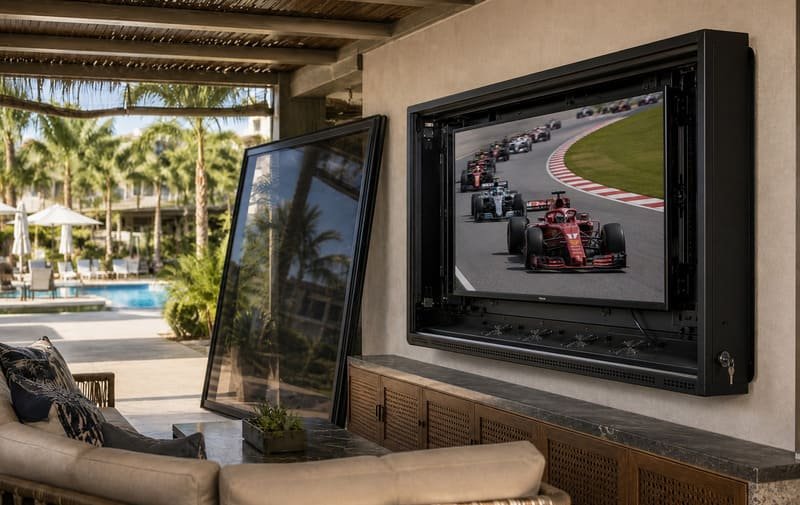
For Middle East customers, heat and large-screen outdoor use come up frequently. A villa courtyard, hotel pool area, or outdoor lounge can face strong sun and long evening operation. If the enclosure is sealed without good airflow thinking, the temperature inside can rise. This can affect the TV, media player, and power parts.
Sony advises using TVs within a temperature range of 0°C to 40°C / 32°F to 104°F and avoiding direct sunlight. Sony TV temperature guidance
Water protection is important, but heat protection is also part of the real decision.
I usually separate heat risk into three parts:
- Local Climate
Is the site mild, hot, humid, desert-like, or coastal? - Site Position
Is the enclosure shaded, partially shaded, or exposed to direct afternoon sun? - Operating Pattern
Will the screen run two hours at night, or all afternoon and evening in a commercial venue?
| Heat Factor | Lower-Risk Example | Higher-Risk Example | My Practical Response |
|---|---|---|---|
| Sun Exposure | Shaded wall | Direct afternoon sun | I suggest more airflow and shade planning |
| Operating Time | Short evening use | All-day commercial use | I check active fan needs carefully |
| Climate | Mild terrace | Hot courtyard or desert region | I focus more on ventilation |
| TV Type | Lower-heat model | High-brightness or thicker model | I check internal space more carefully |
| Accessories | No extra devices inside | Media player and receiver inside | I keep more space for air movement |
For most 80–85 inch commercial projects, I prefer active airflow. Fans can help move warm air and reduce hot spots inside the enclosure. They do not make every installation safe under every condition, but they can improve stability when the design is suitable.
I also remind buyers that shade still matters. If a screen faces direct sun, the image can look washed out, and the enclosure can become hotter. A protective front panel may help reduce some UV exposure depending on material grade and coating, but it should not be described as a complete anti-glare solution.
How Should I Match the Enclosure to USA, Middle East, and European Sites?
A keyword like “best outdoor TV enclosure” does not tell me enough. I need to know the country, site type, operating pattern, and buyer’s real use case.
I match large enclosures by scenario. U.S. buyers often focus on commercial uptime and security. Middle East buyers often focus on heat, sunlight, and long operating hours. European buyers often compare appearance, material feel, and space use. The buyer’s location matters, but the actual site matters more.
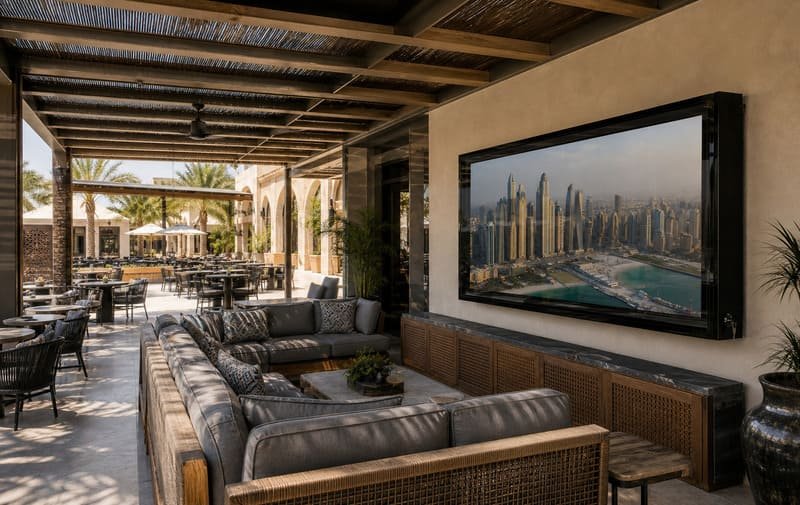
- For U.S. commercial buyers, I often hear direct business questions. A sports bar owner wants patio screens to keep working during game nights. A school buyer wants protection in a public area. A gym buyer may need a large screen near an open training zone. These buyers usually care about downtime, replacement cost, guest access, and easy service.
- For Middle East buyers, I usually review shade and daily operating hours before discussing material. A large 85 inch TV in a courtyard or hotel area may run for many hours. I ask about air temperature, wall orientation, and whether the screen faces direct sun. I do not assume one enclosure works for every hot site.
- For European buyers, I often hear detailed questions about design. They may ask whether polycarbonate looks too plain, whether metal feels more premium, or whether a wood-look style matches the building. I explain the trade-offs instead of calling one material perfect.
RTINGS notes that TV size and viewing distance should be planned together, which is especially important for large screens in restaurants, villas, terraces, and commercial viewing zones. RTINGS TV size and viewing distance guide
| Region or Buyer Type | Common Concern I Hear | What I Check First |
|---|---|---|
| U.S. Sports Bar | Uptime, rain, theft, game-day reliability | Size fit, lock, IP rating, mounting |
| U.S. School or Public Space | Misuse, impact, safety, service | Front panel, lock, bracket access |
| Middle East Villa | Heat, sun, large-screen viewing | Fan system, shade, internal clearance |
| Middle East Hotel | Long operation, outdoor lounge use | Active cooling, service plan, project quantity |
| European Restaurant | Appearance and durability | Slim profile, material choice, finish |
| European Home Terrace | Space and visual fit | Depth, wall position, front panel look |
| Coastal Resort | Salt air, guest access, maintenance | Body material, hardware, gasket and cable exits |
A coastal U.S. hotel and a humid Mediterranean terrace may share similar salt-air concerns. A shaded Middle East lounge may have a different risk level from a fully exposed courtyard. Country matters, but the real site matters more.
Which Material and Design Choices Affect Durability and Appearance?
Material choice is not only about strength. Buyers also care about appearance, weight, corrosion risk, touch safety, maintenance, and whether the enclosure fits the building style.
Polycarbonate, metal, and wood-look designs each have trade-offs. I usually compare impact resistance, weight, salt-air behavior, finish expectations, front-panel clarity, internal depth, and maintenance needs before I suggest a direction. For 80–85 inch screens, a clean profile matters, but the enclosure cannot become so thin that cables and airflow suffer.
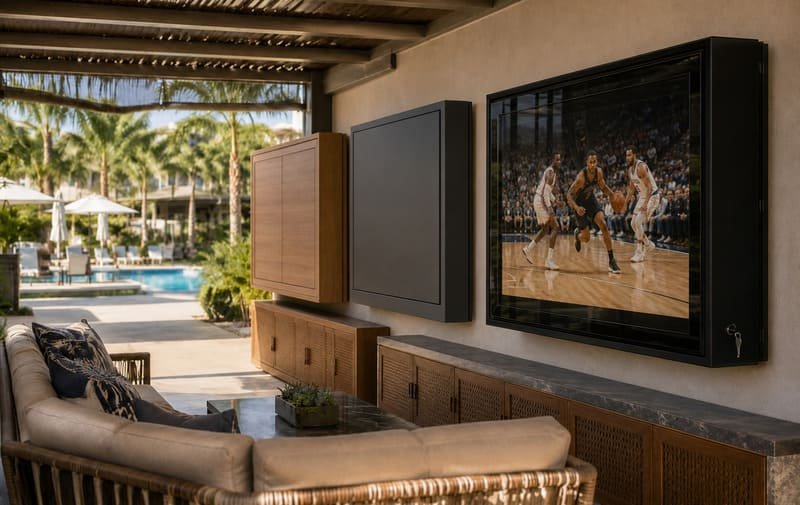
I often work with heavy-duty polycarbonate enclosures because this material can offer a useful balance of impact resistance, lighter weight, transparent design, and lower body-rust risk.
Covestro describes Makrolon polycarbonate as robust, lightweight, glass-like in transparency, and impact resistant even at low temperatures. Covestro Makrolon polycarbonate
A polycarbonate body does not rust like steel, which can be useful for resorts, pool areas, and seaside restaurants. But I do not tell every buyer that one material is always best. Locks, hinges, screws, anchors, brackets, and cable exits still need corrosion-resistant design and inspection.
A metal enclosure may feel more solid or more familiar for some commercial projects. However, coating quality, edge treatment, hardware, and salt-air exposure need careful attention. A wood-look style may match a villa or garden design better, but it needs careful thought around moisture, UV exposure, and long-term outdoor maintenance.
The front panel also matters. A transparent protective panel helps protect the TV screen from rain, dust, touch, and impact risk. It may also help reduce UV exposure depending on material grade, coating, thickness, and supplier test data. It should not be sold as a magic glare solution. Glare depends on sun angle, panel surface, screen brightness, and viewing position.
| Design Choice | Possible Benefit | Possible Concern |
|---|---|---|
| Polycarbonate Body | Lighter body, impact resistance, no steel rust on the body | Some buyers may prefer a metal feel |
| Metal Body | Solid feel, familiar industrial appearance | Salt-air corrosion risk depends on material, coating, and hardware |
| Wood-Look Finish | Warmer visual style for villas or gardens | Outdoor durability depends on structure and coating |
| Slim Profile | Better building integration | Internal space and airflow still must be enough |
| Thick Front Panel | Better physical protection | May affect reflection and viewing feel |
| Lockable Access | Helps reduce casual tampering | Locks and keys need corrosion-resistant design |
| Fan System | Helps reduce heat buildup | Needs vent clearance and maintenance |
For 80–85 inch screens, I also care about the enclosure profile. Large TV enclosures can become bulky fast. A narrow, cleaner design can fit better in hotels, terraces, and public venues. But I do not reduce depth without thinking. If the enclosure becomes too thin, cable space and airflow may suffer.
Good design is a balance between appearance, service space, and protection.
What Should I Confirm Before a Bulk or Commercial Order?
A commercial order should not rely on a product photo. For 80–85 inch enclosures, I want technical details before the project moves forward.
Before a bulk or commercial order, I check the TV model, inner dimensions, outer dimensions, IP rating, fan system, VESA range, cable exits, packaging method, spare parts, warranty support, and lead time. This helps reduce installation surprises, shipping damage, and project delays.
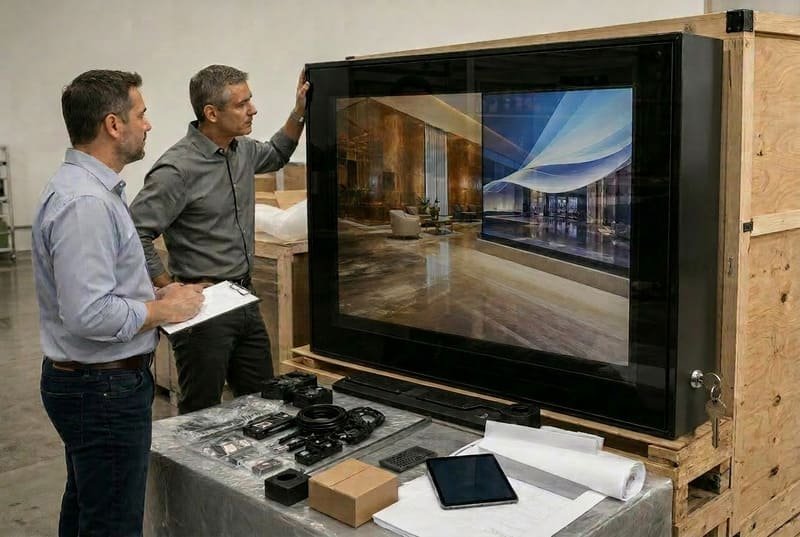
For procurement teams, the enclosure may look like one line on a project list, but it can affect many people later. The installer needs correct dimensions. The finance team wants a lower total cost. The venue manager wants fewer failures. The maintenance team wants access to fans, locks, cables, and internal devices.
This is why I do not like approving large orders based only on a front-view product photo.
CIPS defines Total Cost of Ownership as an estimate used to help buyers determine the end-to-end cost of providing a product or service, including purchase price, acquisition cost, usage cost, and end-of-life cost. CIPS Total Cost of Ownership overview
That idea matters for large TV enclosure projects. A cheap enclosure that causes fit problems, heat problems, transport damage, or difficult service access can become expensive later.
Packaging also matters more at this size. Oversized transparent panels and formed enclosures can be costly to replace if scratched or damaged in transit. For export orders, I suggest confirming carton or crate design, internal protection, accessory packing, spare keys, fan parts, and installation hardware.
I also ask about spare TVs and future replacement plans. One reason buyers choose an enclosure is that they can use a standard indoor TV instead of a dedicated outdoor TV. This can reduce hardware cost and make future screen upgrades easier. The enclosure stays in place, and the TV can be replaced if the size and mounting still match.
But this works only when the original enclosure was selected with enough practical clearance.
| Question I Ask | Reason I Ask It |
|---|---|
| What is the exact TV model number? | I need the true body size and VESA pattern |
| Where will the enclosure be installed? | I need to judge rain, heat, dust, salt air, and access risk |
| How many hours will the TV run daily? | I need to judge heat load |
| Will accessories be installed inside? | I need to keep enough space and airflow |
| Is this a one-site or multi-site rollout? | I need to check repeat fit and lead time |
| Who will install and service it? | I need to think about access, lifting, and mounting |
| What packaging method is required? | I need to reduce transport damage risk |
| Are spare parts needed? | Fans, keys, locks, and hardware may matter for maintenance |
| Is there a long-term TV replacement plan? | The enclosure should support future screen upgrades where possible |
I also suggest that buyers request drawings and specification sheets. A photo is not enough for an 85 inch project. The drawing should show inner dimensions, outer dimensions, mounting holes, VESA range, fan layout, and cable entry options.
For commercial buyers, this step can save site visits, delays, and blame between the supplier, installer, and project manager.
Frequently Asked Questions
Can any 85 inch TV fit an 85 inch waterproof enclosure?
No. I do not assume that. I check the real TV width, height, depth, VESA pattern, rear shape, plug area, and cable direction. The diagonal screen size is not enough. Some TVs have wider frames, deeper backs, or unusual rear housings. I prefer to confirm the exact model before recommending the enclosure.
Is IP65 enough for outdoor TV protection?
IP65 is often a strong starting point for rain and dust protection, but it is not the whole answer. IP65 means dust-tight and protected against water jets under defined test conditions. It does not mean vapor-proof, condensation-proof, chemical-proof, salt-proof, submersible, or maintenance-free. Cable entry, wall angle, roof cover, wind-driven rain, and maintenance all matter.
Can I use a normal indoor TV inside the enclosure?
Yes, this is one common reason buyers choose an enclosure. It can reduce hardware cost and make future TV replacement easier. However, the enclosure does not change the TV manufacturer’s original outdoor-use rating or warranty terms. I still check heat, brightness, operating hours, ventilation, cable routing, and service access.
Does the front panel remove glare?
No. I would not describe it that way. The front panel protects the screen and may help reduce some UV exposure depending on material grade and coating. Glare still depends on sun angle, screen brightness, front surface, reflection source, and viewer position. I usually suggest shade planning when glare is a major concern.
Do I need fans for an 80–85 inch enclosure?
For many large outdoor screens, I prefer fan circulation, especially in hot climates or commercial use. A sealed space can trap heat. Fans help move warm air and reduce hot spots, but they are not air conditioning. The final choice depends on climate, sun exposure, TV heat output, internal clearance, and daily operating time.
Is polycarbonate better than metal?
I do not call one material always better. Polycarbonate can be useful where body-rust risk, weight, impact behavior, and transparent design matter. Metal can feel more solid to some buyers, but salt air, coating damage, seams, and hardware corrosion need attention. The best choice depends on the site and the buyer’s appearance expectations.
What should I send to a supplier before ordering?
I suggest sending the TV model number, installation photos, location climate, expected operating hours, mounting surface details, and quantity. For commercial projects, also ask for drawings, inner dimensions, outer dimensions, VESA details, fan layout, cable entry options, packaging method, spare parts, and lead time.
Is an 80–85 inch enclosure too large for a normal backyard?
It can be too large for many normal home patios unless the viewing distance, wall size, and installation structure support it. For typical backyard seating, 50–55 or 60–65 inches may be more practical. An 80–85 inch enclosure is usually better for large patios, commercial venues, resorts, villas, public institutions, or outdoor viewing zones with longer distances.
Conclusion
I choose an 80–85 inch waterproof TV enclosure by treating it as a project package, not just a product order.
The TV label is not enough.
The product photo is not enough.
The IP rating is not enough by itself.
The material choice is not enough without hardware and maintenance.
The fan system is not enough without shade, airflow, and operating-hour planning.
For this size range, I want to see the full picture:
- TV model.
Internal dimensions.
VESA pattern.
Cable exits.
Climate.
Sun exposure.
Operating hours.
Mounting structure.
Packaging method.
Service access.
Future replacement plan.
The way I explain it to commercial buyers is simple:
An 80–85 inch waterproof TV enclosure is not a normal accessory. It is an outdoor equipment cabinet for a large display project.
If the project is planned correctly, this size can create a powerful viewing experience for hotels, villas, sports bars, resorts, public institutions, and large outdoor spaces. But if the project is treated like a simple TV bracket purchase, the risks become much higher.
Plan the enclosure like a project, and the installation has a much better chance of working smoothly from quotation to long-term use.