
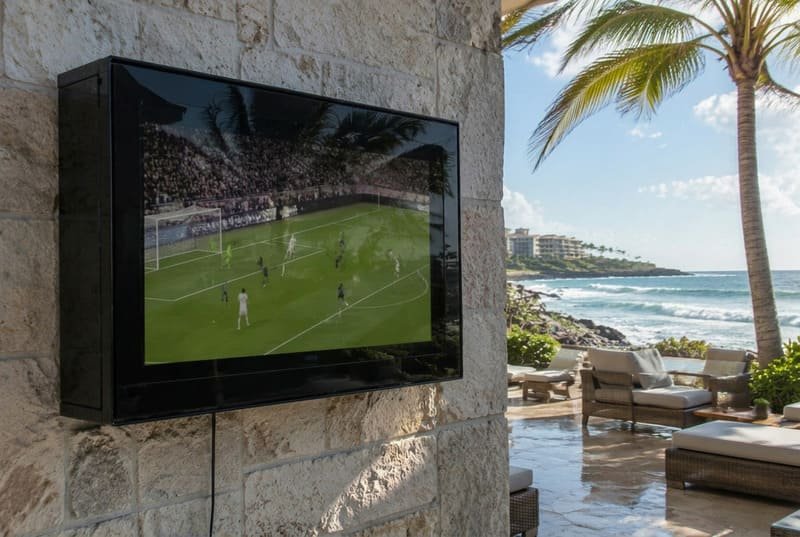
You’ve invested in TVs for your coastal property, but the salty air is a silent threat to screens, hardware, ports, and mounting components. Constant corrosion, repeated service calls, and early screen failures can become frustrating and expensive for hotels, beach bars, resorts, restaurants, and seaside homes.
The best way to protect an outdoor TV from coastal salt air is to treat the installation as a complete protection system. A sealed outdoor TV enclosure, corrosion-resistant body material, protected hardware, sealed cable exits, active airflow, and regular maintenance all work together. A polycarbonate enclosure body does not rust like steel, but locks, hinges, screws, mounts, and cable exits still need corrosion-resistant design and inspection.
I talk with hospitality owners, AV installers, and coastal property managers often. A common pattern I notice is that everyone starts by focusing on rain, which makes sense. Rain is visible. Storms are easy to imagine.
But in a seaside environment, the real persistent enemy is often not the occasional storm. It is the air itself.
Salt air is not a one-time event. It is a constant exposure. Fine salt mist, high humidity, wind-driven moisture, and wet surfaces can slowly affect electronics, fasteners, locks, hinges, cable exits, and wall mounts. Research on printed circuit boards has also shown that humidity, salt spray, and corrosive contaminants can affect electronic reliability in atmospheric environments. PCB corrosion and airborne contamination research
Simply covering a TV is not enough in many coastal locations. The better goal is to create a more stable protective environment around the TV and reduce the weak points where salt air usually enters or attacks.
Let’s break down the options I usually discuss with coastal customers and how to choose a solution that can last.
Last Updated: May 9, 2026 | Estimated Reading Time:10 minutes
By Smith Chen, Outdoor TV Enclosure Engineer at Outvion
Are Fabric Covers or DIY Cabinets Enough for the Coast?
A cheap fabric cover or a weekend DIY cabinet project seems like an easy fix for an outdoor TV. But on the coast, the problem is not only direct rain. It is humid, salty air that can stay around the TV for hours every day.
Fabric covers and most DIY cabinets are usually not enough for coastal TV protection. Covers may block direct rain, but they can also trap humid salt air against the TV. DIY wood or metal cabinets often struggle with sealing, ventilation, material aging, and corrosion unless they are carefully engineered for the coastal environment.
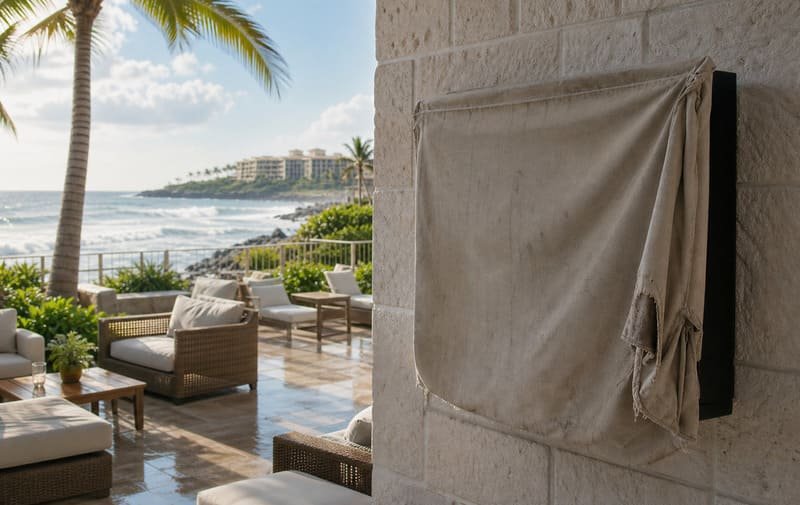
From my experience advising coastal clients, the initial appeal of a low-cost cover or custom wooden cabinet is strong. It feels practical and budget-friendly. But the feedback after one or two seasons often tells a different story.
A fabric cover may keep off rain when the TV is not in use. But on a damp evening, salty air can still remain around the TV housing, ports, and mounting area. If the cover traps moisture instead of allowing the installation to dry properly, corrosion risk may increase.
For a homeowner who only uses the TV occasionally, a cover may feel manageable. For a business such as a sports bar, hotel, or resort, it becomes less practical. Staff have to remove the cover, store it, put it back on, and make sure it is not left off during rain or overnight humidity. That daily operational burden is often where covers fail.
DIY wooden cabinets have another problem. Wood may look warm and attractive at first, but coastal humidity can cause swelling, warping, mold, finish failure, and joint movement. USDA Forest Service research on above-ground wood decay notes that moisture conditions are a key factor in decay risk, especially when wood remains above fiber saturation levels under favorable temperatures. USDA Forest Service wood decay research
DIY metal cabinets can also be risky. If they are not made with suitable coastal materials, coatings, gaskets, cable seals, drainage planning, and ventilation, they may become heavy boxes that rust, trap heat, or allow salt-laden air to reach the TV anyway.
Comparing Common Low-Cost Options
| Protection Method | Salt Air Resistance | Sealing & Humidity | Ventilation | Daily Convenience | Long-Term Risk |
|---|---|---|---|---|---|
| Fabric Cover | Low | May trap humid air | None | Requires manual use every day | TV still exposed when cover is removed or left off |
| DIY Wood Cabinet | Low to Medium | Seal may shift as wood moves | Often poor unless engineered | Heavy and inconvenient | Warping, mold, finish failure, seal gaps |
| DIY Metal Cabinet | Depends on metal and coating | Hard to seal well without proper design | Often poor unless engineered | Heavy and may corrode | Rust, seized hinges, coating damage |
| Purpose-Built Enclosure | Higher if material and hardware are chosen well | Designed gasket and cable-exit system | Can include fan cooling | Lockable and always in place | Still requires correct installation and maintenance |
Thinking through this table often helps buyers understand why upfront savings do not always translate into lower long-term cost.
Coastal protection is not just about blocking a downpour. It is about reducing repeated exposure to salt-laden humidity, protecting weak points, and making the system practical enough that staff or homeowners will actually use it correctly.
Why Do Metal Enclosures Often Fail in Salty Air?
A heavy metal box feels strong and secure, so it seems like the obvious choice for coastal outdoor TV protection. But in salty air, the weak points are often scratches, seams, locks, hinges, screws, and coating damage.
Metal enclosures can work in some coastal projects if the material, coating, hardware, and maintenance plan are strong enough. But lower-cost metal enclosures often rely on powder-coated steel or aluminum, and their long-term performance depends heavily on coating quality, edge treatment, hardware selection, and regular inspection. Once corrosion begins near locks, hinges, screws, or gasket areas, both appearance and sealing performance can suffer.
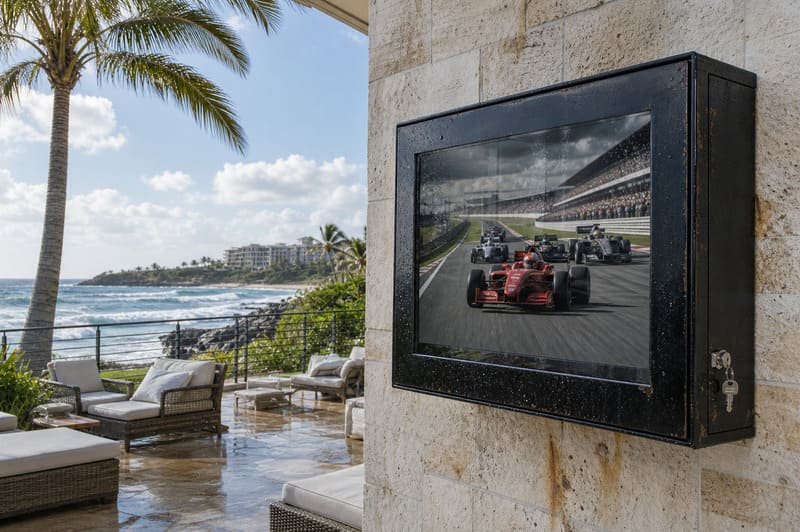
I once worked with a procurement manager for a small chain of beachfront hotels. They had installed steel enclosures a year earlier, and he was already facing serious problems.
During installation, several units received small scratches in the coating. Those scratches did not look important at first. But after months of salt air, rust streaks appeared on the wall, the coating started bubbling in places, and some locks became difficult to operate.
That case stayed with me because it showed an important lesson: in coastal environments, the large flat metal panel is not always the first failure point. The failure often starts at small details.
FEMA guidance on coastal construction highlights that coastal areas often have higher moisture and humidity and may be exposed to salt spray, which can corrode metal connectors and fasteners. FEMA corrosion protection guidance
The same logic applies to TV enclosures. Hinges, locks, screws, brackets, wall anchors, and cable exits can become the weak points.
Material Breakdown: Corrosion Is the Real Enemy
| Material / Structure | Coastal Advantage | Coastal Weak Point | My Practical View |
|---|---|---|---|
| Powder-Coated Steel | Strong, familiar, lower cost | Scratches, cut edges, screws, seams, and coating damage can start rust | Risky in coastal locations unless coating and maintenance are excellent |
| Aluminum | Does not rust like steel and is lighter | Can still suffer pitting or hardware corrosion; coating still matters | Better than steel, but not maintenance-free |
| Stainless Steel | Strong corrosion resistance if correct grade is used | Expensive; still needs correct hardware and care | Good for some premium projects, but cost can be high |
| Polycarbonate Body | Body does not rust like steel; lighter and impact-resistant | Needs UV-stable grade, proper thickness, good hardware and gasket design | Often a lower-maintenance body material for coastal enclosures |
I do not say metal is always bad. A well-designed stainless steel or marine-grade aluminum enclosure with correct hardware can perform well. But for many hotel, bar, restaurant, school, and resort installations, cost, weight, and maintenance make metal less attractive.
This is why we often choose polycarbonate for the enclosure body. Covestro describes Makrolon polycarbonate as robust, lightweight, glass-like in transparency, and impact resistant even at low temperatures. Covestro Makrolon polycarbonate
A polycarbonate body does not rust like steel, which removes one major corrosion pathway in coastal environments. However, this does not mean the entire enclosure system is corrosion-proof. Locks, hinges, screws, mounts, anchors, and cable exits still need corrosion-resistant design and regular inspection.
That is the cautious but practical way to think about coastal materials.
Is a Purpose-Built Outdoor TV Always the Smarter Investment?
After seeing covers, DIY cabinets, and some metal enclosures fail, a dedicated outdoor TV can look like the safest choice. But the higher upfront cost and future replacement cost still need to be considered carefully.
A purpose-built outdoor TV can be a strong choice when full-sun brightness, integrated weather resistance, and a single finished outdoor-rated product are the top priorities. However, it is not automatically the most cost-effective choice for every coastal project. For many large-screen or multi-location installations, a standard TV inside a durable enclosure can offer more upgrade flexibility and lower replacement cost.
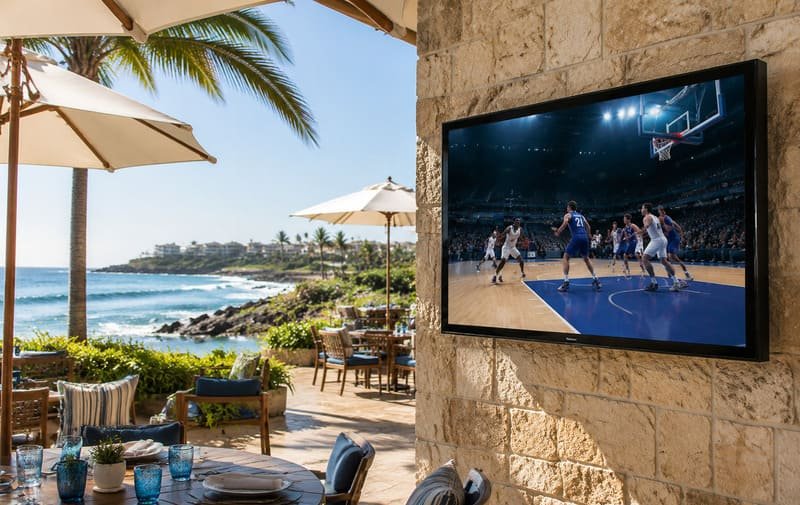
I had a long discussion with a sports bar owner from Florida about this exact dilemma. He wanted to add eight TVs to a new outdoor patio. The quote for dedicated outdoor TVs consumed a large part of the renovation budget.
He asked me, “Is it worth it?”
My answer was not simply yes or no. I asked him to think about the technology cycle. A TV is not like a steel beam or a concrete wall. Screen technology, smart apps, brightness, resolution, and streaming features change quickly.
A dedicated outdoor TV can absolutely be the right solution. For full-sun brightness, integrated outdoor support, anti-glare performance, and simplified product selection, it may be the better fit. Samsung describes The Terrace outdoor TV line as having direct sun protection technology, an anti-glare screen, and IP55 weather resistance. Samsung The Terrace outdoor TVs
But for many commercial buyers, the question is not only whether the TV is strong. It is whether the whole investment model makes sense.
CIPS defines Total Cost of Ownership as a way for buyers to estimate the end-to-end cost of providing a product or service, including purchase price, acquisition cost, usage cost, and end-of-life cost. CIPS Total Cost of Ownership overview
That is how I recommend comparing outdoor TVs and enclosure systems.
Total Cost of Ownership: The Enclosure Advantage
| Factor | Dedicated Outdoor TV | Standard TV + Polycarbonate Enclosure |
|---|---|---|
| Initial Cost | Usually higher, especially for large sizes | Usually lower to medium, depending on TV and enclosure size |
| Technology Upgrades | Replace the full outdoor-rated unit | Keep the enclosure and replace only the TV inside |
| Repair / Replacement | More specialized and potentially more expensive | Standard TV replacement can be simpler |
| Flexibility | Locked into one integrated product | Use any compatible TV that fits the enclosure |
| Protection Asset | Protection is built into the TV itself | Enclosure becomes the long-term protective asset |
| Best Fit | Full-sun, premium, simplified warranty projects | Coastal patios, bars, hotels, schools, resorts, and multi-unit projects where flexibility matters |
The enclosure strategy separates protection from display technology. The enclosure is the long-term protective asset. The TV inside becomes the replaceable screen.
I do not present this as the right answer for everyone. If your project requires full-sun performance, a slim finished outdoor TV look, or a single integrated product with outdoor-rated support, a dedicated outdoor TV may be the better choice.
But if your priority is long-term cost control, upgrade flexibility, physical protection, salt-air isolation, and easier screen replacement, an enclosure system can be very practical.
How Does a Polycarbonate Enclosure Work as a Coastal Defense System?
You need a solution that reduces salt-air exposure, manages heat, and protects the TV without creating a sealed hot box. A modern enclosure should work as a system, not just a shell.
A quality polycarbonate outdoor TV enclosure works as a coastal defense system by combining a non-rusting body, IP-rated sealing, protected cable exits, active airflow, lockable access, and serviceable hardware. The polycarbonate body does not rust like steel, while fan cooling helps reduce heat buildup. However, IP65 is not vapor-proof or condensation-proof, and the system still needs correct installation and maintenance.
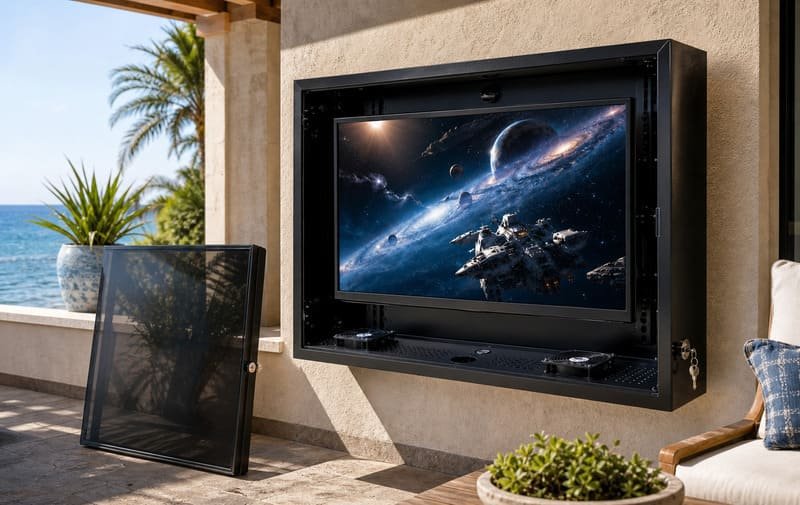
When I explain polycarbonate enclosures to engineers, sourcing managers, and coastal property owners, I emphasize that they are not just passive shells.
The value is in the full system design.
The enclosure body protects the TV from rain, dust, insects, wind-driven moisture, impact, and casual access. The gasket system and cable exits help reduce weak points. The fan system helps move warm air away from the TV. The lockable front limits unauthorized access in public areas.
But I also explain the limits carefully.
The International Electrotechnical Commission explains that IP ratings grade the resistance of an enclosure against the intrusion of dust or liquids. IEC IP Ratings
For an outdoor TV enclosure, IP65 means the enclosure is dust-tight and protected against water jets under defined test conditions. It does not mean vapor-proof, condensation-proof, chemical-proof, salt-proof, or submersible. Real performance depends on gasket compression, cable-exit sealing, lock pressure, installation angle, fan path, and maintenance.
A sealed enclosure without airflow can trap heat. Sony advises using TVs within a temperature range of 0°C to 40°C / 32°F to 104°F and avoiding direct sunlight. Sony TV temperature guidance
That is why active airflow is important. Fans help reduce stagnant warm air and move heat away from the TV. They may reduce condensation risk in some conditions, but condensation still depends on humidity, temperature swings, enclosure sealing, cable exits, and installation conditions.
Breaking Down the System Components
| System Component | Role in Coastal Protection | Important Limit |
|---|---|---|
| Polycarbonate Body | Does not rust like steel; adds impact-resistant protection | Hardware still needs corrosion-resistant design |
| IP65 Sealing | Helps reduce dust and water-jet intrusion | Not vapor-proof, salt-proof, or submersible |
| Sealed Cable Exits | Reduces one common weak point | Poor cable routing can defeat the enclosure |
| Active Fans | Helps reduce heat buildup and stagnant warm air | Not air conditioning; shade and placement still matter |
| Lockable Front Access | Reduces tampering and unauthorized access | Lock materials still need inspection in salt air |
| Transparent Front Panel | Allows viewing while protecting the screen | Can reflect light; placement and shade still matter |
| Service Access | Allows TV replacement, cleaning, and inspection | Needs enough clearance and maintenance planning |
This systematic approach is what transforms a standard TV from an exposed electronic device into a more controlled outdoor display installation.
It does not make the TV invincible. It does not change the TV manufacturer’s original outdoor-use rating or warranty terms. But when the TV, enclosure, location, airflow, and maintenance plan are matched correctly, the system can be much more practical for coastal use than a bare TV or a simple cover.
What Should Coastal Buyers Check Before Choosing a TV Protection System?
Coastal environments are not all the same. A beachfront bar, seaside hotel, marina restaurant, rooftop pool, and ocean-view home all have different levels of salt, wind, splash, sun, and maintenance access.
Before choosing a coastal TV protection system, buyers should check salt-air exposure, body material, hardware quality, IP rating, cooling design, cable exits, installation location, and maintenance plan. The best system is not only weather-resistant. It must also be practical to inspect, clean, and service over time.
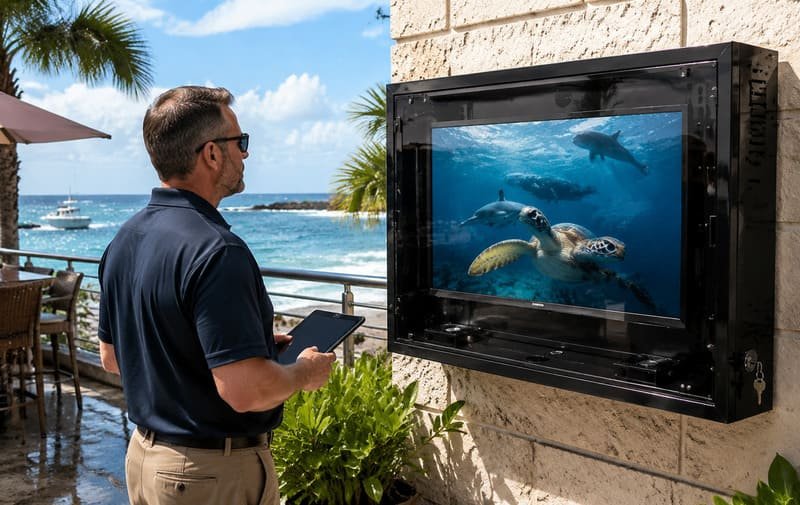
When I review a coastal project, I do not start with the screen size alone. I start with the site.
How close is the TV to the ocean?
Is it exposed to wind-driven spray?
Is the installation under a roof or fully open?
Will the TV run all day?
Is it near a pool, bar, kitchen, or marina?
Can staff clean and inspect it regularly?
What metal parts are exposed?
These details matter more than many buyers expect.
Coastal TV Protection Checklist
| Check | What to Confirm | Why It Matters |
|---|---|---|
| Salt-Air Exposure | Distance from ocean, wind direction, spray level | Determines corrosion risk and maintenance needs |
| Body Material | Polycarbonate, stainless steel, aluminum, coated steel, wood | Affects long-term corrosion and maintenance |
| Hardware | Locks, hinges, screws, anchors, brackets | Metal parts often fail first in coastal environments |
| IP Rating | IP65 or suitable protection level for the location | Helps reduce dust and water-jet intrusion |
| Cable Exits | Compression seals, glands, protected cable route | Cable openings are common weak points |
| Cooling | Fan path, vent clearance, TV size, operating hours | Helps reduce heat buildup around the TV |
| Mounting Surface | Concrete, brick, structural wall, reinforced post | Supports combined TV + enclosure load |
| Maintenance Access | Ability to open, clean, inspect, and service | Salt residue should not be ignored |
| Placement | Shade, splash path, wind exposure, glare | Reduces stress on the system |
For coastal installations, maintenance is not optional. Even a well-designed enclosure should be cleaned and inspected periodically. Salt residue can build up on surfaces, locks, hinges, and vents. Dust and insects can affect fan performance. Cable exits and gaskets should be checked.
The more exposed the site, the more important maintenance becomes.
Frequently Asked Questions
How does salt air damage outdoor TVs?
Salt air contains moisture and dissolved salts that can settle on exposed surfaces, ports, connectors, screws, and metal parts. Over time, this can accelerate corrosion, affect electrical contacts, and shorten the life of unprotected electronics. The risk is higher when humidity, wind-driven spray, and poor ventilation are present.
Is stainless steel better than polycarbonate for coastal TV enclosures?
Stainless steel can perform very well if the correct grade, finish, and hardware are used, but it is usually heavier and more expensive. Polycarbonate is often a lower-maintenance body material because it does not rust like steel and can also provide impact-resistant visibility. However, the best choice depends on cost, weight, installation, hardware design, and maintenance plan.
Does IP65 protect against salt air?
IP65 helps protect against dust and water jets under defined test conditions. It can reduce direct intrusion of water and particles, but it does not mean vapor-proof, condensation-proof, chemical-proof, salt-proof, or maintenance-free. Coastal installations still need corrosion-resistant hardware, sealed cable exits, airflow, and inspection.
Will an enclosure make my TV overheat in the summer?
A well-designed enclosure should not be a sealed hot box. Fan cooling and a planned airflow path help reduce heat buildup, but performance still depends on TV size, sun exposure, outside temperature, vent clearance, operating hours, and whether the installation is shaded.
Does the clear front panel affect picture quality or cause glare?
A high-clarity polycarbonate front panel is designed to keep the screen visible while adding impact and weather protection. However, any transparent front shield can create some reflection. Glare is mainly controlled by placement, shade, screen brightness, viewing angle, and front-panel clarity.
Can I use any indoor TV in a coastal enclosure?
Not automatically. The TV must fit the enclosure’s internal width, height, depth, VESA pattern, cable clearance, and operating temperature requirements. The enclosure helps reduce environmental exposure, but it does not change the TV manufacturer’s original outdoor-use rating or warranty terms.
How often should coastal TV enclosures be cleaned or inspected?
The more exposed the site, the more often it should be checked. For beachfront hotels, bars, resorts, and marinas, regular cleaning and inspection are important. Wipe salt residue from exterior surfaces, keep fan vents clear, check locks and hinges, inspect cable exits, and look for gasket wear.
Conclusion
Coastal salt air protection is not just about covering the TV. It requires a full system.
Fabric covers may trap humid air.
DIY cabinets may warp, rust, or fail to ventilate.
Metal enclosures can work, but scratches, seams, locks, and fasteners need careful corrosion control.
Dedicated outdoor TVs can be strong, but the upfront and replacement costs may be high.
Polycarbonate enclosures can offer a practical middle ground when designed and maintained correctly.
The way I explain it to coastal buyers is simple:
The coast does not attack your TV only during storms. It attacks slowly through the air, the hardware, the cable exits, and the weak points.
A good coastal TV protection system should combine:
Corrosion-resistant body material.
Protected hardware.
IP-rated sealing.
Sealed cable exits.
Active airflow.
Smart placement.
Regular inspection.
For hotels, beachfront bars, resorts, restaurants, marinas, schools, and ocean-view homes, that system-based approach is often the difference between a short-lived outdoor screen and a reliable long-term display setup.