
Placing a TV by your pool sounds great, but it also raises a serious question: how do you enjoy outdoor entertainment without creating an electrical safety risk near water?
The safest distance for a poolside TV is determined by local electrical code and should be verified by a licensed electrician. An outdoor TV enclosure helps protect the TV from rain, splash, dust, insects, heat, and poolside exposure, but electrical safety depends on GFCI/RCD protection, proper wiring, grounding, bonding, and code-compliant installation.
I’ve spent years in the outdoor TV enclosure business, and this question comes up almost every week. A hotel manager in Florida wants a screen near cabanas. A homeowner in California is building a backyard pool area. A sports bar owner wants to add outdoor TVs near a patio pool. They all start with the same question:
“How close can I put the TV to the water?”
My answer usually surprises them. I do not give one universal number. Instead, I explain the real decision process, because the goal is not only to protect the TV. The goal is to create a system that is safe for people, practical to use, and reliable for years.
A poolside outdoor TV enclosure is only one part of that system.
The way I explain it is simple:
The enclosure protects the TV. The electrical system protects people.
Let’s walk through the main placement, safety, and installation factors before drilling any holes.
Last Updated: May 6, 2026 | Estimated Reading Time: 7 minutes
By Smith Chen, Outdoor TV Enclosure Engineer at Outvion
What’s the Real Difference Between Waterproof and Electrically Safe?
You bought a high-quality, IP-rated enclosure, so it feels safe for any poolside location. But just because the box is weather-resistant does not mean the electrical installation is safe near water.
Waterproof and electrically safe are not the same thing. An IP-rated enclosure protects the TV from dust and water exposure, while electrical safety protects people from shock. Near a pool, GFCI/RCD protection, correct outdoor wiring, bonding, grounding, outlet placement, and licensed installation are more important than the enclosure alone.
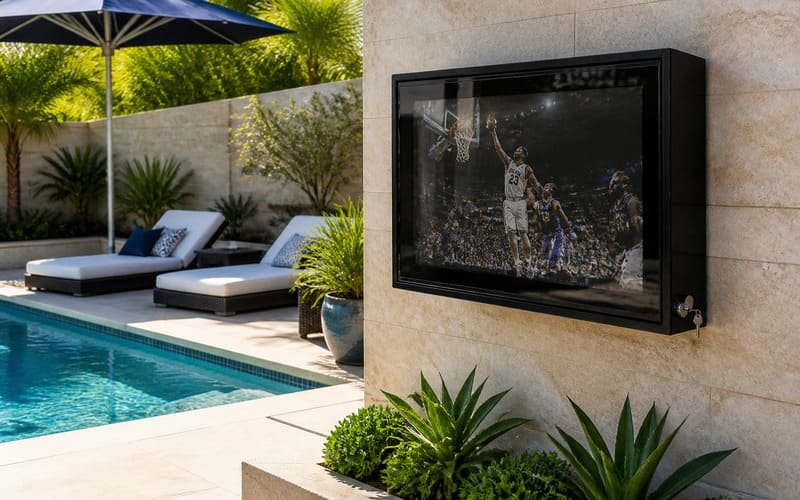
In my conversations with clients, this is the most important point I have to clarify. It is easy to assume that “waterproof” means “pool-safe.” But these two ideas solve different problems.
The IP rating is about equipment protection. The electrical system is about human safety.
The International Electrotechnical Commission explains that IP ratings grade the resistance of an enclosure against the intrusion of dust or liquids. IEC IP Ratings
For example, IP65 means the enclosure is dust-tight and protected against water jets under defined test conditions. But IP65 does not mean electrically safe. It also does not mean vapor-proof, condensation-proof, chemical-proof, or submersible.
The U.S. Consumer Product Safety Commission warns that electrical hazards around pools, spas, and hot tubs can include TVs, extension cords, power cords, electrical outlets, switches, radios, and pool equipment. CPSC electrical safety around pools
I once spoke with an AV integrator for a resort who thought that using an IP65 TV enclosure meant the installation was safe enough. But he also planned to run temporary indoor extension cords under pool deck mats. I had to explain that while the enclosure might protect the TV from splash, a frayed cord or wet connection could create a much more serious safety and liability problem.
The enclosure is important. But it cannot replace a licensed electrician.
The Two Layers of Poolside Protection
| Protection Type | What It Does | What It Protects | Example |
|---|---|---|---|
| Outdoor TV Enclosure | Helps seal the TV from rain, splashes, dust, insects, and environmental exposure | The television and hardware | Pool splash hits the enclosure; the TV remains protected inside |
| Electrical Safety System | Uses code-compliant wiring, GFCI/RCD protection, grounding, bonding, and correct outlet placement | People, guests, and the property | A ground fault is detected and power is shut off quickly |
A Ground Fault Circuit Interrupter, or GFCI, is designed to help protect people from severe or fatal electric shock by cutting power when a ground fault is detected. CPSC GFCI fact sheet
A licensed electrician should confirm local pool electrical code requirements before installation. In the United States, NEC-based pool wiring rules include special requirements for receptacles, GFCI protection, and equipment around swimming pools. Local enforcement and project conditions still matter, so the final placement should always be verified by a qualified professional. Example NEC pool wiring reference
That is why I never tell a customer, “Just install it five feet away” or “ten feet is always safe.” The correct answer depends on the local code, outlet location, wiring method, mounting structure, and whether the project is residential or commercial.
How Do I Find the Best Viewing Spot That’s Also Safe?
You want the perfect poolside view for the big game, but the best viewing angle may not be the safest location. Splash zones, walking paths, glare, and electrical planning all matter.
The ideal poolside TV location balances viewing comfort with practical safety. It should be away from high-splash zones, clear of main walking paths, positioned to reduce glare, high enough to avoid casual impact, and close enough to a code-compliant electrical plan designed by a licensed electrician.
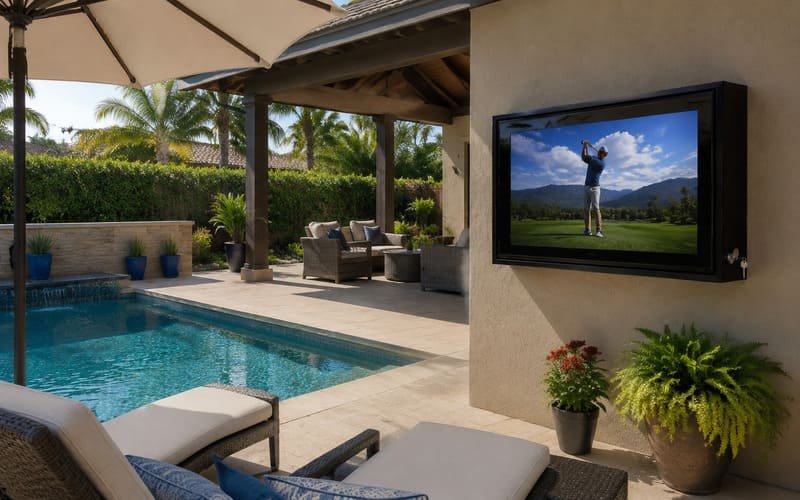
I think the biggest mistake people make is only considering the “best seat.” A customer once sent me a backyard diagram with a 75-inch TV planned on a short column right beside the pool steps. From his favorite lounge chair, the view was perfect.
But the location had several problems.
It was in the main splash zone. It was close to where kids would climb in and out of the pool. It was near a path where people would walk with wet feet. And the power route would have been difficult to make clean and safe.
We moved the planned location to a solid cabana wall farther away. It was still easy to view, but it was safer, higher, better protected from splash, and easier for the electrician to wire properly.
That is the type of trade-off I like to see.
A Checklist for Balancing Viewing and Safety
| Placement Factor | What to Check | Why It Matters |
|---|---|---|
| Splash Zone | Pool steps, diving/cannonball area, cleaning spray, fountains, pool toys | Reduces unnecessary water exposure and impact risk |
| Walking Path | Main route between house, pool, bar, and seating area | Avoids creating a collision or trip hazard |
| Sun Path | Sun position at 10 AM, 2 PM, and 5 PM | Reduces glare and heat buildup |
| Viewing Distance | Seating location and screen size | Prevents the screen from feeling too small or too close |
| Mounting Height | Eye level, safety clearance, and viewing angle | Helps keep the screen visible and out of casual reach |
| Electrical Route | Distance to code-compliant power source | Helps the electrician plan a safe installation |
For viewing distance, do not rely only on guesswork. RTINGS suggests a field of view of about 30 degrees for mixed TV use and notes that viewing distance and TV size should be planned together. RTINGS TV size and viewing distance guide
For outdoor pool areas, I usually recommend choosing a wall or structure that gives you:
- Shade during the hottest part of the day
- A clear view from seating areas
- Minimal foot traffic directly below the TV
- Reduced splash exposure
- A strong wall or post structure
- A practical cable route for the electrician
An enclosure can protect the TV from splash, but placement still matters. A better location reduces the burden on the enclosure, the electrical system, and the installer.
What Installation Factors Should I Check Before Drilling Any Holes?
You found a safe spot with a good viewing angle. But before drilling into the wall, you still need to check structure, weight, airflow, cable routing, and maintenance access.
Before installation, confirm that the mounting surface can support the combined weight of the TV, enclosure, and mounting hardware. You also need clear airflow around fan vents, safe cable routing, enough space to open the enclosure, and a mounting method suitable for wet outdoor conditions.
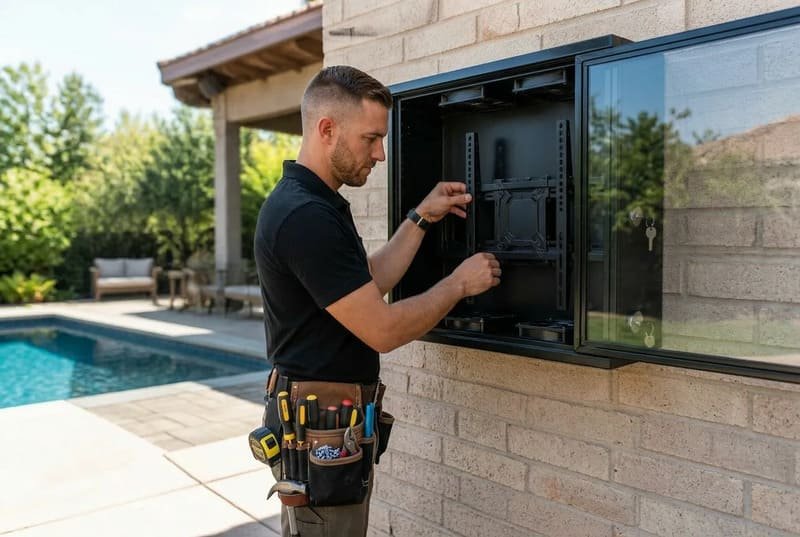
From my manufacturing experience, I know these units often weigh more than customers expect. A 65-inch TV might weigh 50 pounds, and the enclosure can add another 40–50 pounds. That means the wall may need to support close to 100 pounds before you even count the mount and hardware.
A client planning a poolside bar installation once sent me photos of his intended mounting spot: a decorative lattice wall. It looked beautiful, but it was not a safe mounting surface. The lattice would not support the weight, especially with vibration, wind, and people moving around the bar area. We had to work with his contractor to reinforce the wall before installation.
This is a step people sometimes want to skip. But it is essential for a secure and long-lasting installation.
The Pre-Drilling Installation Checklist
- Structural Integrity
Is the mounting surface solid? Brick, concrete, structural wood studs, or reinforced framing are usually better options. Decorative siding, thin metal panels, lattice, or drywall alone are not enough. - Total Weight
Add the weight of the TV, enclosure, mount, and hardware. Then make sure the wall and anchors are rated for more than that load. - Ventilation Clearance
Outdoor TV enclosures with fans need clear airflow. If you mount the unit in a tight alcove or block the vents, heat can build up around the TV. I usually recommend leaving clear space around the fan and vent areas, depending on the enclosure model and fan location. - Maintenance Access
You will need to open the enclosure eventually to inspect cables, clean the inside, replace the TV, or check the fan system. Make sure the front panel can open fully without hitting a wall, column, light fixture, or roof beam. - Cable Routing
Cable exits should be sealed and routed neatly. Poor cable routing can become the weak point in weather protection and electrical safety. - Professional Electrical Work
Any permanent poolside electrical installation should be planned and completed by a licensed electrician. Avoid temporary extension-cord solutions for permanent installations.
Mount Type Considerations
| Mount Type | Best For | Poolside Considerations |
|---|---|---|
| Fixed Mount | Simple, low-profile installations | Strong and stable, but less flexible for glare adjustment |
| Tilting Mount | Higher wall placement and glare reduction | My most common recommendation for poolside viewing |
| Full-Motion Mount | Corner placement or multiple viewing zones | Use carefully; the arm adds leverage and stress to the wall |
| Post / Column Mount | Open pool decks or cabana areas | Must be engineered for weight, wind load, and vibration |
A good poolside installation should feel boring in the best way: solid, clean, safe, and easy to maintain.
How Do Environmental Conditions Affect My Poolside Placement Choice?
You handled the electrical and physical installation plan, but the environment itself can still shorten the life of the setup. Heat, humidity, salt air, wind, and pool chemicals all matter.
Your local climate should influence where and how you place the enclosure. Direct afternoon sun can increase heat risk, humid pool air can create condensation concerns, coastal salt air can corrode metal hardware, and wind can add stress to large screens. The enclosure helps, but placement and material choice still matter.
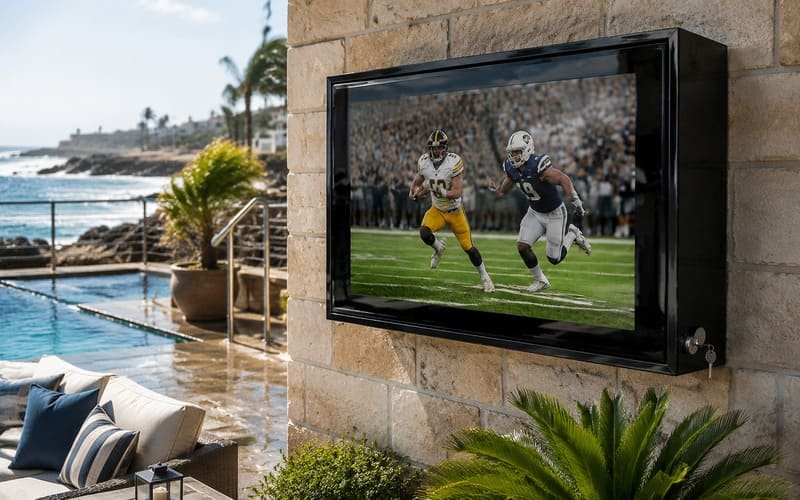
I talked with a resort manager from a coastal island who learned this the hard way. They had installed several powder-coated metal enclosures around their property. Within a couple of years, the salty air had damaged the coating, rust streaks appeared on the wall, and some locks became difficult to operate.
When they came to me, I explained that a polycarbonate body can be a lower-maintenance choice in coastal and poolside environments because the enclosure body itself does not rust like steel. But I also explained that locks, hinges, screws, mounts, and other hardware still need corrosion-resistant design and regular inspection.
FEMA guidance on coastal construction highlights that coastal environments with higher moisture, humidity, and salt spray can corrode metal connectors and fasteners. FEMA coastal corrosion guidance
Polycarbonate can be a strong material choice for outdoor enclosure bodies and front panels. Covestro describes Makrolon polycarbonate as robust, lightweight, glass-like in transparency, and impact resistant even at low temperatures. Covestro Makrolon polycarbonate
But material is only one part of the decision. Placement still matters.
Planning for Your Climate
| Climate Factor | What Can Go Wrong | Placement / Design Tip |
|---|---|---|
| Extreme Heat & Direct Sun | TV may overheat or shut down if heat builds up | Choose shade when possible; use active fan cooling |
| High Humidity | Moisture and temperature swings may increase condensation risk | Avoid stagnant enclosed corners; allow designed airflow |
| Coastal Salt Air | Metal hardware can corrode over time | Use corrosion-resistant hardware and inspect regularly |
| Wind Exposure | Large enclosure can act like a sail | Use strong wall/post structure and proper mounting hardware |
| Pool Chemicals / Cleaning Spray | Residue may affect surfaces and hardware | Keep enclosure outside frequent spray paths |
| Glare | Screen becomes hard to watch | Use shaded wall, tilting mount, and avoid direct sun path |
Sony advises using TVs within a temperature range of 0°C to 40°C / 32°F to 104°F and avoiding direct sunlight. Sony TV temperature guidance
This is why I always ask customers in hot climates like Texas, Arizona, or the Middle East about sun exposure. A location that gets direct, punishing afternoon sun is not ideal, even with a fan-cooled enclosure.
Fans help reduce stagnant warm air and move heat away from the TV. They are not air conditioners. If the enclosure is placed in direct sun on a very hot day, the TV can still face thermal stress. Shade, airflow, screen size, and operating hours all matter.
For humid pool areas, I also avoid promising that fans will “stop condensation.” Condensation depends on humidity, temperature changes, enclosure sealing, and installation conditions. Fans can help reduce stagnant air and heat buildup, but they do not remove the need for smart placement and periodic inspection.
For large screens in windy locations, the structural issue becomes more serious. A 75-inch enclosure mounted on a weak post can behave like a sail. If the location is exposed to strong wind, the installer or structural engineer should verify the mounting plan.
Poolside TV Placement Summary
Before choosing the final wall or post location, use this table as a quick planning guide.
| Placement Factor | What to Check | Why It Matters |
|---|---|---|
| Electrical Safety | Local code, GFCI/RCD, licensed electrician | Protects people, not just the TV |
| Splash Zone | Pool steps, cannonball area, cleaning spray | Reduces water exposure and impact risk |
| Viewing Angle | Seating, distance, sun path, glare | Improves usability and comfort |
| Wall Structure | Brick, concrete, studs, reinforced surface | Supports TV + enclosure weight |
| Ventilation | Fan clearance and airflow path | Helps reduce heat buildup |
| Climate | Salt air, humidity, direct sun, wind | Determines material, hardware, and placement needs |
| Maintenance Access | Door swing, locks, cable access, cleaning | Makes long-term service easier |
The safest and most practical poolside TV location is usually not the closest point to the water. It is the location where electrical safety, viewing comfort, splash protection, structural support, and heat management all work together.
Frequently Asked Questions
Can I use a regular indoor TV in an enclosure by the pool?
Yes, a regular indoor TV can be used inside a properly sized outdoor TV enclosure, but the poolside electrical installation must be handled correctly. The enclosure helps protect the TV from weather exposure, but it does not replace GFCI/RCD protection, proper wiring, grounding, bonding, or local code compliance.
Does an IP65 enclosure make a poolside TV electrically safe?
No. IP65 protects the equipment from dust and water jets under defined test conditions. It does not protect people from electric shock. Electrical safety depends on code-compliant wiring, GFCI/RCD protection, grounding, bonding, correct outlet placement, and professional installation.
Will the enclosure completely eliminate screen glare?
No. A clear front panel protects the TV, but it cannot eliminate glare. Placement, shade, viewing angle, sun path, screen brightness, and a tilting mount are usually more important than the enclosure itself.
Do I really need to hire a licensed electrician?
Yes. For poolside installations, electrical work should be handled by a licensed electrician familiar with local pool and outdoor electrical codes. This is important for safety, insurance, liability, and long-term reliability.
How far from the water should my TV be?
There is no universal distance that applies to every pool. The correct distance depends on local electrical code, outlet location, wiring method, mounting structure, and whether the installation is residential or commercial. A licensed electrician should verify the final placement before installation.
Can I use an extension cord for a poolside TV enclosure?
A temporary extension cord should not be treated as a permanent poolside power solution. Poolside power should be planned with outdoor-rated, code-compliant wiring and GFCI/RCD protection. Ask a licensed electrician to design the power route before installation.
Is a poolside TV enclosure enough for coastal areas?
A polycarbonate enclosure body can reduce body-rust risk compared with steel, but coastal installations still need corrosion-resistant locks, hinges, screws, mounting hardware, and regular inspection. Salt air can still affect exposed metal parts over time.
Conclusion
Placing a TV by the pool is about more than choosing a weatherproof box. It is about building a safe installation system.
The enclosure protects the TV from rain, splash, dust, insects, heat, and poolside exposure.
The electrician protects people through code-compliant wiring, GFCI/RCD protection, grounding, bonding, and safe outlet placement.
The installer protects the project by choosing the right wall, mount, ventilation clearance, and cable route.
The buyer protects long-term usability by thinking about glare, shade, splash zones, wind, humidity, and maintenance access.
The way I explain it to customers is simple:
A poolside TV enclosure protects the screen. A safe poolside installation protects everyone around it.
If you plan both sides correctly, you can create a poolside TV setup that is safer, cleaner, easier to maintain, and more enjoyable for years.