
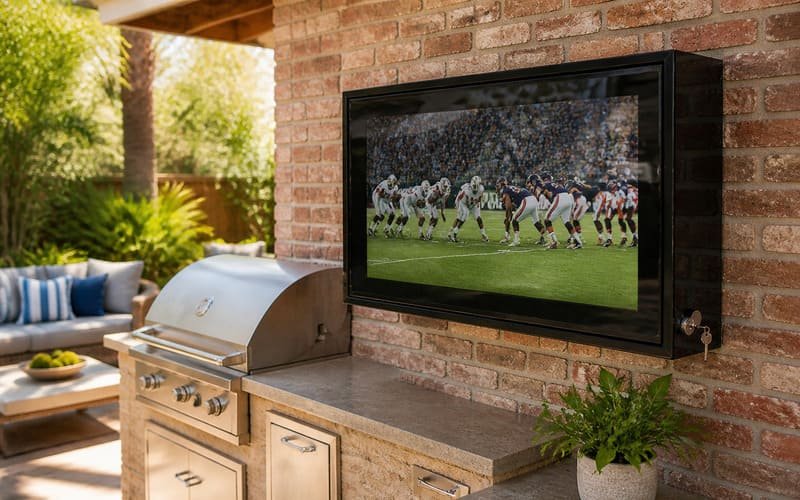
Want a TV outside but worried about the high cost? A dedicated outdoor TV can be expensive, while an outdoor TV enclosure lets you protect a more affordable indoor TV. But the real question is not only which option costs less today. It is which option gives you better long-term value.
For many large-screen patios, sports bars, hotels, restaurants, resorts, and multi-location projects, an indoor TV paired with a high-quality outdoor TV enclosure can be the more cost-effective solution. It usually lowers the upfront cost, simplifies future TV upgrades, and limits replacement expenses to the standard TV inside—not the entire outdoor-rated unit.
This is one of the most common questions I get from customers, whether they are homeowners planning a backyard patio or sourcing managers for a chain of sports bars.
The “outdoor TV vs enclosure” debate is not as simple as comparing two price tags. It is a decision about total cost, future flexibility, protection strategy, installation risk, and how you want to manage replacements over time.
After years of conversations with residential buyers, hotel operators, restaurant owners, AV integrators, and resort project managers, I believe the enclosure route often provides better long-term value—especially for larger screens and multi-unit commercial projects.
But I also want to be fair. A dedicated outdoor TV can still be the better choice in some situations, especially when high brightness, full-sun viewing, and a single integrated outdoor-rated product are the top priorities.
Let’s break down the real cost comparison.
Last Updated: May 5, 2026 | Estimated Reading Time: 7 minutes
By Smith Chen, Outdoor TV Enclosure Engineer at Outvion
Is It Just About the Sticker Price, or Is There More to the Cost?
You’ve seen the huge price gap and wondered if the cheaper option is a trap. It is easy to focus only on the initial purchase, but the real story is in the total investment.
Total Cost of Ownership, or TCO, is the most important way to compare these two options. It includes the initial price, replacement cost, installation labor, maintenance, downtime risk, and future upgrade cost. For many large-screen and commercial installations, the enclosure route can provide a lower TCO over time.
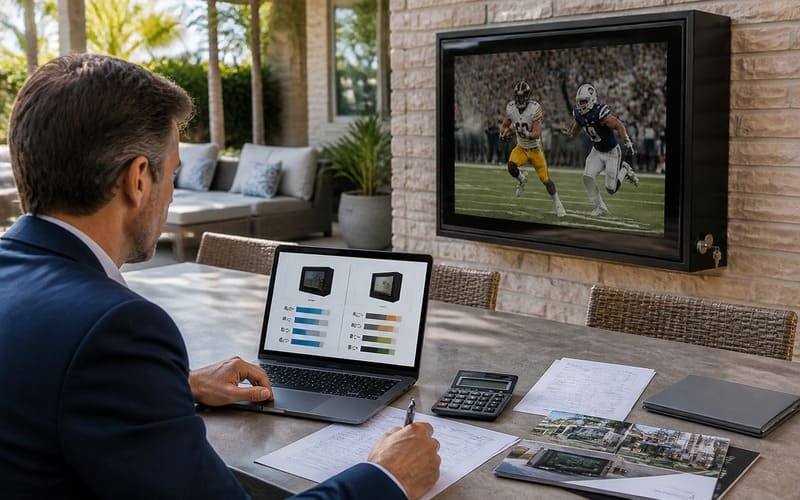
From my experience in manufacturing, I see the whole picture. It is not just about what you pay today. It is about what you may need to pay in three, five, or seven years.
When I talk with commercial buyers from hotels, restaurants, and outdoor entertainment venues, they usually care about TCO more than the first invoice. A bad decision can create unexpected replacement costs, installation delays, and maintenance headaches later.
CIPS defines Total Cost of Ownership as an estimate used to help buyers determine the end-to-end cost of providing a service or product, including purchase price, acquisition cost, usage cost, and end-of-life cost. CIPS Total Cost of Ownership overview
That is exactly how I think buyers should compare outdoor TVs and outdoor TV enclosures.
Breaking Down the Total Cost of Ownership
| Cost Factor | Dedicated Outdoor TV | Indoor TV + Outdoor TV Enclosure | My Thoughts |
|---|---|---|---|
| Upfront Cost | Usually high, especially for large sizes | Medium: standard TV price + enclosure price | The enclosure route often creates major savings for 55″, 65″, 75″, and larger screens. |
| Replacement Cost | High, because the entire outdoor-rated unit may need replacement | Lower, because only the indoor TV inside may need replacement | This is one of the biggest financial advantages of the enclosure model. |
| Upgrade Flexibility | Lower, because the display and weatherproof body are one product | Higher, because the enclosure stays and the TV inside can be upgraded | Useful when TV technology, smart platforms, and screen prices change. |
| Repairability | More specialized | Easier, because the internal TV is a standard consumer screen | Local replacement and troubleshooting can be simpler. |
| Protection Strategy | Built into the TV itself | Built into the separate enclosure system | The enclosure becomes the long-term protective asset. |
| Best Fit | Buyers who want one integrated outdoor-rated product | Buyers who want cost control, large screens, and upgrade flexibility | The best choice depends on brightness needs, environment, and budget. |
I once spoke with a bar owner who had installed several 65-inch outdoor TVs on his patio. After one unit failed outside the warranty period, the replacement cost was painful. He told me that for the cost of replacing that one specialized outdoor TV, he could have bought multiple standard TVs and protected them inside enclosures.
That conversation stayed with me because it shows the real issue. He was no longer looking at enclosures as a “cheap alternative.” He was looking at them as a better asset-management strategy.
For many businesses, that is the real value.
Can an Enclosure Really Protect a TV as Well as a Dedicated Outdoor Model?
You need your outdoor screen to survive rain, dust, humidity, salt air, and heat. So can a protective case around a regular TV really compete with a purpose-built outdoor TV?
A well-engineered outdoor TV enclosure can provide targeted protection against specific risks such as rain, dust, insects, salt air, impact, cable access, and heat buildup. It does not change the indoor TV’s original outdoor-use rating, but it can reduce the environmental exposure that normally damages standard TVs outdoors.
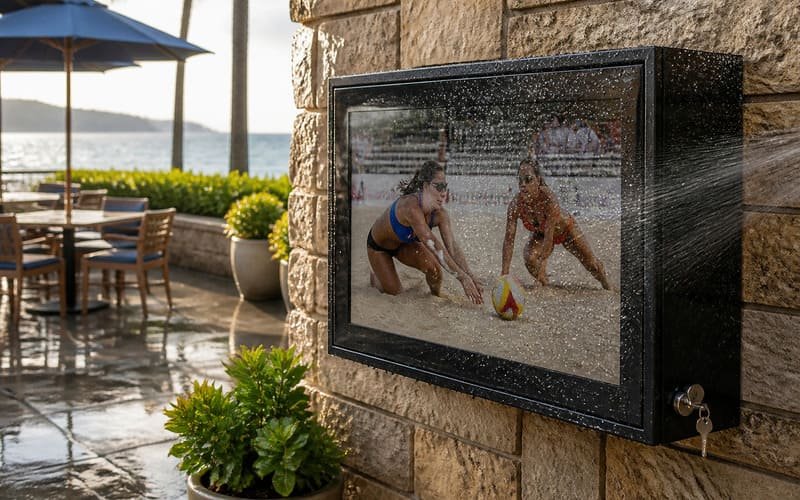
This might sound strange at first, but some customers even use enclosures to protect outdoor TVs. I have talked with coastal resort and restaurant customers who already owned outdoor-rated TVs, but still wanted an extra protective barrier because of salt air, guest access, impact risk, or theft concerns.
That taught me an important lesson: “outdoor-rated” is not one single environment. A shaded patio, a beachfront bar, a hotel pool area, a school courtyard, and a dusty factory wall all create different risks.
A dedicated outdoor TV is designed as a complete outdoor-rated product. That is a real advantage. But an enclosure system lets the buyer choose a very specific protection layer around the screen.
How Enclosures Deliver Targeted Protection
- Sealing and IP Rating:
A quality enclosure should use a tested sealing strategy with gasket compression and protected cable exits. The International Electrotechnical Commission explains that IP ratings grade the resistance of an enclosure against the intrusion of dust or liquids. IEC IP Ratings In practical terms, IP65 means dust-tight protection and protection against water jets under defined test conditions. It does not mean vapor-proof, condensation-proof, chemical-proof, or submersible. Installation quality still matters. - Material Choice:
Many outdoor environments are not just wet. They are humid, salty, dusty, or high-traffic. For coastal areas, the polycarbonate body itself does not rust like steel, which removes one common corrosion pathway. However, locks, hinges, screws, and mounting hardware still need corrosion-resistant design. FEMA’s coastal construction guidance highlights the importance of corrosion-resistant metal connectors and fasteners in coastal areas, which is a useful reminder that salt air can be aggressive on exposed metal parts. FEMA coastal corrosion guidance - Polycarbonate Front Protection:
We use polycarbonate because it offers a strong balance of transparency, impact resistance, lighter weight, and corrosion-resistant body performance. Covestro describes Makrolon polycarbonate as robust, lightweight, glass-like in transparency, and impact resistant even at low temperatures. Covestro Makrolon polycarbonate - Active Cooling:
Heat is a major issue in any outdoor display installation. A sealed box with no airflow plan can trap heat. A well-designed enclosure uses fans, airflow channels, and internal spacing to help reduce heat buildup around the TV. Sony advises using TVs within a temperature range of 0°C to 40°C / 32°F to 104°F and avoiding direct sunlight. Sony TV temperature guidance
The goal is not just to keep the TV dry. The goal is to create a cleaner, safer, more controlled space around the TV.
That said, I avoid saying an enclosure is always “better” than an outdoor TV. The real answer depends on the environment. A full-sun outdoor TV with high brightness may perform better in direct sunlight than a standard indoor TV inside an enclosure. But in many shaded, partial-sun, high-humidity, coastal, or B2B cost-sensitive projects, the enclosure strategy can be very strong.
Does Screen Size Change Which Option Is the Better Deal?
You want a big, impressive screen for a patio, bar, hotel pool, or outdoor event space, but large outdoor TVs can be very expensive. Is there a more affordable way to create a large outdoor display?
Yes. The larger the screen size, the more attractive the enclosure route usually becomes. The price gap between a large standard indoor TV and a dedicated outdoor TV can be thousands of dollars, and that difference often grows at 65″, 75″, and 85″+ sizes.
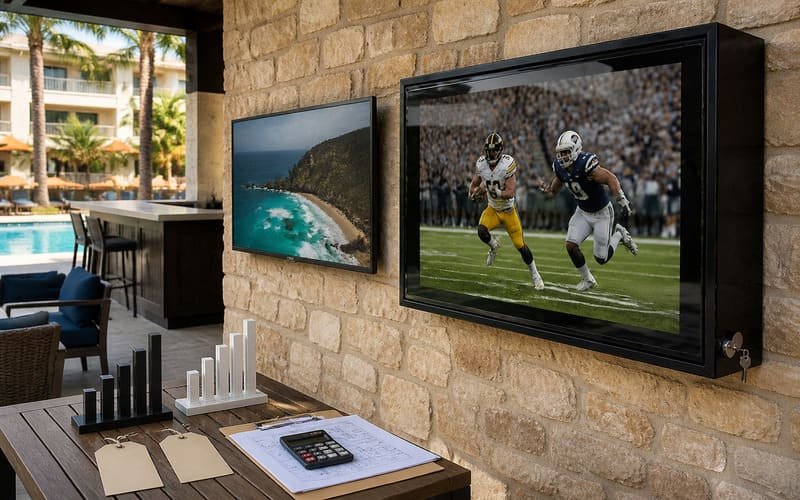
This is where the math becomes hard to ignore.
At smaller sizes, the price difference may still matter, but it may not completely control the decision. At 65 inches and above, the gap often becomes much more important.
At the time of writing, Samsung lists a 75″ The Terrace Partial Sun outdoor TV at $6,499.99 and a 75″ The Terrace Full Sun outdoor TV at $9,999.99. Samsung 75-inch Terrace Partial Sun Samsung 75-inch Terrace Full Sun
SunBrite also lists a 75″ Solis Series Full Sun outdoor TV at $5,498.95. SunBrite 75-inch Solis Full Sun Outdoor TV
By comparison, many 75-inch indoor TVs are available far below those outdoor TV price levels, especially during promotions. Best Buy even maintains a category for 75-inch TVs under $1000. Best Buy 75-inch TVs under $1000
Prices change by brand, retailer, model year, brightness level, sun rating, and promotions. So I would not use these numbers as permanent price rules. But they clearly show the basic market pattern: large outdoor-rated TVs usually cost much more than comparable indoor TVs.
Large-Screen Cost Comparison
| Screen Size | Standard Indoor TV Market Pattern | Dedicated Outdoor TV Market Pattern | Enclosure Advantage |
|---|---|---|---|
| 55″ | Often affordable and widely available | Usually much higher | Savings can be meaningful. |
| 65″ | Strong value range for indoor TVs | Outdoor versions become expensive | Cost difference becomes more important. |
| 75″ | Many indoor models are far below outdoor TV pricing | Outdoor models can cost several thousand dollars | Enclosure route often becomes very attractive. |
| 85″+ | Indoor TV prices vary but are widely available | Outdoor-rated options can become very expensive or limited | Enclosure may make the project possible for many budgets. |
Note: These are general market patterns, not fixed price promises. Always check current retailer and manufacturer pricing before making a purchase decision.
A hotel procurement director I worked with was tasked with outfitting multiple poolside cabanas with large screens. The quote for dedicated outdoor TVs consumed too much of the project budget. Instead, the team considered a system using protective enclosures and standard TVs. The project became more financially realistic because the expensive outdoor protection was moved into the enclosure, while the TV inside remained replaceable.
For large-format displays, that is often the biggest advantage of the enclosure route. It makes bigger screens possible without locking the buyer into the full cost of a specialized outdoor TV every time the screen needs to be replaced or upgraded.
Won’t an Enclosure Make the TV Overheat or the Picture Look Bad?
You may worry that putting a TV in a protective case is a compromise. Will it overheat on a hot day? Will the picture look dull? Will the remote still work through the front panel?
These are valid concerns, but a well-designed enclosure is built to solve them. Active fan cooling helps reduce heat buildup, a high-clarity front panel keeps the screen visible, and most IR remote signals can pass through clear polycarbonate. The key is choosing an engineered enclosure, not a basic sealed box.
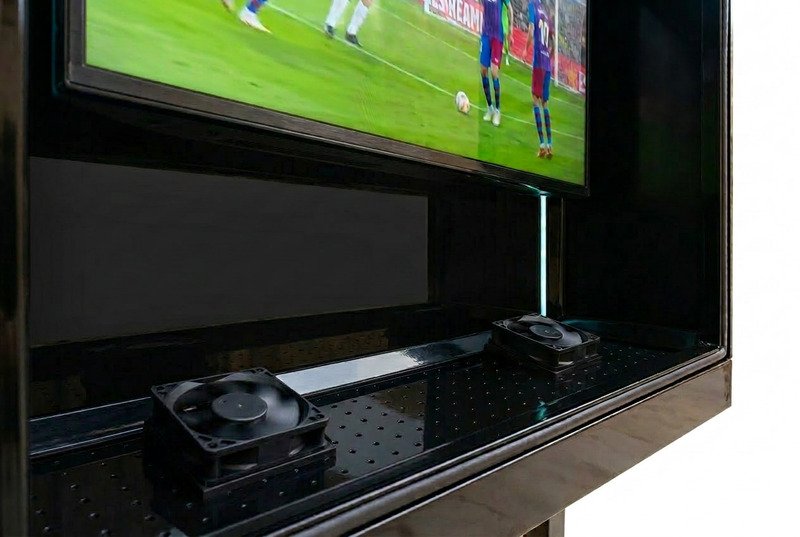
These are the first questions smart buyers ask. If an enclosure created constant heat problems, made the picture hard to see, or blocked basic operation, it would not be a practical product.
The difference is engineering.
Heat Dissipation
This is the most critical issue. A TV generates heat. Outdoor sun adds more heat. A sealed box without airflow can trap that heat.
That is why active airflow is important. In our Pro and Ultra series, fan systems are designed to move warm air away from the TV and help reduce heat buildup inside the enclosure.
I prefer to describe this carefully. Fans do not make the enclosure cold, and they do not guarantee a perfect internal temperature in every environment. Shade, airflow path, TV size, enclosure color, and installation angle all matter.
For high-heat locations or commercial use, I usually recommend stronger fan configurations and careful placement.
Picture Clarity and Glare
The front panel matters a lot. It should not be ordinary plastic. It needs to be clear, impact-resistant, and suitable for outdoor exposure.
Any transparent surface can create some reflection in direct sunlight. That is true for enclosures and also for many TV screens. Placement is still important. If possible, avoid putting the screen where direct afternoon sun hits it.
A good enclosure should preserve comfortable viewing while adding protection. But I would not claim that it makes a standard indoor TV as bright as a premium full-sun outdoor TV. Brightness is one area where a dedicated outdoor TV can still have an advantage.
Remote Control Signal
In most installations, IR remote signals can pass through a clear polycarbonate front panel. But angle, distance, TV sensor location, front panel clarity, and the remote itself can affect performance.
If the setup is commercial or the TV is mounted high, some installers may still use an IR extender or smart control system. That can make operation easier for staff.
Security and Access
In a commercial setting such as a bar patio, hotel courtyard, school, or public space, theft and tampering are real concerns.
A lockable enclosure can reduce casual access to the TV, ports, buttons, and cables. It is not a guarantee against every theft or vandalism scenario, but it makes unauthorized access harder and protects the TV from many common public-space risks.
Compatibility
A good enclosure should support common VESA patterns and provide enough internal clearance for cables and airflow. But no enclosure fits every TV automatically. Buyers still need to check the TV’s width, height, depth, VESA pattern, port direction, and cable clearance before ordering.
An enclosure is not a passive box. It is an active protection system designed to reduce outdoor risks while preserving the performance buyers expect from the TV.
When Is an Outdoor TV Still the Better Choice?
The enclosure route can be very cost-effective, but it is not the right answer for every buyer. Sometimes a dedicated outdoor TV is the cleaner and more practical choice.
A dedicated outdoor TV may be the better choice when full-sun brightness, integrated outdoor warranty, anti-glare performance, or a single finished outdoor-rated product matters more than upfront savings or future upgrade flexibility. The best choice depends on the installation environment and buyer priorities.
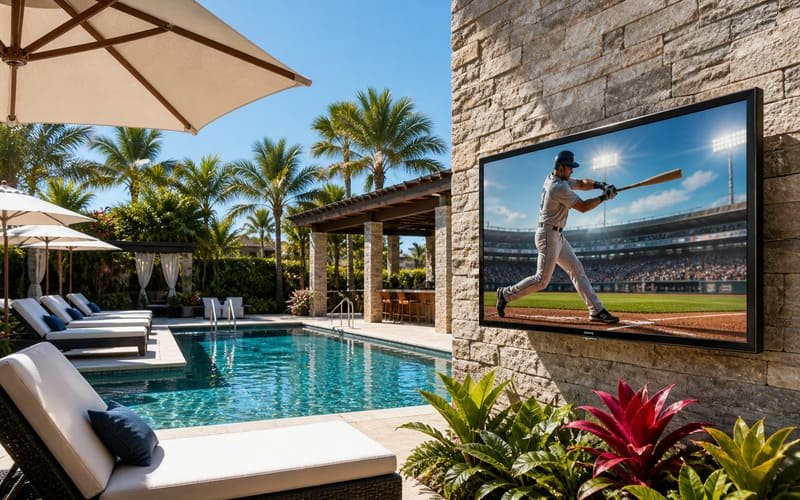
I want to be balanced here. I manufacture outdoor TV enclosures, but I do not believe every project should automatically choose an enclosure.
A dedicated outdoor TV may make more sense when:
- The screen will face full direct sun for long periods.
- The buyer needs very high brightness and anti-glare performance.
- The project requires one integrated product with outdoor-rated support.
- The buyer wants the simplest warranty path.
- The installation budget is less sensitive to upfront cost.
- The project design requires a very slim, finished TV appearance.
- The buyer does not want to manage TV/enclosure compatibility.
Samsung describes The Terrace as a water- and dust-resistant QLED 4K TV designed for full or partial sun, with direct-sun protection, anti-glare screen, and IP55 weather resistance. Samsung The Terrace outdoor TVs
That kind of integrated design can be the right fit for certain premium residential or hospitality projects.
The enclosure route is strongest when cost control, large screen size, physical protection, salt-air isolation, tamper resistance, and future upgrade flexibility matter more.
Here is the way I usually explain the decision:
| Buyer Situation | Better Fit | Why |
|---|---|---|
| Budget-sensitive large screen | Indoor TV + Enclosure | Lower upfront cost and lower replacement cost. |
| Multi-location bar or hotel project | Indoor TV + Enclosure | Easier to standardize protection and replace TVs later. |
| Full direct sun all day | Dedicated Outdoor TV | Higher brightness and outdoor display tuning may matter more. |
| Coastal area with salt air and physical access risk | Enclosure, or Outdoor TV + Enclosure | Extra barrier against salt air, impact, and tampering. |
| Buyer wants simplest warranty path | Dedicated Outdoor TV | One integrated outdoor-rated product can be easier to manage. |
| Future TV upgrade flexibility matters | Indoor TV + Enclosure | Keep the enclosure and replace only the screen inside. |
| Public or semi-public installation | Indoor TV + Enclosure | Lockable shell and impact-resistant front add physical protection. |
This balanced view is important. The question is not “Which product is always better?” The real question is “Which system is better for this location, budget, and operating plan?”
FAQ
Is an outdoor TV enclosure cheaper than an outdoor TV?
In many cases, yes. A standard indoor TV plus a protective enclosure usually has a lower upfront cost than a dedicated outdoor TV, especially at larger screen sizes. The long-term value can also be better because the TV inside can be replaced or upgraded without replacing the entire protective shell.
When is a dedicated outdoor TV worth it?
A dedicated outdoor TV may be worth it when full-sun brightness, anti-glare performance, a slim finished appearance, or an integrated outdoor-rated product is more important than saving money. It can also be a simpler choice for buyers who want one product with one warranty path.
Can I use any indoor TV inside an outdoor enclosure?
Not every indoor TV will fit. Before ordering, check the TV’s width, height, depth, VESA pattern, cable port locations, and operating temperature guidance. The enclosure helps reduce environmental exposure, but it does not change the TV manufacturer’s original outdoor-use rating or warranty terms.
Does an enclosure affect sound quality?
A sealed enclosure can reduce the performance of the TV’s built-in speakers. For outdoor spaces, external weather-resistant speakers are often a better solution because sound dissipates quickly outdoors. This applies to many outdoor entertainment setups, whether the screen is an outdoor TV or an enclosed indoor TV.
Will an enclosure make the TV overheat?
A poorly ventilated box can trap heat. A proper outdoor TV enclosure should include a planned airflow path and fan cooling where needed. Heat risk depends on screen size, direct sun, operating hours, location, shade, and internal clearance.
Is an outdoor TV enclosure good for coastal areas?
A polycarbonate outdoor TV enclosure can be a strong option for coastal areas because the enclosure body does not rust like steel and can add a protective barrier around the TV. However, locks, hinges, screws, mounting hardware, and cable exits still need corrosion-resistant design and regular inspection.
Can I put an outdoor TV inside an enclosure?
Yes, some buyers do this for extra physical protection, salt-air isolation, or tamper resistance. The outdoor TV still needs to fit the enclosure’s internal dimensions, VESA pattern, cable clearance, and airflow requirements.
Conclusion
The outdoor TV vs outdoor TV enclosure decision is really a cost, protection, and flexibility decision.
A dedicated outdoor TV gives you an integrated outdoor-rated product, which can be valuable in full-sun, high-brightness, premium residential, or simplified warranty situations.
An indoor TV paired with an outdoor TV enclosure gives you a different kind of value. It can lower the upfront cost, reduce replacement cost, improve upgrade flexibility, and add a protective shell against weather, impact, salt air, cable access, and tampering.
From my experience, the enclosure route is especially strong for:
Large screens.
Commercial patios.
Sports bars.
Hotels and resorts.
Multi-location projects.
Coastal spaces.
Buyers who want future upgrade flexibility.
The way I explain it to customers is simple:
A dedicated outdoor TV is a finished outdoor product. An outdoor TV enclosure is a long-term protection strategy.
For many buyers, especially those planning large screens or multiple installations, that strategy can be the more cost-effective choice.