
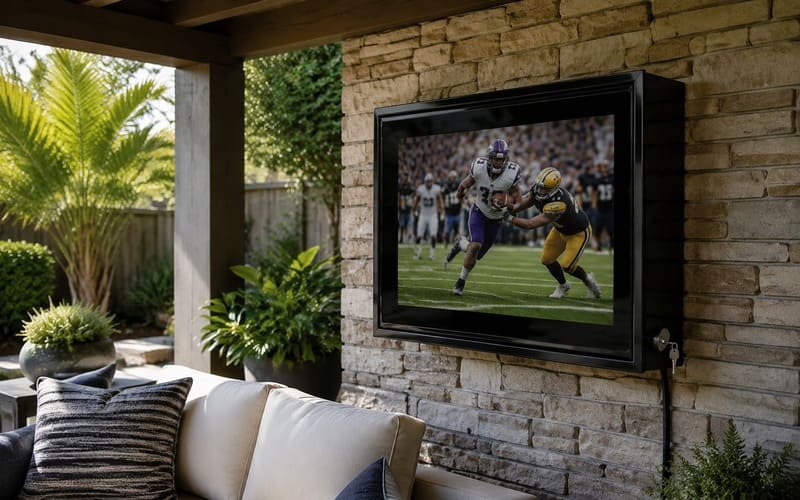
You installed a beautiful TV on your patio, but now the sun turns it into a mirror. The screen looks washed out, the reflection is distracting, and your outdoor entertainment setup feels much less useful than expected.
To reduce glare on an outdoor TV, start with placement and shade before buying new equipment. Position the screen away from direct sun, avoid low-angle reflections, choose a shaded wall or covered area, and then consider screen brightness, matte finishes, and a protective outdoor TV enclosure as supporting solutions.
Many people I talk to believe that solving glare is mainly about buying the most expensive “anti-glare” outdoor TV. From my experience helping homeowners, restaurants, hotels, and bars plan outdoor display setups, I’ve learned that glare is usually a placement problem before it is a product problem.
The most effective solutions often cost nothing at all. Before spending money on a brighter TV, an anti-glare screen, or a special front panel, you need to understand where the sun will be, where people will sit, and what the screen will reflect.
A premium screen can help. A high-quality outdoor TV enclosure can protect the TV. But neither one can fully fix a poor installation location.
Let’s break down what really works, starting with the most important step.
Last Updated: May 7, 2026 | Estimated Reading Time: 9 minutes
By Smith Chen, Outdoor TV Enclosure Engineer at Outvion
Why Is Placement the First Step to Reducing Glare?
You are ready to mount your outdoor TV, but one question stops you: what if the sun hits the screen at the worst possible time? A poor location can make even an expensive TV hard to watch.
Placement is the first step because it reduces the cause of glare before you spend money on equipment. By choosing a shaded spot, avoiding direct sun, and orienting the screen away from the sun’s daily path, you can reduce the biggest glare problem before relying on brightness or anti-glare technology.
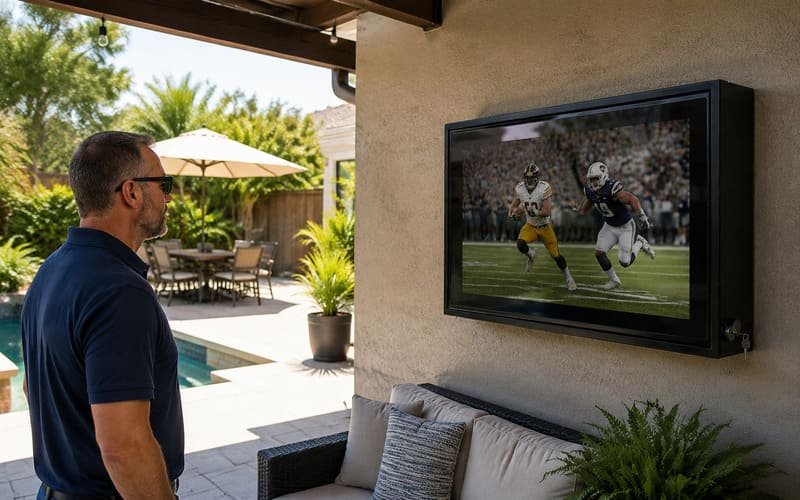
In my conversations with sports bar owners, hotel managers, and homeowners, the first question I ask is not “What TV did you buy?” It is “Where will the TV live?”
Glare is a battle with a light source. The most logical strategy is to avoid fighting that source directly.
In the Northern Hemisphere, a north-facing wall is often one of the better options because it usually receives less direct sun than south- or west-facing walls. In the Southern Hemisphere, the ideal orientation may be different, so the sun path should always be checked for the actual location.
If you do not have an ideal wall, look for consistent shade from a roof, pergola, deep awning, cabana, or covered patio. I have seen clients solve most of their glare problem simply by moving the planned TV location a few feet under an eave.
You also need to think about when the TV will be used.
An east-facing TV may work well for afternoon and evening events but may suffer in the morning. A west-facing TV may be acceptable earlier in the day but can struggle when the low evening sun reflects into the screen. That matters a lot for restaurants, bars, and hotels that depend on late-afternoon or evening viewing.
Outdoor TV Placement Options
| Placement Strategy | Pros | Cons | My Advice |
|---|---|---|---|
| North-Facing Wall | Often receives less direct sun in the Northern Hemisphere | Not available on every patio or building | A strong option if the main seating area can face it |
| Under an Awning / Pergola | Provides more reliable shade | May require an existing or new structure | Ideal for patios, hotel cabanas, and restaurant terraces |
| East-Facing Wall | Better for afternoon and evening viewing | Morning glare may be strong | Good if your main viewing time is after midday |
| West-Facing Wall | Better for morning and early afternoon | Late-day glare can be severe | Avoid if happy hour or sunset viewing is important |
| Freestanding Post / Column | Flexible placement | More exposure to sun, wind, and reflections | Use only with careful sun-path and structural planning |
The key is to plan the TV around the sun, not the other way around. Once the location is wrong, every other solution becomes more expensive and less effective.
Do Anti-Glare Outdoor TVs Really Solve the Problem?
You see premium outdoor TVs that promise bright, anti-glare performance. They look impressive, but you may wonder whether they can really solve reflection problems in full daylight.
Anti-glare outdoor TVs can reduce reflections and improve visibility, but they do not eliminate glare in every condition. High brightness helps the picture compete with ambient light, while matte or anti-glare finishes diffuse reflections. These features work best when paired with smart placement and shade.
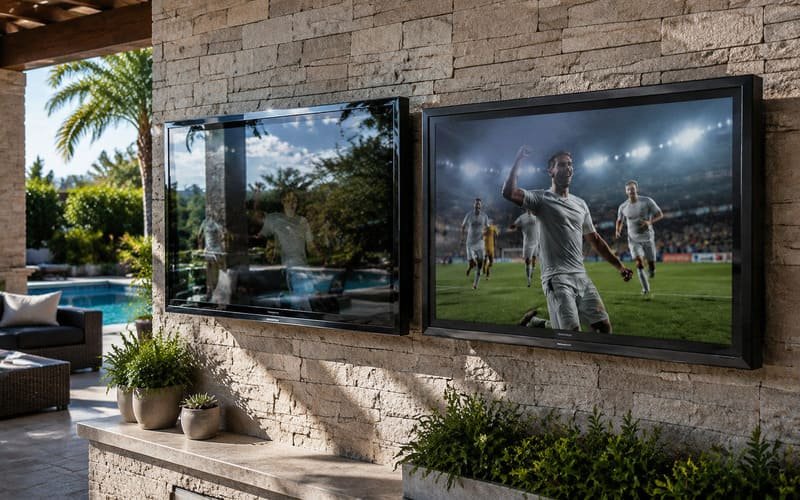
I think it is important to separate two different ideas: brightness and reflection handling.
Brightness is usually measured in nits. A brighter TV pushes more light from the screen toward your eyes, helping the image stay visible in a bright environment. ENERGY STAR’s television criteria use On Mode Power measurements because TVs consume power while producing an image, and in practical outdoor setups, higher brightness also means more heat and power to manage. ENERGY STAR television criteria
Reflection handling is different. A glossy screen may show sharp mirror-like reflections of the sky, trees, patio furniture, pool water, or people sitting behind you. A matte or anti-glare finish spreads that reflected light over a wider area, making reflections less distracting.
RTINGS explains that matte screens are known for reducing glare compared with glossy screens, but reflection handling is not simply a matte-versus-glossy decision. RTINGS reflection handling research
That is why I do not like telling customers, “Just buy the brightest TV.” A very bright glossy screen can still reflect the sun or sky. And a matte screen can reduce sharp reflections but may slightly change perceived contrast or image crispness.
I once had a coastal resort customer who wanted a bright outdoor TV facing the ocean for sunset viewing. I had to be honest: even a very bright, anti-glare screen can struggle when low-angle sun reflects directly into the viewer’s eyes or off nearby water. That does not mean anti-glare technology is useless. It means it has limits.
Screen Features That Affect Outdoor Glare
| Screen Feature | What It Does | Best For | Reality Check |
|---|---|---|---|
| High Brightness | Makes the image more visible in bright ambient light | Bright but shaded patios, covered bars, hotel lounges | Helps visibility but does not remove direct reflections |
| Matte / Anti-Glare Finish | Diffuses reflections so they appear softer | Open-sky reflections, light-colored patios, mixed outdoor light | Can reduce glare but may affect perceived sharpness or contrast |
| Anti-Reflective Coating | Reduces certain reflections using optical coatings | Higher-end display applications | Helpful, but not a full solution for direct sun |
| Smart Placement | Avoids the worst light source before it hits the screen | Almost every outdoor setup | Usually the most cost-effective first step |
| Shade Structure | Blocks direct sunlight and reduces heat | Pergolas, cabanas, patios, restaurant terraces | Often more effective than upgrading the screen alone |
RTINGS’ bright-room TV guidance also notes that some TVs handle indirect reflections well but still show mirror-like reflections when bright light sources are directly opposite the screen. RTINGS bright-room TV guidance
So yes, anti-glare outdoor TVs can help. But they work best as part of a full glare-reduction plan: placement first, shade second, screen finish and brightness third.
Can an Outdoor TV Enclosure Help Reduce Glare?
You are looking into an outdoor TV enclosure to protect the screen from rain and dust, and you hope it might also solve glare. That expectation needs to be realistic.
An outdoor TV enclosure should not be treated as the main anti-glare solution. Its primary job is to protect the TV from weather, dust, insects, impact, and unauthorized access. The front shield may change reflections, and some designs may reduce certain reflections slightly, but placement, shade, screen brightness, and screen finish usually matter much more.
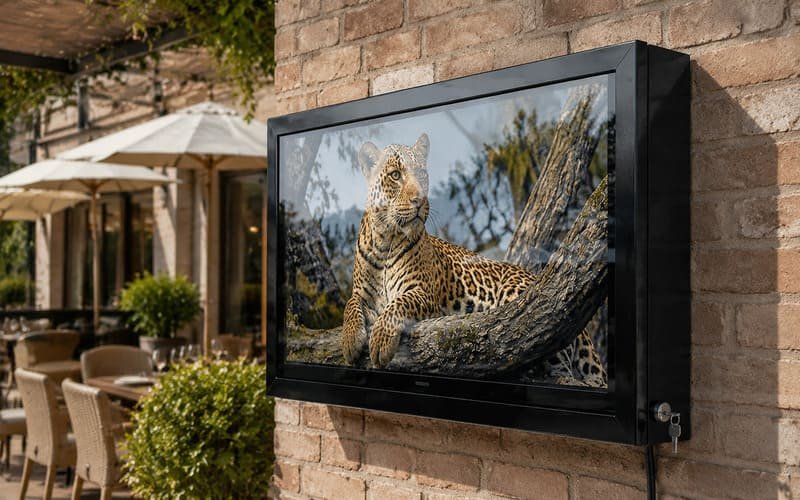
This is one of the most common questions I get from customers, and I always prefer to set clear expectations.
A polycarbonate front shield is not the same thing as a magic anti-glare filter. It adds a protective layer in front of the TV. That layer may change the way reflections look, but it can also introduce its own reflections if the screen is placed in direct sun or opposite a bright sky.
The real purpose of an enclosure is protection.
The International Electrotechnical Commission explains that IP ratings grade the resistance of an enclosure against intrusion by dust or liquids. IEC IP Ratings
For outdoor TV enclosures, IP65 is often used because it indicates dust-tight protection and protection against water jets under defined test conditions. But IP65 does not mean the enclosure is glare-proof, vapor-proof, condensation-proof, chemical-proof, or submersible.
Material matters too. Covestro describes Makrolon polycarbonate as robust, lightweight, glass-like in transparency, and impact resistant even at low temperatures. Covestro Makrolon polycarbonate
For an outdoor TV enclosure, those properties are useful because the front panel needs to protect the TV while still allowing the screen to remain visible. But even a clear, impact-resistant panel cannot fully overcome direct sun glare.
This is the way I explain it:
The enclosure enables the glare-reduction strategy; it is not the strategy itself.
It allows you to place a suitable TV outdoors in a protected operating environment. Then you still need to choose the right location, shade, screen finish, brightness level, and viewing angle.
What an Enclosure Can and Cannot Do for Glare
| Question | Realistic Answer |
|---|---|
| Does an enclosure protect the TV from weather? | Yes, if it is properly designed, sealed, installed, and maintained. |
| Does an enclosure eliminate glare? | No. It may change reflections, but it does not remove the need for smart placement. |
| Can the front panel reflect light? | Yes. Any transparent surface can create some reflection. |
| Can an enclosure let me use a matte indoor TV outdoors? | Yes, if the TV fits, the enclosure is suitable, and the installation is shaded and cooled. |
| Is shade still important? | Yes. Shade is often more important than the enclosure for glare control. |
| Does cooling matter? | Yes. A protected TV still needs heat management, especially in sun or warm climates. |
This balanced expectation is important. If you buy an enclosure expecting it to behave like sunglasses for your TV, you may be disappointed. If you use it as part of a larger placement and protection strategy, it can be very useful.
Is Using an Indoor TV in an Enclosure a Good Anti-Glare Strategy?
The cost savings of using a regular indoor TV in a protective enclosure are tempting. But will the picture be washed out in daylight?
Using an indoor TV inside an outdoor TV cabinet can be a smart strategy for shaded or covered outdoor spaces, especially when the TV has a matte or semi-gloss screen. It is not a good solution for direct sun. The best results come from combining shade, proper placement, active cooling, and a screen finish that handles reflections well.
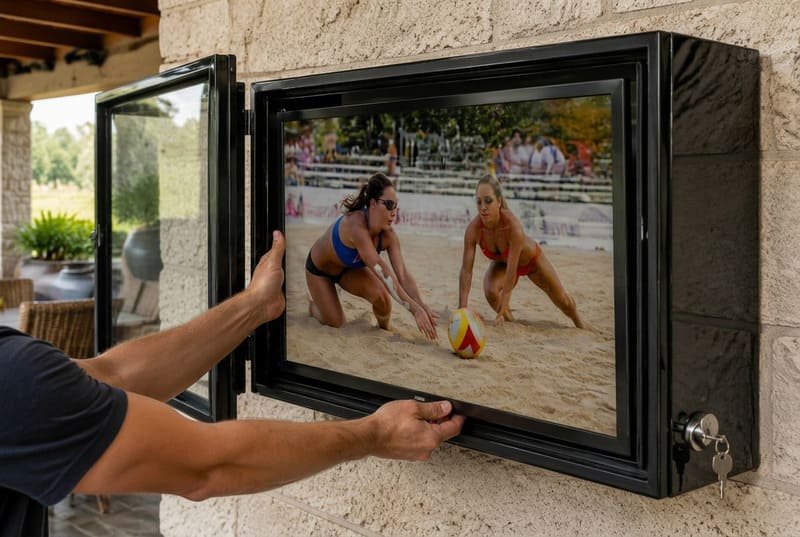
This is where things become interesting for ROI-focused buyers such as restaurant owners, hotels, bars, schools, and even homeowners.
For the price of one premium outdoor TV, some buyers can outfit multiple shaded patio areas with standard indoor TVs protected by quality enclosures. I have seen cafe and restaurant customers consider this strategy because it gives them more screens for the same budget.
But the key is accepting the trade-off.
This setup is not designed for direct, blazing sunlight. It works best in covered patios, deep awnings, shaded pergolas, hotel cabanas, and outdoor bars where the TV is not facing the sun.
When choosing the indoor TV, avoid selecting only by showroom color and contrast. A glossy TV that looks amazing in a dark store may behave like a mirror outside. A matte or semi-gloss screen may be more practical in shaded outdoor conditions.
Brightness is still important, but it should not be the only factor. A bright TV with poor reflection handling can still be hard to watch. A balanced screen with good reflection handling, acceptable brightness, and a shaded enclosure location may create a better real-world result.
For most warm outdoor installations, especially with indoor TVs inside an enclosure, active cooling fans are strongly recommended. Sony advises using TVs within a temperature range of 0°C to 40°C / 32°F to 104°F and avoiding direct sunlight. Sony TV temperature guidance
A sealed box with no airflow plan can trap heat. Siemens’ enclosure thermal design guide discusses cooling options for electronics enclosures, including passive cooling, forced convection fan cooling, sealed systems, fan selection, venting, and temperature-controlled solutions. Siemens enclosure thermal design guide
For outdoor TV enclosure projects, the goal is not to make the inside “cold.” The goal is to help reduce heat buildup around the TV while preserving weather protection.
Dedicated Outdoor TV vs Indoor TV + Enclosure
| Factor | Dedicated Outdoor TV | Indoor TV + Quality Enclosure |
|---|---|---|
| Upfront Cost | Usually higher | Usually lower to medium |
| Direct Sun Performance | Better, especially with high-brightness outdoor models | Usually poor to fair |
| Shaded Patio Performance | Very good | Can be good if the TV has the right screen finish |
| Brightness | Higher on many outdoor models | Varies by indoor TV model |
| Glare Handling | Better if it has matte/anti-glare surface | Depends heavily on TV selection and placement |
| Upgrade Flexibility | Lower because the TV is one integrated outdoor unit | Higher because the TV inside can be replaced later |
| Heat Management | Built into the outdoor TV design | Depends on enclosure fans, airflow, shade, and TV size |
| Best Fit | Open patios, partial sun, premium outdoor applications | Covered patios, shaded restaurants, cabanas, pergolas |
Prices vary by brand, screen size, brightness, retailer, and promotions. I prefer to avoid making fixed price promises. The better way to compare is by use case: direct sun favors a dedicated outdoor TV; shaded and budget-sensitive spaces often make the enclosure strategy more attractive.
What Is the Best Glare-Reduction Strategy for Different Outdoor Spaces?
Not every outdoor TV location has the same glare problem. A poolside screen, a sports bar patio, and a covered backyard pergola all reflect light differently.
The best glare-reduction strategy depends on the outdoor space. In shaded patios, a matte or semi-gloss indoor TV inside an enclosure may work well. In open or partial-sun areas, a brighter outdoor TV may be needed. Near pools or ocean views, placement and viewing angle matter more because water can reflect low-angle sunlight.
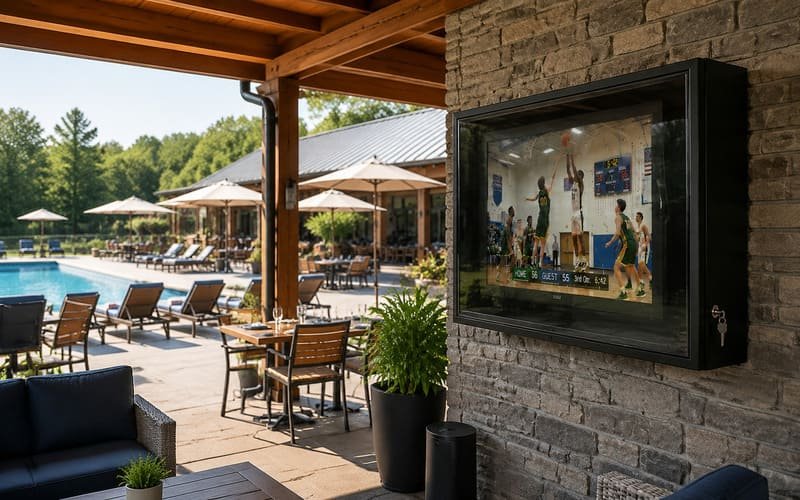
This is where I like to move from theory to practical buying decisions.
When a buyer sends me a photo of the installation area, I look for three things first:
- Where does the sun come from?
- Where will people sit?
- What bright surfaces will the screen reflect?
A white wall, pool surface, ocean view, glass railing, or light stone patio can all create reflection problems. Sometimes the TV is not facing the sun directly, but it is facing a bright object that acts like a reflector.
Here is the practical way I would compare different outdoor spaces:
| Outdoor Space | Main Glare Problem | Best First Step | Product Strategy |
|---|---|---|---|
| Covered Backyard Patio | Ambient brightness and side reflections | Mount under the roof line and avoid bright opposite walls | Indoor TV + enclosure may work well |
| Poolside Area | Water reflection and low-angle sun | Avoid facing the pool surface or sunset direction directly | Outdoor TV or shaded enclosure setup |
| Sports Bar Patio | Long viewing hours and mixed sun angles | Use awnings, correct orientation, and screen height planning | Bright TV + enclosure cooling can work |
| Coastal Resort | Ocean glare, salt air, and sunset reflection | Avoid ocean-facing sunset angle when possible | Outdoor TV, enclosure, or both depending on risk |
| Restaurant Terrace | Glare from glass, white walls, and patio furniture | Test seating positions at peak service time | Matte screen + shaded placement |
| Pergola / Cabana | Partial shade and moving sun patches | Add shade fabric or deeper cover if needed | Indoor TV + enclosure is often practical |
This is why I do not like one-size-fits-all advice such as “buy a brighter TV” or “just add an enclosure.” Glare is local. The best solution depends on the exact wall, sun path, seating layout, and screen choice.
Frequently Asked Questions
Will a brighter TV always reduce outdoor glare?
Not always. Brightness helps the picture compete with ambient light, but it does not remove a direct reflection from a glossy surface. A bright but glossy screen can still act like a mirror if it faces the sun, sky, water, or a bright wall. The best strategy is usually shade, smart placement, good reflection handling, and enough brightness together.
Can I add anti-glare film to an existing TV?
You can, but I suggest caution. Some aftermarket films may diffuse reflections, but they can also reduce clarity, create installation bubbles, or age differently under heat and outdoor conditions. For important outdoor installations, it is usually better to choose a TV with a factory screen finish that already fits the viewing environment.
Does an outdoor TV enclosure reduce glare?
An enclosure may change the way reflections appear, but it should not be treated as the main anti-glare solution. The front shield protects the TV from weather, dust, insects, and impact. Placement, shade, screen brightness, and screen finish usually matter more for glare control.
Is a matte screen better for outdoor viewing?
A matte screen is often better for reducing sharp mirror-like reflections, especially in shaded or bright ambient conditions. However, matte finishes may spread reflected light across a wider area and can affect perceived contrast. It is a trade-off, not a perfect solution.
What is the best direction to face an outdoor TV?
In the Northern Hemisphere, a north-facing wall is often a strong option because it usually receives less direct sun. But the best direction depends on your specific location, seating layout, roof shade, and viewing time. Always check the sun path at the hours when the TV will be used most.
Does shade matter more than screen brightness?
In many cases, yes. Shade reduces the amount of light hitting the screen before the TV has to fight it. A moderately bright TV in a well-shaded location can sometimes look better than a very bright TV placed in the wrong direction.
Can a pool or ocean view make TV glare worse?
Yes. Water can reflect sunlight toward the viewer or the screen, especially at low sun angles. For poolside or coastal installations, avoid placing the TV where it faces strong water reflections during the main viewing hours.
Conclusion
To reduce outdoor TV glare, start with placement and shade. Do not begin by buying the most expensive screen or assuming an enclosure will solve everything.
The best order is simple:
Control the sun first.
Choose shade when possible.
Avoid bright reflections from water, glass, and white walls.
Select a screen with suitable brightness and reflection handling.
Use an outdoor TV enclosure for weather, impact, dust, insects, and access protection.
Add active cooling when using a TV inside an enclosure.
The way I explain it to customers is this:
Outdoor TV glare is usually a location problem before it is a product problem.
If you choose the right wall, control the sun path, and match the TV and enclosure to that location, you can create an outdoor viewing setup that is much easier to watch, more comfortable for guests, and more reliable over time.