
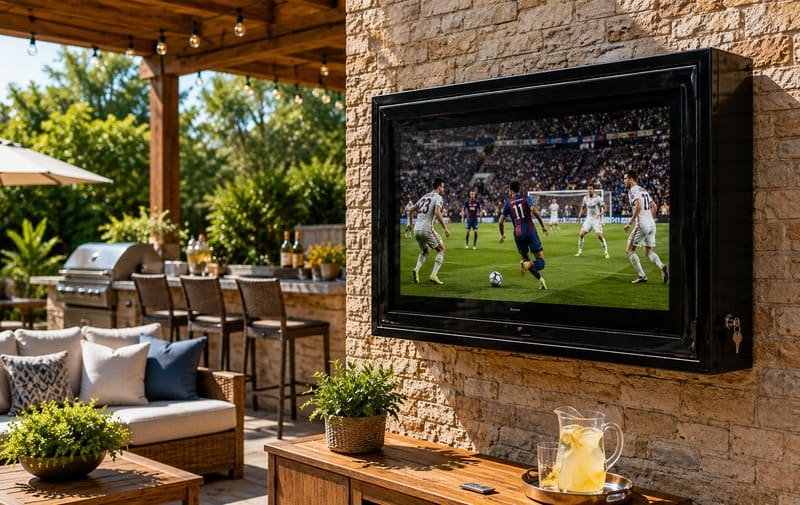
Worried sunlight will damage your outdoor TV screen? Maybe the picture looks washed out in the afternoon, the screen becomes too hot to touch, or you are worried that UV exposure will slowly shorten the life of the display.
Yes, UV exposure can contribute to long-term aging of display films, plastics, and optical layers. But for many outdoor TV installations, heat buildup and glare are often the more immediate problems. The real issue is total sun exposure: UV, heat, glare, screen rating, placement, airflow, and whether the TV is protected by the right outdoor system.
In my years of exporting outdoor TV enclosures, customers frequently ask about UV protection. But when we dig deeper, the conversation usually shifts from a simple “Will UV damage the screen?” to a much more practical discussion about location, heat, glare, and smart installation.
The sun does not create only one problem. UV can age materials slowly. Direct heat can trigger screen blackouts much faster. Glare can make the screen unusable even when the TV itself is working perfectly.
So the real question is not only whether UV exposure can damage an outdoor TV screen. The better question is:
How do you protect an outdoor TV from total sun exposure?
Let’s break down what really matters.
Last Updated: May 8, 2026 | Estimated Reading Time: 8 minutes
By Smith Chen, Outdoor TV Enclosure Engineer at Outvion
Is UV Exposure the Only Threat from the Sun?
You may be focused on UV protection, but your outdoor screen can still overheat or become unreadable even if UV exposure is reduced. Sunlight creates multiple risks at the same time.
No, UV is only one part of the problem. Direct sunlight also includes visible light, which causes glare, and infrared energy, which contributes to heat buildup. UV is more of a long-term aging risk, while heat and glare are often the faster, more visible problems for outdoor TVs.
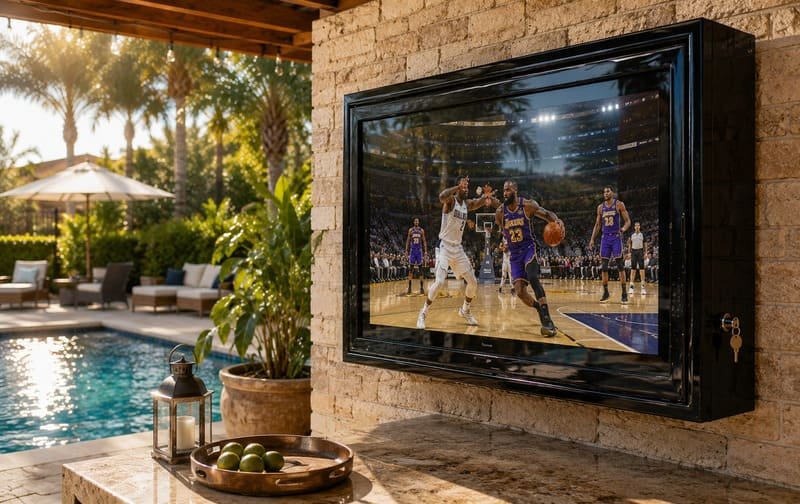
When customers ask me about UV, I usually explain that sunlight should be treated as a complete environmental stress, not just one type of ray.
The TV is not only fighting ultraviolet radiation. It is also fighting heat, visible light, glare, reflection, humidity, and sometimes salt air.
The Triple Threat of Direct Sunlight
| Sunlight Factor | What It Does | Typical Effect on Outdoor TV |
|---|---|---|
| Ultraviolet (UV) Radiation | Can contribute to long-term aging of plastics, polarizers, adhesives, films, and optical layers | Fading, yellowing, contrast loss, or reduced display life over time |
| Visible Light | Creates glare and reflections from sky, walls, water, furniture, or glass | Screen becomes hard to watch, even if the TV is functioning |
| Infrared / Heat Load | Raises surface and internal temperature | Black spots, temporary blackout, shutdown, or accelerated component aging |
Orient Display explains that UV radiation is a major external factor in polarizer aging and can contribute to fading, contrast loss, and reduced display/module lifespan. Orient Display on UV protection for polarizers
That supports the long-term UV concern. But in real outdoor TV installations, heat is often the more urgent operational issue.
Elo explains that an LCD in direct sunlight can reach its clearing point, where the liquid crystal fluid changes state and the screen can turn black and become unreadable. Elo on LCD monitors turning black in direct sunlight
That is why I tell customers not to think only about UV. If the screen is placed in direct afternoon sun, UV protection alone will not solve the problem. You still need to manage heat, glare, airflow, and placement.
Do All Outdoor TVs Handle Direct Sunlight Equally?
You bought an “outdoor TV” and assumed it could handle any sunny location. But then the afternoon sun makes the picture hard to see or the screen starts behaving differently.
No, outdoor TVs are not all designed for the same sun exposure. Some models are intended for full shade, some for partial sun, and some for brighter full-sun conditions. A shade-rated outdoor TV in direct sun can still face overheating, poor visibility, and shortened lifespan.
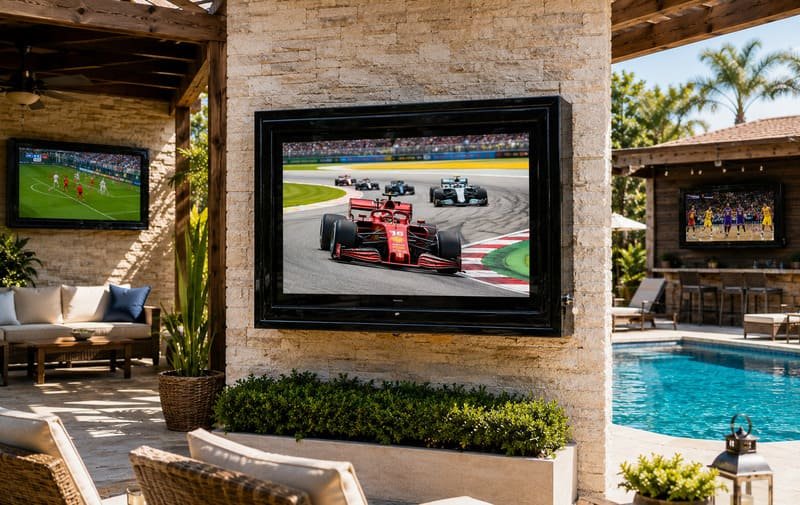
In customer conversations, I often see buyers assume the word “outdoor” means the TV is invincible. That is a costly misunderstanding.
Outdoor-rated TVs still need to match the actual location.
A covered patio is not the same as a pool deck. A hotel cabana is not the same as a west-facing bar wall. A shaded courtyard is not the same as a beachfront restaurant that gets direct afternoon sun.
Manufacturers segment outdoor TVs for this reason. Samsung describes The Terrace as an outdoor TV with direct sun protection technology, an anti-glare TV screen, and IP55 weather resistance. Samsung The Terrace outdoor TVs
SunBrite also separates outdoor TVs by application, including full-shade models such as Veranda and full-sun models such as Solis. SunBrite outdoor TVs
Comparing Outdoor TV Sun Ratings
| Rating | Typical Environment | Key Requirements | Buyer Warning |
|---|---|---|---|
| Full Shade | Covered patios, porches, screened areas with no direct sun | Weather resistance, moderate brightness, basic outdoor durability | Not designed for direct sun exposure |
| Partial Sun | Bright covered areas, morning sun, indirect sunlight | Higher brightness, better reflection handling, stronger heat management | Still needs careful placement |
| Full Sun | Open patios, poolside spaces, exposed commercial areas | High brightness, anti-glare treatment, stronger thermal design | Usually higher cost, and placement still matters |
The practical lesson is simple: match the TV to the location, not just to the screen size.
A full-shade outdoor TV may be a good choice for a covered patio, but that does not mean it should face direct afternoon sun every day. A full-sun outdoor TV may perform better in bright conditions, but even then, shade and smart orientation can improve performance and lifespan.
How Does Direct Sunlight Affect a TV Screen’s Performance and Lifespan?
Your screen looks fine one minute, then dark spots or a black area appear. You may wonder whether the TV is permanently damaged or just temporarily overheated.
Direct sunlight primarily creates thermal stress and visibility problems. The screen surface absorbs heat, the LCD layer can temporarily become unreadable, and internal electronics may age faster under repeated high-temperature exposure. Long-term UV exposure can also contribute to fading and optical-layer aging.
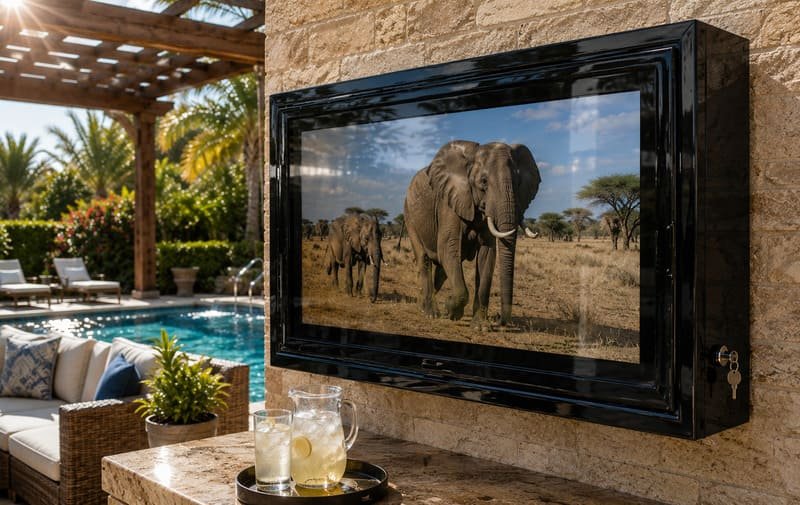
When a TV is placed in direct sun, a chain reaction can begin.
The screen and bezel absorb sunlight. The display surface becomes hotter than the surrounding air. The internal electronics are already generating their own heat. If airflow is limited, the temperature around the TV can rise quickly.
In LCD screens, one possible result is a temporary blackening effect caused by heat. The screen may recover after cooling, but repeated overheating is not something I would ignore.
From Temporary Problem to Long-Term Risk
- Heat Buildup
Dark surfaces can become much hotter than the surrounding air in direct sun. That is why the screen surface temperature matters more than the weather forecast alone. - LCD Blackening / Clearing Point
LCD screens rely on liquid crystals. When they reach certain high temperatures, the liquid crystal layer can lose its normal optical behavior and turn black or unreadable. This may be temporary, but it is a clear sign that the location is too harsh. - Component Stress
Heat is one of the major reliability stresses for electronics. NIST’s Arrhenius reliability model is commonly used to describe how temperature can accelerate certain failure mechanisms. NIST Arrhenius reliability model - Long-Term UV Aging
UV exposure can contribute to fading, yellowing, polarizer aging, adhesive degradation, and contrast loss over time. This process is usually slower than heat-related blackout, but it still matters for long-term outdoor use. - Glare and Customer Experience
Even if the TV is not damaged, severe glare can make the screen unusable. For a restaurant, sports bar, hotel, or resort, an unwatchable screen can be almost as bad as a failed screen.
This is why I do not like treating UV protection as a single checkbox. For outdoor screens, UV, heat, and glare need to be planned together.
Sun Exposure Risk Summary
| Risk | Short-Term Effect | Long-Term Effect | Best Protection |
|---|---|---|---|
| UV Exposure | Usually not immediate | Fading, yellowing, optical film aging, contrast loss | Shade, UV-stable materials, suitable front shield |
| Heat Buildup | Black screen, dark spots, shutdown | Component aging, shorter service life | Shade, airflow, active fans, correct TV rating |
| Glare | Screen becomes hard to watch | Poor customer experience and lower usability | Placement, tilt, matte surface, anti-glare design |
| Humidity / Salt Air | Moisture or corrosion risk | Hardware, connector, and enclosure wear | Sealed enclosure, corrosion-resistant hardware |
| Poor Ventilation | Heat trapped around TV | Repeated thermal stress | Clear airflow path and fan cooling |
Can an Outdoor TV Enclosure Protect Against UV and Heat?
You want to use a cost-effective regular TV outdoors, and an enclosure seems like the solution. But will it really protect against direct sunlight?
An outdoor TV enclosure can help reduce environmental exposure, protect against rain, dust, insects, humidity, and impact, and use a front shield that may reduce some UV exposure depending on material specifications. But an enclosure does not make a standard TV immune to direct sunlight. Without shade, airflow, and active cooling, an enclosure can still trap heat.
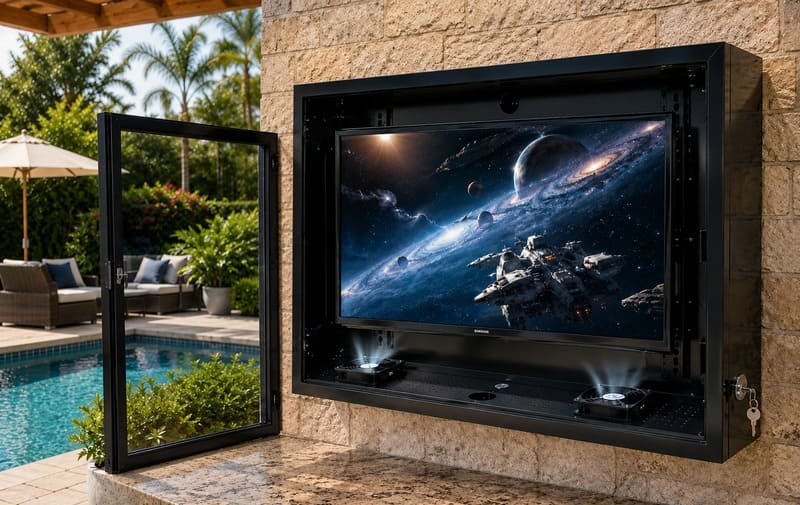
An enclosure is a powerful tool, but it is not magic.
I always explain to customers that the enclosure creates a more controlled micro-environment around the TV. It shields the screen from rain, dust, insects, salt air, impact, and unauthorized access. It also allows buyers to use a standard TV outdoors in many shaded or semi-outdoor locations.
But direct sun is still direct sun.
A UV-stabilized polycarbonate front shield can help reduce UV exposure to the TV, but the exact UV performance depends on the material grade, additives, thickness, coating, and supplier specification. Covestro describes Makrolon polycarbonate as robust, lightweight, glass-like in transparency, and impact resistant even at low temperatures. Covestro Makrolon polycarbonate
For an outdoor TV enclosure, those properties are useful because the front window needs to be transparent, impact-resistant, and durable enough for real outdoor use.
The International Electrotechnical Commission explains that IP ratings grade the resistance of an enclosure against dust or liquid intrusion. IEC IP Ratings
For an outdoor TV enclosure, IP65 can be a strong protection level against dust and water jets under defined test conditions. But IP65 does not mean UV-proof, heat-proof, vapor-proof, condensation-proof, chemical-proof, or submersible.
Enclosure Role in Sun Management
| Enclosure Function | What It Helps With | What It Does Not Solve Alone |
|---|---|---|
| Sealed Body | Rain, dust, insects, splash, and basic environmental exposure | Direct sun heat and glare |
| Polycarbonate Front Shield | Impact protection, visibility, and possible UV reduction depending on material spec | Full-sun screen performance |
| Fan Cooling | Helps move warm air away from the TV | Cannot act like air conditioning |
| Lockable Design | Reduces casual access and tampering | Does not improve sunlight readability |
| Internal TV Replacement | Allows easier future screen upgrade | Does not change the TV manufacturer’s outdoor-use rating |
Without a planned airflow path or active cooling, an enclosure can trap heat and increase the risk of overheating. That is why our Pro and Ultra series use fan systems to help move warm air away from the TV.
I do not describe a fan-cooled enclosure as a full-sun rating upgrade. It is a protective system, not a magic shield against direct sun.
A high-brightness indoor TV inside a fan-cooled enclosure can work well in shaded patios, covered outdoor bars, cabanas, and semi-outdoor commercial spaces. But for direct full-sun exposure, a true full-sun outdoor TV, better shade planning, or a different installation location may be necessary.
What’s the Most Practical Way to Protect an Outdoor TV Investment?
You are ready to install an outdoor screen, but the wrong placement could shorten its life or make it hard to watch. So where should you start?
The most practical protection strategy is shade first, then equipment selection. Choose a location that avoids direct afternoon sun, allows airflow, reduces glare, and matches the screen rating. Then use a suitable outdoor TV or a properly ventilated outdoor TV enclosure based on the real environment.
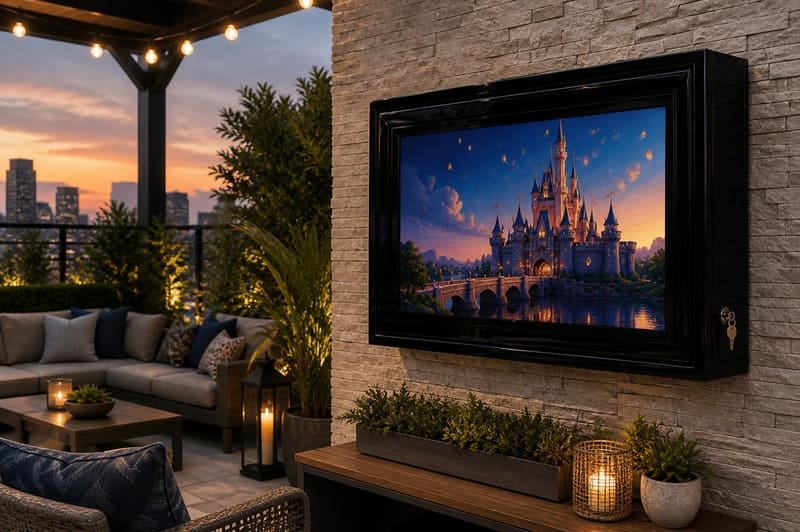
For every enclosure installation I advise on, the conversation starts with location.
No amount of technology beats smart placement. The best customers think like architects before they think like buyers. They ask where the sun comes from, when the screen will be watched, where guests will sit, and how heat will escape.
Sony advises using TVs within a temperature range of 0°C to 40°C / 32°F to 104°F and avoiding direct sunlight. Sony TV temperature guidance
That advice is simple, but it matters. If the TV will be in direct sun during the hottest part of the day, you should not treat that as a normal installation.
A Practical Installation Checklist
- Prioritize Shade
Can you mount the TV under an eave, pergola, roof overhang, cabana, or permanent awning? Shade is the most practical way to reduce UV exposure, heat buildup, and glare at the same time. - Check Sun Orientation
In the Northern Hemisphere, a north-facing wall often receives less direct sun than south- or west-facing walls. In the Southern Hemisphere, the best orientation may be different, so check the sun path at your actual location. - Avoid Direct Afternoon Sun
The hottest part of the day is usually the highest-risk time for heat stress. A spot that looks fine in the morning may be unsuitable at 3 PM. - Ensure Airflow
Do not trap the TV or enclosure in a tight pocket with blocked vents. Heat needs a path out. For enclosures, keep fan vents unobstructed and follow the manufacturer’s clearance guidance. - Use Active Cooling When Needed
If you are using a TV inside an enclosure in a warm climate, fan cooling is strongly recommended. Fans help reduce heat buildup, but they do not replace shade. - Match the Technology to the Site
A full-sun site may need a full-sun outdoor TV. A shaded patio may work well with a high-brightness indoor TV inside a fan-cooled enclosure. A coastal site may need both weather protection and corrosion-resistant hardware. - Plan for Maintenance
Check fans, seals, cable exits, and front panel cleanliness periodically. Dust, pollen, salt air, and insects can all affect long-term performance.
Practical Matching Guide
| Installation Environment | Main Sun Risk | Better Strategy |
|---|---|---|
| Fully shaded patio | Humidity, dust, insects, low glare | Indoor TV + fan-cooled outdoor enclosure may work well |
| Covered restaurant terrace | Long operating hours and heat buildup | Enclosure with active fans and shaded placement |
| Poolside partial sun | Glare, water reflection, heat | Outdoor TV or shaded enclosure setup, depending on exposure |
| Direct full-sun wall | Heat blackout, glare, UV aging | Full-sun outdoor TV and strong shade planning if possible |
| Coastal resort | Salt air, humidity, glare, heat | Outdoor TV, enclosure, or both, with corrosion-resistant hardware |
| Factory or dusty outdoor area | Dust, heat, airborne contamination | IP-rated enclosure with airflow and maintenance access |
The goal is not to buy the most expensive screen. The goal is to match the protection system to the environment.
Frequently Asked Questions
What’s the difference between partial-sun and full-sun outdoor TVs?
Partial-sun outdoor TVs are usually designed for indirect light, covered patios, or limited sun exposure. Full-sun outdoor TVs are designed for harsher bright conditions and usually use higher brightness, stronger reflection handling, and more robust heat management. Always check the manufacturer’s intended installation environment before buying.
Will a brighter screen solve my direct sunlight problem?
Brightness helps visibility, but it does not remove heat stress. A brighter screen can make the image easier to see in bright ambient light, but if the TV cannot dissipate both its own operating heat and the heat from direct sun, it may still dim, shut down, or age faster.
Can I use a regular indoor TV in a fully shaded patio?
A regular indoor TV can be practical in a shaded patio when it is protected by a properly sized, fan-cooled, weather-resistant enclosure. However, you still need to check TV dimensions, operating temperature guidance, warranty terms, ventilation, cable routing, and local electrical requirements.
Does UV exposure damage LCD and OLED screens the same way?
Not exactly. LCD, LED-LCD, OLED, and other display technologies use different optical layers, materials, and heat-management designs. This article mainly discusses common LCD/LED TV outdoor risks. Always check the specific TV manufacturer’s guidance for your model.
Does a polycarbonate enclosure block all UV rays?
No enclosure should be described as blocking all UV unless the supplier provides specific test data. A UV-stabilized polycarbonate front shield can help reduce UV exposure, but actual performance depends on material grade, additives, thickness, coating, and supplier specification.
Is shade more important than UV protection?
In many real installations, yes. Shade reduces UV exposure, heat buildup, and glare at the same time. A shaded location can make a major difference even before you choose the TV or enclosure.
Can direct sunlight void a TV warranty?
It depends on the TV manufacturer’s warranty and installation guidance. A protective enclosure does not change the TV manufacturer’s original outdoor-use rating or warranty terms. Always check the TV manual and warranty before using an indoor TV outdoors.
Conclusion
Yes, UV exposure can damage outdoor TV screens over time. But UV is only one part of the sunlight problem.
Direct sun brings three major risks:
UV can age optical materials.
Heat can cause screen blackout and component stress.
Glare can make the screen unwatchable.
That is why the best protection strategy is not just “UV protection.” It is a complete sun-management plan.
Start with shade.
Check the sun path.
Avoid direct afternoon exposure.
Choose the right outdoor TV rating.
Use a fan-cooled enclosure when appropriate.
Keep airflow clear.
Inspect seals, fans, and hardware over time.
The way I explain it to customers is simple:
UV is a long-term aging factor, but total sun exposure is the real problem.
If you manage UV, heat, glare, airflow, and placement together, your outdoor TV setup has a much better chance of staying clear, usable, and reliable for years.