
A backyard movie night is easy to plan once. The real challenge is building a setup you can use again next weekend without moving the TV, chasing cables, or worrying about weather.
The best backyard movie night setup is not the one with the most decorations. It is the one that is protected, safe, comfortable, and easy enough to use again. Start with a protected outdoor TV setup, safe power, clear seating, soft lighting, useful sound, and a simple routine that lets your family enjoy the movie instead of rebuilding the whole system every time.
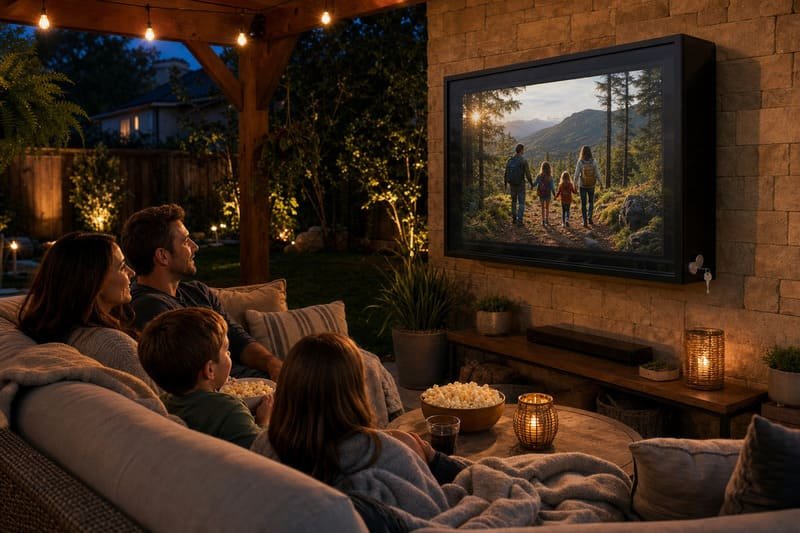
When I review a backyard movie setup, I do not start with snacks, string lights, or LED colors. I start with three practical questions:
Where will the screen stay?
How will it get safe power?
Can the family use it again next weekend without rebuilding everything?
That is the difference between a one-night backyard event and a real outdoor entertainment setup.
A projector, a temporary screen, and a few chairs can work for occasional movie nights. But if you want a more repeatable setup, especially with a fixed patio wall, pergola, outdoor kitchen, or poolside seating area, an outdoor TV setup may be easier to use and more reliable over time.
The goal is not to make your backyard look like a theater showroom. The goal is to make movie night simple enough that you actually use it.
Last Updated: May 19, 2026 | Estimated Reading Time: 10 minutes
By Smith Chen, Outdoor TV Enclosure Engineer at Outvion
Why Should a Backyard Movie Setup Start With Protection?
You may be tempted to start with the biggest TV or the coziest chairs. But if the screen is exposed to rain, dust, insects, heat, or accidental impact, the whole movie setup becomes stressful instead of relaxing.
For most backyard movie setups, protection should come before screen size. A properly designed outdoor TV enclosure can help reduce exposure to rain, dust, insects, splash, humidity, and casual impact, but real protection still depends on IP rating, cable exits, ventilation, installation quality, and maintenance.
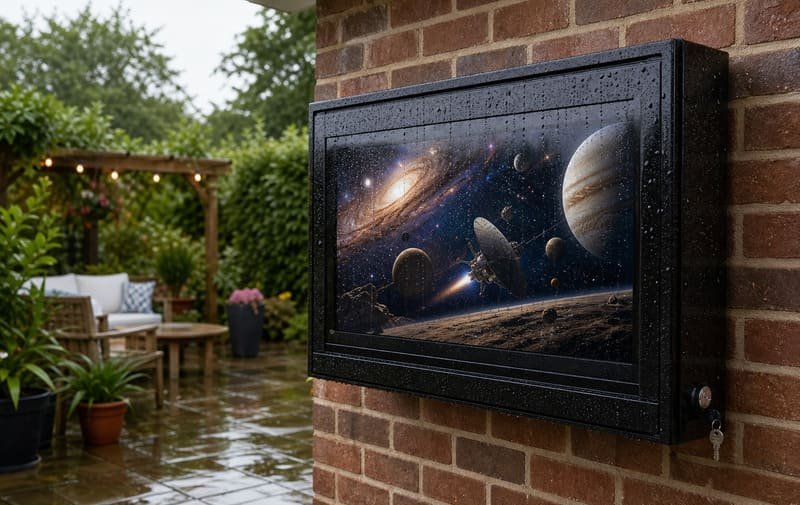
From my experience, the biggest mistake is treating the backyard like an extension of the living room.
It is not.
Your living room does not have wind-blown dust, pollen, bugs, sprinklers, sudden rain, direct sun, or kids throwing balls near the screen. Your backyard does.
That does not mean you cannot use a standard indoor TV outdoors. Many homeowners do exactly that inside a suitable enclosure. But an unprotected indoor TV is not designed for normal outdoor exposure, so using it outside without protection increases the risk of weather damage, overheating, warranty issues, and early failure.
The International Electrotechnical Commission explains that IP ratings grade the resistance of an enclosure against dust and liquid intrusion. IEC IP Ratings
For outdoor TV enclosures, IP65 is often a useful protection level because it indicates dust-tight protection and protection against water jets under defined test conditions. But IP65 does not mean vapor-proof, condensation-proof, chemical-proof, submersible, or maintenance-free.
Backyard Outdoor TV Risks
| Risk | What Can Happen | How an Enclosure Helps |
|---|---|---|
| Rain and Sprinklers | Water reaches the TV body, ports, or cables | Helps reduce water intrusion when installed correctly |
| Dust, Pollen, and Bugs | Vents and ports become dirty or blocked | Creates a physical barrier around the TV |
| Heat | TV may dim, shut down, or become unstable | Fan airflow can help reduce heat buildup |
| Humidity | Moisture can affect connectors and electronics over time | Better sealing and cable exits reduce exposure |
| Accidental Impact | Balls, chairs, or bumps can damage the screen | A clear front shield adds physical protection |
| Public or Guest Access | Kids or guests may touch ports, buttons, or cables | Lockable access can reduce casual tampering |
Sony advises keeping TVs between 0°C and 40°C / 32°F and 104°F and avoiding direct sunlight. Sony TV temperature guidance
That is why I prefer a shaded or partially shaded installation whenever possible. A fan-cooled enclosure helps, but shade, airflow, and correct installation still matter.
If you already have a TV model in mind, compare its width, height, depth, and VESA pattern with the Outvion 50–55 inch outdoor TV enclosure specifications or the correct size range before ordering.
How Do You Choose the Right Outdoor TV Size and Viewing Zone?
A backyard TV should feel immersive, not overwhelming. If the screen is too small, people squint. If it is too large for the seating distance, the setup can feel uncomfortable and visually heavy.
Choose the TV size by starting with the main seating distance and viewing zone. For many backyard movie nights, 50–55 inches works well for average patios, while 60–65 inches fits larger seating areas. Bigger is not always better if the wall, seating distance, and enclosure space do not support it.
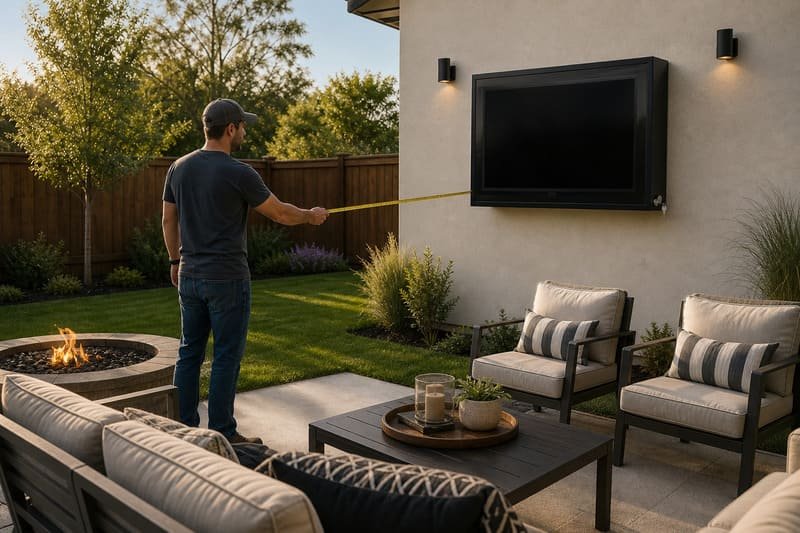
This is where homeowners often jump too quickly.
They see a large TV on sale and imagine a cinema experience. But a backyard is not always a theater. People may sit on an outdoor sofa, around a fire pit, at a dining table, near a pool, or on blankets on the lawn.
RTINGS suggests planning TV size and viewing distance together and uses about a 30-degree field of view as a mixed-use reference point. RTINGS TV size and viewing distance guide
I use that type of guidance as a starting point, not a fixed rule. Outdoor spaces are more flexible than indoor rooms. Seating may move, people may stand, and some guests may watch from an angle.
Backyard Movie Night Size Guide
| TV Size Band | Practical Backyard Viewing Fit | Best For | My Practical View |
|---|---|---|---|
| 40–45 Inches | Shorter viewing distance | Small decks, narrow patios, compact seating corners | Good for cozy spaces, but may feel small for groups |
| 50–55 Inches | Moderate patio distance | Average backyard patios, pergolas, outdoor sofas | Often the best balance for home movie nights |
| 60–65 Inches | Longer seating distance | Larger patios, poolside lounges, family gatherings | More immersive, but needs more wall and enclosure space |
| 70+ Inches | Long viewing distance | Very large backyards or semi-commercial spaces | Impressive, but heavier and more complex |
TV size labels can also be misleading when you choose an enclosure. LG explains that TV size is measured diagonally and does not include the borders or bezels, so buyers should also check the total width, height, and depth in the product specifications. LG TV size guide
That matters because a 55-inch TV does not automatically fit every 55-inch enclosure. You still need to check:
- TV width
- TV height
- TV depth
- VESA pattern
- Cable direction
- Power plug clearance
- Airflow space
For a movie night setup, I prefer a screen that fits the space naturally. The best size is the one people want to use often, not the one that only looks impressive on installation day.
What Makes the Setup Comfortable After Sunset?
A backyard movie night becomes special after sunset, but darkness also creates new problems: eye strain, trip hazards, bugs, poor sound, and glare from the wrong lights.
Comfort after sunset comes from controlled lighting, clear sound, safe movement, and a screen that does not fight the environment. Use soft backlighting or low-level path lighting, avoid lights aimed at the screen, keep walkways visible, and plan audio so guests can hear the movie without blasting the whole neighborhood.
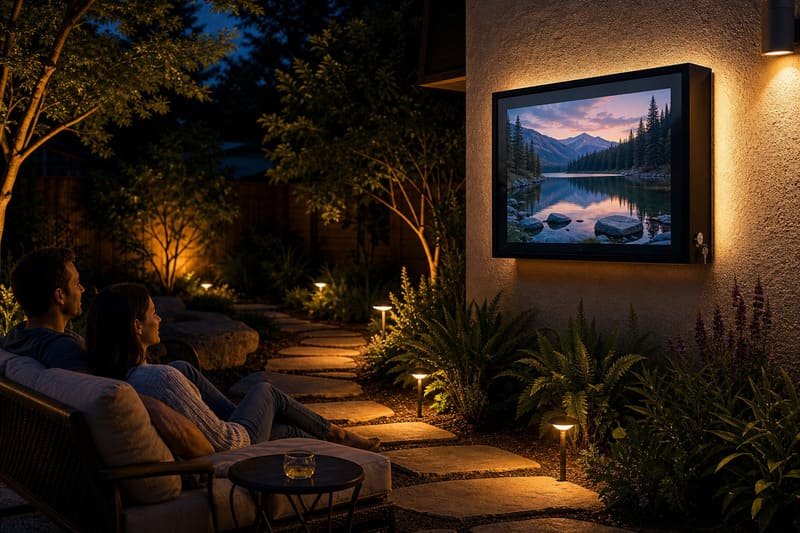
Many homeowners think lighting is only about decoration. I think of it as part of the viewing system.
A bright porch light behind the seating area can reflect on the screen. A strong light near the TV can wash out the picture. A dark pathway can make guests trip when they get up for snacks.
The goal is low, indirect, controlled light.
Using Backlighting Without Creating Glare
Soft backlighting behind the TV can make night viewing more comfortable because it reduces the contrast between a bright screen and a dark background. BenQ explains that well-designed monitor lighting can reduce contrast glare and visual fatigue by providing wide, even, glare-free illumination. BenQ on screen lighting and eye comfort
For outdoor TV enclosures with LED options, I suggest keeping the light dim and indirect. It should glow behind or around the TV, not shine toward the viewer or reflect on the front panel.
Good LED use:
- Warm white for movies
- Soft amber for cozy evenings
- Low blue or neutral white for sports
- Dimmable lighting for longer viewing
- Indirect wall wash, not direct glare
Poor LED use:
- Lights aimed at the screen
- Bright color effects during movies
- Flashing modes during serious viewing
- Path lights shining into guests’ eyes
Sound Matters More Outdoors
TV built-in speakers are usually not enough for outdoor movie nights. Outside, sound disappears faster because there are fewer walls to reflect it.
A portable Bluetooth speaker may be enough for a casual family movie. A weather-resistant outdoor soundbar or small outdoor speaker system is better for a permanent setup.
I usually suggest placing speakers closer to the seating area instead of turning the TV volume very high. This keeps the movie easier to hear while reducing noise spillover to neighbors.
Bugs and Night Comfort
Screens and lights can attract insects. A sealed enclosure helps keep bugs out of the TV area, but it does not keep bugs away from guests.
Use warm, low-level lighting away from the screen. Keep food covered. Place insect-control devices away from the seating area and electronics, not beside the TV.
A comfortable movie night is not about one big feature. It is a group of small decisions that make the space easier to enjoy.
Should You Use an Indoor TV With an Enclosure or a Dedicated Outdoor TV?
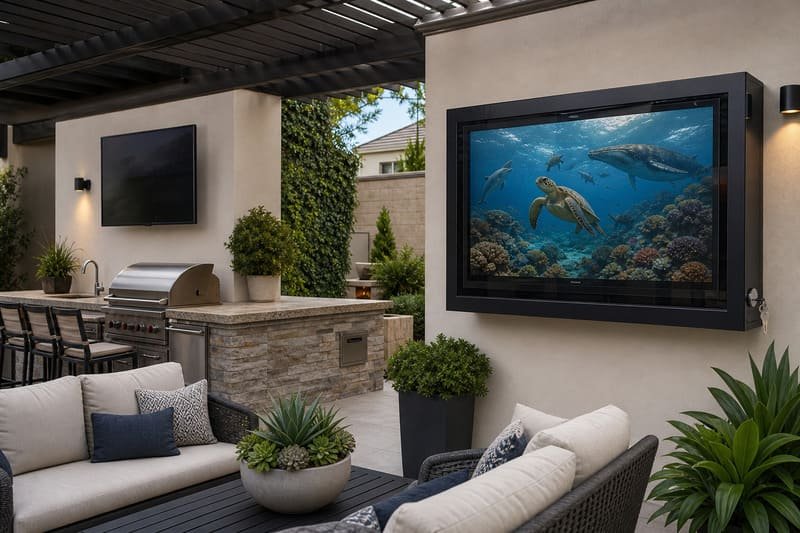
Dedicated outdoor TVs are designed for outdoor environments, but they can be expensive. A standard indoor TV inside an outdoor enclosure can be a practical alternative in many shaded or partially shaded backyard setups.
For many homeowners, an indoor TV inside a suitable outdoor TV enclosure can offer lower upfront cost, easier future replacement, and more TV model choices than a dedicated outdoor TV. However, a dedicated outdoor TV may still be better for full-sun locations, high-brightness needs, or buyers who want one integrated outdoor-rated product.
I do not like saying one choice is always better.
It depends on the backyard.
A dedicated outdoor TV may be the better choice if:
- The screen is exposed to full sun.
- You need high brightness during daytime viewing.
- You want one slim integrated outdoor-rated product.
- You prefer a simpler product warranty path.
- Budget is less sensitive.
An indoor TV with an enclosure may be more practical if:
- The location is shaded or partially shaded.
- Movie nights happen mostly in the evening.
- You want more TV brand and smart-system options.
- You want easier future TV replacement.
- You want the enclosure to become the long-term protective asset.
Backyard TV Strategy Comparison
| Factor | Indoor TV + Enclosure | Dedicated Outdoor TV |
|---|---|---|
| Upfront Cost | Often lower, depending on TV and enclosure | Usually higher |
| Future Upgrade | Easier to replace the TV inside | Replace the full outdoor-rated TV |
| TV Choice | More brands, operating systems, and sizes | Fewer outdoor-rated models |
| Full-Sun Performance | Usually not ideal | Often better if designed for full sun |
| Weather Protection | Depends on enclosure rating and installation | Built into the TV design |
| Repair / Replacement | Standard TV may be easier to source | More specialized |
| Best Fit | Shaded patios, evening movie nights, pergolas | Full-sun spaces, premium outdoor setups |
For backyard movie nights, the enclosure approach often makes sense because most movies happen after sunset or under a covered patio. But I still recommend checking brightness, operating temperature, ventilation, warranty terms, and whether the TV physically fits inside the enclosure.
The enclosure does not change the TV manufacturer’s original outdoor-use rating or warranty terms. It helps reduce exposure, but it does not magically turn every indoor TV into a full-sun outdoor TV.
How Do You Plan Power, Cables, Sound, and Safe Walking Paths?
A backyard movie night can look perfect until someone trips over a cable, rain reaches a connection, or the speaker battery dies halfway through the film. Safety planning is part of the setup.
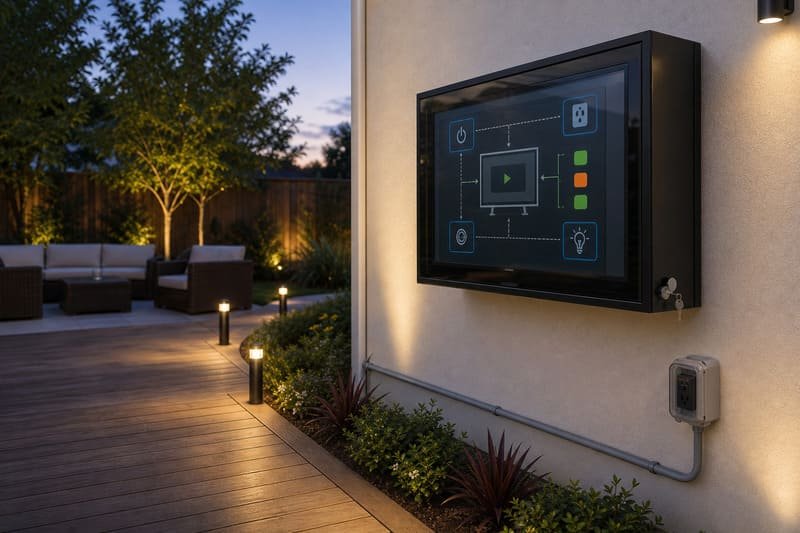
Plan power and cables before you plan decorations. For a permanent backyard TV setup, use outdoor-rated power, GFCI protection, weatherproof outlet covers, protected cable routes, and professional electrical help when needed. Do not rely on indoor extension cords or temporary wiring as a long-term power plan.
This is the section I do not want homeowners to skip.
Outdoor power is not the same as indoor power. Water, shoes, pets, kids, lawn equipment, and moving furniture all create risks.
The Electrical Safety Foundation International recommends GFCI protection outdoors and weatherproof electrical boxes or covers for outdoor outlets. ESFI outdoor electrical safety
The U.S. Consumer Product Safety Commission also advises limiting extension cord use and choosing properly rated cords when they are necessary. CPSC extension cord safety
For a permanent TV area, I prefer a proper outdoor outlet and a clean cable path. If permanent wiring is needed, use a qualified electrician.
Backyard Safety Checklist
| Setup Area | What to Plan | Why It Matters |
|---|---|---|
| Power | Outdoor-rated outlet, GFCI protection, weatherproof cover | Reduces electrical risk |
| Cables | Route along walls, posts, or protected edges | Prevents trips and cable damage |
| Walking Paths | Low-level path lights | Helps guests move safely |
| Seating | Arc or fan layout with clear sightlines | Keeps the screen visible for everyone |
| Sound | Speaker near seating area | Improves audio without blasting volume |
| Lighting | Soft, indirect, dimmable light | Keeps the picture comfortable |
| Weather Plan | Enclosure, shade, quick cleanup routine | Makes setup repeatable |
| Storage | Covers, remotes, speakers, cushions | Reduces setup time next movie night |
Do not run cables across the middle of the seating area if you can avoid it. Keep walkways clear. Use low-level lights that illuminate the ground rather than shining at the screen.
The best backyard movie setup is the one guests can enjoy without noticing the safety planning behind it.
What Is the Simple Backyard Movie Night Setup Checklist?
A repeatable movie night should have a routine. You should know what to turn on, what to check, where people sit, and how to shut everything down afterward.
A simple backyard movie night checklist should cover screen protection, power, sound, seating, lighting, bugs, weather, and cleanup. The fewer steps it takes to start the movie, the more often you will use the setup.
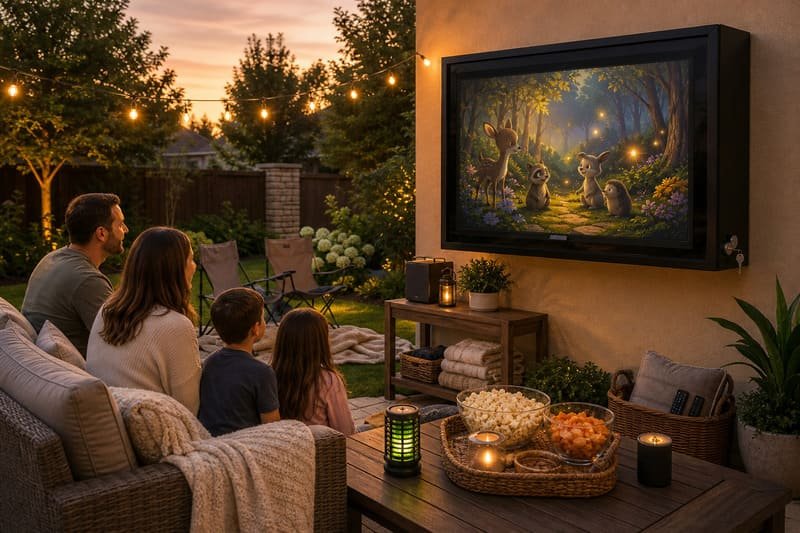
Here is the practical checklist I would use before the first movie night.
Before Installation
| Step | What to Confirm |
|---|---|
| Choose the Screen Location | Shaded or partially shaded wall, pergola, patio, or outdoor kitchen area |
| Measure Viewing Distance | Main seating distance matches the screen size |
| Check TV Dimensions | Width, height, depth, VESA, cable direction |
| Choose the Enclosure Size | Internal space supports TV fit, airflow, and cable clearance |
| Plan Power | Outdoor-rated outlet, GFCI protection, weatherproof cover |
| Plan Sound | Bluetooth speaker, outdoor soundbar, or speaker system |
| Plan Lighting | Soft backlight and low path lights |
| Check Wall Strength | Mounting surface can support TV + enclosure weight |
Before Each Movie Night
| Step | What to Check |
|---|---|
| Front Panel Cleanliness | Wipe dust or fingerprints from the viewing surface |
| Fan Vents | Make sure vents are not blocked by dust, leaves, insects, or furniture |
| Power and Streaming | Test Wi-Fi, streaming app, HDMI, or media device |
| Sound | Charge or connect speakers before guests arrive |
| Seating | Arrange chairs in an arc with clear sightlines |
| Lighting | Turn on path lights and dim backlighting |
| Bug Control | Place insect-control items away from the TV and seating |
| Weather Check | Confirm rain, wind, and temperature conditions |
After the Movie
| Step | What to Do |
|---|---|
| Power Down | Turn off TV, speakers, and accessories |
| Close and Lock | Make sure the enclosure is closed properly |
| Remove Loose Items | Bring in cushions, speakers, remotes, and snacks |
| Check Cables | Make sure nothing is pinched or exposed |
| Clean Lightly | Wipe dust or moisture if needed |
This routine is what makes the setup repeatable.
The first movie night may take some planning. The fifth one should feel easy.
Frequently Asked Questions
Is an outdoor TV better than a projector for backyard movie nights?
It depends on how you use the space. A projector is flexible and can be a good choice for occasional movie nights in dark conditions. An outdoor TV setup is usually better for repeatable use, faster startup, brighter images, streaming convenience, and daytime or early-evening viewing. If you want a fixed setup, a protected outdoor TV is often easier to use.
Can I use an indoor TV for backyard movie nights?
Yes, many homeowners use an indoor TV inside a suitable outdoor TV enclosure. But the enclosure must fit the TV, allow airflow, protect against weather exposure, and support safe cable routing. The enclosure does not change the TV manufacturer’s original outdoor-use rating or warranty terms.
What size TV is best for backyard movie night?
For many home patios, 50–55 inches is a practical starting point. Smaller 40–45 inch TVs can work for compact patios, while 60–65 inch screens are better for larger seating areas. Choose based on viewing distance, wall space, enclosure fit, and how many people will watch.
Do I need an outdoor TV enclosure?
If the TV will stay outside, I strongly recommend using a proper outdoor TV enclosure or a dedicated outdoor TV. A simple fabric cover may help when the TV is off, but it does not protect the screen while you are watching, and it may not solve heat, insects, dust, cable, or impact risks.
How should I handle power safely outside?
Use outdoor-rated power, GFCI protection, weatherproof outlet covers, and protected cable routes. Avoid indoor extension cords outdoors. For a permanent installation, use a qualified electrician instead of relying on temporary extension cords as the long-term power plan.
Do I need external speakers for backyard movies?
Usually, yes. Built-in TV speakers often sound weak outdoors because there are no walls to reflect the sound. A portable Bluetooth speaker can work for casual movie nights. A weather-resistant outdoor soundbar or outdoor speaker system is better for a permanent setup.
Can I leave the TV outside in winter?
It depends on your climate, enclosure, and TV specifications. A sealed enclosure can help protect against snow and moisture, but it does not change the TV manufacturer’s operating or storage temperature limits. Always check the TV manual, especially in freezing climates.
How do I keep bugs away from the screen?
Use warm, low-level lighting away from the screen, keep food covered, and place insect-control devices away from seating and electronics. A sealed enclosure helps keep insects out of the TV area, but the viewing space still needs a separate bug-control plan.
Conclusion
A great backyard movie night setup is not built from decorations first.
It starts with a repeatable system.
A protected screen.
Safe power.
Clear seating.
Comfortable lighting.
Useful sound.
Simple cable routing.
A weather plan.
A quick setup and shutdown routine.
The way I explain it to homeowners is simple:
The best backyard movie night setup is the one your family can use again next weekend.
If you plan only for one magical night, you may end up moving furniture, chasing cords, and worrying about rain every time. If you plan the setup as a protected outdoor TV system, movie night becomes easier, safer, and more enjoyable.
Start with protection.
Match the screen to the seating distance.
Use soft lighting, not glare.
Plan sound and power safely.
Keep the setup simple enough to repeat.
That is how a backyard movie night becomes more than an event. It becomes part of how your outdoor space is used.