
A hotel pool is already one of the most expensive guest-facing spaces to build, maintain, and operate. The real question is not whether a screen looks nice near the water. The better question is whether the pool area is working hard enough across the whole day: morning relaxation, afternoon food and beverage service, sunset drinks, sports nights, private cabanas, and resort events.
Outdoor TVs add business value to hotel pool areas when they help turn an expensive guest amenity into a more active, programmable, F&B-supporting, event-ready space. The hardware matters, but the real value comes from matching screen placement, content, weather protection, guest flow, and hotel operating goals.
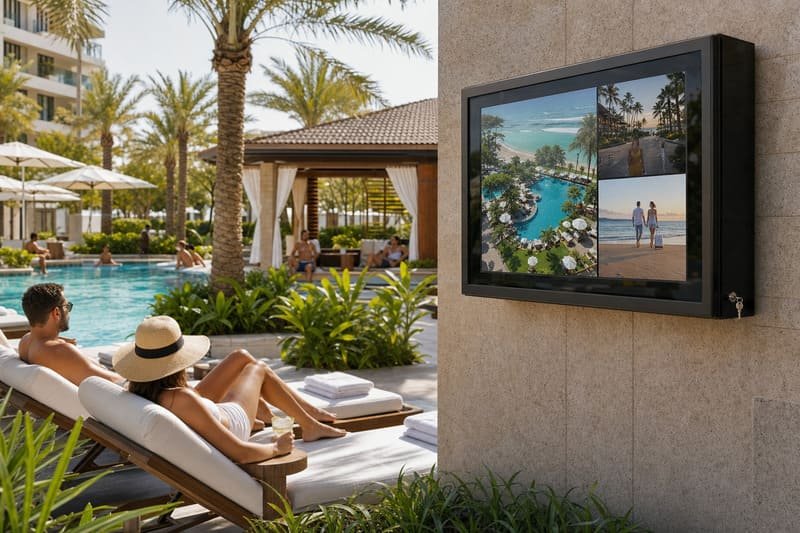
When a hotel buyer asks me whether pool-area TVs are worth it, I usually ask which pool hours are underused first.
Is the pool lively only during the afternoon?
Does the pool bar slow down too early?
Are guests leaving the pool area before dinner?
Is there a space for sports nights, private events, or cabana packages?
Can the hotel communicate daily activities without adding more printed signs?
A hotel pool screen should not be treated as decoration. It should support the way the hotel wants guests to use the space.
For a single flagship screen, a dedicated outdoor TV may be the right choice. For a hotel that needs six, ten, or twenty pool-area screens, the decision becomes more complex. Cost, replacement flexibility, heat, humidity, salt air, installation, guest access, and service access all matter.
The business value comes from matching the display plan to the real hotel operation, not from simply putting a TV near the pool.
Last Updated: May 16, 2026 | Estimated Reading Time: 10 minutes
By Smith Chen, Outdoor TV Enclosure Engineer at Outvion
Why Is the Pool Area More Than a Guest Amenity?
A hotel pool is not only a place to swim. It is part of the guest experience, the property image, and often the food and beverage strategy. If the pool area feels passive, guests may use it for a short time and then move elsewhere.
Outdoor TVs can help make the pool area feel more active, but only when they support a clear guest-use plan. A screen can create a focal point, support pool-bar service, show resort information, host sports nights, or add premium value to cabanas. Without programming, it is only another piece of hardware.
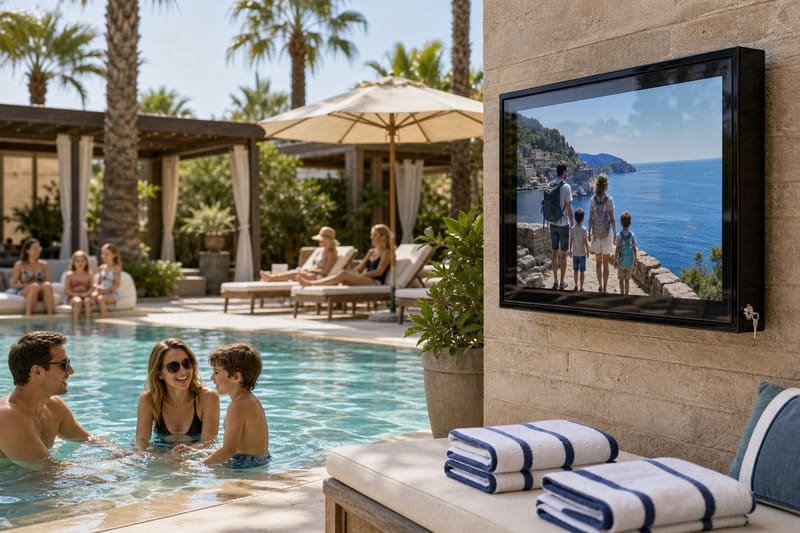
For hotel pool projects, I care less about the number of screens at the beginning and more about the pool schedule.
A resort pool has different time zones:
- Morning calm.
- Afternoon pool bar service.
- Sunset drinks.
- Weekend sports.
- Private cabana use.
- Evening events.
- Seasonal parties.
A screen can support each of these moments differently.
Restaurant and hospitality atmosphere research suggests that ambience and service quality can influence customer satisfaction and behavioural intentions. This is why I see pool-area TVs as part of the guest environment, not just an AV purchase. Restaurant atmosphere and customer behavioural intentions
Where the Business Value Comes From
| Business Value Area | How Pool TVs Help | What Must Be Planned |
|---|---|---|
| Guest Experience | Creates atmosphere and a shared focal point | Placement, brightness, content, and sound level |
| F&B Support | Supports pool bar, happy hour, and event menus | Service timing, menu strategy, staff workflow |
| Event Use | Enables sports nights, pool parties, and private events | Screen size, audio plan, event calendar |
| Guest Communication | Displays resort notices, schedules, and branded messages | Readability, screen location, content updates |
| Asset Utilization | Helps the pool area stay useful beyond swim-only hours | Programming, lighting, seating, weather plan |
| Cost Control | Makes multi-screen strategies easier to plan | TCO, replacement flexibility, service access |
| Risk Control | Protects screens from weather, guests, and maintenance issues | IP rating, cooling, locks, cable exits |
Hotel ancillary revenue is often created through additional products and services beyond the room itself, such as dining, spa, parking, or other on-property spending. SiteMinder ancillary revenue guide
A pool-area TV does not automatically create revenue. But when it supports a pool bar, event program, cabana package, or evening guest experience, it can create more opportunities for guests to stay and spend on property.
How Can Outdoor TVs Support Poolside F&B, Events, and Guest Engagement?
A pool can feel energetic in the afternoon and empty at night. Without programming, guests often move to the lobby, restaurant, or off-property venues sooner than the hotel wants.
Outdoor TVs can support hotel pool operations by giving guests more reasons to stay in the pool area. They can support sports viewing, pool parties, event notices, private cabana experiences, outdoor dining, and branded resort content. But the screen must serve the hotel’s operating plan, not just fill a blank wall.
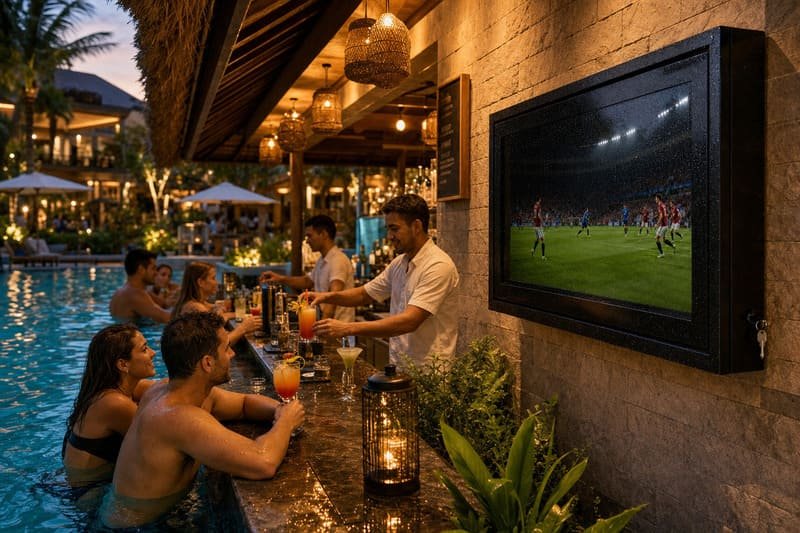
The best hotel pool TV plans I see do not put the same screen in every location. They separate the role of each screen.
A pool-bar screen may need to be visible from several seating zones.
A cabana screen may need a smaller, more premium setup.
A resort-notice screen may need readability more than sports performance.
A flagship event screen may need stronger brightness, sound, and placement planning.
This is where hotels are different from restaurants. A restaurant patio often focuses on dwell time at tables. A hotel pool area has more zones: lounge chairs, cabanas, bar counters, walkways, family pool areas, adults-only zones, and event spaces.
Pool-Area Screen Use Cases
| Pool Use Case | Business Purpose | Screen Role | Selection Concern |
|---|---|---|---|
| Sports Viewing | Build a social pool-bar scene | Main focal screen | Glare, sound, seating angle |
| Pool Parties | Support programmed events | Event and music-video screen | Heat, mounting, cable safety |
| Resort Notices | Communicate daily activities | Information display | Readability and placement |
| Outdoor Dining | Extend restaurant terrace value | Atmosphere and specials screen | Aesthetics, service access |
| Private Cabanas | Add premium guest experience | Smaller personal entertainment screen | Size fit and control access |
| Seasonal Events | Support summer campaigns | Branded content and schedule screen | Content updates and weather protection |
A well-programmed screen can give guests more reasons to stay near the pool, but longer dwell time still depends on seating comfort, service speed, weather, content, sound, and guest demand.
That is why I do not promise fixed revenue growth from a screen alone. I treat the screen as one part of the pool-area operating plan.
Where Should Hotels Place Pool-Area Screens?
A screen in the wrong location can create glare, block staff movement, become difficult to service, or cause safety concerns near water. Placement is not just a visual decision.
Hotels should place pool-area TVs based on guest flow, seating zones, sun direction, service paths, wall strength, sound control, and electrical safety. The best location is usually not the closest point to the water. It is the location where guests can see the screen comfortably while staff can still serve, clean, and maintain the area safely.
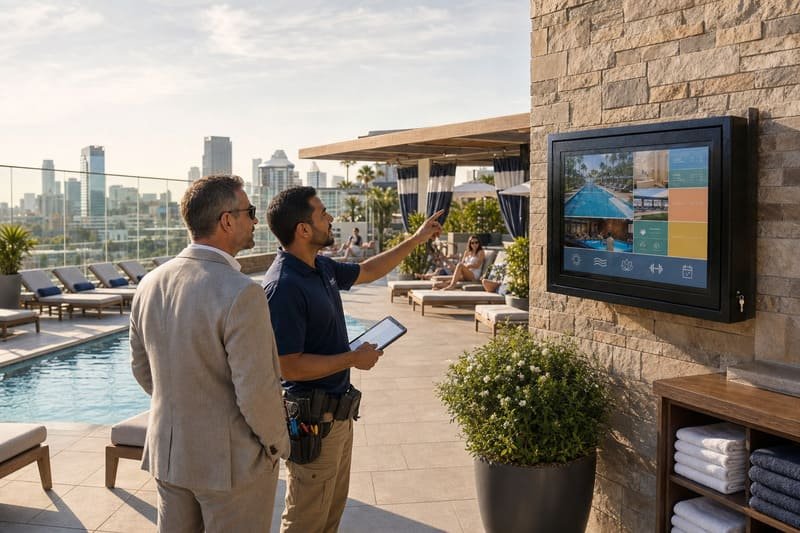
I prefer to start with the guest path.
Where do guests enter the pool area?
Where do they sit longest?
Where does staff carry drinks and towels?
Where does the sun hit at 3 p.m. and 6 p.m.?
Where can cables run safely?
Where can maintenance staff open the enclosure later?
A screen placed in the wrong location may create more complaints than value. Guests may complain about glare. Staff may dislike blocked service paths. Maintenance teams may struggle to clean or access the screen.
RTINGS explains that TV size and viewing distance should be planned together, which is useful when hotels decide whether one large pool screen or several smaller screens will serve guests better. RTINGS TV size and viewing distance guide
Pool-Area Placement Checklist
| Placement Factor | What to Check | Why It Matters |
|---|---|---|
| Main Viewing Zone | Lounge chairs, cabanas, pool bar, dining area | Prevents poor sightlines |
| Guest Flow | Walking paths, pool entry, towel stations | Avoids crowding and accidental contact |
| Staff Route | Food, drinks, cleaning, service carts | Keeps operations smooth |
| Sun Direction | Afternoon sun, sunset glare, reflected water | Protects screen visibility |
| Sound Spillover | Nearby rooms, quiet zones, restaurant tables | Prevents guest complaints |
| Mounting Structure | Wall, column, pergola, reinforced frame | Supports TV + enclosure load |
| Electrical Route | Safe outdoor-rated power planning | Important near water |
| Service Access | Door opening, lock access, cleaning space | Supports long-term maintenance |
Near pools, electrical safety should always be handled by qualified professionals familiar with local code. A TV enclosure helps protect the equipment, but it does not replace safe wiring, GFCI/RCD protection, grounding, bonding, or professional installation.
The enclosure protects the screen.
The electrical system protects people.
The placement plan protects the guest experience.
How Should Hotels Compare Dedicated Outdoor TVs and Indoor TVs with Enclosures?
A hotel may assume a dedicated outdoor TV is always the safest answer. Sometimes it is. But for multi-screen pool projects, the budget and replacement plan can look very different.
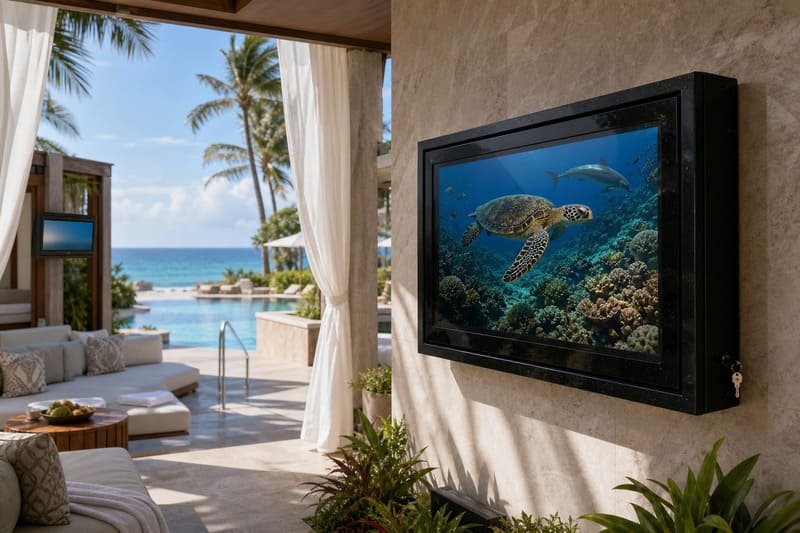
Hotels should compare dedicated outdoor TVs and indoor TVs with enclosures by looking at total cost, replacement flexibility, brightness needs, service access, weather exposure, and brand requirements. A dedicated outdoor TV may be better for one full-sun flagship screen. Indoor TVs with protective enclosures may be more practical for shaded multi-screen pool-bar projects.
I do not like one-size-fits-all advice here.
A dedicated outdoor TV can be a strong option when:
- The screen sits in full sun for long hours.
- The hotel needs very high brightness.
- The brand wants one integrated finished product.
- The screen is a flagship feature.
- The installation budget is less sensitive to upfront cost.
An indoor TV with a suitable outdoor enclosure can make sense when:
- The hotel needs several screens.
- The screens are shaded or partially shaded.
- The hotel already has standard TV supply channels.
- Future replacement flexibility matters.
- The pool area needs protection from rain, dust, guest contact, and humidity.
- The project team wants to control long-term replacement costs.
CIPS defines Total Cost of Ownership as a way to estimate the end-to-end cost of providing a product or service, including purchase price, acquisition cost, usage cost, and end-of-life cost. CIPS Total Cost of Ownership overview
For hotels, that matters because the lowest purchase price is not always the best value. The hotel also has to think about downtime, installation labor, service access, replacement TV availability, and whether the screen can be upgraded later.
Dedicated Outdoor TV vs Indoor TV With Enclosure
| Situation | Better Fit May Be | Reason |
|---|---|---|
| One flagship pool screen in full sun | Dedicated outdoor TV | Brightness and integrated outdoor support may matter most |
| Several shaded screens around pool bar | Indoor TV with enclosure | Bulk cost and replacement flexibility can be easier to manage |
| Coastal resort with salt air | Enclosure or mixed plan | Hardware, cable exits, and body material need long-term planning |
| Luxury cabana with strict design rules | Depends on design | Profile, finish, and guest control matter |
| Existing indoor TVs available | Enclosure | Reuse can reduce capital pressure if fit and cooling are suitable |
| Harsh heat with poor shade | Depends on cooling and brightness | Thermal planning is critical |
| Seasonal European terrace | Often enclosure or mixed plan | Use window may not justify outdoor TVs everywhere |
I usually ask the hotel team to choose based on the most difficult screen location first. If the toughest screen needs a dedicated outdoor TV, easier shaded areas may still use enclosures. A mixed plan can sometimes be more practical than forcing one solution across every pool zone.
What Site Risks Should Hotels Check Before Installation?
Pool TV projects look simple until procurement starts. Then the real questions appear: fit, humidity, salt air, heat, glare, guest access, installation, and maintenance.
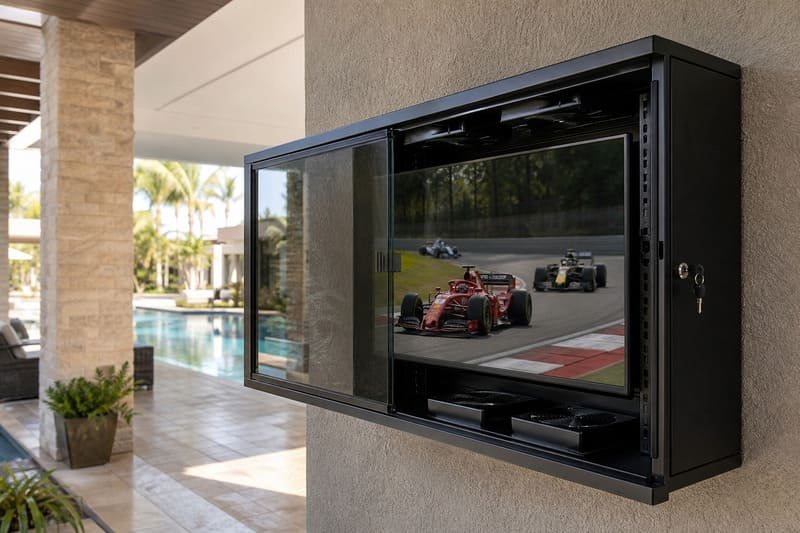
Before installing outdoor TVs in hotel pool areas, I check TV fit, enclosure internal space, heat dissipation, mounting points, cable routing, sun direction, humidity, salt exposure, cleaning routines, guest access, and service access. Waterproofing matters, but it is only one part of a reliable pool-area display plan.
Many hotel buyers ask whether any indoor TV can go into an enclosure.
My answer is no.
The TV must fit the enclosure body, and there must be enough internal space for airflow, cable clearance, and service. A screen that is too tight may trap heat. A screen that is too deep may press against the front panel or block cable routing.
The International Electrotechnical Commission explains that IP ratings grade the resistance of an enclosure against intrusion by dust or liquids. IEC IP Ratings
For pool-area installations, IP65 can be useful because it indicates dust-tight protection and protection against water jets under defined test conditions. But IP65 does not mean vapor-proof, condensation-proof, chemical-proof, salt-proof, pool-safe, or submersible.
Heat also matters. Sony advises using TVs within a temperature range of 0°C to 40°C / 32°F to 104°F and avoiding direct sunlight. Sony TV temperature guidance
For hot pool areas, rooftop pools, and sunny resort terraces, I pay close attention to fan systems, air paths, internal space, and whether the screen is exposed to direct sun for long periods. Fans help reduce heat buildup, but they are not air conditioning.
Material selection also matters near salt air. A polycarbonate body does not rust like steel, which can reduce one corrosion pathway. Covestro describes Makrolon polycarbonate as robust, lightweight, glass-like in transparency, and impact resistant even at low temperatures. Covestro Makrolon polycarbonate
However, the full enclosure system is not automatically corrosion-proof. Locks, hinges, screws, brackets, anchors, wall mounts, and cable exits still need corrosion-resistant design and regular inspection.
For coastal resorts, FEMA guidance on coastal construction notes that salt accumulation and high humidity can accelerate corrosion of untreated steel connectors and fasteners. FEMA coastal corrosion guidance
Hotel Pool TV Installation Checklist
| Checkpoint | Why I Check It | What Can Go Wrong |
|---|---|---|
| TV Outer Size | Confirms physical fit | TV cannot close inside enclosure |
| TV Depth | Protects airflow and cable space | Heat builds up or cables are crushed |
| VESA Pattern | Supports stable mounting | Mount does not align |
| Fan System | Helps manage heat | Screen overheats in summer conditions |
| Cable Path | Keeps service and sealing manageable | Cables pinch or leak points form |
| Front Panel View | Affects image clarity and glare | Reflections become distracting |
| Locking System | Reduces casual access | Guests or staff access ports unintentionally |
| Hardware Material | Matters in humid and coastal areas | Locks, screws, or brackets corrode |
| Service Access | Allows cleaning, reset, inspection, replacement | Maintenance becomes difficult during peak season |
I also explain glare carefully. An enclosure protects the TV, but it does not remove glare by itself. Shade, screen brightness, viewing angle, front-panel reflection, and time of day still matter. I usually suggest that hotel teams check the sun path before final installation.
Frequently Asked Questions
Do outdoor TVs really add business value to hotel pool areas?
They can, but only when they support a real hotel operating goal. Outdoor TVs can help pool areas feel more active, support F&B service, create sports or event programming, improve guest communication, and make the pool feel more complete. They do not guarantee revenue by themselves.
Can hotel pool TVs increase F&B opportunities?
They can support F&B opportunities when paired with pool-bar service, event timing, menus, and staff planning. For example, sports nights, sunset drink specials, cabana packages, or private events can all make the pool area more useful. The screen supports the program; it does not replace the program.
Should hotels use dedicated outdoor TVs or indoor TVs with enclosures?
It depends on the site. A dedicated outdoor TV may be better for one full-sun flagship screen. Indoor TVs with enclosures may be more practical for shaded multi-screen projects where cost control and replacement flexibility matter. Some hotels may use a mixed plan.
Can I use an indoor TV in a hotel pool area?
Yes, but only after checks. The indoor TV needs a suitable outdoor enclosure. The enclosure should fit the TV size, allow airflow, protect against rain and dust, and support safe mounting. The enclosure does not change the TV manufacturer’s original outdoor-use rating or warranty terms.
Where should hotels place pool-area screens?
Place screens where they support the guest path and the intended pool use. Consider lounge chairs, cabanas, bar counters, staff routes, sunlight, glare, sound spillover, wall strength, cable routes, and service access. The best location is rarely chosen by wall space alone.
How do hotels handle heat, glare, and humidity around pool TVs?
Use shade where possible, avoid direct afternoon sun, confirm fan cooling and internal clearance, choose suitable materials, protect cable exits, and inspect hardware regularly. Glare is mainly controlled by placement and viewing angle, not by the enclosure alone.
What is the biggest mistake in bulk hotel pool TV projects?
The biggest mistake is buying by screen size only. A 55-inch or 65-inch TV from one brand may not have the same depth, VESA pattern, cable position, or heat behavior as another. For batch procurement, I prefer one confirmed TV model and one confirmed enclosure configuration.
What should coastal resorts care about most?
Coastal resorts should check salt air, humidity, screws, brackets, locks, cable exits, and enclosure body material. A body material that does not rust like steel can reduce one risk, but exposed metal parts still need corrosion-resistant design and inspection.
Conclusion
The business value of outdoor TVs in hotel pool areas is not just about putting screens near the water.
It is about making an expensive guest-facing space work harder.
- A pool-area TV can support atmosphere.
It can support F&B service. - It can support sports nights and private events.
- It can help communicate resort activities.
It can make cabanas or pool bars feel more premium. - It can give guests another reason to stay on property.
But the value only appears when the plan is complete.
The hotel needs to match the screen role, placement, content, sound, shade, weather protection, electrical planning, maintenance access, and long-term cost model.
The way I explain it to hotel buyers is simple:
A hotel pool TV is not just a screen. It is a guest-experience asset, an event tool, and a procurement decision at the same time.
If the hotel treats it only as hardware, the project may disappoint. If the hotel treats it as part of pool-area programming and asset utilization, it can become a stronger part of the guest experience and a smarter long-term investment.