
A restaurant patio does not fail only because of bad weather. Sometimes it fails because there is no reason for guests to stay after the first drink, no shared focal point during slow hours, and no event feeling when the indoor dining room is already full.
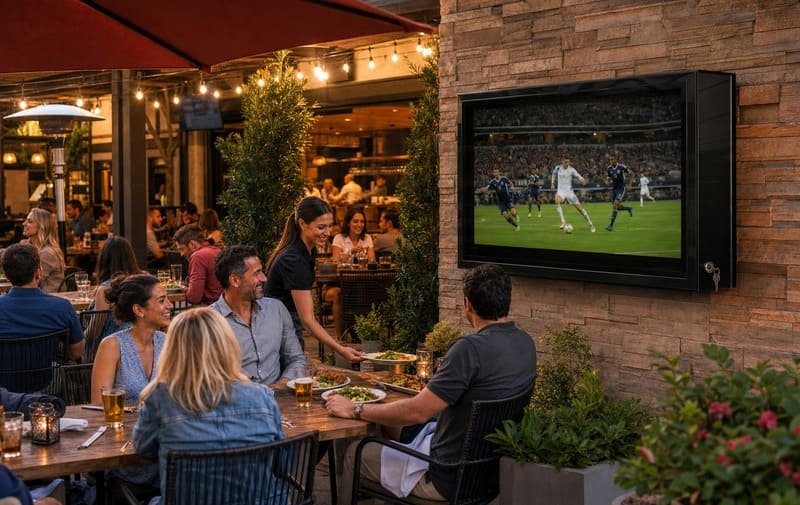
Outdoor TVs can help restaurants support longer customer stays when they are part of a complete patio experience: comfortable seating, clear sightlines, suitable sound, weather-protected hardware, and content that gives guests a reason to linger. The TV is not the strategy by itself. It works best when it turns the patio from extra seating into a programmed hospitality zone.
When a restaurant owner asks me whether an outdoor TV will pay off, I usually ask a different question first:
What will the screen do on a slow Tuesday evening?
Most people immediately think about sports. That makes sense. A big game can bring energy, noise, and shared attention to a patio. But if the screen only matters during major events, the restaurant is leaving too much value on the table.
The best restaurant projects I see do not treat outdoor TVs as decoration. They treat them as programming.
A screen can support game nights, happy-hour specials, digital menus, private events, ambient visuals, seasonal campaigns, brand storytelling, and customer photos. It gives the outdoor area a reason to feel alive even when there is no major match.
Restaurant atmosphere research has shown that ambience and service quality can influence customers’ behavioural intentions, which is why I prefer to think about outdoor TVs as part of the overall restaurant environment, not just as hardware on a wall. Restaurant atmosphere and customer behavioural intentions
Let’s look at how outdoor TVs can help restaurants keep customers longer without turning the patio into a random screen wall.
Last Updated: May 13, 2026 | Estimated Reading Time: 8 minutes
By Smith Chen, Outdoor TV Enclosure Engineer at Outvion
Why Does a Patio Need a Focal Point, Not Just More Seats?
You can add more chairs outside, but empty seats do not automatically create revenue. A patio needs a reason for people to choose it, stay there, and talk about it.
An outdoor TV gives a restaurant patio a shared focal point. It can make guests look in the same direction, start conversations, stay through an event, or remain interested during quieter service periods. But it only works when the screen is placed, programmed, and protected as part of the dining experience.
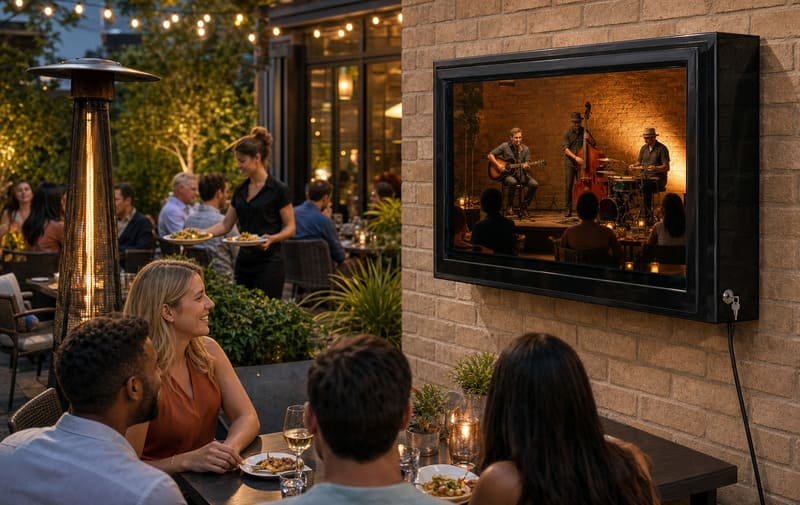
I have seen restaurant patios where the outdoor area looked beautiful but felt passive. Good furniture, nice plants, warm lights—but no reason for guests to stay after the first drink.
A well-planned outdoor TV changes that dynamic. It creates a center of attention.
For a sports bar, that focal point may be a live game. For a hotel restaurant, it might be a premium event screen for poolside dining. For a casual restaurant, it may be a rotating digital board showing today’s specials, upcoming events, or relaxed ambient visuals during early evening hours.
The important point is this: customers usually do not stay longer just because a screen exists. They stay longer because the space feels more active, comfortable, and worth their time.
How Outdoor TVs Can Support Longer Patio Stays
| Driver | How Outdoor TV Helps | What Must Be Planned |
|---|---|---|
| Shared Attention | Gives guests something to watch and talk about | Screen placement, content type, and viewing angle |
| Event Atmosphere | Turns ordinary nights into game nights or themed nights | Sports schedule, sound level, seating layout |
| Off-Peak Activation | Helps slow hours feel more alive | Digital menus, specials, ambient visuals, private events |
| Comfort Perception | Makes waiting or lingering feel more natural | Shade, lighting, temperature, and service rhythm |
| Repeat Visits | Gives customers a reason to return for future events | Event calendar, promotion plan, social media reminders |
| Outdoor Space Identity | Makes the patio feel like a destination, not overflow seating | Design, enclosure appearance, and brand fit |
This is why I do not like the question “Will a patio TV increase revenue?” in isolation.
A better question is:
What experience will the screen help create?
If the answer is clear, the TV can become a useful part of the restaurant’s outdoor strategy.
Is It Only About Sports, or Can the Screen Work Every Day?
Sports are powerful, but a restaurant cannot build its whole outdoor screen strategy around championship nights only. The screen should also have a job on normal days.
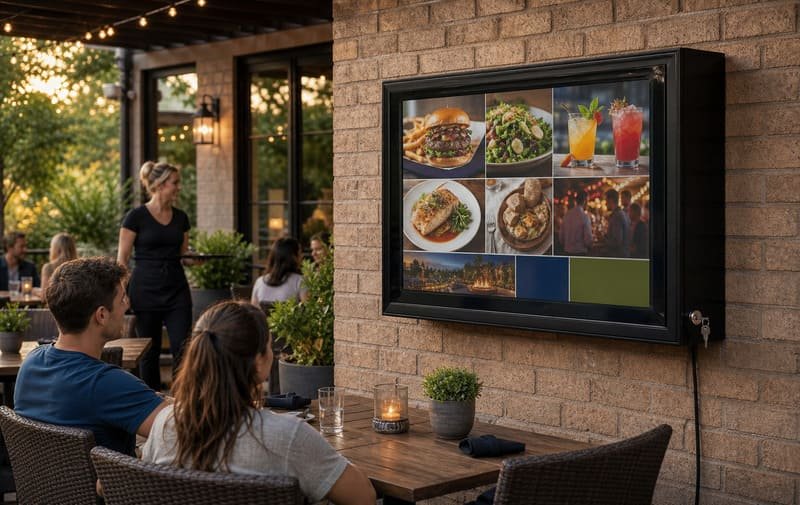
Sports events are often the easiest way to make outdoor TVs valuable, but they should not be the only use. A restaurant can also use outdoor screens for digital menus, happy-hour promotions, private events, ambient visuals, seasonal campaigns, brand videos, and community nights. The best screen is not always the biggest one; it is the one with the best content plan.
In my conversations with restaurant owners, the first use case is usually a big game.
A U.S. sports bar may plan around NFL season. A UK pub may care more about football nights. A hotel restaurant may think about international sports, private events, or guest entertainment near the pool.
Those are all good reasons to install outdoor TVs.
But I always ask what happens when there is no big game.
A screen that only works during peak events is underused. A screen with a weekly content plan can support the patio every day.
Restaurant Screen Programming Ideas
| Restaurant Type | Best Screen Role | Content Strategy | Enclosure Priority |
|---|---|---|---|
| Sports Bar | Game-day focal point | Live sports, pre-game countdowns, multiple matches | Glare control, sound planning, security |
| Casual Restaurant Patio | Atmosphere extension | Specials, menu highlights, brand visuals, ambient video | Clean design, easy staff operation |
| Pub Garden | Social evening gathering point | Football nights, quiz nights, community events | Rain protection, cozy placement |
| Hotel Restaurant | Premium guest experience | Event visuals, private parties, branded content | Aesthetics, low maintenance, quiet operation |
| Coastal Restaurant | Sunset dining and sports combination | Evening specials, music visuals, sports nights | Salt-air resistance, protected hardware |
| Family Restaurant | Light entertainment | Kids’ events, seasonal messages, birthday slides | Safe placement, impact protection |
Digital menus can be useful for changing specials, promoting seasonal dishes, or highlighting happy-hour items. But readability still depends on screen brightness, layout, viewing distance, glare, and where guests sit.
Private events are another overlooked use. A screen can show a wedding slideshow, sponsor message, corporate event schedule, birthday video, or branded welcome message. For restaurants that host parties, this adds value without changing the whole patio design.
The screen becomes more useful when it has a calendar.
That calendar can include:
- Game nights
- Happy-hour promotions
- Weekly quiz nights
- Chef specials
- Seasonal campaigns
- Private events
- Local community nights
- Ambient visuals during quiet periods
For restaurants, the content plan matters as much as the hardware.
How Should Restaurants Plan the Viewing Zone?
A TV in the wrong place can create glare, block traffic, annoy nearby guests, or make half the patio unable to see the screen. A good viewing zone needs more planning than simply choosing a wall.
Restaurants should plan outdoor TVs around sightlines, service paths, seating layout, sun direction, sound level, and guest comfort. The goal is not to make every seat face the screen. The goal is to create a clear viewing zone without disrupting dining, walking routes, or staff service.
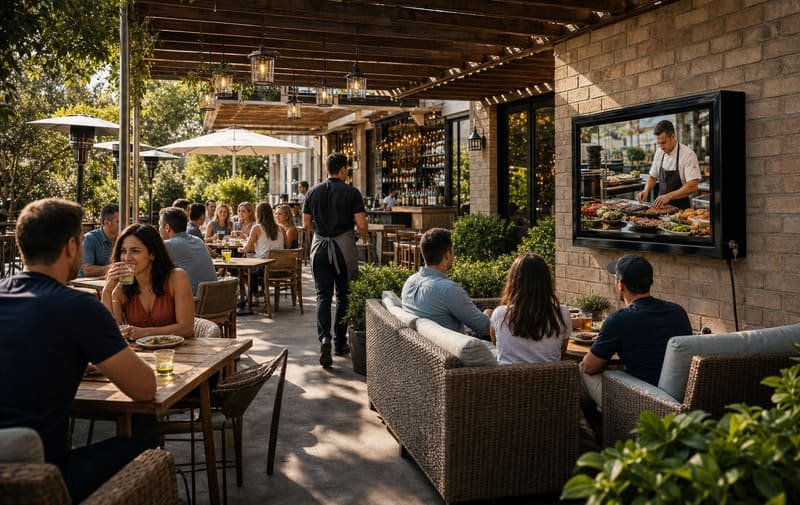
For restaurant patios, I care about sightlines, service paths, sound spillover, and staff access as much as the enclosure size.
A screen mounted too high may be uncomfortable to watch. A screen placed opposite the afternoon sun may become a mirror. A screen installed beside a narrow service route may get hit by trays, carts, or people moving between tables.
The best restaurant installations usually start with photos or a basic patio sketch.
I like to know:
Where do most guests sit?
Where does staff walk?
Where does the sun hit at 5 p.m.?
Where is the bar counter?
Where will the sound go?
Can staff access the TV later?
Will the screen disturb guests who are not watching?
RTINGS recommends planning TV size and viewing distance together, which is especially useful when restaurants are deciding whether one large screen or several smaller screens will serve the space better. RTINGS TV size and viewing distance guide
One Large Screen or Several Smaller Screens?
| Setup | Best For | Main Advantage | Main Risk |
|---|---|---|---|
| One Large Screen | Sports bars, event patios, hotel pool decks | Strong focal point and event atmosphere | Some seats may have poor viewing angles |
| Several Smaller Screens | Large patios with multiple seating zones | More guests can see a screen comfortably | Higher installation and maintenance complexity |
| One Main Screen + Small Support Screens | Restaurants that host game nights and normal dining | Good balance between atmosphere and coverage | Needs careful content and audio planning |
| No-Sound Ambient Screen | Dining-focused patios | Adds atmosphere without dominating conversation | Less useful for sports events |
For many restaurants, one huge screen is not always the best answer. Two or three smaller screens may create better coverage without making one wall feel too heavy.
Sound also needs careful thought. For a big game, guests may want stronger audio. For dinner service, too much sound can make conversation difficult. Directional speakers, separate audio zones, or volume control by time of day can make the setup more flexible.
A good outdoor TV layout should help guests stay longer, not make the patio harder to enjoy.
What Protection Setup Keeps the Screen Working Through Service?
A restaurant patio is not a gentle environment. Screens may face rain, dust, grease in the air, cleaning routines, guest contact, heat, insects, and long operating hours.
For restaurants, the protection setup should keep the screen usable through real service conditions. That means IP-rated protection, fan cooling, lockable access, clear front protection, sealed cable exits, and enough service space for staff or installers. A standard indoor TV can work inside a suitable enclosure, but the enclosure does not change the TV manufacturer’s original outdoor-use rating or warranty terms.
This is where the business case for an outdoor TV enclosure becomes practical.
A dedicated outdoor TV can be the right choice when full-sun brightness, integrated outdoor support, and a slim finished product are the priorities. But many restaurants are budget-sensitive, especially when they need multiple screens.
A standard indoor TV inside a suitable outdoor TV enclosure can make sense when the space is shaded or partially shaded, the enclosure is properly sized, and the restaurant wants easier future screen replacement.
I prefer to think of the enclosure as a protection layer and a service layer.
Key Protection Features for Restaurant Patios
| Feature | Why It Matters for Restaurants | Important Limit |
|---|---|---|
| IP Rating | Helps reduce dust and water intrusion | Not vapor-proof, grease-proof, chemical-proof, or submersible |
| Fan Cooling | Helps reduce heat buildup during long service hours | Fans are not air conditioning; shade still matters |
| Lockable Design | Reduces casual access to TV, ports, and cables | Not a guarantee against all theft or vandalism |
| Clear Front Panel | Protects the screen from touch, dust, and impact | Can still reflect light outdoors |
| Sealed Cable Exits | Reduces weak points around power and signal cables | Poor routing can reduce protection |
| Service Access | Allows staff or installers to inspect, clean, and replace parts | Needs space to open the enclosure safely |
The International Electrotechnical Commission explains that IP ratings grade the resistance of an enclosure against intrusion by dust or liquids. IEC IP Ratings
For outdoor TV enclosures, IP65 can be a useful protection level because it indicates dust-tight protection and protection against water jets under defined test conditions. But I avoid calling it complete waterproofing. IP65 does not mean vapor-proof, condensation-proof, chemical-proof, salt-proof, grease-proof, or submersible.
Heat also matters. Sony advises using TVs within a temperature range of 0°C to 40°C / 32°F to 104°F and avoiding direct sunlight. Sony TV temperature guidance
For restaurants in hot climates, enclosed patios, rooftops, or poolside dining areas, fan cooling and shade planning become important. A fan system can help move warm air away from the TV, but it cannot overcome every poor installation location.
Material choice matters too. Covestro describes Makrolon polycarbonate as robust, lightweight, glass-like in transparency, and impact resistant even at low temperatures. Covestro Makrolon polycarbonate
For a restaurant enclosure, polycarbonate can be useful where impact resistance, clear viewing, and lower body-rust risk matter. But hardware such as locks, hinges, screws, anchors, and mounts still needs inspection, especially in coastal or humid spaces.
What Should Restaurant Owners Check Before Installing Outdoor TVs?
Before buying hardware, restaurant owners should define the screen’s job. Is it for sports, atmosphere, menu promotion, private events, or all of these?
Before installing outdoor TVs, restaurants should check the patio goal, content plan, seating layout, screen size, shade, sound, weather exposure, service access, power route, and long-term maintenance. The best setup is not just the one that survives outside. It is the one staff can actually use during service.
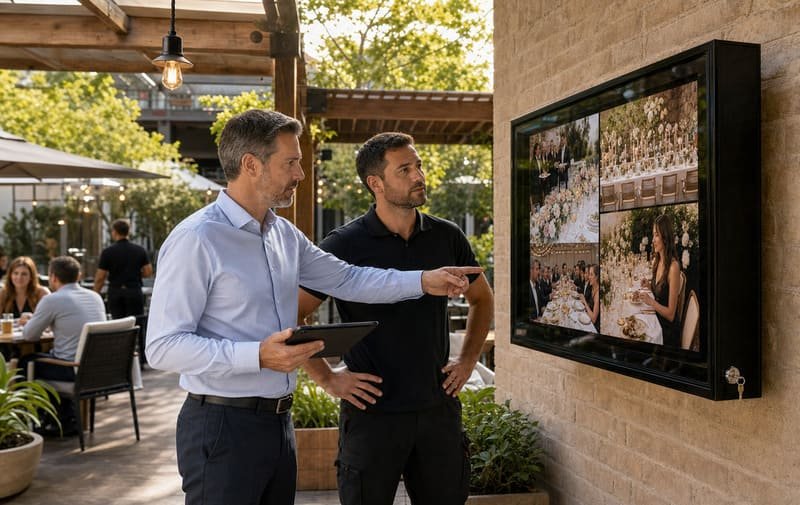
When a restaurant asks me what size enclosure to choose, I prefer to start with the business use case.
A sports bar may want screen coverage across most seats.
A fine-casual patio may want a smaller screen that supports ambience but does not dominate dinner.
A hotel restaurant may want event flexibility and a cleaner aesthetic.
A coastal seafood restaurant may care more about corrosion and wind-driven rain.
A rooftop venue may care more about glare, wind, and sound control.
The hardware should follow the restaurant strategy.
Restaurant Outdoor TV Planning Checklist
| Check | What to Confirm | Why It Matters |
|---|---|---|
| Screen Purpose | Sports, menu, events, ambience, promotions | Determines content and screen layout |
| Main Viewing Zone | Which tables should see the screen? | Prevents poor sightlines |
| Service Paths | Staff walking routes, carts, guest movement | Avoids blocked paths and accidental contact |
| Sun and Glare | Afternoon sun, glass, pool water, bright walls | Protects viewing quality |
| Sound Plan | Game audio, ambient music, quiet dining hours | Prevents guest discomfort |
| Weather Exposure | Rain, dust, humidity, salt air, heat | Determines enclosure and material needs |
| TV Fit | Width, height, depth, VESA, cable clearance | Prevents installation problems |
| Power and Network | Outlet location, cable route, Wi-Fi or wired connection | Keeps the system reliable |
| Staff Access | Cleaning, unlocking, fan inspection, resetting devices | Supports daily operation |
| Future Upgrades | Ability to replace TV later | Helps control long-term cost |
Total Cost of Ownership matters here. CIPS defines Total Cost of Ownership as an estimate that helps buyers understand the end-to-end cost of providing a product or service, including purchase, acquisition, usage, and end-of-life costs. CIPS Total Cost of Ownership overview
For restaurants, this means the cheapest screen setup is not always the lowest-cost setup. If it creates glare complaints, staff access problems, heat issues, or frequent replacements, it becomes expensive in operation.
A good setup should help the restaurant run smoother, not just look impressive on opening day.
Frequently Asked Questions
Do outdoor TVs really make restaurant customers stay longer?
They can support longer stays, but they do not guarantee it by themselves. Outdoor TVs work best when they are part of a complete patio experience: comfortable seating, clear viewing, suitable sound, good service timing, and content that gives guests a reason to stay.
What should restaurants show when there is no live sports event?
Restaurants can show digital menus, daily specials, ambient visuals, branded content, event announcements, private-event slideshows, seasonal promotions, or community messages. The key is to plan content around the restaurant’s service rhythm, not leave the screen blank.
Is one large TV or several smaller TVs better for a patio?
It depends on the layout. One large TV creates a strong focal point for sports and events. Several smaller TVs may work better when the patio has multiple seating zones or awkward sightlines. For many restaurants, one main screen plus smaller support screens is a practical balance.
Does a restaurant patio TV need sound?
Not always. For sports nights, sound can be important. For normal dinner service, too much audio may disturb conversation. Many restaurants use different sound strategies by time of day: quieter ambient visuals during dining hours and stronger audio during event nights.
Can I use a regular indoor TV outside at a restaurant?
Yes, many restaurants use a standard indoor TV inside a suitable outdoor TV enclosure. But the enclosure must be properly sized, ventilated, and installed. It does not change the TV manufacturer’s original outdoor-use rating or warranty terms, so heat, weather, and service access still need careful planning.
Will an enclosure make the screen glare-proof?
No. An enclosure can protect the TV from weather, dust, touch, and impact, but it cannot eliminate glare. Glare is mainly controlled by screen placement, shade, viewing angle, screen brightness, and what the screen faces.
Will the remote control still work through the enclosure?
In many installations, IR remotes can work through a clear front panel, but sensor position, angle, distance, TV model, and front-panel material still matter. For restaurants, staff may prefer a smart control system, IR extender, or central AV control for easier operation.
What should I check before installing outdoor TVs in a restaurant patio?
Check the screen purpose, seating layout, sun direction, sound plan, weather exposure, wall strength, TV dimensions, enclosure internal space, fan cooling, cable route, network connection, and staff service access. The installation should support daily operations, not only first-day appearance.
Conclusion
Outdoor TVs can help restaurants keep customers longer, but not because a screen has magic power.
They work when they create a reason to stay.
A sports bar can turn a patio into a game-night destination.
A casual restaurant can use the screen to support specials and atmosphere.
A hotel restaurant can use it for events and guest experience.
A pub garden can make football nights more social.
A coastal restaurant can create a more active sunset dining space.
The way I explain it to restaurant owners is simple:
An outdoor TV should not be treated as decoration. It should be treated as programming.
That means planning the content, viewing zone, sound, shade, weather protection, staff access, and maintenance before the screen goes up.
If the outdoor TV is protected, visible, useful, and easy for staff to manage, it can help turn a patio from extra seating into a stronger hospitality space—one where guests have more reasons to stay, order another round, and come back for the next event.