
In outdoor display projects, the screen is usually the part that changes first. The wall position, weatherproofing layer, cable route, mounting structure, and access control are the parts you want to keep stable.
An outdoor TV enclosure becomes a long-term asset because it separates the durable protection layer from the replaceable display technology layer. The enclosure protects the outdoor installation for years, while the TV inside can be replaced, upgraded, or standardized as screen technology and business needs change.
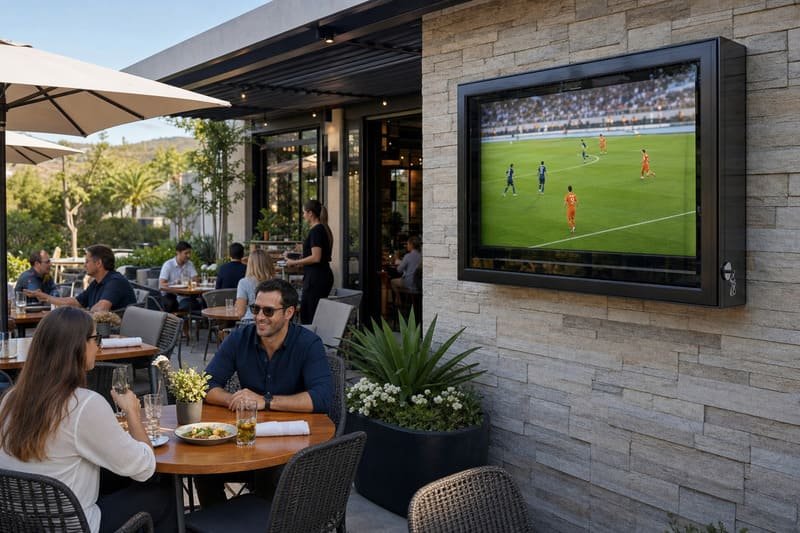
When a hotel or bar buyer asks me whether an enclosure is “just a box,” I usually ask a different question:
What do you plan to replace in three years?
- The screen?
- The wall position?
- The cable route?
- The lockable access?
- The weatherproofing system?
- The whole outdoor display setup?
In most projects, the smart answer is simple: replace the screen when you need to, but keep the protected outdoor installation stable.
That is the real value of an outdoor TV enclosure.
A TV is a fast-changing technology product. Screen prices, smart systems, apps, resolution, brightness, and customer expectations all move quickly. An enclosure is different. If it is designed well, installed correctly, and maintained properly, it becomes part of the outdoor display infrastructure.
I call this a decoupling strategy:
The enclosure is the protection asset. The TV is the replaceable display module.
That idea is more important than simply comparing one outdoor TV price with one enclosure price.
Last Updated: May 21, 2026 | Estimated Reading Time: 8 minutes
By Smith Chen, Outdoor TV Enclosure Engineer at Outvion
Why Should You Separate the Protection Asset from the TV Technology?
A TV and an outdoor enclosure age in different ways. The TV becomes outdated as display technology changes. The enclosure remains valuable because it protects the location, wiring, mounting, access control, and environmental barrier.
The enclosure should be treated as the long-term protection asset, while the TV inside should be treated as the replaceable technology layer. This separation gives B2B buyers more flexibility when screens fail, become outdated, or need to be standardized across multiple locations.
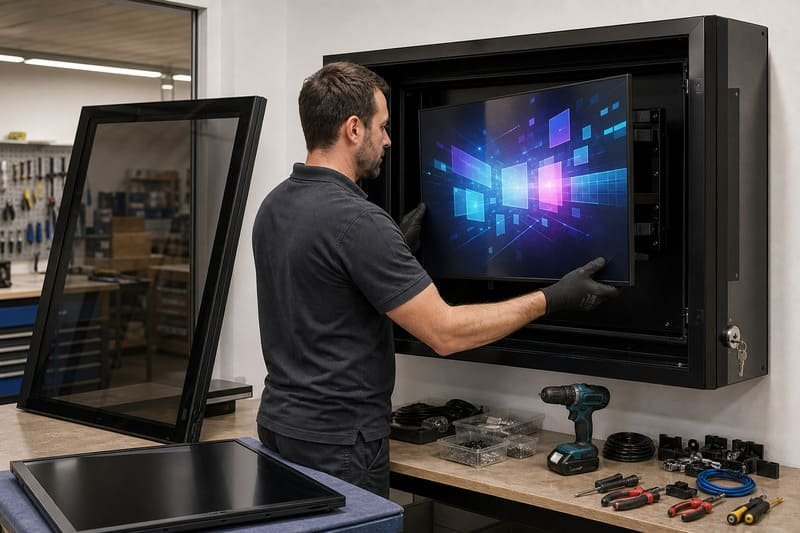
In multi-screen projects, I treat the enclosure as infrastructure first and the TV as a replaceable module second.
That may sound like a small difference, but it changes the buying logic.
- If you buy a dedicated outdoor TV, the protection system and display technology are locked together. When the screen becomes outdated or fails, the whole outdoor-rated unit may need to be replaced.
- If you use a standard TV inside a properly designed enclosure, the protection layer stays in place. When the TV inside needs to be replaced, the buyer can choose a new compatible screen, keep the enclosure, and avoid rebuilding the outdoor installation.
This matters because TV technology changes quickly. The U.S. Bureau of Labor Statistics explains that television quality adjustment considers changing product characteristics such as screen size, resolution, features, and other components when measuring TV prices. BLS television quality adjustment
That supports what I see in real projects: the TV inside is not the permanent asset. It is the part most likely to change.
Asset Layer vs. Technology Layer
| Layer | What It Includes | How Fast It Changes | Buying Logic |
|---|---|---|---|
| Protection Asset Layer | Enclosure body, front shield, lock, seals, cable exits, airflow path | Slow | Choose durable, serviceable, weather-resistant protection |
| Display Technology Layer | TV panel, smart OS, apps, resolution, brightness | Fast | Choose replaceable, available, upgrade-friendly screens |
| Installation Layer | Wall position, bracket, cable route, power route, service access | Medium | Standardize for easier maintenance |
| Operating Layer | Cleaning, fan inspection, lock access, screen replacement | Ongoing | Reduce downtime and service cost |
This is the main reason an enclosure can outlast the TV inside.
The enclosure protects the outdoor position.
The TV delivers the picture.
Those are not the same job.
What Outdoor Risks Does the Enclosure Absorb Over Time?
Outdoor environments attack the whole display system, not just the screen. Rain, dust, heat, humidity, salt air, insects, sunlight, and public access all create stress around the TV.
A professional outdoor TV enclosure helps absorb environmental and operational risks that would otherwise reach the TV directly. It can reduce exposure to rain, dust, insects, splash, heat buildup, casual impact, cable access, and public tampering. But it still depends on correct installation, ventilation, sealing, and maintenance.
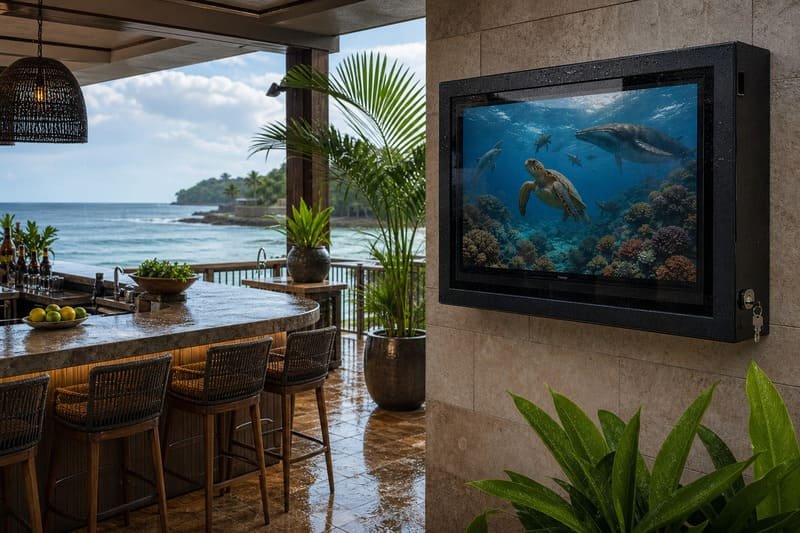
When buyers first contact me, they often talk about rain. That makes sense because rain is visible.
But in my experience, the long-term risks are usually broader:
- heat buildup behind the TV
- dust and insects near vents
- salt air near coastal patios
- humidity around cable exits
- UV exposure on front materials
- guest contact in public spaces
- staff needing access to cables or media devices
- poor airflow from tight installation
An enclosure does not remove every risk. It organizes the risks into a more controlled protection system.
The International Electrotechnical Commission explains that IP ratings grade an enclosure’s resistance against dust or liquid intrusion. IEC IP Ratings
For outdoor TV enclosures, IP65 can be a useful protection level because it indicates dust-tight protection and protection against water jets under defined test conditions. But IP65 does not mean vapor-proof, condensation-proof, chemical-proof, salt-proof, flood-proof, submersible, or maintenance-free.
Cable exits, gasket compression, lock pressure, mounting angle, fan clearance, and inspection all matter.
Outdoor Risk vs. Enclosure Role
| Outdoor Risk | What It Can Do to an Unprotected TV | What the Enclosure Helps Do |
|---|---|---|
| Rain and Splash | Expose the TV body, ports, and cables to moisture | Helps reduce water intrusion when installed correctly |
| Dust and Insects | Block vents, dirty ports, and create maintenance issues | Creates a physical barrier around the TV |
| Heat | Increase thermal stress, dimming, shutdown behavior, or shorter service life | Fan-assisted airflow helps move warm air away |
| Humidity | Increase corrosion and reliability risk over time | Better sealing and cable routing reduce exposure |
| Salt Air | Corrode metal parts, connectors, screws, and hardware | PC body reduces body-rust risk; hardware still needs inspection |
| Public Access | Guests may touch ports, buttons, or cables | Lockable design reduces casual access |
| Impact | Balls, bumps, tools, or public contact may damage the screen | Clear front shield adds physical protection |
Heat deserves special attention. Sony advises using TVs within a temperature range of 0°C to 40°C / 32°F to 104°F and avoiding exposure to direct sunlight. Sony TV temperature guidance
That is why an enclosure should not be a sealed hot box. It needs a planned airflow path.
Material also matters. Covestro describes Makrolon polycarbonate as robust, lightweight, glass-like in transparency, and impact resistant even at low temperatures. Covestro Makrolon polycarbonate
A polycarbonate body does not rust like steel, which removes one corrosion pathway. However, locks, hinges, screws, anchors, cable exits, and mounting hardware still need corrosion-resistant design and regular inspection.
For coastal sites, FEMA guidance notes that salt accumulation and high humidity can accelerate corrosion of untreated steel connectors and fasteners. FEMA coastal corrosion guidance
This is why I do not describe any outdoor enclosure as “maintenance-free.” A good enclosure is an asset because it can be inspected, serviced, and reused—not because it magically removes every environmental risk.
How Does the Enclosure Strategy Change Total Cost of Ownership?
The enclosure strategy changes the cost model because the buyer no longer treats the whole outdoor display as one disposable unit. The protection layer stays. The TV inside can be replaced.
The long-term cost benefit of an outdoor TV enclosure usually comes from separating replacement cycles. The enclosure, mounting position, weather barrier, and cable route can remain stable, while the TV inside can be replaced or upgraded at a lower cost than replacing an entire outdoor-rated display system.
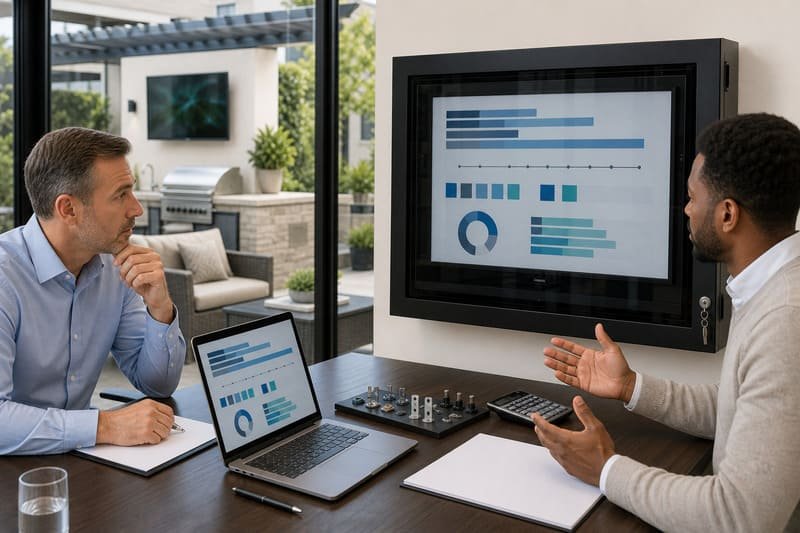
I prefer to talk about total cost of ownership instead of only purchase price.
CIPS defines Total Cost of Ownership as an estimate that helps buyers determine the end-to-end cost of providing a product or service, including purchase price, acquisition cost, usage cost, and end-of-life cost. CIPS Total Cost of Ownership overview
That is exactly the right framework for outdoor display projects.
A buyer should not only ask:
How much does the TV cost today?
A better set of questions is:
What happens when the screen fails?
What happens when the smart system becomes outdated?
What happens when the hotel wants to standardize a new TV model?
What happens when one location needs a replacement quickly?
Can staff access the screen without rebuilding the whole installation?
Can the enclosure support multiple screen generations?
Replacement Cycle Comparison
| Cost / Operation Point | Dedicated Outdoor TV Strategy | Enclosure + Standard TV Strategy |
|---|---|---|
| Protection Layer | Built into the outdoor TV | Separate enclosure remains in place |
| Display Layer | Replaced with the whole outdoor-rated unit | TV inside can be replaced separately |
| Upgrade Flexibility | Lower, because screen and protection are integrated | Higher, if new TV fits the enclosure |
| Service Access | Depends on outdoor TV design | Depends on enclosure access and internal layout |
| Multi-Site Standardization | Can become expensive across many screens | Easier if one TV model and enclosure size are standardized |
| Best Cost Advantage | Single premium full-sun screen | Shaded or semi-outdoor multi-screen projects |
| Main Risk | High replacement cost | Wrong TV fit, poor airflow, weak installation, or poor maintenance |
This does not mean an enclosure always wins. It means the buyer should evaluate the replacement model.
For a restaurant with one flagship screen in full sun, a dedicated outdoor TV may be the better choice. For a hotel with many shaded pool-bar screens, a standard TV inside a suitable enclosure may be easier to refresh over time.
The enclosure strategy becomes strongest when the business wants:
- multiple screens
- local TV replacement options
- easier future upgrades
- standardized installation
- lower replacement pressure
- serviceable hardware
- long-term outdoor display positions
That is why I think of the enclosure as a long-term asset, not just a product shell.
What Makes an Enclosure Worth Keeping Through Multiple TV Replacements?
Not every enclosure deserves to be treated as an asset. A weak cabinet that cracks, traps heat, leaks around cables, or cannot be serviced may become a liability instead.
An enclosure is worth keeping through multiple TV replacements only if it has durable material, correct internal clearance, active airflow, secure mounting, serviceable access, protected cable exits, and replaceable wear parts. The enclosure must be built for long-term use, not just first-day appearance.
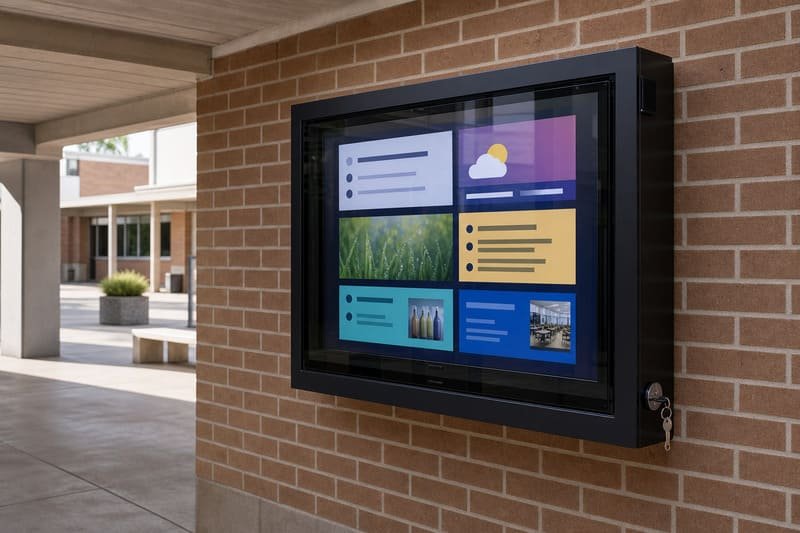
When I review an enclosure design, I do not look only at the outside shell.
I look at how the enclosure will age.
Can the front panel stay clear enough for viewing?
Can the lock be used by staff without frustration?
Can the fan system be cleaned or replaced?
Can the TV be swapped without cutting cables?
Can the cable exit stay sealed after maintenance?
Can the body handle sun, rain, and public-area use?
Can the mount support a future replacement TV?
These are asset questions.
Long-Term Enclosure Asset Checklist
| Feature | Why It Matters for Long-Term Value |
|---|---|
| Durable Body Material | The enclosure should remain usable after the first TV is replaced |
| Clear Front Panel | Visibility matters across multiple screen generations |
| Active Airflow Path | Helps reduce heat buildup around the TV |
| Internal Clearance | Allows TV replacement, cable routing, and airflow |
| VESA Flexibility | Makes future TV replacement easier |
| Sealed Cable Exits | Protects one of the most common weak points |
| Lockable Access | Reduces casual tampering and protects ports |
| Serviceable Fans | Supports long-term cooling performance |
| Replaceable Hardware | Locks, keys, fans, and seals may need service |
| Maintenance Access | Staff should be able to inspect and clean the unit |
TV fit should also be checked carefully. LG explains that TV size is measured diagonally, while buyers still need to check the total width, height, and depth in product specifications. LG TV size guide
That matters because a “55-inch TV” or “65-inch TV” is not enough information. If you want the enclosure to outlast the TV, the enclosure should have practical internal space for future compatible models.
A tight fit may look efficient on day one. But it can make future replacement harder.
For long-term asset planning, I prefer a design that gives the TV room to breathe, room for cables, and room for service.
When Is a Dedicated Outdoor TV Still the Better Choice?
An enclosure strategy is useful, but it is not the right answer for every project. Some installations need the brightness, slim profile, or integrated outdoor design of a dedicated outdoor TV.
A dedicated outdoor TV may still be the better choice for full-sun flagship screens, premium design-sensitive spaces, very high-brightness requirements, or projects where the buyer wants one integrated outdoor-rated product. An enclosure strategy is strongest when replacement flexibility, physical protection, multi-screen standardization, and long-term serviceability matter more.
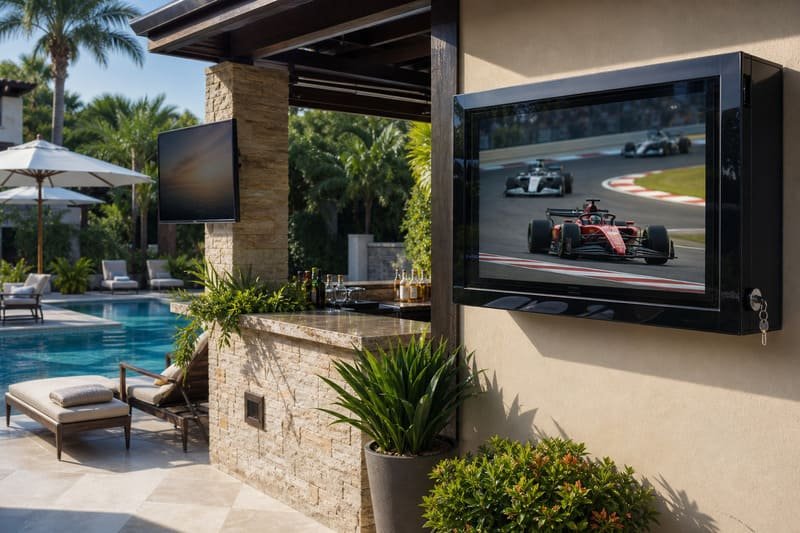
I like this section because it keeps the decision honest.
If a client asks me about a full-sun luxury resort installation with one hero screen, I do not automatically recommend an enclosure. A dedicated outdoor TV may be a better fit if brightness, slim appearance, and integrated outdoor support are the main priorities.
But if the buyer is planning many screens in shaded or semi-outdoor locations, the enclosure strategy often becomes more interesting.
When Each Strategy Makes More Sense
| Project Situation | Enclosure Strategy | Dedicated Outdoor TV |
|---|---|---|
| Shaded restaurant patio with several screens | Often strong | May be more expensive than needed |
| Full-sun flagship display | Needs careful review | Often stronger |
| Hotel pool bar with repeated screen locations | Useful for standardization | Can become costly across many units |
| High-end design wall with slim profile requirement | Depends on enclosure design | May look cleaner |
| Coastal semi-outdoor bar | Useful if hardware is protected and inspected | Also needs corrosion planning |
| Harsh heat with no shade | Requires strong thermal planning | May be better if rated for that use |
| Future TV upgrade priority | Strong | Usually lower flexibility |
| One-off premium screen | Depends on site | Often easier to specify |
This is the point: the enclosure is not a magic answer. It is an asset strategy.
It works best when the buyer wants to separate outdoor protection from display replacement.
What Should Buyers Check Before Treating an Enclosure as an Asset?
A real asset should be serviceable, standardized, and usable across multiple replacement cycles. Before buying, B2B buyers should think beyond the first TV.
Before treating an outdoor TV enclosure as a long-term asset, B2B buyers should check screen quantity, TV standardization, internal dimensions, airflow design, cable route, mounting structure, service access, spare parts, and replacement workflow. The goal is to reduce future downtime, not only finish the first installation.
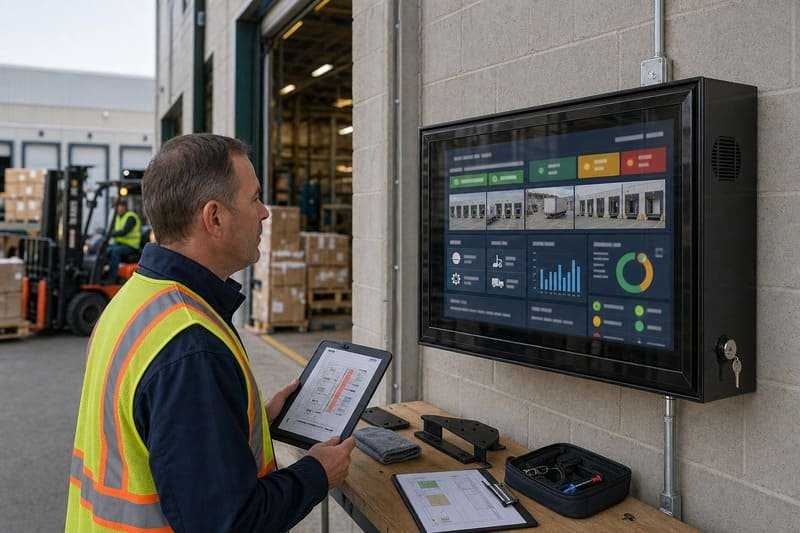
When I work with buyers, I try to move the conversation from product selection to lifecycle planning.
- A hotel may need ten screens.
- A bar chain may need the same setup across several locations.
- A school may need a public-area screen that staff can maintain.
- A warehouse may need digital signage that can be serviced quickly.
- A coastal venue may need extra attention to hardware inspection.
The question is not only “Which enclosure size?”
The better question is:
How will this system be maintained after the first TV is installed?
Lifecycle Decision Checklist
| Question | Why It Matters |
|---|---|
| How many screens will be installed? | Replacement economics change with quantity |
| Can one TV model be standardized? | Reduces fit and service problems |
| Can future TVs fit the same enclosure? | Protects the enclosure’s long-term value |
| Can staff access the TV safely? | Reduces service downtime |
| Are fans, locks, keys, and seals serviceable? | Makes the enclosure maintainable |
| Is the cable exit easy to inspect? | Reduces weak points after maintenance |
| Is the wall or mount part of a long-term plan? | Prevents rebuilding the installation later |
| What happens when the TV fails? | Defines the replacement workflow |
| What happens when the TV becomes outdated? | Supports future upgrade planning |
| Who will clean and inspect the enclosure? | Protects long-term performance |
This checklist is where the enclosure becomes more than a weather cover.
It becomes a managed outdoor display asset.
Frequently Asked Questions
Why is the enclosure the asset and not the TV?
The enclosure protects the outdoor installation: the weather barrier, cable route, mounting position, lockable access, airflow path, and service structure. The TV inside changes faster because screen technology, smart systems, prices, and user expectations change over time.
How long can an outdoor TV enclosure last?
It depends on material quality, installation, climate, maintenance, and hardware design. A well-built enclosure can often outlast the first TV inside it, but it still needs inspection, cleaning, fan checks, seal checks, and hardware maintenance.
Can I replace the TV inside the enclosure later?
Yes, if the new TV fits the enclosure’s internal width, height, depth, VESA pattern, cable clearance, and airflow requirements. I recommend checking the exact TV model before assuming it will fit.
Does the enclosure change the indoor TV warranty?
No. An enclosure helps reduce environmental exposure, but it does not change the TV manufacturer’s original outdoor-use rating or warranty terms. Buyers should always check the TV manual and warranty before using an indoor TV outdoors.
When is a dedicated outdoor TV still better?
A dedicated outdoor TV may be better for full-sun screens, high-brightness needs, slim premium installations, or projects that require one integrated outdoor-rated product. The enclosure strategy is strongest when replacement flexibility and long-term serviceability matter more.
What should businesses check before standardizing enclosures?
Businesses should check TV model compatibility, enclosure internal dimensions, VESA range, cable exits, airflow, mounting structure, installation location, spare parts, service access, and whether future replacement TVs can fit the same enclosure.
Does an enclosure reduce total cost of ownership?
It can, especially in multi-screen projects where the enclosure remains in place while the TV inside can be replaced separately. However, savings depend on TV cost, enclosure cost, installation quality, maintenance, climate, replacement cycles, and downtime cost.
Is polycarbonate always better than metal?
Not always. A polycarbonate body does not rust like steel and can reduce one corrosion pathway, but hardware still needs inspection. Metal may be suitable in some projects if material grade, coating, edges, and hardware are designed for the environment.
Conclusion
An outdoor TV enclosure is valuable because it separates two things that should not be treated the same.
The protection system lasts longer.
The display technology changes faster.
The enclosure protects the outdoor position, cable route, front shield, lockable access, airflow path, and service structure. The TV inside delivers the image, runs the apps, and eventually becomes outdated or needs replacement.
The way I explain it to B2B buyers is simple:
The enclosure is the long-term protection asset. The TV inside is the replaceable display module.
This is not only a cost argument. It is an asset strategy.
For hotels, restaurants, bars, schools, warehouses, resorts, and public-facing venues, this strategy can make outdoor display planning more flexible. It can help buyers standardize installations, reduce replacement pressure, and keep the outdoor protection layer stable while the screen inside changes with technology and business needs.
A good outdoor TV enclosure should not be judged only by how it looks on day one.
It should be judged by whether it can protect, ventilate, secure, and service multiple generations of TVs over time.
That is what makes it a long-term asset.