
A cheap outdoor TV cover looks like a small purchase, but it often creates a daily operating habit: remove it before use, store it somewhere dry, put it back after closing, hope it was not put on too early, and hope no moisture was trapped underneath overnight.
A cheap outdoor TV cover can cost more in repairs because it is not a full protection system. It depends on perfect daily behavior, offers no protection while the TV is being used, may trap moisture or heat if used incorrectly, and cannot secure the TV in commercial or public-facing spaces.
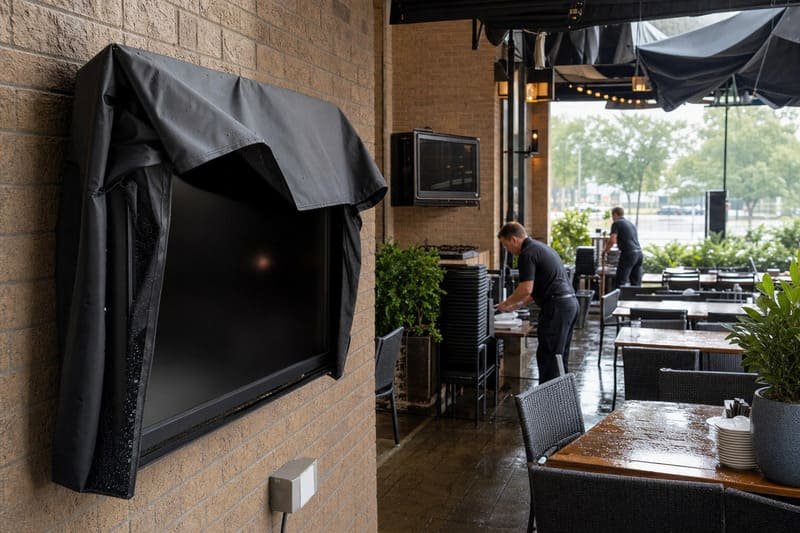
I understand why a simple fabric cover looks attractive:
- It is cheap.
- It is easy to buy.
- It feels like protection.
- And for a low-risk home patio where the TV is fully covered, used occasionally, and checked carefully, a decent fabric cover may be enough.
But for restaurants, bars, hotels, coastal patios, poolside areas, and public venues, the problem is different.
A fabric TV cover is a storage protection tool, not a full operating protection system.
That is the difference many buyers miss.
A low-cost cover does not fail only because the material is cheap. It fails because it depends on perfect daily behavior in an imperfect outdoor environment. Someone must remove it before use, put it back after the TV cools, keep it dry, prevent it from trapping moisture, and make sure it is not left off during sudden rain or overnight dew.
That may work for one careful homeowner. It becomes much harder for a busy restaurant staff, a hotel maintenance team, or a sports bar during a game night.
Last Updated: May 23, 2026 | Estimated Reading Time: 8 minutes
By Smith Chen, Outdoor TV Enclosure Engineer at Outvion
Why Is a Cheap TV Cover a Daily-Use Risk, Not Just a Product Risk?
A fabric cover is not only a product. It is a routine. If the routine fails, the TV becomes exposed at exactly the wrong time.
The biggest weakness of a cheap outdoor TV cover is not only the fabric, zipper, or stitching. It is the daily-use risk. The cover must be removed before the TV runs, dried after rain, reinstalled after service, and stored correctly. If staff forget one step, the TV may face moisture, heat, dust, or impact without real protection.
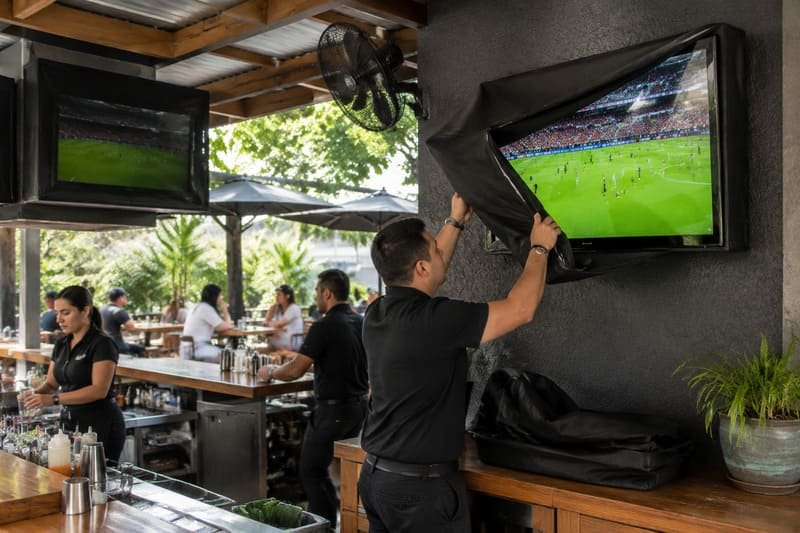
When I review failed outdoor TV setups, I often hear the same sentence:
“We had a cover, but something still happened.”
Usually, the cover was not the whole problem. The routine around the cover was the problem.
Maybe the cover was left off overnight.
Maybe it was put back while the TV was still warm.
Maybe it was stored wet and reused the next day.
Maybe staff turned on the TV without removing it fully.
Maybe the wind lifted the bottom edge.
Maybe a guest touched the cables behind the screen.
Maybe moisture formed inside the cover after a cool night.
This is why I call cheap covers a behavior-dependent solution.
They require people to do everything correctly every day. That is a weak point in commercial environments.
Cover Risk Is a Behavior Problem
| Daily Behavior | What Can Go Wrong | Hidden Cost |
|---|---|---|
| Cover removed before use | Staff forget, rush, or only partially remove it | Heat may be trapped during operation |
| Cover put back too soon | TV is still warm after service | Warm air and moisture may be trapped |
| Cover left off overnight | Sudden rain, dew, or dust exposure | Screen, ports, and rear vents face more risk |
| Cover stored wet | Damp fabric is reused | Moisture is held against the TV |
| Cover used in public area | No lock, no hard front protection | Guest access, impact, or tampering risk |
| Cover used near coast | Salt and humidity stay around the TV | Hardware and ports face corrosion risk |
| Cover used in hot sun | Fabric absorbs heat | TV and cover area may become hotter |
A rigid enclosure does not remove all risk either. It still needs correct installation and maintenance. But it reduces the number of daily human steps required.
That is a major difference for restaurants, bars, hotels, and public-facing venues.
How Can Fabric Covers Trap Moisture or Heat?
A fabric cover may keep direct raindrops off the front of a TV, but moisture and heat are not always direct. They can build up slowly around the screen, especially when the cover is tight, damp, or used at the wrong time.
A low-cost fabric cover may trap moisture or heat when it is fitted tightly, used before the TV cools down, left on in humid conditions, stored wet, or not removed during operation. The risk is not always immediate failure. It is repeated exposure that increases the chance of corrosion, connector problems, overheating, or early replacement.
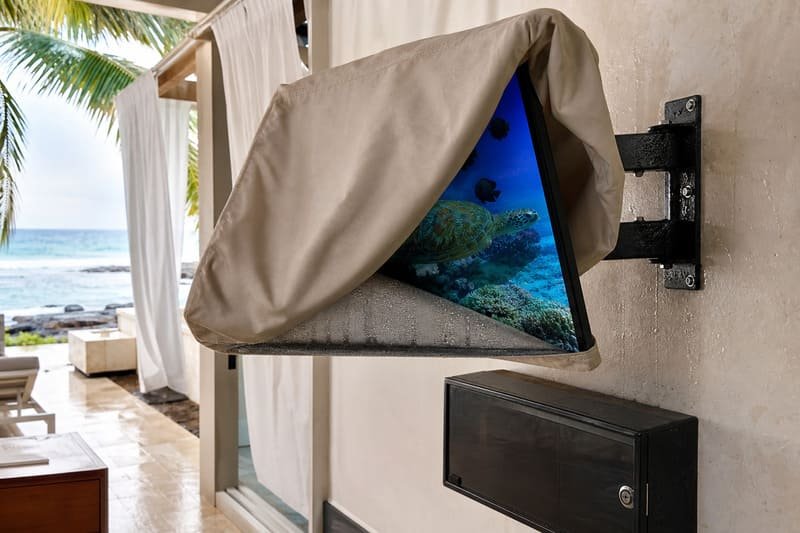
The outdoor environment changes all day.
- A patio can be hot in the afternoon and damp at night.
- A TV can warm up during a game and cool down after closing.
- A cover can feel dry on the outside but hold damp air inside.
- A coastal breeze can carry salt-laden moisture under loose fabric.
- A poolside bar can have splash, humidity, and cleaning routines around the screen.
The National Weather Service explains that dew point is the temperature air must be cooled to in order to reach 100% relative humidity. If air cools further, water vapor can come out of the atmosphere as liquid water. National Weather Service dew point explanation
That matters because a TV cover cannot stop the air around the screen from cooling overnight. If damp air is trapped under the cover, moisture may settle around vents, ports, seams, or the back of the TV.
Heat is another issue.
Sony advises using TVs within a temperature range of 0°C to 40°C / 32°F to 104°F and avoiding exposure to direct sunlight. Sony TV temperature guidance
A cover left on during or immediately after operation can reduce heat escape and increase heat stress around the TV. This can contribute to dimming, shutdown behavior, image problems, or shorter service life, depending on the TV model and conditions.
Moisture and Heat Risk Under Fabric Covers
| Risk | How It Happens | Why It Matters |
|---|---|---|
| Condensation | Damp air cools overnight under the cover | Moisture may settle near vents, ports, and seams |
| Wet Cover Reuse | Cover is stored damp and put back on the TV | Moisture is held close to the screen body |
| Heat After Use | Cover is installed before the TV cools down | Warm air is trapped around the TV |
| Cover During Operation | TV runs while partly covered | Heat cannot escape normally |
| Coastal Air | Salt-laden humidity remains under the cover | Metal parts and ports face higher corrosion risk |
| Dust and Pollen | Fabric and loose openings collect particles | Dust can reach vents and ports over time |
| Wind Movement | Cover shifts or lifts at the bottom | Water and dust may enter from open edges |
This is why I avoid saying “waterproof cover” is the same as “outdoor TV protection.”
A fabric cover may help during storage. But it does not create a controlled operating environment for the TV.
What Hidden Costs Appear After a Cover Fails?
A cheap cover looks like a bargain when you compare only the first receipt. But repair cost is rarely only the TV price. The hidden cost includes labor, downtime, troubleshooting, repeated replacement, and staff time.
The real cost of a failed TV cover includes the replacement screen, AV service calls, staff time, lost display availability, event disruption, repeated cover replacement, and possible warranty disputes. For businesses, the cover price is only one small part of the total cost.
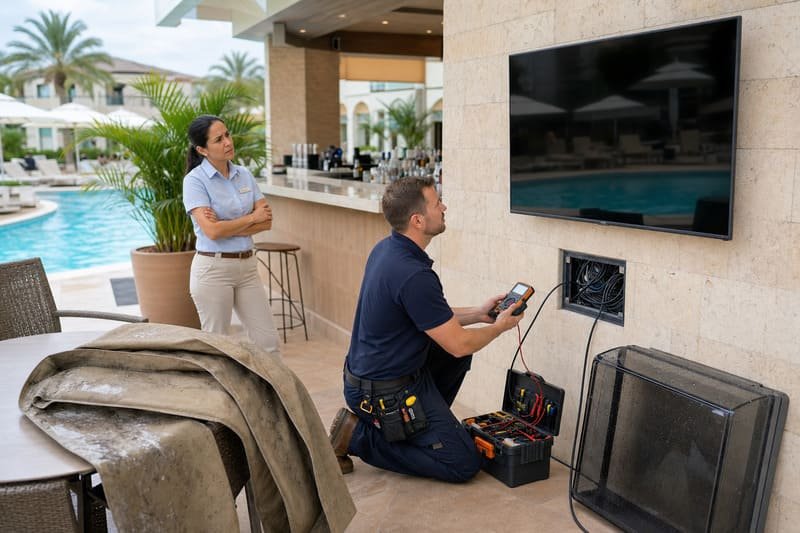
When I discuss outdoor TV protection with commercial buyers, I usually ask them to compare cost layers, not product prices.
A fabric cover may cost very little. But what happens if it fails?
- A technician may need to visit.
- The screen may need to be removed.
- The TV may need to be replaced.
- Staff may spend time troubleshooting.
- The patio screen may be unavailable during a game or event.
- The same installation problem may happen again with the next TV.
CIPS defines Total Cost of Ownership as an estimate that helps buyers understand the end-to-end cost of providing a product or service, including purchase price, acquisition cost, usage cost, and end-of-life cost. CIPS Total Cost of Ownership overview
That is the right way to think about outdoor TV protection.
The lowest-cost cover can become expensive if it increases service calls, replacement cycles, and screen downtime.
The Cheap Cover Cost Stack
| Cost Layer | What It Looks Like in Real Use |
|---|---|
| Cover Price | The visible cost: often the only thing buyers compare |
| Repeated Cover Replacement | Fabric tears, zipper fails, seams stretch, UV weakens material |
| Staff Time | Remove, store, dry, reinstall, and check the cover daily |
| Use Mistakes | Cover left on, left off, installed wet, or forgotten after service |
| TV Replacement | Moisture, heat, impact, or port damage leads to a new screen |
| Service Call | AV technician or installer diagnoses and replaces equipment |
| Downtime | Screen unavailable during sports, events, menus, or guest service |
| Warranty Friction | Outdoor exposure may conflict with indoor TV warranty terms |
| Reinstallation Work | Bracket, cable, power, or media device may need adjustment |
Warranty is important here.
Using an indoor TV outdoors may conflict with the manufacturer’s intended-use and warranty terms. A cover or enclosure helps reduce exposure, but it does not rewrite the TV’s original warranty.
This is why I prefer cautious cost language. A better enclosure does not guarantee zero repair cost. But in medium-risk and high-risk sites, it can reduce the number of ways the TV is exposed to weather, heat, impact, and public access.
When Is a Fabric Cover Enough, and When Is It Not?
A fabric cover is not useless. It has a place. The problem starts when buyers expect it to perform like a rigid outdoor TV enclosure.
A fabric TV cover can be enough for low-risk home patios where the TV is fully covered, used occasionally, and checked carefully. It is usually not enough for restaurants, bars, hotels, poolside spaces, coastal patios, public venues, or any installation where the TV must operate outdoors regularly.
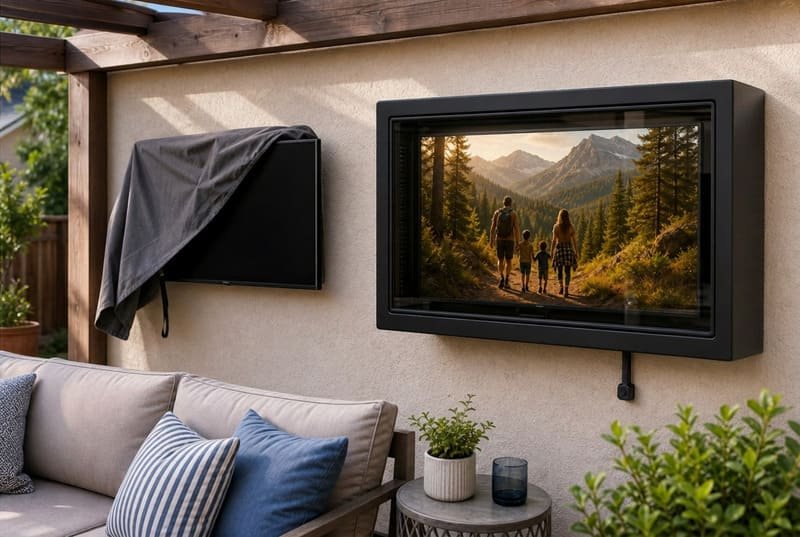
I do not tell every homeowner to buy an industrial enclosure.
That would not be honest.
If the TV is on a fully covered porch, used occasionally, removed during winter, and never operated while covered, a high-quality breathable cover may be a reasonable storage solution.
But that is very different from a commercial patio.
- A restaurant TV may run for hours.
- A hotel pool screen may stay outside all season.
- A sports bar may use multiple screens every weekend.
- A coastal venue may face salt air every evening.
- A public courtyard may need protection from guests and tampering.
Those are not simple storage situations.
Cover vs. Enclosure: Different Jobs
| Protection Method | Best Use | Main Limitation |
|---|---|---|
| Basic Fabric Cover | Low-risk home patio when TV is off | Manual use, no protection while watching |
| Heavy-Duty Fabric Cover | Covered porch, mild weather, occasional use | Still depends on daily behavior and dry storage |
| Rigid Outdoor TV Enclosure | Restaurants, bars, hotels, public areas, semi-exposed patios | Higher upfront cost and needs proper installation |
| Dedicated Outdoor TV | Full-sun premium locations, one flagship screen | Higher replacement cost and fewer model choices |
| Mixed Strategy | Multi-screen commercial venues | Requires planning by location risk |
The key is to match the protection method to the risk level.
A fabric cover protects a TV when it is off.
A rigid enclosure protects the TV while it is installed and in use.
A dedicated outdoor TV integrates outdoor protection into the screen itself.
Those are different jobs.
How Should Businesses Choose the Right Protection Level?
Businesses should not choose protection by price alone. They should look at exposure, operating hours, staff routine, public access, heat, moisture, replacement cost, and how important the screen is during service.
To choose the right protection level, businesses should classify the site as low, medium, or high risk. A low-risk covered home patio may use a cover. A semi-covered restaurant patio may need a ventilated enclosure. A coastal resort, sports bar, or public venue usually needs rigid protection, lockable access, and planned airflow.
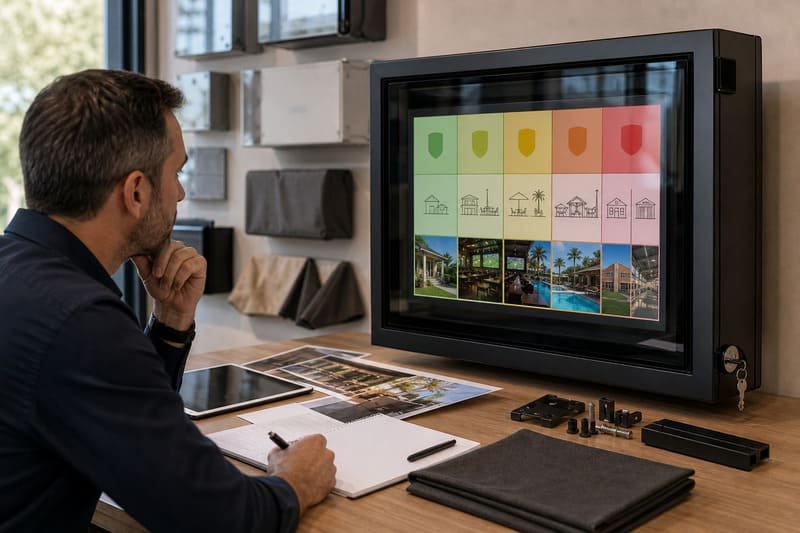
I usually ask buyers five questions before recommending a protection level:
Will the TV stay outside all season?
Will it run during service hours?
Can staff remove and reinstall a cover correctly every day?
Is the screen exposed to guests, salt air, pool moisture, or heat?
What happens if the screen is unavailable during a busy event?
If the answer shows high daily reliance, a cheap fabric cover is usually the wrong protection level.
IP rating also needs careful wording. The International Electrotechnical Commission explains that IP ratings grade the resistance of an enclosure against intrusion by dust or liquids. IEC IP Ratings
For outdoor TV enclosures, IP65 can be a useful benchmark because it indicates dust-tight protection and protection against water jets under defined test conditions. But IP65 does not mean vapor-proof, condensation-proof, flood-proof, pressure-wash-proof, or maintenance-free.
Cable exits, gasket compression, mounting angle, airflow, installation quality, and maintenance still matter.
Material can matter too. Covestro describes Makrolon polycarbonate as robust, lightweight, glass-like in transparency, and impact resistant even at low temperatures. Covestro Makrolon polycarbonate
For rigid enclosures, I also check TV fit. LG explains that TV size is measured diagonally, and buyers should still check total width, height, and depth in the product specifications. LG TV size guide
That matters because a TV that fits too tightly inside an enclosure may block airflow or stress cables.
Site Risk Ladder
| Site Type | Risk Level | Protection Direction |
|---|---|---|
| Fully Covered Home Porch | Low | High-quality fabric cover may be enough when TV is off |
| Backyard Pergola / Patio Wall | Low to Medium | Cover or enclosure depending on exposure and use frequency |
| Semi-Covered Restaurant Patio | Medium | Ventilated enclosure is usually safer than manual cover routine |
| Sports Bar Outdoor Area | Medium to High | Rigid enclosure, lockable access, and airflow planning |
| Hotel Pool or Resort Patio | High | Enclosure or dedicated outdoor TV depending on sun and exposure |
| Coastal Bar / Seaside Restaurant | High | Rigid protection, hardware inspection, and corrosion planning |
| Public School / Warehouse / Outdoor Signage | High | Lockable enclosure and serviceable installation |
This approach is more honest than saying every cover fails or every enclosure is perfect.
The right protection depends on the site.
Frequently Asked Questions
Are fabric TV covers enough for outdoor TVs?
Sometimes. A fabric cover may be enough for a fully covered home patio where the TV is used occasionally and protected when off. It is usually not enough for restaurants, bars, hotels, coastal areas, poolside spaces, or public venues where the TV stays outside and operates regularly.
Can a TV cover trap moisture?
Yes, it can. A cover may trap moisture if it is fitted tightly, stored wet, used in humid weather, installed before the TV cools, or left on through overnight temperature changes. This does not mean every cover always causes moisture damage, but it is a real risk in outdoor use.
Should I remove the cover while the TV is on?
Yes. A fabric cover should be removed before operating the TV. A TV needs airflow to release heat. Running a TV while it is covered or partially covered can increase heat stress and may create performance or service-life problems.
Can I use an indoor TV outside with a cover?
You can physically do it, but it carries risk. An indoor TV is not designed for outdoor exposure, and a cover does not change the manufacturer’s original outdoor-use rating or warranty terms. For regular outdoor use, a proper enclosure or dedicated outdoor TV is usually safer.
Is a fabric cover enough for a restaurant or bar patio?
Usually not. A restaurant or bar patio has longer operating hours, staff routines, guests, moisture, cleaning exposure, and public access. A manual cover depends too much on perfect daily behavior and provides no protection while the TV is being watched.
What is the difference between a TV cover and a TV enclosure?
A TV cover usually protects the TV while it is off and covered. A TV enclosure protects the TV while it is installed and in use. An enclosure can include a rigid shell, clear front shield, locks, cable exits, and airflow planning, depending on the design.
When should I choose a dedicated outdoor TV instead?
A dedicated outdoor TV may be better for full-sun locations, high-brightness needs, slim premium installations, or projects where the buyer wants one integrated outdoor-rated product. A standard TV with a rigid enclosure may be more practical for shaded or semi-covered locations where replacement flexibility matters.
Does an enclosure eliminate all repair costs?
No. An enclosure can reduce exposure and make the installation more serviceable, but it does not eliminate all risk. Installation quality, TV fit, airflow, cable routing, fan maintenance, weather exposure, and user behavior still matter.
Conclusion
A cheap outdoor TV cover can look like a smart saving at first.
But in many real outdoor installations, the cover is not the full cost.
The real cost is the routine around it.
- Removing it.
- Storing it.
- Drying it.
- Putting it back at the right time.
- Keeping it off during operation.
- Making sure staff remember.
- Hoping it does not trap heat or moisture.
- Replacing the TV when the routine fails.
The way I explain it to buyers is simple:
A fabric TV cover is a storage protection tool. It is not a full operating protection system.
For a low-risk home porch, a good fabric cover may be enough.
For a busy restaurant, sports bar, hotel, poolside area, coastal venue, or public-facing screen, the hidden cost of a cheap cover can become much higher than the upfront saving.
The better question is not “Which cover is cheapest?”
The better question is:
What level of protection does this outdoor TV actually need while it is installed, used, cleaned, and maintained every day?
Once you answer that question, the right choice becomes much clearer.