
A restaurant patio does not become dry when the staff turns off the lights. After closing time, the TV is still sitting outside through night air, dew, cleaning moisture, temperature drops, and early-morning condensation.
Outdoor TV moisture protection matters for restaurants and bars because the real risk is not only rain during service hours. Moisture often builds when no one is watching: after closing, overnight, during early-morning dew, after cleaning, and during temperature swings before the next service. A good protection strategy should reduce water exposure, manage airflow, protect cable exits, and keep the screen serviceable for busy nights.
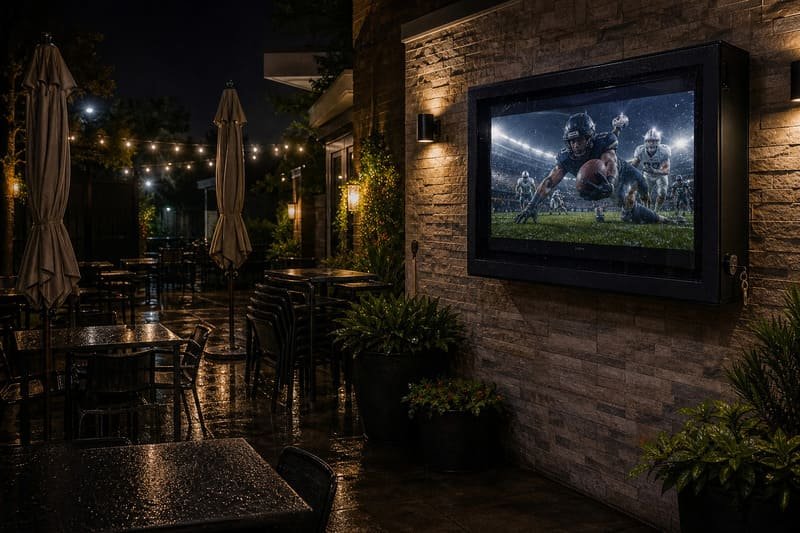
When a restaurant or bar owner asks me why a patio TV failed even though it was under a roof, I usually ask what happened before opening time, not only during the game.
- Was the TV outside overnight?
- Did the temperature drop after closing?
- Was the patio cleaned with water or spray?
- Is the venue near the coast?
- Are the cables entering from below or behind?
- Does the enclosure have airflow, or is it just a sealed box?
For restaurants and bars, outdoor TV moisture protection is not only a rain problem. It is an operating-cycle problem: closed hours, night cooling, morning dew, service humidity, cleaning routines, and long game-night runtime all affect the screen.
That is why I treat moisture protection differently from simple “weatherproofing.” The goal is not just to keep rain off the screen. The goal is to help the display survive the full rhythm of restaurant and bar use.
Last Updated: May 22, 2026 | Estimated Reading Time: 8 minutes
By Smith Chen, Outdoor TV Enclosure Engineer at Outvion
Why Is Moisture a Service-Cycle Problem, Not Just a Weather Problem?
A bar patio may look dry during service, but the moisture cycle starts before guests arrive and continues long after they leave. The TV is exposed to humidity, temperature swings, cleaning routines, and early-morning dew even when the venue is closed.
For restaurants and bars, moisture damage is often linked to the full service cycle. Night cooling, dew point, morning condensation, cleaning spray, humid service air, coastal evenings, and long operating hours all create different stress points. A patio roof may block rain, but it does not control the air around the TV.
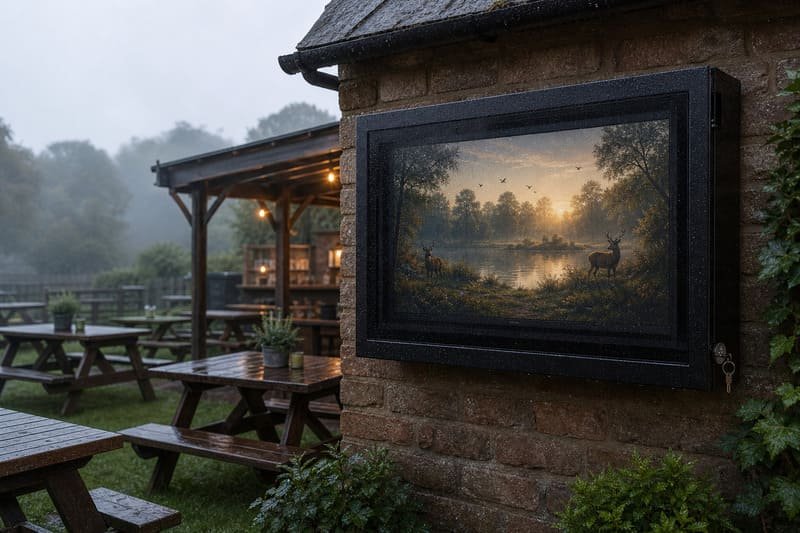
This is the part many venue owners underestimate.
A screen may not fail during the rainstorm.
It may fail after weeks of humid nights.
It may fail after repeated cleaning spray around the patio.
It may fail after salt-laden evening air settles around ports, screws, and cable exits.
It may fail after warm game-night operation followed by a cooler night.
The National Weather Service explains that dew point is the temperature air must be cooled to in order to reach 100% relative humidity. If air cools further, water vapor can come out of the atmosphere as liquid water. National Weather Service dew point explanation
That is why a roof alone cannot solve moisture. A roof can block direct rain, but it cannot stop humid air from cooling, reaching dew point, and forming moisture on cooler surfaces.
Restaurant and Bar Moisture Cycle
| Time Period | Moisture Source | Why It Matters |
|---|---|---|
| After Closing | Night cooling and rising relative humidity | Moisture risk can increase when surfaces cool after service |
| Early Morning | Dew and cold surfaces | A patio roof does not stop ambient moisture |
| Before Opening | Cleaning spray, wet floors, wiped surfaces | Moisture exposure may come from operations, not weather |
| Service Hours | Drinks, steam, kitchen/bar humidity, guests | The TV faces a mixed restaurant environment |
| Game Nights | Long TV runtime followed by cool night air | Warm/cool cycling can add stress over time |
| Coastal Evenings | Salt-laden humid air | Hardware, ports, and cable exits need more inspection |
| Poolside Bars | Splash, humid air, cleaning chemicals nearby | Moisture and corrosion-prone hardware require planning |
This is the key difference between a restaurant patio TV and a TV in a normal covered backyard.
In a business, the screen is part of daily service. It runs longer, gets cleaned around more often, faces more people, and may be expected to work during the busiest hours of the week.
That is why moisture protection should be planned as part of venue operation, not as an afterthought.
Why Is a Patio Roof Not Enough to Protect a TV?
A roof or awning helps, but it only solves direct rain. It does not stop humid air, dew, wind-driven moisture, splash, cleaning routines, or moisture entering through cable gaps and ventilation openings.
A patio roof is not enough because moisture moves through air, not only through falling rain. Standard indoor TVs have vents, ports, seams, and cable areas that were not designed for wet outdoor environments. Even under cover, humidity and condensation can affect electronics over time.
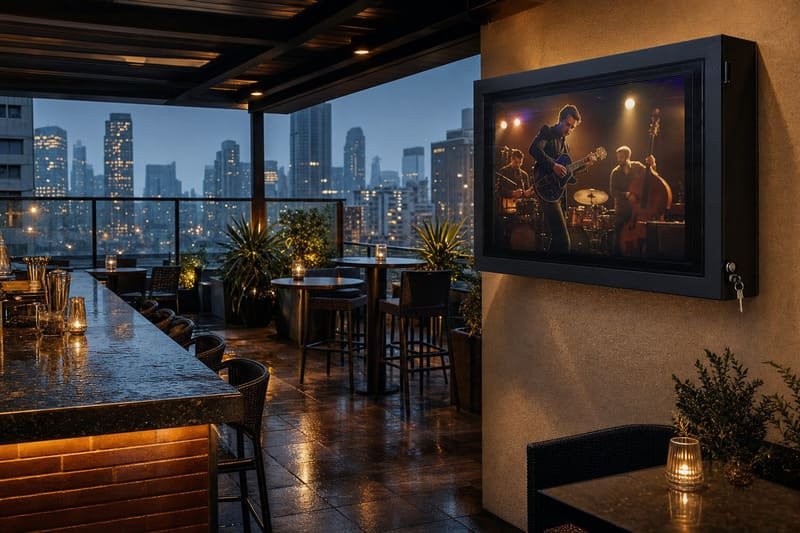
I understand why many owners trust a roof. If the TV never gets directly rained on, it feels protected.
But moisture does not always arrive from above.
- It can arrive through humid air.
- It can settle as dew.
- It can blow sideways in wind.
- It can come from wet floors after cleaning.
- It can collect around power and HDMI ports.
- It can enter through rear vents.
Standard indoor TVs need ventilation, so they usually have openings on the back or sides. Those openings are useful indoors because they help heat escape. Outdoors, they also create a path for humid air, dust, insects, and residue.
Electronics reliability research has repeatedly connected moisture, humidity, condensation, and corrosion with long-term electronic failure mechanisms. One review on water-related degradation in electronics notes that water in liquid or vapor form can affect electronic performance and reliability through several failure mechanisms. Water-related degradation in electronics
I would not describe moisture damage as instant or automatic. The more accurate problem is cumulative risk.
Moisture can increase corrosion, leakage current, connector problems, and long-term reliability risk, especially when the TV cycles between warm operating hours and cooler nights.
Why “Covered” Is Not the Same as “Protected”
| Protection Question | Patio Roof / Awning | Outdoor TV Enclosure |
|---|---|---|
| Blocks Direct Rain | Yes, if rain is vertical | Yes, when installed correctly |
| Controls Ambient Humidity | No | Helps reduce direct exposure, but does not make air dry |
| Protects Rear Vents | No | Creates a controlled barrier around the TV |
| Protects Cable Exits | No | Can use planned cable exits and seals |
| Reduces Guest Contact | No | Lockable front access can help |
| Supports Airflow Planning | No | Fan-assisted airflow can be designed |
| Allows Inspection | Not usually | Serviceable enclosure can be opened and checked |
A roof is useful. I still like roof cover, pergolas, and shade.
But for restaurant and bar TVs, roof cover should be treated as the first layer, not the full protection strategy.
Where Does Moisture Enter a Restaurant Patio TV Setup?
Moisture usually enters through weak points: vents, cable exits, ports, seams, mounting holes, and poorly compressed front-panel edges. The screen face may look fine while the problem starts behind it.
The most common moisture entry points are rear vents, HDMI and power ports, cable exits, mounting holes, gasket edges, and gaps created during poor installation. For restaurants and bars, the cable route is especially important because power, HDMI, media players, and streaming devices are often added after the screen is mounted.
When I review a failed outdoor TV setup, I do not only look at the front of the TV. I look behind it.
That is usually where the story is.
- A rear cable pointing upward can collect water.
- A power plug may be pressed too tightly against the wall.
- A streaming device may be sitting in a damp corner.
- A cable opening may be oversized.
- A screw hole may not be sealed properly.
- A fan vent may be blocked by dust or insects.
- A gasket may not be compressed evenly.
For restaurants and bars, I also pay attention to staff behavior. During a busy night, someone may quickly reset a media box, change a cable, open the enclosure, or move a speaker. If the enclosure is hard to service, people may take shortcuts. Those shortcuts can create moisture paths.
Moisture Entry Points and What to Check
| Entry Point | Why It Can Fail | What to Check |
|---|---|---|
| Rear Vents | Designed for indoor airflow, not wet outdoor air | Enclosure airflow path and vent protection |
| HDMI / Power Ports | Exposed contacts and cable stress | Protected routing and enough bend space |
| Cable Exits | Common weak point after installation | Cable glands, seals, drip loops, and service access |
| Mounting Holes | Water path if poorly sealed | Mounting detail and wall interface |
| Front Panel Edges | Uneven compression can leave gaps | Gasket condition and lock pressure |
| Media Devices | Extra heat and exposed connections | Internal space and cable organization |
| Fan Vents | Can collect dust, insects, and residue | Cleaning and inspection schedule |
A good enclosure design should make these weak points easier to control.
That does not mean the enclosure is maintenance-free. It means the moisture paths are visible, serviceable, and easier to manage.
Why Can Over-Sealing Create a New Problem?
It is tempting to think the best solution is to seal the TV completely. But if the enclosure traps heat and damp air, the system can become a sealed moisture and heat pocket.
The goal is not to trap the TV in a sealed damp box. The goal is to reduce water entry while allowing heat and trapped air to be managed. Active airflow can help reduce stagnant warm air and heat buildup, but it does not guarantee condensation prevention. Sealing, cable exits, airflow, shade, drainage thinking, and inspection all need to work together.
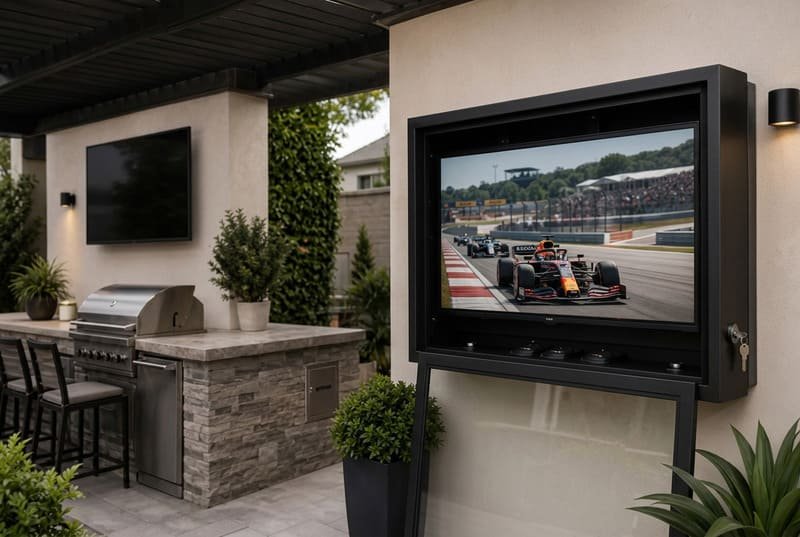
This is one of the most important design lessons in outdoor TV protection.
A box with no airflow may keep out direct splash in one situation but create heat problems in another. A fully open cabinet may let heat out but also allow moisture, dust, and insects in. The difficult part is balancing protection and airflow.
The International Electrotechnical Commission explains that IP ratings grade the resistance of an enclosure against intrusion by dust or liquids. IEC IP Ratings
For many outdoor TV enclosure projects, IP65 can be a useful protection target because it indicates dust-tight protection and protection against water jets under defined test conditions.
But IP65 does not mean vapor-proof, condensation-proof, chemical-proof, salt-proof, grease-proof, submersible, or maintenance-free.
Cable exits, gasket compression, installation angle, fan clearance, and service habits still matter.
Heat also matters. Sony advises using TVs within a temperature range of 0°C to 40°C / 32°F to 104°F and avoiding direct sunlight. Sony TV temperature guidance
Fans can help move warm air away from the TV. They are not air conditioning, and they do not remove every moisture risk. But in a restaurant or bar installation, fan-assisted airflow can make the system more serviceable than a sealed box with no air movement.
Over-Sealed Box vs. Ventilated Protection System
| Feature | Over-Sealed Box | Fan-Assisted Outdoor TV Enclosure |
|---|---|---|
| Rain / Splash Control | May block direct water if sealed correctly | Helps reduce direct water exposure when designed correctly |
| Heat Management | Poor if there is no airflow | Better when intake/exhaust paths are clear |
| Condensation Risk | Can trap damp air | Lower risk when airflow, sealing, and inspection are managed |
| Cable Access | Often difficult | Service access can be planned |
| Fan / Vent Maintenance | Not applicable, but heat may build | Vents and fans need cleaning |
| Long-Term Serviceability | Often poor | Better if locks, fans, seals, and cable exits are accessible |
This is why I prefer the phrase “moisture management” over “just sealing.”
Outdoor TV protection is not only about blocking water. It is about controlling the environment around the TV as much as practical.
How Should Restaurants and Bars Choose a Moisture Protection Strategy?
A restaurant or bar has three common choices: use a standard TV without protection, buy a dedicated outdoor TV, or use a standard TV inside a protective enclosure. Each choice has a different cost and risk profile.
Restaurants and bars should choose a moisture protection strategy by looking at exposure level, screen quantity, operating hours, shade, service access, replacement cost, and how important the screen is during peak service. A dedicated outdoor TV may be best for one full-sun flagship screen, while an indoor TV inside a suitable enclosure may be practical for shaded patios and multi-screen bar projects.
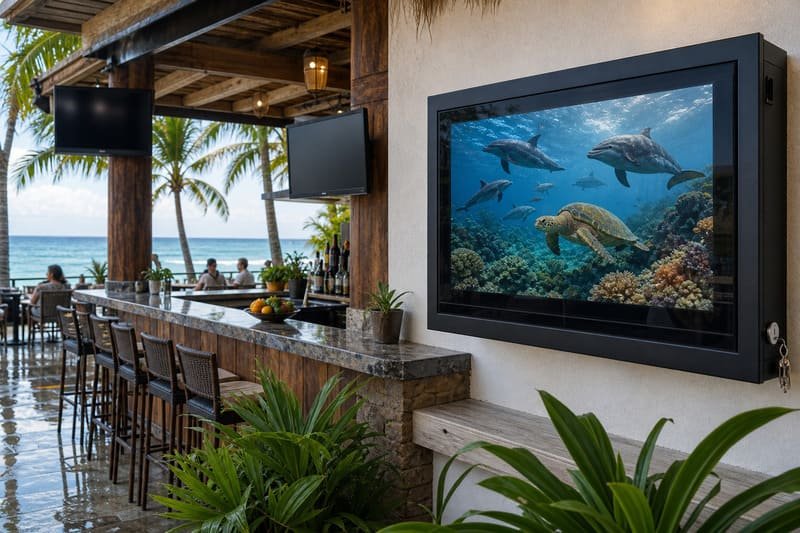
I do not recommend the same solution for every venue.
A beach bar with salt air and wind-driven moisture is not the same as an inland restaurant patio under a roof. A poolside bar is not the same as a small beer garden. A single flagship sports screen is not the same as ten TVs spread around a patio.
Outdoor TV Moisture Protection Options
| Decision Factor | Standard TV Under Roof | Dedicated Outdoor TV | Indoor TV in Protective Enclosure |
|---|---|---|---|
| Upfront Cost | Low | Usually high | Medium, depending on enclosure and TV |
| Moisture Protection | Low | High if rated for the environment | High when enclosure is designed and installed correctly |
| Airflow Planning | TV’s own vents only | Built into outdoor TV design | Depends on fan system and internal clearance |
| Public Access Control | Low | Depends on model and mount | Lockable access can help |
| Replacement Flexibility | Easy, but failures may repeat | Replace the outdoor-rated unit | Replace TV while keeping enclosure |
| Best Use Case | Temporary or very low-risk areas | Full-sun or premium flagship screens | Shaded patios, bars, restaurants, multi-screen venues |
| Main Risk | Moisture and warranty issues | Higher replacement cost | Wrong fit, poor airflow, weak installation, or poor maintenance |
CIPS defines Total Cost of Ownership as an end-to-end cost view that includes purchase price, acquisition cost, usage cost, and end-of-life cost. CIPS Total Cost of Ownership overview
That matters for restaurants and bars because the cheapest first purchase may not be the lowest-cost operating choice.
If a screen fails during the season, the business may face:
- replacement TV cost
- technician call-out cost
- staff time
- wall or cable rework
- guest complaints
- lost screen availability during sports nights
- repeated installation risk
An enclosure does not guarantee zero failures. But it can help separate the long-term protection layer from the replaceable TV inside, which can make future service and upgrades easier.
Material choice also matters. Covestro describes Makrolon polycarbonate as robust, lightweight, glass-like in transparency, and impact resistant even at low temperatures. Covestro Makrolon polycarbonate
For coastal bars, a polycarbonate body does not rust like steel, which removes one corrosion pathway. However, locks, hinges, screws, anchors, cable exits, and wall mounts still need corrosion-resistant design and inspection.
FEMA guidance on coastal construction notes that salt accumulation and high humidity can accelerate corrosion of untreated steel connectors and fasteners. FEMA coastal corrosion guidance
What Should Venue Owners Check Before Installation?
Moisture protection is easiest to plan before the TV goes on the wall. Once the TV is installed, cable routes, fan clearance, service access, and gasket compression are harder to correct.
Before installing outdoor TVs in restaurants and bars, venue owners should check roof coverage, wind direction, cleaning routines, dew exposure, cable exits, TV dimensions, fan clearance, power route, guest access, and maintenance access. The best protection strategy is the one staff can keep using correctly during real service.
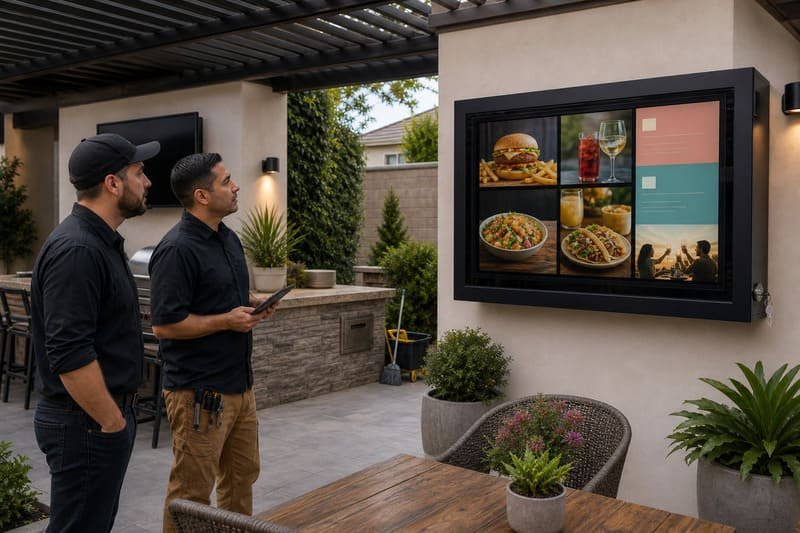
For restaurant and bar projects, I usually ask for site photos before I suggest a configuration. Photos show details that a product list cannot show.
They show where water may collect.
They show whether the wall gets morning shade or afternoon sun.
They show whether the TV is near the bar sink, pool, kitchen pass, or sea breeze.
They show whether staff can open the enclosure without moving furniture.
They show whether cables will enter from above, below, or behind.
TV size also needs checking. LG explains that TV size is measured diagonally, but buyers should still check the total width, height, and depth in the product specifications. LG TV size guide
For an enclosure, the TV’s real dimensions matter because tight fits can create cable stress and reduce airflow.
Restaurant and Bar Moisture Protection Checklist
| Check | What to Confirm | Why It Matters |
|---|---|---|
| Roof Coverage | Direct rain, side rain, roof edge | Roofs block rain but not humidity |
| Night / Morning Conditions | Dew, temperature drop, early moisture | Many risks happen outside service hours |
| Cleaning Routine | Hose, spray, wet floors, wiping | Moisture may come from operations |
| Cable Exit Direction | Upward, downward, rear, side entry | Poor routing can create moisture paths |
| TV Fit | Width, height, depth, VESA pattern | Prevents tight fit and cable pressure |
| Fan Clearance | Intake and exhaust vents are open | Supports heat and airflow management |
| Front Gasket / Door | Even compression and lock pressure | Helps maintain enclosure performance |
| Coastal Exposure | Salt air, wind direction, hardware corrosion | Metal parts need inspection |
| Guest Access | Can guests touch the TV, ports, or cables? | Determines locking and mounting height |
| Service Access | Staff can clean, reset, inspect, and close properly | Reduces shortcuts during busy service |
This checklist is not complicated, but it saves many problems later.
The best moisture protection is not only a product. It is a routine: install correctly, inspect regularly, keep vents clear, check cable exits, and make sure staff close the enclosure properly after access.
Frequently Asked Questions
Is a patio roof enough to protect an outdoor TV from moisture?
No, not by itself. A patio roof can reduce direct rain, but it cannot stop ambient humidity, dew, temperature swings, wind-driven moisture, cleaning spray, or moisture around cable exits. For long-term restaurant or bar use, the TV usually needs a more complete protection strategy.
How does condensation affect outdoor TVs?
Condensation can form when humid air cools and water vapor changes into liquid on cooler surfaces. Around electronics, moisture can increase corrosion, connector problems, leakage current, and reliability risk over time. The risk is higher when the TV repeatedly moves between warm operation and cooler night conditions.
Can moisture damage happen even when it is not raining?
Yes. Moisture risk can come from humidity, dew, cleaning routines, wet floors, splash, steam, coastal air, or temperature swings. Many restaurant and bar TVs sit outside overnight, so the moisture cycle continues even when the venue is closed.
Should an outdoor TV enclosure be completely sealed?
Not necessarily. A completely sealed box can trap heat and damp air if it is not designed correctly. A better strategy is controlled protection: reduce water and dust entry, protect cable exits, and allow heat and trapped air to be managed through planned airflow.
Do fan-cooled enclosures prevent condensation?
They can help reduce stagnant warm air and heat buildup, but they do not guarantee condensation prevention. Condensation depends on humidity, dew point, temperature swings, sealing, cable exits, installation angle, and maintenance. Fans are one part of the system, not the whole solution.
Can I use a standard indoor TV in a restaurant patio enclosure?
Yes, many restaurants and bars use standard indoor TVs inside suitable outdoor TV enclosures. But the enclosure must fit the TV, allow airflow, protect cable exits, and be installed correctly. The enclosure does not change the TV manufacturer’s original outdoor-use rating or warranty terms.
What should coastal bars check more often?
Coastal bars should inspect locks, hinges, screws, brackets, cable exits, wall mounts, fan vents, and gasket areas more often. Salt-laden humidity can accelerate corrosion of exposed or untreated metal parts, so maintenance is important even when the enclosure body itself does not rust like steel.
How often should restaurant and bar owners inspect outdoor TV enclosures?
The more exposed the venue, the more often it should be checked. For busy bars, coastal restaurants, poolside venues, or high-humidity patios, regular visual inspection is useful. Check front-panel cleanliness, lock function, fan vents, cable exits, gasket condition, and whether staff are closing the enclosure properly.
Conclusion
Outdoor TV moisture protection for restaurants and bars is not only about stopping rain.
It is about managing the full moisture cycle of a working venue.
- After-hours humidity.
- Early-morning dew.
- Cleaning spray.
- Service moisture.
- Long game-night runtime.
- Cable exits.
- Fan vents.
- Salt air.
- Staff access.
- Guest contact.
The way I explain it to venue owners is simple:
Moisture protection is not a one-time weather decision. It is part of the restaurant and bar service cycle.
A roof helps, but it is not enough by itself.
A sealed box may block water, but it can trap heat and damp air.
A fan-cooled enclosure can help, but it still needs correct installation and inspection.
A dedicated outdoor TV may be right for some flagship locations.
An indoor TV inside a suitable enclosure can be practical for shaded, serviceable, multi-screen venues.
The best strategy is the one that reduces moisture exposure, manages airflow, protects cable exits, allows maintenance, and keeps the screen ready for the next busy night.
That is how restaurants and bars protect not only the TV, but the guest experience that depends on it.