
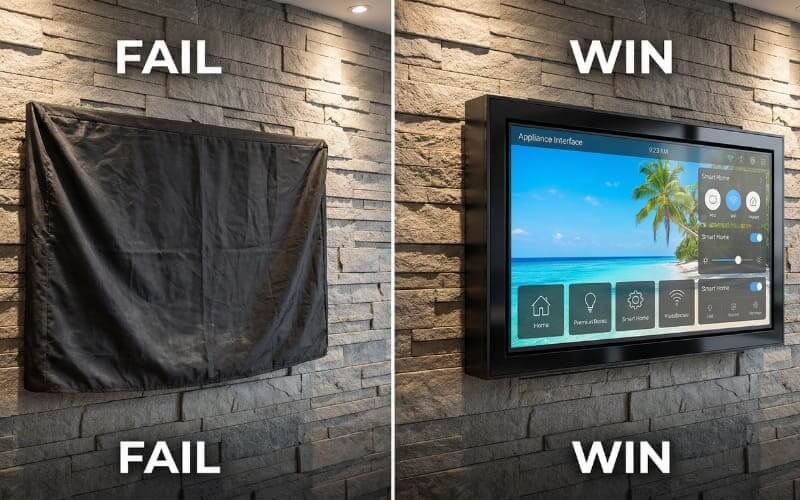
It is a Saturday afternoon. You have just mounted a brand-new 55-inch 4K TV on your patio. You feel smart because, instead of spending $3,000 on a specialized outdoor TV, you bought a standard indoor model and a $35 “Heavy Duty, Waterproof” fabric cover from Amazon. You zip it up like a winter jacket, confident that you have outsmarted the system.
You haven’t. You have just placed your television in a body bag.
As a forensic electronics engineer, I spend my life dissecting failed technology. I have opened thousands of “weather-protected” TVs that died prematurely. The culprit is rarely direct rain or a lightning strike. The killer is the very device you bought to protect it: the fabric cover.
You think you are shielding your investment from the elements. In reality, you are creating an unventilated “Humidity Chamber” that accelerates corrosion, delaminates screens, and cooks internal components.
Fabric covers rely on “water resistance” to stop rain, but they lack rigid seals and active ventilation. This traps rising ground moisture against the screen, creating a greenhouse effect that forces condensation inside the chassis. To truly protect an outdoor TV, you need an Outvion Hard Enclosure, which utilizes IP65 seals to block moisture and active thermodynamic airflow to expel humidity, creating a dry, breathable ecosystem for the electronics
The “Greenhouse Effect”: How Fabric Traps Moisture
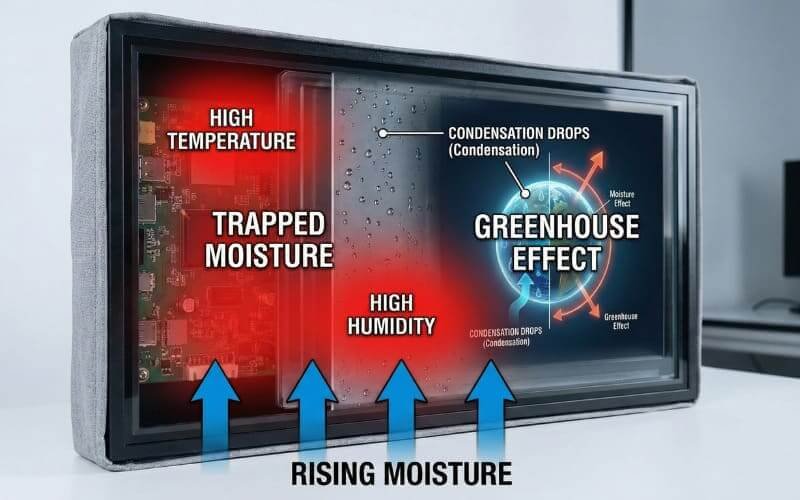
The Science of Failure: Fabric covers are designed like raincoats, not climate control systems. They utilize a “one-way” failure mode: they allow ground moisture to enter from the open bottom, but the waterproof coating prevents it from escaping. This turns your TV mount into a solar still.
The Physics of the “Solar Still”
To understand why fabric covers fail, you have to understand the water cycle on a micro-scale. Most homeowners worry about water coming down (rain). But in outdoor environments, particularly in humid regions like the UK or the US South, the real threat is water coming up.
At night, the earth cools. Moisture from the grass, the patio pavers, and the swimming pool evaporates and rises. A fabric TV cover, which hangs loosely over the device and is often secured by a simple drawstring at the bottom, acts like a capture tent. It catches this rising dampness. The relative humidity inside the cover begins to spike, often reaching 90-100% saturation by 4:00 AM.
When the sun rises the next morning, it hits the black fabric cover. The fabric absorbs solar radiation, rapidly heating the air pocket between the cover and the TV screen.
- The Reaction: The trapped moisture doesn’t just get warm; it vaporizes. You have inadvertently built a Solar Still.
- The Pressure: This warm, humid vapor expands. It looks for an escape. Because the fabric is heavy and coated to be “waterproof,” the vapor cannot escape outward. Instead, the high vapor pressure forces the moisture inward—straight through the ventilation slots of your TV.
The Chemistry of Corrosion: The “Green Death”
Once that moisture is inside, it condenses on the Printed Circuit Boards (PCBs). But it isn’t just pure water anymore. As it sat on your patio, it picked up dust, salts, and pollutants. When this mixture condenses on the copper traces of your motherboard, it creates an electrolyte solution. This triggers Galvanic Corrosion. The different metals on the board (gold, copper, tin lead) begin to exchange electrons through the water.
- The Visual: If you open a TV that has lived under a fabric cover, you won’t see rust. You will see “Green Fur.” This is copper oxide and mold growing across the sensitive electronics. It causes “leakage currents” that make the TV behave erratically before finally shorting out completely.
The Damage: Screen Delamination and “Mura”
The most heartbreaking failure mode I see is Panel Delamination. A modern LED/LCD screen is a sandwich of glass, polarizers, diffusers, and liquid crystal layers glued together. When high-pressure humidity is forced into the TV day after day, the moisture begins to attack the adhesives binding these layers.
- The Symptom: You turn on the TV and see a permanent cloudy spot, usually starting at the corners and creeping inward. Or you see the “Mura Effect”—weird rippling artifacts in the picture.
- The Diagnosis: This is not a dirty screen. The layers of your display are literally peeling apart because they have been steamed. The damage is irreversible.
The Outvion Fix: The Air Gap
An Outvion TV Enclosure is engineered to defeat this physics problem. It utilizes a Thermodynamic Air Gap.
- Sealed Bottom: The enclosure is sealed at the bottom with foam compression glands, preventing rising damp from entering easily.
- Active Airflow: Crucially, the enclosure uses active fans. Even if some humidity enters, the fans circulate the air, maintaining equilibrium between the inside and outside. Moisture is expelled before it can condense and pressurize.
The “Heat Death”: Electronics Need to Breathe
The Thermal Reality: Electronics generate heat even when they are “off.” A tight-fitting fabric cover acts as a thermal blanket, trapping this standby heat and combining it with solar gain. This cooks the electrolytic capacitors, cutting the lifespan of the TV by years.
The Myth of “OFF”
In 2026, a TV is never truly off. It is in “Standby Mode.” It is listening for a remote signal, maintaining a Wi-Fi connection, and checking for software updates. This activity generates a baseline amount of heat—usually 5 to 15 watts.
Indoors, this heat dissipates into the room. Outdoors, wrapped in a thick polyester or canvas cover, that heat has nowhere to go. The fabric acts as insulation (R-Value). It is equivalent to sleeping in a winter coat during the summer.
The Arrhenius Equation: How Heat Kills
In engineering, we use the Arrhenius Equation to predict electronic failure. A simplified rule of thumb is that for every 10°C (18°F) rise in operating temperature, the life of an electronic component is cut in half.
The Summer Problem (Texas, Spain, Dubai)
Now, add the sun. If you live in a hot climate, the ambient temperature might be 95°F (35°C). If your fabric cover is black (which 90% of them are), it absorbs solar energy.
- The Oven Effect: I have measured the temperature underneath a fabric cover on a sunny day in Texas. While the air was 95°F, the surface of the TV screen was 145°F (62°C).
- The Chemical Failure: Inside the TV’s power supply are components called Electrolytic Capacitors. They are filled with a liquid electrolyte. When exposed to chronic high heat, this liquid evaporates. The capacitor bulges, leaks, or dries out.
- The Result: One day, you click the remote, and the TV clicks, but the screen stays black. The power board is dead, cooked in its own sweat.
Thermal Performance – Fabric vs. Hard Enclosure
| Feature | Fabric Cover | Outvion Outdoor TV Enclosure |
|---|---|---|
| Material Thermal Property | Insulator (Traps Heat) | Conductor (Polycarbonate sheds heat) |
| Airflow | Zero (Stagnant Air) | Active (Dual/Quad Fan Systems) |
| Solar Heat Gain | High (Direct contact with TV) | Low (Air gap acts as buffer) |
| Standby Temp (90°F Day) | 130°F – 150°F (Danger Zone) | 95°F – 100°F (Safe Zone) |
Impact Protection: A Tarp vs. A Riot Shield
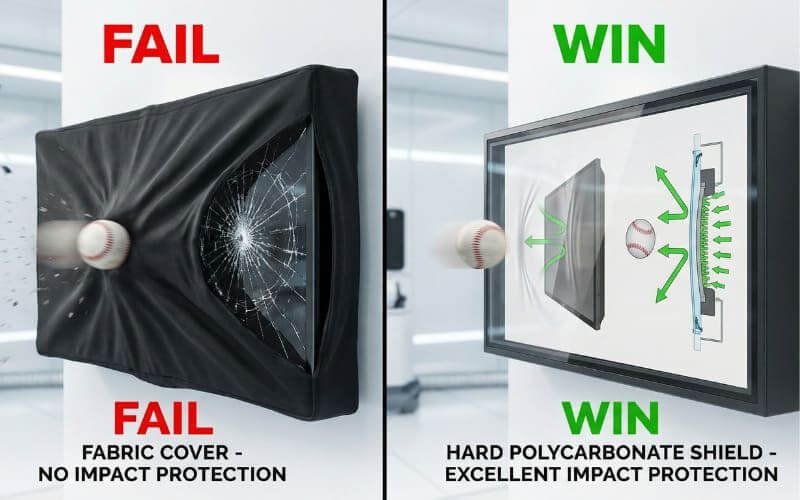
The Durability Test: Fabric stops dust; it does not stop physics. A fabric cover offers zero protection against kinetic energy. A stray frisbee, a hailstone, or a falling branch will crack the fragile LCD screen right through the cloth. Outvion uses Polycarbonate—the same material used in riot shields—to physically bounce projectiles off the screen.
The False Sense of Security
Manufacturers of fabric covers use terms like “Heavy Duty” and “600D Polyester.” These terms refer to abrasion resistance, not impact resistance. They mean the cover won’t rip if you drag it across concrete. They do not mean it will stop a blow.
Imagine wearing a heavy denim jacket and asking someone to hit you with a baseball bat. The denim is “heavy duty,” but your ribs will still break. The fabric transfers 100% of the shock wave directly to the object behind it.
The Fragility of Modern Screens
Modern 4K TVs are incredibly fragile. The LCD matrix is glass, often less than 2mm thick. It takes surprisingly little force to crack it.
- The Hailstorm Test: In a severe thunderstorm with hail, a fabric cover is useless. The hailstones strike the fabric, the fabric strikes the screen, and the screen spiderwebs. You unzip the cover the next day to find a destroyed TV.
- The Yard Work Hazard: A pebble flung by a weed whacker or lawnmower can travel at 100mph. It will punch through a canvas cover like a bullet.
The Riot Shield Material
Outvion Enclosures are constructed using High-Density Optical Polycarbonate.
- Why Polycarbonate? Unlike glass (which is rigid and shatters), polycarbonate is ductile. It yields. When a baseball or a rock hits the front of an Outvion unit, the plastic creates a “trampoline effect.” It flexes inward, absorbs the kinetic energy, and snaps back.
- The Impact Rating: Our TV enclosures are rated IK10, the highest rating for impact protection against external mechanical impacts. A fabric cover has an IK rating of effectively zero.
The “Laziness” Barrier: Usability & Friction
The User Experience: Human beings follow the path of least resistance. If watching TV outside requires a 5-minute setup process involving zippers, velcro, and storing a dirty cover, you will eventually stop doing it. Friction kills usage.
The “Velcro Dance”
Let’s walk through the reality of owning a fabric cover.
- You walk outside with your coffee. You want to check the news.
- You see the TV is wrapped up.
- You have to reach up (often high on the wall) to undo the Velcro at the bottom.
- You have to struggle with the zippers on the sides, which are often stuck with pollen or grit.
- You peel the cover off. Now, what do you do with it? It’s huge, bulky, and likely covered in spiderwebs or morning dew. You can’t put it on the nice patio furniture. You throw it on the ground.
- Now you watch TV.
- When you are done, you have to do the whole thing in reverse.
The Reality: After the third time, you stop bothering. The “hassle factor” outweighs the enjoyment. You paid for an outdoor TV, but you never use it because the cover makes it a chore.
The “Always On” Lifestyle
With an Outvion Outdoor TV enclosure, the protection is Transparent.
- The Process: You walk outside. You pick up the remote. You press “Power.” The TV turns on through the clear front shield.
- The Experience: There is zero setup. Zero breakdown. The remote signal (IR) passes through the enclosure. The sound passes through. The view passes through. You use it just like your indoor TV. The friction is removed, meaning you get maximum ROI on your investment.
Insects & Critters: The Warmest Nest in the Yard
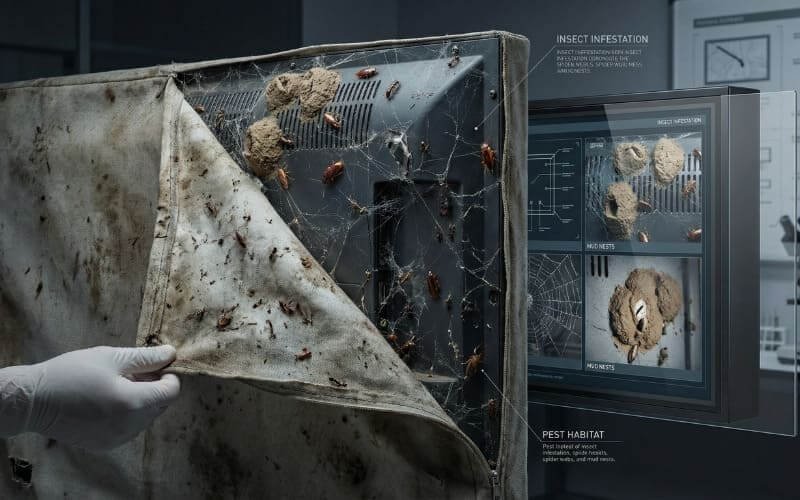
The Biological Risk: The open bottom design of most fabric covers creates a “chimney” effect that insects love. To a spider or a wasp, a covered TV is a warm, dry, dark cave protected from predators. It is a 5-star hotel for nesting.
The Biological Short Circuit
I have opened fabric-covered TVs to find horrors inside. Because the fabric cover creates a dark, warm environment that is protected from the wind, it attracts local fauna.
- Spiders: They love the heat of the power supply. They build dense webs across the high-voltage sections of the board.
- The Risk: Spider webs are organic. When dry, they are insulators. But when the humidity rises (see Section II), those webs absorb moisture and become conductive. A wet spider web across two capacitor legs can cause an arc flash that fries the board.
- Wasps/Mud Daubers: In the US South, mud daubers are notorious for building hard clay nests inside electronics. These mud nests block cooling fans, seizing them up and causing the TV to overheat.
- Ants: Ants are attracted to the electromagnetic fields of transformers (“Crazy Raspberry Ants”). They will swarm inside a TV, filling it with bodies until it shorts out.
The Sealed System
A fabric cover is open at the bottom to allow cables to pass through. This is the front door for pests. An Outvion outdoor TV case utilizes a Compression Foam Seal for cable entry. The foam molds tightly around the power and HDMI cables, leaving zero gaps for bugs. The air intake vents are protected by Micromesh Filters fine enough to block gnats. It is a fortress against biology.
Aesthetics: “Body Bag” vs. Premium Fixture
The Design Verdict: You spent $50,000 renovating your patio. You bought teak furniture, a Traeger grill, and stone pavers. Why would you ruin the aesthetic by hanging a saggy, wrinkled, faded plastic bag on the wall?
The “Trash Bag” Look
Let’s be honest about how fabric covers age.
- Month 1: It looks okay. A bit wrinkly.
- Month 6: The sun has bleached the black fabric to a weird shade of gray-purple. The pollen has stained it yellow. The velcro is fraying. It sags like an ill-fitting suit.
- The Vibe: It looks temporary. It looks cheap. It signals to your guests, “I couldn’t afford a real solution, so I bagged it.”
Curb Appeal and Property Value
An Outvion Hard Enclosure is designed to look like a permanent appliance. It has the same industrial design language as a high-end grill or an outdoor fridge.
- The Material: Powder-coated steel or UV-stabilized ABS/Polycarbonate. It maintains its deep black finish for years.
- The Profile: Slim, architectural, and deliberate. It frames the TV like a piece of art. When you are selling a home, a hard enclosure is listed as a “Feature” (Outdoor Entertainment System). A fabric cover is listed as… nothing. It’s personal property you take with you. The enclosure adds tangible value to the outdoor living space.
Cost Analysis: The “Cheap” Option is Expensive
The ROI Calculation: “Buy nice or buy twice” is the old saying. With outdoor TVs, it’s more like “Buy nice or buy four times.” The churn rate of fabric-covered TVs makes them significantly more expensive over a 5-year period than a proper enclosure system.
Let’s do the math. We will assume a standard 55-inch 4K TV costs $500.
Path A: The “Cheap” Route (Fabric Cover)
- Year 0: Buy TV ($500) + Cover ($30). Total: $530.
- Year 1.5: TV fails due to humidity corrosion or insect damage. Manufacturers void the warranty because they detect oxidation. Buy TV 2 ($500). Cover is faded, buy new cover ($30). Total: $1,060.
- Year 3: TV 2 fails (screen delamination). Buy TV 3 ($500). Total: $1,560.
- The Result: You have spent $1,500+ and dealt with the hassle of replacing the TV twice. You have generated massive e-waste.
Path B: The Engineering Route (Outvion Enclosure)
- Year 0: Buy TV ($500) + Outvion Enclosure ($600). Total: $1,100.
- Year 5: The TV is likely still running because it has lived in a clean, dry, climate-controlled environment. The Enclosure is still in perfect condition.
- The Result: You spent $1,100. You saved $400 cash, plus hours of labor, plus the environmental cost of trashed TV.
5-Year Total Cost of Ownership (TCO)
| Cost Factor | Fabric Cover Strategy | Outvion Hard Enclosure Strategy |
|---|---|---|
| Initial Hardware | $530 | $1,100 |
| Replacement Frequency | High (Avg. every 18 months) | Low (TV lasts 5+ years) |
| Maintenance Cost | $90 (3 covers over 5 yrs) | $0 (Washable) |
| Total Hardware Cost (5 Yrs) | $1,530+ | $1,100 |
| User Experience | Frustrating (Zip/Unzip) | Seamless (Always On) |
| Risk Factor | High (Impact/Bugs/Humidity) | Zero (IP65 Protection) |
Comparison Summary
The Ultimate Showdown – Feature by Feature
| Feature | Fabric TV Cover | Outvion Pro Enclosure | The Engineering Verdict |
|---|---|---|---|
| Moisture Control | Traps Moisture (Greenhouse) | Expels Moisture (Active Airflow) | Fabric causes corrosion. Outvion prevents it. |
| Impact Protection | Zero (Soft) | High (Polycarbonate Shield) | Only Outvion stops a baseball. |
| Temperature | Insulates Heat (Oven) | Regulates Heat (Fan Cooling) | Fabric cooks the TV. Outvion cools it. |
| Pest Control | High Risk (Open bottom) | Sealed (Micromesh Filters) | Fabric is a nest. Outvion is a fortress. |
| Aesthetics | “Trash Bag” Look | “Premium Appliance” Look | Hard enclosures add property value. |
| Visibility | Must remove to watch | Watch through the shield | Outvion removes friction. |
Conclusion
Stop suffocating your TV.
It is time to stop pretending that a $30 piece of polyester can fight the laws of thermodynamics. A fabric cover is a temporary solution that causes permanent damage. It creates a humid, hot, insect-infested environment that slowly destroys the electronics you bought it to protect.
If you are serious about outdoor entertainment, you need to treat your TV like the sensitive electronic instrument it is. You need to give it a home, not a shroud.
Throw away the blanket. Upgrade to the Outvion Pro Enclosure. Save your money, save your TV, and enjoy a setup that looks as good as the rest of your home.
FAQ
1. My cover says “Breathable,” isn’t that enough?
No. “Breathable” in fabrics (like Gore-Tex) usually refers to allowing small amounts of vapor to pass while stopping liquid. However, this passive breathability is not enough to counteract the massive thermal buildup of a black object in the sun, nor the rising damp from a patio. It cannot exchange air volume fast enough to prevent the Dew Point condensation inside the chassis. Only Active Forced Air (fans) can do that.
2. Can I use a fabric cover INSIDE the hard enclosure?
Absolutely Not. This is dangerous. The hard enclosure relies on fans to circulate air around the TV chassis to keep it cool. If you wrap the TV in fabric inside the box, you are insulating it and blocking the airflow. The TV will overheat and shut down within minutes.
3. How do I clean the hard enclosure screen?
It’s simple. The front panel is waterproof Polycarbonate. You can rinse it with a garden hose (low pressure) to remove dust or pollen. For fingerprints, use a mild dish soap and water solution with a microfiber cloth. Avoid ammonia-based cleaners (like Windex) as they can haze the plastic over time.
4. Does the hard enclosure block the remote signal?
No. The polycarbonate material is transparent to Infrared (IR) signals used by standard remotes. It is also transparent to Radio Frequency (RF) signals used by Bluetooth and Wi-Fi. Your remote, your streaming stick, and your Wi-Fi will work perfectly through the case.
5. Is the enclosure heavy to mount?
It is manageable. Most Outvion enclosures weigh between 25-45 lbs (depending on size). The installation is modular: you mount the lightweight empty box to the wall first, then you insert the TV. It is actually easier than mounting a heavy outdoor TV, which requires two people to lift the whole unit at once.
6. Can I leave the hard enclosure up in winter?
Yes. That is the point. The enclosure is designed to stay up 365 days a year. It protects against snow loads, freezing rain, and ice. In fact, the enclosure helps create a thermal buffer that keeps the TV slightly warmer than the freezing ambient air, protecting the LCD crystals.
Recommended Technical Reading
- Electronics Cooling Standards:Electronics Cooling Magazine – Enclosure Design
- Deep dive into thermodynamics and active vs. passive cooling.
- Polycarbonate Impact Ratings:Underwriters Laboratories (UL) – IK Ratings
- Understanding the IK10 impact resistance standard