
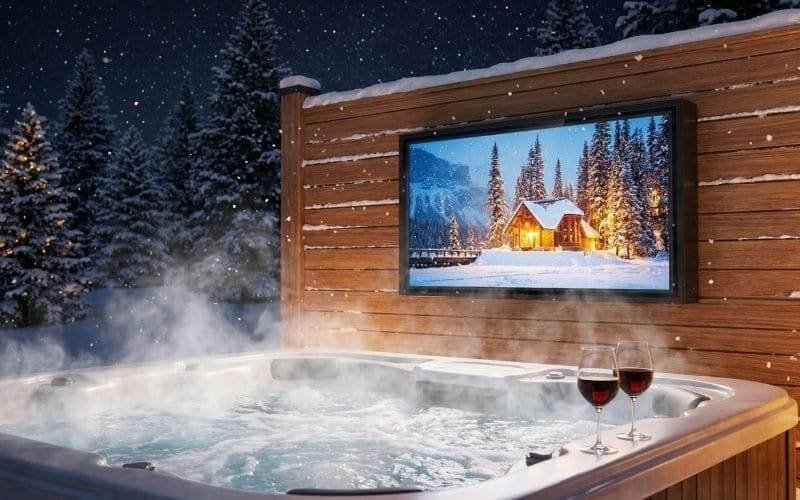
The vision is seductive: It is a crisp December evening, and snow is gently dusting the pines. You are submerged in a 104°F (40°C) hot tub, steam rising into the cold air, a glass of wine in hand. Six feet away, a massive 65-inch screen plays the game in stunning 4K. It is the ultimate convergence of luxury landscaping and modern technology.
But for any homeowner or facility manager with a rudimentary understanding of physics, this image is immediately followed by a jolt of anxiety. Electricity and water? Electronics sitting in a cloud of steam? Is this a fire hazard?
The hesitation is justified. Installing standard electronics in a wet environment is usually a recipe for disaster. However, with the right engineering approach, it is entirely safe and sustainable. The solution does not lie in “Waterproof TVs,” which often fail due to steam intrusion. The solution lies in industrial-grade isolation.
By utilizing an IP65-rated Outvion Enclosure, you create a hermetically sealed environment that allows a standard 4K TV to operate safely poolside. This guide moves beyond the marketing fluff to the hard engineering reality: thermodynamic airflow, chemical resistance, and National Electrical Code (NEC) compliance. Here is how to build a spa cinema that survives the elements.
Why “Steam” is the Real Enemy (The Physics of Intrusion)
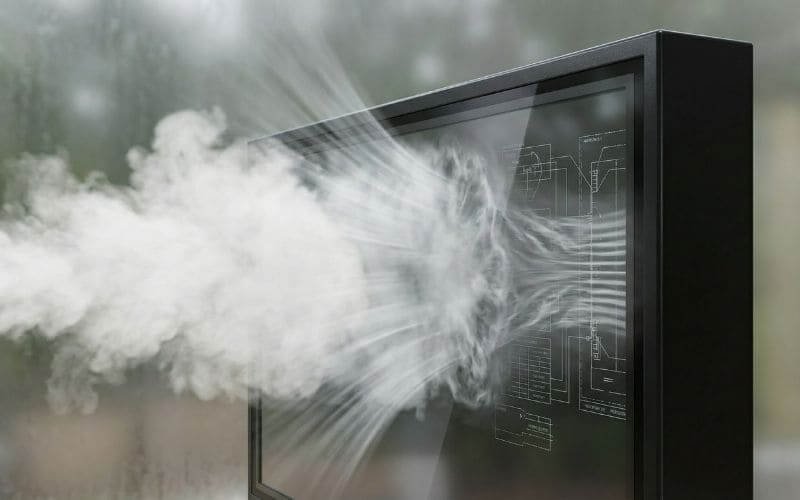
Steam is a gas, not a liquid. While rain falls vertically and can be blocked by simple roof overhangs, steam (water vapor) moves omnidirectionally under high pressure. It penetrates microscopic gaps that liquid water cannot. Standard “Outdoor TVs” often fail in hot tub environments because their passive cooling vents—designed to let heat out—act as intake valves for steam, which then condenses on the motherboard and causes catastrophic short circuits.
When clients ask me about outdoor TVs, their first question is almost always, “Is it rain-proof?” As an engineer, rain is the least of my concerns. Rain is simply gravity-fed liquid water. It falls vertically, has high surface tension, and is easily deflected by simple mechanical overhangs or basic seals. Rain is predictable.
The true enemy of aquatic electronics is Water Vapor (Steam). Unlike rain, steam does not fall; it hunts.
The Physics of Vapor Pressure
To understand why expensive “Outdoor TVs” fail in hot tub environments, we must look at Vapor Pressure. When you uncover a hot tub heated to 104°F in an ambient environment of 40°F, you create a massive pressure differential. The water molecules gain kinetic energy and transition from liquid to gas.
These gas molecules are thousands of times smaller than liquid water droplets. While a rubber gasket might stop a raindrop, high-pressure water vapor can penetrate microscopic imperfections in seals, screw threads, and cable glands. It moves omnidirectionally, pressing against the TV chassis from all sides.
The “Dew Point” Mechanic: Internal Rain
The failure mechanism is rarely a direct short from the steam itself. The killer is Condensation.
- Ingress: The warm, humid vapor penetrates the TV casing.
- The Cold Surface: Inside the TV, the metal chassis and the printed circuit boards (PCBs) are often cooler than the steam.
- Phase Change: When the warm vapor hits the cool motherboard, it hits the Dew Point. The gas instantly undergoes a phase change back into liquid water.
Essentially, it starts raining inside your TV. This distilled water forms droplets directly on the sensitive microprocessor legs and inside the HDMI ports. Because this water is formed inside the casing, it cannot evaporate easily. It pools, bridges electrical contacts, and causes catastrophic short circuits. We call this “Steam Death.”
The “Ventilation Paradox”
This brings us to the fatal flaw of most specialized “Outdoor TVs.” To function in the sun, high-brightness TVs generate immense heat. To dissipate this heat, manufacturers design them with passive ventilation ports (louvers) on the back.
- The Conflict: You need vents to let heat out, but those same vents let steam in.
- The Result: In a dry patio environment, these TVs work fine. Placed 6 feet from a steaming jacuzzi, they act as dehumidifiers, sucking in moisture until they destroy themselves. A sealed enclosure eliminates this paradox by separating the TV’s cooling loop from the external environment.
Chemical Attack: The Chloramine Factor
For my commercial clients managing hotels and public spas, the steam is not just water; it is a corrosive chemical aerosol.
- Chloramines: When chlorine binds with organic contaminants (sweat, oils), it off-gases as Chloramines.
- Intergranular Corrosion: In a saltwater pool or a brominated spa, the steam carries electrolytes. When this saline mist settles on the aluminum chassis of a “weatherproof” TV, it initiates Intergranular Corrosion. This is a microscopic attack where the grain boundaries of the metal dissolve.
I have inspected $5,000 outdoor TVs that looked fine from a distance, but upon close inspection, the aluminum inputs were crumbling into white powder (aluminum oxide). The corrosive nature of the spa environment demands a material that is chemically inert to halogens (Chlorine/Bromine), not just a metal painted with rust-inhibitor.
IP65 Rated Enclosures: The Shield
To survive a poolside environment, an IP65 rating is the absolute minimum requirement. The “6” guarantees the unit is dust-tight (blocking pollen), and the “5” guarantees protection against “Water Jets.” This means the TV is protected not just from rain, but from the dynamic pressure of pool splashes, children doing cannonballs, and maintenance staff using hoses to clean the deck.
If you cannot rely on the TV’s internal weatherproofing, you must rely on an external fortress. This is the function of the Outvion Enclosure. It is not an accessory; it is an environmental isolation chamber.
Decoding the IP Rating: Why 65?
In engineering, we rely on the IEC 60529 Standard, known as the Ingress Protection (IP) Code.
- The First Digit (6): Dust Tight. The enclosure is vacuum sealed against solid ingress. In a backyard, this protects against pollen, grass clippings from leaf blowers, and fine masonry dust.
- The Second Digit (5): Water Jets. This is the specific requirement for pool areas. IPX4 (Splash Proof) is insufficient. IPX5 guarantees protection against “Water jets projected by a nozzle (6.3mm) against enclosure from any direction.”
Why not IP67 (Submersion)? Because IP67 requires a completely airtight seal that prevents any air exchange. A high-brightness TV needs to breathe to cool down. IP65 is the engineering “Sweet Spot”—it stops high-velocity water but allows for controlled air management.
The Thermodynamics of Fog Prevention
The most common complaint with DIY outdoor TV setups is fogging. You are sitting in the hot tub, the TV is on, but the front glass is clouded over with condensation. You are watching a gray blur.
Fog occurs when there is a temperature differential between the humid air and the glass surface. To prevent this, Outvion utilizes a Thermodynamic Airflow System.
- Forced Convection: High-velocity, USB-powered fans run continuously while the TV is powered.
- The “Defroster” Effect: Just like the defroster in your car blows air across the windshield to clear it, the Outvion fans create a laminar flow of air across the inside of the polycarbonate front shield.
- Equilibrium: This airflow ensures that the temperature of the shield matches the internal air temperature, preventing the moisture from finding a cool surface to condense upon.
- Result: Even with a hot tub generating a steam cloud five feet away, the picture remains optically clear.
Stress Test Scenarios
To understand the durability, consider these real-world scenarios that destroy standard electronics:
- The “Cannonball” Test: A group of teenagers jumps into the pool. A massive wave of water—gallons of it—crashes into the wall where the TV is mounted. An Outvion enclosure sheds this water instantly. The hydrostatic pressure of the wave is deflected by the polycarbonate shield.
- The “Pressure Washer” Test: Your facilities team is cleaning the pool deck. They are using a commercial pressure washer to remove mildew from the pavers. They accidentally sweep the spray across the TV. Because of the IP65 rating, the high-velocity jet does not penetrate the seals. The TV inside remains dry.
Use Cases: Aesthetics and ROI
For luxury aesthetics and commercial durability, Polycarbonate outweighs Metal. Outvion’s High-Density Polycarbonate shell offers a matte-black aesthetic that blends into modern architecture while being chemically immune to rust. For commercial operators, this translates to a 10-year asset lifespan versus the 2-year replacement cycle of metal outdoor TVs.
Whether you are designing a private oasis in Bel Air or renovating a Ritz-Carlton pool deck in Florida, the integration of technology must be seamless and financially sound.
The Luxury Aesthetic: Integration, Not Intrusion
A high-end landscape architect does not want a bulky, industrial-looking box ruining the lines of a custom stone wall. The Outvion enclosure is designed with a sleek, matte-black profile (approx. 4-5 inches deep) that can be integrated architecturally.
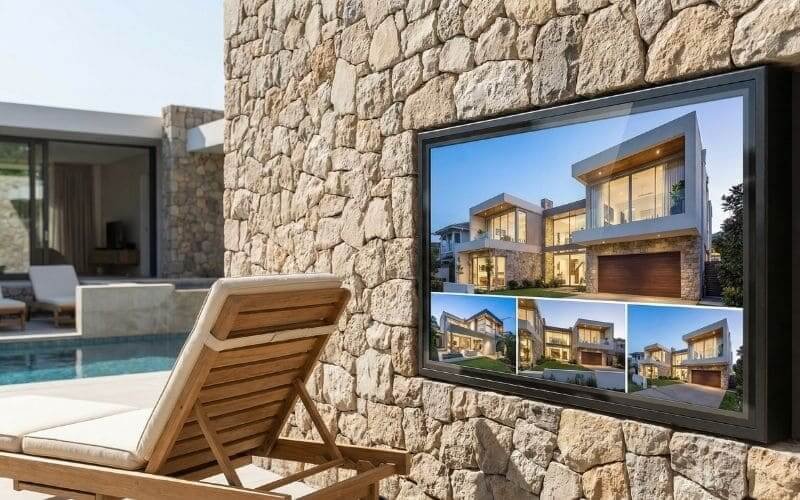
- Flush Mounting: We recommend framing a “niche” or recess into privacy walls or chimney stacks. By setting the enclosure inside this recess, the front bezel sits flush with the stone or cedar siding. This creates a “Video Wall” effect that looks intentional and built-in, rather than bolted-on.
- Hidden Cabling: Nothing ruins a luxury aesthetic like conduit running up a wall. The enclosure features a compression-foam cable entry system at the base. This allows you to run power and data cables through the wall, directly into the back of the unit, completely concealing the wiring for a floating look.
Commercial ROI: The Total Cost of Ownership (TCO)
For Hotel Facility Managers, outdoor TVs are a line item on the CapEx budget that usually bleeds money.
- The Status Quo: Hotels buy $3,000 “Weatherproof” TVs. Due to chlorine corrosion and high-humidity usage, these units typically fail every 18–24 months. Over a 10-year period, a single cabana might require 5 replacement TVs. Total Cost: $15,000+.
- The Outvion Strategy: The hotel buys one Outvion Enclosure ($600) and one Commercial Indoor TV ($400).
- The Enclosure lasts 10+ years because it is plastic and cannot rust.
- The TV lasts 5+ years because it is shielded from the corrosive air.
- When the TV eventually fails, the replacement cost is only $400.
- Total 10-Year Cost: ~$1,400.
- Savings: Over 90% reduction in TCO.
Material Durability Showdown
| Material | Susceptibility to Chlorine | Susceptibility to Salt Air | Est. Lifespan (Poolside) |
|---|---|---|---|
| Powder Coated Steel | High (Rusts at joints/welds) | High (Paint peels/bubbles) | 1-2 Years |
| Anodized Aluminum | Medium (Pitting/Oxidation) | Medium (Galvanic Corrosion) | 2-4 Years |
| Outvion Polycarbonate | ZERO (Chemically Inert) | ZERO (Chemically Inert) | 10+ Years |
The 3 Golden Rules of Electrical Safety
Disclaimer: This section outlines engineering principles. Always hire a licensed electrician to perform installations in accordance with your local laws (NEC in the USA).
Water increases the conductivity of the human body and lowers the resistance of the skin. A shock that would be a “tingle” in a living room can be fatal in a swimming pool. Therefore, safety is not just a feature; it is a rigid code.
Rule 1: The Class A GFCI (The Life Saver)
The Ground Fault Circuit Interrupter (GFCI) is the most critical component of your setup.
- The Mechanism: A standard breaker trips when the wire gets too hot (15 or 20 Amps). A GFCI monitors the balance of current. If 10 Amps go out on the black wire, 10 Amps must return on the white wire. If the GFCI detects a variance of just 5 Milliamps (0.005 Amps), it assumes that electricity is leaking—potentially through a person standing in the pool—and cuts the power.
- The Speed: It reacts in 1/40th of a second. This speed is faster than a human heartbeat, preventing lethal fibrillation.
- The Mandate: Every single piece of equipment in an Outvion enclosure (TV, Fans, Streaming Stick) MUST be plugged into a GFCI-protected circuit.
Rule 2: NEC Article 680 (The Zones)
The National Electrical Code (NEC) Article 680 strictly defines where you can place electronics.
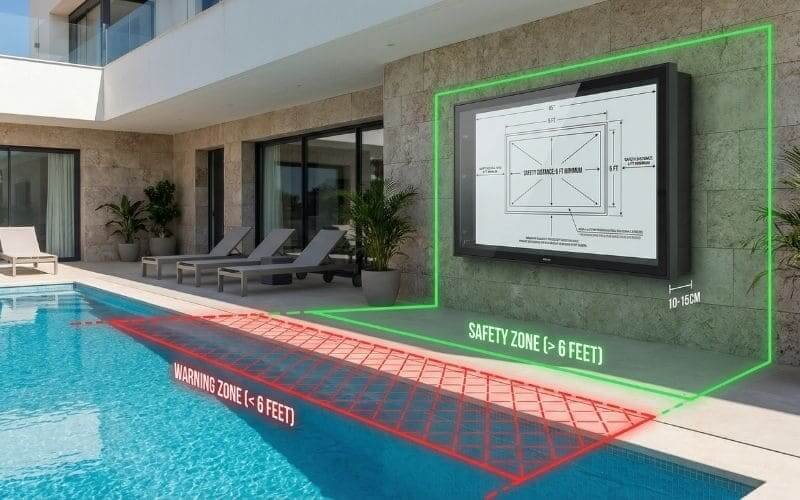
- Zone 1 (0 to 6 Feet / 1.8m): The “No Fly Zone.” Generally, no fixed outlets or electronics are permitted within 6 feet of the inside wall of the pool/spa. This prevents someone in the water from reaching out and touching a live device.
- Zone 2 (6 to 10 Feet): This is the restricted zone. You can install a TV here IF:
- It is on a GFCI circuit.
- It is rigidly mounted (cannot fall).
- It acts as a fixed appliance.
- Zone 3 (10 Feet+): General outdoor wiring rules apply.
- The Engineer’s Advice: Plan your installation for the 6-to-10 foot range. This provides an immersive viewing experience while maintaining full code compliance.
Rule 3: Equipotential Bonding (The Invisible Shield)
This is an advanced concept that most DIYers miss.
- The Risk: “Stray Voltage.” Electrical faults in the ground or from pool pumps can energize metal objects near the pool (like a handrail or a metal TV mount). If you touch the rail and the water, you become the path to ground.
- The Fix: Bonding. A copper wire connects all metal parts of the pool structure (rebar, pump, lights, and metal frames) to create an “Equipotential Grid.”
- The Outvion Advantage: Because the Outvion enclosure shell is made of Polycarbonate (Plastic), it is non-conductive. It breaks the path of electricity. Unlike a metal TV cabinet, you do not need to bond the plastic shell to the pool grid, simplifying installation and increasing safety.
The “Drip Loop” Protocol
Water travels down cables via gravity and surface tension.
- The Danger: If your power cord runs straight from the TV down to the outlet, rainwater or splash water will run down the cord and flow into the socket, causing an arc flash.
- The Fix: Leave a slack loop of cable that hangs below the level of the outlet before curving back up to plug in. Water runs down to the bottom of the “U” and drips off onto the ground, never reaching the electrical contacts.
The Poolside Safety Checklist
| Component | Requirement | Purpose |
|---|---|---|
| Circuit Protection | Class A GFCI | Trips at 5mA leak to prevent electrocution. |
| Distance | > 6 Feet (1.8m) | Prevents bathers from touching the unit. |
| Enclosure Material | Non-Conductive Polymer | Eliminates shock risk from “Stray Voltage.” |
| Mounting | Lag Bolted to Studs | Prevents unit falling into the water. |
| Cable Management | Drip Loop | Prevents water ingress into the outlet. |
Installation Inspiration: Where to Mount?
Placement dictates the experience. You need to balance the Viewing Angle (Eye level is best) with Safety Distance (6ft away). The three most effective mounting strategies are the Swivel Mount (for multi-zone use), the Recessed Niche (for privacy walls), and the Ceiling Drop (for pergolas).
The Swim-Up Bar (Swivel Strategy)
This is the most popular setup for backyards that serve double duty as a pool area and a BBQ dining area.
- The Setup: Use a heavy-duty, outdoor-rated Full Motion (Articulating) Mount attached to a post or house wall.
- The Use Case: During the day, you swivel the TV 90 degrees to face the pool so the kids can watch cartoons while floating. At night, you swivel it back 90 degrees to face the patio dining table for the evening game.
- Cable Warning: Ensure your cables have enough slack to handle the rotation without pulling tight.
The “Privacy Wall” (Recessed Niche)
Hot tubs are often surrounded by a privacy wall made of stone, brick, or cedar.
- The Setup: Mount the Outvion enclosure flat against this wall. Better yet, build a “niche” or cutout in the wall that allows the enclosure to sit flush.
- The Advantage: This usually places the TV at Eye-Level for seated bathers (about 3-4 feet off the deck). This is critical for comfort. If you mount a TV 8 feet high, bathers have to crane their necks back, which ruins the relaxation of the hot tub.
The “Pergola Drop” (Ceiling Mount)
If your hot tub is under a gazebo or pergola to block rain/sun.
- The Setup: Use a Ceiling Pole Mount. The Outvion enclosure has standard VESA patterns on the rear. You bolt a pipe flange to the pergola beam and drop a pipe down.
- The Advantage: This keeps the TV high and dry, well out of the splash zone. It also frees up wall space.
- Safety Note: Ensure the pergola beam can support the weight (TV + Enclosure = ~60-80 lbs).
Comparison: The Smart Choice
Outvion Enclosure vs. Competitors
| Feature | Indoor TV (Naked) | “Weatherproof” TV | Outvion Enclosure |
|---|---|---|---|
| Cost (65″ Class) | $500 | $3,500+ | ~$1,100 (TV + Box) |
| Steam Protection | Zero (Fails instantly) | Low (Vents allow entry) | High (Sealed + Active Air) |
| Chemical Resistance | None | Low (Aluminum corrodes) | High (Inert Plastic) |
| Winter Operation | Risk of freezing | Good | Excellent (Thermal Buffer) |
| Fog Prevention | None | Passive | Active Fan Circulation |
The dream of the hot tub cinema is achievable, but it demands respect for the environment. You are introducing high-voltage electronics into a zone defined by water, steam, and corrosive chemicals.
Standard consumer approaches (naked TVs) are dangerous. Standard commercial approaches (outdoor TVs) are expensive and prone to steam failure. The engineering solution is Isolation.
By securing your display inside an IP65 Outvion Enclosure, you solve the moisture problem, the corrosion problem, and the safety problem in one move. You gain the freedom to watch what you want, when you want, submerged in luxury, without the fear of a blank screen or a safety hazard.
Conclusion
You don’t have to compromise. You don’t have to choose between the luxury of a hot tub cinema and the safety of your family. You don’t have to choose between a stunning aesthetic and industrial durability.
By applying the principles of ingress protection, thermodynamic cooling, and material science, you can create a backyard oasis that rivals the best resorts in the world. You can soak in the steam, watch the snow fall, and cheer for your team in crystal-clear 4K, knowing that your setup is safe, legal, and built to last.
Don’t let the fear of the elements stop you from living the dream.
FAQ
1. Will the heat/steam from the hot tub damage the TV?
No, not if it is in an Outvion Enclosure. A naked TV will fail due to condensation. The Outvion enclosure is sealed (IP65) against steam entry and uses active fans to circulate warm air, preventing condensation and fogging on the screen. It is specifically engineered for this high-humidity environment.
2. Can I watch TV during the day in the pool?
Yes, but brightness matters. The sun is powerful. For daytime viewing, ensure the TV inside the enclosure has a high brightness rating (500+ nits) and set the picture mode to “Vivid” or “Dynamic.” Position the enclosure facing North or East to avoid direct sun on the screen, which causes glare.
3. What happens if the remote falls in the water?
It will be destroyed. Standard TV remotes are not waterproof. We strongly recommend buying a universal “Floating Waterproof Remote” (available online for ~$20) or using a Voice Control system (Alexa/Google) so you never have to bring a physical remote into the tub.
4. How do I clean the enclosure if it gets water spots?
Hose it down. The front panel is waterproof. You can rinse it with fresh water to remove chlorine splashes or salt spots. For stubborn spots, use a mild dish soap solution and a microfiber cloth. Do NOT use ammonia-based cleaners (like Windex), as they can damage the polycarbonate coating over time.
5. Is it safe to install a TV above a hot tub?
Yes, if you follow the rules. Ensure the bottom of the TV is at least 6 feet above the water line (or set back 6 feet horizontally). Ensure it is plugged into a GFCI-protected outlet. Ensure the mount is rated for the weight and bolted securely to studs so it cannot fall.
6. Does the enclosure block the Wi-Fi signal?
No. The enclosure is made of Polycarbonate (plastic), which is “Radio Frequency (RF) Transparent.” Unlike metal outdoor TV cabinets which block Wi-Fi, the Outvion enclosure allows Wi-Fi and Bluetooth signals to pass through freely, so your Smart TV apps will work perfectly.
Recommended Technical Reading
- Pool Electrical Safety:NFPA 70: National Electrical Code (Article 680)
- The official standard for electrical installations near swimming pools.
- IP Ratings Explained:IEC 60529 Standard
- Technical breakdown of Ingress Protection ratings for water and dust.
- Corrosion in Pools:NACE International (Corrosion Society)
- Resources on galvanic corrosion and material selection for chlorinated environments.